An explicit and differentiable Wilson-Daubechies-Meyer transform for gravitational-wave data analysis
Pith reviewed 2026-06-26 16:34 UTC · model grok-4.3
The pith
The Wilson-Daubechies-Meyer transform yields numerically equivalent likelihoods to the frequency domain for LISA galactic binaries under stationary noise.
A machine-rendered reading of the paper's core claim, the machinery that carries it, and where it could break.
Core claim
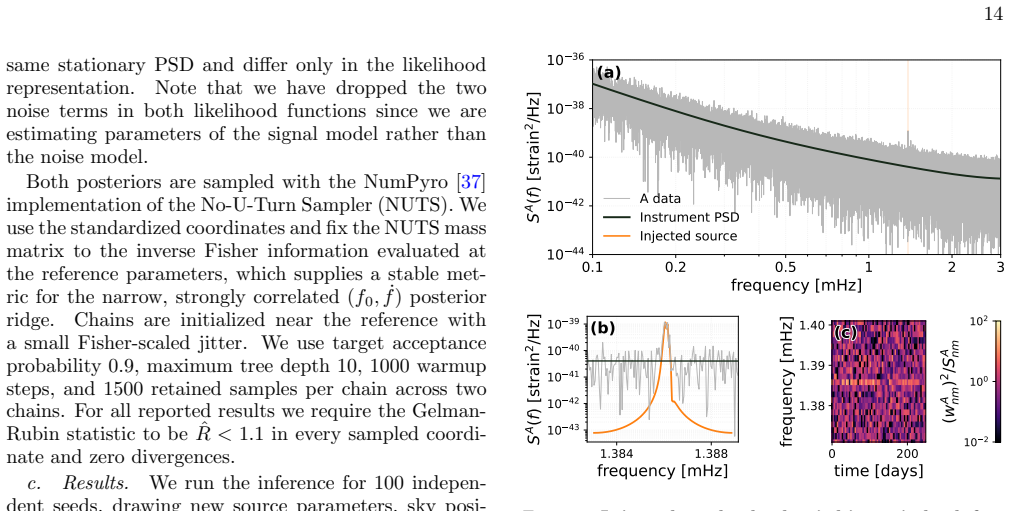
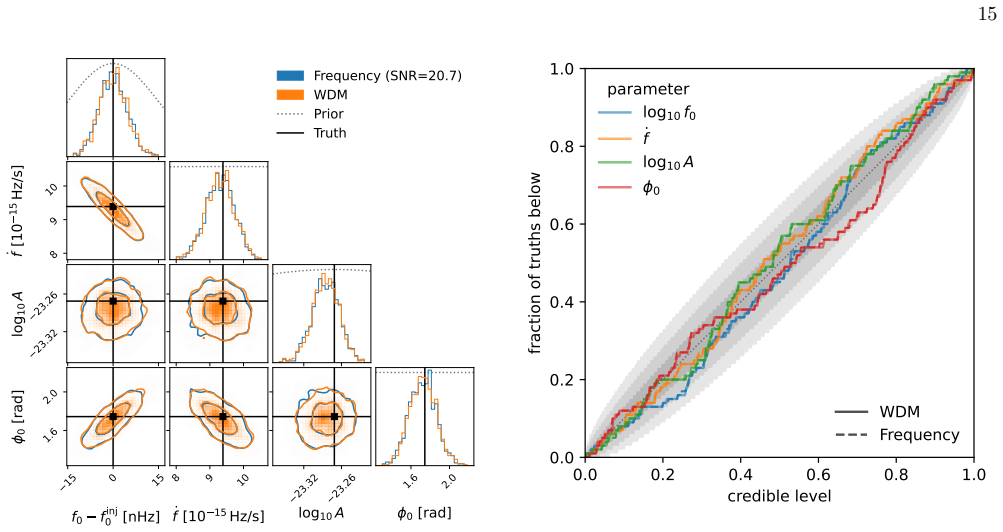
We present wdm_transform, an open-source Python package implementing the WDM wavelet-packet time-frequency transform, and document its mathematical foundations, statistical properties, and practical implementation for gravitational-wave data analysis. The package supplies NumPy and JAX backends, both transforms validated to floating-point precision. As a worked example, we verify that the WDM-domain likelihood reproduces frequency-domain posteriors for a resolved LISA galactic binary under a shared stationary noise model, confirming numerical equivalence of the two representations in that controlled setting.
What carries the argument
The Wilson-Daubechies-Meyer wavelet-packet time-frequency transform, supplied with explicit forward and inverse formulas and a JAX-differentiable implementation.
If this is right
- Systematic optimisation of WDM tilings becomes feasible for specific data-analysis tasks.
- Direct comparisons with alternative time-frequency representations are enabled.
- Analysis of non-stationary noise, stochastic backgrounds, and data gaps in future detectors is supported.
Where Pith is reading between the lines
- The JAX backend opens the possibility of embedding the transform inside gradient-based sampling or optimisation loops for more complex signal models.
- The explicit formulation may allow direct derivation of statistical properties of the transform coefficients without reference to the frequency domain.
- Extension to time-varying noise models could be tested by injecting controlled non-stationarity into the same LISA binary example.
Load-bearing premise
A single shared stationary noise model is sufficient to establish equivalence between the WDM and frequency-domain representations, with any implementation differences remaining below floating-point precision.
What would settle it
A side-by-side computation of WDM-domain and frequency-domain likelihood values or posterior samples for the same resolved LISA galactic binary under the shared stationary noise model that shows disagreement exceeding floating-point precision.
Figures
read the original abstract
The Wilson-Daubechies-Meyer (WDM) time-frequency transform has been widely used in gravitational-wave astronomy, yet a self-contained, mathematically explicit reference for practitioners remains lacking. This is especially true for those wishing to adopt the transform in modern Python and JAX inference workflows. We present wdm_transform, an open-source Python package implementing the WDM wavelet-packet time-frequency transform, and document its mathematical foundations, statistical properties, and practical implementation for gravitational-wave data analysis. The package supplies NumPy and JAX backends, both transforms (forward and inverse) validated to floating-point precision, with the JAX backend enabling GPU-accelerated transforms of million-point data streams in tens of milliseconds. As a worked example, we verify that the WDM-domain likelihood reproduces frequency-domain posteriors for a resolved LISA galactic binary under a shared stationary noise model, confirming numerical equivalence of the two representations in that controlled setting. This work paves the way for systematic optimisation of WDM tilings, a particularly promising direction for the non-stationary noise, stochastic backgrounds, and data gaps anticipated in future detectors, and for direct comparisons with alternative time-frequency representations needed to meet the challenges of future gravitational-wave data analysis.
Editorial analysis
A structured set of objections, weighed in public.
Referee Report
Summary. The manuscript presents the open-source wdm_transform Python package implementing the Wilson-Daubechies-Meyer (WDM) wavelet-packet time-frequency transform, with NumPy and JAX backends. It supplies explicit mathematical foundations and statistical properties, validates both forward and inverse transforms to floating-point precision, and demonstrates via a worked example that the WDM-domain likelihood reproduces frequency-domain posteriors for one resolved LISA galactic binary under a shared stationary noise model.
Significance. If the numerical validations hold, the package supplies a reproducible, differentiable tool for time-frequency GW analysis that is particularly suited to non-stationary noise, stochastic backgrounds, and data gaps. The explicit documentation, JAX GPU acceleration for million-point streams, and open-source release with both backends are concrete strengths that lower the barrier for adoption in modern inference pipelines.
major comments (2)
- [Validation subsection] Validation subsection: the abstract and main text claim that forward and inverse transforms are validated to floating-point precision, yet no quantitative error metrics (maximum absolute difference, relative L2 error, or per-bin statistics) are reported for the tested data streams. This directly supports the central numerical-equivalence claim and must be supplied.
- [Likelihood comparison example] Likelihood comparison example: the demonstration that WDM-domain and frequency-domain posteriors match is restricted to a single resolved galactic binary under one explicitly shared stationary noise model. The text should state the precise data length, frequency range, and any exclusion rules applied to the likelihood, as these choices are load-bearing for the reported numerical equivalence.
minor comments (2)
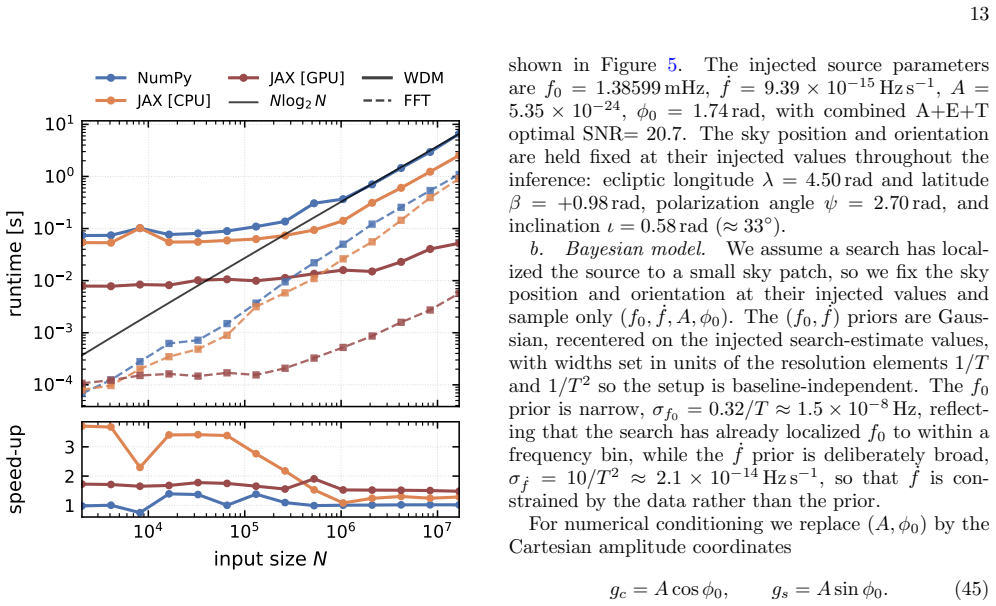
- [Implementation section] The description of the JAX backend performance (tens of milliseconds for million-point streams) would benefit from explicit hardware specifications and a comparison table against the NumPy backend.
- [Mathematical foundations] Notation for the Meyer wavelet scaling function and the associated packet coefficients should be cross-referenced to a single equation number throughout the mathematical foundations section to improve readability.
Simulated Author's Rebuttal
We thank the referee for their constructive feedback and positive recommendation for minor revision. We address each major comment below and will update the manuscript accordingly.
read point-by-point responses
-
Referee: [Validation subsection] Validation subsection: the abstract and main text claim that forward and inverse transforms are validated to floating-point precision, yet no quantitative error metrics (maximum absolute difference, relative L2 error, or per-bin statistics) are reported for the tested data streams. This directly supports the central numerical-equivalence claim and must be supplied.
Authors: We agree that quantitative error metrics are required to fully support the floating-point precision claim. In the revised manuscript we will add a table (or expanded subsection) reporting the maximum absolute difference, relative L2 error, and per-bin statistics for both the forward and inverse transforms on the tested streams. revision: yes
-
Referee: [Likelihood comparison example] Likelihood comparison example: the demonstration that WDM-domain and frequency-domain posteriors match is restricted to a single resolved galactic binary under one explicitly shared stationary noise model. The text should state the precise data length, frequency range, and any exclusion rules applied to the likelihood, as these choices are load-bearing for the reported numerical equivalence.
Authors: We agree that the precise parameters of the demonstration must be stated explicitly for reproducibility. In the revised manuscript we will add the data length (sample count and duration), frequency range, and any bin-exclusion rules used in the LISA galactic-binary likelihood comparison. revision: yes
Circularity Check
No significant circularity identified
full rationale
The paper's central contribution is an open-source implementation of the WDM transform (forward and inverse) with explicit documentation of its mathematical foundations and validation to floating-point precision. The worked example verifies numerical equivalence of WDM-domain and frequency-domain likelihoods for one LISA galactic binary under an explicitly shared stationary noise model. This is an external implementation check against an independent frequency-domain representation, not a derivation that reduces to fitted parameters or self-citations by construction. No load-bearing steps match the enumerated circularity patterns; the result is self-contained against external benchmarks.
Axiom & Free-Parameter Ledger
Reference graph
Works this paper leans on
-
[1]
Wil- son
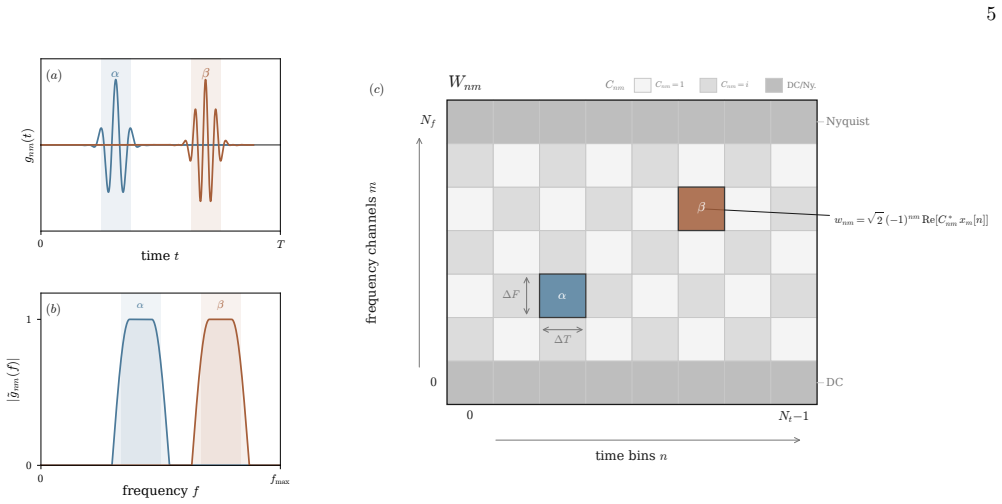
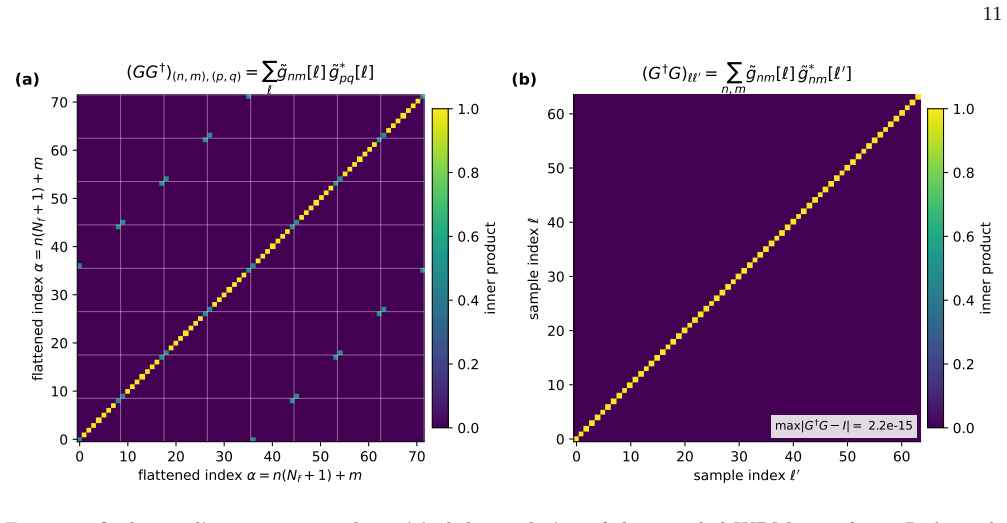
coefficient layout explicitly, spell out the DC and Nyquist channel treatment, and set the normalization, phase, and indexing conventions used by the implemen- tation. These choices are then validated through ex- act round-trip reconstruction tests – applying the for- ward transform followed by its inverse – and empiri- cal checks of coefficient decorrela...
-
[2]
(10) with the interior-channel basis element from Eq
Interior channels(0< m < N f) Starting from Eq. (10) with the interior-channel basis element from Eq. (11), the forward transform can be 3 Our definitions of the Wilson basis functions (11) carefully in- clude them= 0 andm=N f in order for orthogonality to hold. evaluated in the Fourier domain using wnm = N/2−1X l=−N/2 ˜x[l] ˜g∗ nm[l],(17) For a real-valu...
-
[3]
DC channel(m= 0) The DC edge channel has a doubled time-shift ex- ponent and noC nm factor in the basis definition (11). 7 Following the same Fourier-domain evaluation yields wn0 = √ 2ℜ Nt/2−1X l=1 ˜x[l]e4πiln/Nt ˜φ[l] + 1√ 2 ˜x[0] ˜φ[0]./github (21) Note the factor of 4πin the exponent (versus 2πfor interior channels): the DC basis element oscill...
-
[4]
Towards LISA catalogs
Nyquist channel(m=N f) The Nyquist edge channel is handled analogously to the DC channel but centered at the Nyquist frequency fmax. Its structure mirrors the DC case with appropri- ate frequency shifts. In practice, the Nyquist channel is computed using the same windowed-FFT machinery as the interior channels, with the frequency shift set to mNt/2 =N/2. ...
2023
-
[5]
Now we have to consider three cases
The second (quasi)normality condition We want to evaluate X l ˜gnm[l]˜g∗ pq[l] (A10) we immediately note that, since the window support in frequency isN t/2 we are forced to haveq=m. Now we have to consider three cases. Casem= 0, for which we have X l ˜gn0[l]˜g∗ p0[l] = 1 2 N/2−1X l=−N/2 e−4πil(n−p)/Nt ˜φ2[l] = 1 2 Nt/2−1X l=−Nt/2 e−4πil(n−p)/Nt ˜φ2[l] = ...
-
[6]
(A2) is correctly normalized
Normalization of the Meyer window We verify that the Meyer window defined in Eq. (A2) is correctly normalized. We compute N/2−1X l=−N/2 ˜φ2[l] = 2 A Nt 2 −1X l=0 2 Nt − 2 Nt + 2 (A+B) Nt 2 −1X l=A Nt 2 2 Nt cos2 " π 2 2l Nt −A B # = 2A− 2 Nt + 4 Nt B Nt 2 −1X k=0 cos2 π 2 2k BNt = = 2A− 2 Nt + 4 Nt B Nt 2 −1X k=0 1 2 + 4 Nt B Nt 2 −1X k=0 1 2 cos 2πk BNt ...
-
[7]
Interior channels(0< m < N f) Inserting the interior-channel basis element from Eq. (11) and splitting the sum over positive and negative frequencies gives wnm = 1√ 2 N/2−1X l=0 ˜x[l]e2πiln/Nt C ∗ nm ˜φ l− mNt 2 +C nm ˜φ l+ mNt 2 + 1√ 2 −1X l=−N/2 ˜x[l]e2πiln/Nt C ∗ nm ˜φ l− mNt 2 +C nm ˜φ l+ mNt 2 .(B2) Using the reality condition ˜x[−l] = ˜x[l]∗ togethe...
-
[8]
DC channel(m= 0) For the DC edge channel, the basis element has a doubled time-shift exponent and noC nm factor. The same positive/negative frequency splitting yields wn0 = 1√ 2 N/2−1X l=0 ˜x[l]e4πiln/Nt ˜φ[l] +1√ 2 −1X l=−N/2 ˜x[l]e4πiln/Nt ˜φ[l] = √ 2ℜ Nt/2−1X l=1 ˜x[l]e4πiln/Nt ˜φ[l] + 1√ 2 ˜x[0] ˜φ[0],(B4) which is Eq. (21) of the main text
-
[9]
Nyquist channel(m=N f) wnm = 1√ 2 N/2−1X l=0 ˜x[l]e4πiln/Nt ˜φ l− N 2 + ˜φ l+ N 2 + 1√ 2 −1X l=−N/2 ˜x[l]e4πiln/Nt ˜φ l− N 2 + ˜φ l+ N 2 = 1√ 2 N/2−1X l=0 ˜x[l]e4πiln/Nt ˜φ l− N 2 + ˜φ l+ N 2 + 1√ 2 N/2X l=1 ˜x[−l]e−4πiln/Nt ˜φ −l− N 2 + ˜φ −l+ N 2 .(B5) Thel= 0 term in the first summation vanishes, and thel=N/2 term is treated separately: wnm = √ 2ℜ N/2−...
-
[10]
Appendix C: The WDM Covariance Matrix in the stationary case We start from the WDM transform in Eq
The inverse transform We write the inverse transform of thew nm coefficients to recover the signal ˜x[l] forl≥0 since we know that for l <0 the reality condition holds (˜x[−l] = ˜x∗[l]): ˜x[l] = Nt−1X n=0 NfX m=0 wnmgnm[l] = 1√ 2 X n X 0<m<Nf wnme−2πiln/Nt Cnm ˜φ l− mNt 2 +C ∗ nm ˜φ l+ mNt 2 + 1√ 2 X n wn0e−4πiln/Nt ˜φ[l] +1√ 2 X n wnNf e−4πiln/Nt ˜φ l− N...
-
[11]
Kr´ olak and P
A. Kr´ olak and P. Trzaskoma, Classical and Quantum Gravity13, 813 (1996)
1996
-
[12]
Virtuoso and E
A. Virtuoso and E. Milotti, Phys. Rev. D109, 102010 (2024)
2024
-
[13]
Robinet, N
F. Robinet, N. Arnaud, N. Leroy, A. Lundgren, D. Macleod, and J. McIver, SoftwareX12, 100620 (2020)
2020
-
[14]
N. J. Cornish and T. B. Littenberg, Classical and Quantum Gravity32, 135012 (2015)
2015
-
[15]
S. Chatterji, L. Blackburn, G. Martin, and E. Katsavounidis, Class. Quant. Grav.21, S1809 (2004), arXiv:gr-qc/0412119
Pith/arXiv arXiv 2004
-
[16]
E. Chassande-Mottin and A. Pai, Phys. Rev. D73, 042003 (2006), arXiv:gr-qc/0512137
Pith/arXiv arXiv 2006
-
[17]
Gair and L
J. Gair and L. Wen, Classical and Quantum Gravity22, S1359–S1371 (2005)
2005
-
[18]
J. R. Gair, I. Mandel, and L. Wen, Class. Quant. Grav.25, 184031 (2008), arXiv:0804.1084 [gr-qc]
Pith/arXiv arXiv 2008
-
[19]
L. Speri, R. Tenorio, C. Chapman-Bird, and D. Gerosa, Physical Review D113, 10.1103/dh3j-ksfl (2026)
-
[20]
D. Bandopadhyay, C. E. A. Chapman-Bird, and A. Vecchio, Global time-frequency search for stellar-mass binary black holes in LISA (2026), arXiv:2510.19047 [gr-qc]
Pith/arXiv arXiv 2026
-
[21]
Colpiet al., arXiv e-prints , arXiv:2402.07571 (2024), arXiv:2402.07571 [astro-ph.CO]
M. Colpiet al., arXiv e-prints , arXiv:2402.07571 (2024), arXiv:2402.07571 [astro-ph.CO]
Pith/arXiv arXiv 2024
-
[22]
J. Luoet al., Class. Quant. Grav.33, 035010 (2016), arXiv:1512.02076 [astro-ph.IM]
Pith/arXiv arXiv 2016
-
[23]
N. J. Cornish, T. B. Littenberg, B. B´ ecsy, K. Chatziioannou, J. A. Clark, S. Ghonge, and M. Millhouse, Phys. Rev. D 103, 044006 (2021), arXiv:2011.09494 [gr-qc]
arXiv 2021
-
[24]
Necula, S
V. Necula, S. Klimenko, and G. Mitselmakher, Journal of Physics: Conference Series363, 012032 (2012)
2012
-
[25]
M. J. Szczepa´ nczyk, F. Salemi, S. Bini, T. Mishra, G. Vedovato, V. Gayathri, I. Bartos, S. Bhaumik, M. Drago, O. Halim, C. Lazzaro, A. Miani, E. Milotti, G. A. Prodi, S. Tiwari, and S. Klimenko, Phys. Rev. D107, 062002 (2023), arXiv:2210.01754 [gr-qc]
arXiv 2023
- [26]
-
[27]
W. G. Anderson, P. R. Brady, J. D. E. Creighton, and E. E. Flanagan, Phys. Rev. D63, 042003 (2001), arXiv:gr- qc/0008066
arXiv 2001
-
[28]
Klimenko and G
S. Klimenko and G. Mitselmakher, Class. Quant. Grav.21, S1819 (2004)
2004
-
[29]
M. C. Digman and N. J. Cornish, WDMWaveletTransforms: Fast forward and inverse WDM wavelet transforms, Astro- physics Source Code Library, record ascl:2307.037 (2023), ascl:2307.037
2023
-
[30]
M. C. Digman and N. J. Cornish, Phys. Rev. D108, 023022 (2023), arXiv:2212.04600 [gr-qc]
arXiv 2023
-
[31]
M. C. Digman and N. J. Cornish, Astrophys. J.940, 10 (2022), arXiv:2206.14813 [astro-ph.IM]
arXiv 2022
-
[32]
N. Pearson and N. J. Cornish, Phys. Rev. D113, 064033 (2026), arXiv:2509.05479 [gr-qc]
Pith/arXiv arXiv 2026
-
[33]
N. J. Cornish, Phys. Rev. D102, 124038 (2020), arXiv:2009.00043 [gr-qc]
arXiv 2020
-
[34]
N. J. Cornish, arXiv e-prints , arXiv:2511.10632 (2025), arXiv:2511.10632 [gr-qc]
Pith/arXiv arXiv 2025
-
[35]
N. J. Cornish, WDM Transform: Codes to compute the WDM wavelet transform,https://github.com/ eXtremeGravityInstitute/WDM_Transform(2020), eXtreme Gravity Institute, Montana State University. Implements fast TaylorT, TaylorF, and sparse WDM transforms for binary chirp signals in C. Accessed: May 2026
2020
-
[36]
M. C. Digman, WDMWaveletTransforms: Fast forward and inverse WDM wavelet transforms in Python,https:// github.com/XGI-MSU/WDMWaveletTransforms(2022), eXtreme Gravity Institute, Montana State University. Produced under NASA LISA Preparatory Science Grant 80NSSC19K0320. Released v0.0.1, April 2025; GPLv2+ licence. Accessed: May 2026
2022
-
[37]
C. J. Moore, WDM GW wavelets: A fast, JAX-based Python implementation of the Wilson–Daubechies–Meyer wavelet transform for gravitational wave data,https://cjm96.github.io/WDM_GW_wavelets/(2025), gitHub repository:https: //github.com/cjm96/WDM_GW_wavelets. Includes time-delay filter routines for space-based detector responses. Accessed: May 2026
2025
-
[38]
GitLab:https://gitlab.com/gwburst/public/library
cWB Team, coherent WaveBurst (cWB), version cWB-6.4.6.0,https://gwburst.gitlab.io/documentation/latest/ html/(2024), public release used for the LVK O4b analysis. GitLab:https://gitlab.com/gwburst/public/library. GPLv3 licence. Accessed: May 2026
2024
-
[39]
W. M. Farr, WDMWavelets.jl: WDM wavelets in Julia,https://github.com/farr/WDMWavelets.jl(2025), gitHub repository
2025
-
[40]
B. Krishnan, A. M. Sintes, M. A. Papa, B. F. Schutz, S. Frasca, and C. Palomba, Phys. Rev. D70, 082001 (2004), arXiv:gr-qc/0407001
Pith/arXiv arXiv 2004
-
[41]
Palomba, P
C. Palomba, P. Astone, and S. Frasca, Classical and Quantum Gravity22, S1255 (2005)
2005
-
[42]
Savalle, J
E. Savalle, J. Gair, L. Speri, and S. Babak, Phys. Rev. D106, 022003 (2022)
2022
-
[43]
Daubechies, S
I. Daubechies, S. Jaffard, and J. L. Journe, SIAM J. Math. Anal.22, 554 (1991)
1991
- [44]
-
[45]
N. Bartoloet al., J. Cosmol. Astropart. Phys.2022, 009 (2022), arXiv:2201.08782 [astro-ph.CO]
arXiv 2022
-
[46]
Bayle, M
J.-B. Bayle, M. Le Jeune, and J. Menu, jaxgb: Fast LISA response for Galactic binaries using JAX,https://pypi.org/ project/jaxgb/(2025), version 0.2.1, BSD-3-Clause
2025
-
[47]
D. Phan, N. Pradhan, and M. Jankowiak, arXiv e-prints , arXiv:1912.11554 (2019), arXiv:1912.11554 [stat.ML]
Pith/arXiv arXiv 1912
-
[48]
S. Klimenko, S. Mohanty, M. Rakhmanov, and G. Mitselmakher, Phys. Rev. D72, 122002 (2005), arXiv:gr-qc/0508068
Pith/arXiv arXiv 2005
-
[49]
S. Klimenkoet al., Phys. Rev. D93, 042004 (2016), arXiv:1511.05999 [gr-qc]
Pith/arXiv arXiv 2016
-
[50]
Vajpeyi, G
A. Vajpeyi, G. Mentasti, Q. Baghi, O. Burke, and L. Speri, pywavelet/wdm transform: v0.05 (2026)
2026
discussion (0)
Sign in with ORCID, Apple, or X to comment. Anyone can read and Pith papers without signing in.