Exciton Transport in Disordered Perovskite Nanocrystal Solids
Pith reviewed 2026-06-26 16:15 UTC · model grok-4.3
The pith
Energetic disorder from ligand length limits exciton transport in perovskite nanocrystal films more than structural disorder does.
A machine-rendered reading of the paper's core claim, the machinery that carries it, and where it could break.
Core claim
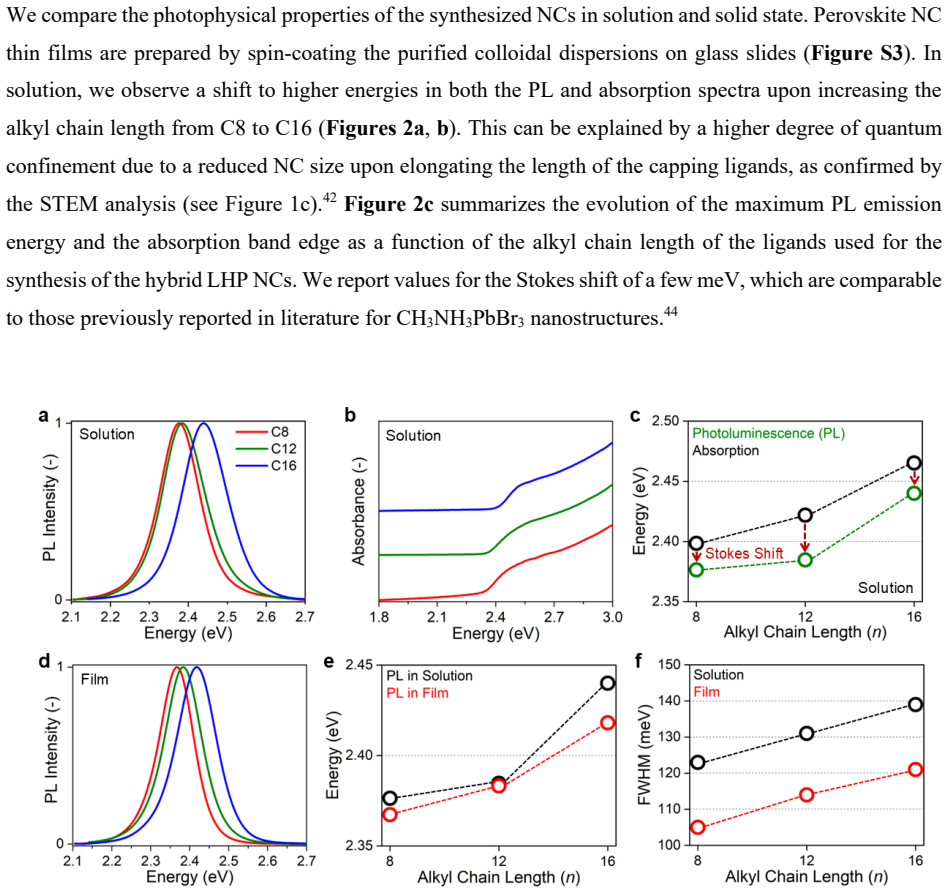
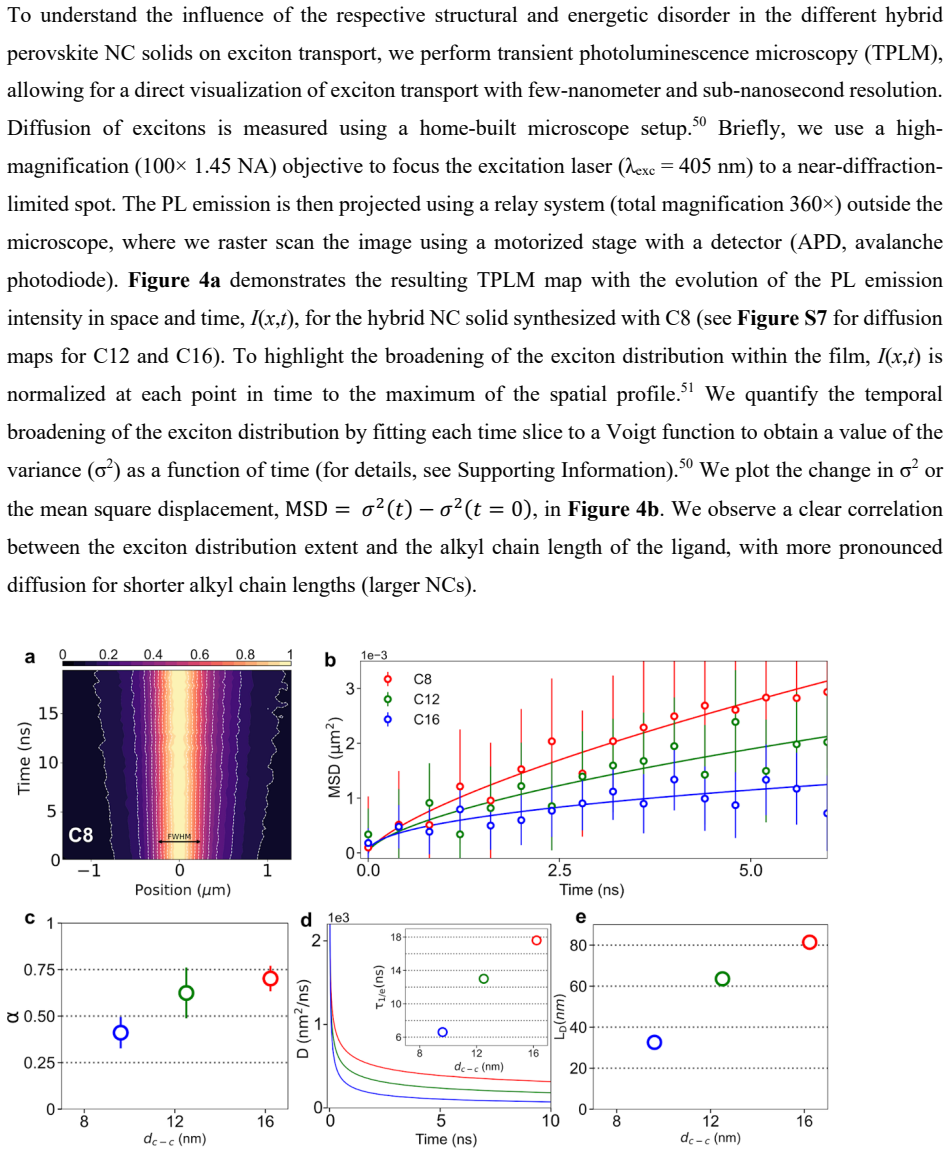
Exciton transport is less efficient in NC solids with long alkyl chain ligands, despite having a significantly more monodisperse ensemble. This demonstrates that energetic disorder, rather than structural disorder, is the dominant factor for predicting exciton transport within these materials.
What carries the argument
Alkyl chain length of the surface ligands, which sets nanocrystal size distribution and the strength of quantum confinement that creates energetic disorder across the ensemble.
If this is right
- Ligand length can be chosen to minimize energetic disorder and thereby raise exciton transport efficiency in devices.
- Reducing size polydispersity alone does not improve transport when it simultaneously raises energetic disorder.
- Quantum confinement in smaller uniform particles directly increases the energy spread that slows exciton motion.
- Ligand engineering supplies a practical route to higher-performance LHP NC films for LEDs, lasers, and solar cells.
Where Pith is reading between the lines
- Synthesis routes that fix particle size while varying confinement energy would isolate the disorder type more cleanly.
- The same energetic-disorder priority may govern charge-carrier transport or Förster transfer in related disordered nanocrystal solids.
- Post-deposition annealing or ligand exchange that narrows the energy distribution without changing sizes could test whether transport recovers.
Load-bearing premise
The assumption that differences in measured exciton transport arise solely from the identified structural versus energetic disorder and not from other ligand-dependent effects such as changes in inter-NC electronic coupling or film morphology.
What would settle it
Measuring exciton diffusion length while independently varying the emission linewidth (energetic disorder) at fixed polydispersity index across ligand lengths; lack of inverse correlation between linewidth and diffusion length would falsify the dominance claim.
Figures
read the original abstract
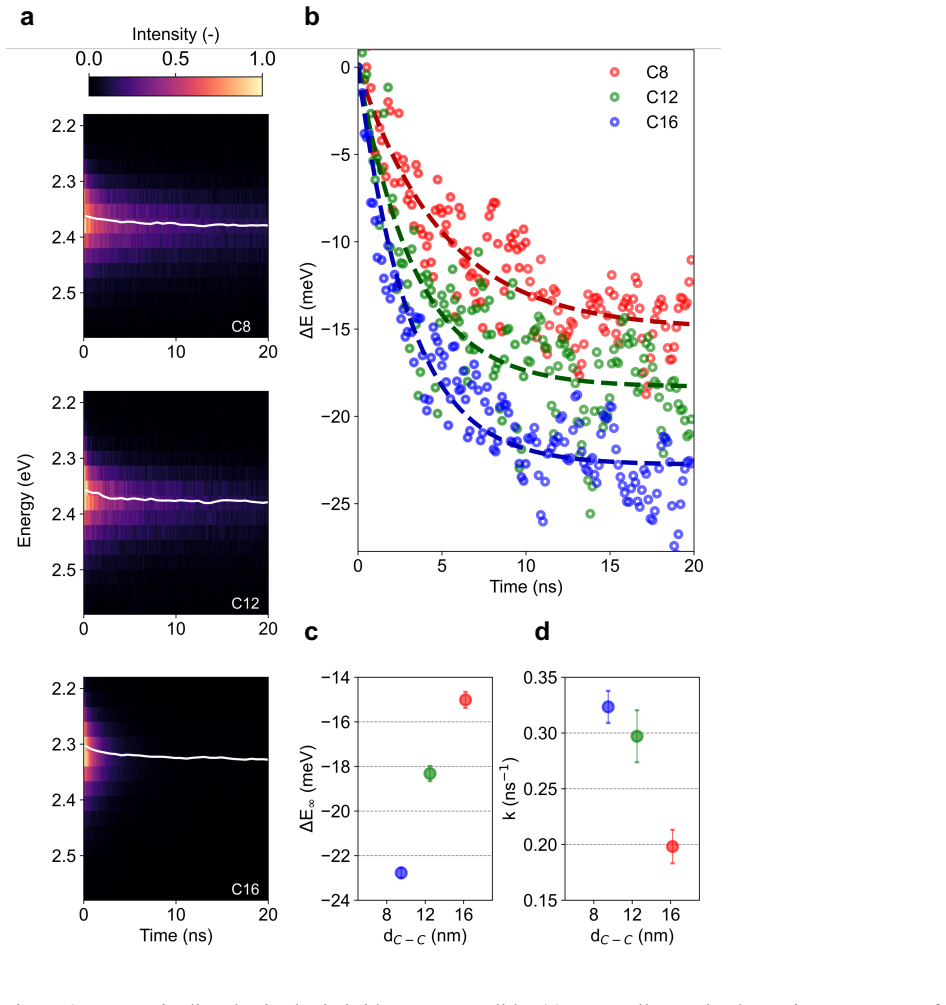
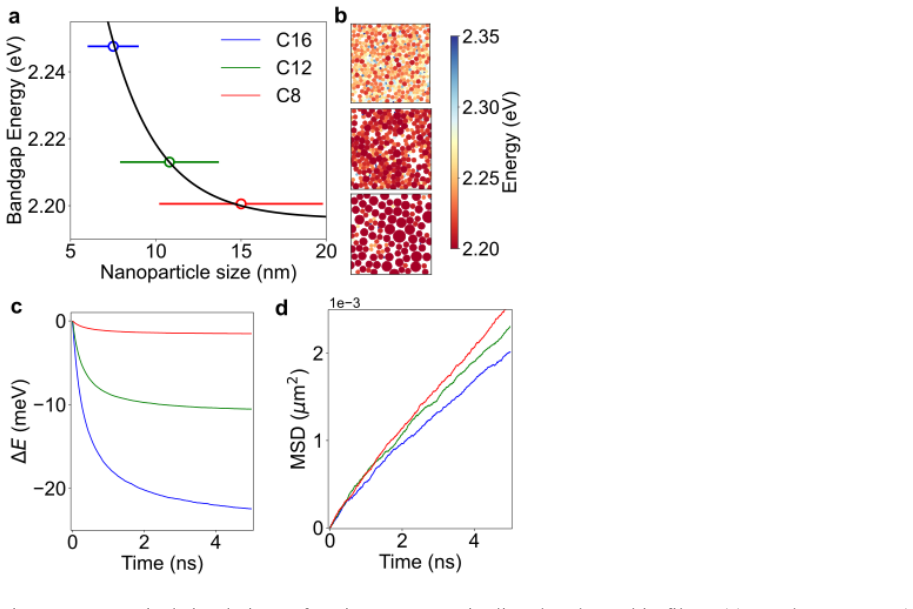
Solution-processed thin films of colloidal lead halide perovskite (LHP) nanocrystals (NCs) show great potential for the implementation into optoelectronic devices such as light-emitting diodes (LEDs), lasers, and solar cells. However, these hybrid LHP NC solids exhibit non-negligible size and shape polydispersity, which introduces both structural and energetic disorder. Here, we resolve the exciton dynamics in space, time, and energy to elucidate the impact of different forms of disorder (structural and energetic) on exciton transport. We show that the disorder depends sensitively on the length of the alkylamine ligand used in the synthesis. While shorter alkyl chain lengths lead to high polydispersity, longer alkyl chains lead to more monodispersed and smaller particles where quantum confinement becomes more pronounced and, consequently, lead to increased energetic disorder. Strikingly, we find that exciton transport is less efficient in NC solids with long alkyl chain ligands, despite having a significantly more monodisperse ensemble. This demonstrates that energetic disorder, rather than structural disorder, is the dominant factor for predicting exciton transport within these materials. These findings reveal the critical role of ligand engineering in designing high-performance optoelectronic devices based on hybrid LHP NCs, providing new insights into energy transport dynamics in disordered systems and highlighting the versatility of these materials for advanced photonic and optoelectronic applications.
Editorial analysis
A structured set of objections, weighed in public.
Referee Report
Summary. The manuscript reports space-time-energy resolved measurements of exciton dynamics in solution-processed thin films of colloidal lead halide perovskite nanocrystals. It claims that longer alkylamine ligands produce more monodisperse but smaller NCs with increased energetic disorder from quantum confinement, resulting in less efficient exciton transport than shorter ligands (which yield higher structural polydispersity but better transport). The central conclusion is that energetic disorder, rather than structural disorder, is the dominant factor limiting exciton transport in these solids.
Significance. If the attribution of transport differences to energetic versus structural disorder holds after controls, the result would be significant for ligand engineering in NC-based optoelectronics (LEDs, lasers, solar cells), showing how to prioritize minimization of energetic disorder over size uniformity. The multi-dimensional resolution of dynamics is a methodological strength for disordered systems.
major comments (1)
- [Abstract] Abstract: the claim that energetic disorder dominates transport (and is the key predictor) rests on the ligand-length comparison without reported quantification of inter-NC spacing, packing fraction, or effective electronic coupling across the series. Longer ligands are expected to increase average separation by 1–2 nm per additional CH2, reducing wave-function overlap and hopping matrix elements independently of the measured disorder; this confound is load-bearing for the central inference.
minor comments (1)
- The abstract states that measurements resolve dynamics in space, time, and energy but supplies no error analysis, sample statistics, or explicit disorder metrics (e.g., linewidths or size distributions) in the provided text; inclusion of these in the main text would strengthen verifiability.
Simulated Author's Rebuttal
We thank the referee for the constructive comments on our manuscript. The primary concern is the potential confounding role of ligand-length-dependent inter-NC spacing in the observed transport trends. We address this point directly below.
read point-by-point responses
-
Referee: [Abstract] Abstract: the claim that energetic disorder dominates transport (and is the key predictor) rests on the ligand-length comparison without reported quantification of inter-NC spacing, packing fraction, or effective electronic coupling across the series. Longer ligands are expected to increase average separation by 1–2 nm per additional CH2, reducing wave-function overlap and hopping matrix elements independently of the measured disorder; this confound is load-bearing for the central inference.
Authors: We agree that ligand length can influence average inter-NC separation and thus electronic coupling, and that this represents a potential confound not explicitly quantified in the original manuscript. However, the space-time-energy resolved measurements directly track how exciton diffusion correlates with the measured energetic disorder (via spectral position and diffusion length), rather than with ligand length alone. The data show poorer transport in the more monodisperse, longer-ligand samples despite the expectation of closer spacing in shorter-ligand films; this pattern is inconsistent with spacing being the dominant variable. We will add a revised discussion section that estimates inter-NC spacing from ligand molecular lengths and available TEM data, and will explicitly discuss the relative contributions of spacing versus energetic disorder to the observed trends. revision: partial
Circularity Check
No circularity: purely experimental measurements with no derivation chain
full rationale
The paper is an experimental study that resolves exciton dynamics via direct measurements in space, time, and energy across ligand series. No equations, fitted parameters, or predictions are presented that reduce to inputs by construction. The central inference (energetic disorder dominates transport) rests on comparative observations of polydispersity, quantum confinement, and transport efficiency, without self-definitional loops, fitted-input predictions, or load-bearing self-citations. The skeptic concern about ligand-dependent inter-NC spacing is an experimental control issue, not a circularity in any claimed derivation.
Axiom & Free-Parameter Ledger
Reference graph
Works this paper leans on
-
[1]
Shamsi, A
J. Shamsi, A. S. Urban, M. Imran, L. De Trizio and L. Manna, Chemical Reviews, 2019, 119, 3296-3348. 22. S. Wang, A. A. Yousefi Amin, L. Wu, M. Cao, Q. Zhang and T. Ameri, Small Structures, 2021, 2, 2000124. 23. S. Kumar, J. Jagielski, T. Marcato, S. F. Solari and C.-J. Shih, The Journal of Physical Chemistry Letters, 2019, 10, 7560-7567. 24. C. B. Murray...
2019
-
[2]
J. Cho, Y.-H. Choi, T. E. O’Loughlin, L. De Jesus and S. Banerjee, Chemistry of Materials, 2016, 28, 6909-6916. 44. M. B. Teunis, M. A. Johnson, B. B. Muhoberac, S. Seifert and R. Sardar, Chemistry of Materials, 2017, 29, 3526-3537. 45. C. R. Kagan, C. B. Murray and M. G. Bawendi, Physical Review B, 1996, 54, 8633-8643. 46. S. A. Crooker, J. A. Hollingswo...
discussion (0)
Sign in with ORCID, Apple, or X to comment. Anyone can read and Pith papers without signing in.