Observation of alignment tensor effects in metastability-exchange collisions with highly polarized 3He ensembles
Pith reviewed 2026-06-26 17:20 UTC · model grok-4.3
The pith
Alignment tensor effects from metastable 3He cause observed polarization dependence in ME collision relaxation and frequency shifts.
A machine-rendered reading of the paper's core claim, the machinery that carries it, and where it could break.
Core claim
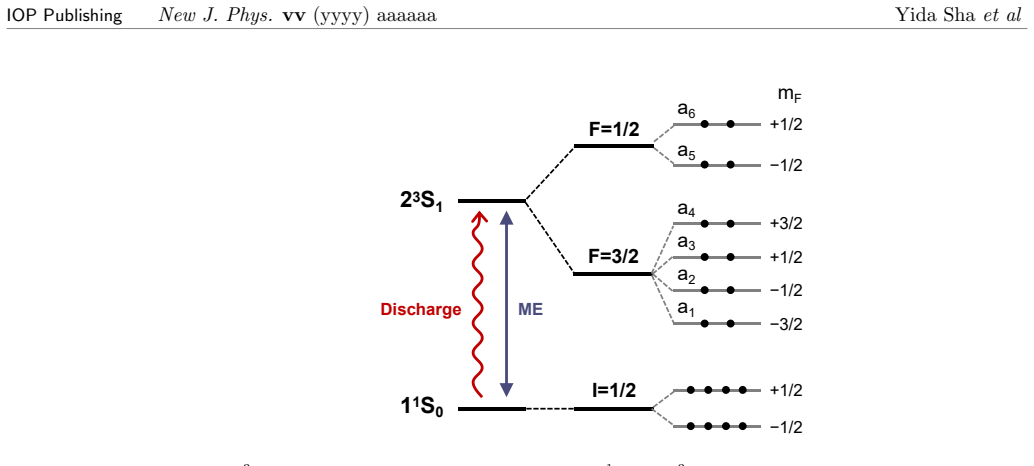
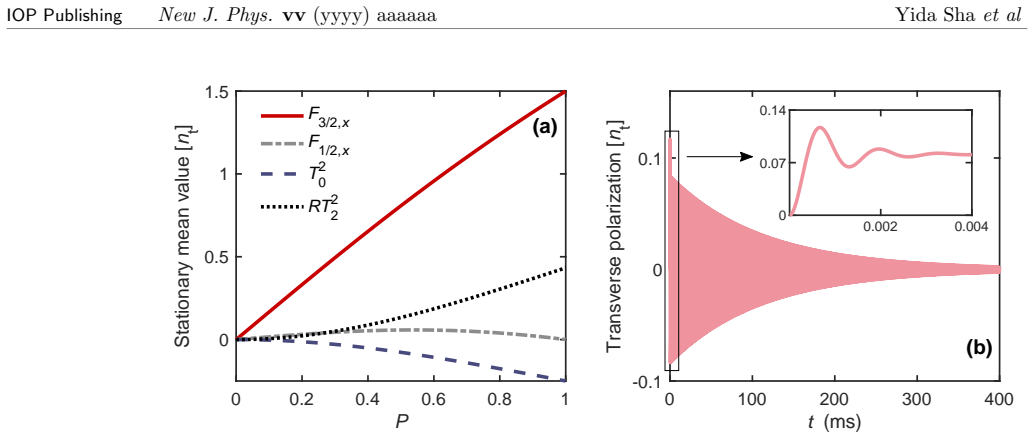
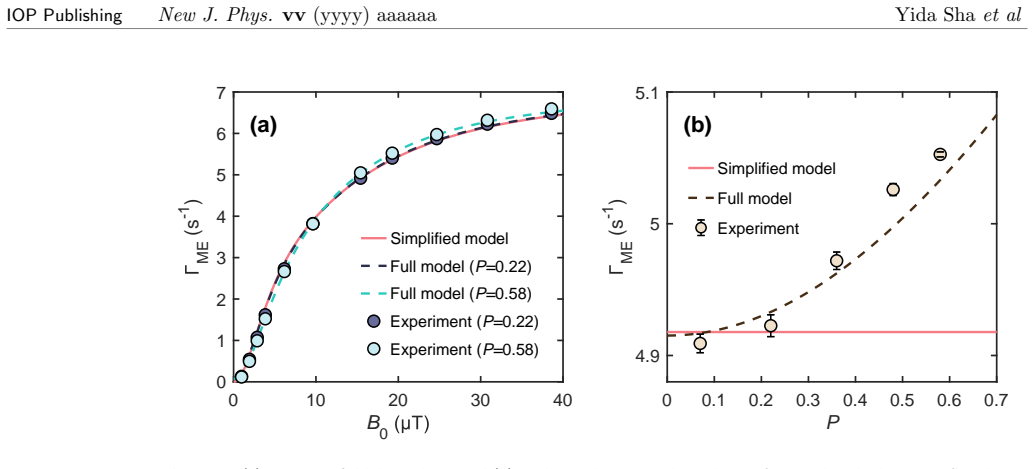
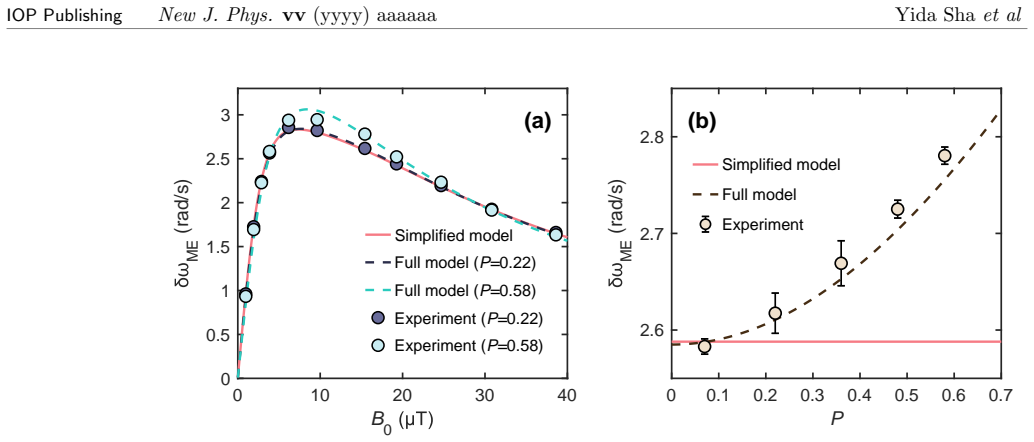
The central claim is that alignment tensor effects originating from the metastable F=3/2 manifold produce measurable contributions to ME-induced relaxation and frequency shift; these contributions are revealed by a clear nuclear-polarization dependence in the response of ground-state-metastable hybrid 3He ensembles to an external magnetic field, and the observations agree with the linearized mean-field model.
What carries the argument
Linearized mean-field model of alignment tensor effects from the metastable F=3/2 manifold, used to predict ME-induced relaxation and frequency shift.
If this is right
- The model supplies a route to correct systematic errors in high-accuracy magnetometry performed with MEOP-prepared 3He.
- The tensor description supplies guidance for optimal protocols that generate nuclear spin-squeezed states.
- Nuclear spin dynamics in highly polarized 3He must now be treated with both orientation and alignment tensor terms.
Where Pith is reading between the lines
- Precision experiments that rely on stable 3He polarization, such as neutron EDM searches, may need to include these tensor shifts in their systematic budgets.
- The same mean-field treatment could be applied to other noble-gas species prepared by metastability-exchange optical pumping.
- Measurements at still higher polarizations or different buffer-gas pressures would test whether nonlinear corrections become visible.
Load-bearing premise
The linearized mean-field approximation is enough to capture the alignment tensor contributions without needing higher-order nonlinear terms or extra manifold couplings.
What would settle it
A set of FID measurements at several polarization levels that show relaxation rates or frequency shifts deviating from the model's linear polarization dependence by more than the stated experimental uncertainty.
Figures
read the original abstract
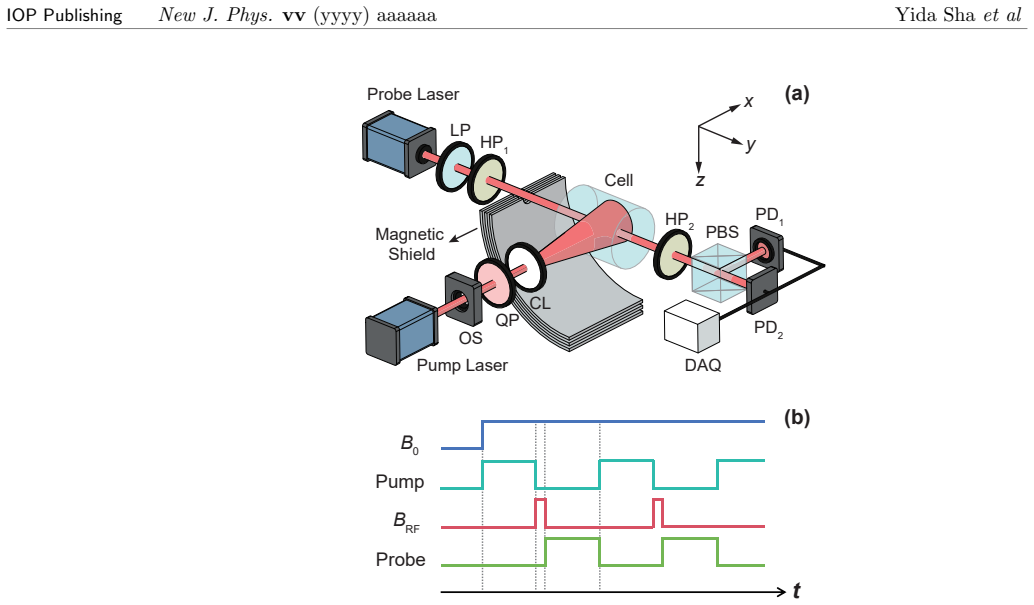
Highly polarized 3He ensembles prepared by metastability-exchange optical pumping (MEOP) have been widely used in precision measurements and fundamental physics. Metastability-exchange (ME) collisions, serving as the basis of MEOP, are traditionally described in terms of atomic orientation, while the significant contributions of metastable alignment tensor at high polarization remain unexplored. In this work, we develop a linearized model under mean-field approximation to investigate alignment tensor effects in highly polarized 3He , which originate from the metastable F = 3/2 manifold and are revealed through ME-induced relaxation and frequency shift. By means of free-induction-decay (FID) measurements, a pronounced dependence on nuclear polarization is experimentally observed in the response of the ground-state-metastable hybrid 3He ensembles to the external magnetic field. Furthermore, after obtaining the characteristics of tensor-induced phenomena, we demonstrate good agreement between the experiment and the theory. This work advances the understanding of nuclear spin dynamics in highly polarized 3He using MEOP. It further provides applications in systematic error correction of high-accuracy magnetometry, as well as in optimal protocol for the generation of nuclear spin-squeezed states.
Editorial analysis
A structured set of objections, weighed in public.
Referee Report
Summary. The paper develops a linearized mean-field model for alignment tensor effects in metastability-exchange collisions of highly polarized 3He originating from the metastable F=3/2 manifold. Via FID measurements on ground-state-metastable hybrid ensembles, it reports experimental observation of a pronounced nuclear-polarization dependence in relaxation and frequency shift, together with good agreement between the data and the model predictions. The work is positioned as advancing understanding of spin dynamics under MEOP and enabling systematic corrections in magnetometry and spin-squeezing protocols.
Significance. If the central claim holds, the result supplies the first direct experimental signature of alignment-tensor contributions to ME-induced relaxation and shifts at the high polarizations routinely achieved by MEOP. This is relevant for precision applications that rely on 3He ensembles. The experimental demonstration of polarization dependence and the construction of an explicit (if linearized) model constitute the main strengths; the manuscript does not claim parameter-free predictions or machine-checked derivations.
major comments (2)
- [Abstract] Abstract and model description: the central claim that the linearized mean-field treatment fully accounts for the observed polarization dependence rests on the untested assertion that higher-order nonlinear terms and F=3/2–F=1/2 manifold couplings remain negligible. No explicit residual analysis or comparison against a nonlinear truncation is reported, so it is unclear whether the reported agreement is achieved by construction once the two tensor coefficients are fitted.
- [Experimental methods] FID data analysis: the support for the experimental observation is weakened by the absence of stated criteria for data exclusion, quantitative error bars on the extracted relaxation rates and shifts, and any validation against an independent baseline (e.g., low-polarization reference runs or a separate observable). These omissions directly limit the strength of the claim that the polarization dependence is unambiguously attributable to the alignment tensor.
minor comments (2)
- Notation for the alignment-tensor coefficients and the precise definition of the mean-field closure should be stated explicitly in the main text rather than left to supplementary material.
- Figure captions should include the polarization values, magnetic-field strength, and cell pressure for each data set to allow direct comparison with the model.
Simulated Author's Rebuttal
We thank the referee for the careful and constructive review of our manuscript. We address each major comment below and will revise the manuscript to strengthen the presentation of both the model validation and the experimental analysis.
read point-by-point responses
-
Referee: [Abstract] Abstract and model description: the central claim that the linearized mean-field treatment fully accounts for the observed polarization dependence rests on the untested assertion that higher-order nonlinear terms and F=3/2–F=1/2 manifold couplings remain negligible. No explicit residual analysis or comparison against a nonlinear truncation is reported, so it is unclear whether the reported agreement is achieved by construction once the two tensor coefficients are fitted.
Authors: We agree that an explicit check on the validity of the linearization is needed to support the central claim. Although the derivation in the manuscript is performed under the mean-field and small-alignment approximations justified by the experimental polarization range, we did not provide a residual analysis or direct comparison to a nonlinear solver. In the revised manuscript we will add a supplementary section that (i) compares the linearized predictions against numerical integration of the full rate equations for the fitted parameters and (ii) shows residual plots of the experimental FID data versus the model. Order-of-magnitude estimates for the neglected F=3/2–F=1/2 couplings will also be included to justify their omission. revision: yes
-
Referee: [Experimental methods] FID data analysis: the support for the experimental observation is weakened by the absence of stated criteria for data exclusion, quantitative error bars on the extracted relaxation rates and shifts, and any validation against an independent baseline (e.g., low-polarization reference runs or a separate observable). These omissions directly limit the strength of the claim that the polarization dependence is unambiguously attributable to the alignment tensor.
Authors: We acknowledge that the experimental section omitted several important details. Data runs were excluded when the FID signal-to-noise ratio fell below a fixed threshold or when obvious technical artifacts (e.g., laser instability) were present; error bars on relaxation rates and shifts were obtained from the covariance matrices of the exponential fits but were not displayed. In the revision we will (i) state the quantitative exclusion criteria, (ii) report the error bars on all plotted quantities, and (iii) add a low-polarization reference data set in which alignment-tensor effects are expected to be negligible, thereby providing an independent baseline that isolates the polarization dependence. revision: yes
Circularity Check
No significant circularity detected
full rationale
The paper develops a linearized mean-field model for alignment tensor effects from the metastable F=3/2 manifold and validates it against independent FID measurements of polarization-dependent relaxation and frequency shifts. No load-bearing steps reduce by construction to fitted parameters, self-definitions, or self-citation chains; the experimental observation of the polarization dependence stands as an external benchmark, and the model is presented as an approximation whose agreement is checked rather than assumed. The derivation remains self-contained against the reported data.
Axiom & Free-Parameter Ledger
free parameters (1)
- tensor-induced relaxation and shift coefficients
axioms (2)
- domain assumption Mean-field approximation holds for the hybrid ground-metastable ensemble
- ad hoc to paper Linearization adequately describes the dynamics at the polarizations studied
Reference graph
Works this paper leans on
-
[1]
Gentile T R, Nacher P J, Saam B, and Walker T G 2017 Optically polarized 3He Rev. Mod. Phys.89, 045004
2017
-
[2]
Schmiedeskamp J, Heil W, Otten E W, Kremer R K, Simon A, and Zimmer J 2006 Paramagnetic relaxation of spin polarized 3He at bare glass surfacesEur. Phys. J.D38, 427
2006
-
[3]
Deninger A, Heil W, Otten E W, Wolf M, Kremer R K, and Simon A 2006 Paramagnetic relaxation of spin polarized 3He at coated glass wallsEur. Phys. J.D38, 439
2006
-
[4]
Lu Y, Abdukerim E, Li B, Lei L, Wu T, and Guo H 2025 3He absolute magnetometer at geomagnetic fieldPhys. Rev. Res.7, 043106
2025
-
[5]
Farooq M, Chupp T, Grange J, Tewsley-Booth A, Flay D, Kawall D, Sachdeva N, and Winter P 2020 Absolute Magnetometry with 3HePhys. Rev. Lett.124, 223001
2020
-
[6]
Koch H-C, Bison G, Gruji´ c Z D, Heil W, Kasprzak M, Knowles P, Kraft A, Pazgalev A, Schnabel A, Voigt J, and Weis A 2015 Design and performance of an absolute 3He/Cs magnetometerEur. Phys. J.D69, 202
2015
-
[7]
Ebert M, Grossmann T, Heil W, Otten E W, Surkau R, Thelen M, Leduc M, Bachert P, Knopp M V, and Schad L R 1996 Nuclear magnetic resonance imaging with hyperpolarised helium-3 Lancet347, 1297
1996
-
[8]
Qing K, Altes T A, Tustison N J, Feng X, Chen X, Mata J F, Miller G W, de Lange E E, Tobias W A, Cates G D Jr, Brookeman J R, and Mugler J P III 2015 Rapid acquisition of helium-3 and proton three-dimensional image sets of the human lung in a single breath-hold using compressed sensingMagn. Reson. Med.74, 1110
2015
-
[9]
Collier G, Pa lasz T, Wojna A, G lowacz B, Suchanek M, Olejniczak Z, and Dohnalik T 2013 A high-field 3He metastability exchange optical pumping polarizer operating in a 1.5 T medical scanner for lung magnetic resonance imagingJ. Appl. Phys.113, 204905
2013
-
[10]
Okudaira T, Oku T, Ino T, Hayashida H, Kira H, Sakai K, Hiroi K, Takahashi S, Aizawa K, Endo H, Endo S, Hino M, Hirota K, Honda T, Ikeda K, Kakurai K, Kambara W, Kitaguchi M, Oda T, Ohshita H, Otomo T, Shimizu H M, Shinohara T, Suzuki J, and Yamamoto T 2020 Development and application of a 3He Neutron Spin Filter at J-PARCNucl. Instrum. Methods Phys. Res....
2020
-
[11]
China Phys
Zhang J, Huang C, Qin Z, Ye F, Amir S M, Salman A, Dong Y, Tian L, Buck Z N, Kreuzpaintner W, Musgrave M, Qi X, Wang T, and Tong X 2022 In-situ optical pumping for polarizing 3He neutron spin filters at the China Spallation Neutron SourceSci. China Phys. Mech. Astron.65, 241011
2022
-
[12]
Jiang C Y, Tong X, Brown D R, Chi S, Christianson A D, Kadron B J, Robertson J L, and Winn B L 2014 Development of a compact in situ polarized 3He neutron spin filter at Oak Ridge National LaboratoryRev. Sci. Instrum.85, 075112
2014
-
[13]
Allmendinger F, Heil W, Karpuk S, Kilian W, Scharth A, Schmidt U, Schnabel A, Sobolev Yu, and Tullney K 2014 New Limit on Lorentz-Invariance- andCPT-Violating Neutron Spin Interactions Using a Free-Spin-Precession 3He-129Xe ComagnetometerPhys. Rev. Lett.112, 110801
2014
-
[14]
Yan H, Sun G A, Peng S M, Zhang Y, Fu C, Guo H, and Liu B Q 2015 Searching for New Spin- and Velocity-Dependent Interactions by Spin Relaxation of Polarized 3He GasPhys. Rev. Lett. 115, 182001
2015
-
[15]
Wu K Y, Chen S Y, Sun G A, Peng S M, Peng M, and Yan H 2022 Experimental Limits on Exotic Spin and Velocity Dependent Interactions Using Rotationally Modulated Source Masses and an Atomic-Magnetometer ArrayPhys. Rev. Lett.129, 051802
2022
-
[16]
Katz O, Reches E, Shaham R, Poem E, Gorshkov A V, and Firstenberg O 2025 Optimal strategies for optical quantum memories using long-lived noble-gas spinsPhys. Rev. Res.7, 043345
2025
-
[17]
Rev.A105, 042606
Katz O, Shaham R, Reches E, Gorshkov A V, and Firstenberg O 2022 Optical quantum memory for noble-gas spins based on spin-exchange collisionsPhys. Rev.A105, 042606
2022
-
[18]
Serafin A, Fadel M, Treutlein P, and Sinatra A 2021 Nuclear Spin Squeezing in Helium-3 by Continuous Quantum Nondemolition MeasurementPhys. Rev. Lett.127, 013601
2021
-
[19]
Serafin A, Castin Y, Fadel M, Treutlein P, and Sinatra A 2021 ´Etude th´ eorique de la compression de spin nucl´ eaire par mesure quantique non destructive en continuC. R. Phys.22, 1
2021
-
[20]
Katz O, Shaham R, Polzik E S, and Firstenberg O 2020 Long-Lived Entanglement Generation of Nuclear Spins Using Coherent LightPhys. Rev. Lett.124, 043602
2020
-
[21]
Batz M, Nacher P J, and Tastevin G 2011 Fundamentals of metastability exchange optical pumping in heliumJ. Phys. Conf. Ser.294, 012002
2011
-
[22]
Walker T G 2011 Fundamentals of Spin-Exchange Optical PumpingJ. Phys. Conf. Ser.294, 012001
2011
-
[23]
Rev.132, 2561
Colegrove F D, Schearer L D, and Walters G K 1963 Polarization of He3 Gas by Optical Pumping Phys. Rev.132, 2561
1963
-
[24]
Bouchiat M A, Carver T R, and Varnum C M 1960 Nuclear Polarization in He 3 Gas Induced by Optical Pumping and Dipolar ExchangePhys. Rev. Lett.5, 373
1960
-
[25]
SPIE(Yokohama Japan)13710, 137100M
Maria-Moreno C, Chupp T, C´ ardenas-Fern´ andez P, Budker D, and Mateos I 2025 Optically pumped Helium-3 nuclear magnetometer characterization for low-frequency space applications inFuture Sensing Technologies 2025: Proc. SPIE(Yokohama Japan)13710, 137100M
2025
-
[26]
Chu P-H, Esler A M, Peng J C, Beck D H, Chandler D E, Clayton S, Hu B-Z, Ngan S Y, Sham C H, So L H, Williamson S, and Yoder J 2011 Dressed spin of polarized 3He in a cellPhys. Rev. C84, 022501
2011
-
[27]
Partridge R B and Series G W 1966 The transfer of coherence by collisions of 3He atomsProc. Phys. Soc.88, 983
1966
-
[28]
Phys.B53, 065202
Li S, Zhan Y, Peng X, Chen J, and Guo H 2020 Linear and nonlinear coherence transfer of resonant nuclear-spin-dressed effect via metastability-exchange collisionsAppl. Phys.B53, 065202
2020
-
[29]
Phys.26, 103037 11 IOP PublishingNew J
Fadel M, Treutlein P, and Sinatra A 2024 Effective Faraday interaction between light and nuclear spins of helium-3 in its ground state: a semiclassical studyNew J. Phys.26, 103037 11 IOP PublishingNew J. Phys.vv(yyyy) aaaaaa Yida Shaet al
2024
-
[30]
Pinard M and Lalo¨ e F 1980 he role of the pauli principle in metastability exchange collisionsJ. Phys. France41, 799
1980
-
[31]
China Phys
Wang Y, Wu L, Zhang K, Peng M, Chen S, and Yan H 2024 A polarized 3He system based on metastability-exchange optical pumpingSci. China Phys. Mech. Astron.67, 273011
2024
-
[32]
Dupont-Roc J, Leduc M, and Lalo¨ e F 1973 Contribution ` a l’´ etude du pompage optique par ´ echange de m´ etastabilit´ e dans 3HeJ. Phys. France34, 961
1973
-
[33]
Batz M 2011 Metastability exchange optical pumping in 3He gas up to 30 mT: Efficiency measurements and evidence of laser-induced nuclear relaxationPhD thesisUniversit´ e Pierre et Marie Curie - Paris VI (available at: https://tel.archives-ouvertes.fr/tel-00665393/document)
2011
-
[34]
Pandey P, Lu H, Maxwell J D, Brock J, Keith C D, Li X, Milner R G, and Nguyen D 2026 Polarizing 3He via metastability exchange optical pumping using a 1.2 mbar sealed cell at magnetic fields up to 5 TNucl. Instrum. Methods Phys. Res.A1081, 170870
2026
-
[35]
Bigelow N P, Nacher P J, and Leduc M 1992 Accurate optical measurement of nuclear polarization in optically pumped 3He gasJ. Phys. II France2, 2159
1992
-
[36]
Wu L Y, Fu C, and Yan H 2025 Optimization of metastability-exchange optical pumping of 3He for low-field magnetometryMeas. Sci. Technol.37, 025003
2025
-
[37]
Nacher P J and Leduc M 1985 Optical pumping in 3He with a laserJ. Phys. France46, 2057
1985
-
[38]
Hunter D, Piccolomo S, Pritchard J D, Brockie N L, Dyer T E, and Riis E 2018 Free-Induction- Decay Magnetometer Based on a Microfabricated Cs Vapor CellPhys. Rev. Appl.10, 014002
2018
-
[39]
Yi K, Liu Y, Wang B, Xiao W, Sheng D, Peng X, and Guo H 2024 Free-induction-decay 4He magnetometer using a multipass cellPhys. Rev. Appl.22, 014084
2024
-
[40]
Phys.18, 506
Shaham R, Katz O, and Firstenberg O 2022 Strong coupling of alkali-metal spins to noble-gas spins with an hour-long coherence timeNat. Phys.18, 506
2022
-
[41]
Zheng W, Gao H, Liu J-G, Zhang Y, Ye Q, and Swank C 2011 General solution to gradient- induced transverse and longitudinal relaxation of spins undergoing restricted diffusionPhys. Rev. A84, 053411
2011
-
[42]
Rev.A76, 033830 12
Cviklinski J, Dantan A, Ortalo J, and Pinard M 2007 Conditional squeezing of an atomic alignmentPhys. Rev.A76, 033830 12
2007
discussion (0)
Sign in with ORCID, Apple, or X to comment. Anyone can read and Pith papers without signing in.