V7995 Sgr: A New FU Orionis Accretion Outburst Near NGC 6589/6590
Pith reviewed 2026-06-26 15:29 UTC · model grok-4.3
The pith
A young stellar object near NGC 6589/6590 underwent an FU Orionis accretion outburst that peaked in late 2024.
A machine-rendered reading of the paper's core claim, the machinery that carries it, and where it could break.
Core claim
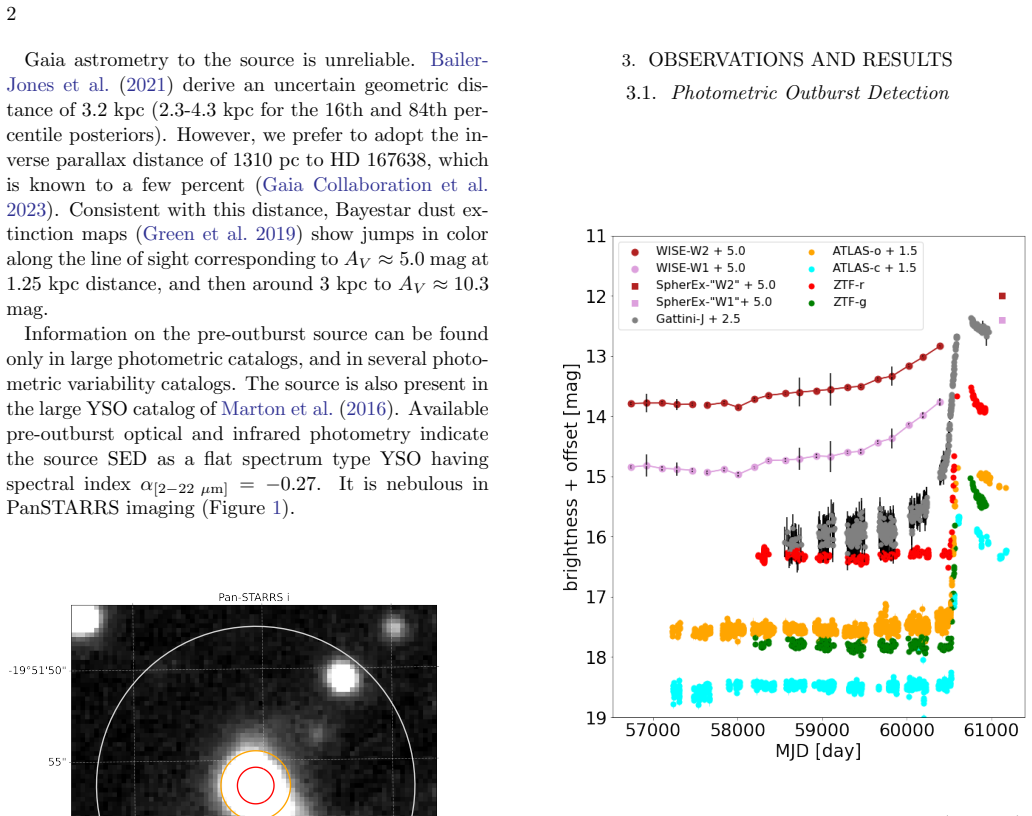
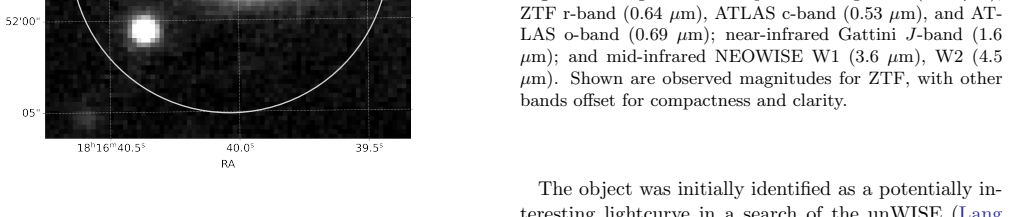
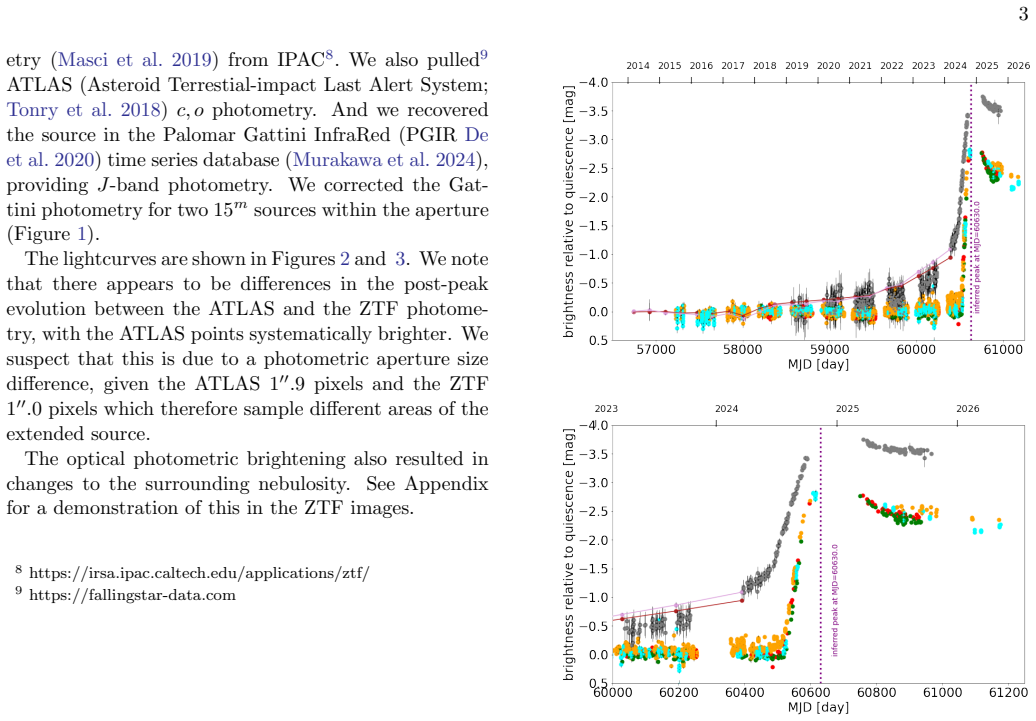
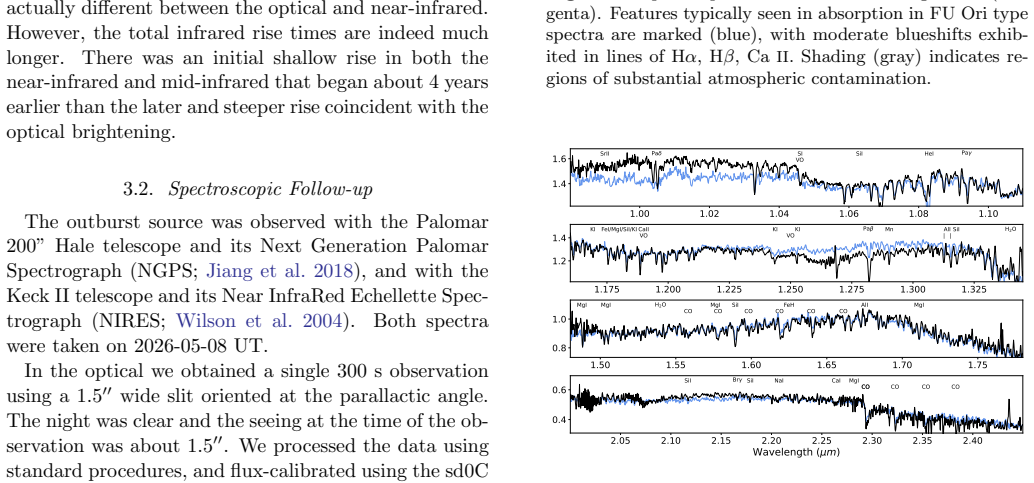
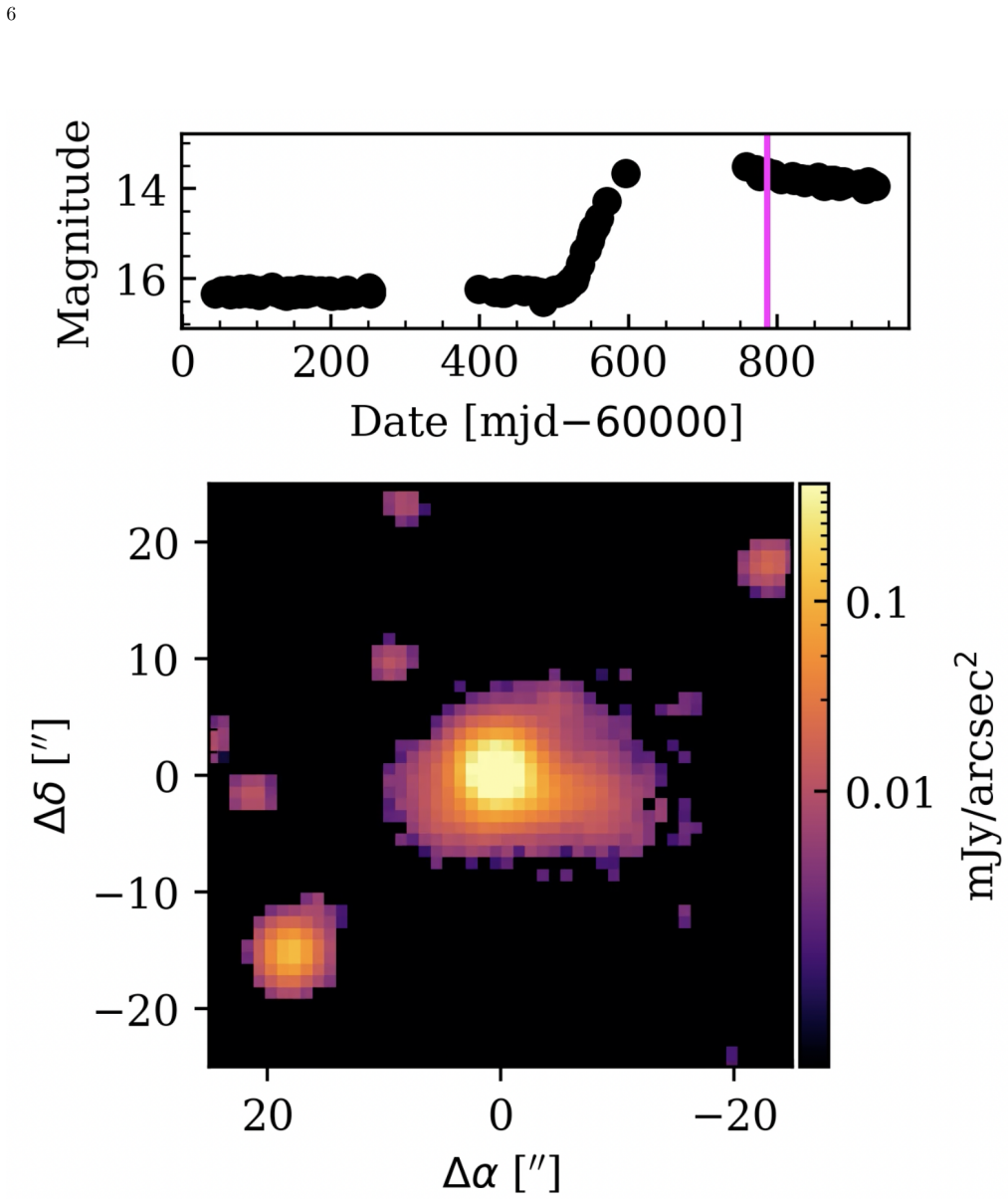
We announce a new FU Orionis type outburst that reached peak brightness in late 2024, following a steep 4.6 month photometric rise of -2.85 mag in the r band. This rapid brightening at all wavelengths was preceded in the infrared by a much shallower rise over 4 years. The progenitor object was an unstudied young stellar object having a flat-spectrum type spectral energy distribution, and extended nebulosity. We present multi-wavelength lightcurves covering the photometric low-state, the outburst, and early post-outburst epochs. Optical imaging shows a concurrent brightening of the extended nebular environment. The spectra confirm an FU Ori type outburst. The outburst source exhibits a mixed-
What carries the argument
The FU Orionis classification, carried by the combination of rapid photometric rise, infrared precursor, and post-peak spectra showing mixed-temperature disk absorption plus blueshifted wind lines.
If this is right
- The source is accreting at an elevated rate through a circumstellar disk.
- A strong wind is launched during the outburst, traced by blueshifted absorption in multiple lines.
- The extended nebulosity brightens in response to the increased central luminosity.
- Continued monitoring can track the decay phase and test whether the event returns to the pre-outburst state.
Where Pith is reading between the lines
- The location near NGC 6589/6590 may link the outburst to clustered star formation, testable by searching for similar events in the same region.
- Modeling the mixed-temperature spectrum could yield an estimate of the accretion rate once the distance is known.
- The four-year infrared precursor suggests a slow buildup phase that could be searched for in archival data of other young stars.
Load-bearing premise
The observed light-curve shape, infrared precursor, and post-peak spectral features are sufficient to classify the event uniquely as an FU Orionis outburst rather than another form of stellar variability.
What would settle it
A spectrum taken near peak or during the rise that lacks both the mixed-temperature absorption and the blueshifted wind features, or that instead shows strong emission lines without disk signatures, would falsify the classification.
Figures
read the original abstract
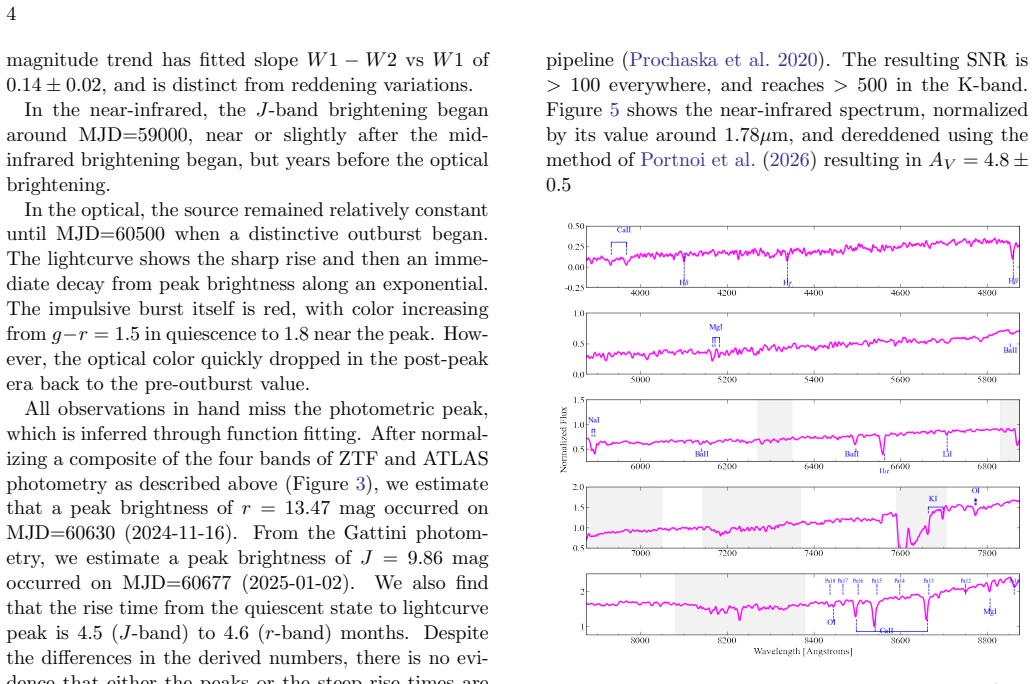
We announce a new FU Orionis type outburst that reached peak brightness in late 2024, following a steep 4.6 month photometric rise of -2.85 mag in the $r$ band. This rapid brightening at all wavelengths was preceeded in the infrared by a much shallower rise over 4 years. The progenitor object was an unstudied young stellar object having a flat-spectrum type spectral energy distribution, and extended nebulosity. We present multi-wavelength lightcurves covering the photometric low-state, the outburst, and early post-outburst epochs. Optical imaging shows a concurrent brightening of the extended nebular environment. We also present follow-up optical/near-infrared spectroscopy taken 1.5 years after the inferred photometric peak. The spectra confirm an FU Ori type outburst. The outburst source exhibits a mixed-temperature absorption spectrum, formed in an accretion disk, and it shows several line species with blueshifted absorption profiles that are formed in a strong wind.
Editorial analysis
A structured set of objections, weighed in public.
Referee Report
Summary. The manuscript announces the discovery of a new FU Orionis-type accretion outburst in V7995 Sgr, which reached peak brightness in late 2024 after a steep 4.6-month optical rise of -2.85 mag in r-band. The event was preceded by a shallower 4-year infrared rise; the progenitor is an unstudied flat-spectrum YSO with associated nebulosity. Multi-wavelength light curves, concurrent nebular brightening, and optical/near-IR spectra taken 1.5 years post-peak are presented. The spectra show a mixed-temperature absorption spectrum formed in an accretion disk plus blueshifted absorption lines from a strong wind, confirming the FU Ori classification.
Significance. If the classification holds, the work adds a new, well-documented member to the small sample of FU Ori outbursts. The combination of rapid optical rise, IR precursor, flat-spectrum progenitor, nebular response, and post-peak disk-plus-wind spectrum supplies additional observational constraints on episodic accretion and outflow launching in young stellar objects.
minor comments (3)
- [Abstract and §1] The abstract and introduction should explicitly list the quantitative criteria (e.g., rise time, amplitude, spectral features) used to classify the event as FU Ori and cite the key reference papers that define those criteria.
- [Photometry section / Figure 1] Figure showing the multi-wavelength light curves should include photometric error bars, the number of epochs, and the telescope/instrument for each band to allow independent verification of the reported rise times and amplitudes.
- [Spectroscopy section] The spectroscopy section should state the exact observation dates (JD or calendar), resolving power, and signal-to-noise ratio achieved, and should compare the observed line profiles quantitatively to at least one well-studied FU Ori template spectrum.
Simulated Author's Rebuttal
We thank the referee for their positive evaluation of our manuscript on the discovery of the new FU Orionis outburst in V7995 Sgr. The referee's summary accurately captures the key elements of the work, including the rapid optical rise, infrared precursor, flat-spectrum progenitor, nebular response, and spectroscopic confirmation. We appreciate the recommendation for minor revision.
Circularity Check
No significant circularity: purely observational classification
full rationale
The paper is an observational report announcing a new FU Orionis outburst based on light-curve morphology, infrared precursor, progenitor SED, nebular brightening, and post-peak spectra showing disk absorption plus wind features. These are compared directly to standard literature criteria for FU Ori events with no equations, fitted parameters, models, derivations, or self-citation chains. No load-bearing step reduces by construction to the paper's own inputs; the classification is an external match rather than an internal redefinition or prediction.
Axiom & Free-Parameter Ledger
Reference graph
Works this paper leans on
-
[1]
Bae, J., Hartmann, L., Zhu, Z., & Nelson, R. P. 2014, ApJ, 795, 61, doi: 10.1088/0004-637X/795/1/61
-
[2]
Demleitner, M., & Andrae, R. 2021, AJ, 161, 147, doi: 10.3847/1538-3881/abd806 6 Figure 6.Still frame from an animation showing the ZTF r-band lightcurve and image of the post-outburst source. There is a morphological change in the nebular environment as the source brightens.On-line version of the journal shows a movie. 7
work page internal anchor Pith review doi:10.3847/1538-3881/abd806 2021
-
[3]
doi:10.1088/1538-3873/aaecbe , eprint =
Bellm, E. C., Kulkarni, S. R., Graham, M. J., et al. 2019, PASP, 131, 018002, doi: 10.1088/1538-3873/aaecbe
-
[4]
Bock, J. J., Aboobaker, A. M., Adamo, J., et al. 2026, ApJ, 999, 139, doi: 10.3847/1538-4357/ae2be2
-
[5]
2024, ApJ, 971, 44, doi: 10.3847/1538-4357/ad5286
Carvalho, A., Hillenbrand, L., Seebeck, J., & Covey, K. 2024, ApJ, 971, 44, doi: 10.3847/1538-4357/ad5286
-
[6]
Carvalho, A. S., Hillenbrand, L. A., Hambsch, F.-J., et al. 2023, ApJ, 953, 86, doi: 10.3847/1538-4357/ace2cb
-
[7]
2023, MNRAS, 523, 5522, doi: 10.1093/mnras/stad1784
Cleaver, J., Hartmann, L., & Bae, J. 2023, MNRAS, 523, 5522, doi: 10.1093/mnras/stad1784
-
[8]
Das, G., Hillenbrand, L. A., & Carvalho, A. S. 2026, arXiv e-prints, arXiv:2605.19710. https://arxiv.org/abs/2605.19710
Pith/arXiv arXiv 2026
-
[9]
De, K., Hankins, M. J., Kasliwal, M. M., et al. 2020, PASP, 132, 025001, doi: 10.1088/1538-3873/ab6069
-
[10]
J., Hillenbrand, L
Fischer, W. J., Hillenbrand, L. A., Herczeg, G. J., et al. 2023, in Astronomical Society of the Pacific Conference
2023
-
[11]
534, Protostars and Planets VII, ed
Series, Vol. 534, Protostars and Planets VII, ed. S. Inutsuka, Y. Aikawa, T. Muto, K. Tomida, & M. Tamura, 355, doi: 10.48550/arXiv.2203.11257 Gaia Collaboration, Vallenari, A., Brown, A. G. A., et al. 2023, A&A, 674, A1, doi: 10.1051/0004-6361/202243940
-
[12]
Graham, M. J., Kulkarni, S. R., Bellm, E. C., et al. 2019, PASP, 131, 078001, doi: 10.1088/1538-3873/ab006c
-
[13]
2019, ApJ, 887, 93, doi: 10.3847/1538-4357/ab5362 Grudi´ c, M
Finkbeiner, D. 2019, ApJ, 887, 93, doi: 10.3847/1538-4357/ab5362
work page internal anchor Pith review doi:10.3847/1538-4357/ab5362 2019
-
[14]
Hartmann, L., & Kenyon, S. J. 1996, ARA&A, 34, 207, doi: 10.1146/annurev.astro.34.1.207
-
[15]
Herbig, G. H. 1966, Vistas in Astronomy, 8, 109, doi: 10.1016/0083-6656(66)90025-0
-
[16]
Hillenbrand, L. A., Carvalho, A. S., Stern, D., et al. 2025, ApJ, 988, 77, doi: 10.3847/1538-4357/ade14d
-
[17]
2023, MNRAS, 521, 5826, doi: 10.1093/mnras/stad866
Houge, A., & Krijt, S. 2023, MNRAS, 521, 5826, doi: 10.1093/mnras/stad866
-
[18]
Hubble, E. P. 1922, ApJ, 56, 400, doi: 10.1086/142713
-
[19]
2018, in Society of Photo-Optical Instrumentation Engineers (SPIE) Conference Series, Vol
Jiang, H., Hu, Z., Xu, M., et al. 2018, in Society of Photo-Optical Instrumentation Engineers (SPIE) Conference Series, Vol. 10702, Ground-based and Airborne Instrumentation for Astronomy VII, ed. C. J
2018
-
[20]
Ground-based and Airborne Instrumentation for Astronomy VII , year = 2018, editor =
Evans, L. Simard, & H. Takami, 107022L, doi: 10.1117/12.2312550
-
[21]
Kenyon, S. J., Hartmann, L., & Hewett, R. 1988, ApJ, 325, 231, doi: 10.1086/165999
-
[22]
Lang, D. 2014, AJ, 147, 108, doi: 10.1088/0004-6256/147/5/108
-
[23]
Laznevoi, S. I., Akimkin, V. V., Pavlyuchenkov, Y. N., et al. 2025, A&A, 700, L24, doi: 10.1051/0004-6361/202554962
-
[24]
Magakian, T. Y. 2003, A&A, 399, 141, doi: 10.1051/0004-6361:20021743
-
[25]
Mainzer, A., Bauer, J., Cutri, R. M., et al. 2014, ApJ, 792, 30, doi: 10.1088/0004-637X/792/1/30
-
[26]
Marton, G., T´ oth, L. V., Paladini, R., et al. 2016, MNRAS, 458, 3479, doi: 10.1093/mnras/stw398
-
[27]
Masci, F. J., Laher, R. R., Rusholme, B., et al. 2019, PASP, 131, 018003, doi: 10.1088/1538-3873/aae8ac
work page internal anchor Pith review doi:10.1088/1538-3873/aae8ac 2019
-
[28]
1990, ApJ, 358, 344, doi: 10.1086/168991
Massey, P., & Gronwall, C. 1990, ApJ, 358, 344, doi: 10.1086/168991
-
[29]
Meisner, A. M., Lang, D., & Schlegel, D. J. 2018, AJ, 156, 69, doi: 10.3847/1538-3881/aacbcd
-
[30]
Murakawa, S., De, K., Ashley, M. C. B., et al. 2024, PASP, 136, 104501, doi: 10.1088/1538-3873/ad7db1
-
[31]
Patterson, M. T., Bellm, E. C., Rusholme, B., et al. 2019, PASP, 131, 018001, doi: 10.1088/1538-3873/aae904
-
[32]
Portnoi, E. R., Hillenbrand, L. A., & Carvalho, A. S. 2026, arXiv e-prints, arXiv:2605.12795. https://arxiv.org/abs/2605.12795
Pith/arXiv arXiv 2026
-
[33]
The Journal of Open Source Software , keywords =
Prochaska, J., Hennawi, J., Westfall, K., et al. 2020, The Journal of Open Source Software, 5, 2308, doi: 10.21105/joss.02308
-
[34]
Astronomy Reports , year = 2017, month = jan, volume =
Samus, N. N., Kazarovets, E. V., Durlevich, O. V., Kireeva, N. N., & Pastukhova, E. N. 2017, Astronomy Reports, 61, 80, doi: 10.1134/S1063772917010085
-
[35]
L., Denneau, L., Heinze, A
Tonry, J. L., Denneau, L., Heinze, A. N., et al. 2018, Publications of the Astronomical Society of the Pacific, 130, 064505. http://stacks.iop.org/1538-3873/130/i=988/a=064505
2018
-
[36]
Vorobyov, E. I., Elbakyan, V. G., Liu, H. B., & Takami, M. 2021, A&A, 647, A44, doi: 10.1051/0004-6361/202039391
-
[37]
Wilson, J. C., Henderson, C. P., Herter, T. L., et al. 2004, in Society of Photo-Optical Instrumentation Engineers (SPIE) Conference Series, Vol. 5492, Ground-based Instrumentation for Astronomy, ed. A. F. M. Moorwood & M. Iye, 1295–1305, doi: 10.1117/12.550925 WISE Team. 2020, NEOWISE 2-Band Post-Cryo Single Exposure (L1b) Source Table, NASA IPAC DataSet...
-
[38]
The Wide-field Infrared Survey Explorer (WISE): Mission Description and Initial On-orbit Performance
Wright, E. L., Eisenhardt, P. R. M., Mainzer, A. K., et al. 2010, AJ, 140, 1868, doi: 10.1088/0004-6256/140/6/1868
work page internal anchor Pith review doi:10.1088/0004-6256/140/6/1868 2010
-
[39]
Zackay, B., Ofek, E. O., & Gal-Yam, A. 2016, ApJ, 830, 27, doi: 10.3847/0004-637X/830/1/27
-
[40]
Zhu, Z., Hartmann, L., Gammie, C., & McKinney, J. C. 2009, ApJ, 701, 620, doi: 10.1088/0004-637X/701/1/620
discussion (0)
Sign in with ORCID, Apple, or X to comment. Anyone can read and Pith papers without signing in.