Neural network surrogates with uncertainty quantification for inverse problems in partial differential equations
Pith reviewed 2026-06-26 18:01 UTC · model grok-4.3
The pith
DeepGaLA neural-network surrogates provide uncertainty-aware PDE approximations comparable to Gaussian processes but more efficient in high dimensions.
A machine-rendered reading of the paper's core claim, the machinery that carries it, and where it could break.
Core claim
DeepGaLA is a neural-network surrogate for differential equation solvers that supplies uncertainty-aware predictions to limit overconfident inference when training data are limited. Across numerical experiments it produces forward-model approximations whose accuracy matches that of established Gaussian-process surrogates while retaining efficiency as parameter dimension grows. It further incorporates differential-equation constraints even in nonlinear regimes. Short runs of delayed-acceptance Markov chain Monte Carlo act as a practical diagnostic for whether the surrogate-induced posterior approximations remain faithful.
What carries the argument
DeepGaLA, a neural network surrogate trained to approximate PDE solutions together with calibrated uncertainty estimates, thereby replacing costly forward evaluations inside Bayesian likelihood computations.
If this is right
- The surrogate reaches accuracy levels comparable to Gaussian-process surrogates for forward-model approximations.
- Computational efficiency holds up better than Gaussian processes when the parameter dimension increases.
- Differential-equation constraints can be incorporated directly, including for nonlinear problems.
- Delayed-acceptance MCMC supplies a usable diagnostic for the quality of the surrogate-induced posterior.
- Uncertainty-quantified neural surrogates thereby support Bayesian inference for complex systems at larger scales.
Where Pith is reading between the lines
- The same surrogate construction could be tested on inverse problems governed by other families of differential equations.
- Calibration performance might be probed in regimes that supply even fewer training evaluations than the reported experiments.
- The constraint-enforcement capability points toward further hybrids that combine the surrogate with additional physics-informed loss terms.
Load-bearing premise
A neural network trained on limited data can produce surrogate predictions whose uncertainty estimates remain calibrated enough for the surrogate-induced posterior to be diagnostically useful via delayed-acceptance MCMC in nonlinear PDE settings.
What would settle it
A nonlinear PDE inverse problem in which posterior samples drawn with the DeepGaLA surrogate differ markedly from those obtained with the exact forward model, even though the delayed-acceptance diagnostic reports agreement.
Figures


read the original abstract
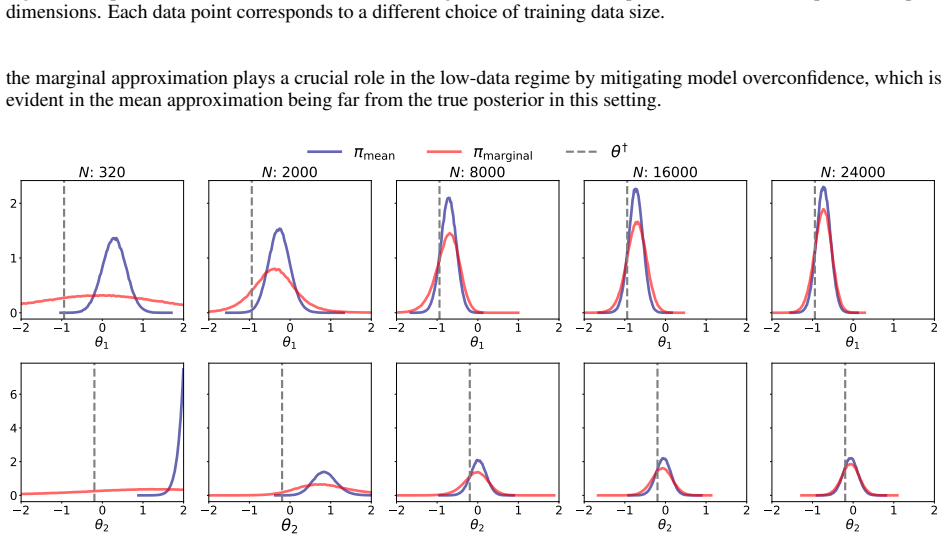
Inverse problems for differential equations arise throughout science and engineering, where one seeks to infer unknown model parameters from noisy or incomplete observations. Traditional numerical methods for these problems are often computationally expensive, particularly in Bayesian settings where evaluating the likelihood becomes costly for complex forward models and high-dimensional parameter spaces. To address this challenge, we introduce DeepGaLA, a neural-network surrogate for differential equation solvers that provides uncertainty-aware predictions, reducing overconfident inference when training data are limited. To evaluate the fidelity of the surrogate-induced posterior approximations in practice, we show that a short run of delayed-acceptance Markov chain Monte Carlo can serve as an effective diagnostic. Across a range of numerical experiments, DeepGaLA delivers forward-model approximations with accuracy comparable to established Gaussian-process surrogates, while better maintaining efficiency as parameter dimension grows. Moreover, it can incorporate differential-equation constraints, including in nonlinear settings. Overall, these results indicate that uncertainty-quantified neural surrogates can enable scalable and reliable Bayesian inference for inverse problems in complex systems.
Editorial analysis
A structured set of objections, weighed in public.
Referee Report
Summary. The manuscript introduces DeepGaLA, a neural-network surrogate for differential equation solvers that supplies uncertainty-aware predictions for Bayesian inverse problems. It claims that numerical experiments demonstrate forward-model accuracy comparable to Gaussian-process surrogates with improved scaling as parameter dimension increases, that the network can incorporate differential-equation constraints even in nonlinear regimes, and that a short delayed-acceptance MCMC run serves as an effective diagnostic for the fidelity of the surrogate-induced posterior.
Significance. If the uncertainty estimates prove well-calibrated, the approach could enable more scalable Bayesian inference for high-dimensional PDE inverse problems than Gaussian-process surrogates while enforcing physical consistency through DE constraints during training. The diagnostic use of delayed-acceptance MCMC is a potentially useful idea for validating surrogate posteriors.
major comments (2)
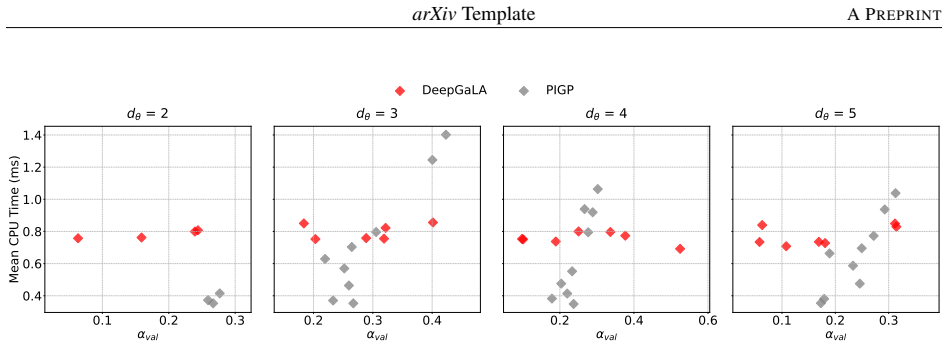
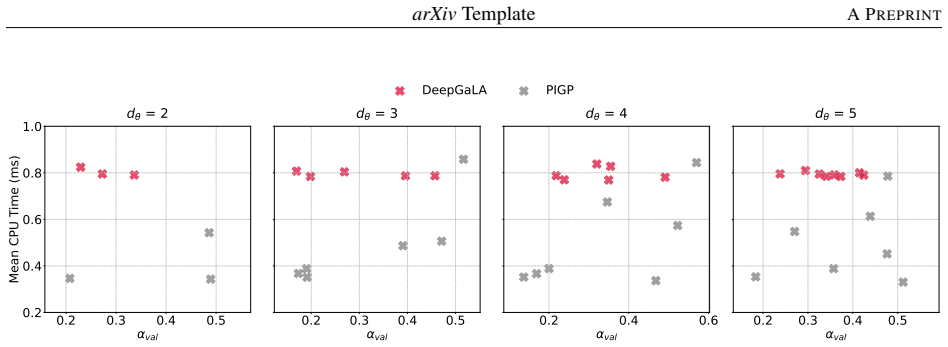
- [Abstract] Abstract: the claim that 'across a range of numerical experiments, DeepGaLA delivers forward-model approximations with accuracy comparable to established Gaussian-process surrogates, while better maintaining efficiency as parameter dimension grows' is unsupported by any quantitative metrics, error bars, dataset sizes, scaling plots, or validation details. This absence prevents assessment of the central empirical claims.
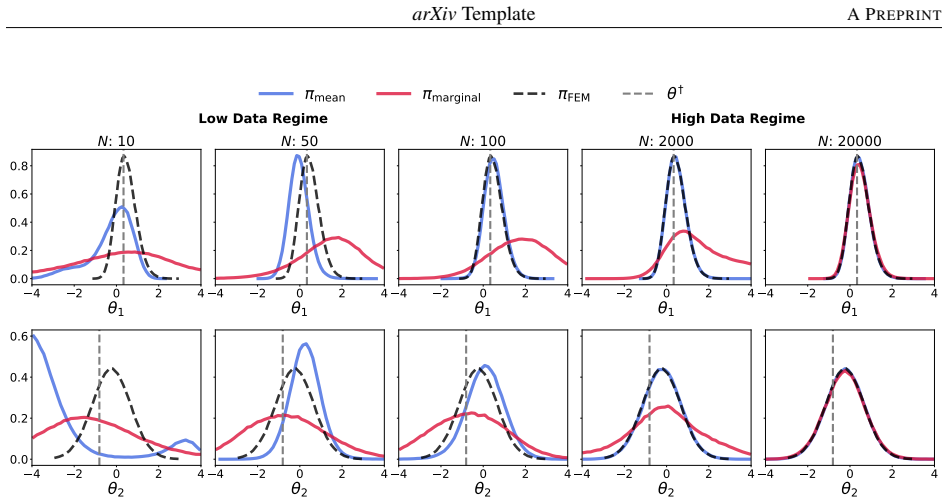
- [Abstract] Abstract: the assertion that 'a short run of delayed-acceptance Markov chain Monte Carlo can serve as an effective diagnostic' for surrogate-induced posterior approximations is stated without any description of the diagnostic procedure, experimental outcomes, coverage diagnostics, or evidence that it detects miscalibration in nonlinear PDE settings. This step is load-bearing for the claim that the uncertainty quantification is usable for inference.
Simulated Author's Rebuttal
We thank the referee for their constructive comments. We address each major comment below and agree that revisions to the abstract are warranted to better contextualize the claims.
read point-by-point responses
-
Referee: [Abstract] Abstract: the claim that 'across a range of numerical experiments, DeepGaLA delivers forward-model approximations with accuracy comparable to established Gaussian-process surrogates, while better maintaining efficiency as parameter dimension grows' is unsupported by any quantitative metrics, error bars, dataset sizes, scaling plots, or validation details. This absence prevents assessment of the central empirical claims.
Authors: We agree that the abstract should not present empirical claims without indicating where supporting evidence appears. The quantitative metrics, error bars, dataset sizes, scaling plots, and validation details for the forward-model accuracy and scaling comparisons are provided in the numerical experiments section of the manuscript. In the revised manuscript we will update the abstract to reference these results or qualify the statement accordingly. revision: yes
-
Referee: [Abstract] Abstract: the assertion that 'a short run of delayed-acceptance Markov chain Monte Carlo can serve as an effective diagnostic' for surrogate-induced posterior approximations is stated without any description of the diagnostic procedure, experimental outcomes, coverage diagnostics, or evidence that it detects miscalibration in nonlinear PDE settings. This step is load-bearing for the claim that the uncertainty quantification is usable for inference.
Authors: We acknowledge that the abstract statement on the delayed-acceptance MCMC diagnostic lacks sufficient context. The diagnostic procedure, its application to surrogate-induced posteriors, experimental outcomes, and evidence of its utility (including in nonlinear settings) are detailed in the main text. We will revise the abstract to include a brief description of the procedure and its observed performance. revision: yes
Circularity Check
No circularity: empirical method with independent experimental validation
full rationale
The paper presents DeepGaLA as a neural-network surrogate trained on data for PDE forward models, with claims of accuracy and efficiency supported by numerical experiments across test cases. No derivations, equations, or self-citations are shown that reduce performance metrics or uncertainty calibration to quantities defined by the method itself. The delayed-acceptance MCMC diagnostic is described as an external check on the surrogate-induced posterior, and comparisons to Gaussian-process baselines are external benchmarks. The work is self-contained against these empirical standards with no load-bearing self-referential steps.
Axiom & Free-Parameter Ledger
Reference graph
Works this paper leans on
-
[1]
Babuška, F
I. Babuška, F. Nobile, and R. Tempone. A stochastic collocation method for elliptic partial differential equations with random input data.SIAM Rev., 52(2):317–355, 2010
2010
-
[2]
T. Bai, A. L. Teckentrup, and K. C. Zygalakis. Gaussian processes for Bayesian inverse problems associated with linear partial differential equations.Stat. Comput., 34(4):Paper No. 139, 25, 2024
2024
-
[3]
Batlle, Y
P. Batlle, Y . Chen, B. Hosseini, H. Owhadi, and A. M. Stuart. Error analysis of kernel/GP methods for nonlinear and parametric PDEs.J. Comput. Phys., 520:Paper No. 113488, 23, 2025
2025
-
[4]
Benning and M
M. Benning and M. Burger. Modern regularization methods for inverse problems.Acta Numer., 27:1–111, 2018
2018
-
[5]
Berner, P
J. Berner, P. Grohs, G. Kutyniok, and P. Petersen. The modern mathematics of deep learning. InMathematical aspects of deep learning, pages 1–111. Cambridge Univ. Press, Cambridge, 2023
2023
-
[6]
D. M. Blei, A. Kucukelbir, and J. D. McAuliffe. Variational inference: a review for statisticians.J. Amer. Statist. Assoc., 112(518):859–877, 2017
2017
-
[7]
Q. Cao, S. Goswami, and G. E. Karniadakis. Laplace neural operator for solving differential equations.Nature Machine Intelligence, 6(6):631–640, 2024
2024
-
[8]
Y . Chen, B. Hosseini, H. Owhadi, and A. M. Stuart. Solving and learning nonlinear PDEs with Gaussian processes. J. Comput. Phys., 447:Paper No. 110668, 29, 2021
2021
-
[9]
J. A. Christen and C. Fox. Markov chain Monte Carlo using an approximation.J. Comput. Graph. Statist., 14(4):795–810, 2005
2005
-
[10]
P. R. Conrad, M. Girolami, S. Särkkä, A. Stuart, and K. Zygalakis. Statistical analysis of differential equations: introducing probability measures on numerical solutions.Stat. Comput., 27(4):1065–1082, 2017
2017
-
[11]
S. L. Cotter, M. Dashti, and A. M. Stuart. Approximation of Bayesian inverse problems for PDEs.SIAM J. Numer. Anal., 48(1):322–345, 2010
2010
-
[12]
Cuomo, V
S. Cuomo, V . Schiano Di Cola, F. Giampaolo, G. Rozza, M. Raissi, and F. Piccialli. Scientific machine learning through physics-informed neural networks: where we are and what’s next.J. Sci. Comput., 92(3):Paper No. 88, 62, 2022
2022
-
[13]
Daxberger*, A
E. Daxberger*, A. Kristiadi*, A. Immer*, R. Eschenhagen*, M. Bauer, and P. Hennig. Laplace Redux — Effortless Bayesian Deep Learning. InAdvances in Neural Information Processing Systems 34 (NeurIPS 2021), pages 20089–20103. Curran Associates, Inc., Dec. 2021. *equal contribution
2021
-
[14]
M. V . de Hoop, D. Z. Huang, E. Qian, and A. M. Stuart. The cost-accuracy trade-off in operator learning with neural networks.J. Mach. Learn., 1(3):299–341, 2022
2022
-
[15]
De Ryck, S
T. De Ryck, S. Lanthaler, and S. Mishra. On the approximation of functions by tanh neural networks.Neural Netw., 143(C):732–750, Nov. 2021
2021
-
[16]
De Ryck and S
T. De Ryck and S. Mishra. Numerical analysis of physics-informed neural networks and related models in physics-informed machine learning.Acta Numer., 33:633–713, 2024
2024
-
[17]
T. Deveney, E. Mueller, and T. Shardlow. A deep surrogate approach to efficient bayesian inversion in pde and integral equation models.arXiv preprint arXiv:1910.01547, 2019
-
[18]
A hierarchical multilevel Markov chain Monte Carlo algorithm with applications to uncertainty quantification in subsurface flow
T. J. Dodwell, C. Ketelsen, R. Scheichl, and A. L. Teckentrup. Multilevel Markov chain Monte Carlo.SIAM Rev., 61(3):509–545, 2019. Revised reprint of “A hierarchical multilevel Markov chain Monte Carlo algorithm with applications to uncertainty quantification in subsurface flow” [3418231]
2019
-
[19]
W. E and B. Yu. The deep Ritz method: a deep learning-based numerical algorithm for solving variational problems.Commun. Math. Stat., 6(1):1–12, 2018
2018
-
[20]
Efendiev, T
Y . Efendiev, T. Hou, and W. Luo. Preconditioning Markov chain Monte Carlo simulations using coarse-scale models.SIAM J. Sci. Comput., 28(2):776–803, 2006
2006
-
[21]
H. W. Engl, M. Hanke, and A. Neubauer.Regularization of inverse problems, volume 375 ofMathematics and its Applications. Kluwer Academic Publishers Group, Dordrecht, 1996
1996
-
[22]
R. G. Ghanem and P. D. Spanos.Stochastic finite elements: a spectral approach. Springer-Verlag, New York, 1991
1991
-
[23]
M. B. Giles. Multilevel Monte Carlo path simulation.Oper. Res., 56(3):607–617, 2008
2008
-
[24]
Goodfellow, Y
I. Goodfellow, Y . Bengio, and A. Courville.Deep learning. Adaptive Computation and Machine Learning. MIT Press, Cambridge, MA, 2016. 27 arXivTemplateA PREPRINT
2016
-
[25]
Gribonval, G
R. Gribonval, G. Kutyniok, M. Nielsen, and F. V oigtlaender. Approximation spaces of deep neural networks. Constr. Approx., 55(1):259–367, 2022
2022
-
[26]
W. K. Hastings. Monte Carlo Sampling Methods Using Markov Chains and Their Applications.Biometrika, 57(1):97–109, 1970
1970
-
[27]
J. He, L. Li, J. Xu, and C. Zheng. Relu deep neural networks and linear finite elements.J. Comput. Math., 38(3):502–527, 2020
2020
-
[28]
Helin, A
T. Helin, A. M. Stuart, A. L. Teckentrup, and K. C. Zygalakis. Introduction to Gaussian process regression in Bayesian inverse problems, with new results on experimental design for weighted error measures. InMonte Carlo and quasi-Monte Carlo methods, volume 460 ofSpringer Proc. Math. Stat., pages 49–79. Springer, Cham, [2024] ©2024
2024
-
[29]
Hennig, M
P. Hennig, M. A. Osborne, and M. Girolami. Probabilistic numerics and uncertainty in computations.Proc. A, 471(2179):20150142, 17, 2015
2015
-
[30]
V . H. Hoang, C. Schwab, and A. M. Stuart. Complexity analysis of accelerated MCMC methods for Bayesian inversion.Inverse Problems, 29(8):085010, 37, 2013
2013
-
[31]
Hochreiter and J
S. Hochreiter and J. Schmidhuber. Long short-term memory.Neural Computation, 9(8):1735–1780, 11 1997
1997
-
[32]
Hornik, M
K. Hornik, M. Stinchcombe, and H. White. Multilayer feedforward networks are universal approximators.Neural Networks, 2(5):359–366, 1989
1989
-
[33]
Immer, M
A. Immer, M. Bauer, V . Fortuin, G. Rätsch, and K. M. Emtiyaz. Scalable marginal likelihood estimation for model selection in deep learning. InInternational Conference on Machine Learning, pages 4563–4573. PMLR, 2021
2021
-
[34]
Jacot, F
A. Jacot, F. Gabriel, and C. Hongler. Neural Tangent Kernel: Convergence and Generalization in Neural Networks. In S. Bengio, H. Wallach, H. Larochelle, K. Grauman, N. Cesa-Bianchi, and R. Garnett, editors,Advances in Neural Information Processing Systems, volume 31. Curran Associates, Inc., 2018
2018
-
[35]
M. I. Jordan, Z. Ghahramani, T. S. Jaakkola, and L. K. Saul.An Introduction to Variational Methods for Graphical Models. Springer Netherlands, Dordrecht, 1998
1998
-
[36]
Kaipio and E
J. Kaipio and E. Somersalo.Statistical and computational inverse problems, volume 160 ofApplied Mathematical Sciences. Springer-Verlag, New York, 2005
2005
-
[37]
Kaipio and E
J. Kaipio and E. Somersalo. Statistical inverse problems: discretization, model reduction and inverse crimes.J. Comput. Appl. Math., 198(2):493–504, 2007
2007
-
[38]
Kaltenbacher, A
B. Kaltenbacher, A. Neubauer, and O. Scherzer.Iterative regularization methods for nonlinear ill-posed problems, volume 6 ofRadon Series on Computational and Applied Mathematics. Walter de Gruyter GmbH & Co. KG, Berlin, 2008
2008
-
[39]
M. C. Kennedy and A. O’Hagan. Bayesian calibration of computer models.J. R. Stat. Soc. Ser. B Stat. Methodol., 63(3):425–464, 2001
2001
-
[40]
D. P. Kingma and J. Ba. Adam: A method for stochastic optimization.CoRR, abs/1412.6980, 2014
work page internal anchor Pith review Pith/arXiv arXiv 2014
-
[41]
Kovachki, Z
N. Kovachki, Z. Li, B. Liu, K. Azizzadenesheli, K. Bhattacharya, A. Stuart, and A. Anandkumar. Neural operator: learning maps between function spaces with applications to PDEs.J. Mach. Learn. Res., 24:Paper No. [89], 97, 2023
2023
-
[42]
N. B. Kovachki, S. Lanthaler, and A. M. Stuart. Operator learning. InNumerical analysis meets machine learning, volume 25 ofHandb. Numer. Anal., pages 419–467. Elsevier/North-Holland, Amsterdam, [2024] ©2024
2024
-
[43]
Kristiadi, M
A. Kristiadi, M. Hein, and P. Hennig. Being bayesian, even just a bit, fixes overconfidence in relu networks. In International conference on machine learning, pages 5436–5446. PMLR, 2020
2020
-
[44]
J. Latz. On the well-posedness of Bayesian inverse problems.SIAM/ASA J. Uncertain. Quantif., 8(1):451–482, 2020
2020
-
[45]
Z. Li, N. B. Kovachki, K. Azizzadenesheli, B. liu, K. Bhattacharya, A. Stuart, and A. Anandkumar. Fourier Neural Operator for Parametric Partial Differential Equations. InInternational Conference on Learning Representations, 2021
2021
-
[46]
Z. Li, H. Zheng, N. Kovachki, D. Jin, H. Chen, B. Liu, K. Azizzadenesheli, and A. Anandkumar. Physics-informed neural operator for learning partial differential equations.ACM/IMS J. Data Sci., 1(3):Art. 9, 27, 2024
2024
-
[47]
H. C. Lie, T. J. Sullivan, and A. L. Teckentrup. Random forward models and log-likelihoods in Bayesian inverse problems.SIAM/ASA J. Uncertain. Quantif., 6(4):1600–1629, 2018. 28 arXivTemplateA PREPRINT
2018
-
[48]
L. Lu, P. Jin, G. Pang, Z. Zhang, and G. E. Karniadakis. Learning nonlinear operators via deeponet based on the universal approximation theorem of operators.Nature machine intelligence, 3(3):218–229, 2021
2021
-
[49]
M. B. Lykkegaard, T. J. Dodwell, C. Fox, G. Mingas, and R. Scheichl. Multilevel delayed acceptance MCMC. SIAM/ASA J. Uncertain. Quantif., 11(1):1–30, 2023
2023
-
[50]
D. J. C. MacKay. Bayesian interpolation.Neural Computation, 4(3):415–447, May 1992
1992
-
[51]
Marzouk and D
Y . Marzouk and D. Xiu. A stochastic collocation approach to Bayesian inference in inverse problems.Commun. Comput. Phys., 6(4):826–847, 2009
2009
-
[52]
Y . M. Marzouk, H. N. Najm, and L. A. Rahn. Stochastic spectral methods for efficient Bayesian solution of inverse problems.J. Comput. Phys., 224(2):560–586, 2007
2007
-
[53]
Matérn.Spatial variation, volume 36 ofLecture Notes in Statistics
B. Matérn.Spatial variation, volume 36 ofLecture Notes in Statistics. Springer-Verlag, Berlin, second edition,
-
[54]
With a Swedish summary
-
[55]
Metropolis, A
N. Metropolis, A. W. Rosenbluth, M. N. Rosenbluth, A. H. Teller, and E. Teller. Equation of State Calculations by Fast Computing Machines.The Journal of Chemical Physics, 21(6):1087–1092, 06 1953
1953
-
[56]
Mishra and R
S. Mishra and R. Molinaro. Estimates on the generalization error of physics-informed neural networks for approximating PDEs.IMA J. Numer. Anal., 43(1):1–43, 2023
2023
-
[57]
A. F. Psaros, X. Meng, Z. Zou, L. Guo, and G. E. Karniadakis. Uncertainty quantification in scientific machine learning: Methods, metrics, and comparisons.Journal of Computational Physics, 477:111902, 2023
2023
-
[58]
Rahaman, A
N. Rahaman, A. Baratin, D. Arpit, F. Draxler, M. Lin, F. Hamprecht, Y . Bengio, and A. Courville. On the Spectral Bias of Neural Networks. In K. Chaudhuri and R. Salakhutdinov, editors,Proceedings of the 36th International Conference on Machine Learning, volume 97 ofProceedings of Machine Learning Research, pages 5301–5310. PMLR, 09–15 Jun 2019
2019
-
[59]
Raissi, P
M. Raissi, P. Perdikaris, and G. E. Karniadakis. Machine learning of linear differential equations using Gaussian processes.J. Comput. Phys., 348:683–693, 2017
2017
-
[60]
Raissi, P
M. Raissi, P. Perdikaris, and G. E. Karniadakis. Physics-informed neural networks: a deep learning framework for solving forward and inverse problems involving nonlinear partial differential equations. InProceedings of the International Conference of Basic Science (2023). Vol. 1, pages 615–623. Int. Press, Somerville, MA, [2024] ©2024
2023
-
[61]
C. E. Rasmussen and C. K. I. Williams.Gaussian processes for machine learning. Adaptive Computation and Machine Learning. MIT Press, Cambridge, MA, 2006
2006
-
[62]
C. P. Robert and G. Casella.Monte Carlo statistical methods. Springer Texts in Statistics. Springer-Verlag, New York, second edition, 2004
2004
-
[63]
G. O. Roberts, A. Gelman, and W. R. Gilks. Weak convergence and optimal scaling of random walk Metropolis algorithms.Ann. Appl. Probab., 7(1):110–120, 1997
1997
-
[64]
G. O. Roberts and R. L. Tweedie. Exponential convergence of Langevin distributions and their discrete approxi- mations.Bernoulli, 2(4):341–363, 1996
1996
-
[65]
Sacks, W
J. Sacks, W. J. Welch, T. J. Mitchell, and H. P. Wynn. Design and analysis of computer experiments.Statist. Sci., 4(4):409–435, 1989. With comments and a rejoinder by the authors
1989
-
[66]
Schwab and J
C. Schwab and J. Zech. Deep learning in high dimension: neural network expression rates for analytic functions inL 2(Rd, γd).SIAM/ASA J. Uncertain. Quantif., 11(1):199–234, 2023
2023
-
[67]
Sharma, S
M. Sharma, S. Farquhar, E. Nalisnick, and T. Rainforth. Do Bayesian Neural Networks Need To Be Fully Stochastic? In F. Ruiz, J. Dy, and J.-W. van de Meent, editors,Proceedings of The 26th International Conference on Artificial Intelligence and Statistics, volume 206 ofProceedings of Machine Learning Research, pages 7694–7722. PMLR, 25–27 Apr 2023
2023
-
[68]
J. W. Siegel and J. Xu. Sharp bounds on the approximation rates, metric entropy, and n-widths of shallow neural networks.Found. Comput. Math., 24(2):481–537, 2024
2024
-
[69]
Sirignano and K
J. Sirignano and K. Spiliopoulos. DGM: a deep learning algorithm for solving partial differential equations.J. Comput. Phys., 375:1339–1364, 2018
2018
-
[70]
M. L. Stein.Interpolation of spatial data. Springer Series in Statistics. Springer-Verlag, New York, 1999. Some theory for Kriging
1999
-
[71]
S. M. Stigler. Laplace’s 1774 memoir on inverse probability.Statist. Sci., 1(3):359–378, 1986
1986
-
[72]
A. M. Stuart. Inverse problems: a Bayesian perspective.Acta Numer., 19:451–559, 2010. 29 arXivTemplateA PREPRINT
2010
-
[73]
A. M. Stuart and A. L. Teckentrup. Posterior consistency for Gaussian process approximations of Bayesian posterior distributions.Math. Comp., 87(310):721–753, 2018
2018
-
[74]
R. S. Sutton and A. G. Barto.Reinforcement learning: an introduction. Adaptive Computation and Machine Learning. MIT Press, Cambridge, MA, second edition, 2018
2018
-
[75]
Tancik, P
M. Tancik, P. Srinivasan, B. Mildenhall, S. Fridovich-Keil, N. Raghavan, U. Singhal, R. Ramamoorthi, J. Barron, and R. Ng. Fourier Features Let Networks Learn High Frequency Functions in Low Dimensional Domains. In H. Larochelle, M. Ranzato, R. Hadsell, M. Balcan, and H. Lin, editors,Advances in Neural Information Processing Systems, volume 33, pages 7537...
2020
-
[76]
A. L. Teckentrup. Convergence of Gaussian process regression with estimated hyper-parameters and applications in Bayesian inverse problems.SIAM/ASA J. Uncertain. Quantif., 8(4):1310–1337, 2020
2020
-
[77]
V oulodimos, N
A. V oulodimos, N. Doulamis, A. Doulamis, and E. Protopapadakis. Deep learning for computer vision: A brief review.Computational Intelligence and Neuroscience, 2018(1):7068349, 2018
2018
-
[78]
S. Wang, S. Sankaran, and P. Perdikaris. Respecting causality for training physics-informed neural networks. Computer Methods in Applied Mechanics and Engineering, 421:116813, 2024
2024
- [79]
-
[80]
S. Wang, H. Wang, and P. Perdikaris. Learning the solution operator of parametric partial differential equations with physics-informed DeepONets.Science Advances, 7(40):eabi8605, 2021
2021
discussion (0)
Sign in with ORCID, Apple, or X to comment. Anyone can read and Pith papers without signing in.