Computing noise-canceling observables via Pauli propagation
Pith reviewed 2026-06-26 16:54 UTC · model grok-4.3
The pith
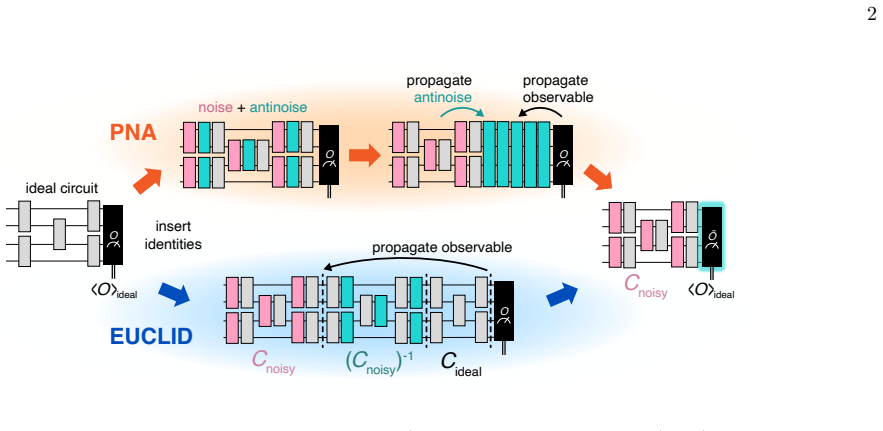
A target observable is classically propagated through noise-canceling inverse channels to produce a modified observable measured directly on a quantum processor.
A machine-rendered reading of the paper's core claim, the machinery that carries it, and where it could break.
Core claim
By propagating a target observable classically through noise-canceling inverse channels, one obtains a modified observable that can be measured directly on a quantum processor. This hybrid method reduces the quantum sampling overhead while simultaneously allowing lower truncation errors with fewer classical resources than traditional Pauli propagation alone.
What carries the argument
Classical propagation of the observable through noise-canceling inverse channels, which generates a modified observable for direct quantum measurement.
If this is right
- Observable estimation can extend beyond the separate limits of pure quantum sampling and pure classical truncation.
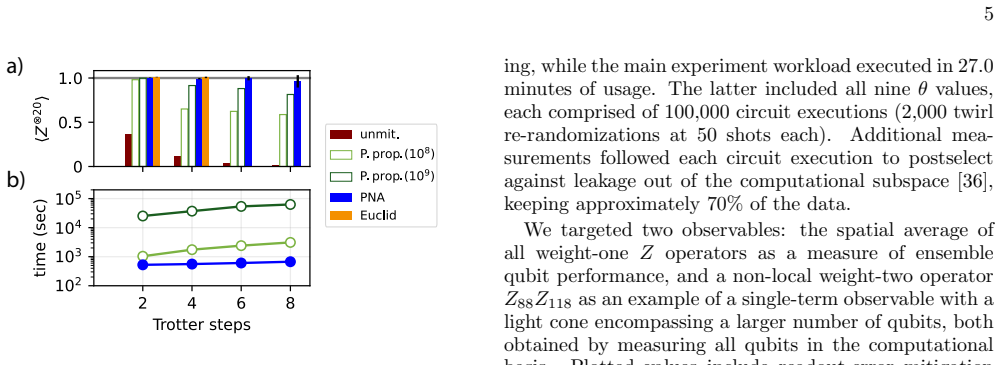
- Two prototype implementations exhibit distinct tradeoffs in truncation strategy when run on 56-qubit superconducting hardware.
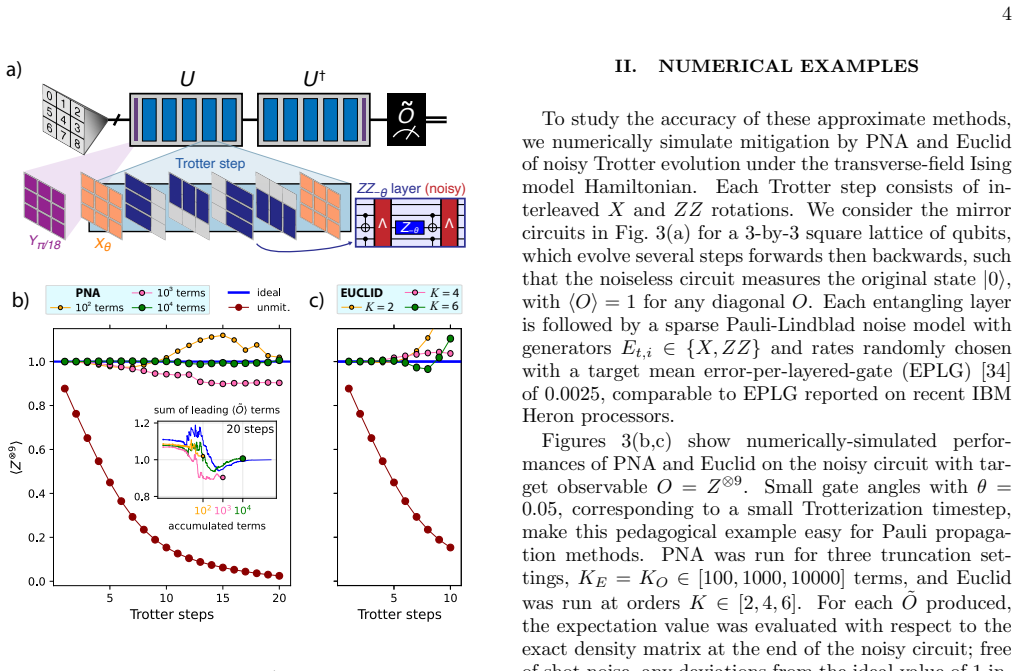
- Numerical benchmarks on canonical models demonstrate lower truncation error for given classical effort than standalone Pauli propagation.
- The framework provides a concrete route to orchestrate classical and quantum resources for larger observable estimations.
Where Pith is reading between the lines
- The same channel-propagation step could be inserted into other classical simulation techniques that currently suffer from rapid growth of operator support.
- If the inverse channels can be approximated with low-rank updates, the method might scale to observables whose support exceeds current classical memory limits.
- Hardware calibration routines that output the inverse channels directly could remove the need for separate noise-model fitting.
Load-bearing premise
The noise model used to construct the inverse channels accurately represents the dominant hardware errors and the chosen truncation strategies remain effective after the observable passes through those channels.
What would settle it
An experiment on the same device and models that shows the hybrid approach requires more total classical-plus-quantum resources than either pure Pauli propagation or standard mitigation for equal accuracy would falsify the claimed efficiency gain.
Figures
read the original abstract
The pursuit of quantum advantage is driving the co-evolution of quantum processors and classical simulation methods. Despite advances in scale and quality, the accuracy of quantum simulation is ultimately limited by error rates and sampling overheads. Similarly, while classical simulation methods such as Pauli propagation have made remarkable progress, their accuracy is ultimately limited by the exponential growth of operator paths and the truncations needed to control memory and runtime. Here we show that these complementary limitations can be mitigated by embedding Pauli propagation within a hybrid error-mitigation framework that reduces quantum sampling overhead while achieving lower truncation errors with fewer classical resources than traditional Pauli propagation alone. In this framework, a target observable is classically propagated through noise-canceling inverse channels, producing a modified observable that is measured directly on a quantum processor. We prototype two implementations and benchmark their performance numerically on canonical models that challenge traditional Pauli propagation. We also perform experiments on a quantum processor using 56 superconducting qubits, revealing the tradeoffs of their respective truncation strategies. These results illustrate how classical and quantum resources can be orchestrated to extend observable estimation beyond the limits of either approach alone, providing a foundation for quantum-centric supercomputing and future demonstrations of quantum advantage.
Editorial analysis
A structured set of objections, weighed in public.
Referee Report
Summary. The manuscript proposes embedding Pauli propagation in a hybrid error-mitigation scheme: a target observable is classically propagated through noise-canceling inverse channels to produce a modified observable that is then measured directly on quantum hardware. The central claim is that this yields lower quantum sampling overhead and lower truncation errors at reduced classical cost relative to standard Pauli propagation. Two prototype implementations are described, with numerical benchmarks on canonical models and experiments on a 56-qubit superconducting processor.
Significance. If the central claim is substantiated, the approach would demonstrate a concrete way to orchestrate classical simulation and quantum measurement to push observable estimation beyond the separate limits of either technique, supporting quantum-centric supercomputing. The 56-qubit experiments constitute a positive empirical component provided they include error bars, controls, and explicit resource accounting.
major comments (2)
- [Abstract] Abstract: the abstract asserts that numerical benchmarks and 56-qubit experiments support reduced truncation errors with fewer classical resources, yet no data, error bars, term counts, or derivation details appear in the provided text; the central claim therefore cannot be verified from the available information.
- [Prototype descriptions] Prototype descriptions: the headline claim requires that classical propagation through inverse channels produces a modified observable whose Pauli support permits lower truncation error at strictly lower classical cost. Because each inverse channel is a linear map whose rank can multiply the number of Pauli terms, the manuscript must quantify the expansion factor and demonstrate that the net term count (after channel application and truncation) remains smaller than the unmitigated case for the reported thresholds; this quantification is absent.
Simulated Author's Rebuttal
We thank the referee for their review and for highlighting points that help clarify the presentation. We respond to each major comment below. The full manuscript contains the supporting data, quantifications, and experimental details; the abstract is a high-level summary as is conventional.
read point-by-point responses
-
Referee: [Abstract] Abstract: the abstract asserts that numerical benchmarks and 56-qubit experiments support reduced truncation errors with fewer classical resources, yet no data, error bars, term counts, or derivation details appear in the provided text; the central claim therefore cannot be verified from the available information.
Authors: The abstract summarizes the results without including raw data or figures, per standard practice. The numerical benchmarks (including data, error bars, term counts, and derivations) and the 56-qubit experiments (with error bars, controls, and resource accounting) are presented in full in the sections on prototype implementations, numerical benchmarks, and hardware experiments. These sections substantiate the central claim of reduced truncation errors at lower classical cost. revision: no
-
Referee: [Prototype descriptions] Prototype descriptions: the headline claim requires that classical propagation through inverse channels produces a modified observable whose Pauli support permits lower truncation error at strictly lower classical cost. Because each inverse channel is a linear map whose rank can multiply the number of Pauli terms, the manuscript must quantify the expansion factor and demonstrate that the net term count (after channel application and truncation) remains smaller than the unmitigated case for the reported thresholds; this quantification is absent.
Authors: The prototype descriptions include explicit quantification of the Pauli-term expansion induced by the inverse channels. For the chosen noise-canceling channels and truncation thresholds, the net term count after channel application and truncation is smaller than in the unmitigated Pauli-propagation case; this is shown via direct comparison in the numerical benchmarks on canonical models, confirming the net classical-resource reduction while lowering truncation error. revision: no
Circularity Check
No circularity detected; framework claims rest on external benchmarks
full rationale
The abstract and description present a hybrid error-mitigation approach that applies Pauli propagation to inverse noise channels, with performance evaluated via numerical benchmarks on canonical models and 56-qubit hardware experiments. No equations, fitted parameters, or derivation steps are shown that reduce a claimed result to its own inputs by construction. No self-citations, uniqueness theorems, or ansatzes are invoked to justify core elements. The central claims about reduced truncation error and sampling overhead are positioned as outcomes of the described orchestration rather than tautological redefinitions, making the derivation chain self-contained against external validation.
Axiom & Free-Parameter Ledger
Reference graph
Works this paper leans on
-
[1]
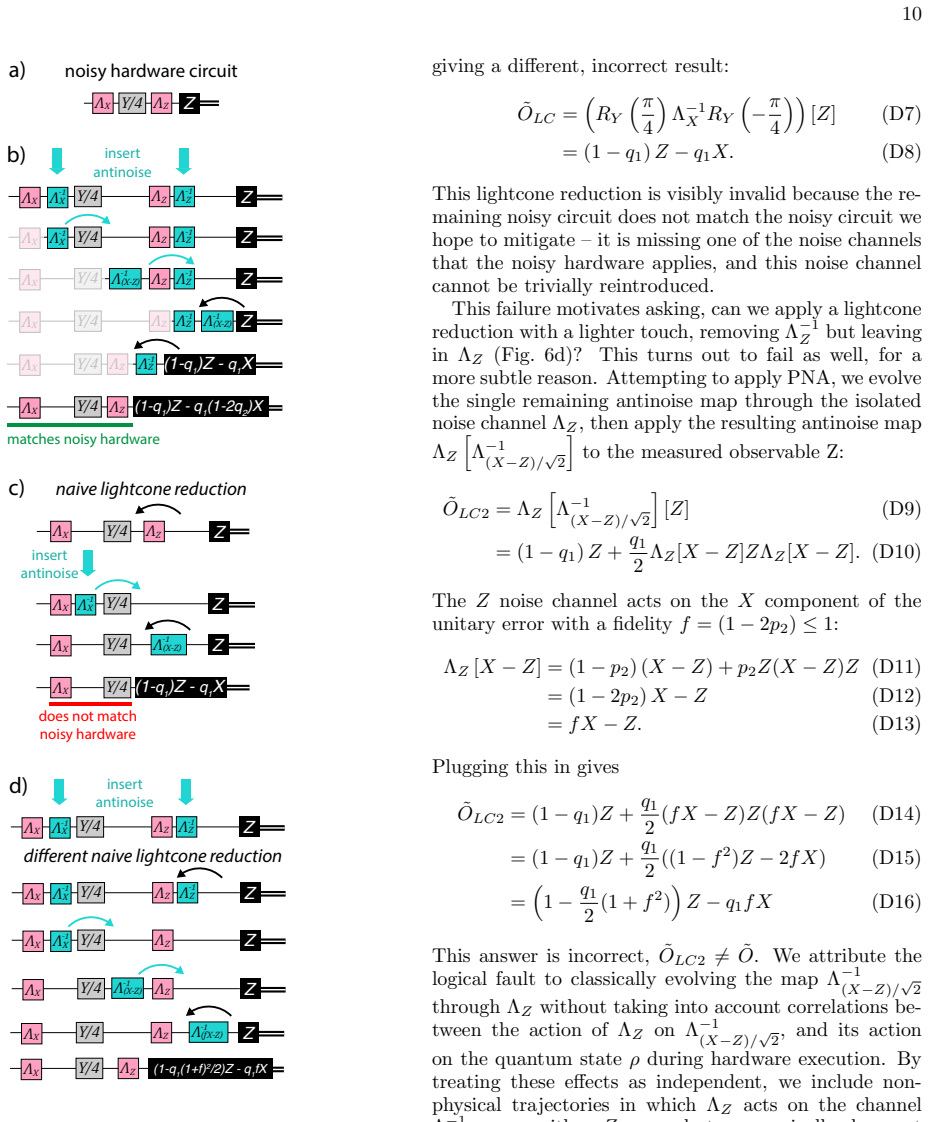
Further details and examples appear in Appendix G. C. Estimation of ˜Oon the QPU Estimating the ˜Oobtained via PNA or Euclid on the noisy QPU provides the mitigated expectation value ⟨O⟩. The structure of ˜Odetermines the sampling cost, which multiplies the total QPU time needed. As the sampling considerations are largely independent of the method used to...
-
[2]
inner-loop
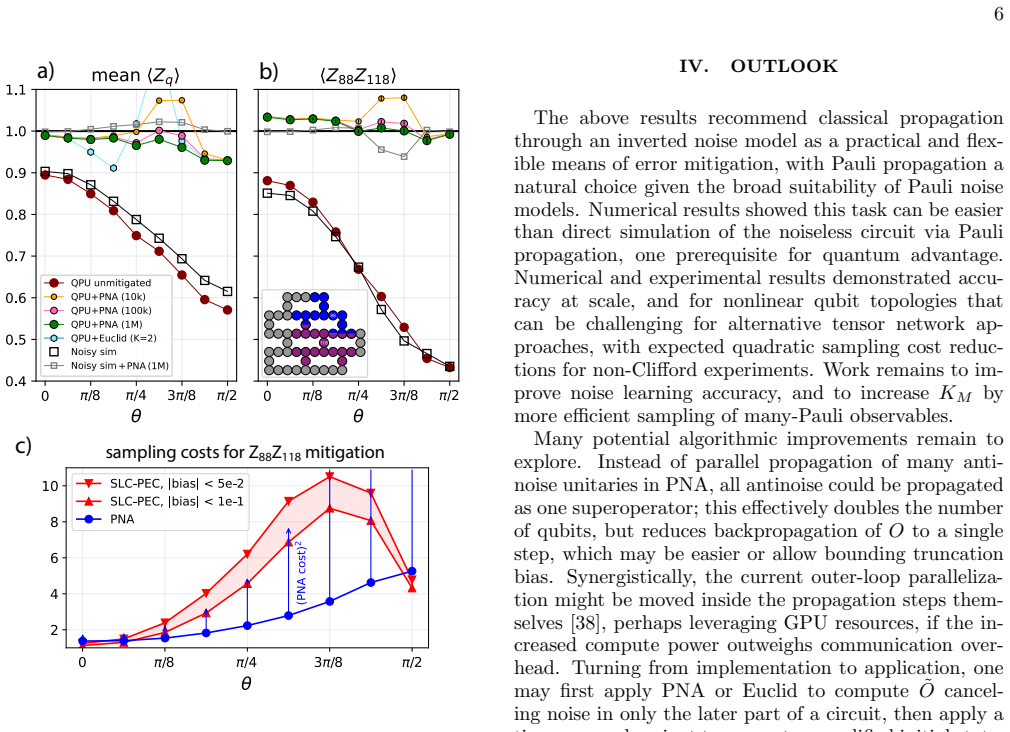
to parsimoniously mitigate just enough errors with PEC to bound the remaining bias below chosen toler- ances of 0.05 and 0.1. Note that a lower tolerance de- mands a higher sampling cost, and the actual bias re- maining may be smaller than the tolerance. For a range of non-Cliffordθvalues, the square of the PNA sam- pling cost roughly tracks the square ro...
-
[3]
!Λ!"!!#"!Λ#
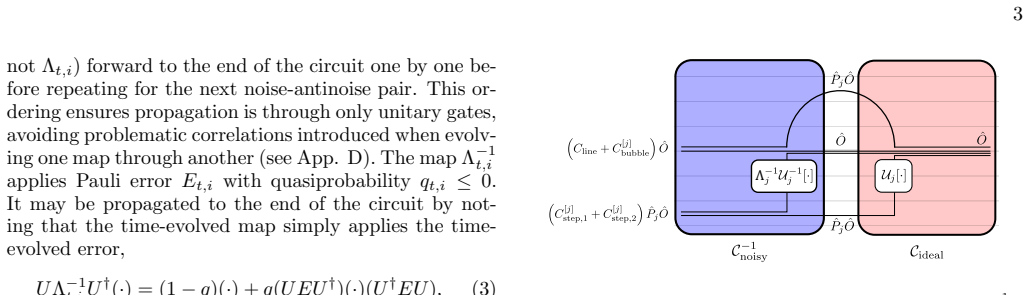
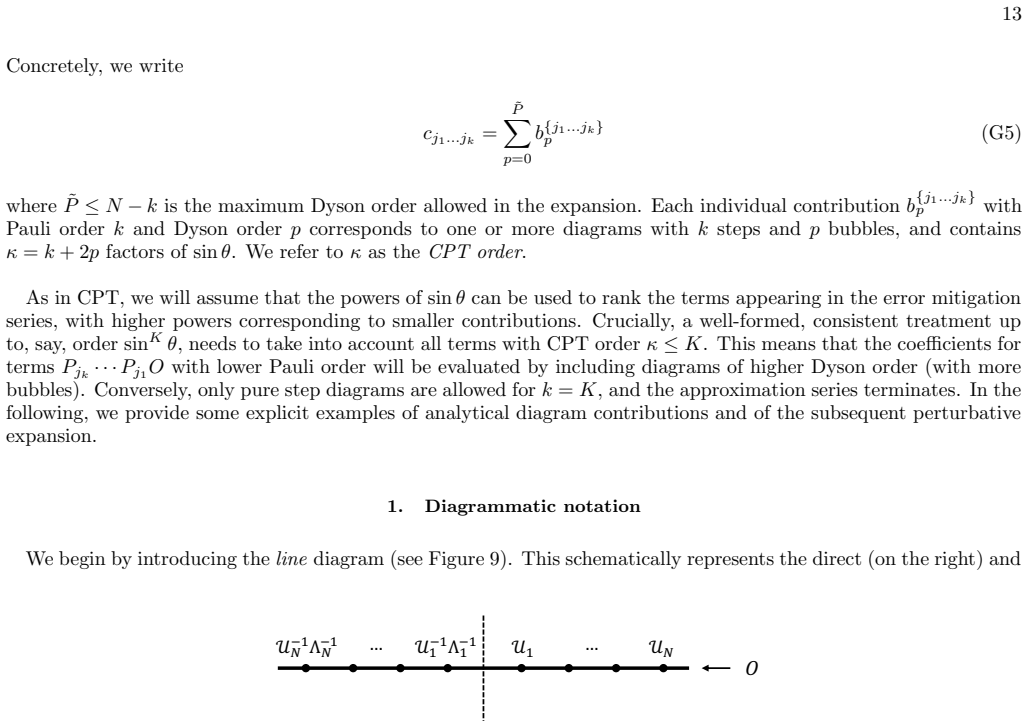
Diagrammatic notation We begin by introducing thelinediagram (see Figure 9). This schematically represents the direct (on the right) and !!!"!Λ!"!!#"!Λ#"!… !#!!… FIG. 9. Graphical representation of aline diagram. The target operatorOis backpropagated from the right to the left. One first applies the inverse noisy map (first half of the diagram), and then ...
-
[4]
(G4) up to a maximum CPT orderκ= 4
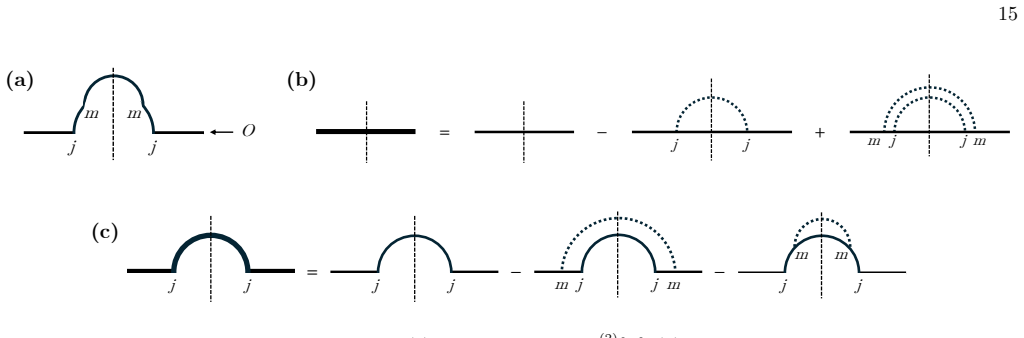
Example: perturbation theory for theObranch As a warm-up example, let us consider the construction ofc∅, namely the coefficient ofO(i.e., thek= 0 component) in Eq. (G4) up to a maximum CPT orderκ= 4. The contributing diagrams are: the line term (Eq. G6, withk= 0 andp= 0), all the 1-bubble terms (Eq. G9, withk= 0 andp= 1) and all the 2-bubble terms (withk=...
-
[5]
The two base diagrams leading toP j1 Oare the stepsZ j1[O] andZ ′ j1[O] introduced in Eqs
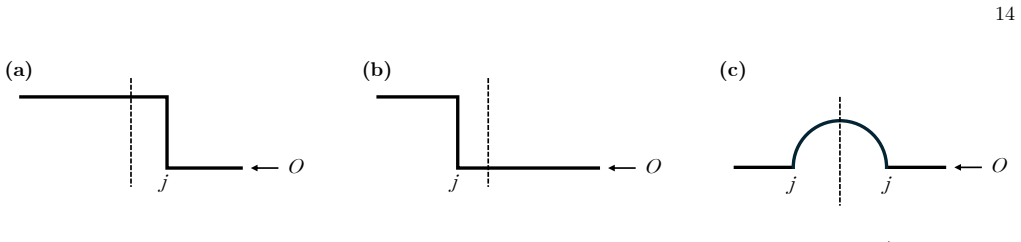
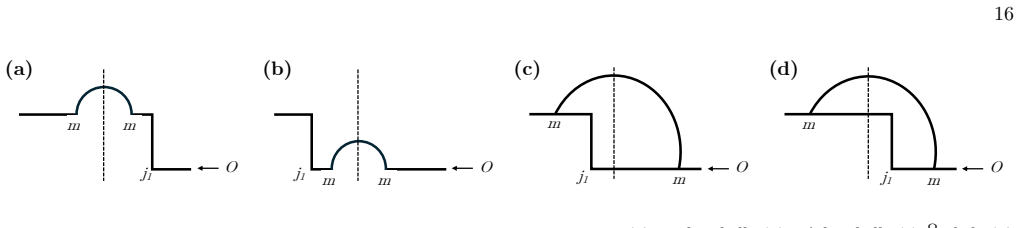
Perturbation theory of step diagrams: theP jObranch Let us now consider the construction of one of the coefficients at Pauli orderk= 1, namelyc j1, up to CPT order κ= 4. The two base diagrams leading toP j1 Oare the stepsZ j1[O] andZ ′ j1[O] introduced in Eqs. (G7)-(G8). In addition to these, we need to consider the case of a single bubble forming on theP...
-
[6]
Preskill, Quantum Computing in the NISQ era and beyond, Quantum2, 79 (2018)
J. Preskill, Quantum Computing in the NISQ era and beyond, Quantum2, 79 (2018)
2018
-
[7]
Bharti, A
K. Bharti, A. Cervera-Lierta, T. H. Kyaw, T. Haug, S. Alperin-Lea, A. Anand, M. Degroote, H. Heimonen, J. S. Kottmann, T. Menke, W.-K. Mok, S. Sim, L.-C. Kwek, and A. Aspuru-Guzik, Noisy intermediate-scale quantum algorithms, Rev. Mod. Phys.94, 015004 (2022)
2022
-
[8]
P. Rall, D. Liang, J. Cook, and W. Kretschmer, Simulation of qubit quantum circuits via Pauli propagation, Phys. Rev. A99, 062337 (2019)
2019
-
[9]
M. S. Rudolph, E. Fontana, Z. Holmes, and L. Cincio, Classical surrogate simulation of quantum systems with lowesa (2023), arXiv:2308.09109 [quant-ph]
arXiv 2023
-
[10]
Beguˇ si´ c, K
T. Beguˇ si´ c, K. Hejazi, and G. K.-L. Chan, Simulating quantum circuit expectation values by Clifford perturbation theory, The Journal of Chemical Physics162, 154110 (2025)
2025
-
[11]
M. S. Rudolph, T. Jones, Y. Teng, A. Angrisani, and Z. Holmes, Pauli propagation: A computational framework for simulating quantum systems (2025), arXiv:2505.21606
Pith/arXiv arXiv 2025
-
[12]
Y. Kim, A. Eddins, S. Anand, K. X. Wei, E. van den Berg, S. Rosenblatt, H. Nayfeh, Y. Wu, M. Zaletel, K. Temme, and A. Kandala, Evidence for the utility of quantum computing before fault tolerance, Nature618, 500 (2023)
2023
-
[13]
Temme, S
K. Temme, S. Bravyi, and J. M. Gambetta, Error mitigation for short-depth quantum circuits, Phys. Rev. Lett.119, 180509 (2017)
2017
-
[14]
Li and S
Y. Li and S. C. Benjamin, Efficient variational quantum simulator incorporating active error minimization, Phys. Rev. X 7, 021050 (2017)
2017
-
[15]
van den Berg, Z
E. van den Berg, Z. K. Minev, A. Kandala, and K. Temme, Probabilistic error cancellation with sparse Pauli–Lindblad models on noisy quantum processors, Nature Physics19, 1116 (2023)
2023
-
[16]
R. Haghshenas, E. Chertkov, M. Mills, W. Kadow, S.-H. Lin, Y.-H. Chen, C. Cade, I. Niesen, T. Beguˇ si´ c, M. S. Rudolph, C. Cirstoiu, K. Hemery, C. M. Keever, M. Lubasch, E. Granet, C. H. Baldwin, J. P. Bartolotta, M. Bohn, J. Cline, M. DeCross, J. M. Dreiling, C. Foltz, D. Francois, J. P. Gaebler, C. N. Gilbreth, J. Gray, D. Gresh, A. Hall, A. Hankin, A...
Pith/arXiv arXiv 2025
- [17]
- [18]
-
[19]
S. Filippov, M. Leahy, M. A. C. Rossi, and G. Garc´ ıa-P´ erez, Scalable tensor-network error mitigation for near-term quantum computing (2023), arXiv:2307.11740
arXiv 2023
-
[20]
L. E. Fischer, M. Leahy, A. Eddins, N. Keenan, D. Ferracin, M. A. C. Rossi, Y. Kim, A. He, F. Pietracaprina, B. Sokolov, S. Dooley, Z. Zimbor´ as, F. Tacchino, S. Maniscalco, J. Goold, G. Garc´ ıa-P´ erez, I. Tavernelli, A. Kandala, and S. N. Filippov, Dynamical simulations of many-body quantum chaos on a quantum computer, Nature Physics22, 302–307 (2026)
2026
-
[21]
S. Majumder, J. R. Garrison, L. Luo, B. Mitchell, M. Amico, A. Seif, M. Tran, K. Sharma, E. van den Berg, Z. Minev, and L. C. G. Govia, Quantum enhanced pauli propagation (2026), arXiv:2603.14485 [quant-ph]
arXiv 2026
- [22]
-
[23]
Robledo-Moreno, M
J. Robledo-Moreno, M. Motta, H. Haas, A. Javadi-Abhari, P. Jurcevic, W. Kirby, S. Martiel, K. Sharma, S. Sharma, T. Shirakawa,et al., Chemistry beyond the scale of exact diagonalization on a quantum-centric supercomputer, Science Advances11, eadu9991 (2025)
2025
-
[24]
Robertson, A
N. Robertson, A. Akhriev, J. Vala, and S. Zhuk, Approximate quantum compiling for quantum simulation: A tensor network based approach, ACM Transactions on Quantum Computing6, 1–15 (2025)
2025
-
[25]
N. F. Robertson, B. Pokharel, B. Fuller, E. Switzer, O. Shtanko, M. Amico, A. Byrne, A. D’Urbano, S. Hayes-Shuptar, A. Akhriev, N. Keenan, S. Bravyi, and S. Zhuk, Tensor network enhanced dynamic multiproduct formulas, PRX Quantum 6, 10.1103/8bzc-dlgt (2025)
-
[26]
C. H. Bennett, G. Brassard, S. Popescu, B. Schumacher, J. A. Smolin, and W. K. Wootters, Purification of noisy entan- glement and faithful teleportation via noisy channels, Phys. Rev. Lett.76, 722 (1996)
1996
-
[27]
E. Knill, Fault-tolerant postselected quantum computation: Threshold analysis (2004), arXiv:quant-ph/0404104
Pith/arXiv arXiv 2004
-
[28]
J. J. Wallman and J. Emerson, Noise tailoring for scalable quantum computation via randomized compiling, Phys. Rev. A94, 052325 (2016)
2016
-
[29]
Qiskit Add-On: Propagated Noise Absorption,https://github.com/Qiskit/qiskit-addon-pna(2025)
2025
-
[30]
Mangini, L
S. Mangini, L. Maccone, and C. Macchiavello, Qubit noise deconvolution, EPJ Quantum Technology9, 1 (2022)
2022
-
[31]
Beguˇ si´ c, J
T. Beguˇ si´ c, J. Gray, and G. K.-L. Chan, Fast and converged classical simulations of evidence for the utility of quantum computing before fault tolerance, Sci. Adv.10, eadk4321 (2024)
2024
-
[32]
S. N. Filippov, S. Maniscalco, and G. Garc´ ıa-P´ erez, Scalability of quantum error mitigation techniques: from utility to advantage (2024), arXiv:2403.13542. 20
arXiv 2024
-
[33]
Huang, R
H.-Y. Huang, R. Kueng, and J. Preskill, Predicting many properties of a quantum system from very few measurements, Nature Physics16, 1050 (2020)
2020
-
[34]
C. Hadfield, S. Bravyi, R. Raymond, and A. Mezzacapo, Measurements of quantum hamiltonians with locally-biased classical shadows (2020), arXiv:2006.15788
arXiv 2020
-
[35]
Garc´ ıa-P´ erez, M
G. Garc´ ıa-P´ erez, M. A. Rossi, B. Sokolov, F. Tacchino, P. K. Barkoutsos, G. Mazzola, I. Tavernelli, and S. Maniscalco, Learning to measure: Adaptive informationally complete generalized measurements for quantum algorithms, PRX Quan- tum2, 040342 (2021)
2021
-
[36]
L. E. Fischer, T. Dao, I. Tavernelli, and F. Tacchino, Dual-frame optimization for informationally complete quantum measurements, Phys. Rev. A109, 062415 (2024)
2024
-
[37]
Huang, R
H.-Y. Huang, R. Kueng, and J. Preskill, Efficient estimation of Pauli observables by derandomization, Phys. Rev. Lett. 127, 030503 (2021)
2021
-
[38]
Gresch and M
A. Gresch and M. Kliesch, Guaranteed efficient energy estimation of quantum many-body hamiltonians using Shadow- Grouping, Nature Communications16, 689 (2025)
2025
-
[39]
D. C. McKay, I. Hincks, E. J. Pritchett, M. Carroll, L. C. G. Govia, and S. T. Merkel, Benchmarking quantum processor performance at scale (2023), arXiv:2311.05933
arXiv 2023
-
[40]
Samplomatic,https://github.com/Qiskit/samplomatic(2025)
2025
-
[41]
Y. Kim, B. Mitchell, B. Saxberg, K. Siva,et al., in preparation
-
[42]
van den Berg, Z
E. van den Berg, Z. K. Minev, and K. Temme, Model-free readout-error mitigation for quantum expectation values, Phys. Rev. A105, 032620 (2022)
2022
-
[43]
L. Broers, R.-Y. Sun, and S. Yunoki, Scalable simulation of quantum many-body dynamics with or-represented quantum algebra (2025), arXiv:2506.13241
arXiv 2025
-
[44]
A. Javadi-Abhari, M. Treinish, K. Krsulich, C. J. Wood, J. Lishman, J. Gacon, S. Martiel, P. D. Nation, L. S. Bishop, A. W. Cross, B. R. Johnson, and J. M. Gambetta, Quantum computing with Qiskit (2024), arXiv:2405.08810
Pith/arXiv arXiv 2024
-
[45]
M. C. Tran, K. Sharma, and K. Temme, Locality and error mitigation of quantum circuits (2023), arXiv:2303.06496
arXiv 2023
-
[46]
Nuerbolati, Z
W. Nuerbolati, Z. Han, J. Chu, Y. Zhou, X. Tan, Y. Yu, S. Liu, and F. Yan, Canceling microwave crosstalk with fixed- frequency qubits, Applied Physics Letters120(2022)
2022
-
[47]
Kosen, H.-X
S. Kosen, H.-X. Li, M. Rommel, R. Rehammar, M. Caputo, L. Gr¨ onberg, J. Fern´ andez-Pend´ as, A. F. Kockum, J. Bizn´ arov´ a, L. Chen, C. Kriˇ zan, A. Nylander, A. Osman, A. F. Roudsari, D. Shiri, G. Tancredi, J. Govenius, and J. Bylander, Signal crosstalk in a flip-chip quantum processor, PRX Quantum5, 030350 (2024)
2024
-
[48]
J. J. Wesdorp, E. Hyypp¨ a, J. Andersson, J. Adam, R. Beriwal, V. Bergholm, S. Dahl, S. D. Fasciati, A. G. Friero, Z. Gao, D. Gusenkova, A. Guthrie, J. Heinsoo, T. Hiltunen, K. Holland, A. Hosseinkhani, S. Inel, J. Ikonen, S. W. Jolin, K. Juliusson, S.-G. Kim, A. Komlev, R. Kokkoniemi, O. Koskinen, J. Kylm¨ al¨ a, A. Landra, J. Lamprich, M. Lehmuskoski, N...
arXiv 2026
-
[49]
K. X. Wei, E. Pritchett, D. M. Zajac, D. C. McKay, and S. Merkel, Characterizing non-Markovian off-resonant errors in quantum gates, Phys. Rev. Appl.21, 024018 (2024)
2024
discussion (0)
Sign in with ORCID, Apple, or X to comment. Anyone can read and Pith papers without signing in.