West Nile virus outbreak in Italy modelled with the quantum Game of Life
Pith reviewed 2026-06-26 14:52 UTC · model grok-4.3
The pith
A quantum Game of Life cellular automaton reproduces West Nile virus infection curves in Italy by tuning only mosquito birth and removal rates.
A machine-rendered reading of the paper's core claim, the machinery that carries it, and where it could break.
Core claim
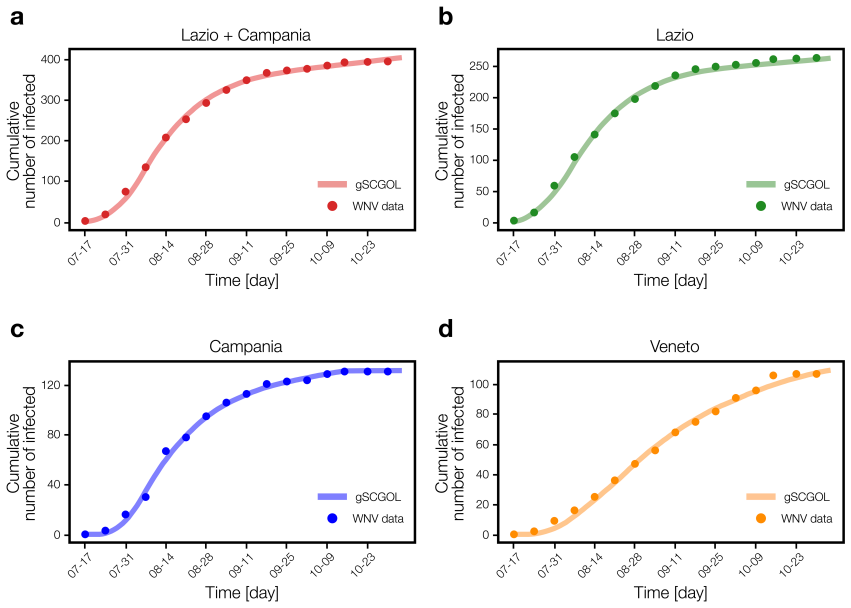
The quantum Game of Life model fits the curves of cumulative infected individuals with high accuracy, either at local and average-regional level, with only optimization of mosquito birth and removal rates parameters.
What carries the argument
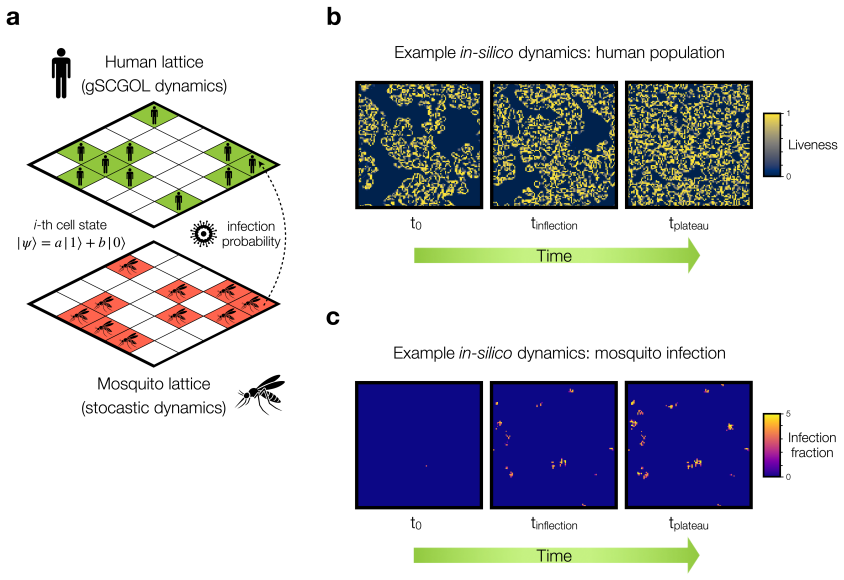
Quantum Game of Life cellular automaton in which human dynamics follow standard Game of Life rules while mosquito birth, removal, and biting interactions occur stochastically on the same lattice.
If this is right
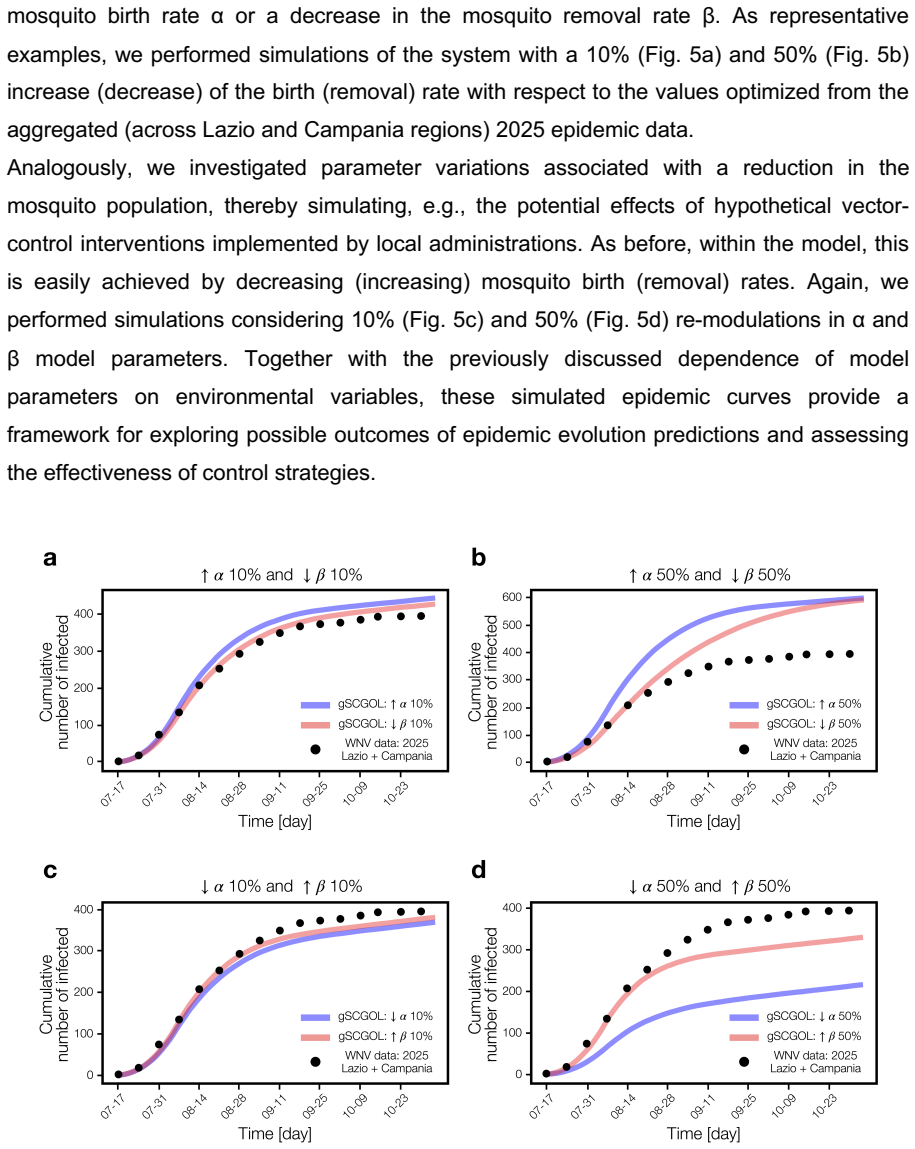
- Varying the mosquito birth and removal rates quantifies the effect of containment measures on total infections.
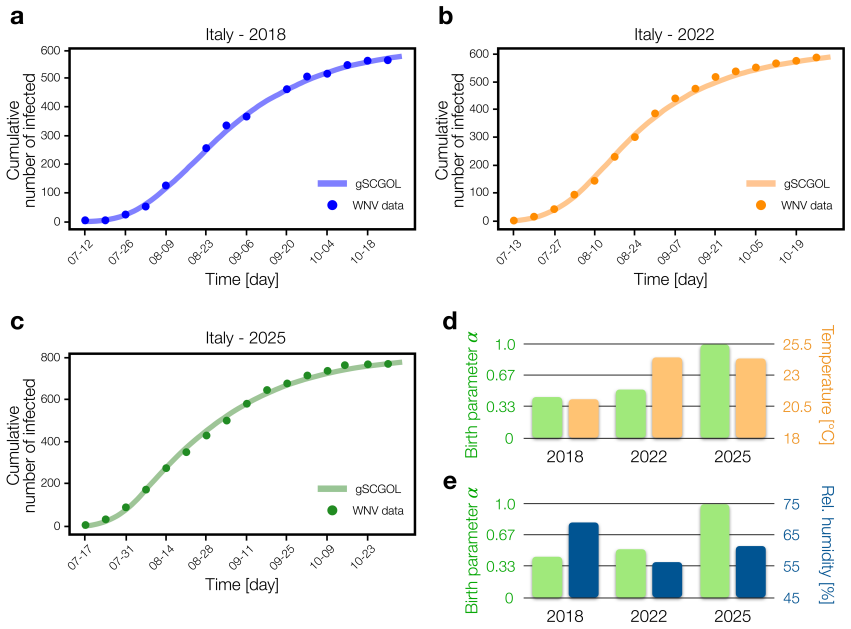
- Increasing mosquito abundance parameters reproduces the impact of climatic or ecological changes on virus spread.
- The model supplies a general description that can be used to test different environmental scenarios for decision makers.
Where Pith is reading between the lines
- The same lattice rules could be applied to other mosquito-borne viruses if their biting and movement patterns are comparable.
- Spatial clustering produced by the cellular automaton might identify priority zones for targeted mosquito control.
- Independent mosquito abundance measurements could serve as an external check on the optimized birth and removal rates.
Load-bearing premise
The quantum Game of Life rules, originally devised for abstract cellular automata, accurately capture the spatial and stochastic dynamics of both human movement and mosquito-human biting interactions for West Nile virus in Italy.
What would settle it
Running the model forward with the fitted mosquito rates and comparing its predicted cumulative cases against actual 2026 infection data; a large mismatch without further parameter changes would falsify the fit claim.
Figures
read the original abstract
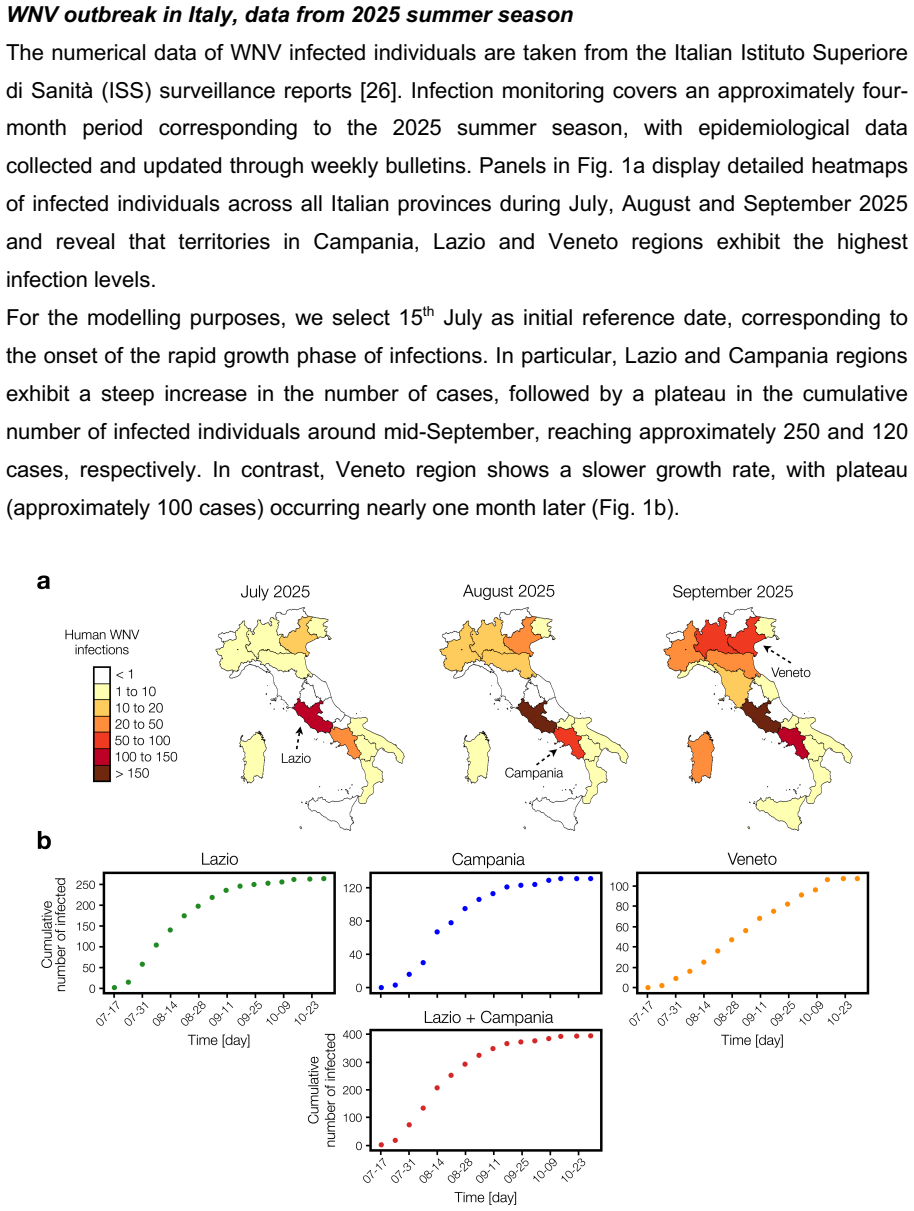
In the last years, an anomalously high spreading of West Nile virus (WNV) has been observed in Italy, with particularly high peaks of infections in southern Lazio, Campania and Veneto regions. The main disease vector for WNV is represented by Culex pipiens mosquitoes, which spread human infections through their bites. Here, we investigate WNV fever epidemic diffusion during summer season 2025 in Italy through a computational approach based on a quantum version of the Game of Life (GOL) cellular automaton model. Specifically, human dynamics evolves according to the GOL rules, while stochastic dynamics of disease vectors, i.e., mosquitoes, as well as their interaction with humans, simultaneously occur. We show that this model fits the curves of cumulative infected individuals with high accuracy, either at local and average-regional level, with only optimization of mosquito birth and removal rates parameters. Furthermore, leveraging model flexibility, we show that changes in model parameters values elucidate system response to environmental variations. For instance, we quantify, e.g., the impact of mosquito spreading containment measures or sudden mosquito increasing abundance due to climatic and ecological changes. Overall, we provide a general, quantitative description of WNV infection spreading in Italy which could represent a supportive tool to test different environmental scenarios and could be useful to devise strategies for decision makers to monitor disease vector dynamics and to control consequent virus diffusion.
Editorial analysis
A structured set of objections, weighed in public.
Referee Report
Summary. The paper introduces a quantum cellular automaton based on the Game of Life to model West Nile virus transmission in Italy during summer 2025. Human movement follows deterministic GOL rules while mosquito population dynamics and human-mosquito interactions are treated stochastically; the model is reported to reproduce observed cumulative infection curves at both local and regional scales after optimizing only the mosquito birth and removal rates.
Significance. A spatially explicit, low-parameter model that could generate scenario forecasts for vector control would be valuable for public-health planning. However, the absence of any out-of-sample validation, comparison with standard SEIR-mosquito models, or derivation of the quantum update rules from measured dispersal or biting data substantially reduces the mechanistic credibility of the reported fits.
major comments (3)
- [Abstract, §3] Abstract and §3 (model description): the headline claim that the quantum GOL reproduces cumulative-infection curves 'with high accuracy' using 'only optimization of mosquito birth and removal rates' is circular; these two rates are the sole free parameters that are tuned to the same data the model is then said to predict. No independent validation set, cross-validation, or out-of-sample forecast is described.
- [§2, §4] §2 and §4: the quantum GOL update rules are adopted from an abstract cellular-automaton literature without derivation from Culex pipiens dispersal kernels, biting-rate measurements, or Italian human-mobility data. Consequently it is unclear whether the two-parameter fit reflects biological mechanism or the flexibility of the discrete-state automaton.
- [§5] §5 (results): no quantitative comparison is provided to a conventional spatially explicit SEIR-mosquito model or to a null random-walk baseline; without such controls it is impossible to judge whether the reported accuracy is attributable to the quantum GOL rules or to the parameter tuning itself.
minor comments (2)
- [§3] Notation for the quantum state update (Eq. 3?) is introduced without an explicit statement of the Hilbert-space dimension or the precise form of the stochastic mosquito operator.
- [Figures 2-4] Figure captions should state the exact geographic units (municipalities vs. provinces) and the number of independent realizations used to generate the plotted curves.
Simulated Author's Rebuttal
We thank the referee for their detailed review and constructive criticism. Below we respond to each major comment, indicating where revisions will be made to the manuscript.
read point-by-point responses
-
Referee: [Abstract, §3] Abstract and §3 (model description): the headline claim that the quantum GOL reproduces cumulative-infection curves 'with high accuracy' using 'only optimization of mosquito birth and removal rates' is circular; these two rates are the sole free parameters that are tuned to the same data the model is then said to predict. No independent validation set, cross-validation, or out-of-sample forecast is described.
Authors: The referee is correct that the two mosquito parameters are fitted to the 2025 infection data. The manuscript highlights the parsimony of achieving good fits at local and regional scales with so few free parameters. We will revise the abstract and §3 to avoid any implication of out-of-sample prediction and will explore adding temporal cross-validation by fitting on early summer data and testing on later periods, if the data granularity permits. revision: partial
-
Referee: [§2, §4] §2 and §4: the quantum GOL update rules are adopted from an abstract cellular-automaton literature without derivation from Culex pipiens dispersal kernels, biting-rate measurements, or Italian human-mobility data. Consequently it is unclear whether the two-parameter fit reflects biological mechanism or the flexibility of the discrete-state automaton.
Authors: The quantum GOL rules provide a discrete framework for human movement that is combined with stochastic mosquito birth, removal, and transmission. Although not calibrated to specific dispersal measurements, the approach demonstrates that such abstract rules, when paired with minimal tuning, can reproduce the observed epidemic curves. We do not claim direct mechanistic derivation from entomological data and view the model as phenomenological in this regard. revision: no
-
Referee: [§5] §5 (results): no quantitative comparison is provided to a conventional spatially explicit SEIR-mosquito model or to a null random-walk baseline; without such controls it is impossible to judge whether the reported accuracy is attributable to the quantum GOL rules or to the parameter tuning itself.
Authors: We agree that direct comparisons would help assess the contribution of the quantum GOL structure. In the revised manuscript we will include results from a standard spatially explicit SEIR model with mosquito compartments and a simple random movement baseline, using the same parameter optimization procedure for fair comparison. revision: yes
- Deriving quantum GOL update rules from specific Culex pipiens dispersal kernels, biting rates, or Italian mobility data would require dedicated empirical research and data acquisition that is outside the scope of this computational modeling study.
Circularity Check
Fitted mosquito birth/removal rates produce the reported high-accuracy WNV curve matches by construction
specific steps
-
fitted input called prediction
[Abstract]
"We show that this model fits the curves of cumulative infected individuals with high accuracy, either at local and average-regional level, with only optimization of mosquito birth and removal rates parameters."
The high-accuracy reproduction of the target curves is obtained by tuning the mosquito birth and removal rates to those same curves; the reported fit is therefore the direct output of the optimization procedure rather than an independent test of the quantum GOL update rules.
full rationale
The paper's central empirical claim is that the quantum Game of Life model reproduces cumulative infected curves at local and regional scales. This claim is explicitly tied to optimization of the two mosquito parameters on the same data; the abstract presents the resulting accuracy as a model success. No out-of-sample prediction, parameter-free derivation of the quantum rules from entomological data, or comparison against standard SEIR or random-walk baselines is described. The reduction therefore matches the fitted-input-called-prediction pattern: the reported fit is statistically forced by the calibration step itself.
Axiom & Free-Parameter Ledger
free parameters (2)
- mosquito birth rate
- mosquito removal rate
axioms (2)
- domain assumption Human population dynamics obey the standard Conway Game of Life update rules
- domain assumption Mosquito stochastic dynamics can be superimposed on the Game of Life grid without altering the core cellular-automaton rules
invented entities (1)
-
quantum version of the Game of Life
no independent evidence
Reference graph
Works this paper leans on
-
[1]
Yellow fever WHO fact sheets https://www.who.int/news-room/fact-sheets/detail/yellow-fever (accessed May 14, 2026). [21] Rift Valley fever- Mauritania and Senegal https://www.who.int/emergencies/disease-outbreak-news/item/2025-DON584 (accessed May 14, 2026). [22] Barry Y, Metz M, Krisztian L, Haas J, Brunn VL, Beyit AD, et al. Local drivers of Rift Valley...
-
[2]
Geographic Expansion of Dengue: The Impact of International Travel
Wilder-Smith A, Gubler DJ. Geographic Expansion of Dengue: The Impact of International Travel. Medical Clinics of North America 2008;92:1377–90. https://doi.org/10.1016/J.MCNA.2008.07.002. [33] Xylella fastidiosa | EFSA https://www.efsa.europa.eu/en/topics/topic/xylella-fastidiosa (accessed May 14, 2026). [34] Mourou M, Incampo G, Carlucci M, Salamone D, ...
-
[3]
Buonomo B, D’Alise A, Della Marca R, Sannino F. Information index augmented eRG to model vaccination behaviour: A case study of COVID-19 in the US. Physica A: Statistical Mechanics and Its Applications 2025;667:130429. https://doi.org/10.1016/J.PHYSA.2025.130429. [45] Cot C, Cacciapaglia G, Islind AS, Óskarsdóttir M, Sannino F. Impact of US vaccination st...
-
[4]
Faux DA, Shah M, Knapp ; Christopher, Knapp C. Games of life. Am J Phys 2020;88:371–8. https://doi.org/10.1119/10.0000666. [58] Abbott D, Davies PCW, Pati AK. Quantum aspects of life. Quantum Aspects of Life 2008:1–442. https://doi.org/10.1142/P581. [59] Flitney AP, Abbott D. A semi-quantum version of the game of Life 2002. [60] Escanez-Exposito D, Garcia...
discussion (0)
Sign in with ORCID, Apple, or X to comment. Anyone can read and Pith papers without signing in.