Transfer-matrix functions for algebraically decaying interactions in variational infinite matrix product states
Pith reviewed 2026-06-26 15:17 UTC · model grok-4.3
The pith
Algebraic tails in infinite MPS are summed directly by applying a polylogarithm matrix function to the connected transfer matrix.
A machine-rendered reading of the paper's core claim, the machinery that carries it, and where it could break.
Core claim
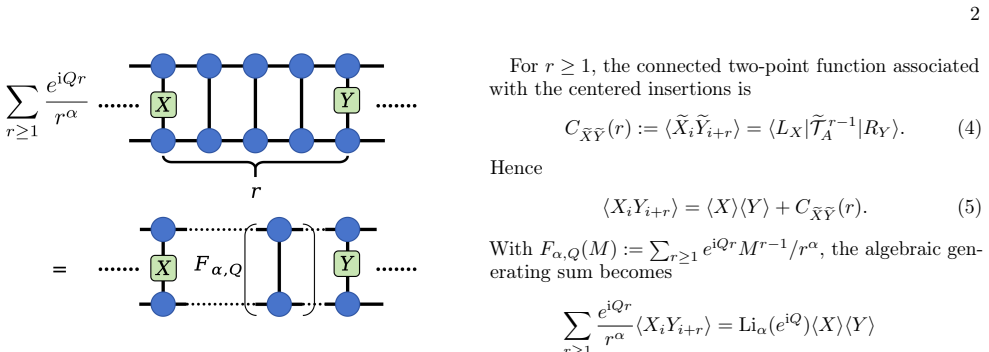
For a fixed finite-D MPS, the algebraic tail e^{iQr}/r^α is represented by the matrix function F_{α,Q}(~T_A) with F_{α,Q}(z)=Li_α(e^{iQ} z)/z, allowing direct summation through the connected transfer matrix without a finite-pole surrogate.
What carries the argument
The matrix function F_{α,Q}(z)=Li_α(e^{i Q} z)/z that encodes the algebraic tail when applied to the connected transfer matrix.
If this is right
- The variational energy functional for any fixed MPS can be evaluated directly on the target algebraic Hamiltonian.
- Critical signatures remain unbiased at known critical points where surrogate representations introduce shifts.
- The same transfer-matrix-function construction applies to both free-fermion and interacting long-range models such as the Haldane-Shastry chain.
- Gradients required for variational optimization are obtained without additional approximation beyond the Krylov and adjoint steps.
Where Pith is reading between the lines
- The method removes a controllable source of systematic error when mapping phase diagrams of long-range quantum spin chains.
- Similar matrix-function representations could be derived for other slowly decaying kernels if their generating functions admit stable evaluation on the transfer matrix.
- The approach suggests that any finite-pole truncation introduces a representation bias whose size grows with the range of the interaction.
Load-bearing premise
The matrix function can be evaluated stably by Krylov iteration and its gradients obtained reliably by Fréchet adjoint plus implicit differentiation at the bond dimensions and lengths used.
What would settle it
A variational calculation at the independently known critical field of the inverse-square Heisenberg chain in which the finite-pole surrogate shifts a critical diagnostic away from the true point while the matrix-function result remains at the expected location.
Figures

read the original abstract
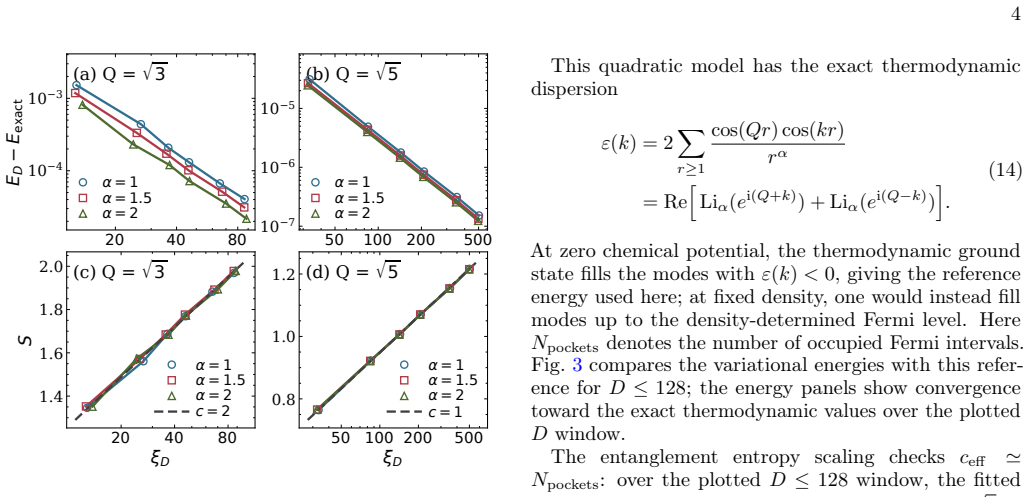
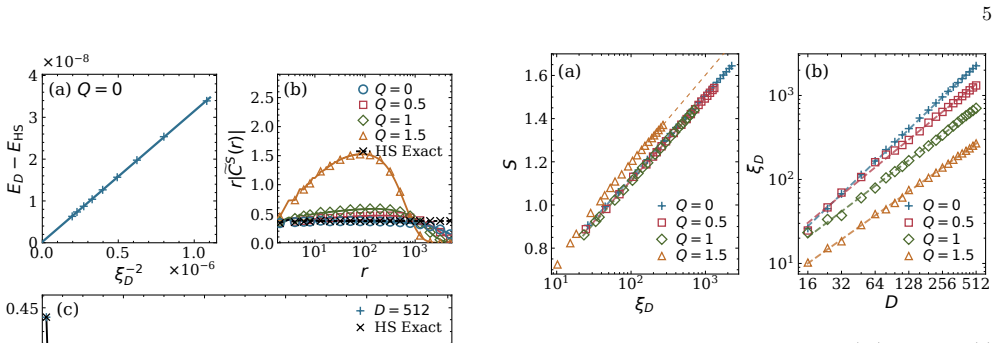
Variational infinite matrix product state (iMPS) calculations usually make Hamiltonians with algebraically decaying interactions compatible with standard MPO algorithms by first replacing the target Hamiltonian with a finite-pole sum-of-exponentials surrogate, thereby introducing a Hamiltonian-representation residual. We formulate the fixed-$D$ variational energy without introducing such a surrogate. For a fixed finite-$D$ MPS, the algebraic tail can be summed directly through the connected transfer matrix: the tail $e^{\mathrm{i} Qr}/r^\alpha$ is represented by the matrix function $F_{\alpha,Q}(\widetilde{T}_A)$, with $F_{\alpha,Q}(z)=\operatorname{Li}_\alpha(e^{\mathrm{i} Q}\,z)/z$. We evaluate the resulting matrix-function action using a Krylov method and obtain stable gradients by combining a Fr\'echet adjoint with implicit fixed-point differentiation. Benchmarks on long-range free fermions and the inverse-square Heisenberg family, including the Haldane--Shastry point, validate the transfer-matrix-function formulation. A long-range Ising-chain calculation illustrates a practical consequence of avoiding a finite-pole Hamiltonian representation. At a fixed, independently known critical field, finite-pole surrogate Hamiltonians can bias a critical diagnostic away from criticality, whereas the matrix-function calculation retains the expected critical signatures of the target algebraic Hamiltonian.
Editorial analysis
A structured set of objections, weighed in public.
Referee Report
Summary. The paper introduces a transfer-matrix function method for variational iMPS calculations with algebraically decaying interactions. For fixed finite bond dimension D, the tail e^{iQr}/r^α is represented exactly (without surrogate) as the matrix function F_{α,Q}(~T_A) = Li_α(e^{iQ} z)/z acting on the connected transfer matrix ~T_A; this is evaluated via Krylov iteration, with gradients obtained from the Fréchet adjoint combined with implicit fixed-point differentiation. The approach is benchmarked on long-range free fermions, the inverse-square Heisenberg chain (including the exactly solvable Haldane-Shastry point), and a long-range Ising model, where it is shown to avoid the critical-diagnostic bias introduced by finite-pole surrogates.
Significance. If the numerical claims hold, the method supplies a parameter-free route to faithful variational energies for long-range systems inside the standard iMPS transfer-matrix language, removing a source of Hamiltonian-representation error that can shift apparent criticality. The direct polylogarithm representation and the combination of Krylov evaluation with Fréchet/implicit gradients constitute a clean technical advance that strengthens tensor-network applicability to algebraically decaying Hamiltonians.
major comments (1)
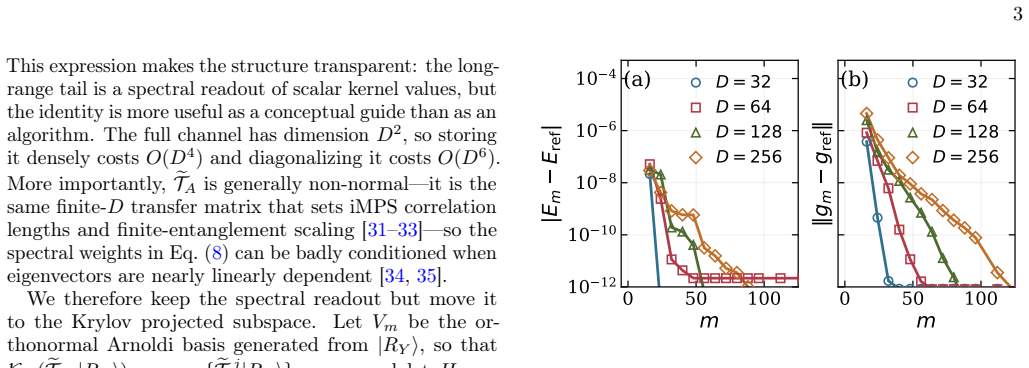
- [Benchmarks] Benchmarks section: the validation on free fermions and inverse-square Heisenberg models is presented as confirming stable Krylov evaluation and reliable gradients, yet the manuscript supplies neither error bars, explicit dependence on Krylov subspace dimension, nor convergence checks with respect to truncation; this leaves the central numerical support for the stability claim only partially documented.
Simulated Author's Rebuttal
We thank the referee for the positive evaluation and the recommendation of minor revision. The single major comment is addressed below; we will strengthen the numerical documentation as suggested.
read point-by-point responses
-
Referee: [Benchmarks] Benchmarks section: the validation on free fermions and inverse-square Heisenberg models is presented as confirming stable Krylov evaluation and reliable gradients, yet the manuscript supplies neither error bars, explicit dependence on Krylov subspace dimension, nor convergence checks with respect to truncation; this leaves the central numerical support for the stability claim only partially documented.
Authors: We agree that the benchmarks would be strengthened by explicit quantitative checks. In the revised manuscript we will add (i) error bars on all reported energies (from repeated optimizations with different random seeds), (ii) a supplementary figure or table showing the dependence of the matrix-function action and final variational energy on Krylov subspace dimension, and (iii) convergence data versus the internal truncation threshold used inside the Krylov iteration. These additions will be placed in the benchmarks section and will directly support the stability claim. revision: yes
Circularity Check
No significant circularity
full rationale
The paper's derivation is a direct re-expression of the algebraic tail sum inside the iMPS transfer-matrix formalism, defining F_{\alpha,Q}(z) = Li_\alpha(e^{iQ} z)/z explicitly from the known polylogarithm and applying it to the connected transfer matrix \widetilde{T}_A. This is a mathematical identity for fixed finite-D MPS, not a fitted parameter or self-referential definition. No self-citations appear as load-bearing steps, no uniqueness theorems are imported from prior author work, and no ansatz is smuggled via citation. Benchmarks on free fermions, Haldane-Shastry, and long-range Ising provide external validation against known physics, confirming the chain is self-contained without reduction to inputs by construction.
Axiom & Free-Parameter Ledger
axioms (2)
- standard math The polylogarithm Li_α(z) defines a matrix function that correctly encodes the algebraic decay when applied to the transfer matrix.
- domain assumption The connected transfer matrix of an infinite MPS captures the contribution of the interaction tail to the variational energy.
Reference graph
Works this paper leans on
-
[1]
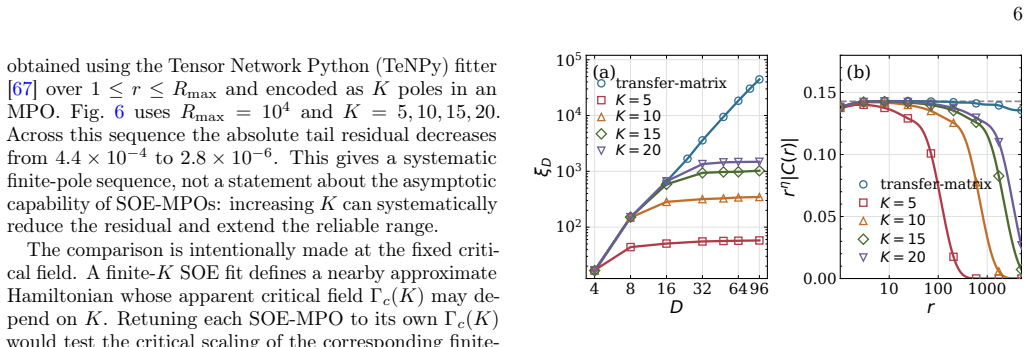
over1 ≤r≤R max and encoded as K poles in an MPO. Fig. 6 uses Rmax = 10 4 and K = 5 , 10, 15, 20. Across this sequence the absolute tail residual decreases from4 .4 × 10−4 to2 .8 × 10−6. This gives a systematic finite-polesequence, notastatementabouttheasymptotic capability of SOE-MPOs: increasingK can systematically reduce the residual and extend the reli...
2020
-
[2]
F. D. M. Haldane, Exact Jastrow–Gutzwiller resonating- valence-bond ground state of the spin-1/2antiferromag- netic Heisenberg chain with1/r2 exchange, Phys. Rev. Lett.60, 635 (1988)
1988
-
[3]
B. S. Shastry, Exact solution of anS = 1/2Heisenberg antiferromagnetic chain with long-ranged interactions, Phys. Rev. Lett.60, 639 (1988)
1988
-
[4]
Rev.96, 99 (1954)
M.A.RudermanandC.Kittel,Indirectexchangecoupling of nuclear magnetic moments by conduction electrons, Phys. Rev.96, 99 (1954)
1954
-
[5]
Kasuya, A theory of metallic ferro- and antiferro- magnetism on Zener’s model, Prog
T. Kasuya, A theory of metallic ferro- and antiferro- magnetism on Zener’s model, Prog. Theor. Phys.16, 45 (1956)
1956
-
[6]
Yosida, Magnetic properties of Cu-Mn alloys, Phys
K. Yosida, Magnetic properties of Cu-Mn alloys, Phys. Rev.106, 893 (1957)
1957
-
[7]
Argüello-Luengo, A
J. Argüello-Luengo, A. González-Tudela, and D. González- Cuadra, Tuning long-range fermion-mediated interactions in cold-atom quantum simulators, Phys. Rev. Lett.129, 083401 (2022)
2022
-
[8]
Defenu, T
N. Defenu, T. Donner, T. Macrì, G. Pagano, S. Ruffo, and A. Trombettoni, Long-range interacting quantum systems, Rev. Mod. Phys.95, 035002 (2023)
2023
-
[9]
Monroe, W
C. Monroe, W. C. Campbell, L.-M. Duan, Z.-X. Gong, A. V. Gorshkov, P. W. Hess, R. Islam, K. Kim, N. M. Linke, G. Pagano, P. Richerme, C. Senko, and N. Y. Yao, Programmable quantum simulations of spin systems with trapped ions, Rev. Mod. Phys.93, 025001 (2021)
2021
-
[10]
Browaeys and T
A. Browaeys and T. Lahaye, Many-body physics with individually controlled Rydberg atoms, Nat. Phys.16, 132 (2020)
2020
-
[11]
Lahaye, C
T. Lahaye, C. Menotti, L. Santos, M. Lewenstein, and T. Pfau, The physics of dipolar bosonic quantum gases, Rep. Prog. Phys.72, 126401 (2009)
2009
-
[12]
Micheli, G
A. Micheli, G. K. Brennen, and P. Zoller, A toolbox for lattice-spin models with polar molecules, Nat. Phys.2, 341 (2006)
2006
-
[13]
Verstraete, V
F. Verstraete, V. Murg, and J. I. Cirac, Matrix product states, projected entangled pair states, and variational renormalization group methods for quantum spin systems, Adv. Phys.57, 143 (2008)
2008
-
[14]
Vidal, Classical simulation of infinite-size quantum lattice systems in one spatial dimension, Phys
G. Vidal, Classical simulation of infinite-size quantum lattice systems in one spatial dimension, Phys. Rev. Lett. 98, 070201 (2007)
2007
-
[15]
Schollwöck, The density-matrix renormalization group in the age of matrix product states, Ann
U. Schollwöck, The density-matrix renormalization group in the age of matrix product states, Ann. Phys. (N.Y.) 326, 96 (2011)
2011
-
[16]
Orús, A practical introduction to tensor networks: Matrix product states and projected entangled pair states, Ann
R. Orús, A practical introduction to tensor networks: Matrix product states and projected entangled pair states, Ann. Phys. (N.Y.)349, 117 (2014)
2014
-
[17]
G. M. Crosswhite, A. C. Doherty, and G. Vidal, Applying matrix product operators to model systems with long- range interactions, Phys. Rev. B78, 035116 (2008)
2008
-
[18]
Pirvu, V
B. Pirvu, V. Murg, J. I. Cirac, and F. Verstraete, Matrix productoperatorrepresentations,NewJ.Phys.12,025012 (2010)
2010
-
[19]
M. P. Zaletel, R. S. K. Mong, C. Karrasch, J. E. Moore, and F. Pollmann, Time-evolving a matrix product state with long-ranged interactions, Phys. Rev. B91, 165112 (2015)
2015
-
[20]
Hubig, I
C. Hubig, I. P. McCulloch, and U. Schollwöck, Generic construction of efficient matrix product operators, Phys. Rev. B95, 035129 (2017)
2017
-
[21]
Z. Li, M. J. O’Rourke, and G. K.-L. Chan, Generalization of the exponential basis for tensor network representations of long-range interactions in two and three dimensions, Phys. Rev. B100, 155121 (2019)
2019
-
[22]
Luijten and H
E. Luijten and H. W. J. Blöte, Boundary between long- range and short-range critical behavior in systems with algebraic interactions, Phys. Rev. Lett.89, 025703 (2002)
2002
-
[23]
Blanchard, M
T. Blanchard, M. Picco, and M. A. Rajabpour, Influence of long-range interactions on the critical behavior of the Ising model, EPL101, 56003 (2013)
2013
-
[24]
M. C. Angelini, G. Parisi, and F. Ricci-Tersenghi, Rela- tions between short-range and long-range Ising models, Phys. Rev. E89, 062120 (2014)
2014
-
[25]
Horita, H
T. Horita, H. Suwa, and S. Todo, Upper and lower critical decay exponents of Ising ferromagnets with long-range interaction, Phys. Rev. E95, 012143 (2017)
2017
-
[26]
Shiratani and S
S. Shiratani and S. Todo, Stochastic parameter optimiza- tion analysis of dynamical quantum critical phenomena in long-range transverse-field Ising chain, Phys. Rev. E 110, 064106 (2024)
2024
-
[27]
J. Kim, D. Kim, and D.-H. Kim, Neural-network quantum- statestudyofthelong-rangeantiferromagneticIsingchain, Phys. Rev. E109, 064123 (2024)
2024
-
[28]
T. Xiao, D. Yao, C. Zhang, Z. Fan, and Y. Deng, Two- dimensional XY ferromagnet induced by long-range inter- action, Chinese Phys. Lett.42, 070002 (2025)
2025
-
[29]
D. Yao, T. Xiao, C. Zhang, Y. Deng, and Z. Fan, Nonclas- sical regime of the two-dimensional long-range XY model: A comprehensive Monte Carlo study, Phys. Rev. B112, 144429 (2025)
2025
-
[30]
Haegeman,Variational Renormalization Group Meth- ods for Extended Quantum Systems, Ph.D
J. Haegeman,Variational Renormalization Group Meth- ods for Extended Quantum Systems, Ph.D. thesis, Ghent University (2011)
2011
-
[31]
Haegeman, J
J. Haegeman, J. I. Cirac, T. J. Osborne, and F. Verstraete, Calculus of continuous matrix product states, Phys. Rev. B88, 085118 (2013)
2013
-
[32]
Zauner, D
V. Zauner, D. Draxler, L. Vanderstraeten, M. Degroote, J. Haegeman, M. M. Rams, V. Stojevic, N. Schuch, and F. Verstraete, Transfer matrices and excitations with matrix product states, New J. Phys.17, 053002 (2015)
2015
-
[33]
Stojevic, J
V. Stojevic, J. Haegeman, I. P. McCulloch, L. Tagliacozzo, and F. Verstraete, Conformal data from finite entangle- ment scaling, Phys. Rev. B91, 035120 (2015)
2015
-
[34]
Vanhecke, J
B. Vanhecke, J. Haegeman, K. Van Acoleyen, L. Vander- straeten, and F. Verstraete, Scaling hypothesis for matrix product states, Phys. Rev. Lett.123, 250604 (2019)
2019
-
[35]
N. J. Higham,Functions of Matrices: Theory and Compu- tation(Society for Industrial and Applied Mathematics, Philadelphia, PA, 2008)
2008
-
[36]
L. N. Trefethen and M. Embree,Spectra and Pseudospec- tra: The Behavior of Nonnormal Matrices and Operators (Princeton University Press, Princeton, NJ, 2005)
2005
-
[37]
Saad, Analysis of some krylov subspace approximations to the matrix exponential operator, SIAM J
Y. Saad, Analysis of some krylov subspace approximations to the matrix exponential operator, SIAM J. Numer. Anal. 29, 209 (1992)
1992
-
[38]
Güttel, Rational krylov approximation of matrix func- tions: Numerical methods and optimal pole selection, GAMM-Mitteilungen36, 8 (2013)
S. Güttel, Rational krylov approximation of matrix func- tions: Numerical methods and optimal pole selection, GAMM-Mitteilungen36, 8 (2013)
2013
-
[39]
Liao, J.-G
H.-J. Liao, J.-G. Liu, L. Wang, and T. Xiang, Differ- entiable programming tensor networks, Phys. Rev. X9, 9 031041 (2019)
2019
-
[40]
Xie, J.-G
H. Xie, J.-G. Liu, and L. Wang, Automatic differentiation of dominant eigensolver and its applications in quantum physics, Phys. Rev. B101, 245139 (2020)
2020
-
[41]
Francuz, N
A. Francuz, N. Schuch, and B. Vanhecke, Stable and efficient differentiation of tensor network algorithms, Phys. Rev. Research7, 013237 (2025)
2025
-
[42]
Krämer, P
N. Krämer, P. Moreno-Muñoz, H. Roy, and S. Hauberg, Gradients of functions of large matrices, inAdv. Neural Inf. Process. Syst. 37(2024) pp. 49484–49518
2024
-
[43]
L. Vanderstraeten, J. Haegeman, and F. Verstraete, Tangent-space methods for uniform matrix product states, SciPost Phys. Lect. Notes7, 10.21468/SciPostPhysLect- Notes.7 (2019)
-
[44]
10, 040 (2021)
M.Hauru, M.VanDamme,andJ.Haegeman,Riemannian optimization of isometric tensor networks, SciPost Phys. 10, 040 (2021)
2021
-
[45]
L. Devos and J. Haegeman, TensorKit.jl: A Julia package forlarge-scaletensorcomputations, withahintofcategory theory (2025), arXiv:2508.10076 [cs.MS]
Pith/arXiv arXiv 2025
-
[46]
Devos, M
L. Devos, M. Van Damme, and J. Haegeman, MPSKit.jl (2026), software, Zenodo concept DOI
2026
-
[47]
Haegeman, OptimKit.jl (2026), software repository, accessed 2026-06-14
J. Haegeman, OptimKit.jl (2026), software repository, accessed 2026-06-14
2026
-
[48]
Haegeman and M
J. Haegeman and M. Hauru, TensorKitManifolds.jl (2026), software repository, accessed 2026-06-14
2026
-
[49]
Jordan and E
P. Jordan and E. Wigner, Über das paulische äquivalen- zverbot, Z. Phys.47, 631 (1928)
1928
-
[50]
E. Lieb, T. Schultz, and D. Mattis, Two soluble models of an antiferromagnetic chain, Ann. Phys. (N.Y.)16, 407 (1961)
1961
-
[51]
Jin and V
B.-Q. Jin and V. E. Korepin, Quantum spin chain, Toeplitz determinants and the Fisher–Hartwig conjecture, J. Stat. Phys.116, 79 (2004)
2004
-
[52]
Calabrese, M
P. Calabrese, M. Mintchev, and E. Vicari, Entanglement entropy of one-dimensional gases, Phys. Rev. Lett.107, 020601 (2011)
2011
-
[53]
F. D. M. Haldane, Z. N. C. Ha, J. C. Talstra, D. Bernard, and V. Pasquier, Yangian symmetry of integrable quan- tum chains with long-range interactions and a new de- scription of states in conformal field theory, Phys. Rev. Lett.69, 2021 (1992)
2021
-
[54]
J. I. Cirac and G. Sierra, Infinite matrix product states, conformal field theory, and the Haldane–Shastry model, Phys. Rev. B81, 104431 (2010)
2010
-
[55]
Gebhard and D
F. Gebhard and D. Vollhardt, Correlation functions for Hubbard-type models: The exact results for the Gutzwiller wave function in one dimension, Phys. Rev. Lett.59, 1472 (1987)
1987
-
[56]
H.-H. Tu, A. E. B. Nielsen, J. I. Cirac, and G. Sierra, Lattice Laughlin states of bosons and fermions at filling fractions1/q, New J. Phys.16, 033025 (2014)
2014
-
[57]
H.-H. Tu, A. E. B. Nielsen, and G. Sierra, Quantum spin models for theSU (n)1 Wess–Zumino–Witten model, Nucl. Phys. B886, 328 (2014)
2014
-
[58]
Marshall, Antiferromagnetism, Proc
W. Marshall, Antiferromagnetism, Proc. R. Soc. A232, 48 (1955)
1955
-
[59]
Calabrese and J
P. Calabrese and J. Cardy, Entanglement entropy and quantum field theory, J. Stat. Mech.2004, P06002 (2004)
2004
-
[60]
Tagliacozzo, T
L. Tagliacozzo, T. R. de Oliveira, S. Iblisdir, and J. I. La- torre, Scaling of entanglement support for matrix product states, Phys. Rev. B78, 024410 (2008)
2008
-
[61]
Pollmann, S
F. Pollmann, S. Mukerjee, A. M. Turner, and J. E. Moore, Theory of finite-entanglement scaling at one-dimensional quantum critical points, Phys. Rev. Lett.102, 255701 (2009)
2009
-
[62]
Pirvu, G
B. Pirvu, G. Vidal, F. Verstraete, and L. Tagliacozzo, Ma- trix product states for critical spin chains: finite-size ver- sus finite-entanglement scaling, Phys. Rev. B86, 075117 (2012)
2012
-
[63]
Sak, Recursion relations and fixed points for ferromag- nets with long-range interactions, Phys
J. Sak, Recursion relations and fixed points for ferromag- nets with long-range interactions, Phys. Rev. B8, 281 (1973)
1973
-
[64]
J.A.Koziol, A.Langheld, S.C.Kapfer,andK.P.Schmidt, Quantum-critical properties of the long-range transverse- field Ising model from quantum Monte Carlo simulations, Phys. Rev. B103, 245135 (2021)
2021
-
[65]
Defenu, A
N. Defenu, A. Trombettoni, and A. Codello, Fixed-point structure and effective fractional dimensionality for O(N) models with long-range interactions, Phys. Rev. E92, 052113 (2015)
2015
-
[66]
M. E. Fisher, S.-k. Ma, and B. G. Nickel, Critical expo- nents for long-range interactions, Phys. Rev. Lett.29, 917 (1972)
1972
-
[67]
Dutta and J
A. Dutta and J. K. Bhattacharjee, Phase transitions in the quantum Ising and rotor models with a long-range interaction, Phys. Rev. B64, 184106 (2001)
2001
-
[68]
Topologi- cal holography, quantum criticality, and boundary states,
J. Hauschild and F. Pollmann, Efficient numerical sim- ulations with tensor networks: Tensor Network Python (TeNPy), SciPost Phys. Lect. Notes5, 10.21468/SciPost- PhysLectNotes.5 (2018)
-
[69]
transfer-matrix-imps, transfer-matrix-imps: Data and re- production scripts for transfer-matrix-function imps cal- culations (2026), gitHub repository
2026
-
[70]
25.12, Polylogarithms (2026), f
DLMF, NIST Digital Library of Mathematical Functions, Sec. 25.12, Polylogarithms (2026), f. W. J. Olver, A. B. Olde Daalhuis, D. W. Lozier, B. I. Schneider, R. F. Boisvert, C. W. Clark, B. R. Miller, B. V. Saunders, H. S. Cohl, and M. A. McClain, eds.; Release 1.2.6 of 2026-03-15
2026
-
[71]
Kandolf and S
P. Kandolf and S. D. Relton, A block Krylov method to compute the action of the Fréchet derivative of a matrix function ona vector with applicationsto conditionnumber estimation, SIAM J. Sci. Comput.39, A1416 (2017)
2017
-
[72]
Y. L. Daleckii and S. G. Krein, Integration and differenti- ation of functions of Hermitian operators and applications to the theory of perturbations, Am. Math. Soc. Transl. Ser. 247, 1 (1965)
1965
discussion (0)
Sign in with ORCID, Apple, or X to comment. Anyone can read and Pith papers without signing in.