Higher Lovelock Curvature Terms Favor Local Nakedness in Dust Collapse
Pith reviewed 2026-06-26 16:13 UTC · model grok-4.3
The pith
Higher Lovelock curvature terms promote local visibility of central singularities in spherical dust collapse rather than restoring cosmic censorship.
A machine-rendered reading of the paper's core claim, the machinery that carries it, and where it could break.
Core claim
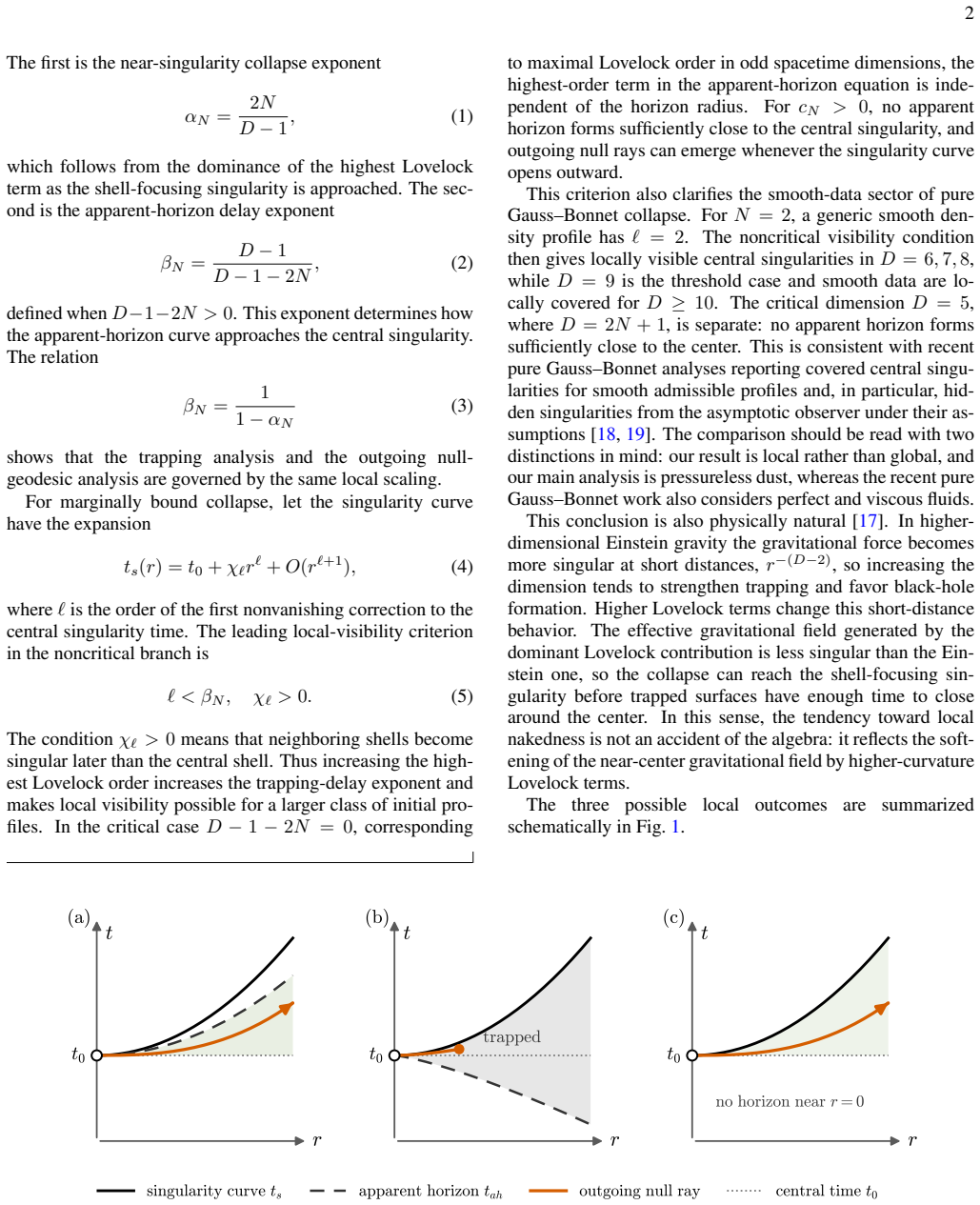
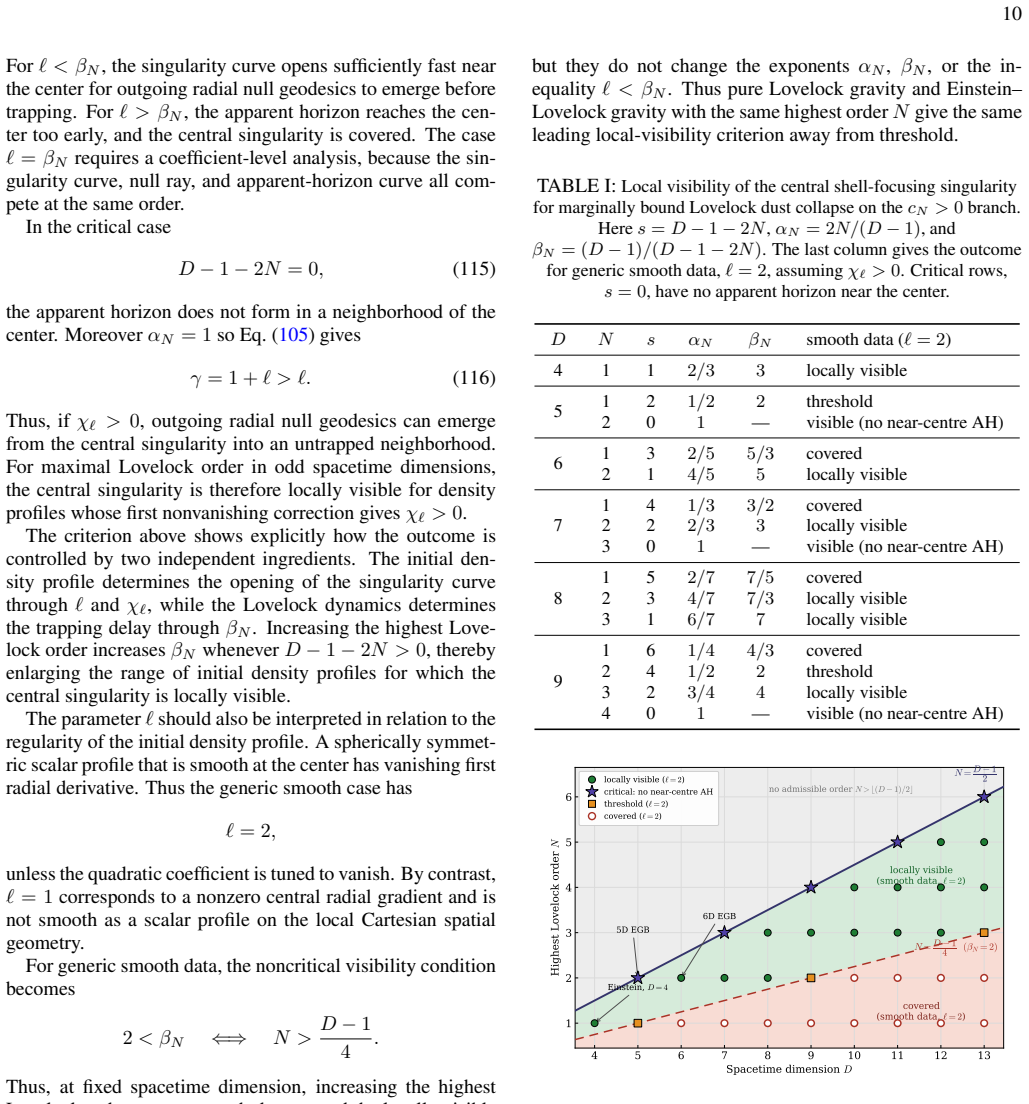
We show that higher-curvature Lovelock terms do not restore local cosmic censorship in spherical dust collapse, but instead promote the local visibility of central shell-focusing singularities. On the collapse branch with positive highest-order Lovelock coefficient c_N, the highest nonvanishing Lovelock order N controls both the near-singularity collapse and the formation of trapped surfaces. In noncritical dimensions, D-1-2N>0, the apparent-horizon curve approaches the singularity curve with trapping exponent β_N=(D-1)/(D-1-2N). Comparing this scale with the first nonvanishing correction r^ℓ to the singularity curve gives the local-visibility condition ℓ<β_N, provided the singularity curve
What carries the argument
The trapping exponent β_N=(D-1)/(D-1-2N) set by the highest Lovelock order N, which governs how quickly the apparent horizon approaches the singularity curve.
Load-bearing premise
The highest nonvanishing Lovelock order N controls both the near-singularity collapse dynamics and the formation of trapped surfaces.
What would settle it
A derivation showing the apparent horizon forms with an exponent other than β_N=(D-1)/(D-1-2N) in a given noncritical dimension and Lovelock order N would falsify the claim.
Figures
read the original abstract
We show that higher-curvature Lovelock terms do not restore local cosmic censorship in spherical dust collapse, but instead promote the local visibility of central shell-focusing singularities. On the collapse branch with positive highest-order Lovelock coefficient \(c_N\), the highest nonvanishing Lovelock order \(N\) controls both the near-singularity collapse and the formation of trapped surfaces. In noncritical dimensions, \(D-1-2N>0\), the apparent-horizon curve approaches the singularity curve with trapping exponent \(\beta_N=(D-1)/(D-1-2N)\). Comparing this scale with the first nonvanishing correction \(r^\ell\) to the singularity curve gives the local-visibility condition \(\ell<\beta_N\), provided the singularity curve opens outward. Thus increasing \(N\) enlarges the class of inhomogeneous initial data producing outgoing radial null rays from the central singularity. In the critical odd-dimensional branch, \(D=2N+1\), no apparent horizon forms sufficiently close to the center, so any outward opening of the singularity curve gives local visibility. The locally visible singularities are Kr\'olak-strong along the emerging null rays, with Tipler strength reached at threshold. For bound and unbound collapse, the noncritical exponents are unchanged: the energy function modifies the opening of the singularity curve, while in the critical branch it enters the leading terminal collapse velocity.
Editorial analysis
A structured set of objections, weighed in public.
Referee Report
Summary. The paper examines spherical dust collapse in Lovelock gravity and claims that higher-order curvature terms do not enforce local cosmic censorship but instead enlarge the set of initial data yielding locally visible central shell-focusing singularities. On the collapse branch with positive leading coefficient c_N, the highest nonvanishing order N governs both the near-singularity dynamics and trapped-surface formation. In noncritical dimensions the apparent horizon approaches the singularity with trapping exponent β_N = (D-1)/(D-1-2N); local visibility follows when the first correction r^ℓ to the singularity curve satisfies ℓ < β_N (provided the curve opens outward). In the critical odd-dimensional case D = 2N+1 no apparent horizon forms near the center, so any outward opening yields visibility. The emerging singularities are stated to be Królak-strong (Tipler-strong at threshold). The energy function affects only the opening of the singularity curve in the noncritical branch and the terminal velocity in the critical branch.
Significance. If the derivation holds, the result is significant for modified-gravity collapse: it supplies an explicit, parameter-free relation between the Lovelock order N and the visibility condition, showing that higher-curvature corrections can systematically promote naked singularities rather than hide them. The work therefore supplies a concrete, falsifiable criterion (the exponent comparison ℓ < β_N) that can be tested against numerical or analytic inhomogeneous data in Lovelock theories.
minor comments (1)
- The abstract states that the locally visible singularities are Królak-strong along the emerging null rays; a brief parenthetical reminder of the precise definition of Królak strength used here would aid readers unfamiliar with the terminology.
Simulated Author's Rebuttal
We thank the referee for the careful reading of the manuscript and the positive recommendation to accept. The referee's summary accurately captures the central claims regarding the role of higher Lovelock orders in promoting local visibility of central singularities.
Circularity Check
No significant circularity
full rationale
The derivation begins from the Lovelock field equations applied to spherical dust collapse, assumes a standard power-series expansion for the singularity curve (a common ansatz in the literature on gravitational collapse), and computes the apparent-horizon location to obtain the trapping exponent β_N = (D-1)/(D-1-2N) in non-critical dimensions. This exponent is then compared with the leading correction term r^ℓ of the singularity curve to obtain the visibility condition ℓ < β_N. No step reduces by construction to a fitted parameter, a self-referential definition, or a load-bearing self-citation; the central result follows directly once the field equations and the expansion ansatz are granted. The paper is therefore self-contained against external benchmarks and receives the default non-circularity score.
Axiom & Free-Parameter Ledger
axioms (2)
- domain assumption Spherical symmetry and inhomogeneous dust matter in Lovelock gravity
- domain assumption Expansion of the singularity curve with leading correction r^ℓ and the form of the apparent-horizon curve
Reference graph
Works this paper leans on
-
[1]
J. R. Oppenheimer and H. Snyder, Phys. Rev.56, 455 (1939)
1939
-
[2]
Penrose, Riv
R. Penrose, Riv. Nuovo Cim.1, 252 (1969)
1969
-
[3]
D. M. Eardley and L. Smarr, Phys. Rev. D19, 2239 (1979)
1979
-
[4]
Christodoulou, Commun
D. Christodoulou, Commun. Math. Phys.93, 171 (1984)
1984
-
[5]
R. P. A. C. Newman, Class. Quant. Grav.3, 527 (1986)
1986
-
[6]
P. S. Joshi and I. H. Dwivedi, Phys. Rev. D47, 5357 (1993), arXiv:gr-qc/9303037
Pith/arXiv arXiv 1993
-
[7]
T. P. Singh and P. S. Joshi, Class. Quant. Grav.13, 559 (1996), arXiv:gr-qc/9409062
Pith/arXiv arXiv 1996
-
[8]
P. S. Joshi, ed.,Gravitational Collapse and Spacetime Singular- ities, Cambridge Monographs on Mathematical Physics (Cam- bridge University Press, 2012)
2012
-
[9]
Lovelock, J
D. Lovelock, J. Math. Phys.12, 498 (1971)
1971
-
[10]
Zumino, Phys
B. Zumino, Phys. Rept.137, 109 (1986)
1986
-
[11]
C. Charmousis, Lect. Notes Phys.769, 299 (2009), arXiv:0805.0568 [gr-qc]
Pith/arXiv arXiv 2009
- [12]
-
[13]
S. Jhingan and S. G. Ghosh, Phys. Rev. D81, 024010 (2010), arXiv:1002.3245 [gr-qc]
Pith/arXiv arXiv 2010
-
[14]
A. Chatterjee, A. Ghosh, and S. C. Jaryal, Phys. Rev. D106, 044049 (2022), arXiv:2108.11680 [gr-qc]
arXiv 2022
-
[15]
S. Ohashi, T. Shiromizu, and S. Jhingan, Phys. Rev. D84, 024021 (2011), arXiv:1103.3826 [gr-qc]
Pith/arXiv arXiv 2011
-
[16]
S. Ohashi, T. Shiromizu, and S. Jhingan, Phys. Rev. D86, 044008 (2012), arXiv:1205.5363 [gr-qc]
Pith/arXiv arXiv 2012
-
[17]
N. Dadhich, S. G. Ghosh, and S. Jhingan, Phys. Rev. D88, 084024 (2013), arXiv:1308.4312 [gr-qc]
Pith/arXiv arXiv 2013
-
[18]
K. F. Dialektopoulos, D. Malafarina, and N. Dadhich, Phys. Rev. D108, 044080 (2023), arXiv:2306.10872 [gr-qc]
arXiv 2023
- [19]
-
[20]
B. P. Brassel, R. Goswami, and S. D. Maharaj, Annals Phys. 446, 169138 (2022)
2022
-
[21]
N. Dadhich, S. Hansraj, and B. Chilambwe, Int. J. Mod. Phys. D26, 1750056 (2016), arXiv:1607.07095 [gr-qc]
Pith/arXiv arXiv 2016
-
[22]
K. Zhou, Z.-Y . Yang, D.-C. Zou, and R.-H. Yue, Int. J. Mod. Phys. D20, 2317 (2011), arXiv:1107.2730 [gr-qc]
Pith/arXiv arXiv 2011
-
[23]
S. A. Hayward, Phys. Rev. D49, 6467 (1994)
1994
- [24]
-
[25]
F. J. Tipler, Phys. Lett. A64, 8 (1977)
1977
-
[26]
C. J. S. Clarke and A. Krolak, J. Geom. Phys.2, 127 (1985)
1985
-
[27]
P. S. Joshi and A. Krolak, Class. Quant. Grav.13, 3069 (1996), arXiv:gr-qc/9605033
Pith/arXiv arXiv 1996
-
[28]
S. G. Ghosh and A. Beesham, Phys. Rev. D64, 124005 (2001), arXiv:gr-qc/0108011
Pith/arXiv arXiv 2001
-
[29]
K. D. Patil, Phys. Rev. D67, 024017 (2003)
2003
-
[30]
R. Goswami and P. S. Joshi, Phys. Rev. D69, 044002 (2004), arXiv:gr-qc/0212097
Pith/arXiv arXiv 2004
discussion (0)
Sign in with ORCID, Apple, or X to comment. Anyone can read and Pith papers without signing in.