Physical-AI: From Channel Awareness to Environmental Intelligence in 6G Wireless Networks
Pith reviewed 2026-06-30 22:22 UTC · model grok-4.3
The pith
Physical-AI integrates perception, world modeling, and decision-making in a closed loop to enable environment-aware 6G networking beyond ISAC.
A machine-rendered reading of the paper's core claim, the machinery that carries it, and where it could break.
Core claim
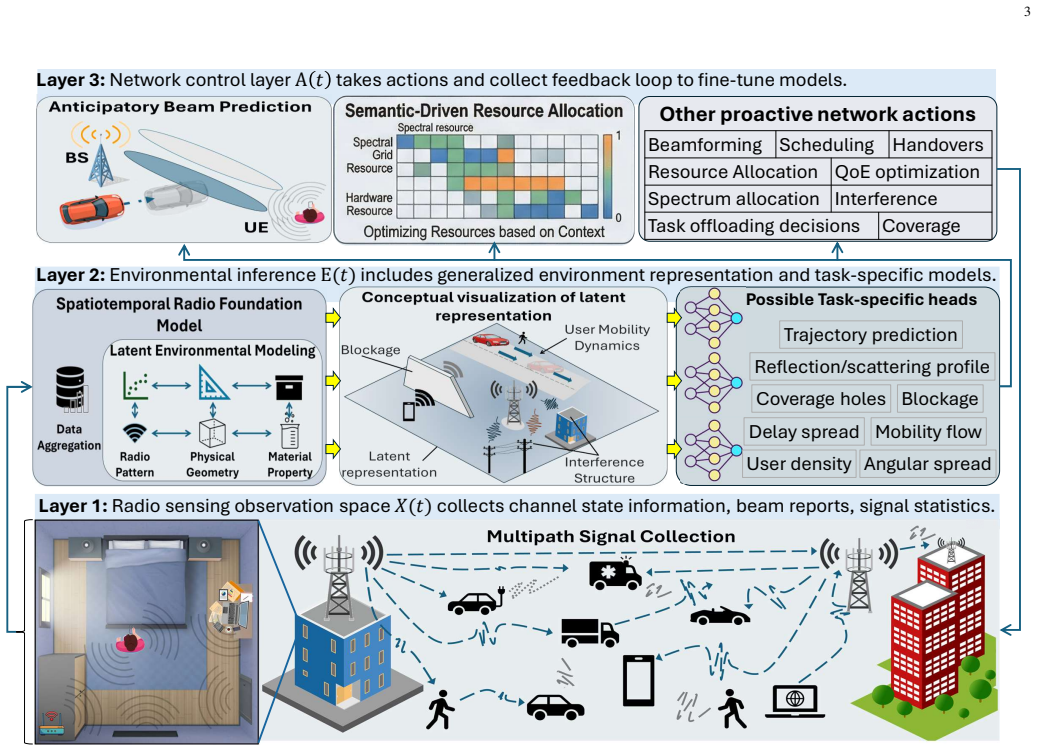
By integrating perception, world modeling, and decision-making in a closed loop, the proposed Physical-AI framework goes beyond ISAC and establishes a promising architecture for intelligent 6G systems, where a self-supervised spatiotemporal radio foundation model transforms distributed radio observations into a shared latent environmental representation that supports inference heads and a task-specific neural decision layer for proactive control.
What carries the argument
The self-supervised spatiotemporal radio foundation model that transforms distributed radio observations into a shared latent environmental representation, on which inference heads for blockage, mobility, and interference operate alongside a neural decision layer for control actions.
Load-bearing premise
A self-supervised spatiotemporal radio foundation model can reliably convert distributed radio observations into a shared latent environmental representation that is sufficient for accurate inference of blockage, mobility, and interference and for effective downstream control actions.
What would settle it
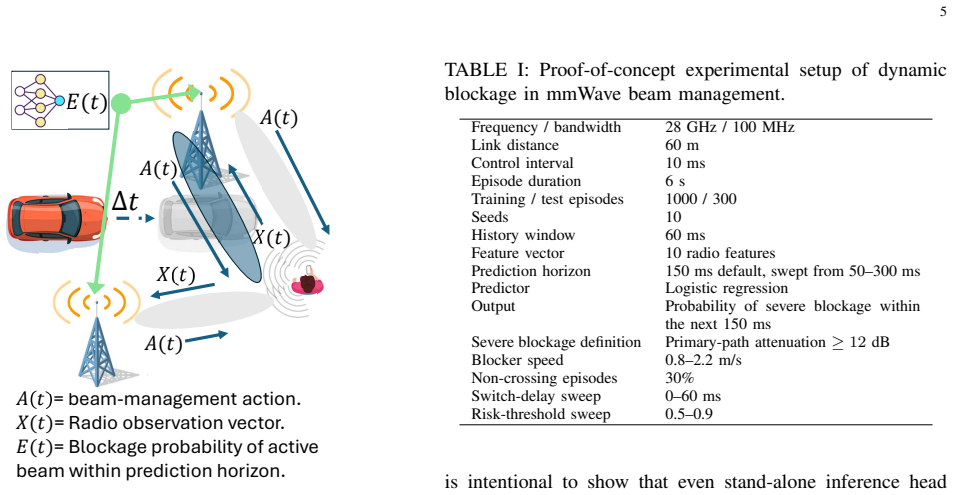
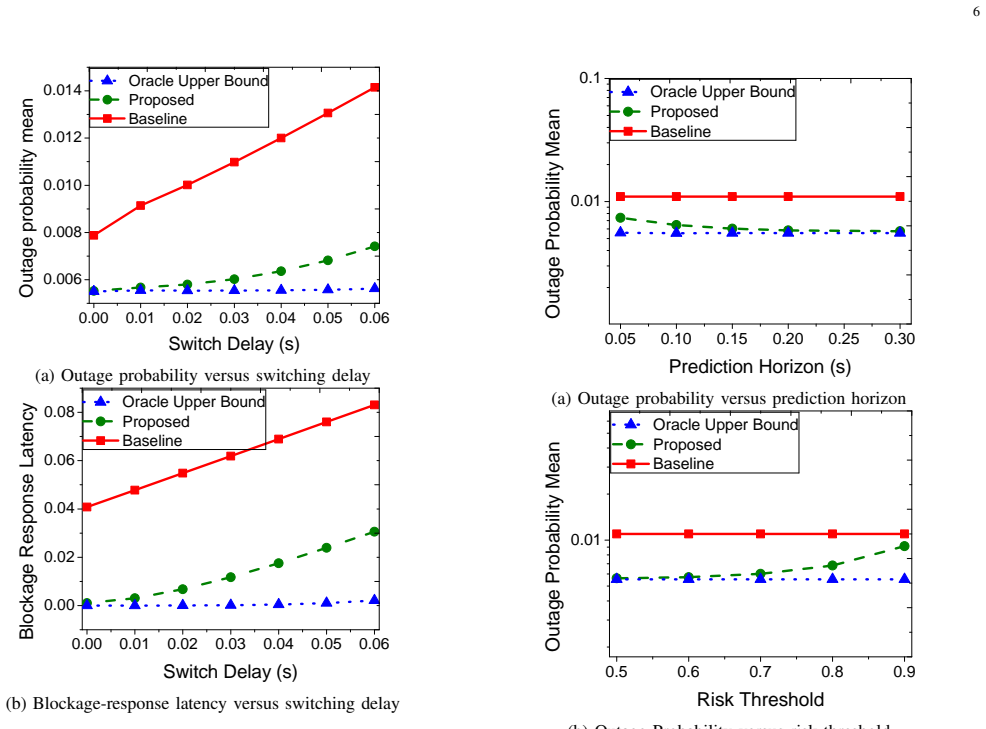
A simulation or field test in which the foundation model produces inaccurate estimates of blockage or mobility under high beam-switching delays, resulting in outage probability and response latency no better than conventional CSI or ISAC baselines.
Figures
read the original abstract
Conventional wireless networks rely on instantaneous channel state information (CSI) and react to channel variations without explicitly modeling the physical environment, limiting their ability to handle blockage, mobility, and interference in dynamic deployments. Paradigms such as Integrated Sensing and Communication (ISAC) add sensing capabilities but lack explicit environment modeling and decision-making. In this article, we propose Physical-AI: a new architecture for environment-aware wireless networking, where radio signals enable sensing, modeling, and interaction with the environment in addition to data transmission. The framework proposes a self-supervised spatiotemporal radio foundation model for transforming distributed radio observations into a shared latent environmental representation. Multiple inference heads operate on this representation to estimate key environmental properties, including blockage, user distribution, mobility dynamics, and interference structure. A task-specific neural decision layer maps this representation to proactive, context-aware control actions. By integrating perception, world modeling, and decision-making in a closed loop, the proposed framework goes beyond ISAC and establishes Physical-AI as a promising architecture for intelligent 6G systems. Simulation results show that the proposed predictive framework reduces outage probability and blockage-response latency, particularly under increasing beam-switching delays.
Editorial analysis
A structured set of objections, weighed in public.
Referee Report
Summary. The manuscript proposes Physical-AI as a new architecture for 6G wireless networks that integrates perception, world modeling, and decision-making in a closed loop. Radio signals are used not only for data transmission but also for sensing and explicit environment modeling via a self-supervised spatiotemporal radio foundation model that converts distributed observations into a shared latent representation; multiple inference heads then estimate blockage, mobility, interference, and user distribution, while a task-specific neural decision layer produces proactive control actions. The framework is positioned as going beyond ISAC, with simulation results claimed to show reduced outage probability and blockage-response latency under increasing beam-switching delays.
Significance. If the central assumptions hold, the architecture could enable a meaningful shift from reactive channel-aware networking to proactive, environment-intelligent systems in dynamic 6G deployments. The closed-loop integration of sensing, latent world modeling, and neural decision-making offers a coherent conceptual extension of ISAC ideas, though its practical significance hinges on empirical demonstration that radio-only observations suffice for the claimed inferences.
major comments (3)
- [Abstract] Abstract: the claim that 'simulation results show that the proposed predictive framework reduces outage probability and blockage-response latency' supplies no methods, datasets, baselines, error bars, or exclusion criteria, making it impossible to assess whether the data supports the architectural claims.
- [Framework description] Framework description (throughout): the self-supervised spatiotemporal radio foundation model is presented as the core mechanism for producing a usable latent environmental representation, yet no architecture details, training objectives, representation-quality metrics, or ablation results are provided to show that distributed radio observations alone generalize to accurate inference of blockage, mobility, and interference.
- [Simulation results] Simulation results paragraph: aggregate gains in outage and latency are reported without quantitative baselines, specific scenarios, or statistical detail, which is load-bearing for the claim that the framework outperforms existing approaches under beam-switching delays.
minor comments (2)
- [Introduction] The distinction between Physical-AI and prior ISAC work could be sharpened with a brief comparison table or explicit list of missing capabilities in ISAC.
- [Framework description] Notation for the latent representation and inference heads is introduced at a high level; a diagram or pseudocode would improve clarity.
Simulated Author's Rebuttal
We thank the referee for the constructive and detailed review of our manuscript on the Physical-AI architecture. We appreciate the identification of areas where additional methodological transparency is needed to support the architectural claims. We address each major comment below and have revised the manuscript to incorporate the requested details on simulation methods, framework architecture, and quantitative results.
read point-by-point responses
-
Referee: [Abstract] Abstract: the claim that 'simulation results show that the proposed predictive framework reduces outage probability and blockage-response latency' supplies no methods, datasets, baselines, error bars, or exclusion criteria, making it impossible to assess whether the data supports the architectural claims.
Authors: We agree that the abstract's brevity precludes inclusion of full methodological details. In the revised manuscript, we will expand the abstract to reference the simulation methodology (ray-tracing generated radio observations in dynamic mmWave scenarios), the datasets employed, explicit baselines (reactive CSI and standard ISAC), and the reporting of results with error bars. Complete descriptions of exclusion criteria and statistical procedures remain in the dedicated evaluation section to maintain abstract length constraints while enabling assessment of the claims. revision: yes
-
Referee: [Framework description] Framework description (throughout): the self-supervised spatiotemporal radio foundation model is presented as the core mechanism for producing a usable latent environmental representation, yet no architecture details, training objectives, representation-quality metrics, or ablation results are provided to show that distributed radio observations alone generalize to accurate inference of blockage, mobility, and interference.
Authors: The referee correctly notes the absence of these specifics in the current version. We will add a dedicated subsection describing the foundation model architecture (a spatiotemporal transformer processing distributed radio spectrograms), the self-supervised training objective (masked token prediction across space and time), representation-quality metrics (e.g., alignment between latent embeddings and ground-truth environment maps), and ablation results demonstrating the contribution of individual inference heads to generalization performance on blockage, mobility, and interference estimation tasks. revision: yes
-
Referee: [Simulation results] Simulation results paragraph: aggregate gains in outage and latency are reported without quantitative baselines, specific scenarios, or statistical detail, which is load-bearing for the claim that the framework outperforms existing approaches under beam-switching delays.
Authors: We acknowledge that the results presentation requires strengthening. The revised manuscript will include a results table providing quantitative comparisons against explicit baselines, detailed scenario specifications (28 GHz urban deployment with specified user mobility patterns and beam-switching delay ranges), and statistical information including means, standard deviations, and confidence intervals across repeated trials. These additions will allow direct evaluation of the reported gains in outage probability and blockage-response latency. revision: yes
Circularity Check
No circularity: conceptual architecture proposal with no derivations or fitted parameters
full rationale
The manuscript presents a high-level framework for Physical-AI without any mathematical derivations, equations, or parameter-fitting procedures. The central claims concern the potential of a self-supervised radio foundation model and downstream inference/decision layers, but these are architectural proposals rather than reductions of outputs to inputs by construction. Simulations report performance gains, yet no load-bearing step equates a prediction to a fitted quantity or relies on self-citation chains for uniqueness. The derivation chain is therefore self-contained and non-circular.
Axiom & Free-Parameter Ledger
invented entities (1)
-
Physical-AI architecture
no independent evidence
Reference graph
Works this paper leans on
-
[1]
A General Channel Model for Integrated Sensing and Communication Scenarios,
Z. Zhang, R. He, B. Ai, M. Yang, C. Li, H. Mi, and Z. Zhang, “A General Channel Model for Integrated Sensing and Communication Scenarios,” IEEE Communications Magazine, vol. 61, no. 5, pp. 68–74, May 2023
2023
-
[2]
JEPA-MSAC: A Joint-Embedding Predictive Architecture for Multimodal Sensing-Assisted Communications,
C. Zheng, J. He, G. Cai, N. Li, M. Bennis, H. Wymeersch, and M. Debbah, “JEPA-MSAC: A Joint-Embedding Predictive Architecture for Multimodal Sensing-Assisted Communications,”arXiv, vol. 2603.29796, 2026. [Online]. Available: https://arxiv.org/abs/2603.29796
-
[3]
Recent Advances in Resource Allocation and Beam Prediction for Large Language Models Empowered ISAC Systems,
X. Li, Y . Gao, M. Zeng, X. Lei, W. Hao, A. Nallanathan, and O. A. Dobre, “Recent Advances in Resource Allocation and Beam Prediction for Large Language Models Empowered ISAC Systems,”IEEE Com- munications Magazine, pp. 1–7, 2026
2026
-
[4]
Machine Learning-Powered Radio Frequency Sensing: A Review,
A. Santra, P. Wang, G. Shaker, B. S. Mysore, G. Dolmans, Y . Chen, N. Shariati, and A. Pandharipande, “Machine Learning-Powered Radio Frequency Sensing: A Review,”IEEE Sensors Journal, vol. 25, no. 13, pp. 23 164–23 183, Jul. 2025
2025
-
[5]
Near-Field User Localization and Channel Estimation for XL-MIMO Systems: Fundamentals, Recent Advances, and Outlooks,
H. Lei, J. Zhang, Z. Wang, B. Ai, and E. Bj ¨ornson, “Near-Field User Localization and Channel Estimation for XL-MIMO Systems: Fundamentals, Recent Advances, and Outlooks,”IEEE Wireless Com- munications, vol. 32, no. 4, pp. 190–198, Aug. 2025
2025
-
[6]
Physical AI: Bridging the Sim-to-Real Divide Toward Embodied, Ethical, and Autonomous Intelligence,
P. P. Ray, “Physical AI: Bridging the Sim-to-Real Divide Toward Embodied, Ethical, and Autonomous Intelligence,”Machine Learning for Computational Science and Engineering, vol. 2, no. 1, p. 1–54, Dec. 2026
2026
-
[7]
Multi-agent embodied ai: Advances and future directions.arXiv preprint arXiv:2505.05108,
Z. Feng, R. Xue, L. Yuan, Y . Yu, N. Ding, M. Liu, B. Gao, J. Sun, X. Zheng, and G. Wang, “Multi-agent Embodied AI: Advances and Future Directions,” Jun. 2025, arXiv:2505.05108 [cs]
-
[8]
Intelligent integrated sensing and communication: a survey,
J. Zhang, W. Lu, C. Xing, N. Zhao, N. Al-Dhahir, G. K. Karagiannidis, and X. Yang, “Intelligent integrated sensing and communication: a survey,”Science China Information Sciences, vol. 68, no. 3, p. 131301, Mar. 2025
2025
-
[9]
Interference Mitigation for Network-Level ISAC: An Optimization Perspective,
D. Xu, Y . Xu, X. Zhang, X. Yu, S. Song, and R. Schober, “Interference Mitigation for Network-Level ISAC: An Optimization Perspective,” IEEE Communications Magazine, vol. 62, no. 9, pp. 28–34, Sep. 2024
2024
-
[10]
Generative AI Based Secure Wireless Sensing for ISAC Networks,
J. Wang, H. Du, Y . Liu, G. Sun, D. Niyato, S. Mao, D. In Kim, and X. Shen, “Generative AI Based Secure Wireless Sensing for ISAC Networks,”IEEE Transactions on Information F orensics and Security, vol. 20, pp. 5195–5210, 2025
2025
-
[11]
Generative AI for Secure and Privacy-Preserving Mobile Crowdsens- ing,
Y . Yang, B. Zhang, D. Guo, H. Du, Z. Xiong, D. Niyato, and Z. Han, “Generative AI for Secure and Privacy-Preserving Mobile Crowdsens- ing,”IEEE Wireless Communications, vol. 31, no. 6, pp. 29–38, Dec. 2024
2024
-
[12]
X. Zhu, Y . Liu, and C. Wang,Intelligent Localization for Integrated Sensing and Communication: Machine Learning-Driven Approaches, ser. SpringerBriefs in Computer Science. Springer Nature Singapore, 2026
2026
-
[13]
Physics-Informed Neural Networks for High-Fidelity Elec- tromagnetic Field Approximation in VLSI and RF EDA Applications,
H. Zhang, “Physics-Informed Neural Networks for High-Fidelity Elec- tromagnetic Field Approximation in VLSI and RF EDA Applications,” Journal of Computing and Electronic Information Management, vol. 18, no. 2, p. 38–46, Sep. 2025
2025
-
[14]
Meta-SimGNN: Adaptive and Robust WiFi Localization Across Dynamic Configurations and Diverse Scenarios,
Q. Xiao, Z. Ye, Y . He, J. Liu, and G. Yu, “Meta-SimGNN: Adaptive and Robust WiFi Localization Across Dynamic Configurations and Diverse Scenarios,”IEEE Transactions on Communications, vol. 74, pp. 1732– 1746, 2026
2026
-
[15]
Wi- Fi Sensing Based on Deep Supervised Dictionary Learning for Robust Device-Free Localization,
H. Huang, C. Wang, L. Zhao, W. Wang, S. Ding, and A. Vasilakos, “Wi- Fi Sensing Based on Deep Supervised Dictionary Learning for Robust Device-Free Localization,”IEEE Transactions on V ehicular Technology, vol. 74, no. 8, pp. 12 842–12 852, Aug. 2025
2025
discussion (0)
Sign in with ORCID, Apple, or X to comment. Anyone can read and Pith papers without signing in.