REVIEW 3 minor 11 references
Zhinong AI: A Design-Science Study of an AI-Enabled Agricultural Decision-Support Platform for Smallholder Production
T0 review · 0 major / 3 minor · reviewed 2026-06-30 · grok-4.3
Pith's one-line read A design-science framework turns an AI agricultural prototype into an empirically testable and accountable decision-support system for smallholder farmers.
desk verdict This is a descriptive design-science case study of the Zhinong AI platform that stays honest about its limits but adds no new methods or results. read the letter →
The pith
A machine-rendered reading of the paper's core claim, the machinery that carries it, and where it could break.
The reading
What carries the argument
The layered architecture and closed-loop sensing-analysis-planning-execution-feedback process, augmented by the function-pain-point mapping matrix and the multi-part governance framework.
What would settle it
A field trial that applies the proposed evaluation indicators to measure whether farmers using the platform show measurable changes in decision accuracy, adoption rate or crop outcome compared with a control group.
Extended reading notes
Core claim
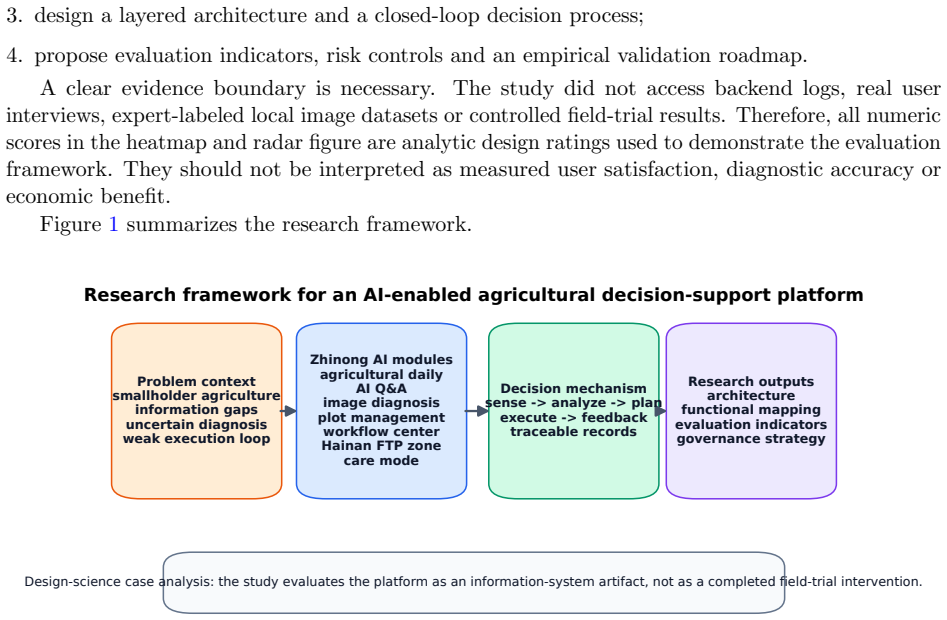
The central claim is that a layered system architecture together with the closed-loop decision process of sensing, analysis, planning, execution and feedback, supported by a function-pain-point mapping matrix, an evaluation indicator system and a governance framework covering data provenance, model risk, expert review, privacy and adoption risk, supplies a structured research framework for transforming an AI agricultural prototype into an empirically testable, accountable and localized decision-support infrastructure for smallholder production.
Load-bearing premise
The layered architecture, closed-loop process and governance framework can serve as a workable base for later empirical tests even though production logs, controlled user studies and expert-labeled local image datasets do not yet exist.
Editorial extensions
If this is right
- The platform can combine information push, natural-language question answering, image diagnosis, plot and calendar management, and workflow orchestration under one interface.
- Special features such as a regional service zone and an age-friendly mode can be added without breaking the overall sensing-to-feedback loop.
- The governance rules on data provenance, model risk and expert review provide concrete checkpoints before deployment.
- The function-pain-point matrix supplies a direct route for linking each technical component to documented smallholder needs.
- Future studies can reuse the indicator system to generate comparable results across different regions or crops.
Reading between the lines
- The same closed-loop structure could be reused to organize decision support in other data-scarce domains such as small-scale fisheries or rural health.
- Collecting the missing local image datasets would directly test whether the diagnosis module improves on generic models.
- The governance framework might lower regulatory barriers when similar AI tools are introduced in other low-resource agricultural settings.
Signed reviews
Editorial analysis
A structured set of objections, weighed in public.
Referee Report
Summary. The manuscript presents a design-science case study of the Zhinong AI Agricultural Decision Platform for smallholder production. It describes an integrated system offering information push services, natural-language QA, image-based crop disease diagnosis, plot and calendar management, workflow orchestration, a Hainan Free Trade Port service zone, and an age-friendly mode. Drawing on project materials, policy context, and prior smart-agriculture research, the paper constructs a layered architecture, a closed-loop decision process (sensing-analysis-planning-execution-feedback), a function-pain-point mapping matrix, an evaluation indicator system, and a governance framework covering data provenance, model risk, expert review, privacy, and adoption risk. The study explicitly states that production logs, controlled user studies, and expert-labeled local datasets were unavailable, so it advances no measured performance claims; its contribution is positioned as a structured research framework to support future empirical testing, accountability, and localization of such systems.
Significance. If the proposed framework holds, it supplies a concrete blueprint for moving AI agricultural prototypes toward empirically testable, governed decision-support infrastructures tailored to smallholders. The emphasis on a closed-loop process, explicit mapping of functions to pain points, indicator system, and multi-aspect governance (data, models, privacy, adoption) addresses recurring challenges in smart-agriculture HCI and could guide more rigorous design-science work that integrates technical architecture with accountability mechanisms.
minor comments (3)
- [Abstract] The abstract and introduction would benefit from an explicit statement of the design-science research questions or guidelines (e.g., reference to Hevner et al. or similar) that structured the construction of the architecture, mapping matrix, and governance elements.
- A schematic diagram or table illustrating the layered architecture and the sensing-analysis-planning-execution-feedback loop would substantially improve clarity of the central descriptive contribution.
- The function-pain-point mapping matrix is described at a high level; adding one or two concrete examples of how specific platform features address identified smallholder pain points would strengthen the reader's ability to assess the framework's applicability.
Simulated Author's Rebuttal
We thank the referee for the careful and accurate summary of the manuscript, the recognition of its design-science framing, and the positive assessment of the proposed frameworks. We note the recommendation for minor revision.
Circularity Check
No significant circularity; purely descriptive design-science proposal
full rationale
The paper presents a design-science case study of an AI agricultural platform, constructing a layered architecture, closed-loop process (sensing-analysis-planning-execution-feedback), function-pain-point mapping matrix, evaluation indicator system, and governance framework. It explicitly states that no measured field performance claims are made because production logs, user studies, and labeled datasets were unavailable. No equations, fitted parameters, quantitative predictions, or derivations appear. Self-citations (if any) are not load-bearing for any central claim, as the work advances no testable predictions or uniqueness theorems that reduce to prior inputs. The contribution is a proposed framework for future empirical testing and is self-contained against external benchmarks.
Assumptions & free parameters
assumptions (1)
- domain assumption Design-science case study is an appropriate method for describing an AI agricultural platform when empirical data are unavailable.
Cite this review
Pith. "Pith review of Zhinong AI: A Design-Science Study of an AI-Enabled Agricultural Decision-Support Platform for Smallholder Production." pith.science (2026). https://pith.science/paper/DFBQPOVO
@misc{pith2026260620601,
  author       = {Pith},
  title        = {Pith review of: Zhinong AI: A Design-Science Study of an AI-Enabled Agricultural Decision-Support Platform for Smallholder Production},
  year         = {2026},
  howpublished = {\url{https://pith.science/paper/DFBQPOVO}},
  note         = {Machine review of arXiv:2606.20601}
}
read the original abstract
Artificial intelligence is increasingly moving from single-purpose agricultural recognition tools toward integrated decision-support systems that connect information access, diagnosis, task execution and post-action feedback. This paper presents a design-science case study of the Zhinong AI Agricultural Decision Platform, a farmer-facing system that integrates agricultural information push services, natural-language question answering, image-based crop disease diagnosis, plot and farming-calendar management, workflow orchestration, a Hainan Free Trade Port agricultural service zone and an age-friendly care mode. Based on public project materials, policy context and prior research on smart agriculture, machine learning and design science, the paper constructs a layered system architecture and a closed-loop decision process summarized as sensing, analysis, planning, execution and feedback. It further proposes a function-pain-point mapping matrix, an evaluation indicator system and a governance framework covering data provenance, model risk, expert review, privacy and adoption risk. The study does not claim measured field performance because production logs, controlled user studies and expert-labeled local image datasets were not available at the time of writing. Instead, the contribution is a structured research framework for transforming an AI agricultural prototype into an empirically testable, accountable and localized decision-support infrastructure for smallholder production.
Figures


Figures from the paper (3 more)


Reference graph
Works this paper leans on
-
[1]
Zhinong AI Agricultural Decision Platform. Project homepage. Available: https://uapi. wfile.top/. Accessed: May 19, 2026
work page 2026
-
[2]
Beijizhida. AI agricultural decision platform “Zhinong AI” released, focusing on farmers’ information access and production decision-making problems. Sohu, May 8, 2026. Available: https://www.sohu.com/a/1020026574_120547276
-
[3]
Zhinong AI Agricultural Decision Platform
Beijizhida. Zhaoyang Li’s team at the University of Sanya launches the “Zhinong AI Agricultural Decision Platform” to explore AI-enabled agricultural production. Sohu, May 10, 2026. Available: https://www.sohu.com/a/1020588003_120547276
-
[4]
Ten departments issued the Digital Village Development Action Plan (2022-2025)
Xinhua News Agency. Ten departments issued the Digital Village Development Action Plan (2022-2025). Xinhua, January 26, 2022. Available: https://www.news.cn/politics/2022-01/ 26/c_1128303847.htm
work page 2022
-
[5]
S. Wolfert, L. Ge, C. Verdouw, and M.-J. Bogaardt. Big data in smart farming - A review. Agricultural Systems, 153:69–80, 2017. doi: 10.1016/j.agsy.2017.01.023
-
[6]
K. G. Liakos, P. Busato, D. Moshou, S. Pearson, and D. Bochtis. Machine learning in agriculture: A review.Sensors, 18(8):2674, 2018. doi: 10.3390/s18082674
-
[7]
S. P. Mohanty, D. P. Hughes, and M. Salathe. Using deep learning for image-based plant disease detection.Frontiers in Plant Science, 7:1419, 2016. doi: 10.3389/fpls.2016.01419
-
[8]
A. Kamilaris and F. X. Prenafeta-Boldu. Deep learning in agriculture: A survey.Computers and Electronics in Agriculture, 147:70–90, 2018. doi: 10.1016/j.compag.2018.02.016
Show all 11 references
-
[9]
K. Jha, A. Doshi, P. Patel, and M. Shah. A comprehensive review on automation in agri- culture using artificial intelligence.Artificial Intelligence in Agriculture, 2:1–12, 2019. doi: 10.1016/j.aiia.2019.05.004
2019 doi
-
[10]
A. R. Hevner, S. T. March, J. Park, and S. Ram. Design science in information systems research. MIS Quarterly, 28(1):75–105, 2004. doi: 10.2307/25148625. 14
2004 doi
-
[11]
Peffers, T
K. Peffers, T. Tuunanen, M. A. Rothenberger, and S. Chatterjee. A design science research methodology for information systems research.Journal of Management Information Systems, 24(3):45–77, 2007. doi: 10.2753/MIS0742-1222240302. 15
2007 doi
Reviewed June 30, 2026 · model on record in the stance chip above.
Discussion (0). Continue with ORCID to comment.