Dissecting emerging slow rhythms in delay-coupled neural oscillators
Pith reviewed 2026-06-26 18:17 UTC · model grok-4.3
The pith
Delayed coupling in inhibitory neural networks generates slow rhythms through phase-difference dynamics
A machine-rendered reading of the paper's core claim, the machinery that carries it, and where it could break.
Core claim
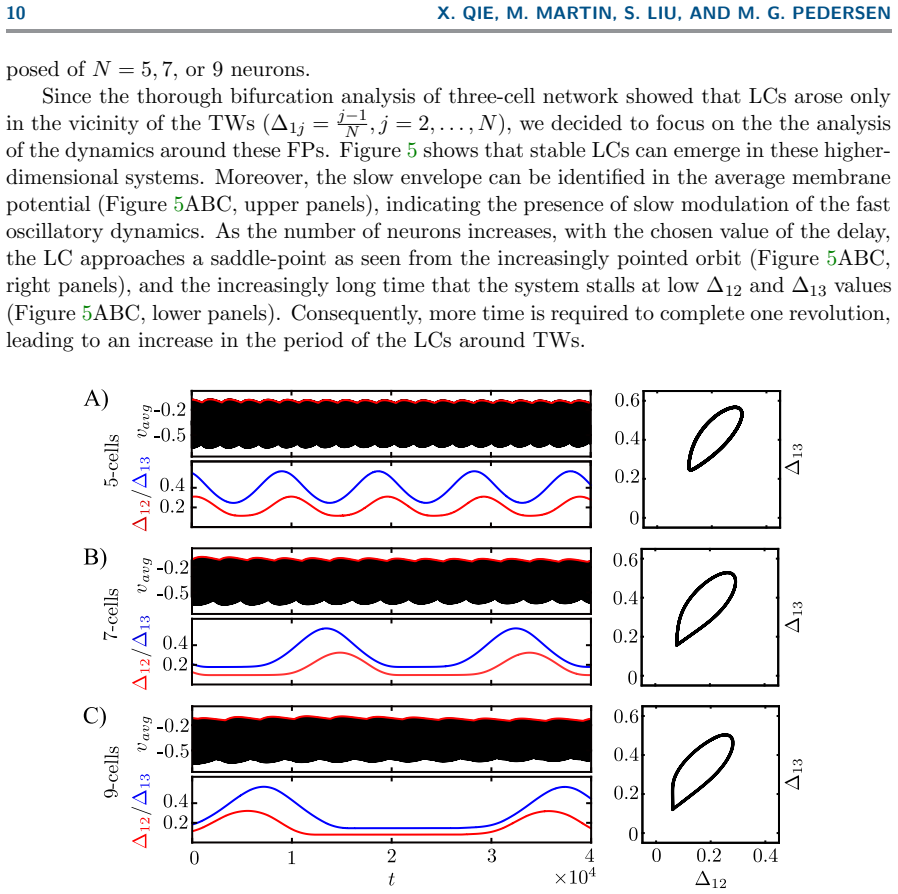
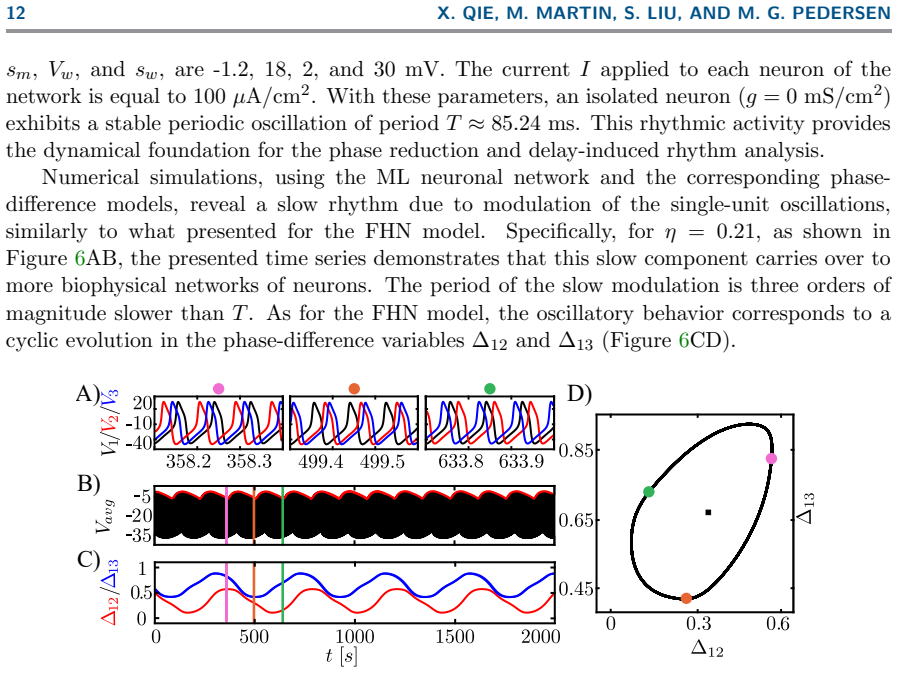
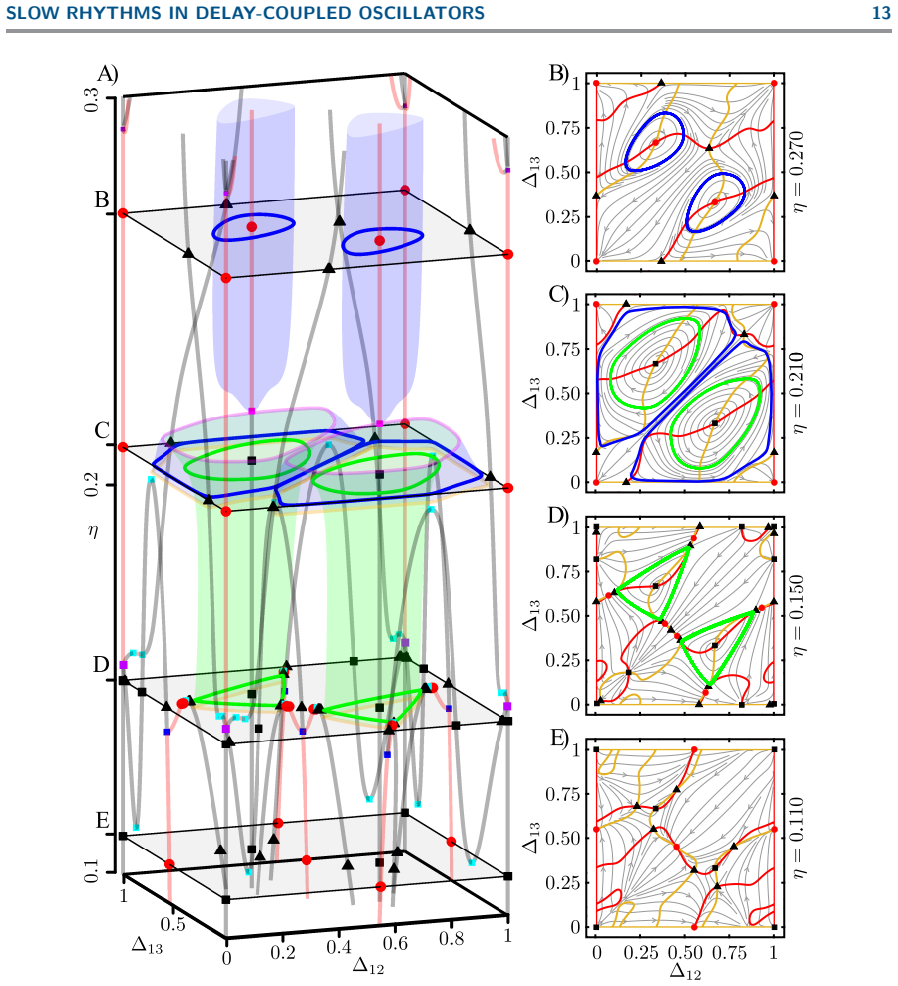
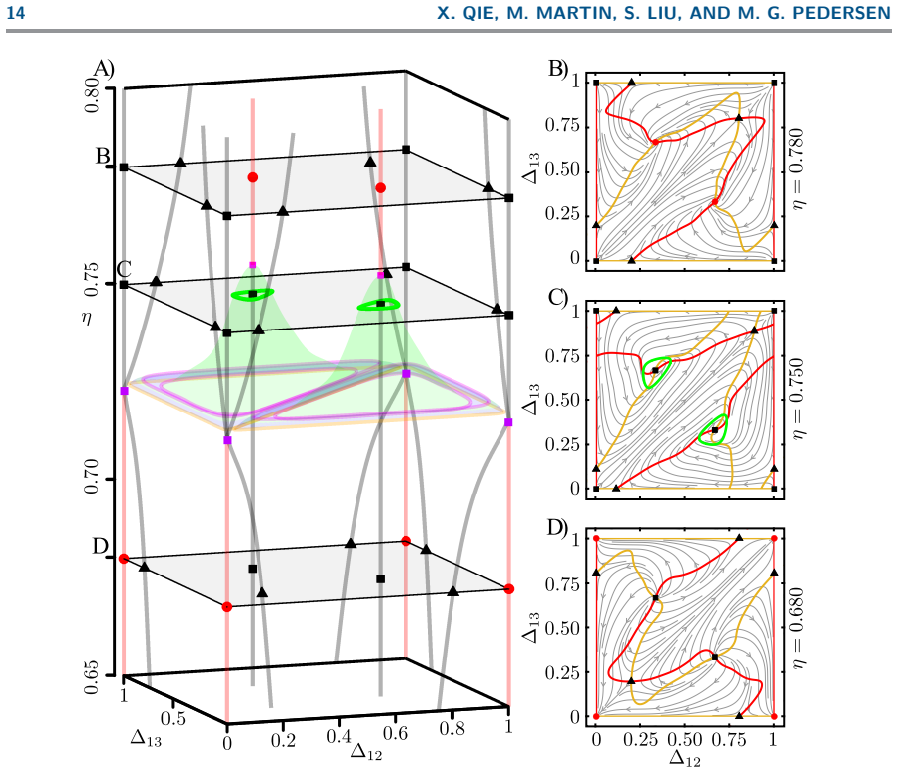
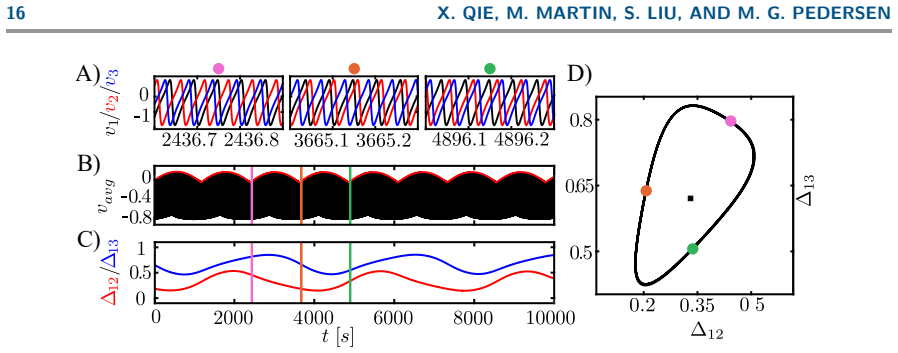
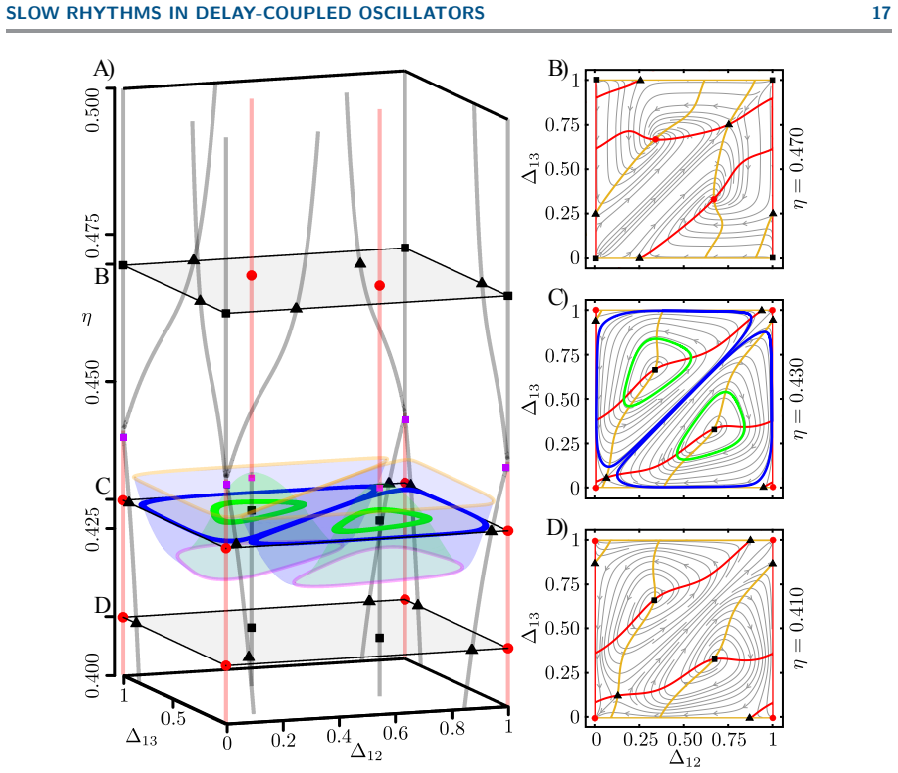
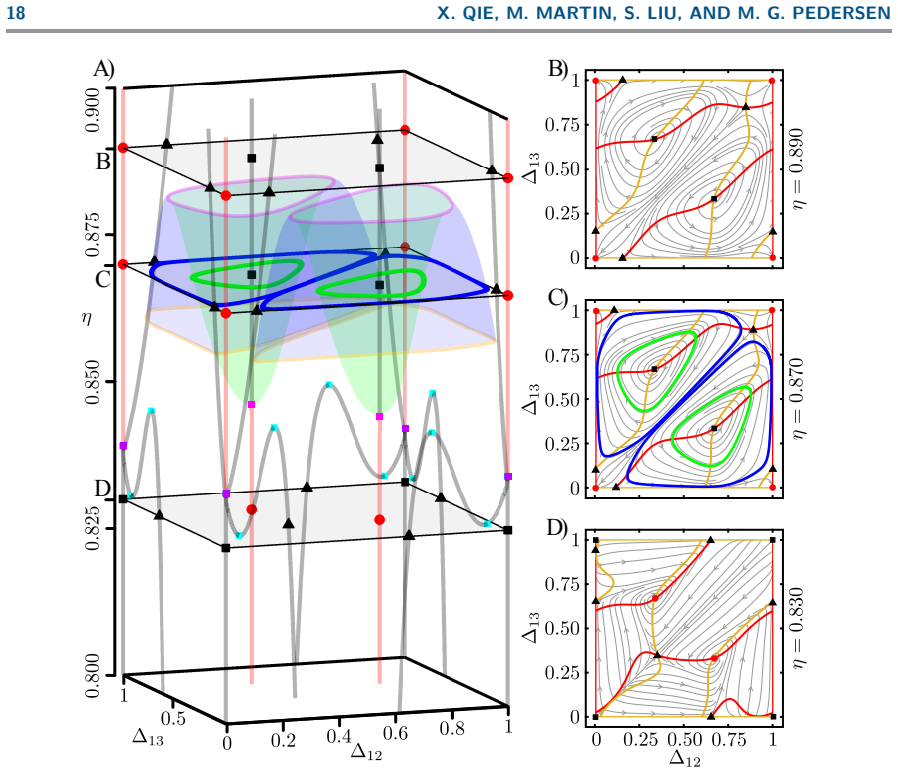
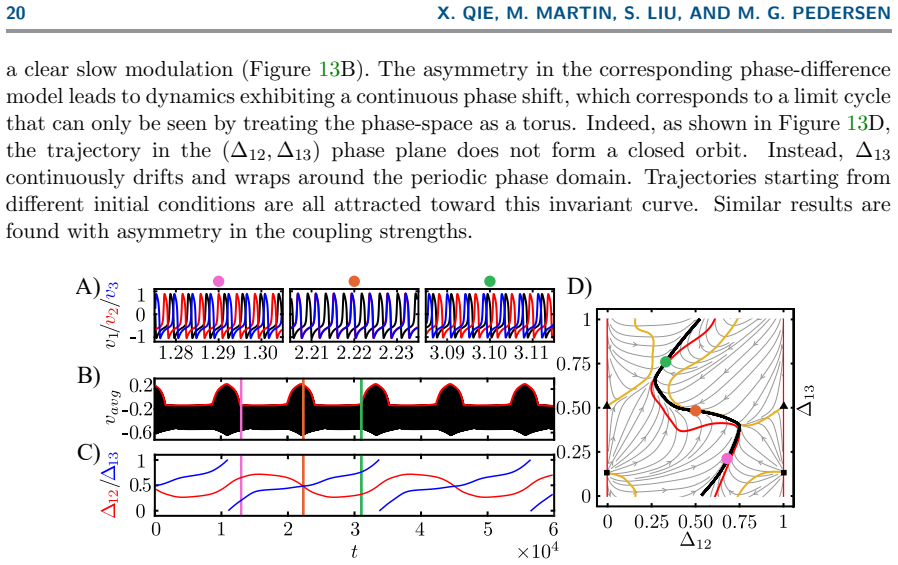
Delayed coupling in inhibitory networks introduces an effective slow-fast structure in the phase-difference dynamics, generating low-frequency components that are not due to intrinsic cellular properties, and this behavior is not specific to a particular model structure. Numerical continuation and bifurcation analysis of the phase-difference model reveal Hopf, heteroclinic, and saddle-node-of-periodics bifurcations that cause and organize the slow rhythmic behavior.
What carries the argument
Phase-difference model with synaptic delay derived from phase response curves of the individual oscillators, analyzed through phase planes and delay-dependent bifurcation diagrams.
If this is right
- Multistability in the phase-difference model corresponds to different patterns of slow modulation in the full oscillator system.
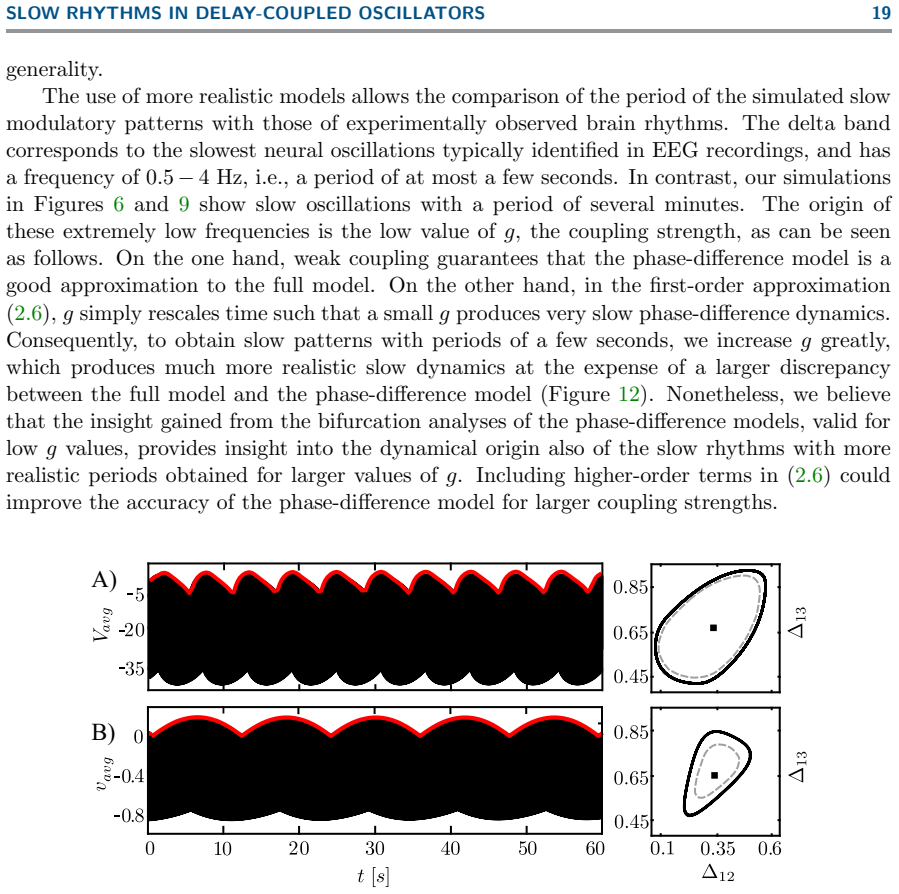
- Limit cycles in the reduced model produce slow modulation of fast oscillations in the original coupled system.
- Treating delay as a bifurcation parameter systematically identifies the parameter regions where slow rhythms appear.
- The same slow rhythms appear in three distinct model classes, supporting generality beyond specific equations.
Where Pith is reading between the lines
- This suggests that many observed slow rhythms in neural circuits could arise purely from network delays even when all cells are fast.
- Similar analysis could be applied to excitatory or mixed networks to check if the effect is specific to inhibition.
- Experimental tests could involve controlled synaptic delays to observe the predicted changes in rhythm frequency.
Load-bearing premise
Phase reduction using phase response curves provides an accurate approximation to the full system dynamics for the relevant delays and parameters.
What would settle it
If the full models exhibit slow rhythms outside the parameter regions predicted by the phase-difference bifurcation diagrams, or if the phase model fails to match the full model trajectories for moderate delays, the approximation would be falsified.
Figures
read the original abstract
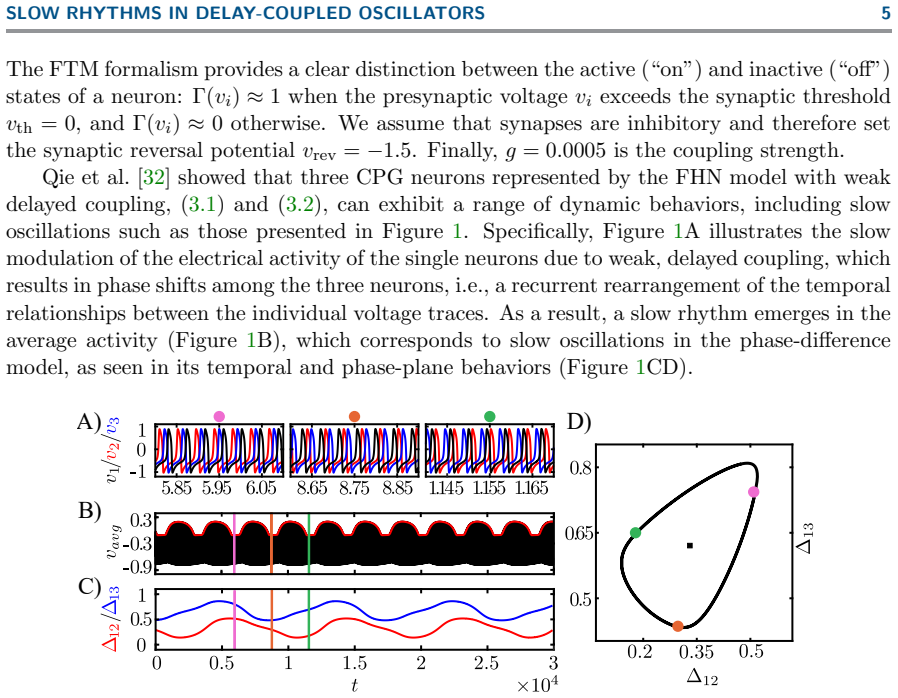
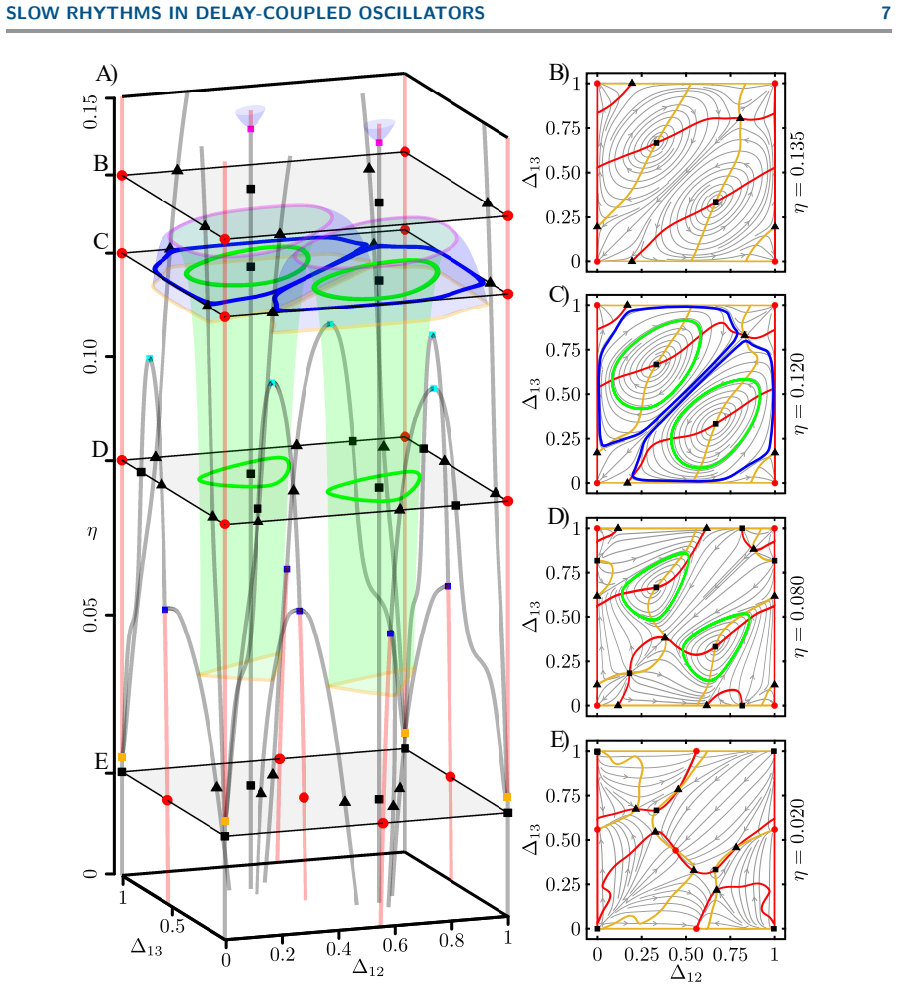
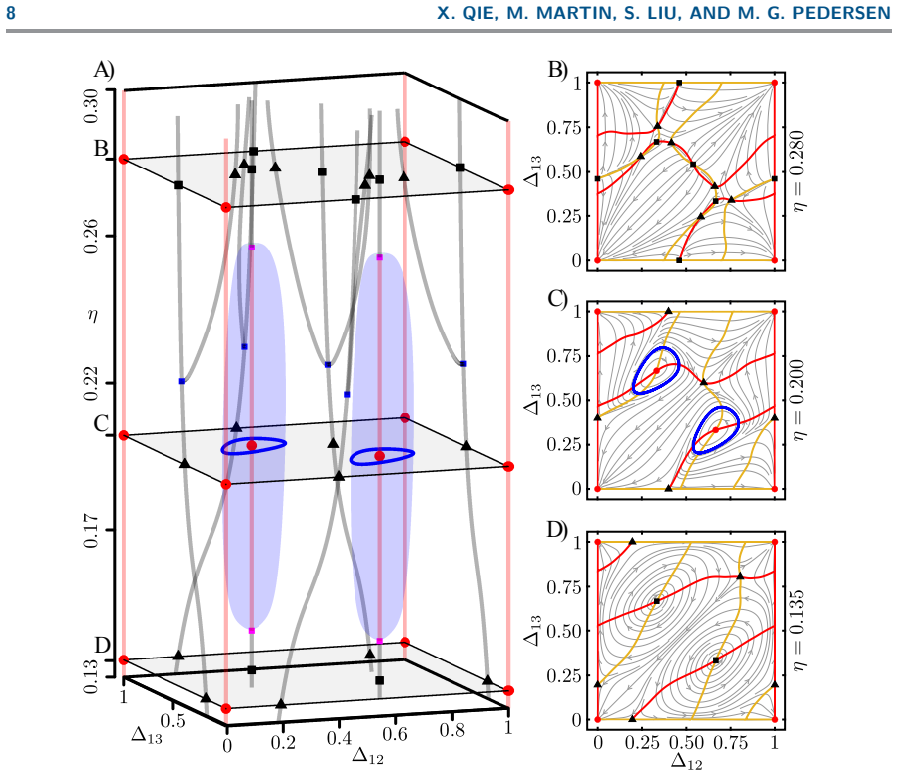
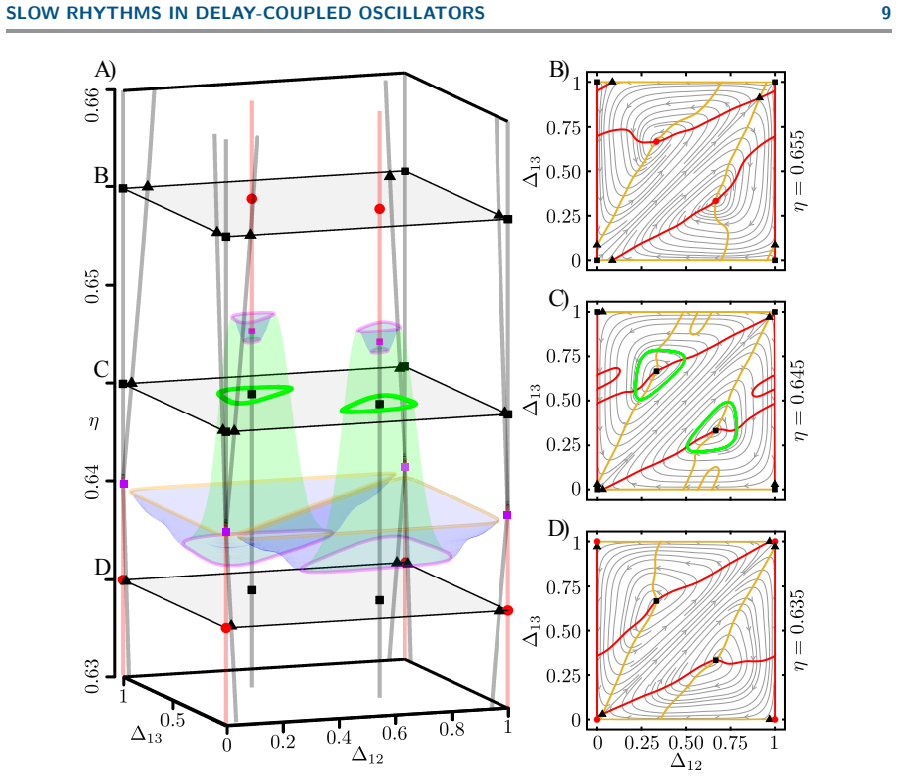
Synaptic transmission delays are ubiquitous in neural circuits and can alter the dynamical repertoire of coupled oscillators quantitatively and qualitatively. Here, we demonstrate that delayed coupling in inhibitory networks introduces an effective slow-fast structure in the phase-difference dynamics, generating low-frequency components that are not due to intrinsic cellular properties, and we show that this behavior is not specific to a particular model structure. The origin of this generic phenomenon is analyzed by numerical continuation and bifurcation analysis, which provides a systematic approach to find such delay-induced slow modulating rhythms. We employ phase reduction based on phase response curves to derive a phase-difference model with delay for mutually inhibitory coupled oscillators, where the individual units are given by the FitzHugh-Nagumo model, the Morris-Lecar model, or a next-generation neural mass model derived from quadratic integrate-and-fire neurons. We use phase planes to study multistability and limit cycles, which correspond to slow modulation of fast oscillations in the full model. Treating the synaptic delay as a bifurcation parameter, we apply numerical continuation to construct delay-dependent bifurcation diagrams. The analysis reveals Hopf, heteroclinic, and saddle-node-of-periodics bifurcations that cause and organize slow rhythmic behavior. Our analysis provides a systematic approach to the search for limit cycles in phase-reduction models corresponding to delay-induced slow rhythms in the original model.
Editorial analysis
A structured set of objections, weighed in public.
Referee Report
Summary. The manuscript claims that synaptic delays in mutually inhibitory networks of neural oscillators generically induce slow modulating rhythms via an effective slow-fast structure in the phase-difference dynamics. This is demonstrated by deriving a delay-augmented phase-difference equation from phase response curves of three distinct models (FitzHugh-Nagumo, Morris-Lecar, and a quadratic integrate-and-fire neural mass), followed by phase-plane analysis and numerical continuation in the delay parameter that locates Hopf, heteroclinic, and saddle-node-of-periodics bifurcations organizing the slow rhythms; the behavior is asserted to be independent of specific model structure.
Significance. If the reduction is validated, the work supplies a model-independent, bifurcation-based method for locating delay-induced slow rhythms and clarifies that such rhythms need not arise from intrinsic cellular slow variables, which would be useful for analyzing rhythm generation in delayed neural circuits.
major comments (1)
- [Phase reduction and bifurcation analysis] The validity of the phase-difference model for finite delays is load-bearing for the central claim that the reported slow rhythms appear in the original networks. The derivation (described in the abstract and methods) assumes the standard weak-coupling, slow-variation regime, yet no quantitative comparison (e.g., relative period error or L2 distance between reduced limit-cycle envelope and full-model voltage trace) is provided for the delay values at which slow modulation is observed.
minor comments (2)
- The range of coupling strengths and delays for which the phase reduction is applied should be stated explicitly, together with any a-priori estimates of its accuracy.
- Figure captions and text should clarify whether the slow rhythms shown are from the reduced model only or include direct full-model simulations for the same parameters.
Simulated Author's Rebuttal
We thank the referee for their detailed review and constructive feedback on our manuscript. The major comment identifies a valid gap in quantitative validation of the phase reduction for finite delays. We address this point directly below and will revise the manuscript accordingly.
read point-by-point responses
-
Referee: The validity of the phase-difference model for finite delays is load-bearing for the central claim that the reported slow rhythms appear in the original networks. The derivation (described in the abstract and methods) assumes the standard weak-coupling, slow-variation regime, yet no quantitative comparison (e.g., relative period error or L2 distance between reduced limit-cycle envelope and full-model voltage trace) is provided for the delay values at which slow modulation is observed.
Authors: We agree that quantitative validation is necessary to support the applicability of the phase-difference reduction at the finite delays where slow modulations are reported. In the revised manuscript we will add direct comparisons for each of the three models (FitzHugh-Nagumo, Morris-Lecar, and the quadratic integrate-and-fire neural mass). These will include (i) the relative error in the period of the slow modulation between the full network and the reduced phase-difference limit cycle, and (ii) the L2 distance between the slow envelope of the full-model voltage traces and the corresponding limit-cycle solution of the phase-difference equation, evaluated at representative delay values inside the slow-rhythm regimes identified by continuation. revision: yes
Circularity Check
No circularity; standard phase reduction and bifurcation analysis applied independently
full rationale
The derivation derives a delay-augmented phase-difference equation from PRCs of three distinct neuron models (FHN, Morris-Lecar, QIF neural mass), then applies numerical continuation to locate Hopf/heteroclinic/saddle-node bifurcations in the reduced system. No step reduces a claimed prediction to a fitted input by construction, invokes a self-citation as the sole justification for a uniqueness claim, or renames an empirical pattern. The central result (delay-induced slow rhythms via effective slow-fast structure in phase-difference dynamics) follows from the explicit reduced equations and standard dynamical-systems tools without circular reduction to the paper's own inputs.
Axiom & Free-Parameter Ledger
free parameters (1)
- synaptic delay
axioms (1)
- domain assumption Phase reduction is applicable to the delay-coupled systems
Reference graph
Works this paper leans on
-
[1]
science , volume=
Neuronal oscillations in cortical networks , author=. science , volume=. 2004 , publisher=
2004
-
[2]
Neuron , volume=
Respiratory rhythm: an emergent network property? , author=. Neuron , volume=. 2002 , publisher=
2002
-
[3]
Chaos: An Interdisciplinary Journal of Nonlinear Science , volume=
Gap-junction coupling can prolong beta-cell burst period by an order of magnitude via phantom bursting , author=. Chaos: An Interdisciplinary Journal of Nonlinear Science , volume=. 2018 , publisher=
2018
-
[4]
Proceedings of the National Academy of Sciences , volume=
Interdependence of cellular and network properties in respiratory rhythm generation , author=. Proceedings of the National Academy of Sciences , volume=. 2024 , publisher=
2024
-
[5]
Brain , volume=
A brain atlas of axonal and synaptic delays based on modelling of cortico-cortical evoked potentials , author=. Brain , volume=. 2022 , publisher=
2022
-
[6]
Discrete Contin
Phase models and oscillators with time delayed coupling , author=. Discrete Contin. Dyn. Syst , volume=
-
[7]
Handbook of brain connectivity , pages=
Time delays in neural systems , author=. Handbook of brain connectivity , pages=. 2007 , publisher=
2007
-
[8]
Current biology , volume=
Central pattern generators and the control of rhythmic movements , author=. Current biology , volume=. 2001 , publisher=
2001
-
[9]
Neuron , volume=
Biological pattern generation: the cellular and computational logic of networks in motion , author=. Neuron , volume=. 2006 , publisher=
2006
-
[10]
Neural networks , volume=
Central pattern generators for locomotion control in animals and robots: a review , author=. Neural networks , volume=. 2008 , publisher=
2008
-
[11]
Physica D: Nonlinear Phenomena , volume=
Phase models and clustering in networks of oscillators with delayed coupling , author=. Physica D: Nonlinear Phenomena , volume=. 2018 , publisher=
2018
-
[12]
2002 , publisher=
Brain dynamics: synchronization and activity patterns in pulse-coupled neural nets with delays and noise , author=. 2002 , publisher=
2002
-
[13]
Proceedings of the National Academy of Sciences , volume=
Fine structure of neural spiking and synchronization in the presence of conduction delays , author=. Proceedings of the National Academy of Sciences , volume=. 1998 , publisher=
1998
-
[14]
Philosophical Transactions of the Royal Society A: Mathematical, Physical and Engineering Sciences , volume=
Delays and weakly coupled neuronal oscillators , author=. Philosophical Transactions of the Royal Society A: Mathematical, Physical and Engineering Sciences , volume=. 2009 , publisher=
2009
-
[15]
Chaos: An Interdisciplinary Journal of Nonlinear Science , volume=
Chimera states in heterogeneous networks , author=. Chaos: An Interdisciplinary Journal of Nonlinear Science , volume=. 2009 , publisher=
2009
-
[16]
Chaos: An Interdisciplinary Journal of Nonlinear Science , volume=
Synaptic delays shape dynamics and function in multimodal neural motifs , author=. Chaos: An Interdisciplinary Journal of Nonlinear Science , volume=. 2025 , publisher=
2025
-
[17]
2010 , publisher=
Mathematical foundations of neuroscience , author=. 2010 , publisher=
2010
-
[18]
1980 , publisher=
The geometry of biological time , author=. 1980 , publisher=
1980
-
[19]
Neural computation , volume=
Type I membranes, phase resetting curves, and synchrony , author=. Neural computation , volume=. 1996 , publisher=
1996
-
[20]
Neural computation , volume=
On the phase reduction and response dynamics of neural oscillator populations , author=. Neural computation , volume=. 2004 , publisher=
2004
-
[21]
Neural modeling and neural networks , pages=
An introduction to neural oscillators , author=. Neural modeling and neural networks , pages=. 1994 , publisher=
1994
-
[22]
Chaos: An Interdisciplinary Journal of Nonlinear Science , volume=
Dynamics and bifurcations in multistable 3-cell neural networks , author=. Chaos: An Interdisciplinary Journal of Nonlinear Science , volume=. 2020 , publisher=
2020
-
[23]
Chaos: An Interdisciplinary Journal of Nonlinear Science , volume=
Cross frequency coupling in next generation inhibitory neural mass models , author=. Chaos: An Interdisciplinary Journal of Nonlinear Science , volume=. 2020 , publisher=
2020
-
[24]
PLoS One , volume=
Key bifurcations of bursting polyrhythms in 3-cell central pattern generators , author=. PLoS One , volume=. 2014 , publisher=
2014
-
[25]
Frontiers in Applied Mathematics and Statistics , volume=
2 -burster for rhythm-generating circuits , author=. Frontiers in Applied Mathematics and Statistics , volume=. 2020 , publisher=
2020
-
[26]
Collective frequencies and metastability in networks of limit-cycle oscillators with time delay , author =. Phys. Rev. Lett. , volume =. 1991 , month =. doi:10.1103/PhysRevLett.67.2753 , url =
-
[27]
Physical Rreview Letters , volume=
Collective modes of coupled phase oscillators with delayed coupling , author=. Physical Rreview Letters , volume=. 2012 , publisher=
2012
-
[28]
Yeung, M. K. Stephen and Strogatz, Steven H. , title =. Physical Review Letters , year =
-
[29]
A Theoretical Approach for Gait Generation of the
Yu, Xiao and Song, Zigen and Sun, Xiuting and Xu, Jian , journal=. A Theoretical Approach for Gait Generation of the. 2026 , publisher=
2026
-
[30]
, publisher =
Ermentrout, G.B. , publisher =. Simulating, analyzing, and animating dynamical systems: A guide to
-
[31]
Physical Review X , volume=
Macroscopic description for networks of spiking neurons , author=. Physical Review X , volume=. 2015 , publisher=
2015
-
[32]
Bard Ermentrout , doi =
Matteo Martin and Anna Kishida Thomas and G. Bard Ermentrout , doi =. XPPLORE: Import, Visualize, and Analyze XPPAUT Data in MATLAB , volume =. International Journal of Bifurcation and Chaos , month =
-
[33]
Methods in neuronal modeling , volume=
Analysis of neural excitability and oscillations , author=. Methods in neuronal modeling , volume=
-
[34]
Physical Review E—Statistical, Nonlinear, and Soft Matter Physics , volume=
Mean-field approximation of two coupled populations of excitable units , author=. Physical Review E—Statistical, Nonlinear, and Soft Matter Physics , volume=. 2013 , publisher=
2013
-
[35]
Zhu et al
Dynamical analysis of multistable 3-cell CPG based on phase response curve and interaction function: Q. Zhu et al. , author=. Nonlinear Dynamics , volume=. 2026 , publisher=
2026
-
[36]
PLOS Computational Biology , volume=
Whole brain functional connectivity: Insights from next generation neural mass modelling incorporating electrical synapses , author=. PLOS Computational Biology , volume=. 2024 , publisher=
2024
-
[37]
From Quasiperiodic Partial Synchronization to Collective Chaos in Populations of Inhibitory Neurons with Delay , author =. Phys. Rev. Lett. , volume =. 2016 , month =. doi:10.1103/PhysRevLett.116.238101 , url =
-
[38]
Physical Review E , volume=
Dynamics of a large system of spiking neurons with synaptic delay , author=. Physical Review E , volume=. 2018 , publisher=
2018
-
[39]
SIAM Journal on Applied Dynamical Systems , volume=
Population dynamics in networks of izhikevich neurons with global delayed coupling , author=. SIAM Journal on Applied Dynamical Systems , volume=. 2024 , publisher=
2024
-
[40]
Yuri A. Kuznetsov , city =. Elements of Applied Bifurcation Theory , volume =. doi:10.1007/978-3-031-22007-4 , isbn =
-
[41]
2024 , publisher=
Nonlinear dynamics and chaos: with applications to physics, biology, chemistry, and engineering , author=. 2024 , publisher=
2024
-
[42]
2007 , publisher=
Dynamical systems in neuroscience , author=. 2007 , publisher=
2007
discussion (0)
Sign in with ORCID, Apple, or X to comment. Anyone can read and Pith papers without signing in.