From Sentiment to Actionable Insights: A Data-Driven Public Sentiment Analysis of Advanced Air Mobility
Pith reviewed 2026-06-26 17:50 UTC · model grok-4.3
The pith
Analysis of over 300,000 online texts identifies six clusters of public concern that shape acceptance of advanced air mobility.
A machine-rendered reading of the paper's core claim, the machinery that carries it, and where it could break.
Core claim
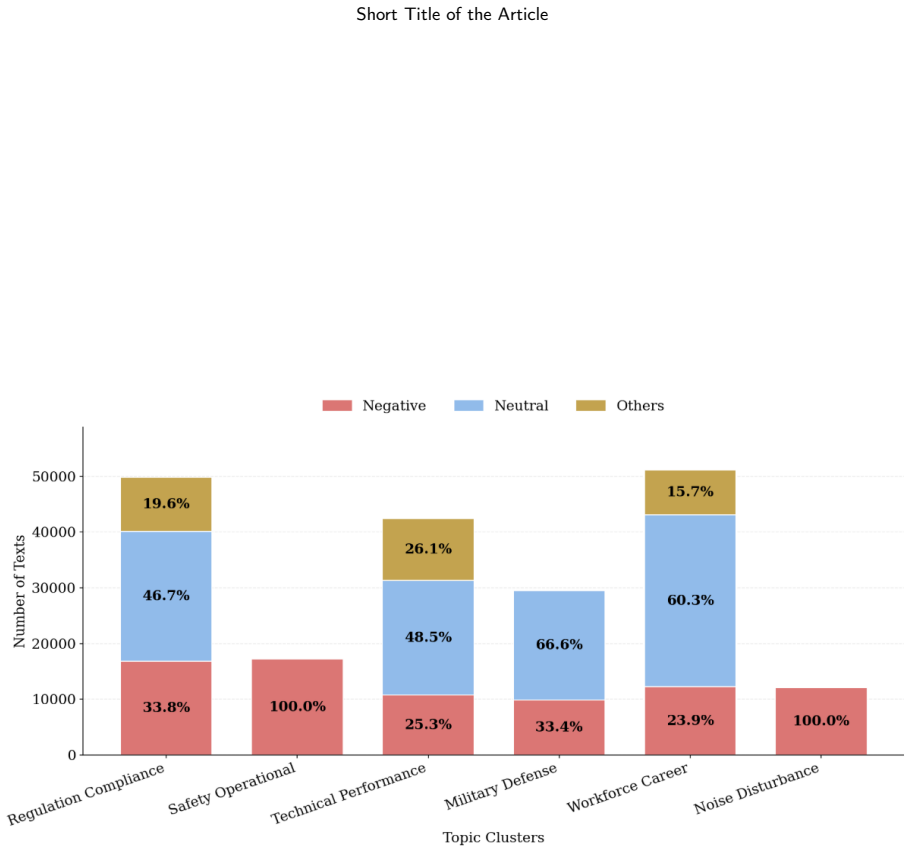
ModernBERT outperforms the other six models on AAM-specific classification; when its labels are used to drive per-sentiment LDA, the resulting topics collapse into six clusters whose shares are workforce and skill development (25.29 percent), regulation and compliance (24.64 percent), technical performance of drones (20.99 percent), military/geopolitics/defense (14.58 percent), safety and operational risks (8.51 percent), and noise and disturbance (5.98 percent).
What carries the argument
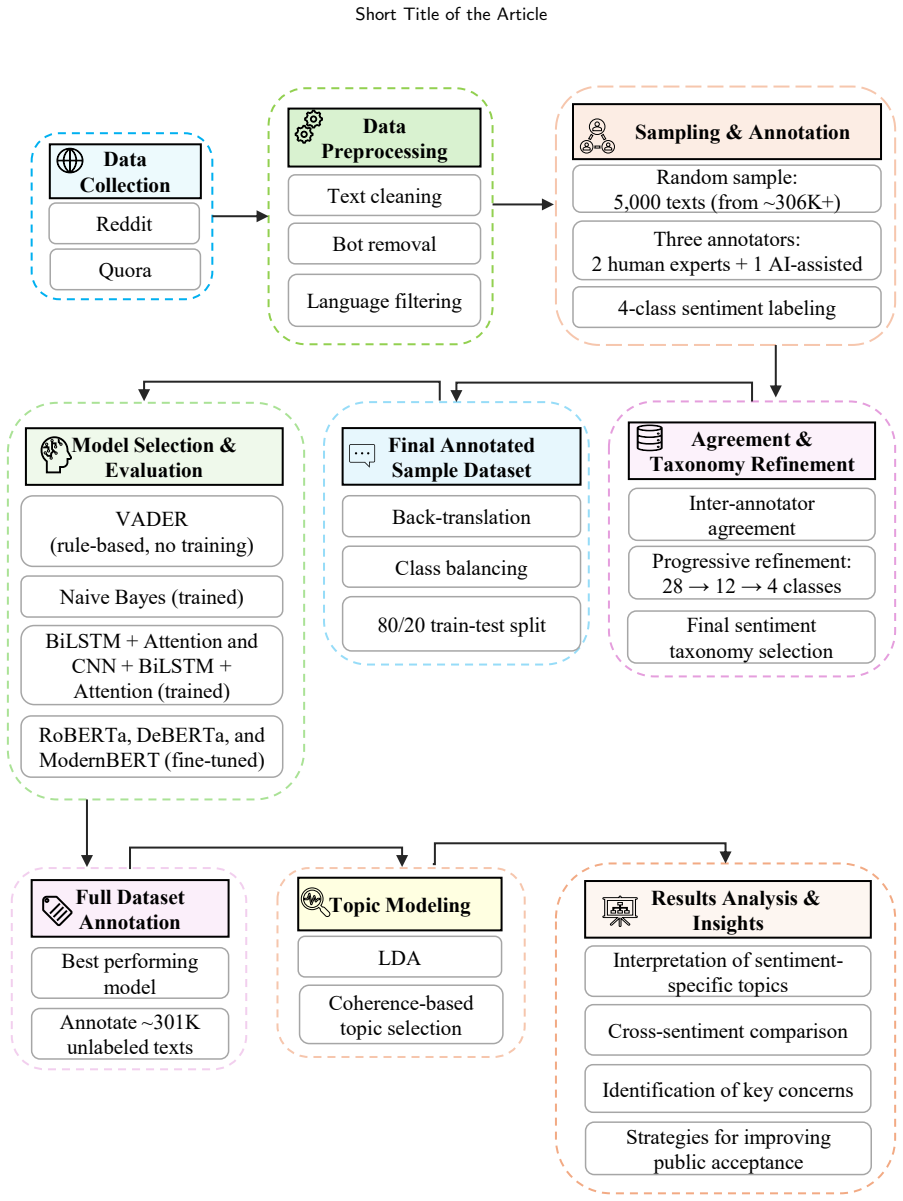
ModernBERT sentiment classifier feeding per-class Latent Dirichlet Allocation to extract and cross-tabulate 20 latent topics from 306,009 texts.
If this is right
- Targeted interventions on workforce training and regulatory clarity could address the two largest clusters and raise overall acceptance.
- Tracking topic evolution from 2008 to 2025 supplies a baseline for monitoring how public discourse shifts with real-world AAM deployments.
- Cross-sentiment topic breakdowns allow operators to distinguish concerns that appear mainly in negative posts from those that also appear in positive ones.
- The six-cluster map supplies a concrete checklist for government and industry communication strategies.
Where Pith is reading between the lines
- The same pipeline could be rerun on future data to test whether cluster shares change after regulatory milestones or first commercial flights.
- Comparing these online-derived clusters against structured survey instruments would quantify any selection bias in Reddit and Quora sources.
- Extending the method to other emerging transport technologies would show whether the same six concern types recur across domains.
Load-bearing premise
The collected Reddit and Quora texts form a representative sample of wider public opinion on AAM and that off-the-shelf models trained on general text transfer accurately to AAM language without domain-specific retraining or ground-truth validation.
What would settle it
A probability-sampled national survey that reports materially different shares for the six clusters or surfaces additional clusters not captured in the online corpus.
Figures
read the original abstract
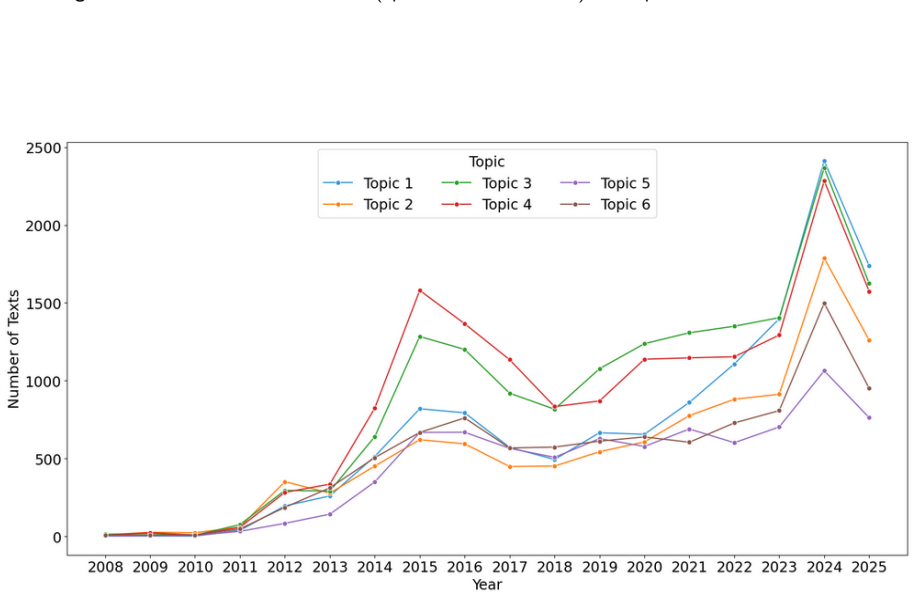
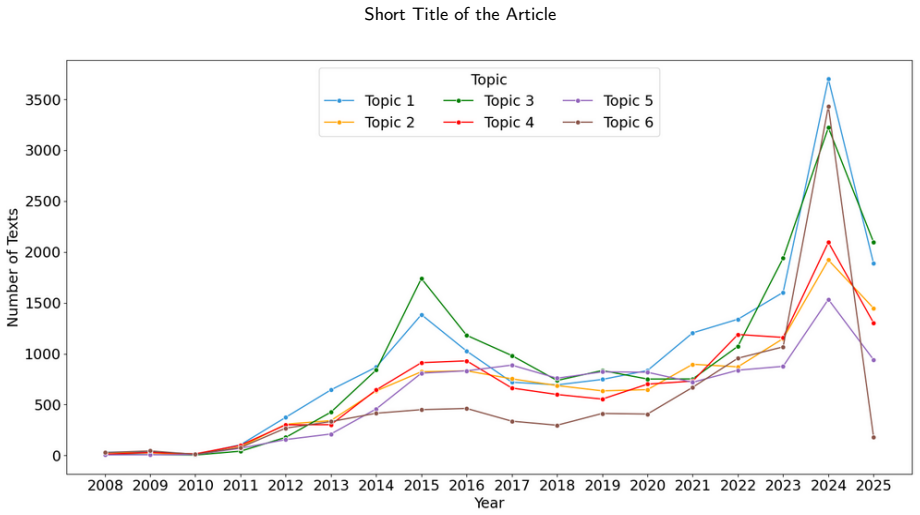
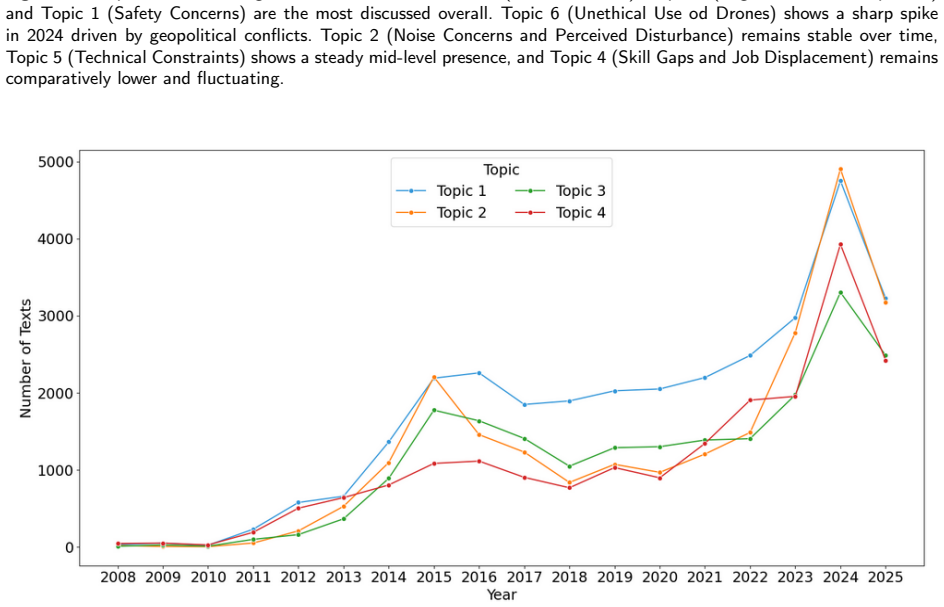
Advanced Air Mobility (AAM) is an emerging low-altitude air transportation system whose successful deployment depends not only on technological advancement but also on public acceptance. This acceptance will drive government support, regulations, noise standards, and willingness to fly, and in turn the overall commercial viability of AAM. Understanding public sentiment toward AAM is therefore essential for identifying its societal barriers and informing its adoption strategies. This study analyzes 306,009 human-generated texts collected from Reddit and Quora to examine public discourse on AAM using AI-based models. Because multiple sentiment analysis models exist, identifying the most accurate model is critical for reliable AAM sentiment prediction and trustworthy public opinion analysis. Accordingly, seven models spanning lexicon-based, machine learning, deep learning, and transformer-based approaches are evaluated for AAM-specific sentiment classification. ModernBERT achieves the best classification performance and is used to label the full dataset. Using the resulting sentiment labels, Latent Dirichlet Allocation (LDA) is applied within each sentiment class to uncover latent topics in public opinion. The analysis identifies 20 distinct topics and traces their temporal evolution from 2008 to 2025. A cross-sentiment topic analysis further reveals six major clusters of public concern: workforce and skill development (25.29% of the dataset), regulation and compliance (24.64%), technical performance of drones (20.99%), military, geopolitics, and defense (14.58%), safety and operational risks (8.51%), and noise and disturbance (5.98%). Based on these findings, this study provides actionable strategies to address these concerns, thereby, improving public acceptance and support AAM deployment.
Editorial analysis
A structured set of objections, weighed in public.
Referee Report
Summary. The manuscript analyzes 306,009 Reddit and Quora texts on Advanced Air Mobility (AAM). It evaluates seven sentiment models (lexicon-based through transformer-based) for AAM-specific classification, selects ModernBERT as best, labels the full corpus, applies LDA within each sentiment class to extract 20 topics, traces their evolution from 2008–2025, and reports six cross-sentiment clusters with exact percentages (workforce/skill development 25.29%, regulation/compliance 24.64%, technical performance 20.99%, military/geopolitics/defense 14.58%, safety/operational risks 8.51%, noise/disturbance 5.98%). Actionable strategies for improving public acceptance are derived from the clusters.
Significance. If the sentiment labels prove reliable on AAM text, the scale of the corpus and the temporal plus cross-sentiment topic analysis would supply concrete, policy-relevant evidence on societal barriers to AAM deployment. The explicit cluster percentages and the 2008–2025 trend analysis are potentially useful for regulators and industry.
major comments (3)
- [Abstract] Abstract and model-evaluation section: the claim that seven models were evaluated for AAM-specific sentiment classification and that ModernBERT was selected is unsupported by any performance numbers, train/test splits, error bars, or comparison against an AAM-held-out set. General-corpus accuracy does not establish transfer to AAM terminology (regulation, noise, workforce, geopolitics), rendering the downstream LDA topics and six-cluster percentages unreliable.
- [Results (topic clusters)] Topic-modeling and results sections: the reported cluster shares (e.g., workforce 25.29%, regulation 24.64%) and the 20-topic solution rest entirely on the unvalidated ModernBERT labels. Without a human-annotated AAM validation set, any reported accuracy on non-AAM data cannot confirm that the clusters capture genuine public concerns rather than label noise.
- [Methods] Methods (data and labeling pipeline): the 306,009 Reddit/Quora posts are treated as a representative sample of broader public sentiment, yet no domain-specific fine-tuning or ground-truth AAM labels are described. This assumption is load-bearing for all temporal-evolution and cross-sentiment claims.
minor comments (1)
- [Abstract] The abstract states the temporal range extends to 2025; the manuscript should explicitly state how posts dated after the current date were obtained or whether the range is a projection.
Simulated Author's Rebuttal
We thank the referee for the constructive and detailed feedback. We agree that the model evaluation and validation steps require substantially more documentation and empirical support to ensure the reliability of the sentiment labels and downstream topic clusters. We will revise the manuscript to address each of these points.
read point-by-point responses
-
Referee: [Abstract] Abstract and model-evaluation section: the claim that seven models were evaluated for AAM-specific sentiment classification and that ModernBERT was selected is unsupported by any performance numbers, train/test splits, error bars, or comparison against an AAM-held-out set. General-corpus accuracy does not establish transfer to AAM terminology (regulation, noise, workforce, geopolitics), rendering the downstream LDA topics and six-cluster percentages unreliable.
Authors: We agree that the current manuscript does not provide sufficient detail on the model evaluation. In the revised version we will add a dedicated model-evaluation subsection containing a comparison table for all seven models. The table will report accuracy, macro-F1, and other metrics on both general corpora and an AAM-specific held-out set (with train/test splits and confidence intervals). This will explicitly justify the selection of ModernBERT for the AAM domain and support the subsequent LDA and clustering results. revision: yes
-
Referee: [Results (topic clusters)] Topic-modeling and results sections: the reported cluster shares (e.g., workforce 25.29%, regulation 24.64%) and the 20-topic solution rest entirely on the unvalidated ModernBERT labels. Without a human-annotated AAM validation set, any reported accuracy on non-AAM data cannot confirm that the clusters capture genuine public concerns rather than label noise.
Authors: The referee is correct that the cluster percentages depend on the quality of the ModernBERT labels. We will add a human-validation experiment: a random sample of AAM posts will be independently annotated by multiple annotators for sentiment; we will report inter-annotator agreement and the agreement between ModernBERT predictions and human labels. These results will be presented before the LDA and cross-sentiment clustering sections so that readers can assess the reliability of the reported topic shares. revision: yes
-
Referee: [Methods] Methods (data and labeling pipeline): the 306,009 Reddit/Quora posts are treated as a representative sample of broader public sentiment, yet no domain-specific fine-tuning or ground-truth AAM labels are described. This assumption is load-bearing for all temporal-evolution and cross-sentiment claims.
Authors: We will revise the methods section to state explicitly that no domain-specific fine-tuning was performed and that the seven models were applied using their publicly released weights. A new limitations paragraph will discuss the representativeness of Reddit and Quora data, the lack of ground-truth AAM sentiment labels, and the implications for temporal and cross-sentiment analyses. We will also note that the scale of the corpus still provides useful evidence of online discourse even if it is not a perfect proxy for the general population. revision: yes
Circularity Check
Standard empirical pipeline with no circular derivation
full rationale
The paper describes a standard empirical workflow: evaluate seven off-the-shelf sentiment models on AAM-related text, select the best performer (ModernBERT), apply it to label 306k posts, then run LDA topic modeling and cluster analysis. No equations, fitted parameters, self-citations, or uniqueness theorems appear in the provided text that would reduce any claimed result to an input by construction. The central outputs (topic percentages, temporal trends) are downstream applications of the labeling step rather than self-referential derivations, satisfying the criteria for a non-circular empirical study.
Axiom & Free-Parameter Ledger
free parameters (1)
- number of topics
Reference graph
Works this paper leans on
-
[1]
Building a Performance Comparison Framework for Urban Air Mobility Airspace Management Concepts, in: 2023 IEEE/AIAA 42nd Digital Avionics Systems Conference (DASC), pp. 1–10. doi:10.1109/DASC58513.2023.10311113. Aeronautics, N., Administration, S.,
-
[2]
Available online: https://www.nasa.gov/aam
Advanced Air Mobility (AAM) Mission Overview. Available online: https://www.nasa.gov/aam. Ahmed,H.U.,Huang,Y.,Lu,P.,Bridgelall,R.,2022. Technologydevelopmentsandimpactsofconnectedandautonomousvehicles:Anoverview. Smart Cities 5, 382–404. doi:10.3390/smartcities5010022. Al Haddad, C., Chaniotakis, E., Straubinger, A., Plötner, K.O., Antoniou, C.,
-
[3]
Transportation Research Part A: Policy and Practice 132, 696–712
Factors affecting the adoption and use of urban air mobility. Transportation Research Part A: Policy and Practice 132, 696–712. doi:10.1016/j.tra.2019.12.020. Albalate, D., Bel, G.,
-
[4]
Public administration review 72, 336–349
High-speed rail: Lessons for policy makers from experiences abroad. Public administration review 72, 336–349. doi:10.1111/j.1540-6210.2011.02492.x. Altun, A.T., Hasanzade, M., Saldiran, E., Guner, G., Uzun, M., Fremond, R., Tang, Y., Bhundoo, P., Su, Y., Xu, Y., et al.,
-
[5]
doi:10.3390/aerospace10080712. Amelia,P.N.,Atiqah,N.B.,Hasibuan,A.,2026.PublicsentimentanalysisofgovernmentsubsidypoliciesonTwitterusingtheNaïveBayesclassifier. Journal of Intelligent Computing and Advanced Data Science 1, 1–15. Aposporis, P.,
-
[6]
Transportation Research Interdisciplinary Perspectives 24, 101064
A review of global and regional frameworks for the integration of an unmanned aircraft system in air traffic management. Transportation Research Interdisciplinary Perspectives 24, 101064. doi:https://doi.org/10.1016/j.trip.2024.101064. Artstein, R.,
-
[7]
URL:https://doi.org/10.1007/978-94-024-0881-2_11, doi:10.1007/ 978-94-024-0881-2_11
Inter-annotator agreement. URL:https://doi.org/10.1007/978-94-024-0881-2_11, doi:10.1007/ 978-94-024-0881-2_11. Artstein, R., Poesio, M.,
-
[8]
Technology in society 59, 101180
Public acceptance of drones: Knowledge, attitudes, and practice. Technology in society 59, 101180. doi:10.1016/j.techsoc. 2019.101180. Bahdanau, D., Cho, K., Bengio, Y.,
-
[9]
Bansal,P.,Kockelman,K.,Singh,A.,2016
doi:doi.org/10.3390/logistics4020012. Bansal,P.,Kockelman,K.,Singh,A.,2016. AssessingPublicOpinionsofandInterestinNewVehicleTechnologies. TransportationResearchPart C doi:10.1016/j.trc.2016.01.019. Barari, G., Janke, C., Lin, Y.,
-
[10]
doi:10.3390/admsci16010053. Batool,A.,Byun,Y.C.,2024.EnhancedSentimentAnalysisandTopicModelingDuringthePandemicUsingAutomatedLatentDirichletAllocation. IEEE Access 12, 81206–81220. doi:10.1109/ACCESS.2024.3411717. Bauranov, A., Rakas, J.,
-
[11]
Progress in Aerospace Sciences 125, 100726
Designing airspace for urban air mobility: A review of concepts and approaches. Progress in Aerospace Sciences 125, 100726. doi:10.1016/j.paerosci.2021.100726. Bengio, Y.,
-
[12]
Foundations and Trends in Machine Learning 2, 1–127
Learning deep architectures for ai. Foundations and Trends in Machine Learning 2, 1–127. doi:10.1561/2200000006. Bengio, Y., Simard, P., Frasconi, P.,
-
[13]
IEEE Transactions on Neural Networks 5, 157–166
Learning long-term dependencies with gradient descent is difficult. IEEE Transactions on Neural Networks 5, 157–166. doi:10.1109/72.279181. Bhaduri, E., Choudhury, C.F., 2026a. Shifting skies: A cross-country investigation of evolution of public perception toward urban air mobility through twitter (x) discourse. Journal of Air Transport Management 132, 10...
-
[14]
Journal of Machine Learning Research 3, 993–1022
Latent Dirichlet Allocation. Journal of Machine Learning Research 3, 993–1022. Butterworth-Hayes,P.,2024. Easapublishescompletedpackageofadvancedairmobilityregulations. URL:https://www.unmannedairspace. info/uncategorized/easa-publishes-completed-package-of-advanced-air-mobility-regulations/. published: May 24, 2024; Accessed: 2026-05-14. Cartile, A., Mar...
2024
-
[15]
Cero, I., Luo, J., Falligant, J.M.,
doi:10.3390/aerospace12080724. Cero, I., Luo, J., Falligant, J.M.,
-
[16]
Perspectives on behavior science 47, 283–310
Lexicon-based sentiment analysis in behavioral research. Perspectives on behavior science 47, 283–310. doi:10.1007/s40614-023-00394-x. Chancey,E.T.,Politowicz,M.,2020a.DesigningandTrainingforAppropriateTrustinIncreasinglyAutonomousAdvancedAirMobilityOperations: A Mental Model Approach: Version
-
[17]
National Aeronautics and Space Administration (NASA)
Technical Memorandum. National Aeronautics and Space Administration (NASA). NASA Document ID: 20205003378. Chancey, E.T., Politowicz, M.S., 2020b. Public trust and acceptance for concepts of remotely operated urban air mobility transportation, in: Proceedings of the Human Factors and Ergonomics Society Annual Meeting, pp. 1516–1520. doi:10.1177/1071181320...
-
[18]
Risk Perception and the Public Acceptance of Drones. Risk analysis 35, 1167–1183. doi:10.1111/risa.12330. Cohen, A.P., Shaheen, S.A., Farrar, E.M.,
-
[19]
IEEE Transactions on Intelligent Transportation Systems 22, 6074–6087
Urban air mobility: History, ecosystem, market potential, and challenges. IEEE Transactions on Intelligent Transportation Systems 22, 6074–6087. doi:10.1109/TITS.2021.3082767. Collobert, R., Weston, J., Bottou, L., Karlen, M., Kavukcuoglu, K., Kuksa, P.,
-
[20]
URL:https://adamconnell.me/reddit-statistics/
Reddit user age, gender, and demographics statistics (2026). URL:https://adamconnell.me/reddit-statistics/. accessed: 2026-05-14. Current Trends,
2026
-
[21]
After twitter: How fragmented social media is rebuilding the online public square. URL:https://www.currenttrends. news/2026/01/after-twitter-how-fragmented-social.html. accessed: 2026-05-14. Dällenbach,N.,Wüstenhagen,R.,2022. Howfardonoiseconcernstravel?exploringhowfamiliarityandjusticeshapenoiseexpectationsandsocial acceptanceofplannedwindenergyprojects....
-
[22]
Journal of the American Society for Information Science 41, 391–407
Indexing by latent semantic analysis. Journal of the American Society for Information Science 41, 391–407. doi:10.1002/(SICI)1097-4571(199009)41:6<391::AID-ASI1>3.0.CO;2-9. Demszky, D., Movshovitz-Attias, D., Ko, J., Cowen, A., Nemade, G., Ravi, S.,
-
[23]
GoEmotions: A Dataset of Fine-Grained Emotions, in: Proceedings of the 58th Annual Meeting of the Association for Computational Linguistics, Association for Computational Linguistics, Online. pp. 4040–4054. URL:https://www.aclweb.org/anthology/2020.acl-main.372. Deng, S., Sinha, A.P., Zhao, H.,
2020
-
[24]
Decision Support Systems 94, 65–76
Adapting sentiment lexicons to domain-specific social media texts. Decision Support Systems 94, 65–76. doi:10.1016/j.dss.2016.11.001. Devlin, J., Chang, M.W., Lee, K., Toutanova, K.,
-
[25]
BERT: Pre-training of Deep Bidirectional Transformers for Language Understanding, in: NAACL-HLT, Minneapolis, Minnesota, USA. pp. 4171–4186. DiBattista,A.,Grayling,S.,Hasselaar,E.,Leopold,T.,Li,R.,Rayner,M.,Zahidi,S.,2023. Futureofjobsreport2023,in:WorldEconomicForum, World Economic Forum Geneva, Switzerland, Geneva, Switzerland. pp. 978–2. Dolata, M., Sc...
2023
-
[26]
Government Information Quarterly 40, 101874
Moving beyond privacy and airspace safety: Guidelines for just drones in policing. Government Information Quarterly 40, 101874. doi:10.1016/j.giq.2023.101874. Doo,J.T.,Pavel,M.D.,Didey,A.,Hange,C.,Diller,N.P.,Tsairides,M.A.,Smith,M.,Bennet,E.,Bromfield,M.,Mooberry,J.,2021. NASAElectric Vertical Takeoff and Landing (eVTOL) Aircraft Technology for Public Se...
-
[27]
Transportation research part A: policy and practice 46, 1241–1251
The influence of individual’s risk perception and attitudes on travel behavior. Transportation research part A: policy and practice 46, 1241–1251. doi:https://doi.org/10.1016/j.tra.2012.05.013. Elman, J.L.,
-
[28]
Finding Structure in Time. Cognitive Science 14, 179–211. doi:10.1207/s15516709cog1402\_1. European Union Aviation Safety Agency (EASA),
-
[29]
URL:https://www.easa.europa.eu/en/domains/ drones-air-mobility/drones-air-mobility-landscape/urban-air-mobility-uam
Urban air mobility (uam). URL:https://www.easa.europa.eu/en/domains/ drones-air-mobility/drones-air-mobility-landscape/urban-air-mobility-uam. accessed: 2026-05-14. Fein, D.J.,
2026
-
[30]
Psychological Bulletin 76, 378–382
Measuring nominal scale agreement among many raters. Psychological Bulletin 76, 378–382. doi:10.1037/h0031619. Fu, S., Avdelidis, N.P.,
-
[31]
Furman, B., Fabian, L., Ellis, S., Muller, P., Swenson, R.,
doi:10.3390/s23198124. Furman, B., Fabian, L., Ellis, S., Muller, P., Swenson, R.,
-
[32]
Journal of Medical Internet Research 22, e16649
Public Perception of Artificial Intelligence in Medical Care: Content Analysis of Social Media. Journal of Medical Internet Research 22, e16649. doi:10.2196/16649. Gao, Z., Yu, Y., Wei, Q., Topcu, U., Clarke, J.P.,
-
[33]
Transportation Research Part C: Emerging Technologies 165, 104740
Noise-aware and equitable urban air traffic management: An optimization approach. Transportation Research Part C: Emerging Technologies 165, 104740. doi:10.1016/j.trc.2024.104740. Garcia, J.S., Truong, D., Hampton, S., Winter, S.R., Echevarne, R., Stolzer, A.J.,
-
[34]
Transportation Research Interdisciplinary Perspectives 36, 101836
Governance and effectiveness in aviation safety oversight: A structural model analysis. Transportation Research Interdisciplinary Perspectives 36, 101836. doi:10.1016/j.trip.2026.101836. Gers, F.A., Schmidhuber, J., Cummins, F.,
-
[35]
Neural Computation 12, 2451–2471
Learning to Forget: Continual Prediction with LSTM. Neural Computation 12, 2451–2471. doi:10.1162/089976600300015015. Giladi, R.,
-
[36]
Transportation Research Part D: Transport and Environment 87, 102527
Real-time identification of aircraft sound events. Transportation Research Part D: Transport and Environment 87, 102527. doi:10.1016/j.trd.2020.102527. Go, A., Bhayani, R., Huang, L.,
-
[37]
doi:10.3390/engproc2024080038. Hamilton,W.L.,Clark,K.,Leskovec,J.,Jurafsky,D.,2016.InducingDomain-SpecificSentimentLexiconsfromUnlabeledCorpora,in:Proceedings of the 2016 conference on empirical methods in natural language processing, Austin, TX, USA. pp. 595–605. Hasan, K.U.,
-
[38]
URL:https://thebatterytips.com/ battery-specifications/are-drones-battery-operated/
Are drones battery operated? insights on energy sources and lifespan challenges. URL:https://thebatterytips.com/ battery-specifications/are-drones-battery-operated/. accessed: 2026-05-14. Hatzivassiloglou, V., McKeown, K.,
2026
-
[39]
Predicting the Semantic Orientation of Adjectives, in: Proceedings of ACL, pp. 174–181. He, P., Liu, X., Gao, J., Chen, W., 2021a. DeBERTa: Decoding-enhanced BERT with Disentangled Attention. URL:https://arxiv.org/abs/ 2006.03654,arXiv:2006.03654. He, P., et al., 2021b. DeBERTa: Decoding-enhanced BERT with disentangled attention, in: ICLR. doi:10.48550/ar...
work page internal anchor Pith review Pith/arXiv arXiv doi:10.48550/arxiv.2006.03654 2006
-
[40]
Chinese Journal of Aeronautics 38, 103233
A methodology for aircraft mission effectiveness evaluation and design space exploration based on virtual operational test. Chinese Journal of Aeronautics 38, 103233. doi:10.1016/j.cja.2024.09.009. Hu, M., Liu, B.,
-
[41]
Mining and summarizing customer reviews, in: Proceedings of the Tenth ACM SIGKDD International Conference on Knowledge Discovery and Data Mining, Association for Computing Machinery, New York, NY, USA. p. 168–177. URL:https://doi.org/ 10.1145/1014052.1014073, doi:10.1145/1014052.1014073. Hugging Face, Accessed: Mar
-
[42]
Languages Supported on Hugging Face.https://huggingface.co/languages. Hutto,C.,Gilbert,E.,2014a.Vader:Aparsimoniousrule-basedmodelforsentimentanalysisofsocialmediatext,in:Proceedingsoftheinternational AAAI conference on web and social media, pp. 216–225. doi:10.1609/icwsm.v8i1.14550. Hutto, C., Gilbert, E., 2014b. VADER: A Parsimonious Rule-Based Model fo...
-
[43]
accessed: 2026-05-14
URL:https://www.quantumrun.com/consulting/ twitter-users-statistics/. accessed: 2026-05-14. Jalandharachari, A., Bindhani, S., Kasodhan, P., Harish, D., Murthy, B.R., et al.,
2026
-
[44]
Journal of the Air Transport Research Society , 100104doi:10.1016/j.jatrs.2026
Integrating digital competency into aviation training: An auditable inputs–processes–outcomes framework. Journal of the Air Transport Research Society , 100104doi:10.1016/j.jatrs.2026. 100104. Jenkins, A.,
-
[45]
International Journal of Lifelong Education 40, 215–228
Patterns of participation and non-participation in learning in mid-life and their determinants. International Journal of Lifelong Education 40, 215–228. doi:10.1080/02601370.2021.1937357. Jeong,D.,Hwang,S.,Kim,J.,Yu,H.,Park,E.,2023. Publicperspectiveonrenewableandotherenergyresources:Evidencefromsocialmediabig data and sentiment analysis. Energy Strategy ...
-
[46]
Deep Pyramid Convolutional Neural Networks for Text Categorization, in: Proceedings of the 55th Annual Meeting of the Association for Computational Linguistics (Volume 1: Long Papers), Vancouver, Canada. doi:10.18653/v1/P17-1052. Johnson, W., Silva, C.,
-
[47]
Kelemen,M.,Polishchuk,V.,Sabo,J.,2023
Impact of Technology and Mission Variations on Aircraft Designed for Advanced Air Mobility, in: 13th Annual Electric VTOL Symposium, San Jose, CA, USA. Kelemen,M.,Polishchuk,V.,Sabo,J.,2023. AHybridModelforEvaluatingtheOutcomesofStudentPilotswithintheDidacticSystemofAviation Education. Aerospace
2023
-
[48]
Kiesewetter, L., Shakib, K.H., Singh, P., Rahman, M., Khandelwal, B., Kumar, S., Shah, K.,
doi:10.3390/aerospace10030281. Kiesewetter, L., Shakib, K.H., Singh, P., Rahman, M., Khandelwal, B., Kumar, S., Shah, K.,
-
[49]
Progress in Aerospace Sciences 142, 100949
A holistic review of the current state of research on aircraft design concepts and consideration for advanced air mobility applications. Progress in Aerospace Sciences 142, 100949. doi:10.1016/j.paerosci.2023.100949. Kim, Y., 2014a. Convolutional Neural Networks for Sentence Classification, in: EMNLP, Doha, Qatar. Kim,Y.,2014b. Convolutionalneuralnetworks...
-
[50]
Unmanned aircraft system traffic management (UTM) concept of operations, in: AIAA Aviation Forum and Exposition, Washington, DC, US. NASA Document ID: 20190000370. Kumar,A.,Abhishek,K.,ShafeeqBM,A.,2025.SentXFormer:atransformer-enhancedhybriddeeplearningframeworkforcross-domainsentiment analysis of customer reviews. Scientific Reports doi:10.1038/s41598-0...
-
[51]
URL:https://arxiv.org/abs/1909.11942,arXiv:1909.11942
ALBERT: A Lite BERT for Self-supervised Learning of Language Representations. URL:https://arxiv.org/abs/1909.11942,arXiv:1909.11942. LeCun, Y., Bengio, Y., Hinton, G.,
Pith/arXiv arXiv 1909
-
[52]
Deep learning. Nature 521, 436–444. doi:10.1038/nature14539. Lee,C.,Bae,B.,Lee,Y.L.,Pak,T.Y.,2023. Societalacceptanceofurbanairmobilitybasedonthetechnologyadoptionframework. Technological Forecasting and Social Change 196, 122807. doi:10.1016/j.techfore.2023.122807. Lee, D.D., Seung, H.S.,
-
[53]
Learning the Parts of Objects by Non-negative Matrix Factorization. Nature 401, 788–791. doi:10.1038/44565. Li, Q.,
-
[54]
Research on Text Sentiment Classification and Recognition Based on Improved BiLSTM and TextCNN, in: 2024 2nd International Conference on Mechatronics, IoT and Industrial Informatics (ICMIII), IEEE. pp. 210–219. doi:10.1109/ICMIII62623.2024.00046. Li, W., Hu, X., Liu, Y.,
-
[55]
Joint sentiment/topic model for sentiment analysis, in: Proceedings of the 18th ACM Conference on Information and Knowledge Management, Association for Computing Machinery, New York, NY, USA. p. 375–384. URL:https://doi.org/10.1145/ 1645953.1646003, doi:10.1145/1645953.1646003. Lindhout,P.,Reniers,G.,2022. The“TransparencyforSafety”Triangle:DevelopingaSma...
-
[56]
Morgan & Claypool
Sentiment Analysis and Opinion Mining. Morgan & Claypool. Liu,J.,Sun,S.,Tang,K.,Fan,X.,Lv,J.,Fu,Y.,Feng,X.,Zeng,L.,2025. IoT-BasedAirportNoisePerceptionandMonitoring:Multi-SourceData Fusion, Spatial Distribution Modeling, and Analysis. Sensors 25,
2025
-
[57]
RoBERTa: A Robustly Optimized BERT Pretraining Approach
doi:10.3390/s25082347. Liu,Y.,Ott,M.,Goyal,N.,Du,J.,Joshi,M.,Chen,D.,Levy,O.,Lewis,M.,Zettlemoyer,L.,Stoyanov,V.,2019. RoBERTa:ARobustlyOptimized BERT Pretraining Approach, in: arXiv preprint arXiv:1907.11692. doi:10.48550/arXiv.1907.11692. Liu, Z., Wang, Y., Kasai, J., Hajishirzi, H., Smith, N.A.,
work page internal anchor Pith review Pith/arXiv arXiv doi:10.3390/s25082347 2019
-
[58]
Probing Across Time: What Does RoBERTa Know and When?, in: Findings of the Association for Computational Linguistics: EMNLP 2021, Punta Cana, Dominican Republic. pp. 820–842. Madigan, R., Louw, T., Wilbrink, M., Schieben, A., Merat, N.,
2021
-
[59]
Transportation Research Part F: Traffic Psychology and Behaviour 50, 55–64
What influences the decision to use automated public transport? using utaut to understand public acceptance of automated road transport systems. Transportation Research Part F: Traffic Psychology and Behaviour 50, 55–64. doi:10.1016/j.trf.2017.07.007. Mankins, J.C.,
-
[60]
Acta Astronautica 65, 1216–1223
Technology readiness assessments: A retrospective. Acta Astronautica 65, 1216–1223. doi:10.1016/j.actaastro.2009. 03.058. Mao, Y., Liu, Q., Zhang, Y.,
-
[61]
Journal of King Saud University-Computer and Information Sciences 36, 102048
Sentiment analysis methods, applications, and challenges: A systematic literature review. Journal of King Saud University-Computer and Information Sciences 36, 102048. doi:10.1016/j.jksuci.2024.102048. Marini,L.,Tonetti,M.S.,Nibali,L.,Rojas,M.A.,Aimetti,M.,Cairo,F.,Cavalcanti,R.,Crea,A.,Ferrarotti,F.,Graziani,F.,etal.,2021. Thestaging and grading system i...
-
[62]
Journal of Infection and Public Health 14, 1505–1512
Public sentiment analysis and topic modeling regarding covid-19 vaccines on the reddit social media platform: A call to action for strengthening vaccine confidence. Journal of Infection and Public Health 14, 1505–1512. doi:https://doi.org/10.1016/j.jiph.2021.08.010. Michel, A.H., Gettinger, D.,
-
[63]
URL:https://dronecenter.bard.edu/2015-drone-year-in-review/
2015 Drone Year in Review. URL:https://dronecenter.bard.edu/2015-drone-year-in-review/. accessed: 2026-04-02. Minaee,S.,Kalchbrenner,N.,Cambria,E.,Nikzad,N.,Chenaghlu,M.,Gao,J.,2021. DeepLearning–basedTextClassification:AComprehensive Review. ACM Computing Surveys
2015
-
[64]
doi:10.1145/3439726. Moons, F., Vandervieren, E.,
-
[65]
doi:10.3758/s13428-025-02746-8. Mullen, T., Collier, N.,
-
[66]
Accident Analysis & Prevention 159, 106228
How can regulatory authorities improve safety in organizations by influencing safety culture? A conceptual model of the relationships and a discussion of implications. Accident Analysis & Prevention 159, 106228. doi:10.1016/j.aap. 2021.106228. First Author et al.:Preprint submitted to ElsevierPage 35 of 38 Short Title of the Article Nakshi, P., Palm, M., ...
-
[67]
Transportation Research Record , 03611981251378483doi:10.1177/03611981251378483
Using Questionnaires to Identify Travel Barriers: How (Not) to Ask Questions. Transportation Research Record , 03611981251378483doi:10.1177/03611981251378483. National Academies of Sciences, Engineering, and Medicine,
-
[68]
Built Environment Project and Asset Management 14, 278–295
Significant risks that trigger cost overruns and delays in urban rail projects: a typical case study of Vietnam. Built Environment Project and Asset Management 14, 278–295. doi:10.1108/BEPAM-01-2023-0027. Nguyen, T.H., Shirai, K., Velcin, J.,
-
[69]
Expert Systems with Applications 42, 9603–9611
Sentiment analysis on social media for stock movement prediction. Expert Systems with Applications 42, 9603–9611. doi:10.1016/j.eswa.2015.07.052. Nilsson,S.,2024. AdvancedAirMobility(AAM)isComingtoaTownNearYou...AreYouReady?,in:UASSummit&Expo,GrandForks,North Dakota, USA. Noori, B.,
-
[70]
Applied Artificial Intelligence 35, 567–588
Classification of Customer Reviews Using Machine Learning Algorithms. Applied Artificial Intelligence 35, 567–588. doi:10.1080/08839514.2021.1922843. Nordhoff,S.,deWinter,J.,Kyriakidis,M.,vanArem,B.,Happee,R.,2019. Amused,accepted,andused?attitudesandemotionstowardsautomated vehicles, their relationships, and predictive value for usage intention. Transpor...
-
[71]
Paris: Organisation for Economic Co-operation and Development doi:10.1787/9789264311756-en
Getting Skills Right: Future-Ready Adult Learning Systems. Paris: Organisation for Economic Co-operation and Development doi:10.1787/9789264311756-en. OpenAI,
-
[72]
Accessed: 2026-03-
OpenAI API Documentation.https://platform.openai.com/docs/api-reference/introduction. Accessed: 2026-03-
2026
-
[73]
AMachineLearning-BasedUsabilityEvaluationMethodforeLearningSystems
Oztekin,A.,Zaim,S.,Delen,D.,2013. AMachineLearning-BasedUsabilityEvaluationMethodforeLearningSystems. DecisionSupportSystems 56, 63–73. doi:10.1016/j.dss.2013.05.003. Pang, B., Lee, L., Vaithyanathan, S.,
-
[74]
Thumbs up? sentiment classification using machine learning techniques, in: Proceedings of the 2002 Conference on Empirical Methods in Natural Language Processing (EMNLP 2002), Association for Computational Linguistics. pp. 79–86. doi:10.3115/1118693.1118704. Park, E., Lee, K., Han, T., Nam, H.S.,
-
[75]
Pongsakornsathien,N.,Safwat,N.E.D.,Xie,Y.,Gardi,A.,Sabatini,R.,2025
doi:10.3390/jpm12010020. Pongsakornsathien,N.,Safwat,N.E.D.,Xie,Y.,Gardi,A.,Sabatini,R.,2025. Advancesinlow-altitudeairspacemanagementforuncrewedaircraft and advanced air mobility. Progress in Aerospace Sciences 154, 101085. doi:10.1016/j.paerosci.2025.101085. Pons-Prats, J., Živojinović, T., Kuljanin, J.,
-
[76]
TransportationResearchPartE:LogisticsandTransportationReview166,102868
On the understanding of the current status of urban air mobility development and its future prospects:Commutinginaflyingvehicleasanewparadigm. TransportationResearchPartE:LogisticsandTransportationReview166,102868. doi:10.1016/j.tre.2022.102868. Poria,S.,Cambria,E.,Gelbukh,A.,2017. Context-DependentSentimentAnalysisinUser-GeneratedVideos. ACLdoi:10.18653/...
-
[77]
Accessed 2026-03-03
PRAW Documentation.https://praw.readthedocs.io. Accessed 2026-03-03. PublicCEO,
2026
-
[78]
URL:https://www.publicceo.com/2016/03/ drones-a-growing-hazard-in-the-absence-of-tighter-regulations/
Drones: A growing hazard in the absence of tighter regulations. URL:https://www.publicceo.com/2016/03/ drones-a-growing-hazard-in-the-absence-of-tighter-regulations/. Qiu, G., Liu, B., Bu, J., Chen, C.,
2016
-
[79]
Computational Linguistics 37, 9–27
Opinion Word Expansion and Target Extraction through Double Propagation. Computational Linguistics 37, 9–27. doi:10.1162/coli_a_00034. Quora Inc.,
-
[80]
Raza,W.,Renkhoff,J.,Ogirimah,O.,Bawa,G.K.,Stansbury,R.S.,2025
Quora for Business.https://business.quora.com/. Raza,W.,Renkhoff,J.,Ogirimah,O.,Bawa,G.K.,Stansbury,R.S.,2025. AdvancedAirMobility:Innovations,Applications,Challenges,andFuture Potential. Journal of Air Transportation 33, 169–187. doi:10.2514/1.D0440. Reddit Inc.,
discussion (0)
Sign in with ORCID, Apple, or X to comment. Anyone can read and Pith papers without signing in.