Warm fermionic dark matter from freeze-in at stronger coupling
Pith reviewed 2026-06-26 16:25 UTC · model grok-4.3
The pith
Fermionic warm dark matter via Higgs-portal freeze-in requires higher reheating temperatures than scalar cases because production is velocity-suppressed.
A machine-rendered reading of the paper's core claim, the machinery that carries it, and where it could break.
Core claim
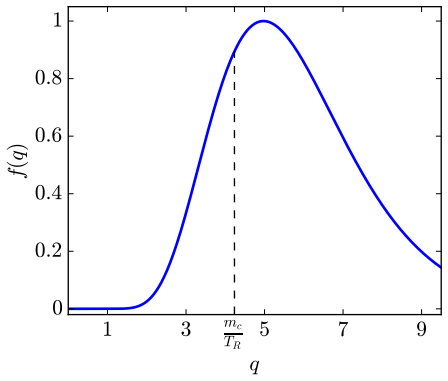
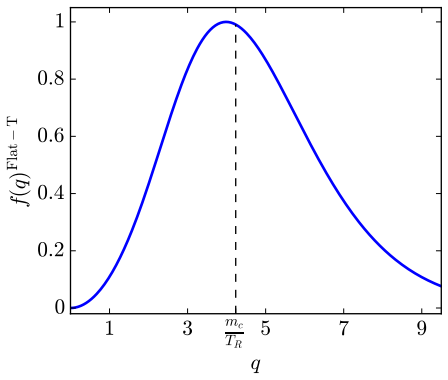
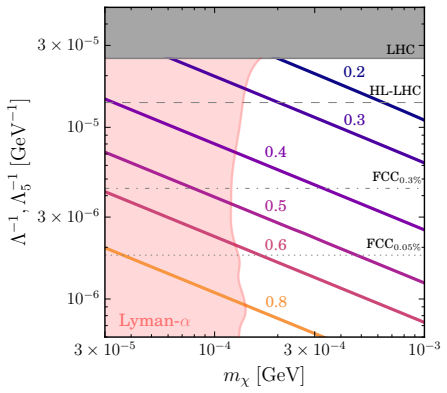
In the minimal Higgs portal, fermionic dark matter production is velocity suppressed, so the correct relic abundance requires larger reheating temperatures than those sufficient for scalar dark matter; the resulting momentum distribution is strongly non-thermal and outside the range captured by the common αβγ parametrization, while Lyman-α observations exclude masses below 100-180 keV depending on reheating history.
What carries the argument
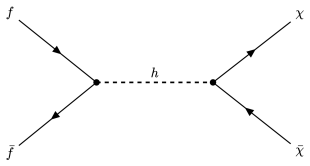
The velocity-suppressed fermionic production reaction in the Higgs portal that enables freeze-in at stronger coupling under low reheating temperatures.
If this is right
- Larger reheating temperatures are required to match the observed relic abundance.
- The dark matter momentum distribution is strongly non-thermal and not captured by the αβγ parametrization.
- Lyman-α forest observations exclude dark matter masses below about 100-180 keV depending on reheating history.
- Invisible Higgs decays become potentially observable because the coupling can be larger while still satisfying the out-of-equilibrium condition.
Where Pith is reading between the lines
- The non-thermal distribution could produce distinct signatures in small-scale structure formation beyond the Lyman-α bound.
- Collider searches for invisible Higgs decays could directly probe the coupling values allowed by this production mechanism.
- Similar velocity suppression may appear in other fermionic freeze-in models, altering mass bounds across a wider range of portals.
Load-bearing premise
The reheating temperature is low enough that dark matter production from the Standard Model thermal bath remains Boltzmann-suppressed and the dark matter stays out of equilibrium.
What would settle it
A measurement showing that the momentum distribution of warm fermionic dark matter follows the αβγ parametrization or that a particle with mass below 100 keV accounts for the full relic density would contradict the central claim.
Figures

read the original abstract
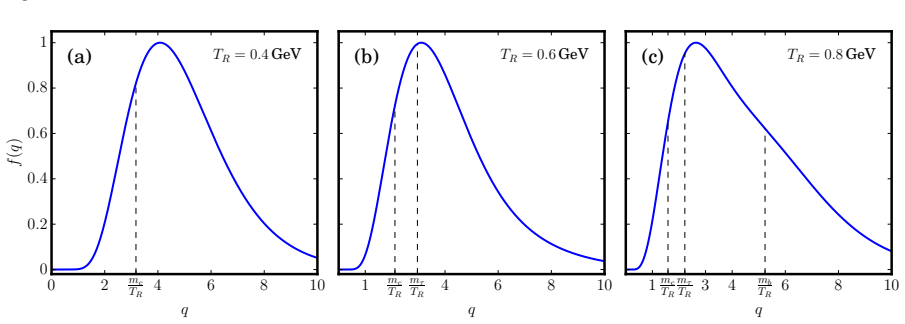
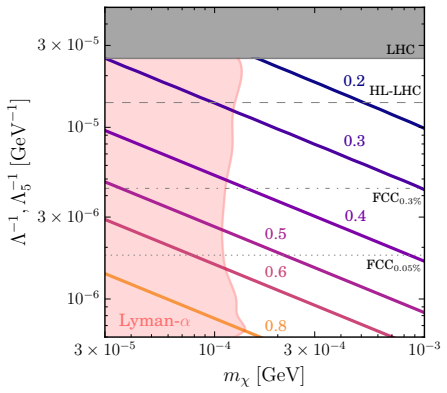
We study warm fermionic dark matter (DM) in the framework of freeze-in at stronger coupling, in the minimal Higgs portal scenario. The reheating temperature is taken to be low, so that DM production from the Standard Model thermal bath is Boltzmann-suppressed and the DM stays out of equilibrium even for a sizeable coupling. This opens the possibility of observable signatures, in particular invisible Higgs decays. We compute the DM relic abundance including both the pre- and post-reheating contributions. We find that the fermionic DM production reaction is strongly velocity suppressed, requiring larger reheating temperatures than those obtained for scalar DM in order to reproduce the correct relic abundance. The resulting DM momentum distribution is strongly non-thermal and its shape is not captured by the common $\alpha\beta\gamma$-parametrization. We find that the Lyman-$\alpha$ constraint excludes DM masses below about $100 -180\,\mathrm{keV}$, depending on the reheating history.
Editorial analysis
A structured set of objections, weighed in public.
Referee Report
Summary. The manuscript examines warm fermionic dark matter produced via freeze-in in the minimal Higgs-portal model, taking a low reheating temperature so that production remains Boltzmann-suppressed and the DM stays out of equilibrium despite a sizeable coupling. The relic abundance is computed including both pre- and post-reheating contributions; the fermionic production channel is found to be strongly velocity-suppressed, requiring higher reheating temperatures than for scalar DM to match the observed density. The resulting momentum distribution is strongly non-thermal and is shown not to be captured by the standard αβγ parametrization. Lyman-α constraints are applied, excluding DM masses below 100–180 keV depending on reheating history.
Significance. If the out-of-equilibrium condition is satisfied for the parameter choices needed to reproduce the relic density, the work supplies a concrete, calculable example of warm fermionic DM whose momentum distribution can be directly confronted with structure-formation data and which admits potentially observable invisible Higgs decays. The explicit demonstration that the distribution deviates from the αβγ form is a useful technical contribution.
major comments (2)
- [framework condition (abstract and §2)] The central framework assumption—that DM remains out of equilibrium even at the larger couplings and reheating temperatures required by velocity suppression—is load-bearing for both the relic calculation and the momentum distribution used for Lyman-α bounds, yet no explicit verification that Γ_DM(T) < H(T) holds throughout the relevant epoch for the benchmark points is provided.
- [§4] §4 (relic abundance computation): the pre- and post-reheating contributions are added after fitting the coupling and T_reh to Ω_DM; it is not shown that the same parameters simultaneously satisfy the out-of-equilibrium requirement used to justify the freeze-in treatment itself.
minor comments (2)
- [Lyman-α section] The range 100–180 keV for the Lyman-α bound should be accompanied by a brief statement of the precise velocity-distribution moments or transfer-function cutoff used to obtain the two ends of the interval.
- [production rate] Notation for the velocity-suppression factor in the production rate should be defined once in the text rather than only in a figure caption.
Simulated Author's Rebuttal
We thank the referee for the careful reading and constructive comments. We agree that explicit verification of the out-of-equilibrium condition is required to substantiate the freeze-in treatment for the benchmark points and will add this to the revised manuscript.
read point-by-point responses
-
Referee: [framework condition (abstract and §2)] The central framework assumption—that DM remains out of equilibrium even at the larger couplings and reheating temperatures required by velocity suppression—is load-bearing for both the relic calculation and the momentum distribution used for Lyman-α bounds, yet no explicit verification that Γ_DM(T) < H(T) holds throughout the relevant epoch for the benchmark points is provided.
Authors: We agree that an explicit check of Γ_DM(T) < H(T) for the benchmark points is necessary. In the revised version we will add a figure and accompanying text in §2 (or an appendix) showing the ratio Γ_DM(T)/H(T) for the fitted parameters across the production epoch, confirming that the out-of-equilibrium condition is satisfied. revision: yes
-
Referee: [§4] §4 (relic abundance computation): the pre- and post-reheating contributions are added after fitting the coupling and T_reh to Ω_DM; it is not shown that the same parameters simultaneously satisfy the out-of-equilibrium requirement used to justify the freeze-in treatment itself.
Authors: We acknowledge that the manuscript does not demonstrate simultaneous satisfaction of the relic-density fit and the out-of-equilibrium condition. We will revise §4 to include this verification, showing that the parameters chosen to reproduce Ω_DM also satisfy Γ_DM(T) < H(T) throughout the relevant temperature range. revision: yes
Circularity Check
No significant circularity; central results follow from explicit integration under stated assumptions
full rationale
The paper assumes a low reheating temperature that keeps production Boltzmann-suppressed and DM out of equilibrium (abstract), then integrates the production rate for fermions to obtain the relic density and momentum distribution. The velocity suppression, non-thermal shape, and Lyman-α bound are direct numerical outcomes of that integration rather than redefinitions or self-citations. No equation or claim reduces by construction to a fitted input renamed as a prediction, and the framework condition is an explicit premise rather than a derived result.
Axiom & Free-Parameter Ledger
free parameters (3)
- Higgs portal coupling
- Reheating temperature
- DM mass
axioms (2)
- domain assumption Minimal Higgs-portal interaction between the fermion and the SM Higgs doublet
- domain assumption Standard Boltzmann suppression at low reheating temperature keeps DM out of equilibrium
Reference graph
Works this paper leans on
-
[1]
E. W. Kolb and M. S. Turner,The Early Universe, vol. 69. Taylor and Francis, 5, 2019
2019
-
[2]
Gondolo and G
P. Gondolo and G. Gelmini,Cosmic abundances of stable particles: Improved analysis, Nucl. Phys. B360(1991) 145–179
1991
-
[3]
L. J. Hall, K. Jedamzik, J. March-Russell, and S. M. West,Freeze-In Production of FIMP Dark Matter,JHEP03(2010) 080
2010
-
[4]
Cosme, F
C. Cosme, F. Costa, and O. Lebedev,Temperature evolution in the Early Universe and freeze-in at stronger coupling,JCAP06(2024) 031
2024
-
[5]
Lebedev, A
O. Lebedev, A. P. Morais, V. Oliveira, and R. Pasechnik,Invisible Higgs decay from dark matter freeze-in at stronger coupling,JHEP04(2025) 136
2025
-
[6]
Lebedev and J.-H
O. Lebedev and J.-H. Yoon,On gravitational preheating,JCAP07(2022), no. 07 001
2022
-
[7]
Koutroulis, O
F. Koutroulis, O. Lebedev, and S. Pokorski,Gravitational production of sterile neutrinos, JHEP04(2024) 027
2024
-
[8]
Lebedev,Scalar overproduction in standard cosmology and predictivity of non-thermal dark matter,JCAP02(2023) 032
O. Lebedev,Scalar overproduction in standard cosmology and predictivity of non-thermal dark matter,JCAP02(2023) 032
2023
-
[9]
Cosme, F
C. Cosme, F. Costa, and O. Lebedev,Freeze-in at stronger coupling,Phys. Rev. D109 (2024), no. 7 075038
2024
-
[10]
Koivunen, O
N. Koivunen, O. Lebedev, and M. Raidal,Probing sterile neutrino freeze-in at stronger coupling,Eur. Phys. J. C84(2024), no. 11 1234
2024
-
[11]
Arcadi, F
G. Arcadi, F. Costa, A. Goudelis, and O. Lebedev,Higgs portal dark matter freeze-in at stronger coupling: observational benchmarks,JHEP07(2024) 044
2024
-
[12]
Feiteira, O
D. Feiteira, O. Lebedev, and V. Oliveira,Warm dark matter from freeze-in at stronger coupling,Phys. Lett. B877(2026) 140486
2026
-
[13]
B. Patt and F. Wilczek,Higgs-field portal into hidden sectors,hep-ph/0605188
-
[14]
Lebedev,The Higgs portal to cosmology,Prog
O. Lebedev,The Higgs portal to cosmology,Prog. Part. Nucl. Phys.120(2021) 103881
2021
-
[15]
Y. G. Kim and K. Y. Lee,The Minimal model of fermionic dark matter,Phys. Rev. D75 (2007) 115012
2007
-
[16]
Lopez-Honorez, T
L. Lopez-Honorez, T. Schwetz, and J. Zupan,Higgs portal, fermionic dark matter, and a Standard Model like Higgs at 125 GeV,Phys. Lett. B716(2012) 179–185. [18]ATLASCollaboration, G. Aadet. al.,Combination of searches for invisible decays of the Higgs boson using 139 fb−1 of proton-proton collision data at s=13 TeV collected with the ATLAS experiment,Phys....
2012
-
[17]
P. A. Rivadeneira Bracho,Search for invisible decays of the Higgs boson produced via vector boson fusion at the ATLAS detector with 139 fb−1 of integrated luminosity. PhD thesis, University of Hamburg, 2022. 15
2022
-
[18]
Giacomelli
P. Giacomelli. talk at ICHEP 2018
2018
-
[19]
Mehta, N
A. Mehta, N. Rompotis, and S. Randles,Higgs to invisible at the FCC-ee, Mar., 2025
2025
-
[20]
G. F. Giudice, E. W. Kolb, and A. Riotto,Largest temperature of the radiation era and its cosmological implications,Phys. Rev. D64(2001) 023508
2001
-
[21]
M. A. G. Garcia, K. Kaneta, Y. Mambrini, and K. A. Olive,Reheating and Post-inflationary Production of Dark Matter,Phys. Rev. D101(2020), no. 12 123507
2020
-
[22]
Ballesteros, M
G. Ballesteros, M. A. G. Garcia, and M. Pierre,How warm are non-thermal relics? Lyman-αbounds on out-of-equilibrium dark matter,JCAP03(2021) 101
2021
-
[23]
D’Eramo and A
F. D’Eramo and A. Lenoci,Lower mass bounds on FIMP dark matter produced via freeze-in,JCAP10(2021) 045
2021
-
[24]
K. J. Bae, A. Kamada, S. P. Liew, and K. Yanagi,Light axinos from freeze-in: production processes, phase space distributions, and Ly-αforest constraints,JCAP01(2018) 054
2018
-
[25]
Decant, J
Q. Decant, J. Heisig, D. C. Hooper, and L. Lopez-Honorez,Lyman-αconstraints on freeze-in and superWIMPs,JCAP03(2022) 041
2022
-
[26]
Irˇ siˇ cet
V. Irˇ siˇ cet. al.,New Constraints on the free-streaming of warm dark matter from intermediate and small scale Lyman-αforest data,Phys. Rev. D96(2017), no. 2 023522
2017
-
[27]
Murgia, A
R. Murgia, A. Merle, M. Viel, M. Totzauer, and A. Schneider,”Non-cold” dark matter at small scales: a general approach,JCAP11(2017) 046
2017
-
[28]
J. L. D. Blas and T. Tram,The Cosmic Linear Anisotropy Solving System (CLASS) II: Approximation schemes,JCAP07(2021) 034
2021
-
[29]
Lesgourgues and T
J. Lesgourgues and T. Tram,The Cosmic Linear Anisotropy Solving System (CLASS) IV: efficient implementation of non-cold relics,JCAP09(2011) 032. 16
2011
discussion (0)
Sign in with ORCID, Apple, or X to comment. Anyone can read and Pith papers without signing in.