Perturbative Approach to Nonlinear Capacitance Matrix Formulations
Pith reviewed 2026-06-26 16:14 UTC · model grok-4.3
The pith
A rigorous two-way correspondence exists between continuous nonlinear Helmholtz solitons and discrete nonlinear capacitance systems via expansions in √δ.
A machine-rendered reading of the paper's core claim, the machinery that carries it, and where it could break.
Core claim
Using the Dirichlet-to-Neumann operator and a capacitance formalism, we develop a perturbative cascade that expands the resonant frequency and field in powers of √δ. Our main result is a rigorous two-way correspondence with a finite discrete nonlinear capacitance system: every discrete solution lifts to a continuous soliton (a convergent expansion, analytic in √δ), and every continuous family with the natural subwavelength scaling reduces to a discrete one. The construction is algorithmic, giving higher-order corrections in both the subwavelength and non-subwavelength regimes, the latter via a frequency-dependent capacitance matrix.
What carries the argument
The perturbative cascade in powers of √δ via the Dirichlet-to-Neumann operator and nonlinear capacitance formalism, which produces the exact lifting from discrete solutions to continuous solitons and the reduction from continuous families to discrete ones.
If this is right
- Higher-order corrections to frequency and field can be computed algorithmically for any given discrete solution.
- A frequency-dependent capacitance matrix yields the corresponding expansions outside the strict subwavelength regime.
- Symmetry-breaking bifurcations in symmetric configurations such as dimers can be tracked through the discrete system and then lifted.
- The correspondence applies uniformly to any finite collection of high-contrast inclusions supporting cubic nonlinearity.
Where Pith is reading between the lines
- The discrete capacitance system may serve as a reduced-order model for designing nonlinear metamaterial responses at low computational cost.
- The same perturbative structure could be tested on other nonlinearities or on inclusions with different shapes to check whether the lifting remains analytic.
- If the correspondence holds, then stability properties proven for the discrete system would transfer directly to the continuous solitons for small δ.
Load-bearing premise
The high-contrast limit δ → 0 combined with subwavelength scaling permits a convergent perturbative cascade in √δ that establishes the exact lifting and reduction between the continuous nonlinear Helmholtz system and the discrete capacitance system.
What would settle it
A direct numerical solution of the continuous nonlinear Helmholtz equation for small but positive δ that deviates from the field predicted by lifting a discrete capacitance solution beyond the remainder bound of the √δ series would falsify the two-way correspondence.
Figures
read the original abstract
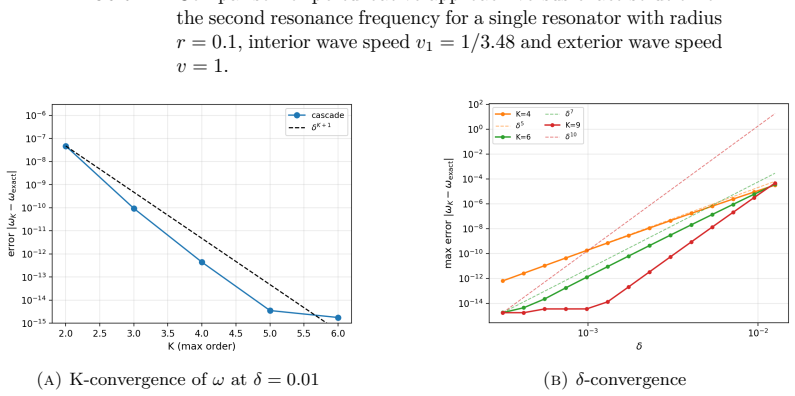
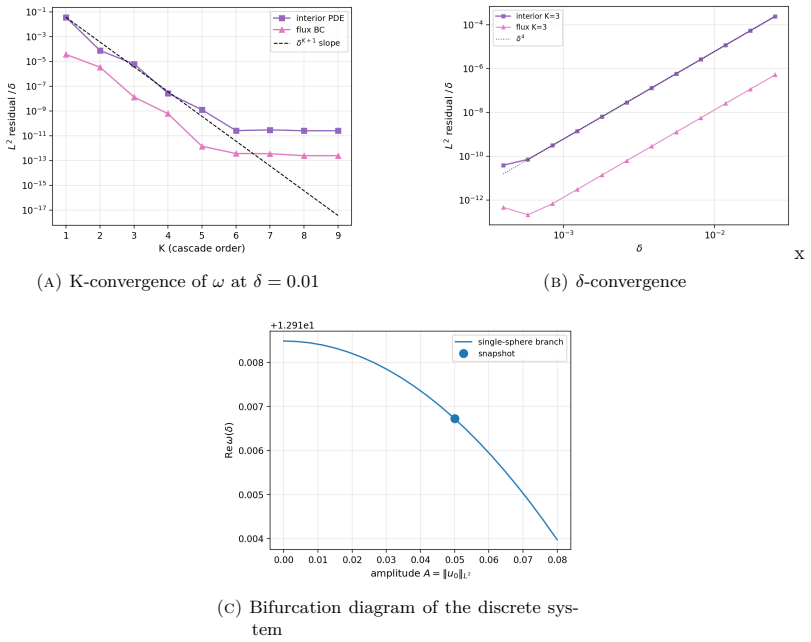
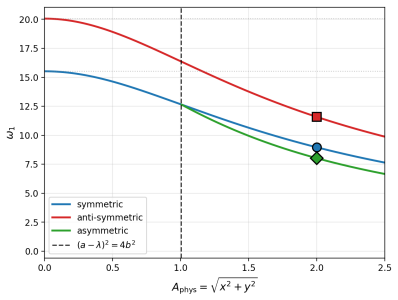
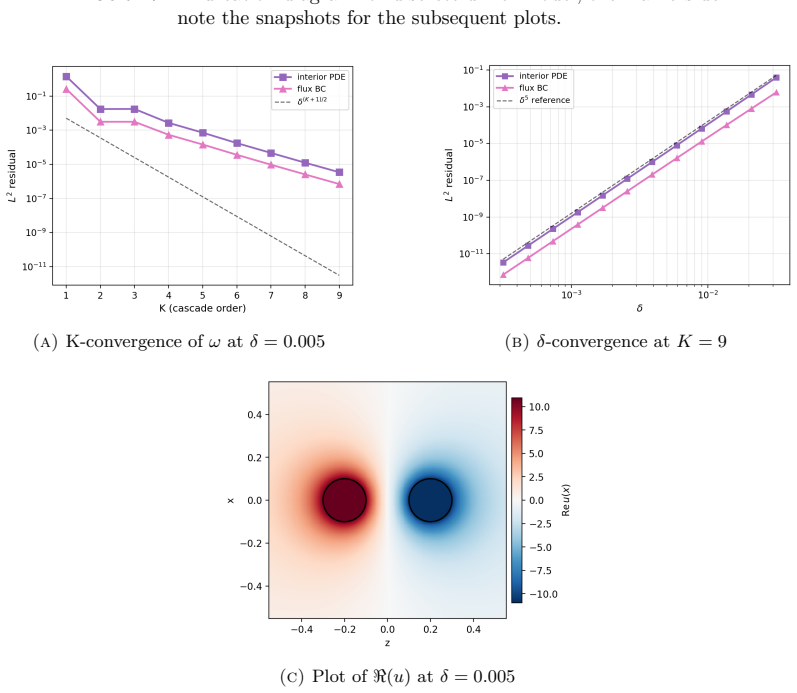
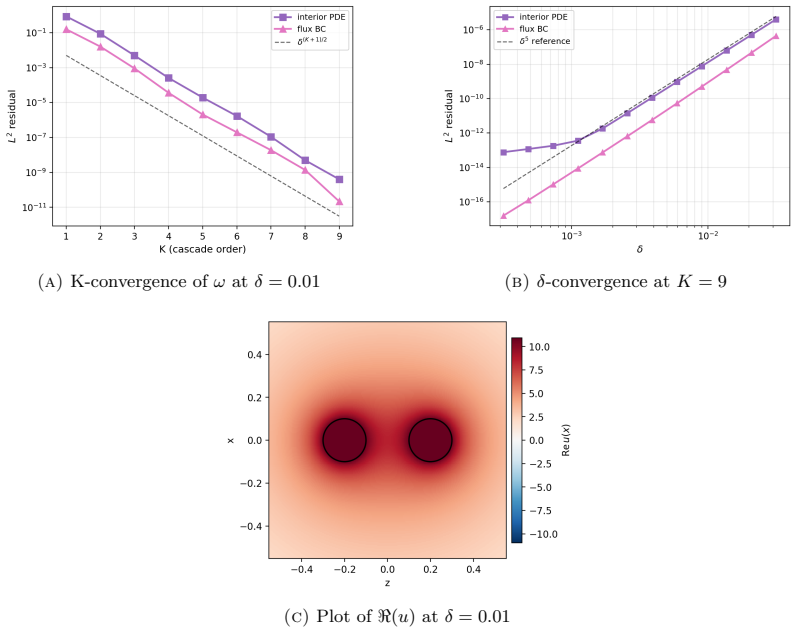
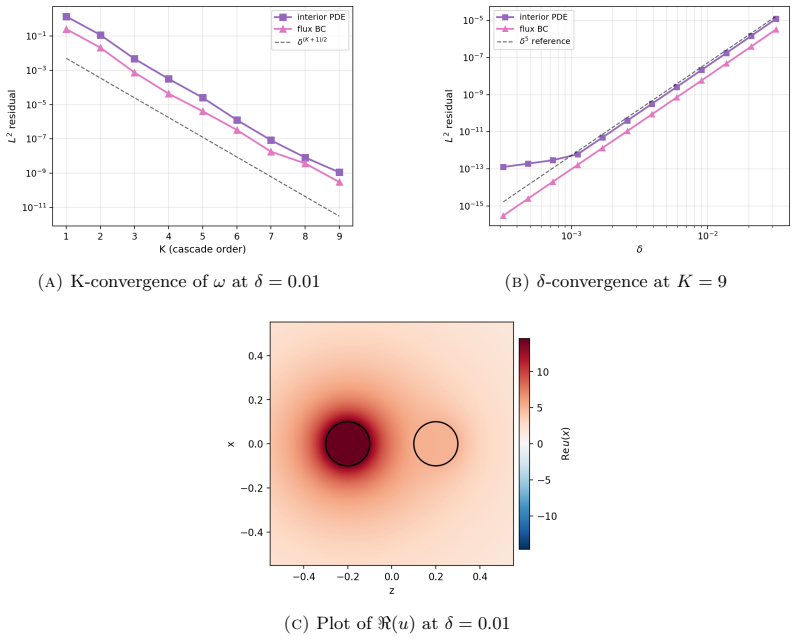
We study a nonlinear Helmholtz system with cubic nonlinearity on high-contrast inclusions in three dimensions, and the solitons that emerge as the contrast $\delta$ tends to zero. Using the Dirichlet-to-Neumann operator and a capacitance formalism, we develop a perturbative cascade that expands the resonant frequency and field in powers of $\sqrt{\delta}$. Our main result is a rigorous two-way correspondence with a finite discrete nonlinear capacitance system: every discrete solution lifts to a continuous soliton (a convergent expansion, analytic in $\sqrt{\delta}$), and every continuous family with the natural subwavelength scaling reduces to a discrete one. The construction is algorithmic, giving higher-order corrections in both the subwavelength and non-subwavelength regimes, the latter via a frequency-dependent capacitance matrix. We illustrate the theory numerically and characterise a symmetry-breaking bifurcation in a symmetric dimer.
Editorial analysis
A structured set of objections, weighed in public.
Referee Report
Summary. The manuscript develops a perturbative approach to a nonlinear Helmholtz system with cubic nonlinearity on high-contrast inclusions in three dimensions. Using the Dirichlet-to-Neumann operator and a capacitance formalism, it constructs an expansion of the resonant frequency and field in powers of √δ. The central claim is a rigorous two-way correspondence with a finite discrete nonlinear capacitance system: every discrete solution lifts to a continuous soliton via a convergent expansion analytic in √δ, and every continuous family with subwavelength scaling reduces to a discrete one. The construction is algorithmic, providing higher-order corrections in both subwavelength and non-subwavelength regimes (via a frequency-dependent capacitance matrix), and the theory is illustrated numerically by characterizing a symmetry-breaking bifurcation in a symmetric dimer.
Significance. If the two-way correspondence and convergence hold, the work supplies a rigorous bridge between continuous nonlinear PDE models and discrete capacitance systems for subwavelength solitons. The algorithmic construction of corrections and the numerical bifurcation example are concrete strengths that could support efficient analysis in nonlinear metamaterials or photonics.
major comments (1)
- [Main result (Theorem on two-way correspondence, likely §4)] The proof that the √δ perturbative cascade converges and remains analytic under the cubic nonlinearity (invoked via the Dirichlet-to-Neumann operator) requires explicit a-priori estimates that close the induction uniformly with respect to inclusion geometry. The current argument appears to extend linear-case bounds without fully controlling secular terms or remainder growth at each order, which is load-bearing for both the lifting and reduction directions of the main correspondence.
minor comments (2)
- The abstract states the setting is three-dimensional, but the title does not specify dimension; add a clarifying sentence in the introduction.
- [Numerical illustration] In the numerical section, state the mesh resolution and solver tolerance used for the dimer bifurcation computation.
Simulated Author's Rebuttal
We thank the referee for the positive summary and for identifying a point where the proof of the main two-way correspondence can be strengthened for clarity. We address the concern regarding a-priori estimates below and will revise the manuscript accordingly.
read point-by-point responses
-
Referee: The proof that the √δ perturbative cascade converges and remains analytic under the cubic nonlinearity (invoked via the Dirichlet-to-Neumann operator) requires explicit a-priori estimates that close the induction uniformly with respect to inclusion geometry. The current argument appears to extend linear-case bounds without fully controlling secular terms or remainder growth at each order, which is load-bearing for both the lifting and reduction directions of the main correspondence.
Authors: We appreciate the referee drawing attention to the need for explicit uniform estimates. In the proof of the main theorem (Theorem 4.1), the induction proceeds by constructing successive corrections to the field and frequency. Secular terms arising from the cubic nonlinearity are removed at each order by an algebraic correction to the resonant frequency, which is always solvable because the leading-order capacitance matrix is positive definite. The remainder after N orders is controlled in the appropriate Sobolev space by combining the boundedness of the Dirichlet-to-Neumann map (uniform under the fixed-geometry, high-contrast assumptions) with the Lipschitz continuity of the cubic term. These bounds are independent of δ and of the particular inclusion shapes provided the inclusions remain separated and have C^2 boundaries. Nevertheless, we agree that the current write-up compresses the induction closure and does not isolate the uniform-in-geometry constants. In the revision we will insert a new auxiliary lemma (after Lemma 4.3) that states the precise a-priori estimate on the remainder and verifies that the induction constant remains bounded uniformly with respect to the inclusion geometry. This will also make the control of remainder growth explicit at each order. revision: yes
Circularity Check
No significant circularity; derivation self-contained via explicit perturbative construction
full rationale
The paper constructs an explicit perturbative cascade in powers of √δ using the Dirichlet-to-Neumann operator and capacitance formalism, then proves a two-way correspondence between discrete nonlinear capacitance solutions and continuous solitons. No step reduces a claimed prediction to a fitted input by construction, nor does any load-bearing premise rest solely on self-citation of an unverified uniqueness result. The analyticity and convergence claims are presented as theorems derived from the cascade, not presupposed. The numerical illustrations are post-hoc verification rather than the source of the result. This is the normal case of a self-contained mathematical derivation.
Axiom & Free-Parameter Ledger
Reference graph
Works this paper leans on
-
[1]
104, Cambridge university press, 2007
AmbrosettiAntonio andMalchiodiAndrea,Nonlinear analysis and semilinear elliptic problems, vol. 104, Cambridge university press, 2007
2007
-
[2]
Full low-frequency asymptotics for the reduced wave equation
AmmariH. andNédélecJ.-C., “Full low-frequency asymptotics for the reduced wave equation”, in:Applied Mathematics Letters12.1 (1999), pp. 127–131
1999
-
[3]
Functional Analytic Methods for Discrete Approximations of Subwavelength Resonator Systems
AmmariHabib,DaviesBryn, andHiltunenErik Orvehed, “Functional Analytic Methods for Discrete Approximations of Subwavelength Resonator Systems”, in:Pure and Applied Analysis6.3 (2024)
2024
-
[4]
136, CBMS Regional Conference Series in Mathematics, American Mathematical Society, Providence, RI, 2026
AmmariHabib,DaviesBryn, andHiltunenErik Orvehed,Mathematical Theories for Metamaterials: From Condensed Matter Theory to Subwavelength Physics, vol. 136, CBMS Regional Conference Series in Mathematics, American Mathematical Society, Providence, RI, 2026
2026
-
[5]
Minnaert resonances for acoustic waves in bubbly media
AmmariHabib,FitzpatrickBrian,GontierDavid,LeeHyundae, andZhangHai, “Minnaert resonances for acoustic waves in bubbly media”, in:Annales de l’Institut Henri Poincaré C, Analyse non linéaire35.7 (2018), pp. 1975–1998
2018
-
[6]
Nonlinear Subwavelength Resonances in Three Dimensions
AmmariHabib andKoscheThea, “Nonlinear Subwavelength Resonances in Three Dimensions”, in:Studies in Applied Mathematics154.3 (2025)
2025
-
[7]
Dielectric scattering resonances for high-refractive resonators with cubic nonlinearity
AmmariHabib andLiBowen, “Dielectric scattering resonances for high-refractive resonators with cubic nonlinearity”, in:Journal of Differential Equations475 (2026), p. 114459. 26
2026
-
[8]
AmmariHabib,LiBowen,LiuPing, andShaoYingjie, “Frequency-dependent capac- itance matrix formulation for Fabry-P\’erot resonances. Part I: One-dimensional finite systems”, in:arXiv preprint arXiv:2604.01159(2026)
arXiv 2026
-
[9]
AmmariHabib,LiBowen,LiuPing,ShaoYingjie, andUhlmannAlexander, Frequency-dependent capacitance matrix formulation for Fabry-Perot resonances in two and three dimensional systems, 2026, arXiv:2605.27572 [math.AP]
Pith/arXiv arXiv 2026
-
[10]
AmmariHabib andQiuJiayu, “Analysis of nonlinear resonances in resonator crystals: Tight-binding approximation and existence of subwavelength soliton-like solutions”, in: arXiv preprint arXiv:2509.04184(2025)
arXiv 2025
-
[11]
A radiation and propagation problem for a Helmholtz equation with a compactly supported nonlinearity
AngermannLutz, “A radiation and propagation problem for a Helmholtz equation with a compactly supported nonlinearity”, in:Communications in Nonlinear Science and Numerical Simulation126 (2023), p. 107422
2023
-
[12]
Symmetry breaking regime in the nonlinear Hartree equation
AschbacherWH,FröhlichJ,GrafGM,SchneeK, andTroyerM, “Symmetry breaking regime in the nonlinear Hartree equation”, in:Journal of Mathematical Physics 43.8 (2002), pp. 3879–3891
2002
-
[13]
Gaps in the spectrum of two-dimensional square packing of stiff disks
D’EliaL andNazarovSA, “Gaps in the spectrum of two-dimensional square packing of stiff disks”, in:Applicable Analysis102.9 (2023), pp. 2611–2627
2023
-
[14]
Roadmap on metamaterial theory, modelling and design
DaviesBryn,SzyniszewskiStefan,DiasMarcelo A,W aalLeo de,KisilAnastasia, P SmyshlyaevValery,CooperShane,KamotskiIlia V,TouboulMarie,Craster Richard V, et al., “Roadmap on metamaterial theory, modelling and design”, in:Journal of Physics D: Applied Physics58.20 (2025), p. 203002
2025
-
[15]
200, Graduate Studies in Mathematics, American Mathematical Society, Providence, RI, 2019
DyatlovSemyon andZworskiMaciej,Mathematical theory of scattering resonances, vol. 200, Graduate Studies in Mathematics, American Mathematical Society, Providence, RI, 2019
2019
-
[16]
The discrete self-trapping equation
EilbeckJ Ch,LomdahlPS, andScottAlwyn C, “The discrete self-trapping equation”, in:Physica D: Nonlinear Phenomena16.3 (1985), pp. 318–338
1985
-
[17]
Dual variational methods and nonvanishing for the nonlinear Helmholtz equation
EvequozGilles andWethTobias, “Dual variational methods and nonvanishing for the nonlinear Helmholtz equation”, in:Advances in Mathematics280 (2015), pp. 690–728
2015
-
[18]
Subwavelength resonant acoustic scattering in fast time-modulated media
FepponF. andAmmariH., “Subwavelength resonant acoustic scattering in fast time-modulated media”, in:Journal de Mathématiques Pures et Appliquées187 (2024), pp. 233–293
2024
-
[19]
Modal decompositions and point scatterer approximations near the Minnaert resonance frequencies
FepponFlorian andAmmariHabib, “Modal decompositions and point scatterer approximations near the Minnaert resonance frequencies”, in:Studies in Applied Mathematics149.1 (2022), pp. 164–229
2022
-
[20]
Subwavelength Resonances in One-Dimensional High-Contrast Acoustic Media
FepponFlorian,ChengZijian, andAmmariHabib, “Subwavelength Resonances in One-Dimensional High-Contrast Acoustic Media”, in:SIAM J. Appl. Math.83.2 (2023), pp. 625–665
2023
-
[21]
SingularperturbationDirichletproblemin a double-periodic perforated plane
FerraressoFrancescoandTaskinenJari,“SingularperturbationDirichletproblemin a double-periodic perforated plane”, in:ANNALI DELL’UNIVERSITA’DI FERRARA 61.2 (2015), pp. 277–290
2015
-
[22]
Spatial solitons in periodic nanostruc- tures
GorbachAndriy V andSkryabinDmitry V, “Spatial solitons in periodic nanostruc- tures”, in:Physical Review A—Atomic, Molecular, and Optical Physics79.5 (2009), p. 053812
2009
-
[23]
Inverse medium scat- tering for a nonlinear Helmholtz equation
GriesmaierRoland,KnöllerMarvin, andMandelRainer, “Inverse medium scat- tering for a nonlinear Helmholtz equation”, in:Journal of Mathematical Analysis and Applications515.1 (2022), p. 126356
2022
-
[24]
KielhoferHansjorg,Bifurcation Theory, en, 2nd ed., Applied Mathematical Sciences (Springer), Springer Science+Business Media, Jan. 2012
2012
-
[25]
Symmetry- breaking bifurcation in nonlinear Schrödinger/Gross–Pitaevskii equations
KirrEW,KevrekidisPG,ShlizermanEli, andWeinsteinMichael I, “Symmetry- breaking bifurcation in nonlinear Schrödinger/Gross–Pitaevskii equations”, in:SIAM journal on mathematical analysis40.2 (2008), pp. 566–604. 27
2008
-
[26]
Electrostatics of two charged conducting spheres
LeknerJohn, “Electrostatics of two charged conducting spheres”, in:Proceedings of the Royal Society A: Mathematical, Physical and Engineering Sciences468.2145 (2012), pp. 2829–2848
2012
-
[27]
XVI. On Musical Air-Bubbles and the Sounds of Running Water
MinnaertM., “XVI. On Musical Air-Bubbles and the Sounds of Running Water”, in: The London, Edinburgh, and Dublin Philosophical Magazine and Journal of Science 16.104 (1933), pp. 235–248,doi:10.1080/14786443309462277
-
[28]
NečasJindřich,Direct Methods in the Theory of Elliptic Equations, Springer Berlin Heidelberg, 2012,doi:10.1007/978-3-642-10455-8
-
[29]
Gap solitons in periodic discrete nonlinear Schrödinger equations
PankovA, “Gap solitons in periodic discrete nonlinear Schrödinger equations”, in: Nonlinearity19.1 (2005), p. 27
2005
-
[30]
Gap solitons in periodic discrete nonlinear Schrödinger equations with saturable nonlinearities
PankovAlexander, “Gap solitons in periodic discrete nonlinear Schrödinger equations with saturable nonlinearities”, in:Journal of mathematical analysis and applications 371.1 (2010), pp. 254–265
2010
-
[31]
Perturbation theory for nonlinear Schrödinger equations
SacchettiAndrea, “Perturbation theory for nonlinear Schrödinger equations”, in: Nonlinearity36.11 (2023), pp. 6048–6070. Habib Ammari ETH Zürich, Department of Mathematics, Rämistrasse 101, 8092 Zürich, Switzerland, orcid.org/0000-0001-7278-4877 . Email address:habib.ammari@math.ethz.ch Clemens Thalhammer ETH Zürich, Department of Mathematics, Rämistrasse...
2023
discussion (0)
Sign in with ORCID, Apple, or X to comment. Anyone can read and Pith papers without signing in.