From Uncertainty to Stability and Fidelity: Guiding Sparse-View 3D Gaussian Splatting with Fisher Information
Pith reviewed 2026-06-26 18:08 UTC · model grok-4.3
The pith
Fisher Information selects informative views and adapts regularization to stabilize sparse-view 3D Gaussian Splatting.
A machine-rendered reading of the paper's core claim, the machinery that carries it, and where it could break.
Core claim
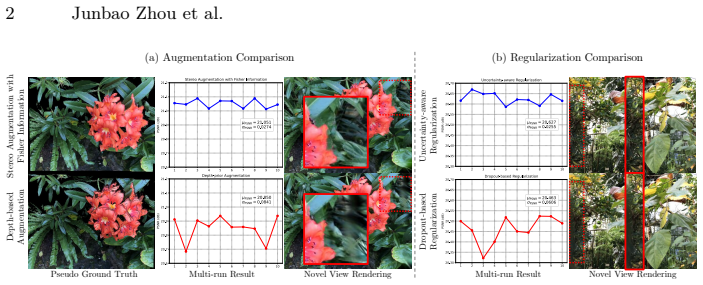
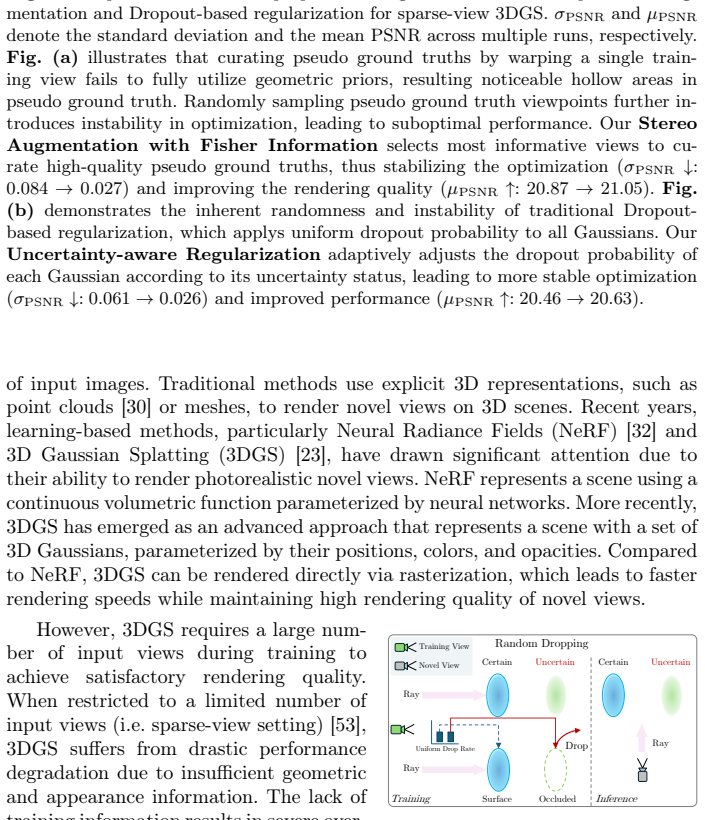
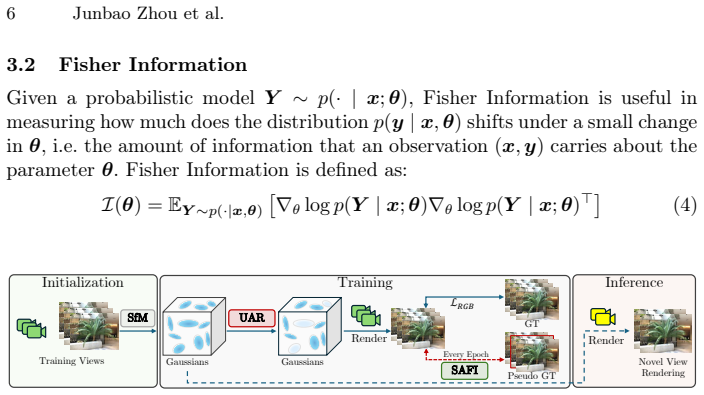
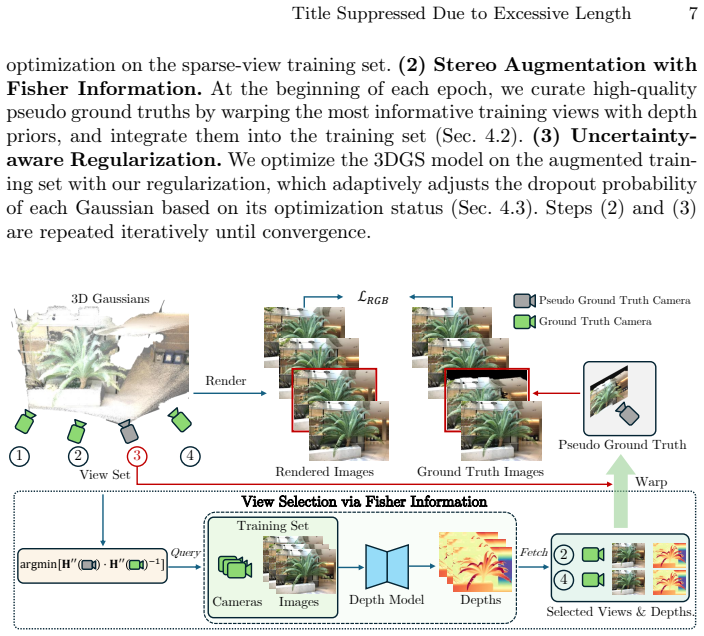
By computing Fisher Information to choose the most informative supporting viewpoints for stereo augmentation and to scale the dropout probability of each 3D Gaussian according to its uncertainty, the optimization avoids the compounded randomness of prior methods, yielding more stable training and higher rendering fidelity on sparse-view inputs.
What carries the argument
Fisher Information, used both to rank candidate viewpoints by expected information gain and to quantify per-Gaussian uncertainty for adaptive regularization.
If this is right
- Stereo augmentation becomes deterministic rather than random, producing more consistent pseudo ground truth.
- Dropout regularization becomes uncertainty-aware, removing high-uncertainty Gaussians more often and low-uncertainty ones less often.
- Overfitting is reduced because both augmentation and regularization are now driven by the same information-theoretic signal.
- The resulting renderings achieve state-of-the-art scores on existing sparse-view novel view synthesis benchmarks.
Where Pith is reading between the lines
- The same Fisher-guided selection principle could be tested on other radiance-field representations that also suffer from sparse-view instability.
- If the uncertainty estimates prove reliable, they might serve as a stopping criterion or active-learning signal for acquiring additional real views.
- The approach implicitly treats Fisher Information as a cheap proxy for model sensitivity; verifying this proxy against explicit Hessian computations would strengthen the method.
Load-bearing premise
Fisher Information can be computed reliably inside the 3DGS optimization loop and will select views and dropout rates that genuinely reduce uncertainty rather than introduce new bias.
What would settle it
A controlled run on the same sparse-view benchmarks in which random view selection and uniform dropout probability produce equal or higher PSNR and SSIM than the Fisher-guided versions.
Figures
read the original abstract
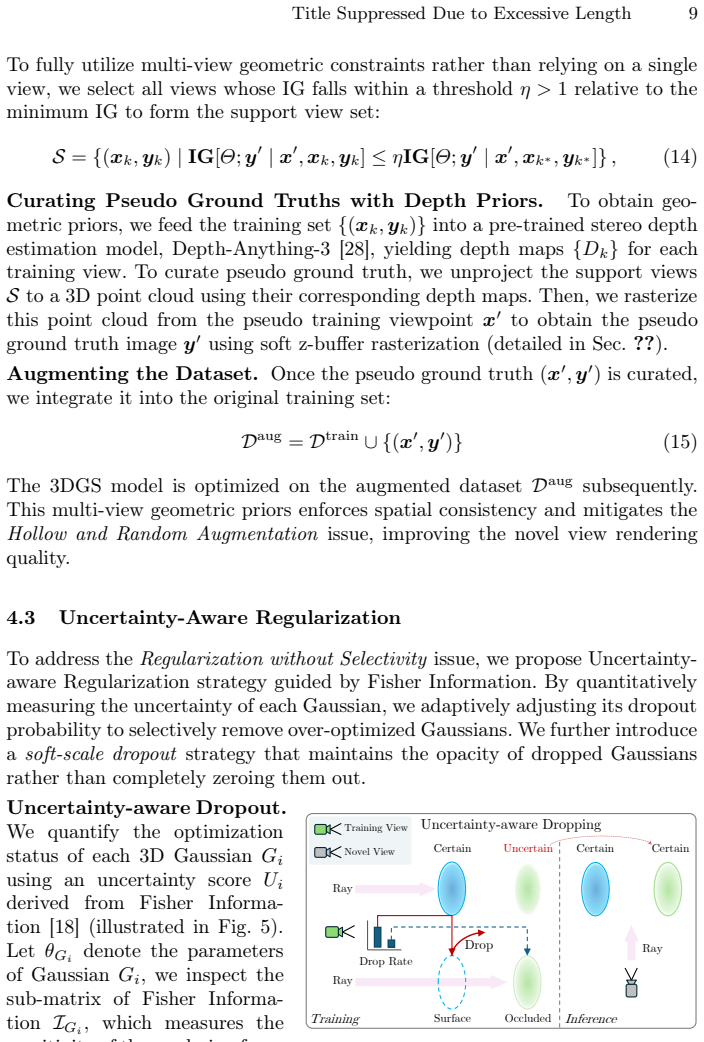
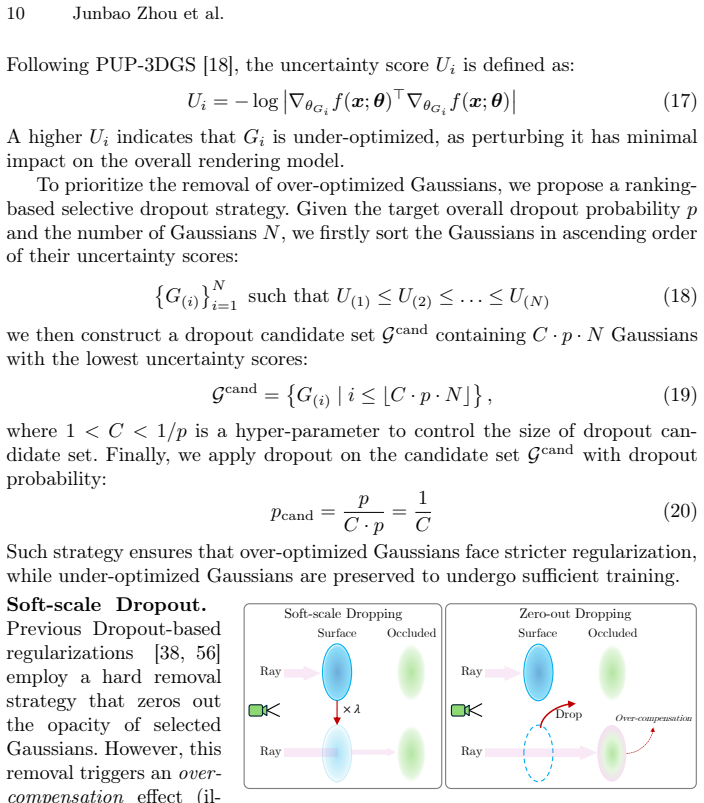
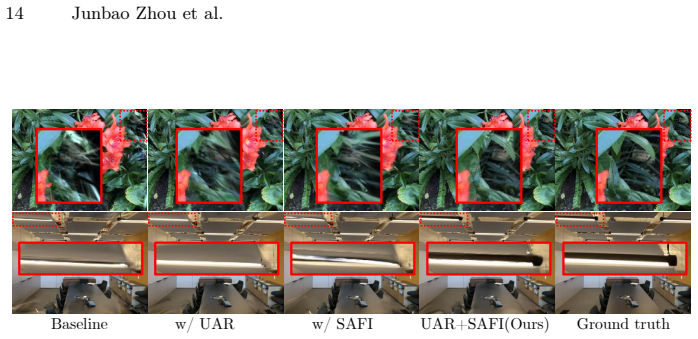
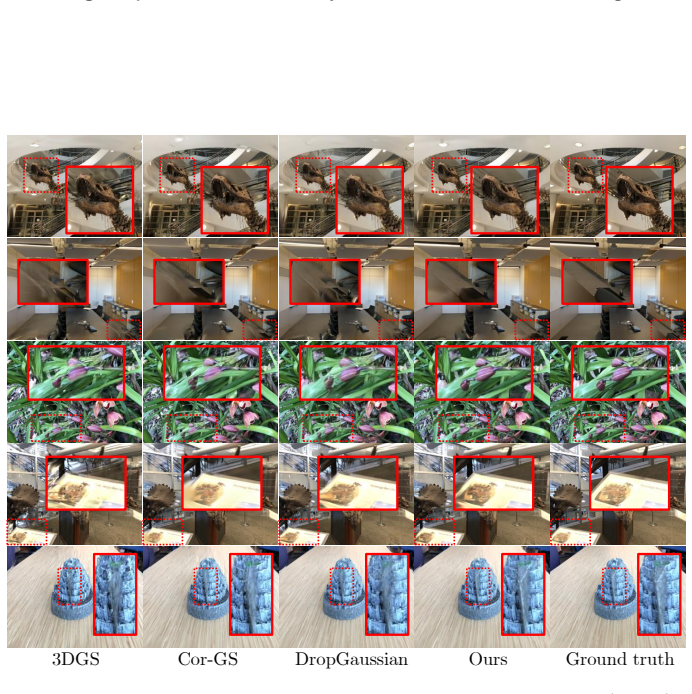
3D Gaussian Splatting (3DGS) has emerged as a promising technique for novel view synthesis. However, 3DGS requires dense input views to achieve high-quality rendering. In sparse-view scenarios, 3DGS often prones to overfitting, resulting in noticeable artifacts and degraded rendering quality. Previous methods explore to address this issue by introducing additional priors (e.g. depth priors) or integrating regularization techniques (e.g. Dropout). However, these methods are often applied without principled guidance. In particular, prior-based augmentation typically samples novel viewpoints randomly, while Dropout-based regularization randomly removes Gaussians. The compounded randomness introduces uncertainty and instability, limiting the fidelity of novel view synthesis. In this paper, we propose a novel method for sparse-view 3DGS that incorporates Fisher Information to quantitatively guide the utilization of geometric priors and regularization. Specifically, our method comprises two key components: (1) Stereo augmentation with Fisher Information. By leveraging Fisher Information, we actively select most informative supporting views and use depth priors to curate reliable pseudo ground truths, which reduces randomness in augmentation and improves stability and rendering fidelity; (2) Uncertainty-aware regularization. We reduce the instability of Dropout-based regularization by using Fisher Information to quantitatively measure the uncertainty of each 3D Gaussian, and adaptively adjust the removal probability, leading to more stable and effective regularization. With these two components, our method effectively mitigates overfitting and improves the stability of optimization in sparse-view 3DGS, resulting in superior rendering fidelity. Extensive experiments show that our method achieves state-of-the-art performance in sparse-view novel view synthesis benchmarks.
Editorial analysis
A structured set of objections, weighed in public.
Referee Report
Summary. The paper claims that Fisher Information can be used to guide two components in sparse-view 3D Gaussian Splatting: (1) active selection of the most informative supporting views for stereo augmentation with depth priors, reducing randomness compared to prior random sampling, and (2) per-Gaussian uncertainty measurement to adaptively modulate dropout probability in regularization. These are asserted to mitigate overfitting, improve optimization stability, and yield superior rendering fidelity, with extensive experiments demonstrating state-of-the-art performance on sparse-view novel view synthesis benchmarks.
Significance. If the Fisher Information proxies are shown to reliably correlate with view informativeness and Gaussian sensitivity, the method would supply a principled, quantitative alternative to random augmentation and dropout in data-scarce 3DGS settings. This could meaningfully advance novel-view synthesis for applications where dense capture is impractical, while building on established information-theoretic tools without introducing new external priors.
major comments (2)
- [§3.1] §3.1 (Stereo augmentation with Fisher Information): The central claim that Fisher Information computed on the rendering loss ranks supporting views more reliably than random sampling requires explicit validation. The manuscript must include an ablation (e.g., Table comparing random vs. FI-selected views under identical depth priors) demonstrating lower final test loss or smaller train-test gap for the FI-guided selection; without this, the component reduces to guided random augmentation whose advantage is unproven.
- [§3.2] §3.2 (Uncertainty-aware regularization): The per-Gaussian uncertainty scalar derived from the empirical Fisher (almost always diagonal or block-diagonal in 3DGS due to alpha compositing) is used to modulate dropout probability. The paper must report quantitative evidence (e.g., ablation on the train-test PSNR gap and artifact metrics) that this adaptive scheme measurably outperforms standard random Dropout; otherwise the regularization benefit is not load-bearing for the stability claim.
minor comments (2)
- [Abstract] Abstract: 'prones to overfitting' should read 'is prone to overfitting'.
- [§3] Notation: clarify whether the Fisher Information is the full matrix, diagonal approximation, or empirical estimate, and specify the exact loss whose Hessian is approximated.
Simulated Author's Rebuttal
We thank the referee for the constructive feedback. The major comments correctly identify the need for component-specific ablations to substantiate the advantages of Fisher Information guidance. We address each point below and will revise the manuscript accordingly.
read point-by-point responses
-
Referee: [§3.1] §3.1 (Stereo augmentation with Fisher Information): The central claim that Fisher Information computed on the rendering loss ranks supporting views more reliably than random sampling requires explicit validation. The manuscript must include an ablation (e.g., Table comparing random vs. FI-selected views under identical depth priors) demonstrating lower final test loss or smaller train-test gap for the FI-guided selection; without this, the component reduces to guided random augmentation whose advantage is unproven.
Authors: We agree that an explicit ablation isolating Fisher Information-guided view selection from random sampling (with fixed depth priors) is required to validate the ranking claim. The current manuscript reports overall benchmark gains but does not contain this isolated comparison. In the revised version we will add the requested table, reporting final test loss and train-test gap for both strategies. revision: yes
-
Referee: [§3.2] §3.2 (Uncertainty-aware regularization): The per-Gaussian uncertainty scalar derived from the empirical Fisher (almost always diagonal or block-diagonal in 3DGS due to alpha compositing) is used to modulate dropout probability. The paper must report quantitative evidence (e.g., ablation on the train-test PSNR gap and artifact metrics) that this adaptive scheme measurably outperforms standard random Dropout; otherwise the regularization benefit is not load-bearing for the stability claim.
Authors: We concur that a direct quantitative comparison of the uncertainty-modulated dropout against standard random dropout is necessary to establish the adaptive scheme's contribution. The manuscript emphasizes end-to-end improvements but omits this isolated ablation. We will include the requested metrics (train-test PSNR gap and artifact measures) in the revision. revision: yes
Circularity Check
No circularity: Fisher Information applied as external guidance without self-referential reduction
full rationale
The paper proposes two components that apply the established Fisher Information concept to guide view selection and per-Gaussian dropout in 3DGS. No equations, derivations, or claims in the abstract or described method reduce a 'prediction' or result to a fitted input or self-citation by construction. The central claims rest on empirical experiments rather than any load-bearing self-definition or imported uniqueness theorem. This is the common case of an applied method paper whose derivation chain is self-contained against external benchmarks.
Axiom & Free-Parameter Ledger
axioms (1)
- domain assumption Fisher Information provides a quantitative measure of uncertainty for 3D Gaussians and informativeness for novel views that can be used to guide augmentation and regularization effectively.
Reference graph
Works this paper leans on
-
[1]
In: Proceedings of the IEEE/CVF international conference on computer vision
Barron, J.T., Mildenhall, B., Tancik, M., Hedman, P., Martin-Brualla, R., Srini- vasan, P.P.: Mip-nerf: A multiscale representation for anti-aliasing neural radiance fields. In: Proceedings of the IEEE/CVF international conference on computer vision. pp. 5855–5864 (2021)
2021
-
[2]
In: Proceedings of the IEEE/CVF conference on computer vision and pattern recognition
Barron, J.T., Mildenhall, B., Verbin, D., Srinivasan, P.P., Hedman, P.: Mip- nerf 360: Unbounded anti-aliased neural radiance fields. In: Proceedings of the IEEE/CVF conference on computer vision and pattern recognition. pp. 5470–5479 (2022)
2022
-
[3]
In: Proceedings of the IEEE/CVF International Conference on Computer Vision
Barron, J.T., Mildenhall, B., Verbin, D., Srinivasan, P.P., Hedman, P.: Zip-nerf: Anti-aliased grid-based neural radiance fields. In: Proceedings of the IEEE/CVF International Conference on Computer Vision. pp. 19697–19705 (2023)
2023
-
[4]
In: European conference on computer vision
Chen, A., Xu, Z., Geiger, A., Yu, J., Su, H.: Tensorf: Tensorial radiance fields. In: European conference on computer vision. pp. 333–350. Springer (2022)
2022
-
[5]
In: European Conference on Computer Vision
Chen, D., Liu, Y., Huang, L., Wang, B., Pan, P.: Geoaug: Data augmentation for few-shot nerf with geometry constraints. In: European Conference on Computer Vision. pp. 322–337. Springer (2022)
2022
-
[6]
In: Proceedings of the IEEE/CVF Conference on Computer Vision and Pattern Recognition
Chen, T., Wang, P., Fan, Z., Wang, Z.: Aug-nerf: Training stronger neural radiance fields with triple-level physically-grounded augmentations. In: Proceedings of the IEEE/CVF Conference on Computer Vision and Pattern Recognition. pp. 15191– 15202 (2022)
2022
-
[7]
In: European Conference on Computer Vision
Chen,Y.,Wu,Q.,Lin,W.,Harandi,M.,Cai,J.:Hac:Hash-gridassistedcontextfor 3d gaussian splatting compression. In: European Conference on Computer Vision. pp. 422–438. Springer (2024)
2024
-
[8]
In: Proceedings of the IEEE/CVF Conference on Com- puter Vision and Pattern Recognition
Chung, J., Oh, J., Lee, K.M.: Depth-regularized optimization for 3d gaussian splat- ting in few-shot images. In: Proceedings of the IEEE/CVF Conference on Com- puter Vision and Pattern Recognition. pp. 811–820 (2024) 16 Junbao Zhou et al
2024
-
[9]
In: Seminal Graphics Papers: Pushing the Boundaries, Volume 2, pp
Debevec, P.E., Taylor, C.J., Malik, J.: Modeling and rendering architecture from photographs: A hybrid geometry-and image-based approach. In: Seminal Graphics Papers: Pushing the Boundaries, Volume 2, pp. 465–474 (2023)
2023
-
[10]
In: Proceedings of the IEEE/CVF conference on computer vision and pattern recognition
Deng,K.,Liu,A.,Zhu,J.Y.,Ramanan,D.:Depth-supervisednerf:Fewerviewsand faster training for free. In: Proceedings of the IEEE/CVF conference on computer vision and pattern recognition. pp. 12882–12891 (2022)
2022
-
[11]
Advances in neural information processing systems37, 140138–140158 (2024)
Fan, Z., Wang, K., Wen, K., Zhu, Z., Xu, D., Wang, Z., et al.: Lightgaussian: Unbounded 3d gaussian compression with 15x reduction and 200+ fps. Advances in neural information processing systems37, 140138–140158 (2024)
2024
-
[12]
In: European Conference on Computer Vision
Fang,G.,Wang,B.:Mini-splatting:Representingsceneswithaconstrainednumber of gaussians. In: European Conference on Computer Vision. pp. 165–181. Springer (2024)
2024
-
[13]
In: Proceedings of the IEEE/CVF conference on computer vision and pattern recognition
Fridovich-Keil, S., Yu, A., Tancik, M., Chen, Q., Recht, B., Kanazawa, A.: Plenox- els: Radiance fields without neural networks. In: Proceedings of the IEEE/CVF conference on computer vision and pattern recognition. pp. 5501–5510 (2022)
2022
-
[14]
In: Proceedings of the IEEE/CVF international conference on computer vision
Garbin, S.J., Kowalski, M., Johnson, M., Shotton, J., Valentin, J.: Fastnerf: High- fidelity neural rendering at 200fps. In: Proceedings of the IEEE/CVF international conference on computer vision. pp. 14346–14355 (2021)
2021
-
[15]
arXiv preprint arXiv:2511.14633 (2025)
Gu, M., Zhang, J., Li, J., Yu, X., Luo, H., Zheng, J., Bai, X.: Sparsesurf: Sparse-view 3d gaussian splatting for surface reconstruction. arXiv preprint arXiv:2511.14633 (2025)
arXiv 2025
-
[16]
In: Proceedings of the IEEE/CVF Conference on Computer Vision and Pattern Recognition
Guo, Y.C., Kang, D., Bao, L., He, Y., Zhang, S.H.: Nerfren: Neural radiance fields with reflections. In: Proceedings of the IEEE/CVF Conference on Computer Vision and Pattern Recognition. pp. 18409–18418 (2022)
2022
-
[17]
In: Proceedings of the IEEE/CVF Conference on Computer Vision and Pattern Recognition
Hamdi, A., Melas-Kyriazi, L., Mai, J., Qian, G., Liu, R., Vondrick, C., Ghanem, B., Vedaldi, A.: Ges: Generalized exponential splatting for efficient radiance field rendering. In: Proceedings of the IEEE/CVF Conference on Computer Vision and Pattern Recognition. pp. 19812–19822 (2024)
2024
-
[18]
In: Proceedings of the Computer Vision and Pattern Recognition Conference
Hanson, A., Tu, A., Singla, V., Jayawardhana, M., Zwicker, M., Goldstein, T.: Pup 3d-gs: Principled uncertainty pruning for 3d gaussian splatting. In: Proceedings of the Computer Vision and Pattern Recognition Conference. pp. 5949–5958 (2025)
2025
-
[19]
In: Proceedings of the IEEE/CVF International Conference on Computer Vision
Hu, W., Wang, Y., Ma, L., Yang, B., Gao, L., Liu, X., Ma, Y.: Tri-miprf: Tri-mip representation for efficient anti-aliasing neural radiance fields. In: Proceedings of the IEEE/CVF International Conference on Computer Vision. pp. 19774–19783 (2023)
2023
-
[20]
In: ACM SIGGRAPH 2024 conference papers
Huang, B., Yu, Z., Chen, A., Geiger, A., Gao, S.: 2d gaussian splatting for geo- metrically accurate radiance fields. In: ACM SIGGRAPH 2024 conference papers. pp. 1–11 (2024)
2024
-
[21]
In: Proceedings of the IEEE/CVF international conference on computer vision
Jain, A., Tancik, M., Abbeel, P.: Putting nerf on a diet: Semantically consistent few-shot view synthesis. In: Proceedings of the IEEE/CVF international conference on computer vision. pp. 5885–5894 (2021)
2021
-
[22]
In: Proceedings of the IEEE conference on computer vision and pattern recognition
Jensen, R., Dahl, A., Vogiatzis, G., Tola, E., Aanæs, H.: Large scale multi-view stereopsis evaluation. In: Proceedings of the IEEE conference on computer vision and pattern recognition. pp. 406–413 (2014)
2014
-
[23]
ACM Transactions on Graphics42(4) (July 2023),https://repo-sam.inria.fr/fungraph/3d-gaussian-splatting/
Kerbl, B., Kopanas, G., Leimkühler, T., Drettakis, G.: 3d gaussian splatting for real-time radiance field rendering. ACM Transactions on Graphics42(4) (July 2023),https://repo-sam.inria.fr/fungraph/3d-gaussian-splatting/
2023
-
[24]
arXiv preprint arXiv:2208.00549 (2022) Title Suppressed Due to Excessive Length 17
Kirsch, A., Gal, Y.: Unifying approaches in active learning and active sam- pling via fisher information and information-theoretic quantities. arXiv preprint arXiv:2208.00549 (2022) Title Suppressed Due to Excessive Length 17
arXiv 2022
-
[25]
arXiv preprint arXiv:2301.10941 (2023)
Kwak, M.S., Song, J., Kim, S.: Geconerf: Few-shot neural radiance fields via geo- metric consistency. arXiv preprint arXiv:2301.10941 (2023)
arXiv 2023
-
[26]
In: Proceedings of the IEEE/CVF Conference on Computer Vision and Pattern Recognition
Lee, J.C., Rho, D., Sun, X., Ko, J.H., Park, E.: Compact 3d gaussian representation for radiance field. In: Proceedings of the IEEE/CVF Conference on Computer Vision and Pattern Recognition. pp. 21719–21728 (2024)
2024
-
[27]
In: Proceedings of the IEEE/CVF conference on computer vision and pattern recognition
Li, J., Zhang, J., Bai, X., Zheng, J., Ning, X., Zhou, J., Gu, L.: Dngaussian: Opti- mizing sparse-view 3d gaussian radiance fields with global-local depth normaliza- tion. In: Proceedings of the IEEE/CVF conference on computer vision and pattern recognition. pp. 20775–20785 (2024)
2024
-
[28]
arXiv preprint arXiv:2511.10647 (2025)
Lin, H., Chen, S., Liew, J.H., Chen, D.Y., Li, Z., Shi, G., Feng, J., Kang, B.: Depth anything 3: Recovering the visual space from any views. arXiv preprint arXiv:2511.10647 (2025)
Pith/arXiv arXiv 2025
-
[29]
Advances in Neural Information Processing Systems33, 15651–15663 (2020)
Liu, L., Gu, J., Zaw Lin, K., Chua, T.S., Theobalt, C.: Neural sparse voxel fields. Advances in Neural Information Processing Systems33, 15651–15663 (2020)
2020
-
[30]
In: Proceedings of the IEEE/CVF Conference on Computer Vision and Pattern Recognition
Meshry, M., Goldman, D.B., Khamis, S., Hoppe, H., Pandey, R., Snavely, N., Martin-Brualla, R.: Neural rerendering in the wild. In: Proceedings of the IEEE/CVF Conference on Computer Vision and Pattern Recognition. pp. 6878– 6887 (2019)
2019
-
[31]
ACM Transactions on Graphics (ToG)38(4), 1–14 (2019)
Mildenhall, B., Srinivasan, P.P., Ortiz-Cayon, R., Kalantari, N.K., Ramamoorthi, R., Ng, R., Kar, A.: Local light field fusion: Practical view synthesis with pre- scriptive sampling guidelines. ACM Transactions on Graphics (ToG)38(4), 1–14 (2019)
2019
-
[32]
Commu- nications of the ACM65(1), 99–106 (2021)
Mildenhall, B., Srinivasan, P.P., Tancik, M., Barron, J.T., Ramamoorthi, R., Ng, R.: Nerf: Representing scenes as neural radiance fields for view synthesis. Commu- nications of the ACM65(1), 99–106 (2021)
2021
-
[33]
ACM transactions on graphics (TOG)41(4), 1–15 (2022)
Müller,T.,Evans,A.,Schied,C.,Keller,A.:Instantneuralgraphicsprimitiveswith a multiresolution hash encoding. ACM transactions on graphics (TOG)41(4), 1–15 (2022)
2022
-
[34]
In: Euro- pean Conference on Computer Vision
Navaneet, K., Pourahmadi Meibodi, K., Abbasi Koohpayegani, S., Pirsiavash, H.: Compgs: Smaller and faster gaussian splatting with vector quantization. In: Euro- pean Conference on Computer Vision. pp. 330–349. Springer (2024)
2024
-
[35]
In: Proceedings of the IEEE/CVF Con- ference on Computer Vision and Pattern Recognition
Niedermayr, S., Stumpfegger, J., Westermann, R.: Compressed 3d gaussian splat- ting for accelerated novel view synthesis. In: Proceedings of the IEEE/CVF Con- ference on Computer Vision and Pattern Recognition. pp. 10349–10358 (2024)
2024
-
[36]
In: Proceedings of the IEEE/CVF conference on computer vision and pattern recognition
Niemeyer, M., Barron, J.T., Mildenhall, B., Sajjadi, M.S., Geiger, A., Radwan, N.: Regnerf: Regularizing neural radiance fields for view synthesis from sparse in- puts. In: Proceedings of the IEEE/CVF conference on computer vision and pattern recognition. pp. 5480–5490 (2022)
2022
-
[37]
Proceedings of the ACM on Computer Graphics and Interactive Techniques7(1), 1–17 (2024)
Papantonakis, P., Kopanas, G., Kerbl, B., Lanvin, A., Drettakis, G.: Reducing the memory footprint of 3d gaussian splatting. Proceedings of the ACM on Computer Graphics and Interactive Techniques7(1), 1–17 (2024)
2024
-
[38]
In: Proceedings of the Computer Vision and Pattern Recognition Conference
Park, H., Ryu, G., Kim, W.: Dropgaussian: Structural regularization for sparse- view gaussian splatting. In: Proceedings of the Computer Vision and Pattern Recognition Conference. pp. 21600–21609 (2025)
2025
-
[39]
In: International conference on machine learning
Radford, A., Kim, J.W., Hallacy, C., Ramesh, A., Goh, G., Agarwal, S., Sastry, G., Askell, A., Mishkin, P., Clark, J., et al.: Learning transferable visual models from natural language supervision. In: International conference on machine learning. pp. 8748–8763. PmLR (2021)
2021
-
[40]
In: Proceedings of the IEEE/CVF international conference on computer vision
Reiser, C., Peng, S., Liao, Y., Geiger, A.: Kilonerf: Speeding up neural radiance fields with thousands of tiny mlps. In: Proceedings of the IEEE/CVF international conference on computer vision. pp. 14335–14345 (2021) 18 Junbao Zhou et al
2021
-
[41]
In: Proceedings of the IEEE/CVF conference on computer vision and pattern recognition
Roessle, B., Barron, J.T., Mildenhall, B., Srinivasan, P.P., Nießner, M.: Dense depth priors for neural radiance fields from sparse input views. In: Proceedings of the IEEE/CVF conference on computer vision and pattern recognition. pp. 12892– 12901 (2022)
2022
-
[42]
In: 2006 IEEE computer society conference on computer vision and pattern recognition (CVPR’06)
Seitz, S.M., Curless, B., Diebel, J., Scharstein, D., Szeliski, R.: A comparison and evaluation of multi-view stereo reconstruction algorithms. In: 2006 IEEE computer society conference on computer vision and pattern recognition (CVPR’06). vol. 1, pp. 519–528. IEEE (2006)
2006
-
[43]
Song, J., Park, S., An, H., Cho, S., Kwak, M.S., Cho, S., Kim, S.: Därf: Boosting radiancefieldsfromsparseinputviewswithmonoculardepthadaptation.Advances in Neural Information Processing Systems36, 68458–68470 (2023)
2023
-
[44]
The journal of machine learning research15(1), 1929–1958 (2014)
Srivastava, N., Hinton, G., Krizhevsky, A., Sutskever, I., Salakhutdinov, R.: Dropout: a simple way to prevent neural networks from overfitting. The journal of machine learning research15(1), 1929–1958 (2014)
1929
-
[45]
In: Pro- ceedings of the IEEE/CVF Conference on Computer Vision and Pattern Recogni- tion
Suhail, M., Esteves, C., Sigal, L., Makadia, A.: Light field neural rendering. In: Pro- ceedings of the IEEE/CVF Conference on Computer Vision and Pattern Recogni- tion. pp. 8269–8279 (2022)
2022
-
[46]
In: Proceedings of the IEEE/CVF confer- ence on computer vision and pattern recognition
Sun, C., Sun, M., Chen, H.T.: Direct voxel grid optimization: Super-fast conver- gence for radiance fields reconstruction. In: Proceedings of the IEEE/CVF confer- ence on computer vision and pattern recognition. pp. 5459–5469 (2022)
2022
-
[47]
In: Proceedings of the IEEE/CVF Conference on Computer Vision and Pattern Recognition
Truong, P., Rakotosaona, M.J., Manhardt, F., Tombari, F.: Sparf: Neural radiance fields from sparse and noisy poses. In: Proceedings of the IEEE/CVF Conference on Computer Vision and Pattern Recognition. pp. 4190–4200 (2023)
2023
-
[48]
IEEE Transactions on Pattern Analysis and Machine Intelligence (2024)
Verbin, D., Hedman, P., Mildenhall, B., Zickler, T., Barron, J.T., Srinivasan, P.P.: Ref-nerf: Structured view-dependent appearance for neural radiance fields. IEEE Transactions on Pattern Analysis and Machine Intelligence (2024)
2024
-
[49]
In: Proceedings of the IEEE/CVF international conference on computer vision
Wang, G., Chen, Z., Loy, C.C., Liu, Z.: Sparsenerf: Distilling depth ranking for few-shot novel view synthesis. In: Proceedings of the IEEE/CVF international conference on computer vision. pp. 9065–9076 (2023)
2023
-
[50]
In: ProceedingsoftheIEEE/CVFConferenceonComputerVisionandPatternRecog- nition
Wang, P., Liu, Y., Chen, Z., Liu, L., Liu, Z., Komura, T., Theobalt, C., Wang, W.: F2-nerf: Fast neural radiance field training with free camera trajectories. In: ProceedingsoftheIEEE/CVFConferenceonComputerVisionandPatternRecog- nition. pp. 4150–4159 (2023)
2023
-
[51]
In: Proceedings of the IEEE/CVF conference on computer vision and pattern recognition
Wu, R., Mildenhall, B., Henzler, P., Park, K., Gao, R., Watson, D., Srinivasan, P.P., Verbin, D., Barron, J.T., Poole, B., et al.: Reconfusion: 3d reconstruction with diffusion priors. In: Proceedings of the IEEE/CVF conference on computer vision and pattern recognition. pp. 21551–21561 (2024)
2024
-
[52]
In: Proceedings of the IEEE/CVF Conference on Computer Vision and Pattern Recognition
Wynn, J., Turmukhambetov, D.: Diffusionerf: Regularizing neural radiance fields with denoising diffusion models. In: Proceedings of the IEEE/CVF Conference on Computer Vision and Pattern Recognition. pp. 4180–4189 (2023)
2023
-
[53]
arXiv preprint arXiv:2312.00206 (2023)
Xiong, H., Muttukuru, S., Upadhyay, R., Chari, P., Kadambi, A.: Sparsegs: Real- time 360{\deg}sparse view synthesis using gaussian splatting. arXiv preprint arXiv:2312.00206 (2023)
Pith/arXiv arXiv 2023
-
[54]
IEEE transactions on pattern analysis and machine intelligence45(10), 12148–12166 (2023)
Xu,H.,Yuan,J.,Ma,J.:Murf:Mutuallyreinforcingmulti-modalimageregistration and fusion. IEEE transactions on pattern analysis and machine intelligence45(10), 12148–12166 (2023)
2023
-
[55]
In: Proceedings of the IEEE/CVF conference on computer vision and pattern recognition
Xu, Q., Xu, Z., Philip, J., Bi, S., Shu, Z., Sunkavalli, K., Neumann, U.: Point-nerf: Point-based neural radiance fields. In: Proceedings of the IEEE/CVF conference on computer vision and pattern recognition. pp. 5438–5448 (2022) Title Suppressed Due to Excessive Length 19
2022
-
[56]
In: Proceedings of the Computer Vision and Pattern Recognition Conference
Xu, Y., Wang, L., Chen, M., Ao, S., Li, L., Guo, Y.: Dropoutgs: Dropping out gaussians for better sparse-view rendering. In: Proceedings of the Computer Vision and Pattern Recognition Conference. pp. 701–710 (2025)
2025
-
[57]
In: Proceedings of the IEEE/CVF conference on computer vision and pattern recognition
Yang, J., Pavone, M., Wang, Y.: Freenerf: Improving few-shot neural rendering with free frequency regularization. In: Proceedings of the IEEE/CVF conference on computer vision and pattern recognition. pp. 8254–8263 (2023)
2023
-
[58]
In: Proceedings of the 32nd ACM International Conference on Multimedia
Ye, Z., Li, W., Liu, S., Qiao, P., Dou, Y.: Absgs: Recovering fine details in 3d gaussian splatting. In: Proceedings of the 32nd ACM International Conference on Multimedia. pp. 1053–1061 (2024)
2024
-
[59]
In: Proceedings of the IEEE/CVF international conference on computer vision
Yu, A., Li, R., Tancik, M., Li, H., Ng, R., Kanazawa, A.: Plenoctrees for real-time rendering of neural radiance fields. In: Proceedings of the IEEE/CVF international conference on computer vision. pp. 5752–5761 (2021)
2021
-
[60]
In: European Conference on Computer Vision
Zhang, J., Li, J., Yu, X., Huang, L., Gu, L., Zheng, J., Bai, X.: Cor-gs: sparse-view 3d gaussian splatting via co-regularization. In: European Conference on Computer Vision. pp. 335–352. Springer (2024)
2024
-
[61]
In: European Conference on Computer Vision
Zhang, Z., Hu, W., Lao, Y., He, T., Zhao, H.: Pixel-gs: Density control with pixel- aware gradient for 3d gaussian splatting. In: European Conference on Computer Vision. pp. 326–342. Springer (2024)
2024
-
[62]
In: European conference on computer vision
Zhu, Z., Fan, Z., Jiang, Y., Wang, Z.: Fsgs: Real-time few-shot view synthesis using gaussian splatting. In: European conference on computer vision. pp. 145–
discussion (0)
Sign in with ORCID, Apple, or X to comment. Anyone can read and Pith papers without signing in.