ELDiff: When Evidential Learning Meets Text-to-Image Diffusion
Pith reviewed 2026-06-26 17:38 UTC · model grok-4.3
The pith
ELDiff adds evidential learning to text-to-image diffusion to reduce segmentation bias and semantic conflicts in multi-object scenes.
A machine-rendered reading of the paper's core claim, the machinery that carries it, and where it could break.
Core claim
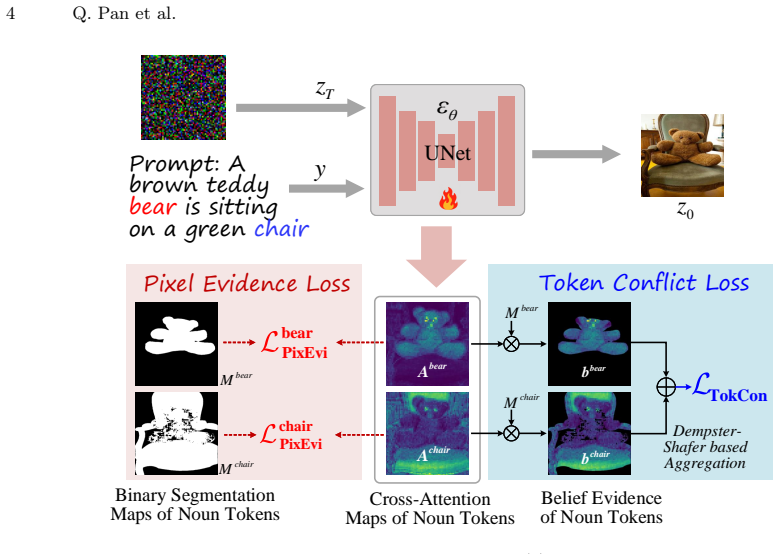
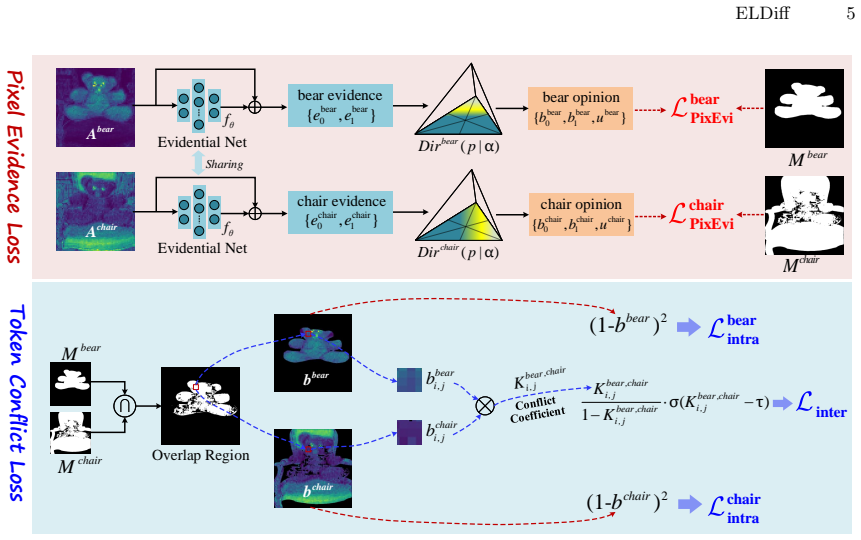
ELDiff is a new evidential learning-supervised T2I diffusion model that leverages uncertainty metrics and conflict detection to enhance fault tolerance of unreliable segmentation maps and suppress semantic conflicts, strengthening object-wise consistency learning through a pixel evidence loss that restrains overconfidence via evidential regularization and a token conflict loss that optimizes a measured conflict factor.
What carries the argument
Pixel evidence loss and token conflict loss, which apply evidential regularization to unreliable segmentation labels and optimize a conflict factor between object tokens.
If this is right
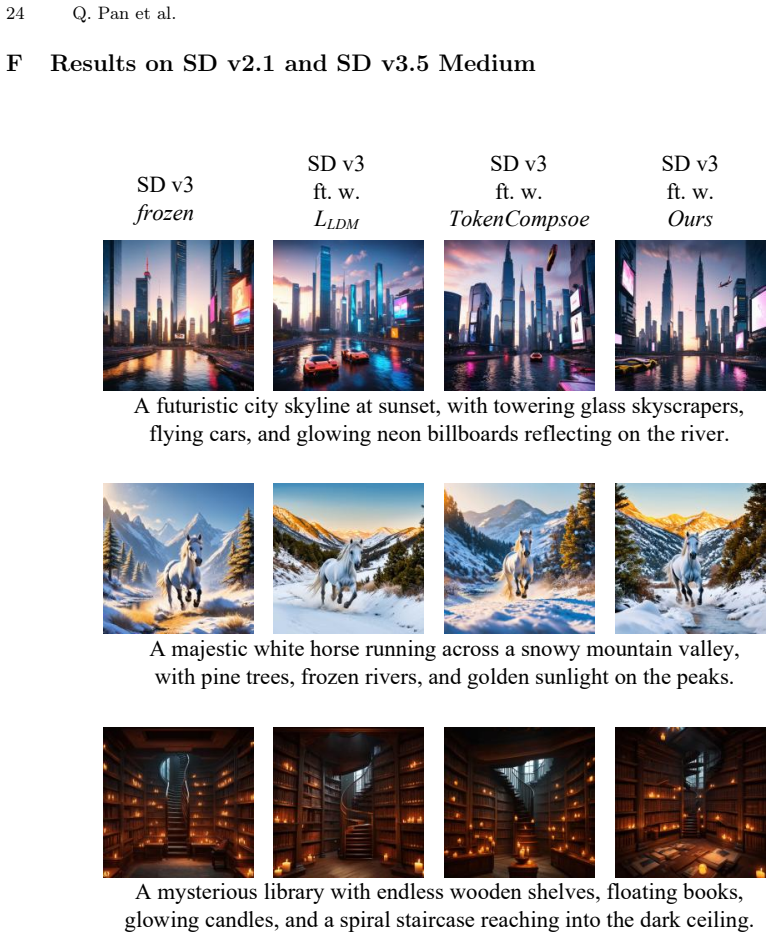
- ELDiff outperforms existing training-based and train-free T2I diffusion models on SD v1.4, SD v2.1, SDXL, SD v3.5, and Qwen-Image.
- Gains are achieved without requiring additional inference-time manipulations.
- ELDiff integrates directly into the existing training pipeline of T2I diffusion models.
Where Pith is reading between the lines
- Similar uncertainty handling could be tested in video or 3D generation where element consistency across frames or views is required.
- The method may allow training on automatically generated or lower-quality segmentation data instead of clean manual maps.
- Extending the conflict loss to other modalities such as text-to-video or image-to-text could address overlapping concepts in those settings.
Load-bearing premise
The pixel evidence loss and token conflict loss can reliably reduce segmentation map bias and semantic overlap conflict without creating new training instabilities or degrading single-object performance.
What would settle it
A controlled test on a multi-object prompt set with deliberately noisy or overlapping segmentation maps where ELDiff produces more missing objects, attribute errors, or lower human preference scores than standard token-supervised training.
Figures

read the original abstract
In multi-object text-to-image (T2I) diffusion, ensuring semantic consistency between textual prompts and generated visual content is crucial for image synthesis. However, such consistency constraint is often underemphasized in the denoising process of diffusion models. Although token supervised diffusion models can mitigate this issue by learning object-wise consistency between the image content and object segmentation maps, it tends to suffer from the problems of segmentation map bias and semantic overlap conflict, especially when involving multiple objects. In this paper, we propose ELDiff, a new evidential learning-supervised T2I diffusion model, which leverages the advantages of uncertainty metric and conflict detection to enhance the fault tolerance of unreliable segmentation maps and suppress semantic conflicts, strengthening object-wise consistency learning. Specifically, a pixel evidence loss is proposed to restrain overconfidence in unreliable labels through evidential regularization, and a token conflict loss is designed to weaken the contradiction between semantics through optimizing a measured conflict factor. Extensive experiments show that our ELDiff outperforms existing training based and train-free based T2I diffusion models on SD v1.4, SD v2.1, SDXL, SD v3.5, and Qwen-Image, without requiring additional inference-time manipulations. Notably, ELDiff can be seamlessly extended to the existing training pipeline of T2I diffusion models. Code can be found at https://github.com/QingtaoPan/ELDiff.
Editorial analysis
A structured set of objections, weighed in public.
Referee Report
Summary. The paper proposes ELDiff, a text-to-image diffusion model that augments standard training with evidential learning. It introduces a pixel evidence loss to regularize overconfidence on unreliable segmentation maps and a token conflict loss to reduce semantic contradictions between tokens. The central claim is that these additions improve object-wise consistency in multi-object generation, yielding better performance than both training-based and train-free baselines across SD v1.4, v2.1, SDXL, SD v3.5, and Qwen-Image, while requiring no inference-time changes and integrating seamlessly into existing diffusion training pipelines.
Significance. If the empirical claims are substantiated, ELDiff would demonstrate a practical training-time route to better semantic alignment in diffusion models by exploiting uncertainty quantification and conflict measurement, without the overhead of test-time interventions. The public code release at the cited GitHub repository is a clear strength for reproducibility. The significance remains conditional on verification that the added losses preserve training stability and do not trade off single-object fidelity.
major comments (1)
- [Experiments] The central claim that the pixel evidence loss and token conflict loss improve multi-object consistency without introducing training instabilities or degrading single-object performance is load-bearing, yet the manuscript provides no loss curves, divergence statistics, or single-object metrics to support it (Experiments section). Without these, the reported gains on SD v1.4–v3.5 and Qwen-Image cannot be assessed for robustness.
minor comments (1)
- Notation for the conflict factor and evidence parameters should be defined explicitly at first use to avoid ambiguity when the losses are combined with the standard diffusion objective.
Simulated Author's Rebuttal
We thank the referee for the constructive comment on the need for explicit validation of training stability and single-object performance. We address this below.
read point-by-point responses
-
Referee: [Experiments] The central claim that the pixel evidence loss and token conflict loss improve multi-object consistency without introducing training instabilities or degrading single-object performance is load-bearing, yet the manuscript provides no loss curves, divergence statistics, or single-object metrics to support it (Experiments section). Without these, the reported gains on SD v1.4–v3.5 and Qwen-Image cannot be assessed for robustness.
Authors: We agree that the manuscript lacks direct evidence such as loss curves, divergence statistics, or single-object metrics to substantiate the claims of no training instabilities or degradation in single-object fidelity. While the reported gains across multiple base models are consistent, this does not constitute explicit verification. In the revised version we will add training loss curves (comparing standard diffusion loss with the added pixel evidence and token conflict losses), divergence statistics between evidential and standard predictions, and single-object metrics (FID and CLIP score on single-object prompts) to directly support the robustness claims. revision: yes
Circularity Check
No circularity in derivation chain
full rationale
The paper derives pixel evidence loss (via evidential regularization to restrain overconfidence) and token conflict loss (via measured conflict factor to weaken semantic contradictions) from standard evidential learning theory applied to existing diffusion objectives. These are presented as new supervisory terms that extend the training pipeline without any reduction to fitted parameters, self-referential definitions, or load-bearing self-citations. No equations or claims in the abstract or described method equate outputs to inputs by construction; the central claims rest on independent evidential metrics rather than renaming or refitting the target consistency metrics themselves. The approach is self-contained against external benchmarks.
Axiom & Free-Parameter Ledger
Reference graph
Works this paper leans on
-
[1]
Advances in neural information processing systems33, 14927–14937 (2020)
Amini, A., Schwarting, W., Soleimany, A., Rus, D.: Deep evidential regression. Advances in neural information processing systems33, 14927–14937 (2020)
2020
-
[2]
Bai, S., Cai, Y., Chen, R., Chen, K., Chen, X., Cheng, Z., Deng, L., Ding, W., Gao, C., Ge, C., et al.: Qwen3-vl technical report. arXiv preprint arXiv:2511.21631 (2025)
work page internal anchor Pith review Pith/arXiv arXiv 2025
-
[3]
In: Proceedings of the IEEE/CVF international conference on computer vision
Bao, W., Yu, Q., Kong, Y.: Evidential deep learning for open set action recognition. In: Proceedings of the IEEE/CVF international conference on computer vision. pp. 13349–13358 (2021)
2021
-
[4]
In: Proceedings of the IEEE/CVF conference on computer vision and pattern recognition
Blattmann, A., Rombach, R., Ling, H., Dockhorn, T., Kim, S.W., Fidler, S., Kreis, K.: Align your latents: High-resolution video synthesis with latent diffusion models. In: Proceedings of the IEEE/CVF conference on computer vision and pattern recognition. pp. 22563–22575 (2023)
2023
-
[5]
ACM transactions on Graphics (TOG)42(4), 1–10 (2023)
Chefer, H., Alaluf, Y., Vinker, Y., Wolf, L., Cohen-Or, D.: Attend-and-excite: Attention-based semantic guidance for text-to-image diffusion models. ACM transactions on Graphics (TOG)42(4), 1–10 (2023)
2023
-
[6]
In: The Twelfth International Conference on Learning Representations
Chen, J., Jincheng, Y., Chongjian, G., Yao, L., Xie, E., Wang, Z., Kwok, J., Luo, P., Lu, H., Li, Z.: Pixart-α: Fast training of diffusion transformer for photorealistic text-to-image synthesis. In: The Twelfth International Conference on Learning Representations
-
[7]
In: Pro- ceedings of the IEEE/CVF winter conference on applications of computer vision
Chen, M., Laina, I., Vedaldi, A.: Training-free layout control with cross-attention guidance. In: Pro- ceedings of the IEEE/CVF winter conference on applications of computer vision. pp. 5343–5353 (2024)
2024
-
[8]
arXiv preprint arXiv:2310.18235 (2023)
Cho,J.,Hu,Y.,Garg,R.,Anderson,P.,Krishna,R.,Baldridge,J.,Bansal,M.,Pont-Tuset,J.,Wang,S.: Davidsonian scene graph: Improving reliability in fine-grained evaluation for text-to-image generation. arXiv preprint arXiv:2310.18235 (2023)
-
[9]
In: Classic works of the Dempster-Shafer theory of belief functions, pp
Dempster, A.P.: Upper and lower probabilities induced by a multivalued mapping. In: Classic works of the Dempster-Shafer theory of belief functions, pp. 57–72 (2008)
2008
-
[10]
Advances in Neural Information Processing Systems36, 58648–58669 (2023)
Du, C., Li, Y., Qiu, Z., Xu, C.: Stable diffusion is unstable. Advances in Neural Information Processing Systems36, 58648–58669 (2023)
2023
-
[11]
In: Forty-first international conference on machine learning (2024)
Esser, P., Kulal, S., Blattmann, A., Entezari, R., Müller, J., Saini, H., Levi, Y., Lorenz, D., Sauer, A., Boesel, F., et al.: Scaling rectified flow transformers for high-resolution image synthesis. In: Forty-first international conference on machine learning (2024)
2024
-
[12]
In: The Eleventh International Conference on Learning Representations
Feng, W., He, X., Fu, T.J., Jampani, V., Akula, A.R., Narayana, P., Basu, S., Wang, X.E., Wang, W.Y.: Training-free structured diffusion guidance for compositional text-to-image synthesis. In: The Eleventh International Conference on Learning Representations
-
[13]
In: Proceedings of the IEEE/CVF Conference on Computer Vision and Pattern Recognition
Feng, Z., Zhang, Z., Yu, X., Fang, Y., Li, L., Chen, X., Lu, Y., Liu, J., Yin, W., Feng, S., et al.: Ernie-vilg 2.0: Improving text-to-image diffusion model with knowledge-enhanced mixture-of-denoising-experts. In: Proceedings of the IEEE/CVF Conference on Computer Vision and Pattern Recognition. pp. 10135– 10145 (2023)
2023
-
[14]
In: International conference on medical image computing and computer- assisted intervention
Fu, W., Chen, Y., Liu, W., Yue, X., Ma, C.: Evidence reconciled neural network for out-of-distribution detection in medical images. In: International conference on medical image computing and computer- assisted intervention. pp. 305–315 (2023)
2023
-
[15]
Advances in Neural Information Processing Systems36, 52132–52152 (2023)
Ghosh, D., Hajishirzi, H., Schmidt, L.: Geneval: An object-focused framework for evaluating text-to- image alignment. Advances in Neural Information Processing Systems36, 52132–52152 (2023)
2023
-
[16]
arXiv preprint arXiv:2212.10015 (2022)
Gokhale, T., Palangi, H., Nushi, B., Vineet, V., Horvitz, E., Kamar, E., Baral, C., Yang, Y.: Bench- marking spatial relationships in text-to-image generation. arXiv preprint arXiv:2212.10015 (2022)
-
[17]
In: Proceedings of the IEEE/CVF Conference on Computer Vision and Pattern Recognition
Guo, X., Liu, J., Cui, M., Li, J., Yang, H., Huang, D.: Initno: Boosting text-to-image diffusion models via initial noise optimization. In: Proceedings of the IEEE/CVF Conference on Computer Vision and Pattern Recognition. pp. 9380–9389 (2024)
2024
-
[18]
Advances in Neural Information Processing Systems36, 66923–66939 (2023)
Hao, Y., Chi, Z., Dong, L., Wei, F.: Optimizing prompts for text-to-image generation. Advances in Neural Information Processing Systems36, 66923–66939 (2023)
2023
-
[19]
Advances in neural information processing systems 30(2017) ELDiff 15
Heusel, M., Ramsauer, H., Unterthiner, T., Nessler, B., Hochreiter, S.: Gans trained by a two time-scale update rule converge to a local nash equilibrium. Advances in neural information processing systems 30(2017) ELDiff 15
2017
-
[20]
IEEE Transactions on Pattern Analysis and Machine Intelligence47(5), 3563–3579 (2025)
Huang, K., Duan, C., Sun, K., Xie, E., Li, Z., Liu, X.: T2i-compbench++: An enhanced and compre- hensive benchmark for compositional text-to-image generation. IEEE Transactions on Pattern Analysis and Machine Intelligence47(5), 3563–3579 (2025)
2025
-
[21]
Advances in Neural Information Processing Systems36, 78723–78747 (2023)
Huang, K., Sun, K., Xie, E., Li, Z., Liu, X.: T2i-compbench: A comprehensive benchmark for open- world compositional text-to-image generation. Advances in Neural Information Processing Systems36, 78723–78747 (2023)
2023
-
[22]
Machine Intelligence Research21(4), 617–630 (2024)
Ji, W., Li, J., Bi, Q., Liu, T., Li, W., Cheng, L.: Segment anything is not always perfect: An investigation of sam on different real-world applications. Machine Intelligence Research21(4), 617–630 (2024)
2024
-
[23]
Advances in Neural Information Processing Systems37, 76177–76209 (2024)
Jiang, D., Song, G., Wu, X., Zhang, R., Shen, D., Zong, Z., Liu, Y., Li, H.: Comat: Aligning text-to- image diffusion model with image-to-text concept matching. Advances in Neural Information Processing Systems37, 76177–76209 (2024)
2024
-
[24]
In: 2012 15th International Conference on Information Fusion
Jøsang, A., Hankin, R.: Interpretation and fusion of hyper opinions in subjective logic. In: 2012 15th International Conference on Information Fusion. pp. 1225–1232 (2012)
2012
-
[25]
Jsang,A.:SubjectiveLogic:Aformalismforreasoningunderuncertainty.SpringerPublishingCompany, Incorporated (2018)
2018
-
[26]
arXiv preprint arXiv:2512.16853 , year=
Kamath, A., Chang, K.W., Krishna, R., Zettlemoyer, L., Hu, Y., Ghazvininejad, M.: Geneval 2: Ad- dressing benchmark drift in text-to-image evaluation. arXiv preprint arXiv:2512.16853 (2025)
-
[27]
In: 2025 IEEE/CVF Winter Conference on Applications of Computer Vision (WACV)
Kang, W., Galim, K., Koo, H.I., Cho, N.I.: Counting guidance for high fidelity text-to-image synthesis. In: 2025 IEEE/CVF Winter Conference on Applications of Computer Vision (WACV). pp. 899–908. IEEE (2025)
2025
-
[28]
In: Proceedings of the IEEE/CVF conference on computer vision and pattern recognition
Ke, L., Tai, Y.W., Tang, C.K.: Deep occlusion-aware instance segmentation with overlapping bilayers. In: Proceedings of the IEEE/CVF conference on computer vision and pattern recognition. pp. 4019– 4028 (2021)
2021
-
[29]
In: Proceedings of the Computer Vision and Pattern Recognition Conference
Kim, J., Esmaeili, E., Qiu, Q.: Text embedding is not all you need: Attention control for text-to-image semantic alignment with text self-attention maps. In: Proceedings of the Computer Vision and Pattern Recognition Conference. pp. 8031–8040 (2025)
2025
-
[30]
Auto-Encoding Variational Bayes
Kingma, D.P., Welling, M.: Auto-encoding variational bayes. arXiv preprint arXiv:1312.6114 (2013)
work page internal anchor Pith review Pith/arXiv arXiv 2013
-
[31]
In: Proceedings of the IEEE/CVF international conference on computer vision
Kirillov, A., Mintun, E., Ravi, N., Mao, H., Rolland, C., Gustafson, L., Xiao, T., Whitehead, S., Berg, A.C., Lo, W.Y., et al.: Segment anything. In: Proceedings of the IEEE/CVF international conference on computer vision. pp. 4015–4026 (2023)
2023
-
[32]
Kopetzki, A.K., Charpentier, B., Zügner, D., Giri, S., Günnemann, S.: Evaluating robustness of pre- dictive uncertainty estimation: Are dirichlet-based models reliable? In: International Conference on Machine Learning. pp. 5707–5718 (2021)
2021
-
[33]
In: Proceedings of the IEEE/CVF conference on computer vision and pattern recogni- tion
Kumari, N., Zhang, B., Zhang, R., Shechtman, E., Zhu, J.Y.: Multi-concept customization of text-to- image diffusion. In: Proceedings of the IEEE/CVF conference on computer vision and pattern recogni- tion. pp. 1931–1941 (2023)
1931
-
[34]
arXiv preprint arXiv:2210.16056 (2022)
Liew, J.H., Yan, H., Zhou, D., Feng, J.: Magicmix: Semantic mixing with diffusion models. arXiv preprint arXiv:2210.16056 (2022)
-
[35]
In: Proceedings of the IEEE/CVF conference on computer vision and pattern recognition
Lin, C.H., Gao, J., Tang, L., Takikawa, T., Zeng, X., Huang, X., Kreis, K., Fidler, S., Liu, M.Y., Lin, T.Y.: Magic3d: High-resolution text-to-3d content creation. In: Proceedings of the IEEE/CVF conference on computer vision and pattern recognition. pp. 300–309 (2023)
2023
-
[36]
In: European conference on computer vision
Lin,T.Y.,Maire,M.,Belongie,S.,Hays,J.,Perona,P.,Ramanan,D.,Dollár,P.,Zitnick,C.L.:Microsoft coco: Common objects in context. In: European conference on computer vision. pp. 740–755 (2014)
2014
-
[37]
Transactions of the Association for Compu- tational Linguistics11, 635–651 (2023)
Liu, F., Emerson, G., Collier, N.: Visual spatial reasoning. Transactions of the Association for Compu- tational Linguistics11, 635–651 (2023)
2023
-
[38]
In: European conference on computer vision
Liu,N., Li, S., Du, Y., Torralba, A., Tenenbaum, J.B.: Compositional visual generation with composable diffusion models. In: European conference on computer vision. pp. 423–439 (2022)
2022
-
[39]
In: European conference on computer vision
Liu, S., Zeng, Z., Ren, T., Li, F., Zhang, H., Yang, J., Jiang, Q., Li, C., Yang, J., Su, H., et al.: Grounding dino: Marrying dino with grounded pre-training for open-set object detection. In: European conference on computer vision. pp. 38–55 (2024) 16 Q. Pan et al
2024
-
[40]
In: European conference on computer vision
Liu, S., Zeng, Z., Ren, T., Li, F., Zhang, H., Yang, J., Jiang, Q., Li, C., Yang, J., Su, H., et al.: Grounding dino: Marrying dino with grounded pre-training for open-set object detection. In: European conference on computer vision. pp. 38–55. Springer (2024)
2024
-
[41]
Loshchilov,I.,Hutter,F.:Decoupledweightdecayregularization.In:InternationalConferenceonLearn- ing Representations
-
[42]
In: Proceedings of the AAAI conference on artificial intelligence
Ma, W.D.K., Lahiri, A., Lewis, J.P., Leung, T., Kleijn, W.B.: Directed diffusion: Direct control of object placement through attention guidance. In: Proceedings of the AAAI conference on artificial intelligence. vol. 38, pp. 4098–4106 (2024)
2024
-
[43]
Advances in neural infor- mation processing systems31(2018)
Malinin, A., Gales, M.: Predictive uncertainty estimation via prior networks. Advances in neural infor- mation processing systems31(2018)
2018
-
[44]
Advances in Neural Information Processing Systems36, 72983–73007 (2023)
Minderer, M., Gritsenko, A., Houlsby, N.: Scaling open-vocabulary object detection. Advances in Neural Information Processing Systems36, 72983–73007 (2023)
2023
-
[45]
IEEE Transactions on Medical Imaging45(4), 1369–1382 (2025)
Pan, Q., Li, Z., Yang, G., Yang, Q., Ji, B.: Evivlm: When evidential learning meets vision language model for medical image segmentation. IEEE Transactions on Medical Imaging45(4), 1369–1382 (2025)
2025
-
[46]
In: Pro- ceedings of the IEEE/CVF Conference on Computer Vision and Pattern Recognition
Pandey, D.S., Yu, Q.: Multidimensional belief quantification for label-efficient meta-learning. In: Pro- ceedings of the IEEE/CVF Conference on Computer Vision and Pattern Recognition. pp. 14391–14400 (2022)
2022
-
[47]
In: Proceedings of the AAAI Conference on Artificial Intelligence
Pandey, D.S., Yu, Q.: Evidential conditional neural processes. In: Proceedings of the AAAI Conference on Artificial Intelligence. vol. 37, pp. 9389–9397 (2023)
2023
-
[48]
In: International Conference on Learning Representations
Park, D., Kim, S., Moon, T., Kim, M., Lee, K., Cho, J.: Rare-to-frequent: Unlocking compositional generation power of diffusion models on rare concepts with llm guidance. In: International Conference on Learning Representations
-
[49]
In: Proceedings of the IEEE international conference on computer vision
Plummer, B.A., Wang, L., Cervantes, C.M., Caicedo, J.C., Hockenmaier, J., Lazebnik, S.: Flickr30k en- tities: Collecting region-to-phrase correspondences for richer image-to-sentence models. In: Proceedings of the IEEE international conference on computer vision. pp. 2641–2649 (2015)
2015
-
[50]
In: The Twelfth Interna- tional Conference on Learning Representations
Podell, D., English, Z., Lacey, K., Blattmann, A., Dockhorn, T., Müller, J., Penna, J., Rombach, R.: Sdxl: Improving latent diffusion models for high-resolution image synthesis. In: The Twelfth Interna- tional Conference on Learning Representations
-
[51]
SDXL: Improving Latent Diffusion Models for High-Resolution Image Synthesis
Podell, D., English, Z., Lacey, K., Blattmann, A., Dockhorn, T., Müller, J., Penna, J., Rom- bach, R.: Sdxl: Improving latent diffusion models for high-resolution image synthesis. arXiv preprint arXiv:2307.01952 (2023)
work page internal anchor Pith review Pith/arXiv arXiv 2023
-
[52]
In: The Eleventh International Conference on Learning Representations
Poole, B., Jain, A., Barron, J.T., Mildenhall, B.: Dreamfusion: Text-to-3d using 2d diffusion. In: The Eleventh International Conference on Learning Representations
-
[53]
In: Proceedings of the Computer Vision and Pattern Recognition Conference
Qiu,W.,Wang,J.,Tang,M.:Self-crossdiffusionguidancefortext-to-imagesynthesisofsimilarsubjects. In: Proceedings of the Computer Vision and Pattern Recognition Conference. pp. 23528–23538 (2025)
2025
-
[54]
In: Inter- national conference on machine learning
Radford, A., Kim, J.W., Hallacy, C., Ramesh, A., Goh, G., Agarwal, S., Sastry, G., Askell, A., Mishkin, P., Clark, J., et al.: Learning transferable visual models from natural language supervision. In: Inter- national conference on machine learning. pp. 8748–8763 (2021)
2021
-
[55]
Hierarchical Text-Conditional Image Generation with CLIP Latents
Ramesh, A., Dhariwal, P., Nichol, A., Chu, C., Chen, M.: Hierarchical text-conditional image generation with clip latents. arXiv preprint arXiv:2204.06125 (2022)
work page internal anchor Pith review Pith/arXiv arXiv 2022
-
[57]
Advances in Neural Information Processing Systems36, 3536–3559 (2023)
Rassin, R., Hirsch, E., Glickman, D., Ravfogel, S., Goldberg, Y., Chechik, G.: Linguistic binding in diffusion models: Enhancing attribute correspondence through attention map alignment. Advances in Neural Information Processing Systems36, 3536–3559 (2023)
2023
-
[58]
In: Proceedings of the IEEE/CVF conference on computer vision and pattern recognition
Rombach, R., Blattmann, A., Lorenz, D., Esser, P., Ommer, B.: High-resolution image synthesis with latent diffusion models. In: Proceedings of the IEEE/CVF conference on computer vision and pattern recognition. pp. 10684–10695 (2022)
2022
-
[59]
In: International Conference on Medical image computing and computer-assisted intervention
Ronneberger, O., Fischer, P., Brox, T.: U-net: Convolutional networks for biomedical image segmen- tation. In: International Conference on Medical image computing and computer-assisted intervention. pp. 234–241 (2015) ELDiff 17
2015
-
[60]
Advances in neural information processing systems35, 36479–36494 (2022)
Saharia, C., Chan, W., Saxena, S., Li, L., Whang, J., Denton, E.L., Ghasemipour, K., Gontijo Lopes, R., Karagol Ayan, B., Salimans, T., et al.: Photorealistic text-to-image diffusion models with deep language understanding. Advances in neural information processing systems35, 36479–36494 (2022)
2022
-
[61]
Advances in neural information processing systems31(2018)
Sensoy, M., Kaplan, L., Kandemir, M.: Evidential deep learning to quantify classification uncertainty. Advances in neural information processing systems31(2018)
2018
-
[62]
Sentz, K., Ferson, S.: Combination of evidence in dempster-shafer theory (2002)
2002
-
[63]
Advances in neural information processing systems33, 17247–17257 (2020)
Shi,W.,Zhao,X.,Chen,F.,Yu,Q.:Multifaceteduncertaintyestimationforlabel-efficientdeeplearning. Advances in neural information processing systems33, 17247–17257 (2020)
2020
-
[64]
In: The Eleventh International Conference on Learning Representations
Singer, U., Polyak, A., Hayes, T., Yin, X., An, J., Zhang, S., Hu, Q., Yang, H., Ashual, O., Gafni, O., et al.: Make-a-video: Text-to-video generation without text-video data. In: The Eleventh International Conference on Learning Representations
-
[65]
arXiv preprint arXiv:2311.17946 (2023)
Sun, J., Fu, D., Hu, Y., Wang, S., Rassin, R., Juan, D.C., Alon, D., Herrmann, C., Van Steenkiste, S., Krishna, R., et al.: Dreamsync: Aligning text-to-image generation with image understanding feedback. arXiv preprint arXiv:2311.17946 (2023)
-
[66]
In: Proceedings of the AAAI Conference on Artificial Intelligence
Tomani, C., Buettner, F.: Towards trustworthy predictions from deep neural networks with fast ad- versarial calibration. In: Proceedings of the AAAI Conference on Artificial Intelligence. vol. 35, pp. 9886–9896 (2021)
2021
-
[67]
In: Proceedings of the IEEE/CVF Conference on Computer Vision and Pattern Recognition
Wang, Z., Sha, Z., Ding, Z., Wang, Y., Tu, Z.: Tokencompose: Text-to-image diffusion with token- level supervision. In: Proceedings of the IEEE/CVF Conference on Computer Vision and Pattern Recognition. pp. 8553–8564 (2024)
2024
-
[68]
Wu, C., Li, J., Zhou, J., Lin, J., Gao, K., Yan, K., Yin, S.m., Bai, S., Xu, X., Chen, Y., et al.: Qwen- image technical report. arXiv preprint arXiv:2508.02324 (2025)
work page internal anchor Pith review Pith/arXiv arXiv 2025
-
[69]
In: Proceedings of the IEEE/CVF Conference on Computer Vision and Pattern Recognition
Wu, T.H., Lian, L., Gonzalez, J.E., Li, B., Darrell, T.: Self-correcting llm-controlled diffusion models. In: Proceedings of the IEEE/CVF Conference on Computer Vision and Pattern Recognition. pp. 6327–6336 (2024)
2024
-
[70]
In: Proceedings of the IEEE/CVF Conference on Computer Vision and Pattern Recognition
Xu, Y., Zhao, Y., Xiao, Z., Hou, T.: Ufogen: You forward once large scale text-to-image generation via diffusion gans. In: Proceedings of the IEEE/CVF Conference on Computer Vision and Pattern Recognition. pp. 8196–8206 (2024)
2024
-
[71]
Advances in Neural Information Processing Systems36, 41693–41706 (2023)
Xue, Z., Song, G., Guo, Q., Liu, B., Zong, Z., Liu, Y., Luo, P.: Raphael: Text-to-image generation via large mixture of diffusion paths. Advances in Neural Information Processing Systems36, 41693–41706 (2023)
2023
-
[72]
Advances in Neural Information Processing Systems36, 37636–37656 (2023)
Yang, L., Liu, J., Hong, S., Zhang, Z., Huang, Z., Cai, Z., Zhang, W., Cui, B.: Improving diffusion- based image synthesis with context prediction. Advances in Neural Information Processing Systems36, 37636–37656 (2023)
2023
-
[73]
In: International Conference on Learning Representations
Zhang, X., Yang, L., Li, G., Cai, Y., Xie, J., Tang, Y., Yang, Y., Wang, M., Cui, B.: Itercomp: Iterative composition-aware feedback learning from model gallery for text-to-image generation. In: International Conference on Learning Representations. pp. 8608–8628 (2025)
2025
-
[74]
Advances in Neural Information Processing Systems36, 30641–30661 (2023)
Zhang, Y., Xing, J., Lo, E., Jia, J.: Real-world image variation by aligning diffusion inversion chain. Advances in Neural Information Processing Systems36, 30641–30661 (2023)
2023
-
[75]
Advances in neural information processing systems33, 12827–12836 (2020)
Zhao, X., Chen, F., Hu, S., Cho, J.H.: Uncertainty aware semi-supervised learning on graph data. Advances in neural information processing systems33, 12827–12836 (2020)
2020
-
[76]
Neurocomputing p
Zhong, J., Pan, Q., Zhou, X., Lin, J., Zhuang, X.: Evidential learning driven breast tumor segmentation with stage-divided vision-language interaction. Neurocomputing p. 132411 (2025)
2025
-
[77]
<A><R><B>,
Zhou, Y., Zhou, D., Wang, Y., Feng, J., Hou, Q.: Maskdiffusion: Boosting text-to-image consistency with conditional mask. International Journal of Computer Vision133(5), 2805–2824 (2025) 18 Q. Pan et al. Appendix This supplementary material contains several sections that provide additional details related to our work on ELDiff. Specifically, it will cover...
2025
-
[78]
is used to assess the quality of the generated images from two datasets: i) 25014 image-caption pairs sampled from the COCO instance validation set; ii) 5000 image-caption pairs sampled from the Flickr30K instance validation set [49].4) CLIP Score[33] is utilized to evaluate realism, which reflects the degree of match between generated images and text pro...
discussion (0)
Sign in with ORCID, Apple, or X to comment. Anyone can read and Pith papers without signing in.