Rothe's Method for Quantum Dynamics in Atoms and Molecules with Gaussian Wavepackets
Pith reviewed 2026-06-26 15:00 UTC · model grok-4.3
The pith
Rothe's method stabilizes propagation of flexible Gaussian wavepackets for laser-driven quantum dynamics in atoms and molecules.
A machine-rendered reading of the paper's core claim, the machinery that carries it, and where it could break.
Core claim
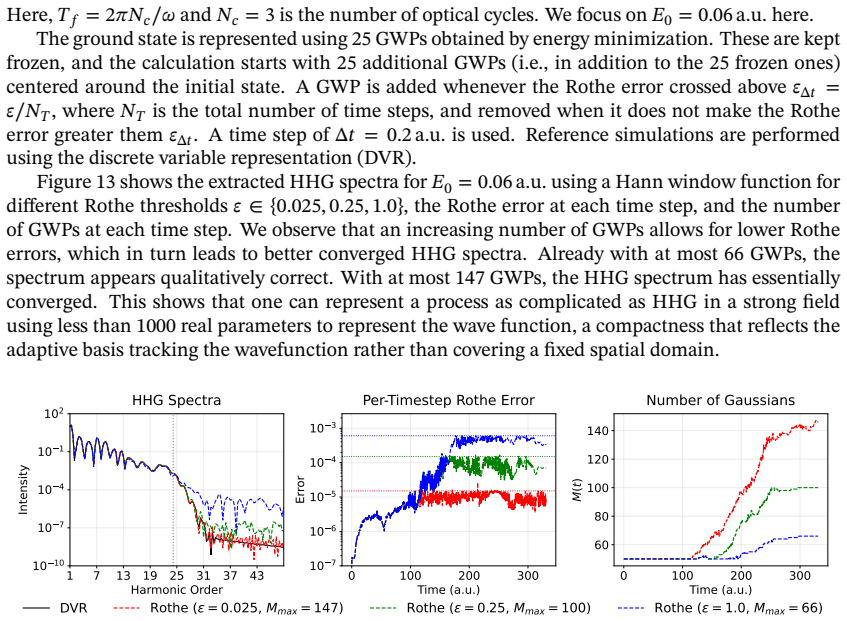
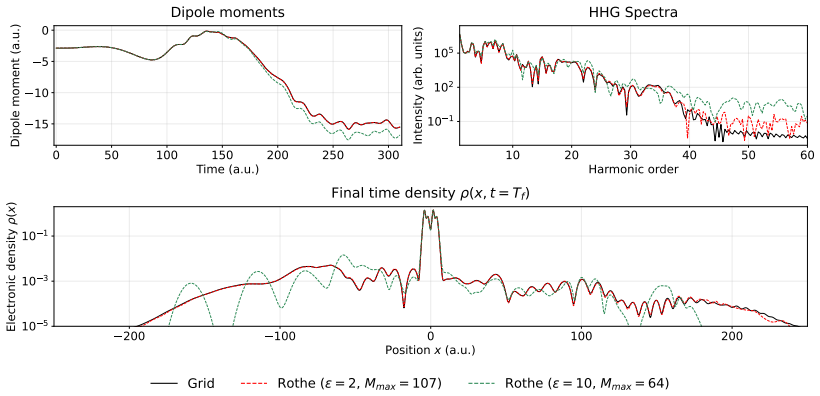
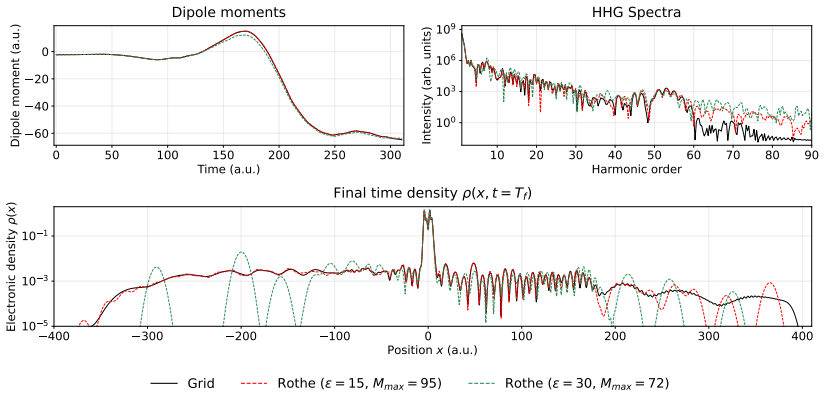
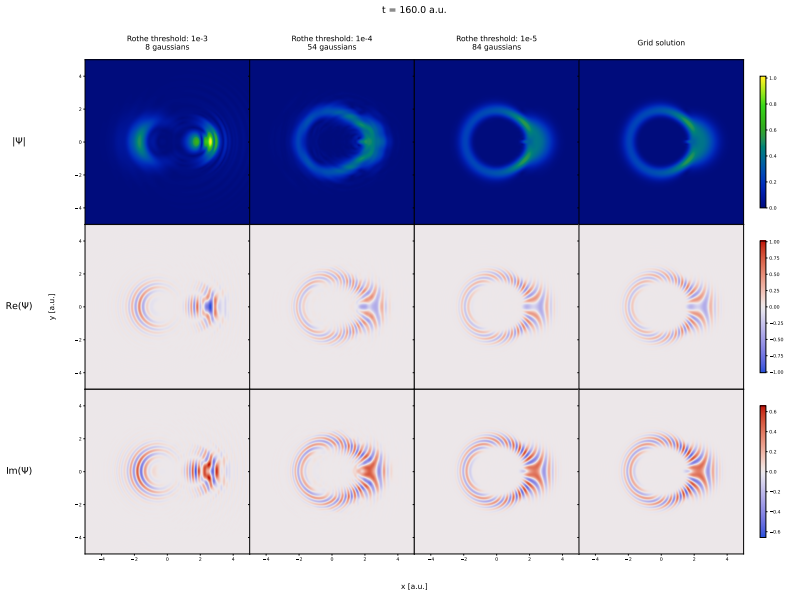
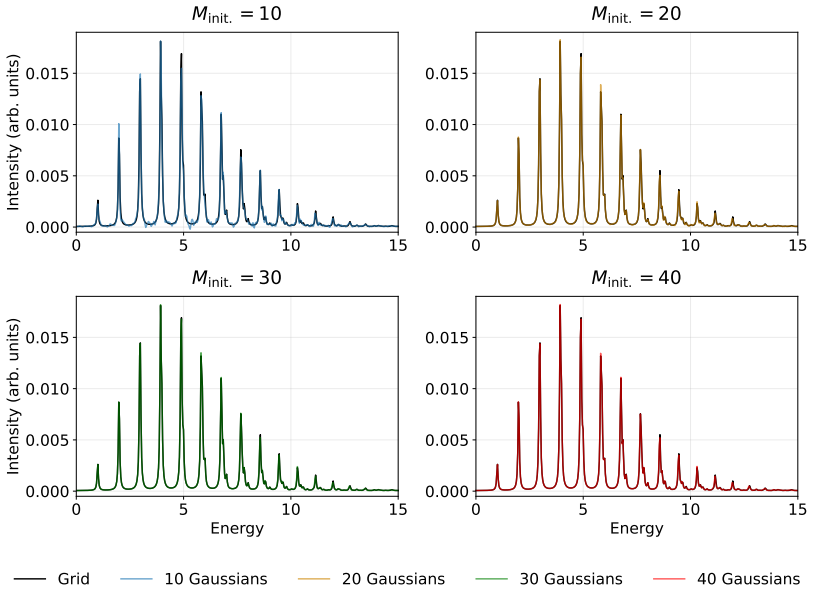
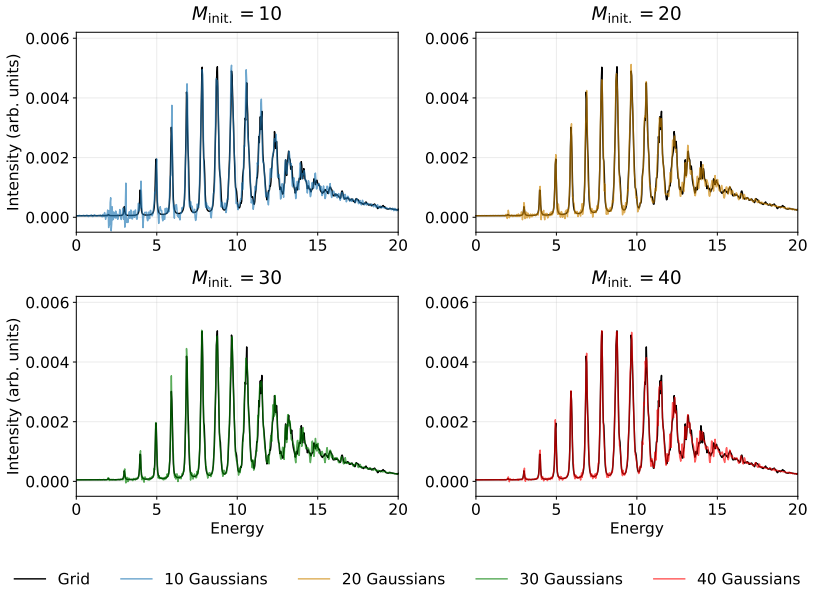
Gaussian wavepackets propagated via Rothe's method deliver results on par with highly accurate grid-based methods for both electronic and rovibrational quantum dynamics, including ultrafast nonlinear continuum processes such as high-harmonic generation, while requiring remarkably few wavepackets to reach grid-level accuracy.
What carries the argument
Rothe's method, an alternative time-propagation scheme that improves numerical stability over conventional time-dependent variational principles when applied to fully flexible Gaussian wavepackets.
If this is right
- Electronic and rovibrational laser-driven phenomena become simulable with far fewer basis functions than grid methods require.
- Memory demands drop enough to allow larger systems or longer propagation times.
- The same framework can in principle extend to fully coupled electronic-nuclear quantum dynamics.
- Continuum processes such as high-harmonic generation are accessible without explicit grid discretization of the continuum.
Where Pith is reading between the lines
- If the remaining matrix-element and cusp challenges are solved, the method could be combined with existing Gaussian-basis electronic-structure codes for larger molecules.
- The low basis count suggests possible hybrid schemes that mix Gaussian wavepackets with other localized bases for multi-scale dynamics.
- Direct benchmarking against grid results on additional nonlinear observables would provide a clear next test of accuracy retention.
Load-bearing premise
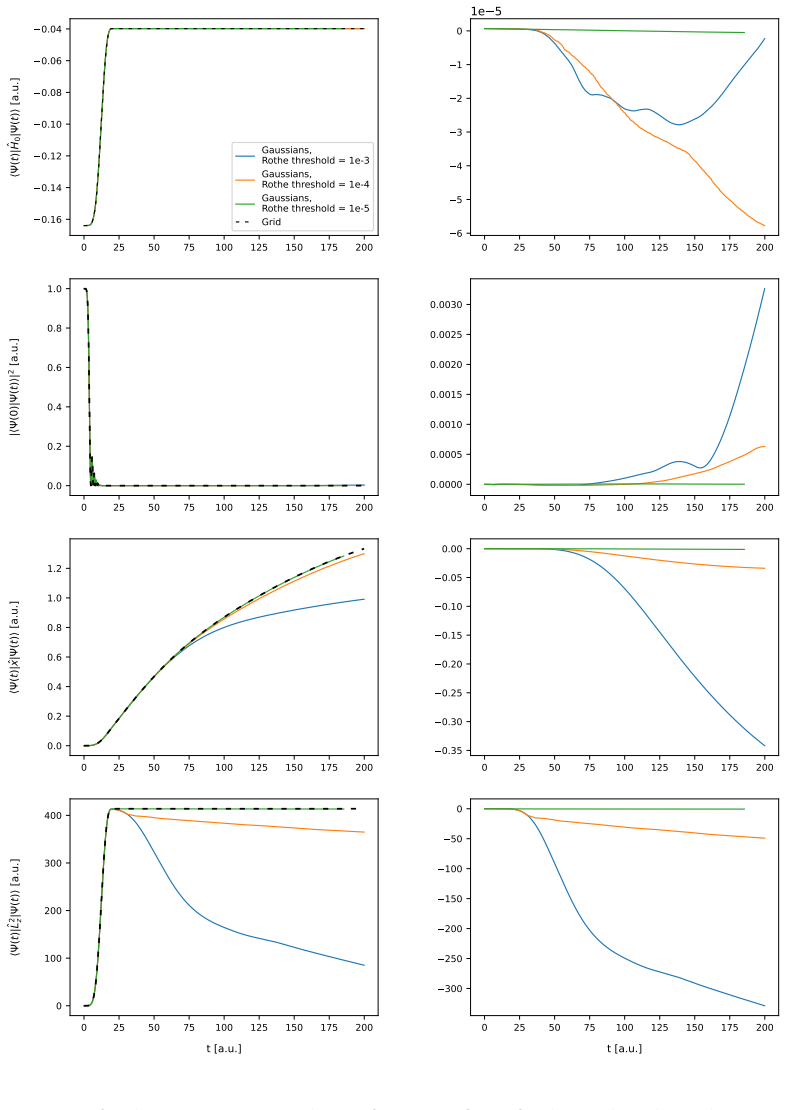
Numerical stability gains from Rothe's method will survive once matrix elements of the squared Hamiltonian and Coulomb cusps are handled without introducing errors comparable to those avoided.
What would settle it
A side-by-side computation of high-harmonic generation spectra for a simple atom or molecule in which the squared-Hamiltonian matrix elements are evaluated exactly and the Gaussian-Rothe results deviate measurably from converged grid benchmarks.
Figures
read the original abstract
Capable of capturing both bound and continuum quantum dynamics, Gaussian wavepackets are highly attractive basis functions for simulating laser-driven processes in atoms and molecules. Unfortunately, fully flexible Gaussian wavepackets are exceedingly challenging to propagate in a numerically stable manner within the framework of conventional time-dependent variational principles. In this chapter, we discuss the sources of the numerical issues and review an alternative approach, Rothe's method, that offers a route to improved numerical stability. Recent proof-of-concept simulations based on Rothe's method indicate that Gaussian wavepackets provide results on par with highly accurate grid-based methods for both electronic and rovibrational quantum dynamics, including ultrafast nonlinear processes that involve the continuum such as high-harmonic generation. Remarkably few Gaussian wavepackets are needed to achieve the high accuracy of grid-based approaches, indicating that further algorithmic developments and efficient implementations may enable efficient simulations of not only electronic and rovibrational phenomena but also fully coupled electronic-nuclear quantum dynamics with significantly reduced memory demands. We also point out remaining practical challenges, including matrix elements of the squared Hamiltonian and the treatment of Coulomb cusps.
Editorial analysis
A structured set of objections, weighed in public.
Referee Report
Summary. The manuscript reviews numerical instabilities in propagating fully flexible Gaussian wavepackets under conventional time-dependent variational principles and proposes Rothe's method as an alternative route to improved stability. It presents proof-of-concept simulations indicating that Gaussian wavepackets achieve accuracy comparable to grid-based methods for electronic and rovibrational quantum dynamics, including continuum-involved processes such as high-harmonic generation, while requiring remarkably few basis functions. The work notes remaining practical challenges with squared-Hamiltonian matrix elements and Coulomb cusps and suggests the approach may enable memory-efficient fully coupled electron-nuclear simulations.
Significance. If the reported parity with grid benchmarks holds after the flagged challenges are resolved, the method could provide a basis-set route to high-accuracy simulations of laser-driven processes with substantially lower memory requirements than grid approaches, particularly for dynamics involving both bound and continuum states.
minor comments (2)
- The abstract qualifies the accuracy claim with 'indicate that' and 'may enable'; the main text should ensure all simulation results are presented with explicit quantitative comparisons (e.g., error metrics or overlap values) to the cited grid benchmarks so readers can assess the 'on par' statement directly.
- Because the work is framed as proof-of-concept, a dedicated subsection summarizing the specific systems, number of Gaussians employed, and observed convergence behavior would improve clarity without altering the central narrative.
Simulated Author's Rebuttal
We thank the referee for the positive assessment of the manuscript, the recognition of its potential significance, and the recommendation for minor revision. The report does not enumerate any specific major comments, so we have no individual points requiring point-by-point rebuttal or clarification at this stage.
Circularity Check
No significant circularity; derivation self-contained against external benchmarks
full rationale
The manuscript reviews Rothe's method as an alternative to conventional variational principles for propagating Gaussian wavepackets, then reports proof-of-concept simulations whose accuracy is assessed exclusively against independent grid-based reference calculations. No derivation step reduces a claimed result to a fitted parameter or self-citation by construction; the central claims are qualified as indicative and the open issues (squared-Hamiltonian matrix elements, Coulomb cusps) are stated explicitly rather than assumed away. Comparisons remain external and falsifiable.
Axiom & Free-Parameter Ledger
axioms (1)
- domain assumption Conventional time-dependent variational principles for Gaussian wavepacket propagation suffer from numerical instabilities that Rothe's method can mitigate.
Reference graph
Works this paper leans on
-
[1]
S.Bubin,M.Pavanello,W.-C.Tung,K.L.Sharkey,andL.Adamowicz.“Born–Oppenheimer andNon-Born–Oppenheimer,AtomicandMolecularCalculationswithExplicitlyCorrelated Gaussians”.Chem.Rev.113(2013),36–79.doi:10.1021/cr200419d
-
[2]
Theory and application of explicitly correlated Gaussians
J. Mitroy, S. Bubin, W. Horiuchi, Y. Suzuki, L. Adamowicz, W. Cencek, K. Szalewicz, J. Ko- masa, D. Blume, and K. Varga. “Theory and application of explicitly correlated Gaussians”. Rev.Mod.Phys.85(2013),693–749.doi:10.1103/RevModPhys.85.693
-
[3]
Pre-Born–Oppenheimermolecularstructuretheory
E.Mátyus.“Pre-Born–Oppenheimermolecularstructuretheory”.Mol.Phys.117(2019),590– 609.doi:10.1080/00268976.2018.1530461
-
[4]
Laser-induceddynamicalignmentof theHDmoleculewithouttheBorn–Oppenheimerapproximation
L.Adamowicz,S.Kvaal,C.Lasser,andT.B.Pedersen.“Laser-induceddynamicalignmentof theHDmoleculewithouttheBorn–Oppenheimerapproximation”.J.Chem.Phys.157(2022), 144302.doi:10.1063/5.0101352
-
[5]
StrongElectron-Electron-Nuclei Correlations in Two-Photon Double Ionization of H2
K.Arteaga,J.Feist,D.Jelovina,F.Martín,andA.Palacios.“StrongElectron-Electron-Nuclei Correlations in Two-Photon Double Ionization of H2”.Phys. Rev. Lett.133 (2024), 123201. doi:10.1103/PhysRevLett.133.123201
-
[6]
M.BornandR.Oppenheimer.“ZurQuantentheoriederMolekeln”.Ann.Phys.(Leipzig)389 (1927),457–484.doi:10.1002/ANDP.19273892002
-
[7]
M.BornandK.Huang.DynamicalTheoryofCrystalLattices.Oxford:ClarendonPress,1954
1954
-
[8]
H.-D.Meyer,F.Gatti,andG.A.Worth,eds.MultidimensionalQuantumDynamics:MCTDH TheoryandApplications.Weinheim:Wiley,2009.doi:10.1002/9783527627400
-
[9]
Ab Initio Multiple Spawning: Photochem- istryfromFirstPrinciplesQuantumMolecularDynamics
M. Ben-Nun, J. Quenneville, and T. J. Martínez. “Ab Initio Multiple Spawning: Photochem- istryfromFirstPrinciplesQuantumMolecularDynamics”.J.Phys.Chem.A104(2000),5161– 5175.doi:10.1021/jp994174i
-
[10]
Theoretical methods for attosecond electron and nuclear dynamics: applications to the H2 molecule
A. Palacios, J. L. Sanz-Vicario, and F. Martín. “Theoretical methods for attosecond electron and nuclear dynamics: applications to the H2 molecule”.J. Phys. B48 (2015), 242001.doi: 10.1088/0953-4075/48/24/242001
-
[11]
Real-TimeTime-DependentElec- tronic Structure Theory
X.Li,N.Govind,C.Isborn,A.E.DePrince,andK.Lopata.“Real-TimeTime-DependentElec- tronic Structure Theory”.Chem. Rev.120 (2020), 9951–9993.doi:10.1021/acs.chemrev. 0c00223
-
[12]
Ultrafast charge migration by electron correlation
L. Cederbaum and J. Zobeley. “Ultrafast charge migration by electron correlation”.Chem. Phys.Lett.307(1999),205–210.doi:10.1016/S0009-2614(99)00508-4
-
[13]
AttosecondElectronDynamics inMolecules
M.Nisoli,P.Decleva,F.Calegari,A.Palacios,andF.Martín.“AttosecondElectronDynamics inMolecules”.Chem.Rev.117(2017),10760–10825.doi:10.1021/acs.chemrev.6b00453
-
[14]
Theory of high- harmonic generation by low-frequency laser fields
M. Lewenstein, P. Balcou, M. Y. Ivanov, A. L’Huillier, and P. B. Corkum. “Theory of high- harmonic generation by low-frequency laser fields”.Phys. Rev. A49 (1994), 2117–2132.doi: 10.1103/PhysRevA.49.2117
-
[15]
Time-dependent theory of multiphoton ionization of xenon
K. C. Kulander. “Time-dependent theory of multiphoton ionization of xenon”.Phys. Rev. A 38(1988),778–787.doi:10.1103/PhysRevA.38.778. 43
-
[16]
Dynamics of Short-Pulse Excitation, Ion- ization and Harmonic Conversion
K. C. Kulander, K. J. Schafer, and J. L. Krause. “Dynamics of Short-Pulse Excitation, Ion- ization and Harmonic Conversion”.Super-Intense Laser-Atom Physics. Ed. by B. Piraux, A. L’Huillier, and K. Rzążewski. NATO ASI Series. Boston: Springer, 1993, pp. 95–110.doi: 10.1007/978-1-4615-7963-2_10
-
[17]
ProtonicStructureofMolecules.I.AmmoniaMolecules
I.L.Thomas.“ProtonicStructureofMolecules.I.AmmoniaMolecules”.Phys.Rev.185(1969), 90–94.doi:10.1103/PhysRev.185.90
-
[18]
I. L. Thomas and H. W. Joy. “Protonic Structure of Molecules. II. Methodology, Center-of- Mass Transformation, and the Structure of Methane, Ammonia, and Water”.Phys. Rev. A2 (1970),1200–1208.doi:10.1103/PhysRevA.2.1200
-
[19]
F.Pavošević,T.Culpitt,andS.Hammes-Schiffer.“MulticomponentQuantumChemistry:In- tegratingElectronicandNuclearQuantumEffectsviatheNuclear-ElectronicOrbitalMethod”. Chem.Rev.120(2020),4222–4253.doi:10.1021/acs.chemrev.9b00798
-
[20]
Real-TimeTime- DependentNuclear-ElectronicOrbitalApproach:DynamicsbeyondtheBorn-Oppenheimer Approximation
L.Zhao,Z.Tao,F.Pavošević,A.Wildman,S.Hammes-Schiffer,andX.Li.“Real-TimeTime- DependentNuclear-ElectronicOrbitalApproach:DynamicsbeyondtheBorn-Oppenheimer Approximation”.J. Phys. Chem. Lett.11 (2020), 4052–4058.doi:10 . 1021 / acs . jpclett . 0c00701
2020
-
[21]
G. D. Smith.Numerical Solution of Partial Differential Equations: Finite Difference Methods. 3rded.Oxford:ClarendonPress,1985
1985
-
[22]
A. Natan, A. Benjamini, D. Naveh, L. Kronik, M. L. Tiago, S. P. Beckman, and J. R. Che- likowsky.“Real-spacepseudopotentialmethodforfirstprinciplescalculationsofgeneralperi- odicandpartiallyperiodicsystems”.Phys.Rev.B78(2008),075109.doi:10.1103/PhysRevB. 78.075109
-
[23]
D.Hochstuhl,C.M.Hinz,andM.Bonitz.“Time-dependentmulticonfigurationmethodsfor the numerical simulation of photoionization processes of many-electron atoms”.Eur. Phys. J.:Spec.Top.223(2014),177–336.doi:10.1140/epjst/e2014-02092-3
-
[24]
ApplicationsofB-splinesin atomic and molecular physics
H.Bachau,E.Cormier,P.Decleva,J.E.Hansen,andF.Martín.“ApplicationsofB-splinesin atomic and molecular physics”.Rep.Prog.Phys.64 (2001), 1815–1943.doi:10.1088/0034- 4885/64/12/205
-
[25]
Multiresolutionoftheonedimensionalfree-particle propagator. Part 1: Construction
E.Dinvay,Y.Zabelina,andL.Frediani.“Multiresolutionoftheonedimensionalfree-particle propagator. Part 1: Construction”.Comput. Phys. Commun.308 (2025), 109436.doi:10 . 1016/j.cpc.2024.109436
arXiv 2025
-
[26]
Multiresolution of the one dimensional free-particle propagator. Part 2: Imple- mentation
E. Dinvay. “Multiresolution of the one dimensional free-particle propagator. Part 2: Imple- mentation”.Comput. Phys. Commun.308 (2025), 109438.doi:10 . 1016 / j . cpc . 2024 . 109438
2025
-
[27]
S. F. Boys. “Electronic wave functions - I. A general method of calculation for the stationary states of any molecular system”.Proc. R. Soc. Lond. A200 (1950), 542–554.doi:10.1098/ rspa.1950.0036
arXiv 1950
-
[28]
S.F.Boys.“Theintegralformulaeforthevariationalsolutionofthemolecularmany-electron waveequationintermsofGaussianfunctionswithdirectelectroniccorrelation”.Proc.R.Soc. Lond.A.Math.Phys.Sci.258(1960),402–411.doi:10.1098/rspa.1960.0195
-
[29]
K. Singer. “The use of Gaussian (exponential quadratic) wave functions in molecular prob- lems - I. General formulae for the evaluation of integrals”.Proc.R.Soc.Lond.A.Math.Phys. Sci.258(1960),412–420.doi:10.1098/rspa.1960.0196. 44
-
[30]
Gaussians for Electronic and RovibrationalQuantumDynamics
A. P. Woźniak, L. Adamowicz, T. B. Pedersen, and S. Kvaal. “Gaussians for Electronic and RovibrationalQuantumDynamics”.J.Phys.Chem.A128(2024),3659–3671.doi:10.1021/ acs.jpca.4c00364
2024
-
[31]
D.J.Tannor.Introductiontoquantummechanics:atime-dependentperspective.Sausalito,Cal- ifornia:UniversityScienceBooks,2007
2007
-
[32]
E.J.Heller.Thesemiclassicalwaytodynamicsandspectroscopy.Princeton:PrincetonUniver- sityPress,2018
2018
-
[33]
Time-dependentapproachtosemiclassicaldynamics
E.J.Heller.“Time-dependentapproachtosemiclassicaldynamics”.J.Chem.Phys.62(1975), 1544–1555.doi:10.1063/1.430620
-
[34]
Frozen Gaussians: A very simple semiclassical approximation
E. J. Heller. “Frozen Gaussians: A very simple semiclassical approximation”.J. Chem. Phys. 75(1981),2923–2931.doi:10.1063/1.442382
-
[35]
AbInitioSemiclassicalEvaluationofVibrationallyResolvedElec- tronicSpectrawithThawedGaussians
J.VanicekandT.Begusic.“AbInitioSemiclassicalEvaluationofVibrationallyResolvedElec- tronicSpectrawithThawedGaussians”.MolecularSpectroscopyandQuantumDynamics.Ed. by R. Marquardt and M. Quack. St. Louis: Elsevier, 2021, pp. 199–229.doi:10.1016/B978- 0-12-817234-6.00011-8
-
[36]
S.-I.Sawada,R.Heather,B.Jackson,andH.Metiu.“Astrategyfortimedependentquantum mechanicalcalculationsusingaGaussianwavepacketrepresentationofthewavefunction”. J.Chem.Phys.83(1985),3009–3027.doi:10.1063/1.449204
-
[37]
Thematrixsingularityprobleminthetime-dependentvariationalmethod
K.G.Kay.“Thematrixsingularityprobleminthetime-dependentvariationalmethod”.Chem. Phys.137(1989),165–175
1989
-
[38]
Matching-pursuit for simulations of quantum processes
Y. Wu and V. S. Batista. “Matching-pursuit for simulations of quantum processes”.J. Chem. Phys.118(2003),6720–6724.doi:10.1063/1.1560636
-
[39]
Linear dependence and energy conservation in Gaussian wavepacket basis sets
S. Habershon. “Linear dependence and energy conservation in Gaussian wavepacket basis sets”.J.Chem.Phys.136(2012),014109.doi:10.1063/1.3671978
-
[40]
W.KochandT.J.Frankcombe.“BasisExpansionLeaping:ANewMethodtoSolvetheTime- Dependent Schrödinger Equation for Molecular Quantum Dynamics”.Phys. Rev. Lett.110 (2013),263202.doi:10.1103/PhysRevLett.110.263202
-
[41]
Quantum Dy- namicsSimulationsUsingGaussianWavepackets:ThevMCGMethod
G. Richings, I. Polyak, K. Spinlove, G. Worth, I. Burghardt, and B. Lasorne. “Quantum Dy- namicsSimulationsUsingGaussianWavepackets:ThevMCGMethod”.Int.Rev.Phys.Chem. 34(2015),269–308.doi:10.1080/0144235X.2015.1051354
-
[42]
Solving Time-dependent Schrödinger EquationUsingGaussianWavePacketDynamics
M. H. Lee, C. W. Byun, N. N. Choi, and D. S. Kim. “Solving Time-dependent Schrödinger EquationUsingGaussianWavePacketDynamics”.J.KoreanPhys.Soc.73(2018),1269–1278. doi:10.3938/jkps.73.1269
-
[43]
Simulation of a hydrogen atom in a laser field using the time-dependent variational principle
K. Rowan, L. Schatzki, T. Zaklama, Y. Suzuki, K. Watanabe, and K. Varga. “Simulation of a hydrogen atom in a laser field using the time-dependent variational principle”.Phys. Rev. E 101(2020),023313.doi:10.1103/PhysRevE.101.023313
-
[44]
Variational Dynamics of Multicomponent Wave Functions Represented in a Basis Driven by a Time- DependentGaussianWavepacket
S. Garashchuk, J. Stetzler, C. D. Jayawardana, M. A. Safo, and V. A. Rassolov. “Variational Dynamics of Multicomponent Wave Functions Represented in a Basis Driven by a Time- DependentGaussianWavepacket”.J.Chem.TheoryComput.21(2025),7249–7266
2025
-
[45]
M. Feischl, C. Lasser, C. Lubich, and J. Nick.Regularized dynamical parametric approxima- tion.arXiv:2403.19234v3[math].2026.doi:10.48550/arXiv.2403.19234
-
[46]
A.SzaboandN.S.Ostlund.ModernQuantumChemistry.NewYork:Dover,1989
1989
-
[47]
Helgaker, P
T. Helgaker, P. Jørgensen, and J. Olsen.Molecular Electronic-Structure Theory. Chichester: Wiley,2000. 45
2000
-
[48]
The History and Evolution of Gaussian Basis Sets
I. Shavitt. “The History and Evolution of Gaussian Basis Sets”.Isr. J. Chem.33 (1993), 357– 367.doi:10.1002/ijch.199300044
-
[49]
Atomic orbital basis sets
F. Jensen. “Atomic orbital basis sets”.WIREs Comput. Mol. Sci.3 (2013), 273–295.doi:10. 1002/wcms.1123
2013
-
[50]
B.NagyandF.Jensen.“BasisSetsinQuantumChemistry”.ReviewsinComputationalChem- istry.Ed.byA.L.ParrillandK.B.Lipkowitz.Vol.30.Hoboken:Wiley,2017,pp.93–149.doi: 10.1002/9781119356059.ch3
-
[51]
Théorie quantique des courants interatomiques dans les combinaisons aroma- tiques
F. London. “Théorie quantique des courants interatomiques dans les combinaisons aroma- tiques”.J.Phys.Radium8(1937),397–409.doi:10.1051/jphysrad:01937008010039700
-
[52]
Commentary: The Materials Project: A materials genome approach to accelerating materials innovation
E. I. Tellgren, A. Soncini, and T. Helgaker. “Nonperturbative ab initio calculations in strong magneticfieldsusingLondonorbitals”.J.Chem.Phys.129(2008),154114.doi:10.1063/1. 2996525
work page doi:10.1063/1 2008
-
[53]
Aparamagneticbondingmech- anism for diatomics in strong magnetic fields
K.K.Lange,E.I.Tellgren,M.R.Hoffmann,andT.Helgaker.“Aparamagneticbondingmech- anism for diatomics in strong magnetic fields.”Science337 (2012), 327–331.doi:10.1126/ science.1219703
2012
-
[54]
Recent Ad- vances in Wave Function-Based Methods of Molecular-Property Calculations
T. Helgaker, S. Coriani, P. Jørgensen, K. Kristensen, J. Olsen, and K. Ruud. “Recent Ad- vances in Wave Function-Based Methods of Molecular-Property Calculations”.Chem. Rev. 112(2012),543–631.doi:10.1021/cr2002239
-
[55]
Thequantumchemistryofattosecondmolecularscience
A.PalaciosandF.Martín.“Thequantumchemistryofattosecondmolecularscience”.WIREs Comput.Mol.Sci.10(2020),e1430.doi:10.1002/wcms.1430
-
[56]
Time-dependent coupled-cluster theory
B. S. Ofstad, E. Aurbakken, Ø. S. Schøyen, H. E. Kristiansen, S. Kvaal, and T. B. Pedersen. “Time-dependent coupled-cluster theory”.WIREs Comput. Mol. Sci.13 (2023), e1666.doi: 10.1002/wcms.1666
-
[57]
UniversalGaussian-basissetsforanoptimum representationofRydbergandcontinuumwavefunctions
K.Kaufmann,W.Baumeister,andM.Jungen.“UniversalGaussian-basissetsforanoptimum representationofRydbergandcontinuumwavefunctions”.J.Phys.B22(1989),2223–2240
1989
-
[58]
S. Klinkusch, P. Saalfrank, and T. Klamroth. “Laser-induced electron dynamics including photoionization: A heuristic model within time-dependent configuration interaction the- ory”.J.Chem.Phys.131(2009),114304.doi:10.1063/1.3218847
-
[59]
J. A.Sonk, M.Caricato, andH. B. Schlegel.“TD-CI Simulationof theElectronic OpticalRe- sponse of Molecules in Intense Fields: Comparison of RPA, CIS, CIS(D), and EOM-CCSD”. J.Phys.Chem.A115(2011),4678–4690.doi:10.1021/jp107384p
-
[60]
J.A.SonkandH.B.Schlegel.“TD-CISimulationoftheElectronicOpticalResponseofMolecules inIntenseFieldsII:ComparisonofDFTFunctionalsandEOM-CCSD”.J.Phys.Chem.A115 (2011),11832–11840.doi:10.1021/jp206437s
-
[61]
E.LuppiandM.Head-Gordon.“Computationofhigh-harmonicgenerationspectraofH 2and N2 in intense laser pulses using quantum chemistry methods and time-dependent density functionaltheory”.Mol.Phys.110(2012),909–923.doi:10.1080/00268976.2012.675448
-
[62]
E. Luppi and M. Head-Gordon. “The role of Rydberg and continuum levels in computing highharmonicgenerationspectraofthehydrogenatomusingtime-dependentconfiguration interaction”.J.Chem.Phys.139(2013),164121.doi:10.1063/1.4824482
-
[63]
P. Krause, J. A. Sonk, and H. B. Schlegel. “Strong field ionization rates simulated with time- dependent configuration interaction and an absorbing potential”.J.Chem.Phys.140 (2014), 174113.doi:10.1063/1.4874156. 46
-
[64]
A.F.White,C.J.Heide,P.Saalfrank,M.Head-Gordon,andE.Luppi.“Computationofhigh- harmonicgenerationspectraofthehydrogenmoleculeusingtime-dependentconfiguration- interaction”.Mol.Phys.114(2016),947–956.doi:10.1080/00268976.2015.1119900
-
[65]
Gaussian continuum basis functions for calculating high-harmonic generation spectra
E. Coccia, B. Mussard, M. Labeye, J. Caillat, R. Taieb, J. Toulouse, and E. Luppi. “Gaussian continuum basis functions for calculating high-harmonic generation spectra”.Int. J. Quan- tumChem.116(2016),1120–1131.doi:10.1002/qua.25146
-
[66]
Optimal Basis Set for Electron Dynamics in Strong Laser Fields: The case of Molecular Ion H+ 2
M. Labeye, F. Zapata, E. Coccia, V. Véniard, J. Toulouse, J. Caillat, R. Taieb, and E. Luppi. “Optimal Basis Set for Electron Dynamics in Strong Laser Fields: The case of Molecular Ion H+ 2”.J.Chem.TheoryComput.14(2018),5846–5858.doi:10.1021/acs.jctc.8b00656
-
[67]
C. F. Pauletti, E. Coccia, and E. Luppi. “Role of exchange and correlation in high-harmonic generation spectra of H2, N2, and CO2: Real-time time-dependent electronic-structure ap- proaches”.J.Chem.Phys.154(2021),014101.doi:10.1063/5.0033072
-
[68]
A.P.Woźniak,M.Lesiuk,M.Przybytek,D.K.Efimov,J.S.Prauzner-Bechcicki,M.Mandrysz, M.Ciappina,E.Pisanty,J.Zakrzewski,M.Lewenstein,andR.Moszyński.“Asystematiccon- structionofGaussianbasissetsforthedescriptionoflaserfieldionizationandhigh-harmonic generation”.J.Chem.Phys.154(2021),094111.doi:10.1063/5.0040879
-
[69]
A.P.Woźniak,M.Przybytek,M.Lewenstein,andR.Moszyński.“Effectsofelectroniccorrela- tiononthehighharmonicgenerationinhelium:Atime-dependentconfigurationinteraction singles vs time-dependent full configuration interaction study”.J. Chem. Phys.156 (2022), 174106.doi:10.1063/5.0087384
-
[70]
Time-dependent ab initio approaches for high-harmonic genera- tion spectroscopy
E. Coccia and E. Luppi. “Time-dependent ab initio approaches for high-harmonic genera- tion spectroscopy”.J. Phys. Condens. Matter34 (2022), 073001.doi:10.1088/1361- 648X/ ac3608
-
[71]
A. S. Durden and H. B. Schlegel. “Evaluation of Diffuse Basis Sets for Simulations of Strong Field Ionization Using Time-Dependent Configuration Interaction with a Complex Absorb- ingPotential”.J.Phys.Chem.A129(2025),3353–3367.doi:10.1021/acs.jpca.5c00195
-
[72]
M.P.doCarmoandF.J.Flaherty.Riemanniangeometry.Boston:Birkhäuser,1993
1993
-
[73]
J.Marsden,T.Ratiu,andR.Abraham.Manifolds,tensoranalysis,andapplications.NewYork: Springer,2001
2001
-
[74]
Avariationalsolutionofthetime-dependentSchrödingerequation
A.D.McLachlan.“Avariationalsolutionofthetime-dependentSchrödingerequation”.Mol. Phys.8(1964),39–44.doi:10.1080/00268976400100041
-
[75]
Goldstein, C
H. Goldstein, C. P. Poole, and J. L. Safko.ClassicalMechanics. 3. ed. San Francisco: Addison Wesley,2008
2008
-
[76]
C. Lubich.From Quantum to Classical Molecular Dynamics: Reduced Models and Numerical Analysis.ZurichLecturesinAdvancedMathematicsVol.12.Zürich:EuropeanMathematical Society,2008.doi:10.4171/067
work page doi:10.4171/067 2008
-
[77]
F. A. Matsen. “Spin-Free Quantum Chemistry”.Advances in Quantum Chemistry. Ed. by P.-O. Löwdin. Vol. 1. New York: Academic Press, 1964, pp. 59–114.doi:10.1016/S0065- 3276(08)60375-5
-
[78]
M.Hamermesh.Grouptheoryanditsapplicationtophysicalproblems.NewYork:Dover,1989
1989
-
[79]
Onthecompletenessofasystemofcoherentstates
A.M.Perelomov.“Onthecompletenessofasystemofcoherentstates”.Theor.Math.Phys.6 (1971),156–164.doi:10.1007/BF01036577
-
[80]
The Gaussian wave packet transform via quadrature rules
P. Bergold and C. Lasser. “The Gaussian wave packet transform via quadrature rules”.IMA J.Numer.Anal.44(2024),1785–1820.doi:10.1093/imanum/drad049. 47
discussion (0)
Sign in with ORCID, Apple, or X to comment. Anyone can read and Pith papers without signing in.