Out-of-Equilibrium Effects in Non-Radial Relativistic Stellar Perturbations: A Model-Agnostic Formulation and Mode Analysis
Pith reviewed 2026-06-26 15:56 UTC · model grok-4.3
The pith
A model-agnostic framework extends the Lindblom-Detweiler formalism to incorporate generic nonequilibrium corrections into non-radial relativistic stellar perturbations in both even- and odd-parity channels.
A machine-rendered reading of the paper's core claim, the machinery that carries it, and where it could break.
Core claim
The central claim is the construction of a unified, model-agnostic framework for non-radial relativistic stellar perturbations that incorporates generic nonequilibrium corrections to the perfect-fluid sector in both even- and odd-parity channels. The framework is formulated in terms of the tensorial structure and thermodynamic decomposition of the corrections, without relying on any specific constitutive relations. This decomposition determines how the effects enter the perturbation equations and contribute to geometric deformations and fluid fluctuations. Application to the Bemfica-Disconzi-Noronha-Kovtun fluid yields perturbative shifts in frequencies and damping times of modes connected t
What carries the argument
Extension of the Lindblom-Detweiler formalism via the tensorial structure and thermodynamic decomposition of generic nonequilibrium corrections to the perfect-fluid sector.
If this is right
- Nonequilibrium corrections enter the perturbation equations and contribute to geometric deformations and fluid fluctuations through the tensorial and thermodynamic decomposition.
- For the Bemfica-Disconzi-Noronha-Kovtun fluid, modes connected to perfect-fluid counterparts exhibit shifts in frequencies and damping times when transport coefficients vanish perturbatively.
- Structural features of the closed eigenvalue problem can produce additional mode families beyond those of the perfect-fluid case.
- The same unified framework applies to any relativistic fluid theory to determine how it modifies the structure of non-radial stellar perturbations.
Where Pith is reading between the lines
- Observed frequencies of stellar oscillations could be used to place bounds on the size of nonequilibrium corrections inside neutron stars.
- The decomposition method could be applied to rotating or magnetized stars by adding the corresponding background terms to the same equations.
- Similar tensorial decompositions might organize out-of-equilibrium effects in perturbations of other compact objects, such as black-hole accretion flows.
Load-bearing premise
The tensorial structure and thermodynamic decomposition of generic nonequilibrium corrections can be introduced into the Lindblom-Detweiler equations without relying on any specific constitutive relations.
What would settle it
Direct numerical solution of the perturbation equations for a specific viscous fluid using both the general decomposition and the full constitutive relations, checking whether the mode frequencies and damping times agree exactly in the small-coefficient limit.
Figures
read the original abstract
We present a systematic, model-agnostic analysis of out-of-equilibrium effects, including viscosity and thermal conductivity, in non-radial oscillations of relativistic stars. Extending the Lindblom-Detweiler formalism, we construct, to our knowledge, the first general framework for linear, non-radial relativistic stellar perturbations that incorporates generic nonequilibrium corrections to the perfect-fluid sector in both the even- and odd-parity channels. Our framework is formulated in terms of the tensorial structure and thermodynamic decomposition of generic corrections without relying on any specific constitutive relations, thereby allowing us to elucidate, at a structural level, how these effects enter the perturbation equations and contribute to geometric deformations and fluid fluctuations. As an application, we consider the Bemfica-Disconzi-Noronha-Kovtun fluid and perturbatively investigate shifts in the frequencies and damping times of modes connected to their perfect-fluid counterparts in the limit of vanishing transport coefficients. We also identify structural features of the closed eigenvalue problem that can give rise to additional mode families. Our formalism provides a unified framework for analyzing how different relativistic fluid theories modify the structure of non-radial stellar perturbations.
Editorial analysis
A structured set of objections, weighed in public.
Referee Report
Summary. The paper presents a systematic, model-agnostic analysis of out-of-equilibrium effects, including viscosity and thermal conductivity, in non-radial oscillations of relativistic stars. Extending the Lindblom-Detweiler formalism, it constructs a general framework for linear, non-radial relativistic stellar perturbations that incorporates generic nonequilibrium corrections to the perfect-fluid sector in both even- and odd-parity channels. The framework is formulated in terms of the tensorial structure and thermodynamic decomposition of generic corrections without relying on specific constitutive relations. As an application, it perturbatively investigates shifts in the frequencies and damping times of modes for the Bemfica-Disconzi-Noronha-Kovtun (BDNK) fluid in the limit of vanishing transport coefficients and identifies structural features of the closed eigenvalue problem that can give rise to additional mode families.
Significance. If the structural decomposition closes the eigenvalue problem as claimed, this provides a unified framework for analyzing how different relativistic fluid theories with dissipation modify non-radial stellar perturbations. This is significant for modeling dissipative effects in neutron star dynamics and their potential gravitational-wave signatures, with the model-agnostic approach allowing broad applicability across fluid models.
major comments (2)
- [§3] §3 (framework construction): the assertion that the tensorial structure and thermodynamic decomposition of generic corrections can be introduced into the Lindblom-Detweiler equations without specific constitutive relations, and that this decomposition is sufficient to close the eigenvalue problem for both parity sectors, requires explicit verification. The manuscript should display the resulting perturbation equations and confirm that the number of independent equations matches the number of variables after decomposition.
- [§5] §5 (BDNK application): the perturbative calculation of frequency and damping-time shifts must explicitly demonstrate recovery of the perfect-fluid Lindblom-Detweiler modes in the vanishing-transport-coefficient limit, including the first-order correction terms and confirmation that no spurious modes are introduced at this order.
minor comments (3)
- The introduction should expand the literature review to include additional references on dissipative effects in relativistic stellar perturbations to better support the novelty claim.
- Notation for the correction tensors and thermodynamic variables should be collected in a dedicated table or appendix for clarity when comparing to the original Lindblom-Detweiler variables.
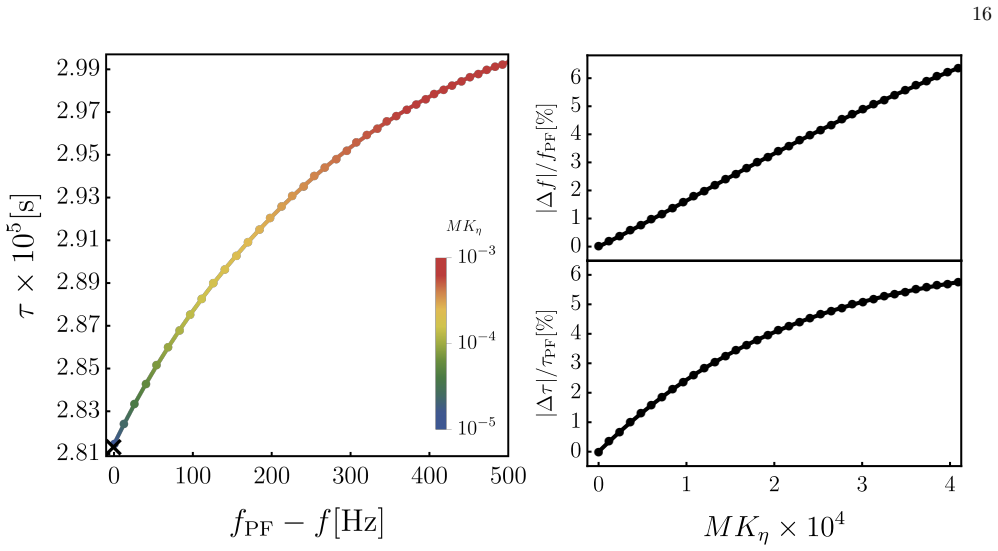
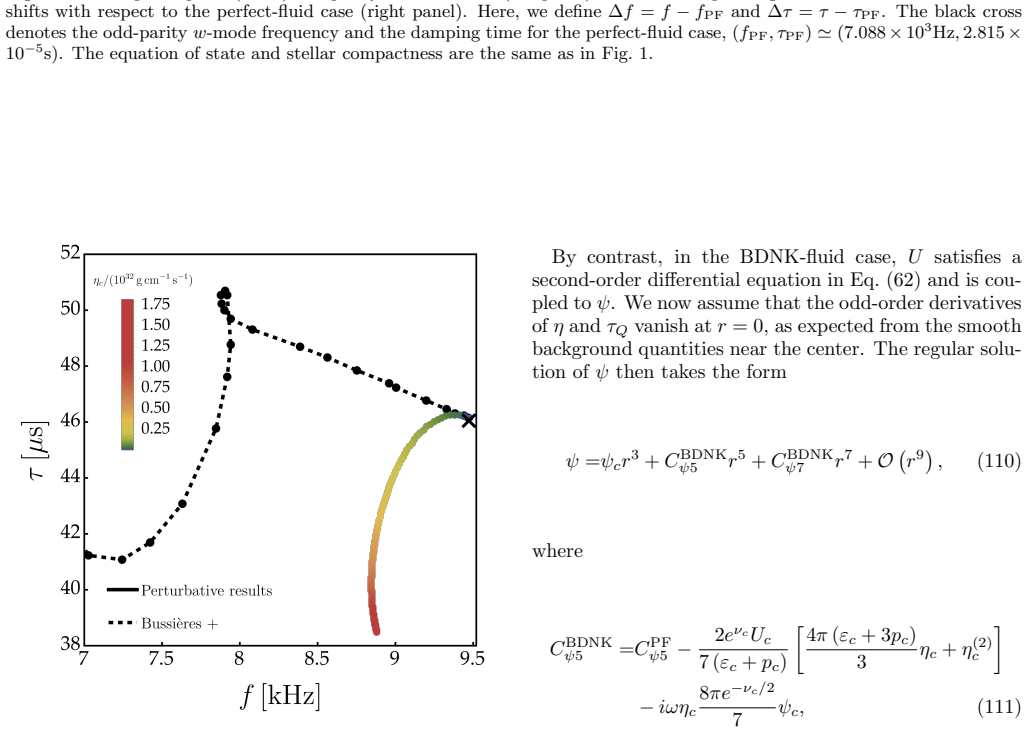
- Figure captions describing mode shifts would benefit from additional detail on the parameter values used and the scale of the plotted quantities.
Simulated Author's Rebuttal
We thank the referee for their thorough review and for identifying points that will improve the clarity of the manuscript. We address each major comment below. The revisions will consist of adding explicit equation displays and verification steps without altering the core claims of the work.
read point-by-point responses
-
Referee: §3 (framework construction): the assertion that the tensorial structure and thermodynamic decomposition of generic corrections can be introduced into the Lindblom-Detweiler equations without specific constitutive relations, and that this decomposition is sufficient to close the eigenvalue problem for both parity sectors, requires explicit verification. The manuscript should display the resulting perturbation equations and confirm that the number of independent equations matches the number of variables after decomposition.
Authors: We agree that explicit verification strengthens the presentation. In the revised version we will display the complete set of linearized perturbation equations for both even- and odd-parity sectors after the thermodynamic decomposition is substituted. We will then tabulate the number of independent equations and unknowns (including the auxiliary variables introduced by the generic corrections) to confirm that the system remains closed and that the eigenvalue problem is well-posed. This count follows directly from the fact that the decomposition respects the original Lindblom-Detweiler variable structure while adding only the dissipative contributions consistent with the thermodynamic relations already used in the perfect-fluid sector. revision: yes
-
Referee: §5 (BDNK application): the perturbative calculation of frequency and damping-time shifts must explicitly demonstrate recovery of the perfect-fluid Lindblom-Detweiler modes in the vanishing-transport-coefficient limit, including the first-order correction terms and confirmation that no spurious modes are introduced at this order.
Authors: The perturbative expansion is constructed so that the zeroth-order equations are identically the Lindblom-Detweiler system; this is stated in the manuscript but not written out in full detail. In revision we will explicitly substitute the vanishing-transport-coefficient limit into the first-order correction equations, recover the original modes, and display the resulting first-order shifts in frequency and damping time. We will also note that the perturbative ordering preserves the number of degrees of freedom, thereby excluding spurious modes at this order. The BDNK constitutive relations enter only through the first-order source terms and do not enlarge the variable set. revision: yes
Circularity Check
No significant circularity detected
full rationale
The paper constructs a model-agnostic extension of the Lindblom-Detweiler equations by inserting the tensorial structure and thermodynamic decomposition of generic nonequilibrium corrections into both parity sectors. This is done without invoking specific constitutive relations or fitting any parameters to data within the paper; the subsequent perturbative application to the BDNK fluid is an explicit limit-taking exercise on an external fluid model. No derivation step reduces by construction to a self-definition, a fitted input relabeled as a prediction, or a load-bearing self-citation chain. The central result is therefore an independent structural generalization whose content is not equivalent to its own inputs.
Axiom & Free-Parameter Ledger
axioms (1)
- domain assumption The Lindblom-Detweiler formalism admits a systematic insertion of generic nonequilibrium corrections via their tensorial structure and thermodynamic decomposition.
Reference graph
Works this paper leans on
-
[1]
To this end, we perform a harmonic decomposition for metric and fluid perturbations
Nonequilibrium amplitudes Here, we introduce fundamental variables associated withS µν andJ µ, and collectively call themnonequi- librium amplitudes. To this end, we perform a harmonic decomposition for metric and fluid perturbations. In the Regge-Wheeler gauge [84], the metric perturbation in the Fourier domain reads δgµνdxµdxν =−r ℓ H ℓmeνdt2 −2iωrH ℓm ...
-
[2]
Fluid perturbations For the fluid perturbations, we consider the displace- ment ofε,p, andu µ:ε→ε+δε, p→p+δp, u µ → 5 uµ +δu µ. We parameterize the Lagrangian displace- ment of these fluid variables by two radial functions of W ℓm =W ℓm(r) andV ℓm =V ℓm(r) as ξr =r ℓ−1e−λ/2W ℓme−iωtYℓm, ξ A =−r ℓV ℓme−iωtEℓm A . (20) We express the Eulerian perturbation o...
-
[3]
The first three are associated with bulk viscosity, shear viscos- ity, thermal conductivity, respectively, whereas the latter three are referred to as causal regulators
Constitutive relations The BDNK fluid is parametrized by the following con- stitutive relations: [74–77, 90] E=τ E [uµ∇µε+ (ε+p) Θ],(64) P=−ζΘ +τ P [uµ∇µε+ (ε+p) Θ],(65) Qµ =κT ε+p n ∆µσ∇σ (µ/T) (66) +τ Q [(ε+p)u ν∇νuµ + ∆µσ∇σp], T µν =−2ησ µν,(67) N=0,(68) J µ =0,(69) with six transport coefficients,ζ, η, κ, τ E , τP , τQ. The first three are associated ...
-
[4]
In other words, we introduce a bookkeeping param- eter in front of the transport coefficients, and expand the perturbation variables in terms of it
Small-transport-coefficient expansion We work within a small-transport-coefficient expan- sion. In other words, we introduce a bookkeeping param- eter in front of the transport coefficients, and expand the perturbation variables in terms of it. The assumption for the small transport coefficients is commonly adopted in previous work [78, 86] and is support...
-
[5]
As presented in Eqs
Structural suppression of the causal-regulator corrections Equations (64) and (65) show that the contributions associated withτ E andτ P enter through the same com- bination, implying that they affect the perturbation in a similar manner. As presented in Eqs. (B1), (B4), and (B7), the contributions ofτ E andτ p enterS 00,S 0, andS Ω, and are proportional ...
-
[6]
We quantify the shifts induced by shear and bulk viscosity within the small-transport-coefficient expansion by as- suming zero thermal conductivity, i.e.,κ= 0
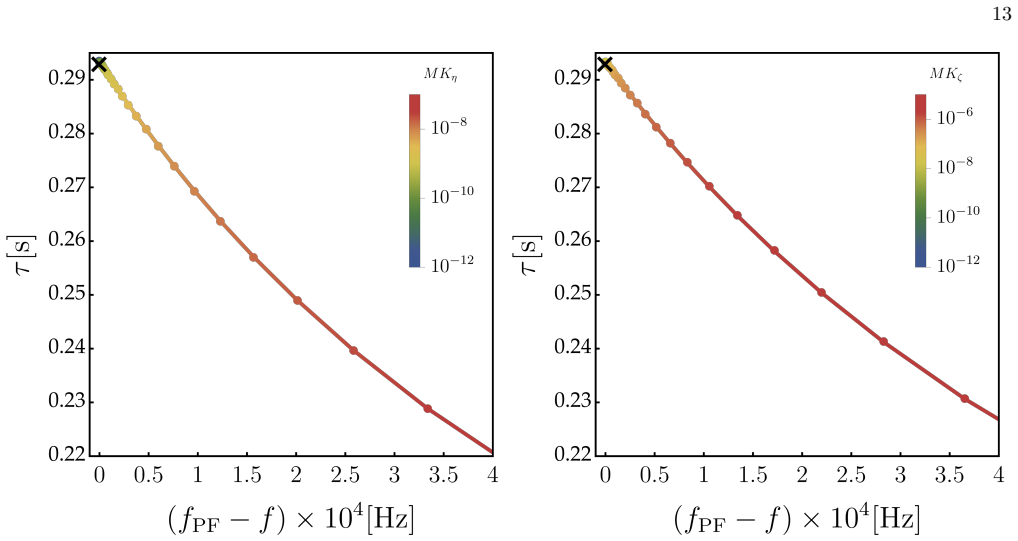
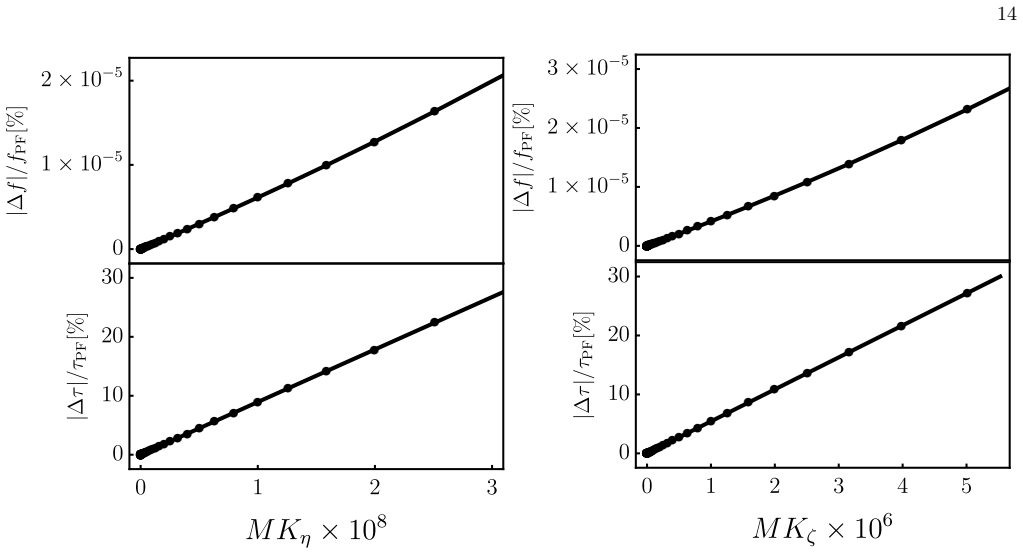
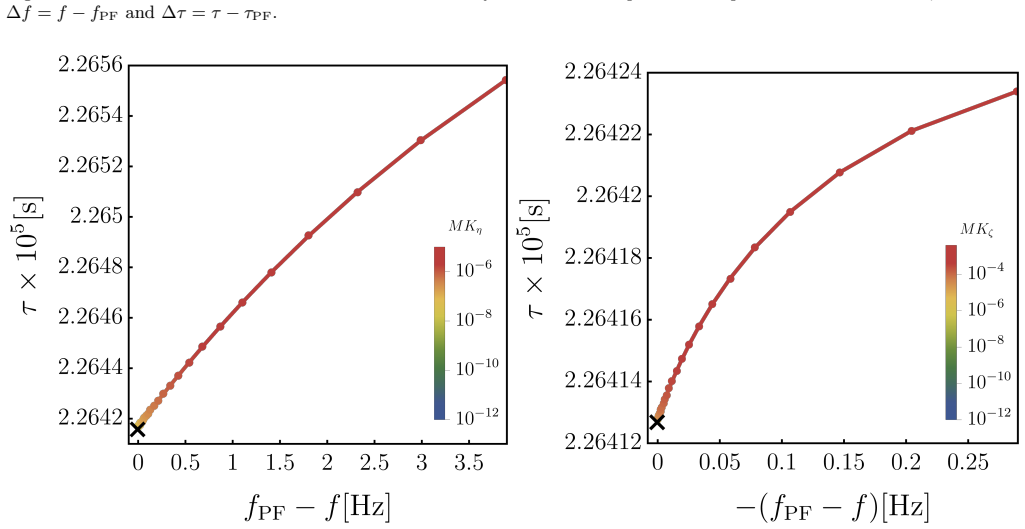
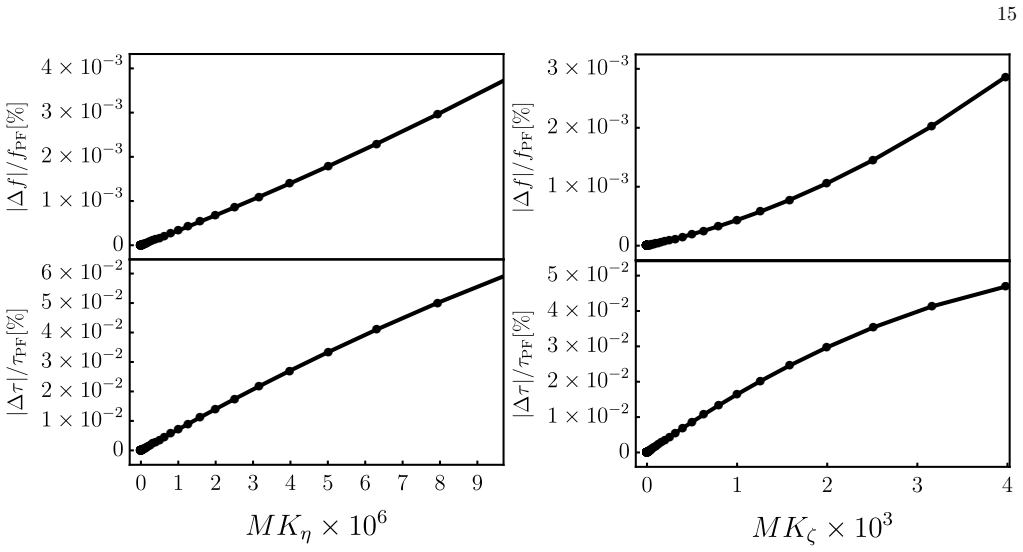
Mode shift It is natural to expect that the out-of-equilibrium cor- rections induce characteristic mode-frequency shifts. We quantify the shifts induced by shear and bulk viscosity within the small-transport-coefficient expansion by as- suming zero thermal conductivity, i.e.,κ= 0. In this work, we parameterizeηandζas η=K η ε ρsat 2 , ζ=K ζ ε ρsat 2 ,(92) ...
-
[7]
Let us first consider the perfect-fluid case
Odd parity First, we focus on theℓ= 2 odd-parity perturbation. Let us first consider the perfect-fluid case. It follows from the corresponding counterpart of Eq. (61) that the regu- lar solution ofψatr= 0 takes the form ψ=ψ cr3 +C PF ψ5 r5 +C PF ψ7 r7 +O r9 ,(105) whereψ c is an arbitrary constant. The coefficients are given by CPF ψ5 = ψc 14 16π(ε c −p c...
-
[8]
We first focus on the shear and bulk viscous contributions in the BDNK fluid
Even parity We now turn to the even-parity sector. We first focus on the shear and bulk viscous contributions in the BDNK fluid. The relevant nonequilibrium ampli- tudesS 0, S1, SZ, SΩ, given in Eqs. (B4)–(B7), contain H2, K, V, W, V ′, W ′. Since Eqs. (45) and (47) involve derivatives of these amplitudes, i.e.,S′ 0 andS ′ 1, the result- ing perturbation ...
-
[9]
(B10) Here, we have imposedµ i/T= const., requiring that the heat flux vanishes in equilibrium
Even-parity sector For the even-parity sector, the nonequilibrium ampli- tudes are given by 20 S00 =−iωτ ε e−ν/2 rℓ−2 Ξ, (B1) S01 =−κ ε+p n eν/2 rℓ−2 µiT ′ T 2 δTr − T ′ T δµr,i + µi T δT ′ r +δµ ′ r,i −τ Q eν/2 rℓ−2 " eλRr + Ξα 2r n c2 s 1−e λ 1 + 8πr2p −2r c2 s ′o (B2) − Ξ 2r n 1 +c 2 s −e λ 1 +c 2 s 1 + 8πr2p −2r c2 s ′o +c 2 s (Ξ′ −Ξ ′ α) # , S0A =−κ ...
-
[10]
Odd-parity sector For the odd-parity sector, the nonequilibrium ampli- tudes are given by S− 0A =−τ Qeν/2r2R− A,(B16) S− 1A =ηe−ν/2 iωh1 − eν 4π(ε+p) U ′ + ν′ − 2 r − ε′ +p ′ ε+p U ,(B17) S− Z =−η eν/2 2π(ε+p) U.(B18) with Rµ =R− A 0,0, B ℓm θ , Bℓm φ sin2 θ ! e−iωt,(B19) R− A =− iω 4πr2 4πe−ν(ε+p)h+U . 22
-
[11]
K. Somiya (KAGRA), Class. Quant. Grav.29, 124007 (2012), arXiv:1111.7185 [gr-qc]
arXiv 2012
-
[12]
F. Acerneseet al.(VIRGO), Class. Quant. Grav.32, 024001 (2015), arXiv:1408.3978 [gr-qc]
Pith/arXiv arXiv 2015
-
[13]
Aasiet al.(LIGO Scientific), Class
J. Aasiet al.(LIGO Scientific), Class. Quant. Grav.32, 074001 (2015), arXiv:1411.4547 [gr-qc]
Pith/arXiv arXiv 2015
-
[14]
P. Amaro-Seoane, H. Audley, S. Babak, J. Baker, E. Ba- rausse, P. Bender, E. Berti, P. Binetruy, M. Born, D. Bor- toluzzi, J. Camp, C. Caprini, V. Cardoso, M. Colpi, J. Conklin, N. Cornish, C. Cutler, K. Danzmann, R. Dolesi, L. Ferraioli, V. Ferroni, E. Fitzsimons, J. Gair, L. Gesa Bote, D. Giardini, F. Gibert, C. Grimani, H. Hal- loin, G. Heinzel, T. Her...
Pith/arXiv arXiv 2017
-
[15]
D. Kasen, B. Metzger, J. Barnes, E. Quataert, and E. Ramirez-Ruiz, Nature551, 80 (2017), arXiv:1710.05463 [astro-ph.HE]
Pith/arXiv arXiv 2017
-
[16]
B. P. Abbottet al.(LIGO Scientific, Virgo, Fermi GBM, INTEGRAL, IceCube, AstroSat Cadmium Zinc Telluride Imager Team, IPN, Insight-Hxmt, ANTARES, Swift, AGILE Team, 1M2H Team, Dark Energy Camera GW-EM, DES, DLT40, GRAWITA, Fermi-LAT, ATCA, ASKAP, Las Cumbres Observatory Group, OzGrav, DWF (Deeper Wider Faster Program), AST3, CAAS- TRO, VINROUGE, MASTER, J...
Pith/arXiv arXiv 2017
-
[17]
B. P. Abbottet al.(LIGO Scientific, Virgo, 1M2H, Dark Energy Camera GW-E, DES, DLT40, Las Cum- bres Observatory, VINROUGE, MASTER), Nature551, 85 (2017), arXiv:1710.05835 [astro-ph.CO]
Pith/arXiv arXiv 2017
-
[18]
I. M. Romero-Shaw, P. D. Lasky, E. Thrane, and J. C. Bustillo, Astrophys. J. Lett.903, L5 (2020), arXiv:2009.04771 [astro-ph.HE]
arXiv 2020
-
[19]
A. G. Abacet al.(LIGO Scientific, VIRGO, KAGRA), (2025), arXiv:2510.27022 [astro-ph.CO]
arXiv 2025
-
[20]
J. M. Lattimer and M. Prakash, Phys. Rept.621, 127 (2016), arXiv:1512.07820 [astro-ph.SR]
Pith/arXiv arXiv 2016
-
[21]
F. ¨Ozel and P. Freire, Ann. Rev. Astron. Astrophys.54, 401 (2016), arXiv:1603.02698 [astro-ph.HE]
Pith/arXiv arXiv 2016
-
[22]
G. F. Burgio, H. J. Schulze, I. Vidana, and J. B. Wei, Prog. Part. Nucl. Phys.120, 103879 (2021), arXiv:2105.03747 [nucl-th]
arXiv 2021
-
[23]
B. P. Abbottet al.(LIGO Scientific, Virgo), Phys. Rev. Lett.119, 161101 (2017), arXiv:1710.05832 [gr-qc]
Pith/arXiv arXiv 2017
-
[24]
B. P. Abbottet al.(LIGO Scientific, Virgo), Phys. Rev. Lett.121, 161101 (2018), arXiv:1805.11581 [gr-qc]
Pith/arXiv arXiv 2018
-
[25]
B. P. Abbottet al.(LIGO Scientific, Virgo), Phys. Rev. X9, 011001 (2019), arXiv:1805.11579 [gr-qc]
Pith/arXiv arXiv 2019
-
[26]
B. P. Abbottet al.(LIGO Scientific, Virgo), Astrophys. J. Lett.892, L3 (2020), arXiv:2001.01761 [astro-ph.HE]
arXiv 2020
-
[27]
Punturoet al., Class
M. Punturoet al., Class. Quant. Grav.27, 194002 (2010)
2010
-
[28]
S. Isoyama, H. Nakano, and T. Nakamura, PTEP2018, 073E01 (2018), arXiv:1802.06977 [gr-qc]
Pith/arXiv arXiv 2018
-
[29]
D. Reitzeet al., Bull. Am. Astron. Soc.51, 035 (2019), arXiv:1907.04833 [astro-ph.IM]
Pith/arXiv arXiv 2019
-
[30]
Kawamuraet al., PTEP2021, 05A105 (2021), arXiv:2006.13545 [gr-qc]
S. Kawamuraet al., PTEP2021, 05A105 (2021), arXiv:2006.13545 [gr-qc]
Pith/arXiv arXiv 2021
-
[31]
Abacet al.(ET), (2025), arXiv:2503.12263 [gr-qc]
A. Abacet al.(ET), (2025), arXiv:2503.12263 [gr-qc]
Pith/arXiv arXiv 2025
-
[32]
D. Meacher, K. Cannon, C. Hanna, T. Regimbau, and B. S. Sathyaprakash, Phys. Rev. D93, 024018 (2016), arXiv:1511.01592 [gr-qc]
Pith/arXiv arXiv 2016
-
[33]
G. Ashtonet al., Astrophys. J. Suppl.241, 27 (2019), arXiv:1811.02042 [astro-ph.IM]
Pith/arXiv arXiv 2019
- [34]
-
[35]
D. Williams, J. Veitch, M. L. Chiofalo, P. Schmidt, R. P. Udall, A. Vajpeji, and C. Hoy, J. Open Source Softw.8, 4170 (2023), arXiv:2207.01468 [gr-qc]
arXiv 2023
-
[36]
R. Tania and J. Suresh, Phys. Rev. D113, 063028 (2026), arXiv:2506.12237 [gr-qc]
arXiv 2026
-
[37]
K. D. Kokkotas and B. G. Schmidt, Living Rev. Rel.2, 2 (1999), arXiv:gr-qc/9909058
Pith/arXiv arXiv 1999
-
[38]
V. Ferrari, Bull. Astron. Soc. India39, 203 (2011), arXiv:1105.1678 [gr-qc]
Pith/arXiv arXiv 2011
-
[39]
N. Andersson and K. D. Kokkotas, Mon. Not. Roy. As- tron. Soc.299, 1059 (1998), arXiv:gr-qc/9711088
Pith/arXiv arXiv 1998
-
[40]
O. Benhar, V. Ferrari, and L. Gualtieri, Phys. Rev. D 70, 124015 (2004), arXiv:astro-ph/0407529
Pith/arXiv arXiv 2004
-
[41]
Andersson, Universe7, 97 (2021), arXiv:2103.10223 [gr-qc]
N. Andersson, Universe7, 97 (2021), arXiv:2103.10223 [gr-qc]
arXiv 2021
-
[42]
Non-Radial Pul- sation of General-Relativistic Stellar Models. I. Analytic Analysis for L ¿= 2,
K. S. Thorne and A. Campolattaro, “Non-Radial Pul- sation of General-Relativistic Stellar Models. I. Analytic Analysis for L ¿= 2,” (1967)
1967
-
[43]
Campolattaro and K
A. Campolattaro and K. S. Thorne, Astrophys. J.159, 847 (1970)
1970
-
[44]
K. S. Thorne, Astrophys. J.158, 1 (1969)
1969
-
[45]
K. S. Thorne, Astrophys. J.158, 997 (1969)
1969
-
[46]
J. R. Ipser and K. S. Thorne, Astrophys. J.181, 181 (1973)
1973
-
[47]
Lindblom and S
L. Lindblom and S. L. Detweiler, Astrophys. J. Suppl. 53, 73 (1983)
1983
-
[48]
S. L. Detweiler and L. Lindblom, Astrophys. J.292, 12 (1985)
1985
-
[49]
L. Gualtieri, J. A. Pons, and G. Miniutti, Phys. Rev. D 70, 084009 (2004), arXiv:gr-qc/0405063
Pith/arXiv arXiv 2004
-
[50]
D. D. Doneva and S. S. Yazadjiev, Phys. Rev. D85, 124023 (2012), arXiv:1203.3963 [gr-qc]
Pith/arXiv arXiv 2012
-
[51]
S. Mondal and M. Bagchi, Phys. Rev. D110, 123011 (2024), arXiv:2309.00439 [gr-qc]. 23
arXiv 2024
-
[52]
S. Y. Lau, S. Ajith, V. Guedes, and K. Yagi, Phys. Rev. D110, 083020 (2024), arXiv:2405.04653 [gr-qc]
arXiv 2024
-
[53]
J. Redondo-Yuste, Class. Quant. Grav.42, 075012 (2025), arXiv:2411.16841 [gr-qc]
arXiv 2025
-
[54]
A. Kumar, D. A. Caballero, H. Sotani, and N. Yunes, (2026), arXiv:2605.03305 [gr-qc]
Pith/arXiv arXiv 2026
-
[55]
D. Lai, Mon. Not. Roy. Astron. Soc.270, 611 (1994), arXiv:astro-ph/9404062
Pith/arXiv arXiv 1994
-
[56]
Bildsten and C
L. Bildsten and C. Cutler, Astrophys. J.400, 175 (1992)
1992
-
[57]
E. R. Most, S. P. Harris, C. Plumberg, M. G. Alford, J. Noronha, J. Noronha-Hostler, F. Pretorius, H. Witek, and N. Yunes, Mon. Not. Roy. Astron. Soc.509, 1096 (2021), arXiv:2107.05094 [astro-ph.HE]
arXiv 2021
-
[58]
J. L. Ripley, A. Hegade K. R., and N. Yunes, Phys. Rev. D108, 103037 (2023), arXiv:2306.15633 [gr-qc]
arXiv 2023
-
[59]
J. L. Ripley, A. Hegade K. R., R. S. Chan- dramouli, and N. Yunes, Nature Astron.8, 1277 (2024), arXiv:2312.11659 [gr-qc]
arXiv 2024
- [60]
- [61]
- [62]
-
[63]
M. G. Alford, L. Bovard, M. Hanauske, L. Rezzolla, and K. Schwenzer, Phys. Rev. Lett.120, 041101 (2018), arXiv:1707.09475 [gr-qc]
Pith/arXiv arXiv 2018
-
[64]
E. R. Most, A. Haber, S. P. Harris, Z. Zhang, M. G. Alford, and J. Noronha, Astrophys. J. Lett.967, L14 (2024), arXiv:2207.00442 [astro-ph.HE]
arXiv 2024
- [65]
- [66]
- [67]
-
[68]
Flowers and N
E. Flowers and N. Itoh, Astrophys. J.206, 218 (1976)
1976
-
[69]
Cutler and L
C. Cutler and L. Lindblom, Astrophys. J.314, 234 (1987)
1987
-
[70]
P. S. Shternin and D. G. Yakovlev, Phys. Rev. D78, 063006 (2008), arXiv:0808.2018 [astro-ph]
Pith/arXiv arXiv 2008
-
[71]
Eckart, Phys
C. Eckart, Phys. Rev.58, 919 (1940)
1940
-
[72]
L. D. Landau and E. M. Lifshitz,Fluid Mechanics, Sec- ond Edition: Volume 6 (Course of Theoretical Physics), 2nd ed., Course of theoretical physics / by L. D. Lan- dau and E. M. Lifshitz, Vol. 6 (Butterworth-Heinemann, 1987)
1987
-
[73]
W. A. Hiscock and L. Lindblom, Phys. Rev. D31, 725 (1985)
1985
-
[74]
M¨ uller, Zeitschrift fur Physik198, 329 (1967)
I. M¨ uller, Zeitschrift fur Physik198, 329 (1967)
1967
-
[75]
Israel, Annals Phys.100, 310 (1976)
W. Israel, Annals Phys.100, 310 (1976)
1976
-
[76]
Israel and J
W. Israel and J. M. Stewart, Phys. Lett. A58, 213 (1976)
1976
-
[77]
J. M. Stewart, Proceedings of the Royal Society of Lon- don Series A357, 59 (1977)
1977
-
[78]
Israel and J
W. Israel and J. M. Stewart, Proceedings of the Royal Society of London Series A365, 43 (1979)
1979
-
[79]
Israel and J
W. Israel and J. M. Stewart, Annals Phys.118, 341 (1979)
1979
-
[80]
F. S. Bemfica, M. M. Disconzi, and J. Noronha, Phys. Rev. Lett.122, 221602 (2019), arXiv:1901.06701 [gr-qc]
Pith/arXiv arXiv 2019
discussion (0)
Sign in with ORCID, Apple, or X to comment. Anyone can read and Pith papers without signing in.