Deciphering Noise in tip--sample Interactions: Insights into Nanoscale Dynamics
Pith reviewed 2026-06-26 15:49 UTC · model grok-4.3
The pith
Tip-sample interactions in ambient AFM create non-thermal noise from nanoscopic liquid necks that exceeds thermal fluctuations and supplies distinct chemical contrast.
A machine-rendered reading of the paper's core claim, the machinery that carries it, and where it could break.
Core claim
Tip-sample interactions in ambient conditions introduce a non-thermal noise component that significantly exceeds the thermal background; this noise arises from the stochastic formation and rupture of nanoscopic liquid necks and serves as a direct fingerprint of local wettability and dissipative dynamics, providing chemical contrast distinct from and complementary to the electrostatic potential mapped by KPFM.
What carries the argument
The noise channel generated by stochastic formation and rupture of nanoscopic liquid necks, which functions as a spectroscopic fingerprint of local surface properties.
Load-bearing premise
The measured fluctuations are produced by stochastic nanoscopic liquid-neck formation and rupture rather than by other sources of non-thermal noise.
What would settle it
Repeat the force-spectroscopy and 3D imaging experiments in vacuum or at controlled low humidity where liquid necks cannot form and check whether the excess non-thermal noise component vanishes.
Figures
read the original abstract
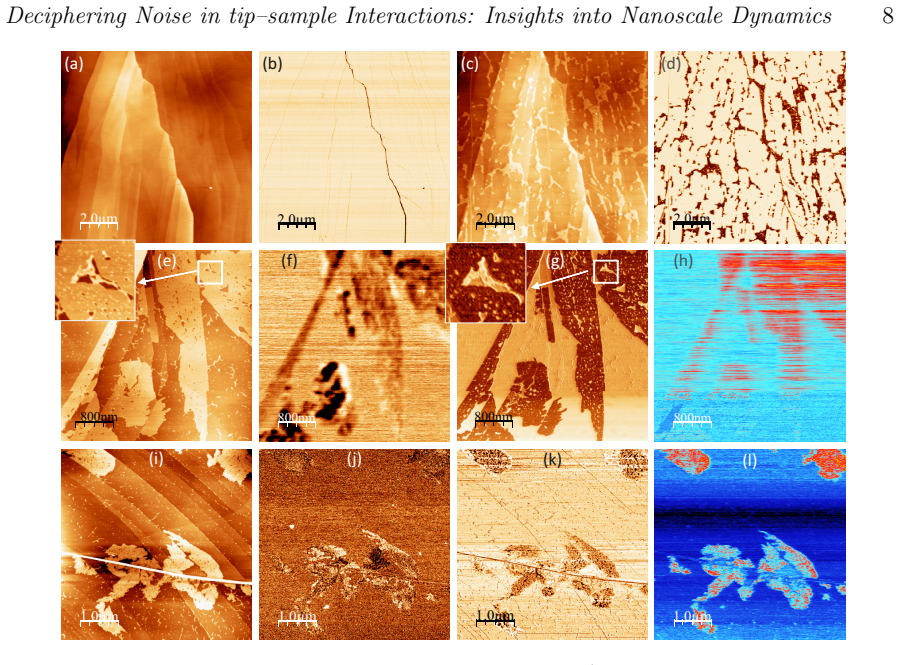
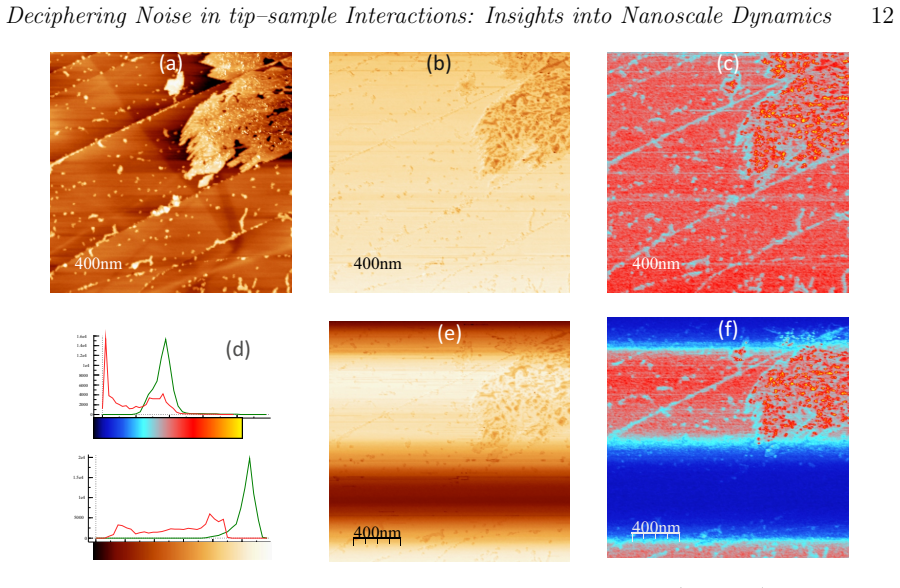
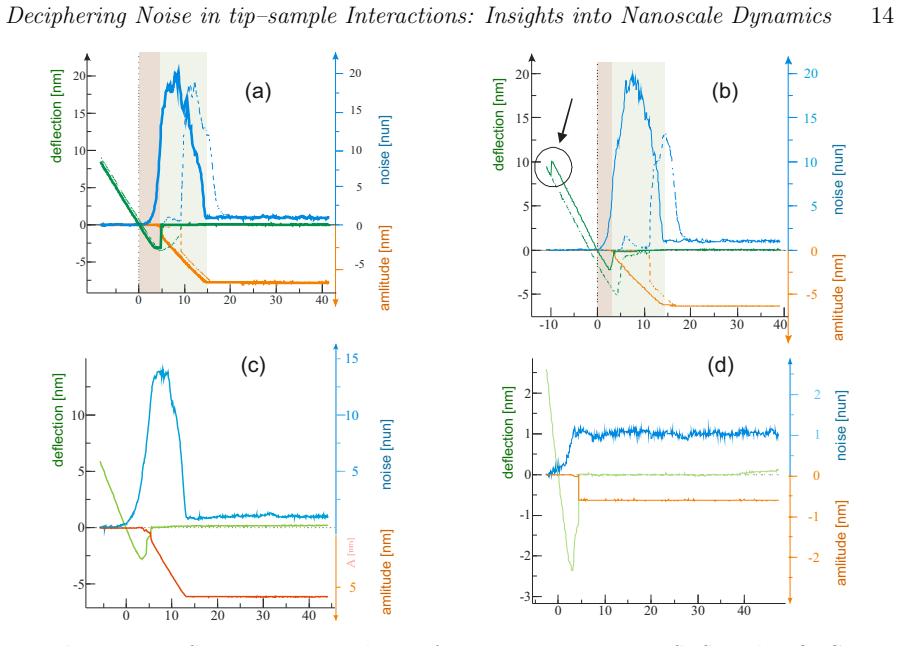
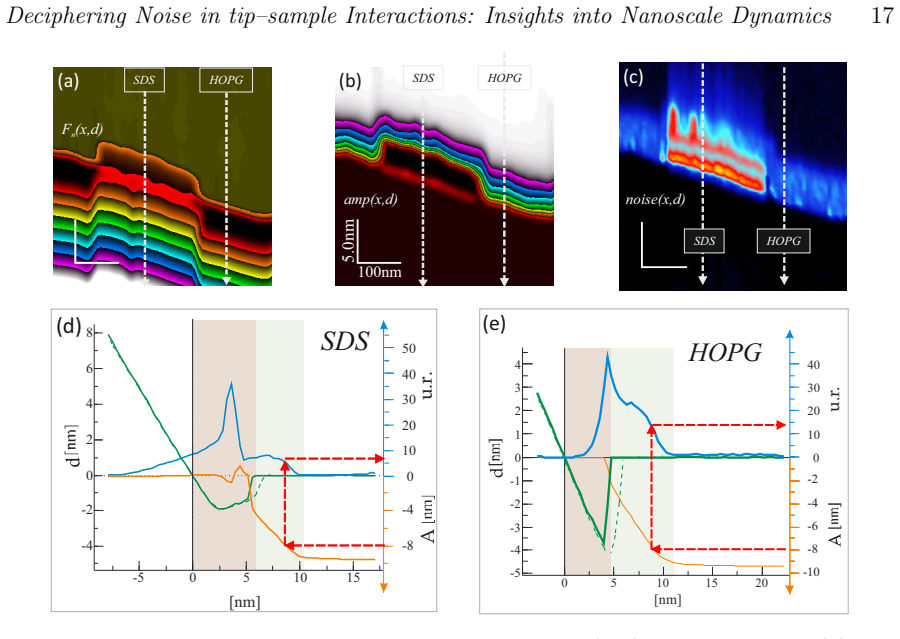
Noise sets the fundamental limits of resolution and sensitivity in Dynamic Atomic Force Microscopy (DAFM). While thermal fluctuations are conventionally assumed to be the dominant noise source, this work demonstrates that tip--sample interactions in ambient conditions introduce a non--thermal noise component that significantly exceeds the thermal background. Using a model system of sodium dodecyl sulfate (SDS) on graphite, we characterize this noise through force spectroscopy, 3D imaging modes, and Kelvin Probe Force Microscopy (KPFM). This interaction--induced noise arises from the stochastic formation and rupture of nanoscopic liquid necks, serving as a direct fingerprint of local wettability and dissipative dynamics. Crucially, we find that this ``noise channel'' provides chemical contrast that is distinct from and complementary to the electrostatic potential mapped by KPFM. By deciphering the physical origin of these fluctuations, we establish that noise is not merely an instrumental artifact but a rich spectroscopic signal, and we propose that Frequency Modulation (FM--DAFM) offers a superior approach to decouple these dissipative effects for high--resolution imaging.
Editorial analysis
A structured set of objections, weighed in public.
Referee Report
Summary. The manuscript claims that tip-sample interactions in ambient dynamic atomic force microscopy (DAFM) introduce a non-thermal noise component from stochastic formation and rupture of nanoscopic liquid necks that exceeds the thermal background. Using a SDS/graphite model system, force spectroscopy, 3D imaging, and KPFM measurements show this noise provides chemical contrast distinct from and complementary to electrostatic potential maps, with FM-DAFM proposed as a superior mode to decouple dissipative effects.
Significance. If the experimental interpretation holds, the work is significant for reframing interaction-induced noise as a spectroscopic signal for local wettability and dissipative dynamics rather than an artifact. The combination of quantitative noise spectra, humidity-dependent controls, and direct KPFM comparison on a model system supplies a concrete experimental foundation that could advance ambient AFM by enabling noise-based chemical contrast.
minor comments (3)
- [Results] §3 (Results on noise spectra): the statement that interaction noise 'significantly exceeds' thermal background would be strengthened by explicit reporting of the measured ratio (e.g., factor of X) and its uncertainty from the power spectral density data.
- [Discussion] §4.2 (KPFM comparison): the claim of 'distinct and complementary' contrast requires a quantitative metric (e.g., spatial correlation coefficient or feature overlap percentage) between the noise map and KPFM potential map to support the complementarity assertion.
- [Figures] Figure 5 (3D imaging): the humidity-dependent control data should include error bars or standard deviations on the noise amplitude to allow readers to assess the statistical significance of the observed trends.
Simulated Author's Rebuttal
We thank the referee for the positive assessment of our work and the recommendation for minor revision. No specific major comments were raised in the report.
Circularity Check
No significant circularity; experimental claims rest on direct observations
full rationale
The manuscript is an experimental study using force spectroscopy, 3D imaging, and KPFM on an SDS/graphite model system. No equations, derivations, fitted parameters presented as predictions, or self-citation chains appear in the abstract or described content. Claims about non-thermal noise from liquid-neck formation are supported by humidity controls and direct map comparisons, remaining independent of any internal reduction to inputs. This is the expected outcome for observation-driven work without mathematical self-reference.
Axiom & Free-Parameter Ledger
Reference graph
Works this paper leans on
-
[1]
Israelachvili J N 2011Intermolecular and Surface Forces3rd ed (Burlington, MA: Academic Press) ISBN 9780123919274 URLhttps://shop.elsevier.com/books/ intermolecular-and-surface-forces/israelachvili/978-0-12-391927-4
-
[2]
1103/PhysRevLett.81.4549
Mohideen U and Roy A 1998Physical Review Letters814549–4552 URLhttps://doi.org/10. 1103/PhysRevLett.81.4549
-
[3]
Zhang J, Chen P, Yuan B, Ji W, Cheng Z, Qiu X and Gross L 2013Science342611–614 URL https://doi.org/10.1126/science.1242603
-
[4]
Butt H J and Kappl M 2010Surface and Interfacial Forces(John Wiley & Sons) URLhttps: //doi.org/10.1002/9783527629411
-
[5]
Tabor D and Winterton R H S 1969Proceedings of the Royal Society of London. A. Mathematical and Physical Sciences312435–450 URLhttps://doi.org/10.1098/rspa.1969.0169
-
[6]
Binnig G, Quate C F and Gerber C 1986Physical Review Letters56930–933 URLhttps: //doi.org/10.1103/PhysRevLett.56.930
-
[7]
1103/RevModPhys.75.949
Giessibl F 2003Review of Modern Physics75(3) 949–983 URLhttp://link.aps.org/doi/10. 1103/RevModPhys.75.949
-
[8]
Weisenhorn A L, Hansma P K, Albrecht T R and Quate C F 1989Applied Physics Letters54 2651–2653 URLhttps://doi.org/10.1063/1.101024
-
[9]
Butt H J, Cappella B and Kappl M 2005Surface Science Reports591–152 URLhttps: //doi.org/10.1016/j.surfrep.2005.08.003
-
[10]
Palacios-Lid´ on E, Munuera C, Ocal C and Colchero J 2010Ultramicroscopy110789–800 URL https://doi.org/10.1016/j.ultramic.2010.01.015
-
[11]
Butt H J and Jaschke M 1995Nanotechnology61–7 URLhttps://doi.org/10.1088/0957-4484/ 6/1/001 Deciphering Noise in tip–sample Interactions: Insights into Nanoscale Dynamics20
-
[12]
Milburn G J, Jacobs K and Walls D F 1994Physical Review A505256–5263 URLhttps: //doi.org/10.1103/PhysRevA.50.5256
-
[13]
Labuda A, Kobayashi K, Kiracofe D, Suzuki K, Gr¨ utter P and Yamada H 2012Nanotechnology 23025503 URLhttps://doi.org/10.1088/0957-4484/23/2/025503
-
[15]
Labuda A, Lysy M and Gr¨ utter P 2012Applied Physics Letters101113105 URLhttps: //doi.org/10.1063/1.4745781
-
[16]
Nyquist H 1928Physical Review32110–113 URLhttps://doi.org/10.1103/PhysRev.32.110
-
[17]
Callen H B and Welton T A 1951Physical Review8334–40 URLhttps://doi.org/10.1103/ PhysRev.83.34
-
[18]
Schwabl F 2006Statistical Mechanics2nd ed (Berlin and New York: Springer) ISBN 9783540323433 URLhttps://link.springer.com/book/9783540323433
-
[19]
Albrecht T R, Gr¨ utter P, Horne D and Rugar D 1991Journal of Applied Physics69668–673 URL https://doi.org/10.1063/1.347347
-
[20]
D¨ urig U, Z¨ uger O and Stalder A 1992Journal of Applied Physics721778–1798 URLhttps: //doi.org/10.1063/1.352348
-
[21]
1103/PhysRevB.64.245403
Colchero J, Gil A and Bar´ o A M 2001Physical Review B64245403 URLhttps://doi.org/10. 1103/PhysRevB.64.245403
-
[22]
Wastl D S, Weymouth A J and Giessibl F J 2013Physical Review B87245415 URLhttps: //doi.org/10.1103/PhysRevB.87.245415
-
[23]
Wastl D S 2017Microscopy Research and Technique8050–65 URLhttps://doi.org/10.1002/ jemt.22730
-
[24]
Almonte L and Colchero J 2017Nanoscale92903–2915 URLhttps://doi.org/10.1039/ C6NR07967A
-
[25]
Garc´ ıa R and P´ erez R 2002Surface Science Reports47197–301 URLhttps://doi.org/10.1016/ S0167-5729(02)00077-8
-
[26]
Ruppert M G, Harcombe D M, Ragazzon M R P, Moheimani S O R and Fleming A J 2017Beilstein Journal of Nanotechnology81407–1426 URLhttps://doi.org/10.3762/bjnano.8.142
-
[27]
D¨ urig U, Gimzewski J K and Pohl D W 1986Physical Review Letters572403–2406 URL https://doi.org/10.1103/PhysRevLett.57.2403
-
[28]
Koslowski B, Baur C and M¨ oller R 1995Journal of Applied Physics7728–33 URLhttps: //doi.org/10.1063/1.359390
-
[29]
K¨ urz P, M¨ oller R, Baur C and Esslinger A 1991Journal of Vacuum Science & Technology B9 609–611 URLhttps://doi.org/10.1116/1.585468
-
[30]
Chakraborty I and Balachandran B 2011Nonlinear Dynamics65233–243 URLhttps://doi. org/10.1007/s11071-011-0034-2
-
[31]
Howell S, Kuila D, Kasibhatla B and Reifenberger R G 2002Langmuir185120–5125 URL https://doi.org/10.1021/la0157014
-
[32]
Gonz´ alez-Mart´ ınez J F, Nieto-Carvajal I and Colchero J 2013Nanotechnology24185701 URL https://doi.org/10.1088/0957-4484/24/18/185701
-
[33]
Colchero J, Cuenca M, Gonz´ alez Mart´ ınez J, Abad J, Perez Garc´ ıa B, Palacios-Lid´ on E and Abell´ an J 2011Journal of Applied Physics109024310 URLhttps://doi.org/10.1063/1.3533769
-
[34]
Sader J E 2019Review of Scientific Instruments90086103 URLhttps://doi.org/10.1063/1. 5115768
-
[35]
Gonz´ alez Mart´ ınez J, Nieto Carvajal I, Abad J and Colchero J 2012Nanoscale Research Letters 7174 ISSN 1556-276X URLhttp://www.nanoscalereslett.com/content/7/1/174
-
[36]
1038/nmat3709 Deciphering Noise in tip–sample Interactions: Insights into Nanoscale Dynamics21
Li Z, Wang Y, Kozbial A, Shenoy G, Zhou F, McGinley R, Ireland P, Morganstein B, Kunkel A, Surwade S P, Li L and Liu H 2013Nature Materials12925–931 URLhttps://doi.org/10. 1038/nmat3709 Deciphering Noise in tip–sample Interactions: Insights into Nanoscale Dynamics21
-
[37]
Kozbial A, Li Z, Sun J, Gong X, Zhou F, Wang Y, Xu H, Liu H and Li L 2014Carbon74218–225 URLhttps://doi.org/10.1016/j.carbon.2014.03.025
-
[38]
Mukerjee P and Mysels K J 1971Critical Micelle Concentrations of Aqueous Surfactant Systems (Washington, D.C.: National Bureau of Standards (NSRDS-NBS 36))
-
[39]
Al-Soufi W and Novo M 2021Molecules265339 URLhttps://doi.org/10.3390/ molecules26175339
-
[40]
Prado M C and Neves B R A 2025Langmuir4113079–13091 pMID: 40391610, PMCID: PMC12139036 URLhttps://doi.org/10.1021/acs.langmuir.5c00640
-
[41]
Wanless E J and Ducker W A 1996Journal of Physical Chemistry1003207–3214 URLhttps: //doi.org/10.1021/jp952439x
-
[42]
Abad J, Gonz´ alez Mart´ ınez J and Colchero J 2013Review of Scientific Instruments84046101 ISSN 0034-6748, 1089-7623 URLhttp://scitation.aip.org/content/aip/journal/rsi/84/ 4/10.1063/1.4801460
-
[43]
Palacios-Lid´ on E, P´ erez-Garc´ ıa B and Colchero J 2009Nanotechnology20085707 URLhttps: //doi.org/10.1088/0957-4484/20/8/085707
-
[44]
Generic transport formula for a system driven by marko- vian reservoirs.Phys
Giessibl F J 1997Physical Review B5616010–16015 URLhttps://doi.org/10.1103/PhysRevB. 56.16010
-
[45]
Men Y, Zhang X and Wang W 2009The Journal of Chemical Physics131184702 article 184702 URLhttps://doi.org/10.1063/1.3257624
-
[46]
Sahag´ un E, Garc´ ıa-Mochales P, Sacha G M and S´ aenz J J 2007Physical Review Letters98176106 article 176106 URLhttps://doi.org/10.1103/PhysRevLett.98.176106
-
[47]
Marmur A 1993Langmuir91922–1926 URLhttps://doi.org/10.1021/la00031a047
-
[48]
Butt H J and Kappl M 2009Advances in Colloid and Interface Science14648–60 URL https://doi.org/10.1016/j.cis.2008.10.002
-
[49]
Colchero J, Storch A, Luna M, Gomez Herrero J and Bar´ o A 1998Langmuir142230–2234 URL https://doi.org/10.1021/la971150z
-
[50]
Luna M, Colchero J and Bar´ o A M 1998Applied Physics Letters723461–3463 URLhttps: //doi.org/10.1063/1.121666
-
[51]
Wei Z, Liu J, Wei R and Peng A 2021Journal of Microscopy283219–231 URLhttps: //doi.org/10.1111/jmi.13035
-
[52]
Almonte L, Pimentel C, Rodr´ ıguez-Ca˜ nas E, Abad J, Fern´ andez V and Colchero J 2021Nano Select3977–989 URLhttps://doi.org/10.1002/nano.202100193
-
[53]
Sadewasser S and Glatzel T (eds) 2012Kelvin Probe Force Microscopy(Springer Series in Surface Sciencesvol 48) (Berlin, Heidelberg: Springer Berlin Heidelberg) ISBN 978-3-642-22566-6
-
[54]
Zahmatkeshsaredorahi A, Millan-Solsona R, Jakob D S, Collins L and Xu X G 2025Nature Reviews Methods Primers553 URLhttps://doi.org/10.1038/s43586-025-00424-9
-
[55]
Melitz W, Shen J, Kummel A and Lee S 2011Surface Science Reports661–27 URLhttps: //doi.org/10.1016/j.surfrep.2010.10.001
-
[56]
L¨ u J, Delamarche E, Eng L, Bennewitz R, Meyer E and G¨ untherodt H J 1999Langmuir15 8184–8188 URLhttps://doi.org/10.1021/la9904861
-
[57]
Horcas I, Fern´ andez R, G´ omez-Rodr´ ıguez J M, Colchero J, G´ omez-Herrero J and Bar´ o A M 2007 Review of Scientific Instruments78013705 URLhttps://doi.org/10.1063/1.2432410
-
[58]
Santos S, Olukan T A, Lai C Y and Chiesa M 2021Molecules267083 URLhttps://doi.org/ 10.3390/molecules26237083
-
[59]
Yang Q, Sun P, Fumagalli L, Stebunov Y V, Grigorieva I V, Haigh S J, Zhou Z, Wang F and Geim A K 2020Nature588250–253 URLhttps://doi.org/10.1038/s41586-020-2978-1
-
[60]
Uhlig M R and Garcia R 2021Nano Letters215593–5598 URLhttps://doi.org/10.1021/acs. nanolett.1c01092
-
[61]
Zitzler L, Herminghaus S and Mugele F 2002Physical Review B66155436 article 155436 URL https://doi.org/10.1103/PhysRevB.66.155436
-
[62]
Sahag´ un E and S´ aenz J J 2012Physical Review B85235412 article 235412 URLhttps: Deciphering Noise in tip–sample Interactions: Insights into Nanoscale Dynamics22 //doi.org/10.1103/PhysRevB.85.235412
-
[63]
Santos S, Barcons V, Verdaguer A and Chiesa M 2011Journal of Applied Physics110114902 URLhttps://doi.org/10.1063/1.3663437
-
[64]
Chiesa M, Gadelrab K, Stefancich M, Armstrong P, Li G, Souier T, Thomson N H, Barcons V, Font J, Verdaguer A, Phillips M A and Santos S 2012The Journal of Physical Chemistry Letters 32125–2129 URLhttps://doi.org/10.1021/jz300576p
-
[65]
Bocquet L, Charlaix E, Ciliberto S and Crassous J 1998Nature396735–737 URLhttps: //doi.org/10.1038/25492
-
[66]
Bocquet L and Charlaix E 2010Chemical Society Reviews391073–1095 URLhttps://doi.org/ 10.1039/B909366B
-
[67]
Evans R, Marini Bettolo Marconi U and Tarazona P 1986The Journal of Chemical Physics84 2376–2399 URLhttps://doi.org/10.1063/1.450352
-
[68]
Fumagalli L, Esfandiar A, Fabregas R, Hu S, Ares P, Janardanan A, Yang Q, Radha B, Taniguchi T, Watanabe K, Gomila G, Novoselov K S and Geim A K 2018Science3601339–1342 URL https://doi.org/10.1126/science.aat4191
-
[69]
Pettersson L G M, Henchman R H and Nilsson A 2016Chemical Reviews1167459–7462 editorial URLhttps://doi.org/10.1021/acs.chemrev.6b00363
discussion (0)
Sign in with ORCID, Apple, or X to comment. Anyone can read and Pith papers without signing in.