Spin correlations and quantum entanglement in γγ to tbar t at polarized photon colliders with NLO QCD corrections
Pith reviewed 2026-06-26 14:04 UTC · model grok-4.3
The pith
NLO QCD corrections increase the γγ → ttbar cross section substantially but leave spin correlations and entanglement measures nearly unchanged.
A machine-rendered reading of the paper's core claim, the machinery that carries it, and where it could break.
Core claim
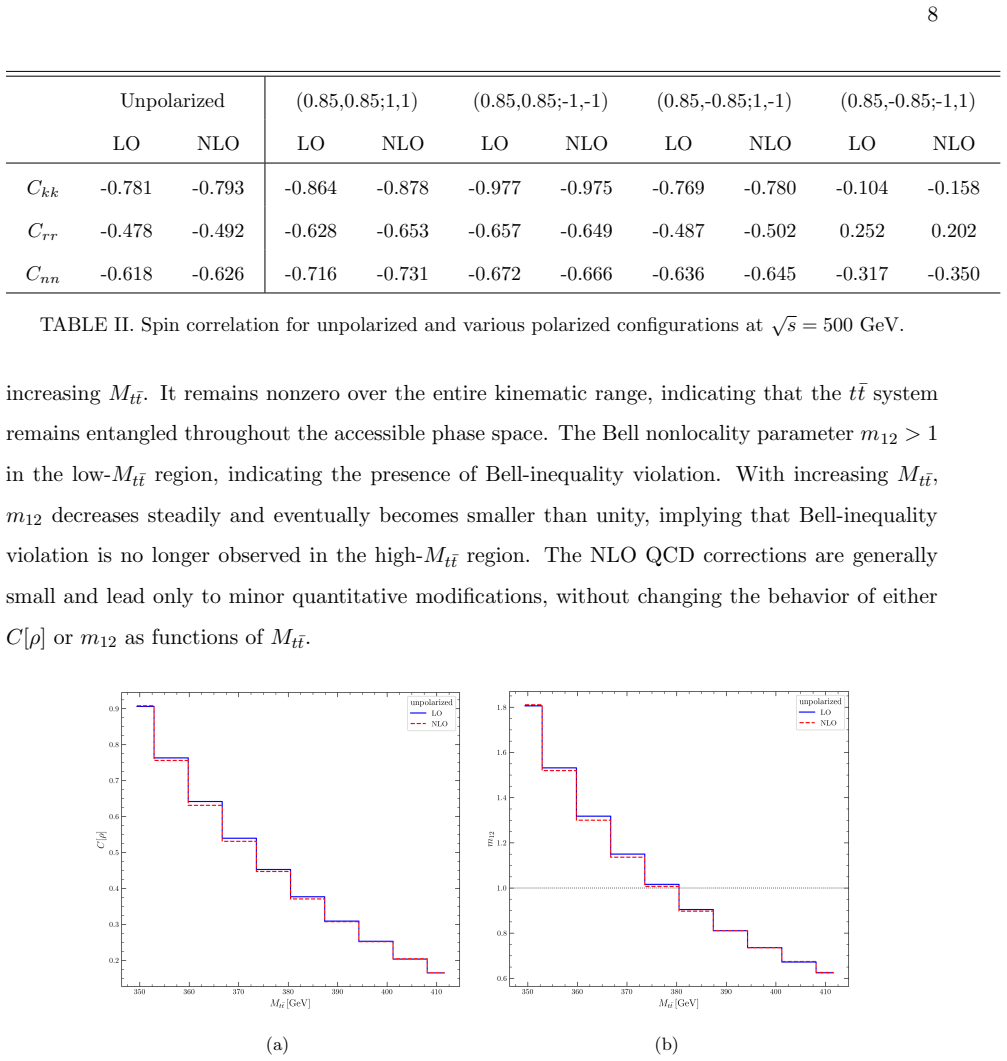
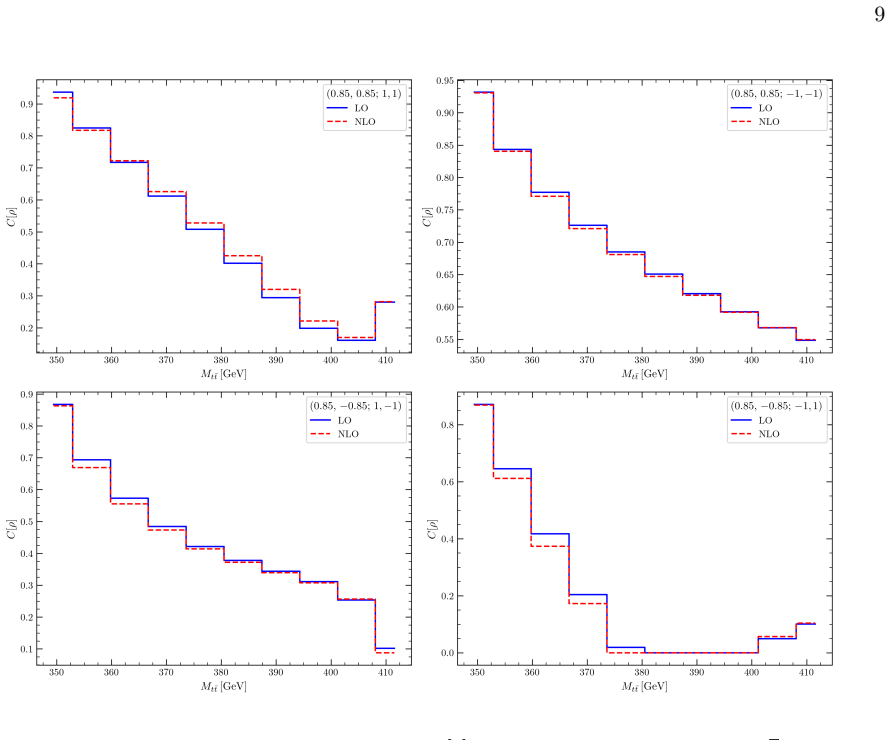
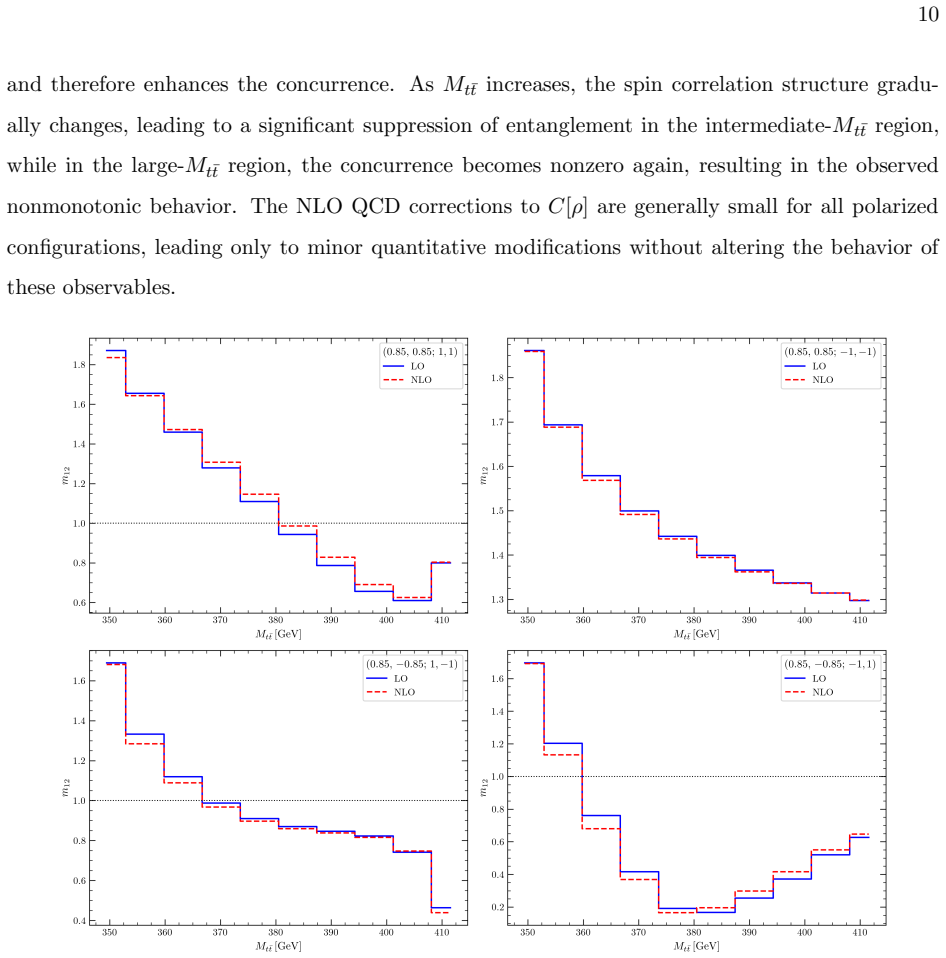
Using the spin density matrix of the ttbar system produced in γγ collisions, the NLO QCD corrections enhance the total cross section while having only a minor impact on spin observables; entanglement reaches its maximum near the ttbar invariant-mass threshold and both entanglement and Bell nonlocality vary strongly with the choice of beam polarization configurations.
What carries the argument
The spin density matrix of the ttbar system, which encodes all spin correlations and permits direct calculation of entanglement witnesses and Bell inequality violations.
If this is right
- The total production rate of ttbar pairs rises noticeably once NLO QCD effects are included.
- Normalized spin observables and derived entanglement measures remain stable under these corrections.
- Entanglement is strongest when the ttbar invariant mass is close to threshold.
- Both entanglement and Bell nonlocality change markedly when the initial photon beam polarizations are varied.
- The results supply reference predictions for future photon-collider searches for quantum correlations in top pairs.
Where Pith is reading between the lines
- If the polarization dependence holds, experiments could use different laser settings to maximize or minimize the observed entanglement signal.
- The stability of spin observables under NLO corrections suggests that leading-order calculations may already give reliable entanglement estimates for other heavy-quark processes at photon colliders.
- A direct comparison with electron-positron collider results on the same observables could test whether the initial-state polarization mechanism alters the extracted quantum correlations.
Load-bearing premise
The photons are assumed to arrive with precisely known polarization spectra taken from standard Compton backscattering models, free of extra uncertainties from the collider environment.
What would settle it
An experimental measurement at a photon collider showing that the spin correlation coefficients or an entanglement witness near the ttbar threshold deviates by more than the quoted theoretical uncertainty from the NLO prediction under a given polarization setting.
Figures
read the original abstract
We study spin correlations and quantum entanglement in the process $\gamma\gamma\to t\bar t$ with the photons coming from Compton backscattered laser beam. We present predictions for the cross sections and spin observables including next-to-leading order (NLO) QCD corrections under various beam-polarization configurations. The NLO QCD corrections significantly enhance the total cross section while having only a minor impact on spin observables. Using the spin density matrix of the $t\bar t$ system, we further investigate quantum entanglement and Bell nonlocality. We find that the entanglement is the strongest near the $t\bar t$ invariant-mass threshold, while both entanglement and Bell nonlocality are highly sensitive to the initial beam polarization. Our results provide a theoretical basis for future studies of quantum correlations in top-quark pair production at photon colliders.
Editorial analysis
A structured set of objections, weighed in public.
Referee Report
Summary. The manuscript computes spin correlations, quantum entanglement, and Bell nonlocality in γγ → tt̄ at polarized photon colliders, with photons from Compton backscattering. It includes NLO QCD corrections under different beam-polarization configurations and reports that NLO terms substantially increase the total cross section while shifting spin observables only mildly. Entanglement is found to peak near the tt̄ threshold, and both entanglement and Bell nonlocality exhibit strong dependence on the initial photon polarization states.
Significance. If the results hold, the work supplies NLO-accurate predictions for quantum-information observables in top-pair production at future photon colliders, with explicit polarization dependence. The inclusion of NLO QCD corrections and the systematic scan over beam configurations constitute clear technical strengths that go beyond leading-order studies.
major comments (1)
- [Photon spectra and polarization modeling (results section)] The claim that entanglement and Bell nonlocality are 'highly sensitive' to initial beam polarization (abstract and results section) rests on folding the partonic amplitudes with photon spectra and polarization degrees taken from standard laser-beam Compton models. No propagation of additional systematic uncertainties (laser jitter, beam overlap, nonlinear QED corrections, or detector acceptance) is performed; if these uncertainties are comparable in size to the differences between the polarization configurations examined, the sensitivity conclusion does not survive.
Simulated Author's Rebuttal
We thank the referee for the careful reading of our manuscript and the positive assessment of its technical contributions. We address the single major comment below.
read point-by-point responses
-
Referee: The claim that entanglement and Bell nonlocality are 'highly sensitive' to initial beam polarization (abstract and results section) rests on folding the partonic amplitudes with photon spectra and polarization degrees taken from standard laser-beam Compton models. No propagation of additional systematic uncertainties (laser jitter, beam overlap, nonlinear QED corrections, or detector acceptance) is performed; if these uncertainties are comparable in size to the differences between the polarization configurations examined, the sensitivity conclusion does not survive.
Authors: We agree that the reported sensitivity is obtained by convoluting the NLO partonic results with standard Compton-backscattered photon spectra and polarization degrees from the literature, without a dedicated propagation of additional experimental systematics (laser jitter, beam overlap, nonlinear QED, or detector acceptance). Our study is a theoretical calculation focused on NLO QCD corrections and the dependence on the idealized beam-polarization configurations; a full experimental uncertainty budget would require dedicated collider simulations that lie outside the present scope. We will add a clarifying paragraph in the results section stating that the sensitivity conclusions hold within the standard photon-spectrum framework and that further experimental effects merit dedicated study. revision: partial
Circularity Check
No circularity: standard perturbative NLO QCD calculation with external inputs
full rationale
The paper computes NLO QCD corrections to γγ → tt̄ cross sections and spin observables using the spin density matrix, then derives entanglement and Bell nonlocality measures. Photon spectra and polarizations are taken as external inputs from standard Compton backscattering models. No equations reduce by construction to fitted parameters, no self-citations bear the central load, and no ansatz or uniqueness theorem is smuggled in. The claimed sensitivity to beam polarization follows from varying the input polarization configurations, which are independent of the computed observables. This is a self-contained perturbative derivation.
Axiom & Free-Parameter Ledger
Reference graph
Works this paper leans on
-
[1]
W. Bernreuther, J. Phys. G35, 083001 (2008), arXiv:0805.1333 [hep-ph]
Pith/arXiv arXiv 2008
- [2]
-
[3]
D. Chakraborty, J. Konigsberg, and D. L. Rainwater, Ann. Rev. Nucl. Part. Sci.53, 301 (2003), arXiv:hep-ph/0303092
Pith/arXiv arXiv 2003
-
[4]
I. I. Y. Bigi, Y. L. Dokshitzer, V. A. Khoze, J. H. Kuhn, and P. M. Zerwas, Phys. Lett. B181, 157 (1986)
1986
-
[5]
G. Mahlon and S. J. Parke, Phys. Rev. D81, 074024 (2010), arXiv:1001.3422 [hep-ph]
Pith/arXiv arXiv 2010
-
[6]
G. Mahlon and S. J. Parke, Phys. Lett. B411, 173 (1997), arXiv:hep-ph/9706304
Pith/arXiv arXiv 1997
-
[7]
W. Bernreuther, A. Brandenburg, Z. G. Si, and P. Uwer, Nucl. Phys. B690, 81 (2004), arXiv:hep- ph/0403035
arXiv 2004
-
[8]
W. Bernreuther, M. Fuecker, and Z.-G. Si, Phys. Rev. D74, 113005 (2006), arXiv:hep-ph/0610334
Pith/arXiv arXiv 2006
-
[9]
W. Bernreuther, A. Brandenburg, Z. G. Si, and P. Uwer, Phys. Rev. Lett.87, 242002 (2001), arXiv:hep- ph/0107086
arXiv 2001
-
[10]
W. Bernreuther and Z.-G. Si, Phys. Lett. B725, 115 (2013), [Erratum: Phys.Lett.B 744, 413–413 (2015)], arXiv:1305.2066 [hep-ph]
Pith/arXiv arXiv 2013
-
[11]
Atwood, A
D. Atwood, A. Aeppli, and A. Soni, Phys. Rev. Lett.69, 2754 (1992)
1992
-
[12]
J. A. Aguilar-Saavedra, Nucl. Phys. B812, 181 (2009), arXiv:0811.3842 [hep-ph]
Pith/arXiv arXiv 2009
-
[13]
G. Aad et al. (ATLAS), Phys. Rev. Lett.114, 142001 (2015), arXiv:1412.4742 [hep-ex]
Pith/arXiv arXiv 2015
-
[14]
A. M. Sirunyan et al. (CMS), Phys. Rev. D100, 072002 (2019), arXiv:1907.03729 [hep-ex]
arXiv 2019
-
[15]
N. Gigena and R. Rossignoli, Phys. Rev. A95, 062320 (2017), arXiv:1704.08091 [quant-ph]
Pith/arXiv arXiv 2017
-
[16]
M. Fabbrichesi, R. Floreanini, and G. Panizzo, Phys. Rev. Lett.127, 161801 (2021), arXiv:2102.11883 [hep-ph]
arXiv 2021
-
[17]
M. Fabbrichesi, R. Floreanini, and L. Marzola, JHEP11, 005 (2025), arXiv:2505.02902 [hep-ph]
arXiv 2025
-
[18]
L. Antozzi, E. Chalbaud, F. D´ eliot, F. Fabbri, M. C. N. Fiolhais, B. Fuks, A. Onofre, M. White, and P. Zhu, (2026), arXiv:2602.23426 [hep-ph]
Pith/arXiv arXiv 2026
-
[19]
Y. Afik and J. R. M. de Nova, Eur. Phys. J. Plus136, 907 (2021), arXiv:2003.02280 [quant-ph]
arXiv 2021
- [20]
-
[21]
A. Hayrapetyan et al. (CMS), Rept. Prog. Phys.87, 117801 (2024), arXiv:2406.03976 [hep-ex]
arXiv 2024
-
[22]
I. F. Ginzburg, G. L. Kotkin, V. G. Serbo, and V. I. Telnov, Nucl. Instrum. Meth.205, 47 (1983)
1983
-
[23]
H. Abramowicz et al. (Linear Collider), (2025), arXiv:2503.24049 [hep-ex]
arXiv 2025
-
[24]
H. Abramowicz et al. (Linear Collider Vision), (2025), 10.1140/epjs/s11734-026-02153-w, arXiv:2503.19983 [hep-ex]
-
[25]
I. F. Ginzburg, G. L. Kotkin, S. L. Panfil, V. G. Serbo, and V. I. Telnov, Nucl. Instrum. Meth. A219, 5 (1984)
1984
-
[26]
Harlander, M
R. Harlander, M. Je˙ zabek, J. K¨ uhn, and T. Teubner, Physics Letters B346, 137 (1995). 14
1995
-
[27]
S. J. Parke and Y. Shadmi, Phys. Lett. B387, 199 (1996), arXiv:hep-ph/9606419
Pith/arXiv arXiv 1996
-
[28]
G. Mahlon and S. J. Parke, Phys. Rev. D53, 4886 (1996), arXiv:hep-ph/9512264
Pith/arXiv arXiv 1996
-
[29]
Y. Afik and J. R. M. de Nova, Phys. Rev. Lett.130, 221801 (2023), arXiv:2209.03969 [quant-ph]
arXiv 2023
-
[30]
S. Y. Choi, D. W. Kang, J. S. Lee, and C. B. Park, (2026), arXiv:2603.12830 [hep-ph]
arXiv 2026
-
[31]
A. J. Barr, M. Fabbrichesi, R. Floreanini, E. Gabrielli, and L. Marzola, Prog. Part. Nucl. Phys.139, 104134 (2024), arXiv:2402.07972 [hep-ph]
arXiv 2024
-
[32]
Y. Afik and J. R. M. de Nova, Quantum6, 820 (2022), arXiv:2203.05582 [quant-ph]
arXiv 2022
-
[33]
G. Jikia and A. Tkabladze, Phys. Rev. D54, 2030 (1996), arXiv:hep-ph/9601384
Pith/arXiv arXiv 2030
-
[34]
M. Melles and W. J. Stirling, Eur. Phys. J. C9, 101 (1999), arXiv:hep-ph/9810432
Pith/arXiv arXiv 1999
-
[35]
A. Denner, S. Dittmaier, and M. Strobel, Phys. Rev. D53, 44 (1996), arXiv:hep-ph/9507372
Pith/arXiv arXiv 1996
-
[36]
A. A. Penin and A. A. Pivovarov, Phys. Atom. Nucl.64, 275 (2001), arXiv:hep-ph/9904278
Pith/arXiv arXiv 2001
-
[37]
Z. Capatti, M. Fraaije, V. Hirschi, L. Huber, B. Ruijl, and H.-S. Shao, JHEP03, 068 (2026), arXiv:2509.13439 [hep-ph]
arXiv 2026
-
[38]
W. Bernreuther, D. Heisler, and Z.-G. Si, JHEP12, 026 (2015), arXiv:1508.05271 [hep-ph]
Pith/arXiv arXiv 2015
-
[39]
W. K. Wootters, Phys. Rev. Lett.80, 2245 (1998), arXiv:quant-ph/9709029
Pith/arXiv arXiv 1998
-
[40]
J. F. Clauser, M. A. Horne, A. Shimony, and R. A. Holt, Phys. Rev. Lett.23, 880 (1969)
1969
-
[41]
Horodecki, P
R. Horodecki, P. Horodecki, and M. Horodecki, Phys. Lett. A200, 340 (1995)
1995
-
[42]
Navas et al
S. Navas et al. (Particle Data Group), Phys. Rev. D110, 030001 (2024)
2024
discussion (0)
Sign in with ORCID, Apple, or X to comment. Anyone can read and Pith papers without signing in.