Characterization of GaN:Si and ZnO:Ga for position-resolved fast timing applications
Pith reviewed 2026-06-26 12:50 UTC · model grok-4.3
The pith
GaN:Si and ZnO:Ga scintillators achieve detector timing resolutions of 35 ps and 49 ps, more than three times better than YAP:Ce.
A machine-rendered reading of the paper's core claim, the machinery that carries it, and where it could break.
Core claim
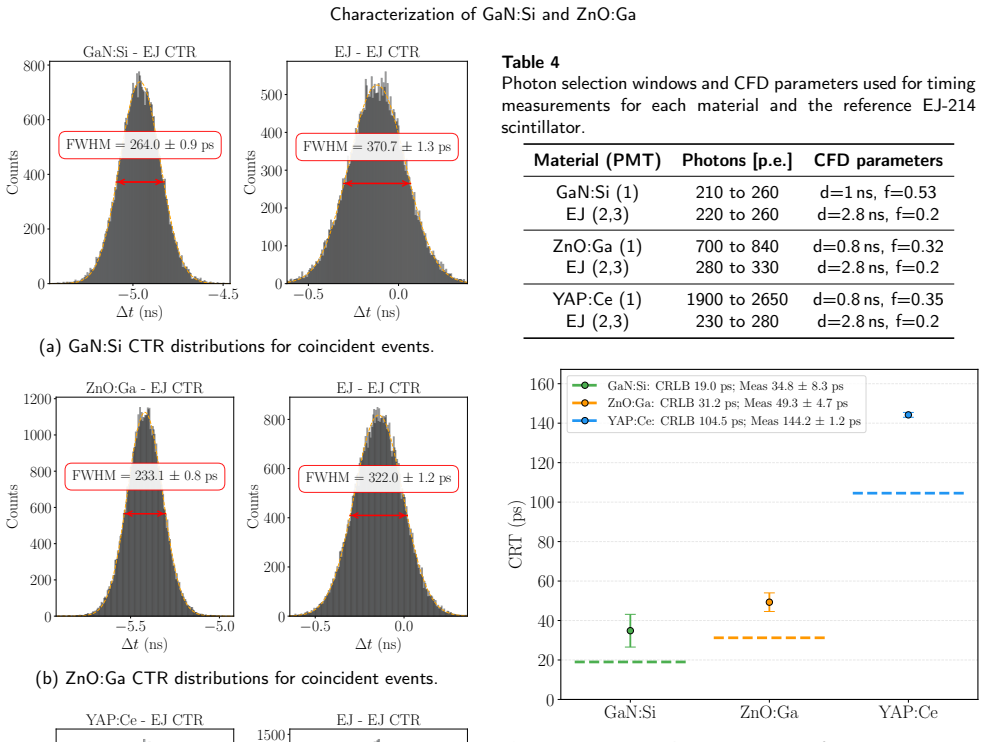
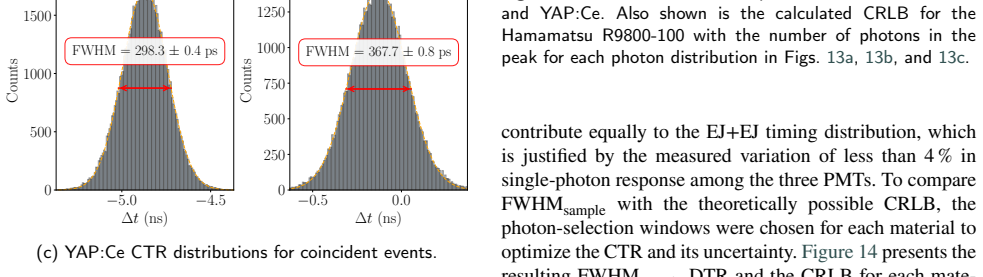
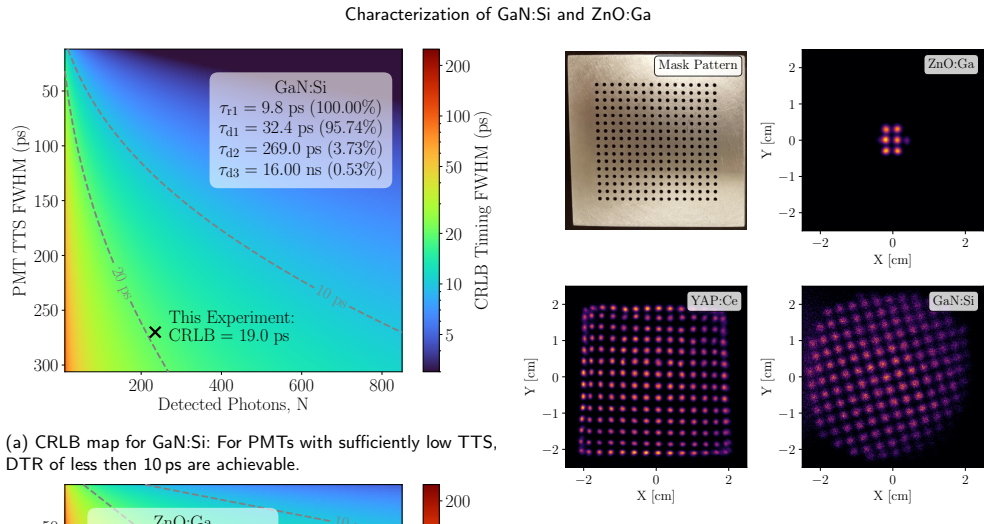
GaN:Si and ZnO:Ga exhibit (35(9))ps and (49(5))ps DTR, respectively, compared to (144(2))ps for conventional, single-crystal YAP:Ce, with >3x improvement in timing resolution, while maintaining good position resolution and alpha peak visibility.
What carries the argument
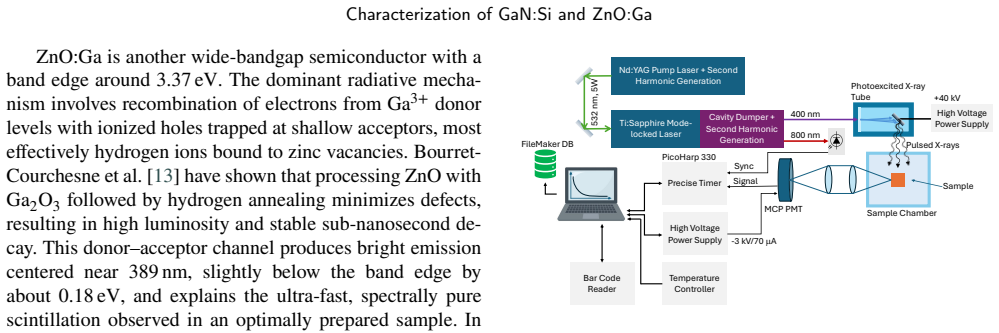
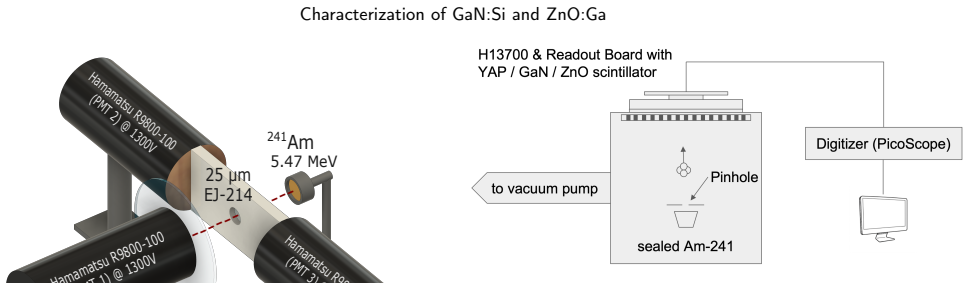
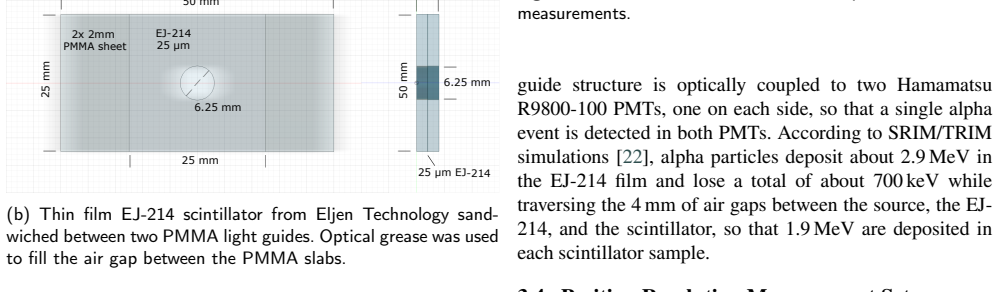
Coincidence timing resolution (CTR) and detector timing resolution (DTR) measurements using a plastic scintillator reference setup to compare the materials under identical conditions.
If this is right
- These materials can serve as high-performance replacements for YAP:Ce in API systems requiring high timing, position, and energy resolution.
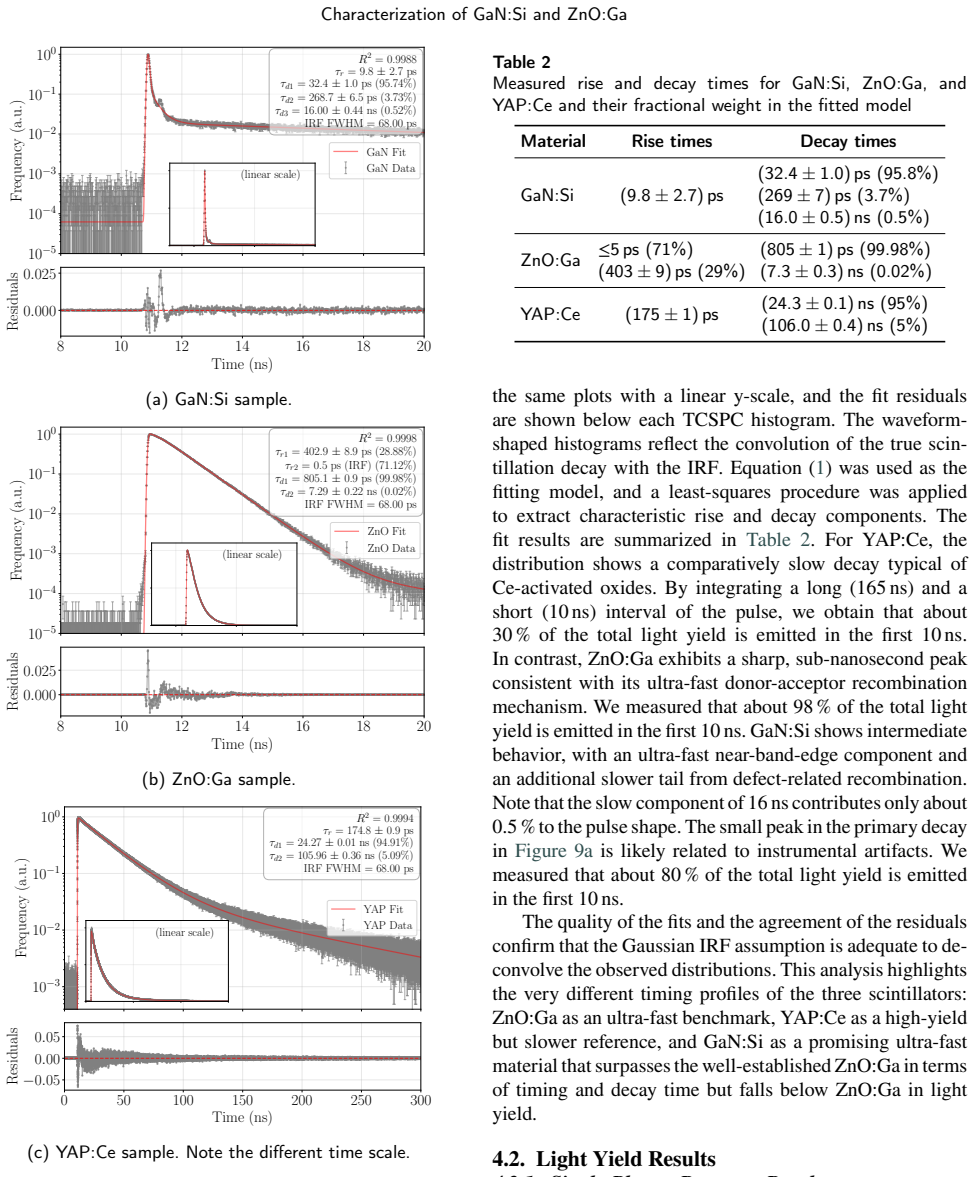
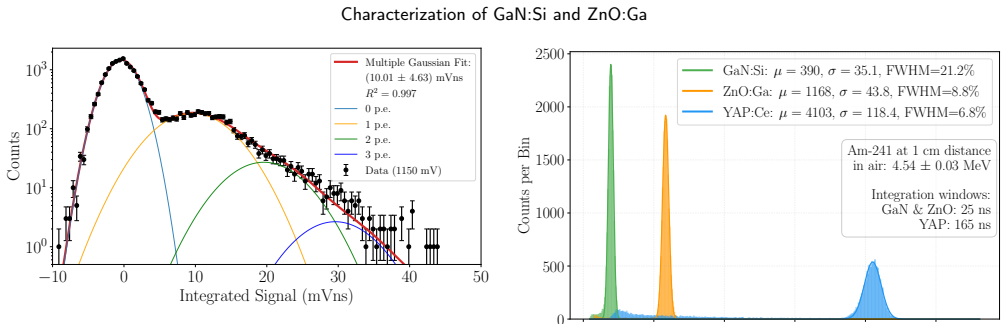
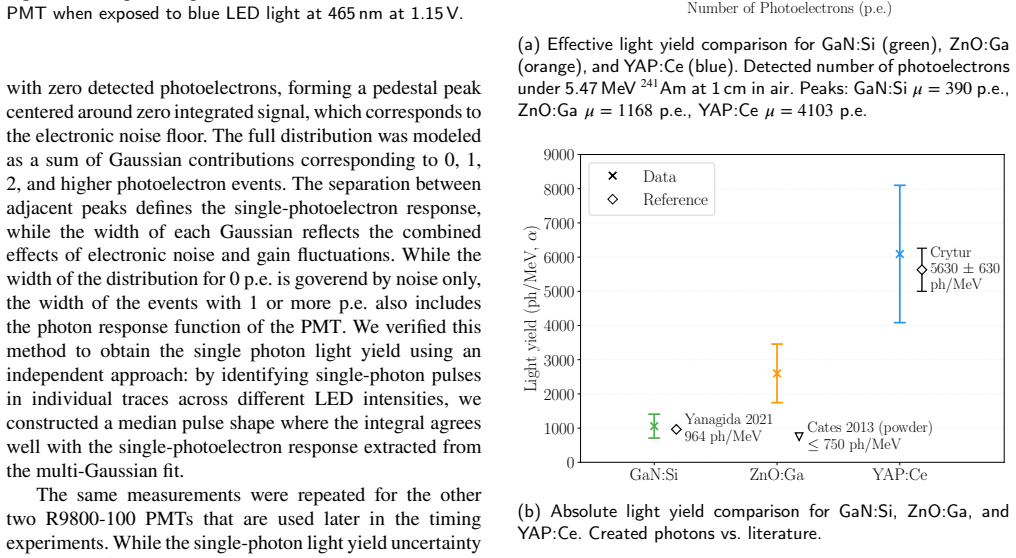
- Both show fast rise times of less than 15 ps and brightness over 1000 ph/MeV with resolved alpha peaks.
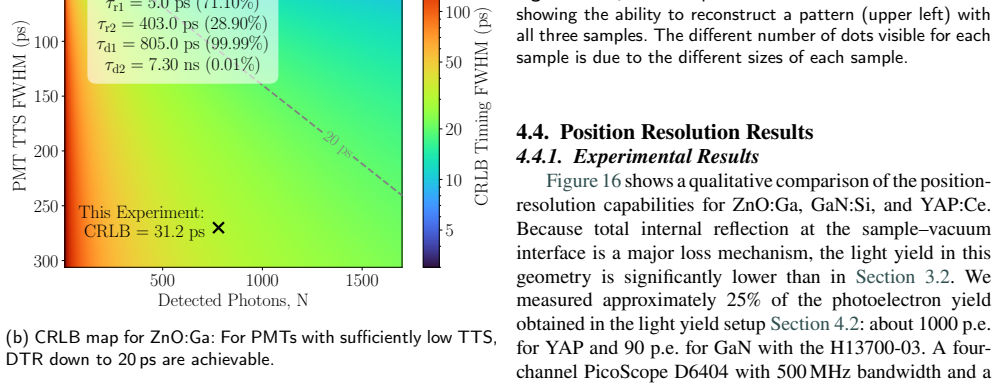
- GaN:Si has a very fast 32 ps decay, while ZnO:Ga has 805 ps, both single-component.
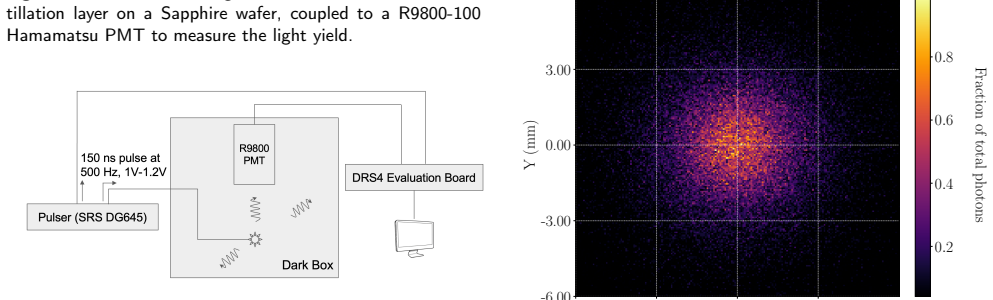
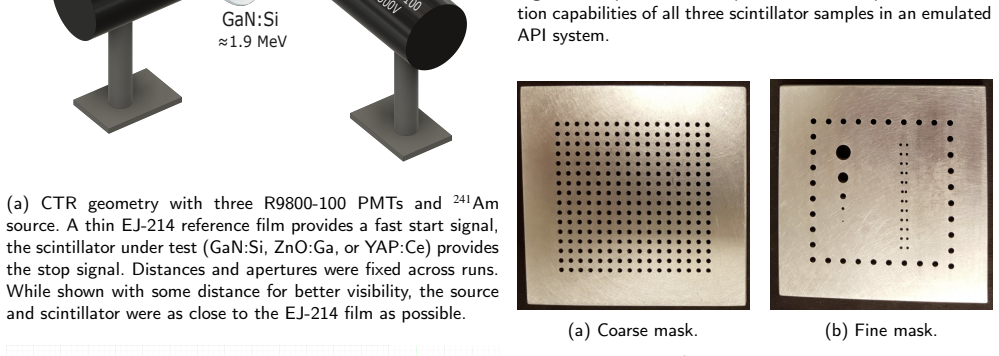
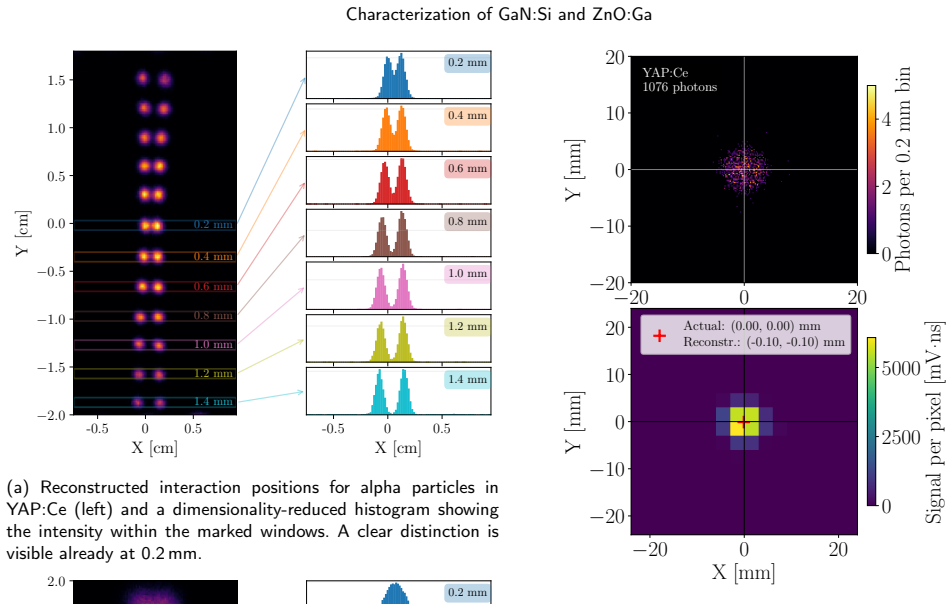
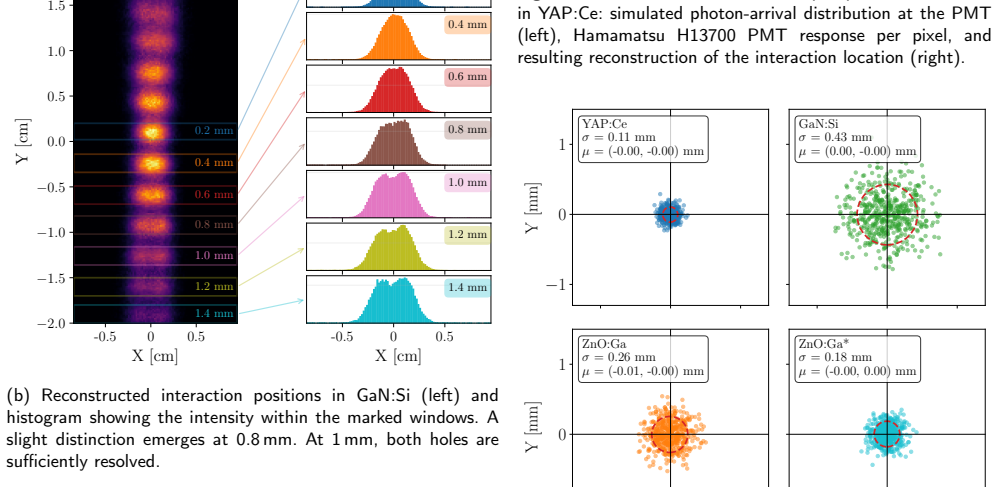
- Position resolution is better than 0.2 mm for YAP:Ce, approximately 1 mm for GaN:Si, and 0.3 mm simulated for ZnO:Ga.
Where Pith is reading between the lines
- If the timing improvement holds in other setups, it could enable better 3D mapping in medical or security applications.
- The position resolution difference suggests trade-offs between materials for different use cases.
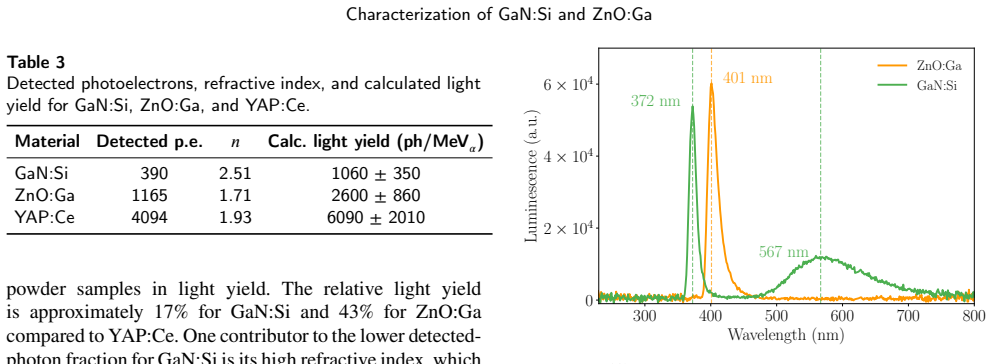
- The red-shifted near-bandgap emission spectra suggest potential for reduced self-absorption compared to polycrystalline forms.
Load-bearing premise
The experimental setup using a plastic scintillator reference provides a valid and unbiased baseline for comparing intrinsic detector timing resolution across the three materials under identical conditions.
What would settle it
Repeating the DTR measurements in a setup without the plastic reference or with a different reference detector that yields DTR values for GaN:Si and ZnO:Ga not significantly better than YAP:Ce.
Figures
read the original abstract
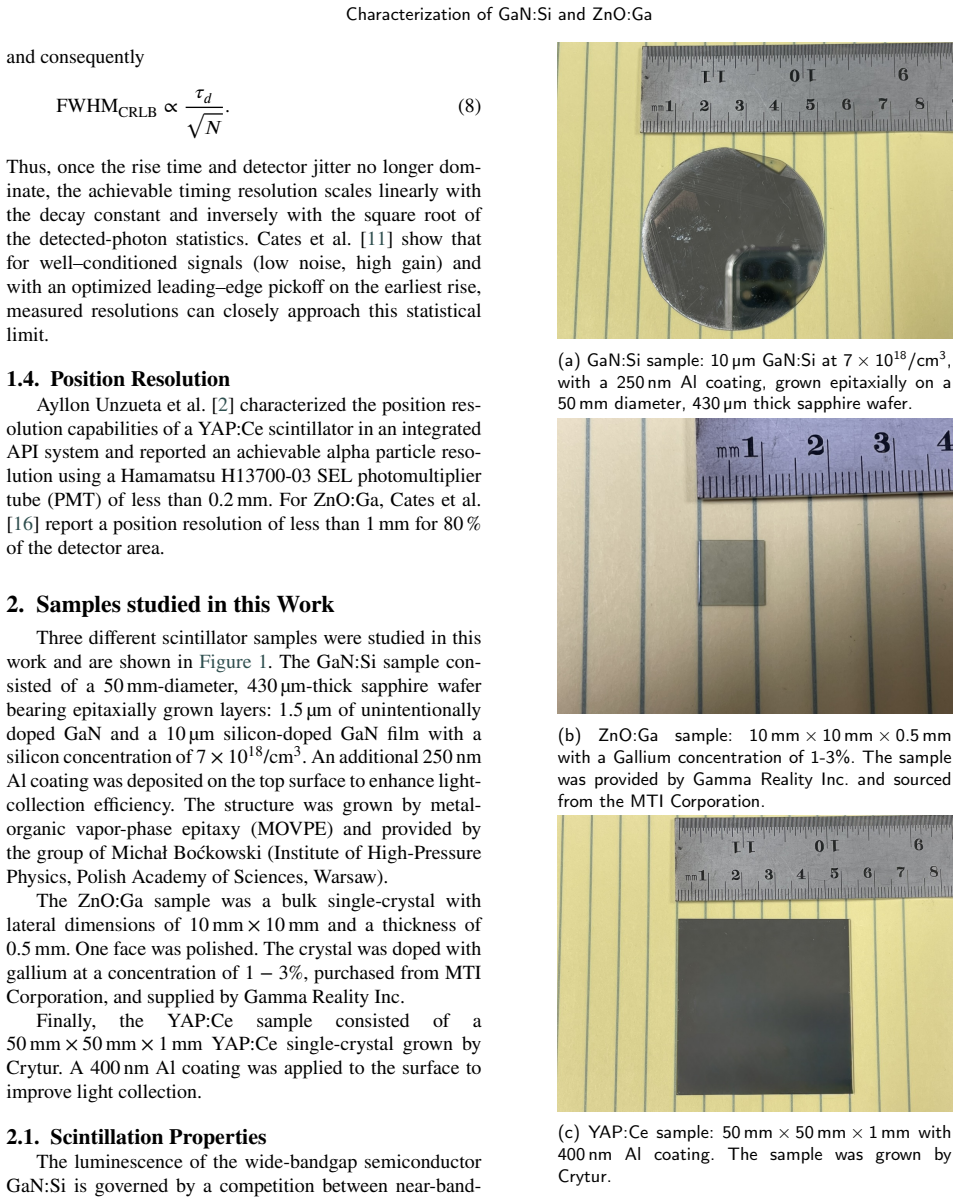
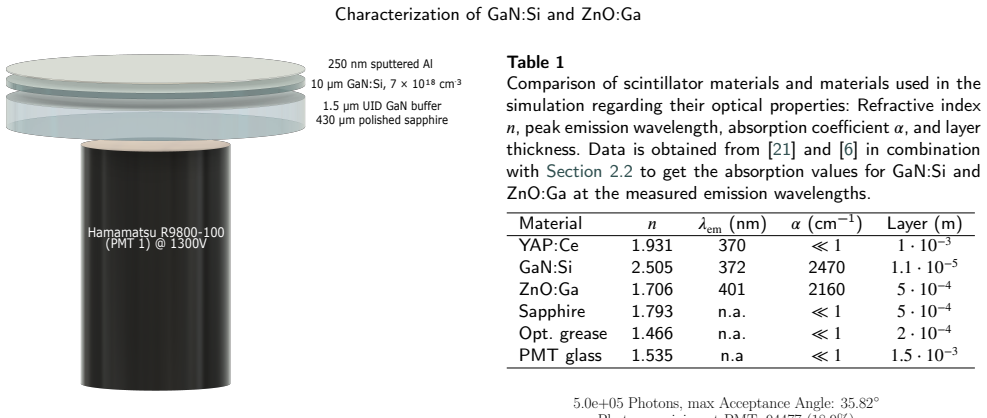
We present the characterization of two fast, crystalline inorganic scintillators, silicon-doped gallium nitride (GaN:Si) and gallium-doped zinc oxide (ZnO:Ga), and compare their performance with cerium-doped yttrium aluminium perovskite (YAP:Ce) for in-vacuum alpha-detection applications that require high-performance timing, position, and energy resolution, such as 3D elemental mapping, medical imaging, and homeland security applications. In this paper, we propose ZnO:Ga and GaN:Si as high-performance drop-in replacements for the alpha detector in Associated Particle Imaging (API) systems. However, the results reported here also have wide applicability. Prior work has reported on polycrystalline forms of ZnO:Ga, which suffer from self-absorption. To our knowledge, GaN:Si has not been proposed to be used in API systems. We present room-temperature scintillation time constants obtained via X-ray-induced time-correlated single-photon counting for both proposed materials. They both exhibit exceedingly fast rise times of <15ps, and high brightness >1000ph/MeV with resolved alpha-peaks. Single-crystal ZnO:Ga and single-crystal GaN:Si yield single-component decays of 805ps and 32ps, respectively. Using a plastic scintillator reference setup, coincidence timing resolution (CTR) and detector timing resolution (DTR) measurements demonstrate a >3x improvement in timing resolution compared to traditional YAP:Ce. GaN:Si and ZnO:Ga exhibit (35(9))ps and (49(5))ps DTR, respectively, compared to(144(2))ps for conventional, single-crystal YAP:Ce. Finally, we evaluate their position resolution in an experimental setup designed for API and measure better than 0.2mm for YAP:Ce and approximately 1mm for GaN:Si. We obtain a position resolution of 0.3mm for ZnO:Ga from simulations. We also present alpha-induced ionoluminescence emission spectra that reveal direct, red-shifted near-bandgap emission.
Editorial analysis
A structured set of objections, weighed in public.
Referee Report
Summary. The manuscript characterizes single-crystal GaN:Si and ZnO:Ga as fast inorganic scintillators for position-resolved alpha detection, reporting X-ray-induced TCSPC decay times (<15 ps rise, 32 ps and 805 ps single-component decays), DTR values of 35(9) ps (GaN:Si) and 49(5) ps (ZnO:Ga) versus 144(2) ps for YAP:Ce obtained via plastic-scintillator coincidence setup, position resolutions of <0.2 mm (YAP:Ce), ~1 mm (GaN:Si) and 0.3 mm simulated (ZnO:Ga), plus alpha-induced ionoluminescence spectra, and proposes the new materials as drop-in replacements for YAP:Ce in API systems.
Significance. If the reported DTR values are shown to be intrinsic and directly comparable, the >3x timing improvement constitutes a concrete advance for fast-timing scintillator applications in medical imaging, security, and elemental mapping; the work supplies specific measured quantities with uncertainties and addresses prior polycrystalline self-absorption limitations.
major comments (1)
- [Coincidence timing resolution and DTR extraction section] Coincidence timing resolution and DTR extraction section: the manuscript states that DTR values are obtained from CTR measurements with a plastic scintillator reference under identical conditions, but supplies neither the explicit quadrature-subtraction formula nor independent reference-only CTR runs confirming that the reference contribution remains constant across the three test crystals (different emission wavelengths and light yields). This step is load-bearing for the central >3x improvement claim.
minor comments (1)
- [Abstract] Abstract: missing space before the parenthesis in 'compared to(144(2))ps'.
Simulated Author's Rebuttal
We thank the referee for their careful review and constructive comment on the coincidence timing resolution and DTR extraction. We address the point directly below and will revise the manuscript accordingly.
read point-by-point responses
-
Referee: [Coincidence timing resolution and DTR extraction section] Coincidence timing resolution and DTR extraction section: the manuscript states that DTR values are obtained from CTR measurements with a plastic scintillator reference under identical conditions, but supplies neither the explicit quadrature-subtraction formula nor independent reference-only CTR runs confirming that the reference contribution remains constant across the three test crystals (different emission wavelengths and light yields). This step is load-bearing for the central >3x improvement claim.
Authors: We agree that the explicit quadrature-subtraction formula was omitted and should be added for clarity and reproducibility. The DTR is extracted via DTR = sqrt(CTR^2 - DTR_ref^2), where DTR_ref is determined from independent measurements of the plastic scintillator reference detector. Because the reference detector, readout electronics, bias settings, and all other experimental conditions are held strictly identical for the GaN:Si, ZnO:Ga, and YAP:Ce measurements, the reference contribution remains constant irrespective of the test crystal's emission wavelength or light yield. The plastic reference has a broad emission spectrum that is well-matched to the photodetector response in all cases, so no differential effect arises. We will insert the formula and a concise justification of constancy into the revised Coincidence timing resolution and DTR extraction section. This addresses the concern without requiring new data. revision: yes
Circularity Check
No circularity: experimental measurements with no derivations or self-referential predictions
full rationale
The paper is a pure experimental characterization reporting measured quantities (rise times, decay constants, CTR, DTR, position resolution) from X-ray and alpha-induced tests on GaN:Si, ZnO:Ga, and YAP:Ce. No equations, first-principles derivations, fitted parameters renamed as predictions, or self-citation chains appear in the abstract or described methods. DTR values are stated as direct experimental outputs from the plastic reference coincidence setup under identical conditions; the skeptic concern about reference subtraction is a potential methodological gap but does not constitute a circular reduction of any claimed derivation to its own inputs. The work is self-contained against external benchmarks (measured timing spectra) and receives the default non-finding for experimental reports.
Axiom & Free-Parameter Ledger
Reference graph
Works this paper leans on
-
[1]
Stefan Gundacker, Rosana Martinez Turtos, Etiennette Auffray, Marco Paganoni, and Paul Lecoq. High-frequency sipm read- out advances measured coincidence time resolution limits in TOF- PET.Physics in Medicine & Biology, 64(5):055012, 2019. doi:10.1088/1361-6560/aafd52
-
[2]
Mauricio Ayllon Unzueta, Bernhard Ludewigt, Brian Mak, Tanay Tak,andArunPersaud.Anall-digitalassociatedparticleimagingsys- temforthe3Ddeterminationofisotopicdistributions.ReviewofSci- entific Instruments, 92(6):063305, 06 2021. doi:10.1063/5.0030499
-
[3]
Development of a time-tagged neutron source for SNM detection.Physics Procedia, 66:105–110, 2015
Qing Ji, Bernhard Ludewigt, Joe Wallig, Will Waldron, and Jim Tinsley. Development of a time-tagged neutron source for SNM detection.Physics Procedia, 66:105–110, 2015. doi:10.1016/j.phpro.2015.05.015
-
[4]
Anin-situ3Delemental imager for planetary missions based on active neutron interrogation
MauricioAyllonUnzueta,LuothChou,JuanCristhianLuqueGutier- rez, Julius Meyer, Sanetra B Newman, Patrick N Peplowski, Arun Persaud,JackTWilson,andAnnMParsons. Anin-situ3Delemental imager for planetary missions based on active neutron interrogation. npj Space Exploration, 1(1):12, 2025. doi:10.1038/s44453-025- 00012-x
-
[5]
3D imaging and material composition with the GRI API system
R Pavlovsky and Gamma Reality Inc. 3D imaging and material composition with the GRI API system. InProceedings of the 2025 J. Meyer et al.:Preprint submitted to ElsevierPage 13 of 14 Characterization of GaN:Si and ZnO:Ga Symposium on Radiation Measurements and Applications (SORMA West 2025), Berkeley, CA, USA, 2025. Oral presentation, contribu- tion #1235
2025
-
[6]
Cathodoluminescence of epitaxial GaN and ZnO thin films for scintillator applications
HPD Schenk, SI Borenstain, A Berezin, A Schön, E Cheifetz, A Dadgar, and A Krost. Cathodoluminescence of epitaxial GaN and ZnO thin films for scintillator applications. Journal of crystal growth, 311(16):3984–3988, 2009. doi:https://doi.org/10.1016/j.jcrysgro.2009.06.018
-
[7]
Edge emission of n-type conducting ZnO and CdS.Solid-State Electronics, 9(11-12):1107–1110, 1966
W Lehmann. Edge emission of n-type conducting ZnO and CdS.Solid-State Electronics, 9(11-12):1107–1110, 1966. doi:https://doi.org/10.1016/0038-1101(66)90134-1
-
[8]
Photoluminescence and scintillation properties GaN.Applied Physics Express, 14(8):082006, 2021
Takayuki Yanagida, Takumi Kato, Daisuke Nakauchi, Go Okada, and Noriaki Kawaguchi. Photoluminescence and scintillation properties GaN.Applied Physics Express, 14(8):082006, 2021. doi:10.35848/1882-0786/ac13d8
-
[9]
Patrick Pittet, Guo-Neng Lu, Jean-Marc Galvan, Jean-Marie Bluet, Ismail Anas, Jean-Yves Giraud, and Jacques Balosso. PL characterization of GaN scintillator for radioluminescence- based dosimetry.Optical Materials, 31(10):1421–1424, 2009. doi:https://doi.org/10.1016/j.optmat.2008.09.012
-
[10]
HPDSchenk,SIBorenstain,ABerezin,ASchön,ECheifetz,SKhat- sevich, and DH Rich. Band gap narrowing and radiative efficiency of silicon doped GaN.Journal of Applied Physics, 103(10), 2008. doi:10.1063/1.2919775
-
[12]
Evaluation of melt-grown, ZnO single crystals for use as alpha-particle detectors
John S Neal, Nancy C Giles, Xiaocheng Yang, R Andrew Wall, K Burak Ucer, Richard T Williams, Dariusz J Wisniewski, Lynn A Boatner, Varathajan Rengarajan, Jeff Nause, et al. Evaluation of melt-grown, ZnO single crystals for use as alpha-particle detectors. IEEE Transactions on Nuclear Science, 55(3):1397–1403, 2008. doi:10.1109/TNS.2008.922829
-
[13]
ED Bourret-Courchesne, SE Derenzo, and MJ Weber. Development of ZnO:Ga as an ultra-fast scintillator.Nuclear Instruments and Methods in Physics Research Section A: Accelerators, Spectrome- ters, Detectors and Associated Equipment, 601(3):358–363, 2009. doi:https://doi.org/10.1016/j.nima.2008.12.206
-
[14]
Stefan Seifert, Herman T van Dam, and Dennis R Schaart. The lower bound on the timing resolution of scintillation detec- tors.Physics in medicine and biology, 57(7):1797–1814, 2012. doi:https://doi.org/10.1088/0031-9155/57/7/1797
-
[15]
Addison-Wesley, 2012
MorrisHDeGroot,MarkJSchervish,etal.Probabilityandstatistics. Addison-Wesley, 2012
2012
-
[16]
J.W.Cates,J.P.Hayward,andX.Zhang. Measurementofachievable timing resolution with ZnO:Ga films.IEEE Transactions on Nuclear Science, 60(4):3127–3133, 2013. doi:10.1109/TNS.2013.2272883
-
[17]
Structural and optical properties of Si-doped GaN.Physical Review B, 61(4):2812, 2000
A Cremades, L Görgens, O Ambacher, M Stutzmann, and F Scholz. Structural and optical properties of Si-doped GaN.Physical Review B, 61(4):2812, 2000. doi:10.1103/PhysRevB.61.2812
-
[18]
Mehmet Yilmaz. Investigation of characteristics of ZnO:Ga nanocrystalline thin films with varying dopant content.Ma- terials Science in Semiconductor Processing, 40:99–106, 2015. doi:https://doi.org/10.1016/j.mssp.2015.06.031
-
[19]
SW Yu, MH Carpenter, F Ponce, S Friedrich, JS Lee, P Olalde- Velasco,WLYang,andDÅberg.EnergylevelsoftheCeactivatorrel- ativetotheYAP(Ce)scintillatorhost.JournalofPhysics:Condensed Matter,27(18):185501,2015.doi:10.1088/0953-8984/27/18/185501
-
[20]
Designofapulsedx-raysystemforfluorescentlifetimemeasurements with a timing accuracy of 109 ps
SE Derenzo, WW Moses, SoC Blankespoor, M Ito, and K Oba. Designofapulsedx-raysystemforfluorescentlifetimemeasurements with a timing accuracy of 109 ps. InIEEE Conference on Nuclear Science Symposium and Medical Imaging, pages 117–119. IEEE,
-
[21]
doi:10.1109/NSSMIC.1992.301136
-
[22]
Accessed: 2025-03-15, 2025
Refractive Index Database. Accessed: 2025-03-15, 2025. URL https://www.refractiveindex.info
2025
-
[23]
James F. Ziegler, M.D. Ziegler, and J.P. Biersack. SRIM – the stopping and range of ions in matter (2010).Nuclear Instruments and Methods in Physics Research Section B: Beam Interactions with Materials and Atoms, 268(11):1818–1823, 2010. ISSN 0168-583X. doi:https://doi.org/10.1016/j.nimb.2010.02.091. URLhttps://www. sciencedirect.com/science/article/pii/S...
-
[24]
Qiyu Peng, Woon-Seng Choong, and W William Moses. Evaluation of the timing properties of a high quantum efficiency photomultiplier tube.IEEEtransactionsonnuclearscience,60(5):3212–3219,2013. doi:10.1109/TNS.2013.2281176
-
[25]
Photoluminescence and scintillation propertiesofthegansubstrate.OpticalMaterials,169:117697,2026
Yuta Tominaga, Takumi Kato, Akihiro Nishikawa, Keiichiro Miyazaki, Daisuke Nakauchi, Noriaki Kawaguchi, Yukiharu Uraoka, and Takayuki Yanagida. Photoluminescence and scintillation propertiesofthegansubstrate.OpticalMaterials,169:117697,2026. ISSN 0925-3467. doi:https://doi.org/10.1016/j.optmat.2025.117697. URLhttps://www.sciencedirect.com/science/article/...
-
[26]
Julius Meyer, Joshua W. Cates, Woon-Seng Choong, Juan Cristhian Luque Gutierrez, Federico Moretti, Ryan Pavlovsky, Mauricio Ayllon Unzueta, Weronika W. Wolszczak, Markus Roth, and Arun Persaud. Data and scripts used in this work.Uploaded on Zenodo, 2026. URLhttps://doi.org/10.5281/zenodo.19490023. J. Meyer et al.:Preprint submitted to ElsevierPage 14 of 14
discussion (0)
Sign in with ORCID, Apple, or X to comment. Anyone can read and Pith papers without signing in.