Thermal Stability and QNMs of a Hairy Black Hole in the Presence of a Monopole Field
Pith reviewed 2026-06-26 13:38 UTC · model grok-4.3
The pith
The thermal stability of a hairy black hole with dilaton and monopole increases as the dilaton scalar charge decreases, while larger black hole charges reduce the magnitude of quasi-normal mode frequencies.
A machine-rendered reading of the paper's core claim, the machinery that carries it, and where it could break.
Core claim
The authors examine a hairy black hole metric that extends the GHS-GM solution through the addition of a dilaton and a monopole field. Thermodynamic quantities are computed to determine thermal stability, and the equations for linear perturbations are solved to extract quasi-normal modes. The thermal behavior depends on the dilaton scalar charge such that smaller values increase stability, and increasing the black hole charge causes both real and imaginary parts of the quasi-normal frequencies to decrease in absolute value, with overtones damping faster and no unstable modes appearing.
What carries the argument
The generalized GHS-GM black hole metric that includes a dilaton scalar charge and a monopole field, from which thermodynamic potentials and quasi-normal mode equations are derived.
If this is right
- Thermal stability rises when the dilaton scalar charge is reduced.
- Both real and imaginary parts of quasi-normal frequencies shrink as black hole charge increases.
- Overtone modes decay faster than the fundamental modes.
- No positive imaginary parts appear, confirming the absence of unstable modes.
Where Pith is reading between the lines
- The parameter dependence may limit allowable scalar charges in dynamical black hole formation scenarios.
- The faster damping of overtones could shape the late-time ringdown phase in gravitational wave signals from similar objects.
- Analogous trends might appear when the same stability methods are applied to other Einstein-dilaton-monopole solutions.
Load-bearing premise
The chosen generalization of the GHS-GM metric with dilaton and monopole provides a consistent background where standard thermodynamic and perturbation methods apply without extra instabilities.
What would settle it
A computation of quasi-normal modes that yields a positive imaginary part for any overtone or fundamental mode at large black hole charge would falsify the stability conclusion.
Figures
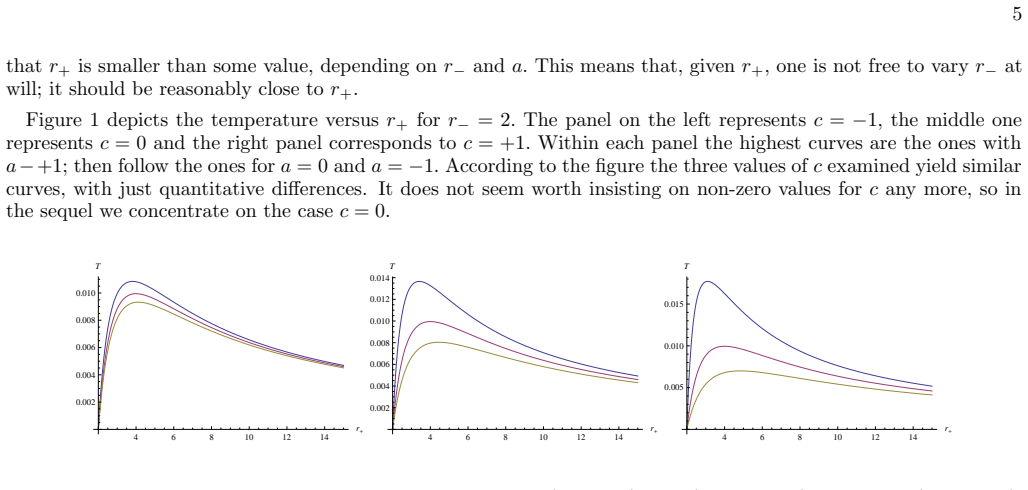
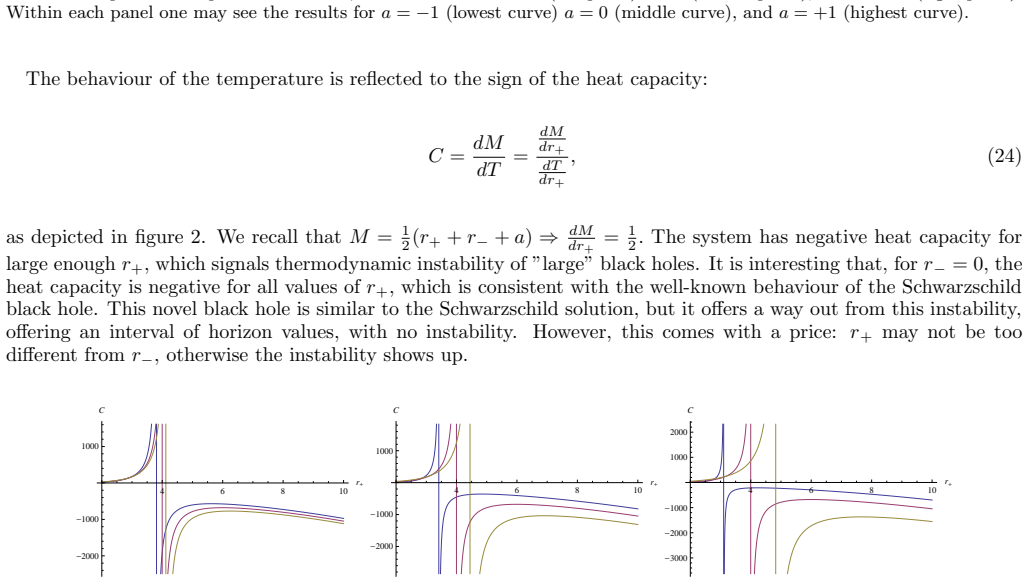
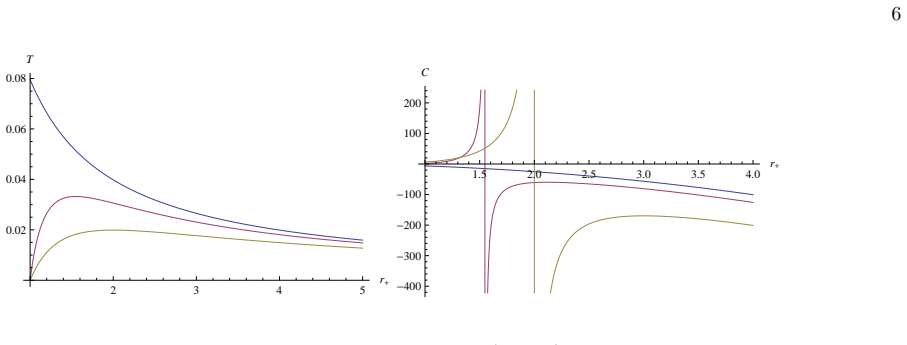
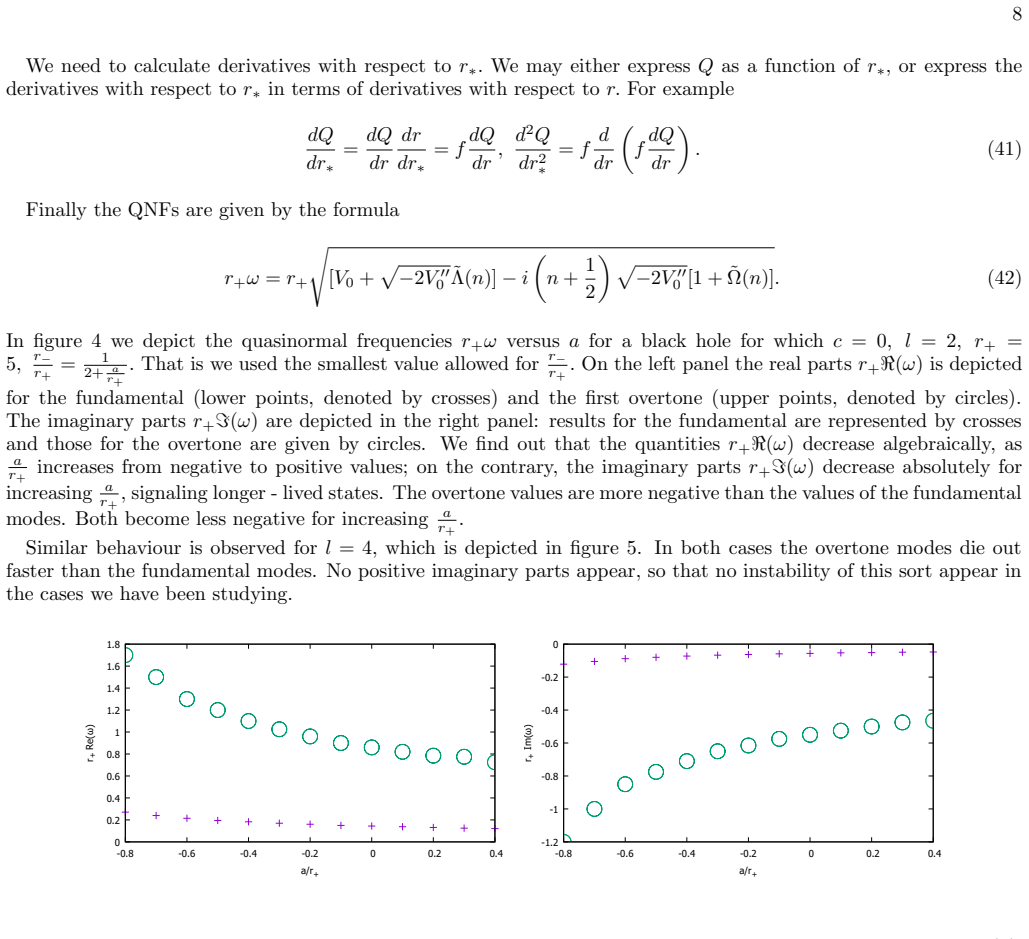
read the original abstract
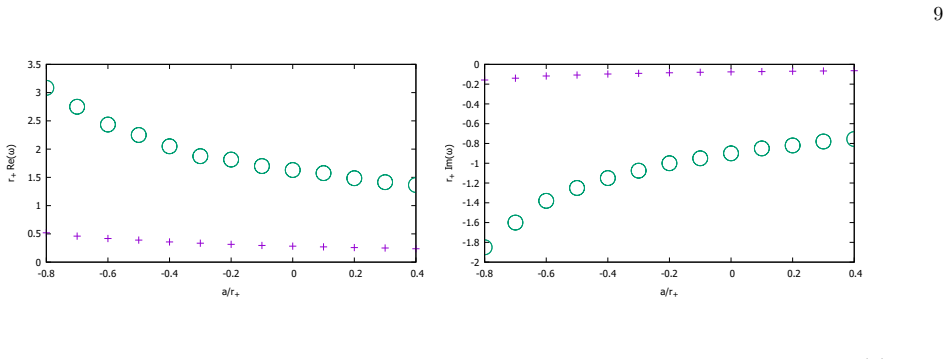
We study the stability of a generalization of the GHS-GM black hole in the presence of a dilaton and a monopole field. We find that the thermal behaviour of system depends on the scalar charge of the dilaton field and as this parameter is decreasing the system becomes more thermally stable. We also find that, as the charge of the black hole is increasing, both the real and the imaginary parts of the quasi-normal frequencies decrease in absolute value. The overtone modes die out faster than the fundamental modes and no positive imaginary parts appear, indicating the stabilty of the system
Editorial analysis
A structured set of objections, weighed in public.
Referee Report
Summary. The manuscript studies the thermal stability and quasi-normal modes of a generalization of the GHS-GM black hole metric that includes a dilaton field and a monopole. It claims that the system's thermal behavior depends on the dilaton scalar charge, with decreasing scalar charge increasing thermal stability; that both real and imaginary parts of the QNMs decrease in absolute value as black-hole charge increases; that overtone modes decay faster than fundamental modes; and that the absence of positive imaginary parts indicates stability of the system.
Significance. If the metric is an exact solution to the field equations and the thermodynamic and perturbation calculations are correctly performed, the results would add concrete information on how scalar charge and monopole effects influence stability in hairy black-hole spacetimes. The work could be relevant to ongoing studies of black-hole thermodynamics and ringdown signals in theories with additional fields, but the abstract provides no indication of parameter-free derivations, machine-checked results, or falsifiable predictions that would strengthen its impact.
major comments (3)
- [Introduction / Metric Ansatz] The manuscript provides no explicit verification (e.g., substitution into the Einstein-dilaton-monopole equations or computation of the residual stress-energy tensor) that the chosen generalized GHS-GM ansatz is an exact solution. This check is load-bearing for every subsequent thermodynamic identity and for the Schrödinger-like equation used to extract QNMs.
- [Thermodynamic Analysis] The claim that thermal stability increases as the dilaton scalar charge decreases is stated without reference to the concrete diagnostic employed (sign of specific heat, sign of free-energy difference, or turning-point criterion) or to the explicit dependence on the charge parameter in the first law or Smarr relation.
- [Quasi-normal Mode Calculation] The QNM results (both Re(ω) and Im(ω) decreasing with black-hole charge, no positive Im(ω)) presuppose a well-defined effective potential and boundary conditions derived from the metric; without confirmation that the metric satisfies the background equations, the perturbation equation itself may contain spurious source terms.
minor comments (2)
- [Abstract] Typo in abstract: 'stabilty' should read 'stability'.
- [Abstract] The abstract does not specify the numerical method (e.g., continued fractions, WKB, or direct integration) or the range of overtone numbers used for the QNM spectrum.
Simulated Author's Rebuttal
We thank the referee for the careful reading and constructive comments. We address each major comment below and will revise the manuscript accordingly to improve clarity and rigor.
read point-by-point responses
-
Referee: [Introduction / Metric Ansatz] The manuscript provides no explicit verification (e.g., substitution into the Einstein-dilaton-monopole equations or computation of the residual stress-energy tensor) that the chosen generalized GHS-GM ansatz is an exact solution. This check is load-bearing for every subsequent thermodynamic identity and for the Schrödinger-like equation used to extract QNMs.
Authors: We agree that an explicit verification strengthens the foundation of the work. In the revised version we will add an appendix that substitutes the generalized GHS-GM ansatz into the Einstein-dilaton-monopole field equations, computes the residual, and confirms that the stress-energy tensor is consistent with the ansatz, thereby establishing it as an exact solution. revision: yes
-
Referee: [Thermodynamic Analysis] The claim that thermal stability increases as the dilaton scalar charge decreases is stated without reference to the concrete diagnostic employed (sign of specific heat, sign of free-energy difference, or turning-point criterion) or to the explicit dependence on the charge parameter in the first law or Smarr relation.
Authors: The stability conclusion is drawn from the sign of the specific heat capacity obtained via the first law. We will revise the thermodynamic section to state this diagnostic explicitly, supply the first-law and Smarr relations with the scalar-charge dependence shown, and indicate how decreasing scalar charge enlarges the region of positive specific heat. revision: yes
-
Referee: [Quasi-normal Mode Calculation] The QNM results (both Re(ω) and Im(ω) decreasing with black-hole charge, no positive Im(ω)) presuppose a well-defined effective potential and boundary conditions derived from the metric; without confirmation that the metric satisfies the background equations, the perturbation equation itself may contain spurious source terms.
Authors: The added metric verification (see first comment) will confirm the background. With that established, the linearized perturbation equations yield the standard Schrödinger-like form without extraneous sources. We will also add a short paragraph specifying the ingoing/outgoing boundary conditions used in the QNM computation. revision: yes
Circularity Check
No circularity: standard thermodynamic and QNM methods applied to assumed metric without self-referential reductions visible
full rationale
The abstract and provided context describe application of standard first-law thermodynamics and Schrödinger-like QNM equations to a generalized GHS-GM metric ansatz. No equations are quoted that define a quantity in terms of itself, rename a fit as a prediction, or reduce a central claim to a self-citation chain. The skeptic concern about metric consistency is a correctness/verification issue, not a circularity reduction per the enumerated patterns. The derivation chain is therefore treated as self-contained against external benchmarks.
Axiom & Free-Parameter Ledger
Reference graph
Works this paper leans on
-
[1]
Black Holes and Membranes in Higher Dimensional Theories with Dilaton Fields,
G. W. Gibbons and K. i. Maeda, “Black Holes and Membranes in Higher Dimensional Theories with Dilaton Fields,” Nucl. Phys. B298, 741-775 (1988)
1988
-
[2]
Charged black holes in string theory,
D. Garfinkle, G. T. Horowitz and A. Strominger, “Charged black holes in string theory,” Phys. Rev. D43, 3140 (1991) [erratum: Phys. Rev. D45, 3888 (1992)
1991
-
[3]
K. M. Lee, V. P. Nair and E. J. Weinberg, “A Classical Instability of Reissner-Nordstrom Solutions and the Fate of Magnetically Charged Black Holes,” Phys. Rev. Lett.68, 1100-1103 (1992) [arXiv:hep-th/9111045 [hep-th]]
Pith/arXiv arXiv 1992
-
[4]
Electric and Magnetic Charges in Superstring Models,
X. G. Wen and E. Witten, “Electric and Magnetic Charges in Superstring Models,” Nucl. Phys. B261, 651-677 (1985)
1985
-
[5]
Quantised singularities in the electromagnetic field,,
P. A. M. Dirac, “Quantised singularities in the electromagnetic field,,” Proc. Roy. Soc. Lond. A133, no.821, 60-72 (1931)
1931
-
[6]
Consequences of Dirac’s theory of positrons,
W. Heisenberg and H. Euler, “Consequences of Dirac’s theory of positrons,” Z. Phys.98, no.11-12, 714-732 (1936) [arXiv:physics/0605038 [physics]]
Pith/arXiv arXiv 1936
-
[7]
Fresnel analysis of the wave propagation in nonlinear electrodynamics,
Y. N. Obukhov and G. F. Rubilar, “Fresnel analysis of the wave propagation in nonlinear electrodynamics,” Phys. Rev. D 66, 024042 (2002) [arXiv:gr-qc/0204028 [gr-qc]]
Pith/arXiv arXiv 2002
-
[8]
D. P. Theodosopoulos, T. Karakasis, G. Koutsoumbas and E. Papantonopoulos, “Motion of particles around a magnetically charged Euler–Heisenberg black hole with scalar hair and the Event Horizon Telescope,” Eur. Phys. J. C84, no.6, 592 (2024) [arXiv:2311.02740 [gr-qc]]
arXiv 2024
-
[9]
Exact black holes in string-inspired Euler-Heisenberg theory,
A. Bakopoulos, T. Karakasis, N. E. Mavromatos, T. Nakas and E. Papantonopoulos, “Exact black holes in string-inspired Euler-Heisenberg theory,” Phys. Rev. D110, no.2, 2 (2024) [arXiv:2402.12459 [hep-th]]
arXiv 2024
-
[10]
Magnetically charged Euler-Heisenberg black holes with scalar hair,
T. Karakasis, G. Koutsoumbas, A. Machattou and E. Papantonopoulos, “Magnetically charged Euler-Heisenberg black holes with scalar hair,” Phys. Rev. D106, no.10, 104006 (2022) [arXiv:2207.13146 [gr-qc]]
arXiv 2022
-
[11]
Thermodynamics of the Euler-Heisenberg-AdS black hole,
D. Magos and N. Bret´ on, “Thermodynamics of the Euler-Heisenberg-AdS black hole,” Phys. Rev. D102, no.8, 084011 (2020) [arXiv:2009.05904 [gr-qc]]
arXiv 2020
-
[12]
Thermodynamic phase transition of Euler-Heisenberg-AdS black hole on free energy landscape,
H. Dai, Z. Zhao and S. Zhang, “Thermodynamic phase transition of Euler-Heisenberg-AdS black hole on free energy landscape,” Nucl. Phys. B991, 116219 (2023) [arXiv:2202.14007 [gr-qc]]
arXiv 2023
-
[13]
Birefringence and quasinormal modes of the Einstein-Euler-Heisenberg black hole,
N. Bret´ on and L. A. L´ opez, “Birefringence and quasinormal modes of the Einstein-Euler-Heisenberg black hole,” Phys. Rev. D104, no.2, 024064 (2021) [arXiv:2105.12283 [gr-qc]]
arXiv 2021
-
[14]
Black Hole in a Model with Dilaton and Monopole Fields,
E. Kyriakopoulos, “Black Hole in a Model with Dilaton and Monopole Fields,” Int. J. Mod. Phys. D15, 2223-2228 (2006), [arXiv:gr-qc/0611059 [gr-qc]]
Pith/arXiv arXiv 2006
-
[15]
Kyriakopoulos, ”Black Hole in a Model with Dilaton and Monopole Fields
E. Kyriakopoulos, ”Black Hole in a Model with Dilaton and Monopole Fields. II”, arXiv:gr-qc/0611060
-
[16]
Thermal stability of hairy black holes,
N. Chatzifotis, P. Dorlis, N. E. Mavromatos and E. Papantonopoulos, “Thermal stability of hairy black holes,” Phys. Rev. D107, no.8, 084053 (2023) [arXiv:2302.03980 [gr-qc]]
arXiv 2023
-
[17]
R. B´ ecar, P. A. Gonz´ alez, E. Papantonopoulos and Y. V´ asquez, “Quasinormal modes of three-dimensional rotating Hoˇrava AdS black hole and the approach to thermal equilibrium,” Eur. Phys. J. C80, no.7, 600 (2020) [arXiv:1906.06654 [gr-qc]]
arXiv 2020
-
[18]
E. Kyriakopoulos, ”Black Holes in Models with Dilaton Field and Electric or Electric and Magnetic Charges”, Class.Quant.Grav. 23 (2006) 7591-7602, arXiv:gr-qc/0611061
Pith/arXiv arXiv 2006
-
[19]
Black holes as elementary particles,
C. F. E. Holzhey and F. Wilczek, “Black holes as elementary particles,” Nucl. Phys. B380, 447-477 (1992) [arXiv:hep- th/9202014 [hep-th]]
arXiv 1992
-
[20]
Quasinormal modes of charged, dilaton black holes,
V. Ferrari, M. Pauri and F. Piazza, “Quasinormal modes of charged, dilaton black holes,” Phys. Rev. D63, 064009 (2001) [arXiv:gr-qc/0005125 [gr-qc]]. 10
Pith/arXiv arXiv 2001
-
[21]
Gravitational perturbation of Garfinkle-Horowitz-Strominger dilaton black hole and quasinormal modes,
K. Lin, “Gravitational perturbation of Garfinkle-Horowitz-Strominger dilaton black hole and quasinormal modes,” Int. J. Theor. Phys.49, 2786-2792 (2010)
2010
-
[22]
Black Hole Normal Modes: A WKB Approach. 1. Foundations and Application of a Higher Order WKB Analysis of Potential Barrier Scattering,
S. Iyer and C. M. Will, “Black Hole Normal Modes: A WKB Approach. 1. Foundations and Application of a Higher Order WKB Analysis of Potential Barrier Scattering,” Phys. Rev. D35, 3621 (1987)
1987
-
[23]
Black Hole Normal Modes: A WKB Approach. 2. Schwarzschild Black Holes,
S. Iyer, “Black Hole Normal Modes: A WKB Approach. 2. Schwarzschild Black Holes,” Phys. Rev. D35, 3632 (1987)
1987
discussion (0)
Sign in with ORCID, Apple, or X to comment. Anyone can read and Pith papers without signing in.