All-sky modeling of Galactic emission at radio and microwave frequencies
Pith reviewed 2026-06-26 13:54 UTC · model grok-4.3
The pith
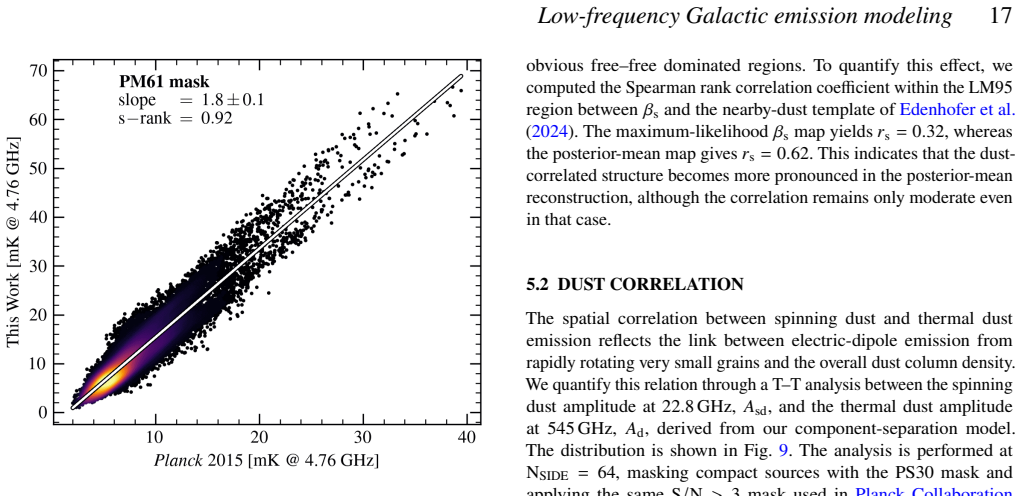
Incorporating new low-frequency surveys doubles the recovered synchrotron amplitude at 4.76 GHz compared to Planck 2015.
A machine-rendered reading of the paper's core claim, the machinery that carries it, and where it could break.
Core claim
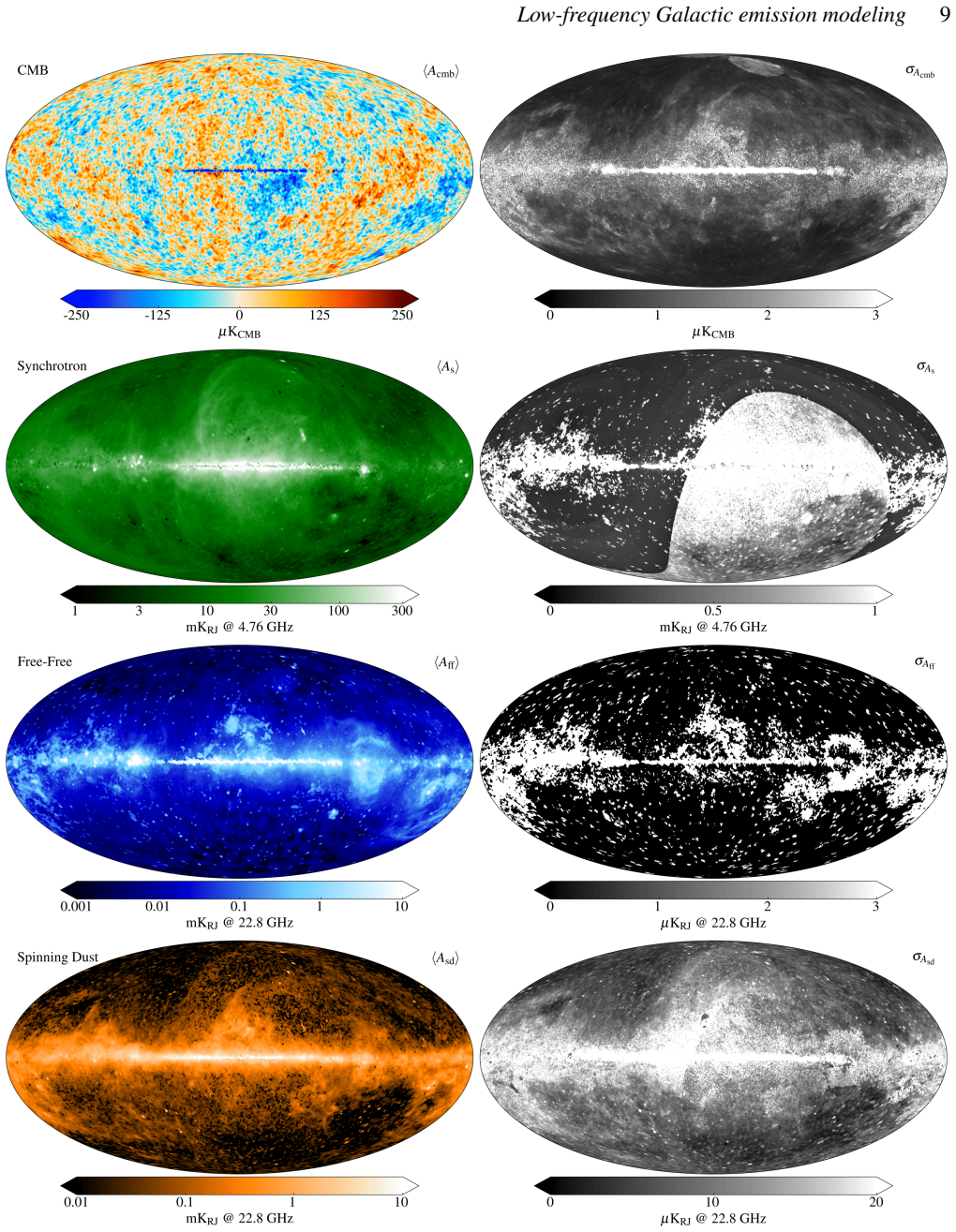
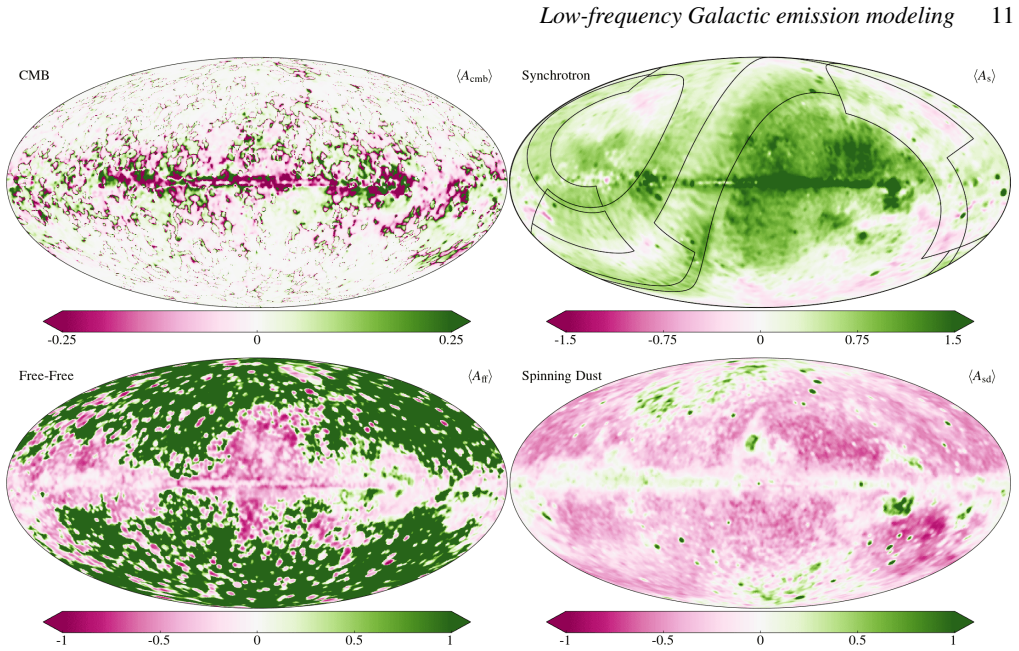
We present a new all-sky model of low-frequency diffuse Galactic emission in the regime where synchrotron, free-free, and spinning dust dominate. The model extends the Planck 2015 analysis by incorporating recent radio and microwave surveys and reprocessed data. Using a Bayesian parametric approach with Commander, we derive spatially varying amplitude and spectral parameter maps. The revised low-frequency anchoring increases the recovered synchrotron amplitude at 4.76 GHz by a factor of approximately two compared to the Planck 2015 prediction. The model achieves RMS temperature residuals below 10 μK over 95% of the sky up to 353 GHz, with fractional residuals below 1.5% in the Galactic plane
What carries the argument
The Commander Bayesian parametric component-separation algorithm applied to 35 full- and partial-sky maps at 1 degree resolution, modeling synchrotron as a power-law with spatially varying index, free-free emission, and a single-component log-normal spinning dust spectrum.
If this is right
- The fit yields a full-sky synchrotron amplitude and spectral-index solution.
- It produces an all-sky characterization of spinning dust emission with a single log-normal spectral model.
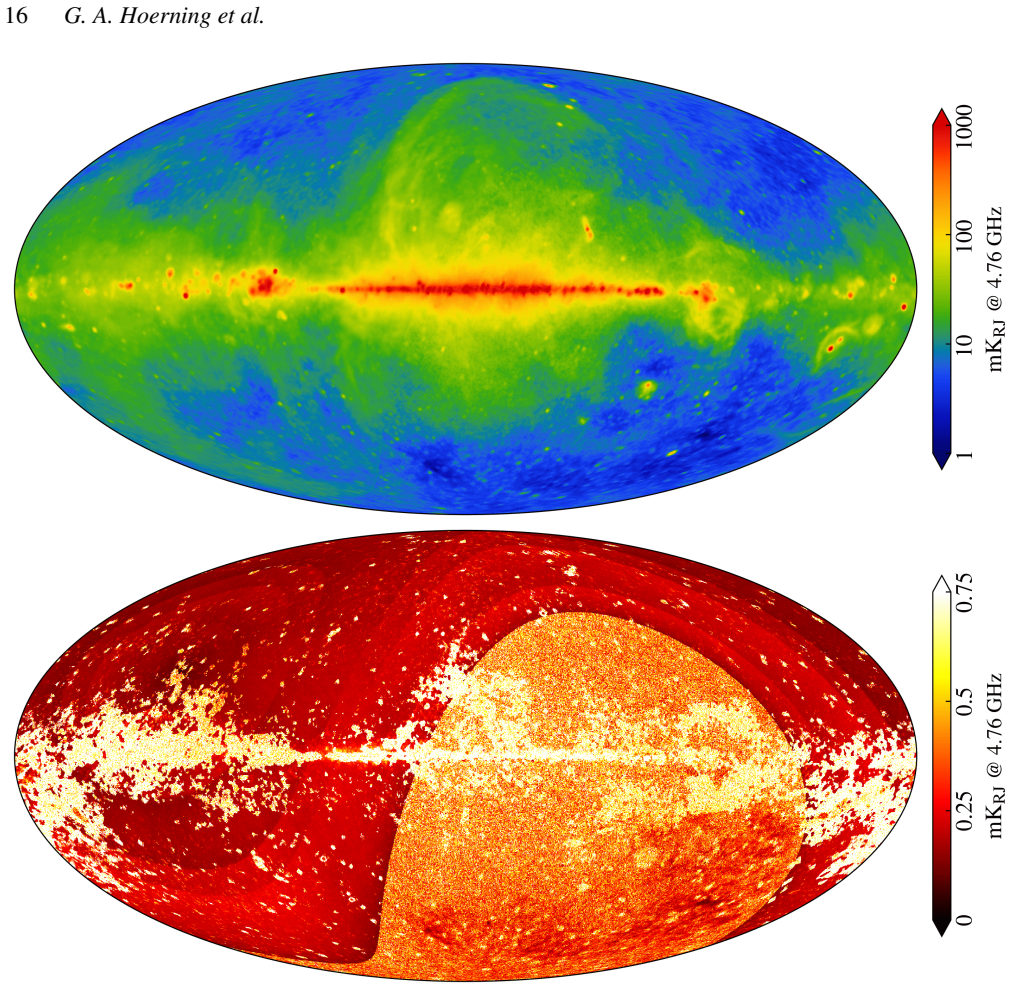
- It delivers a reconstructed all-sky total-intensity map at 4.76 GHz tracing diffuse synchrotron with reduced systematics.
- Residual angular power spectra lie more than two orders of magnitude below the CMB spectrum.
- The products provide a new reference for foreground modeling and sky-simulation applications.
Where Pith is reading between the lines
- This upward revision in synchrotron amplitude could require adjustments to foreground templates used in analyses of large-scale CMB anomalies.
- The model might be extended by testing its predictions against new narrow-band surveys at frequencies outside the current fit range.
- Improved low-frequency constraints could reduce uncertainty in separating Galactic emission from extragalactic signals in future radio continuum surveys.
- The single log-normal spinning dust component could be compared against multi-component alternatives in targeted Galactic plane regions to check for spatial variations.
Load-bearing premise
The chosen parametric forms for synchrotron, free-free, and spinning dust together with the specific set of input surveys fully describe the true emission without major unmodeled components or calibration mismatches.
What would settle it
An independent measurement at a frequency between 1 and 353 GHz not included in the fit that shows RMS temperature residuals above 10 μK over more than 5 percent of the sky would falsify the claimed model accuracy.
Figures
read the original abstract
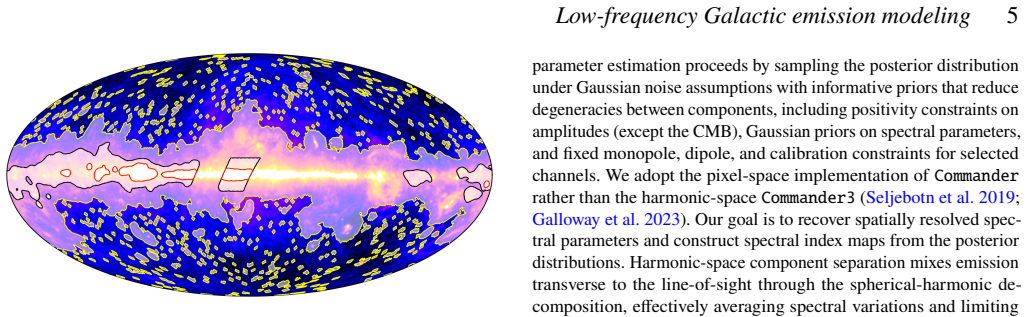
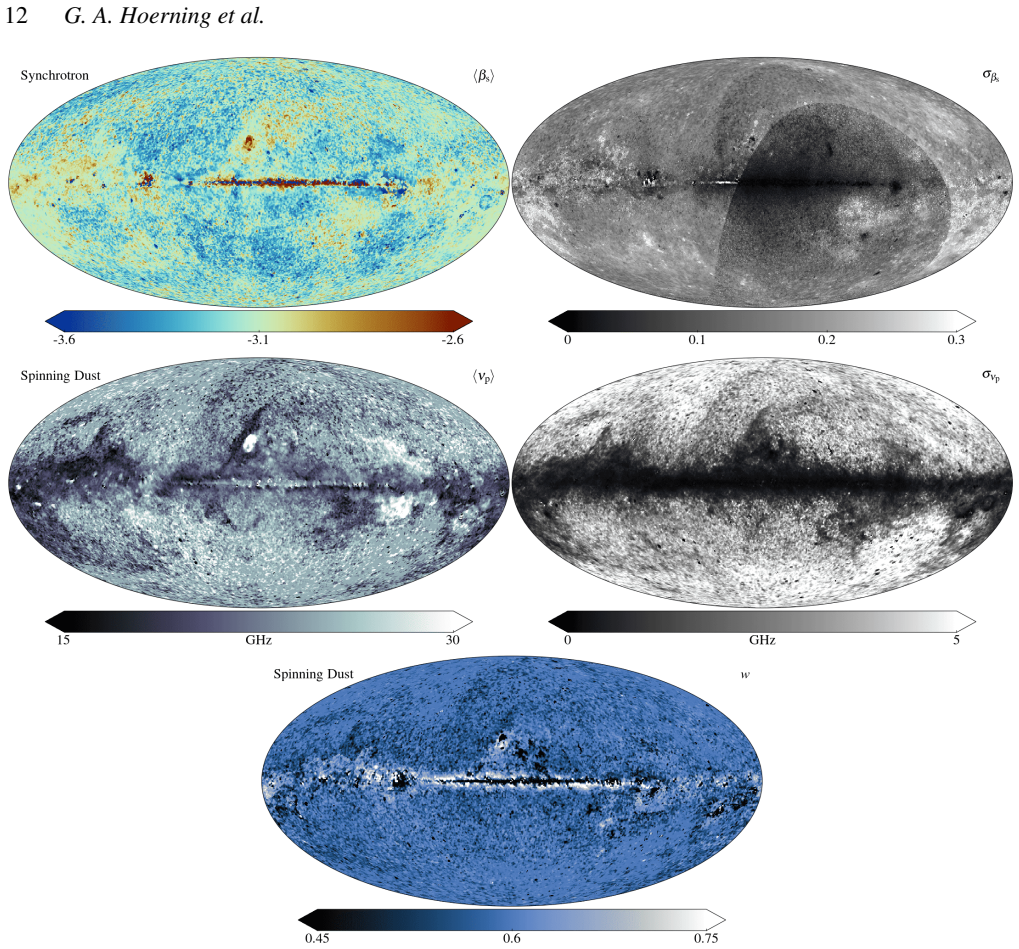
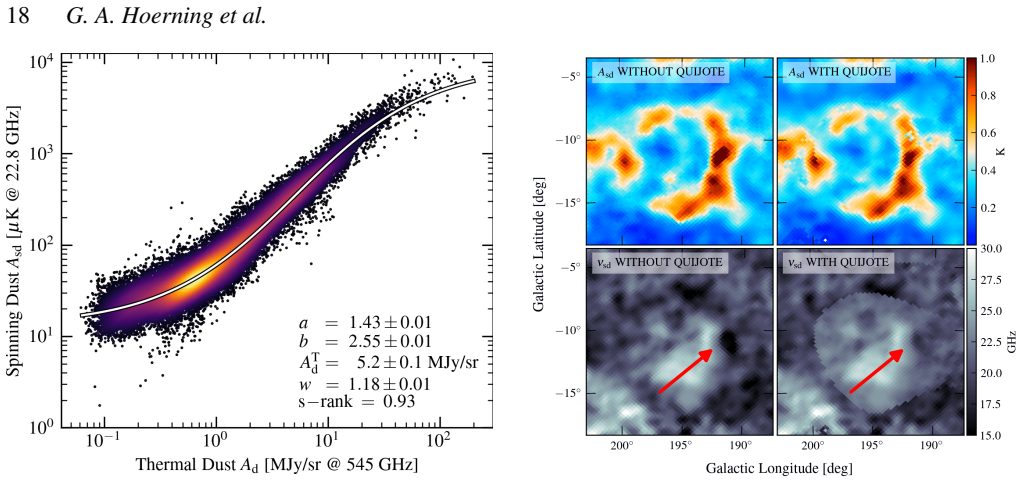
We present a new all-sky model of low-frequency diffuse Galactic emission in the regime where synchrotron, free-free, and spinning dust dominate. The model extends the Planck 2015 diffuse component-separation analysis by incorporating recent radio and microwave surveys. We fit 35 full- and partial-sky maps at 1 degree resolution, including S-PASS at 2.30 GHz, C-BASS at 4.76 GHz, and QUIJOTE at 10-20 GHz, together with reprocessed WMAP and Planck LFI data from the Cosmoglobe collaboration and Planck HFI channels. Using a Bayesian parametric approach with Commander, we derive spatially varying amplitude and spectral parameter maps for the dominant low-frequency foreground components in total intensity. The main products are a full-sky synchrotron amplitude and spectral-index solution, an all-sky characterization of spinning dust emission with a single-component log-normal spectral model, and a reconstructed all-sky total-intensity map at 4.76 GHz tracing diffuse synchrotron emission with reduced systematics relative to Haslam 408 MHz. The revised low-frequency anchoring increases the recovered synchrotron amplitude: at 4.76 GHz, it is approximately a factor of two higher than the Planck 2015 prediction. The model achieves RMS temperature residuals below 10 $\mathrm{\mu}$K over 95% of the sky up to 353 GHz, with fractional residuals below 1.5% in the Galactic plane and below 5% across QUIJOTE bands. Residual angular power spectra lie more than two orders of magnitude below the CMB spectrum. These products describe the transition between radio and microwave emission and provide a new reference for foreground modeling and sky-simulation applications.
Editorial analysis
A structured set of objections, weighed in public.
Referee Report
Summary. The paper presents a new all-sky parametric model of diffuse Galactic emission (synchrotron with spatially varying amplitude and index, free-free, and single-component log-normal spinning dust) at 1° resolution. It extends the Planck 2015 Commander analysis by jointly fitting 35 maps including new low-frequency surveys (S-PASS 2.3 GHz, C-BASS 4.76 GHz, QUIJOTE 10-20 GHz) plus reprocessed WMAP/Planck data. The central result is a factor-of-two increase in recovered synchrotron amplitude at 4.76 GHz relative to Planck 2015, with RMS residuals <10 μK over 95% of the sky up to 353 GHz and fractional residuals <1.5% in the plane.
Significance. If the parametric model is adequate, the work supplies an improved reference foreground model for CMB analyses and simulations, with stronger low-frequency constraints than prior efforts. The reported residuals and use of independent surveys constitute a concrete advance in foreground characterization; the higher synchrotron amplitude is a falsifiable prediction that can be tested against additional data.
major comments (2)
- [Abstract, §4] Abstract and §4 (model validation): the factor-of-two synchrotron amplitude increase at 4.76 GHz is presented without accompanying uncertainty maps or posterior widths on the amplitude; it is unclear whether this shift exceeds the joint posterior uncertainty given the added low-frequency anchors.
- [§3.2] §3.2 (spinning dust parametrization): the choice of a single log-normal component with spatially varying amplitude and peak frequency is load-bearing for the low residuals up to 353 GHz; no test is shown for whether a two-component spinning-dust model or additional curvature terms would alter the synchrotron amplitude solution by more than the reported factor of two.
minor comments (2)
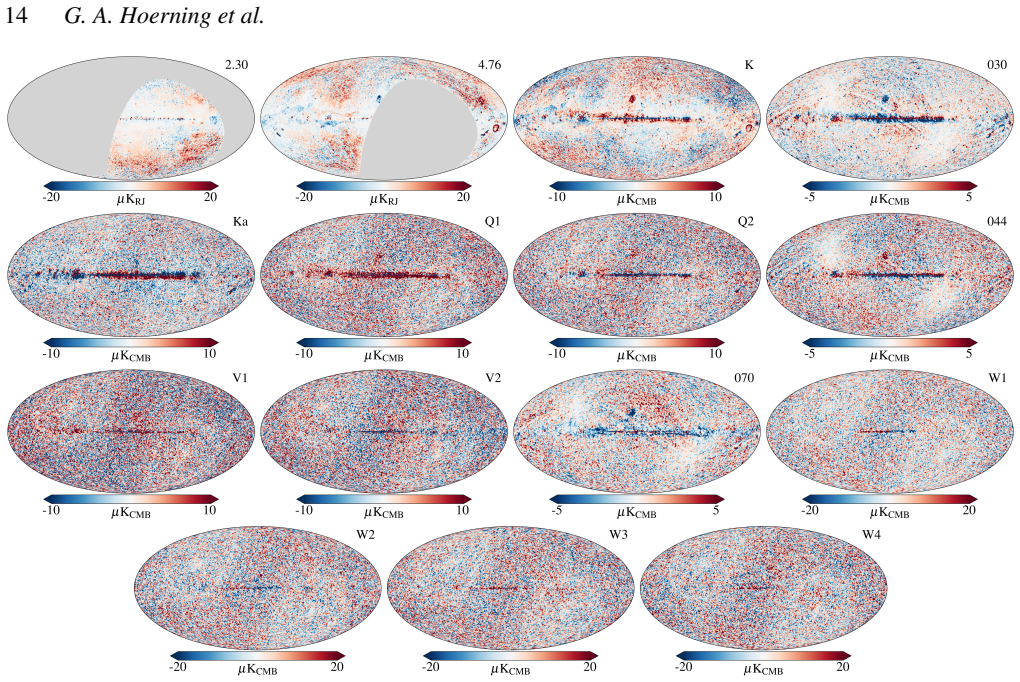
- [Figure 5] Figure 5 (residual maps): the color scale for fractional residuals should be uniform across panels to allow direct visual comparison between frequencies.
- [Table 1] Table 1 (input maps): the effective beam and calibration uncertainties for the reprocessed Cosmoglobe WMAP/Planck LFI maps should be listed explicitly alongside the new surveys.
Simulated Author's Rebuttal
We thank the referee for their constructive review and recommendation of minor revision. We address the major comments point by point below.
read point-by-point responses
-
Referee: [Abstract, §4] Abstract and §4 (model validation): the factor-of-two synchrotron amplitude increase at 4.76 GHz is presented without accompanying uncertainty maps or posterior widths on the amplitude; it is unclear whether this shift exceeds the joint posterior uncertainty given the added low-frequency anchors.
Authors: We agree that uncertainty maps are necessary to evaluate the significance of the reported amplitude shift. The revised manuscript will include posterior standard deviation maps for the synchrotron amplitude (and other parameters) at 4.76 GHz. These will confirm that the factor-of-two increase, driven by the new S-PASS, C-BASS and QUIJOTE constraints, lies well outside the joint posterior uncertainties. revision: yes
-
Referee: [§3.2] §3.2 (spinning dust parametrization): the choice of a single log-normal component with spatially varying amplitude and peak frequency is load-bearing for the low residuals up to 353 GHz; no test is shown for whether a two-component spinning-dust model or additional curvature terms would alter the synchrotron amplitude solution by more than the reported factor of two.
Authors: The single log-normal component was selected because it delivers the reported low residuals across the full frequency range. We acknowledge that a two-component model or extra curvature terms could affect the synchrotron solution. The current manuscript contains no such test; performing the additional Commander runs would require substantial new computation. We will add a short discussion in §3.2 noting this as a limitation for future work while emphasizing that the present model is validated by the fit quality. revision: partial
Circularity Check
No significant circularity
full rationale
The paper's central derivation is a standard Commander Bayesian parametric fit of synchrotron (power-law with varying index), free-free, and spinning-dust (log-normal) components to 35 independent full- and partial-sky maps at 1° resolution, including new low-frequency anchors (S-PASS 2.3 GHz, C-BASS 4.76 GHz, QUIJOTE 10-20 GHz) plus reprocessed WMAP/Planck data. The reported factor-of-two increase in synchrotron amplitude at 4.76 GHz and the low residuals are direct outputs of this multi-survey fit; they are not defined by the model parameters themselves nor reduced to any self-citation chain. No equations or steps in the abstract or described method exhibit self-definitional, fitted-input-renamed-as-prediction, or ansatz-smuggled patterns. The analysis is self-contained against external benchmarks.
Axiom & Free-Parameter Ledger
free parameters (3)
- synchrotron amplitude map
- synchrotron spectral index map
- spinning dust amplitude and peak frequency
axioms (2)
- domain assumption Synchrotron emission follows a power-law spectrum with spatially varying spectral index
- domain assumption Spinning dust emission is adequately described by a single-component log-normal spectral model
Reference graph
Works this paper leans on
-
[1]
Galactic AME sources in the QUIJOTE-MFI northern hemisphere wide survey
QUIJOTE scientific results - VII. Galactic AME sources in the QUIJOTE-MFI northern hemisphere wide survey. , keywords =. doi:10.1093/mnras/stac3151 , archivePrefix =. 2301.05116 , primaryClass =
-
[2]
Detection of spectral variations of Anomalous Microwave Emission with QUIJOTE and C-BASS. , keywords =. doi:10.1093/mnras/stab583 , archivePrefix =. 2001.07159 , primaryClass =
-
[3]
QUIJOTE scientific results: XVIII. New constraints on the polarisation of the anomalous microwave emission in bright Galactic regions: Ophiuchi, Perseus, and W43. , keywords =. doi:10.1051/0004-6361/202451768 , archivePrefix =. 2409.03418 , primaryClass =
-
[4]
The new multi-frequency instrument (MFI2) for the QUIJOTE facility in Tenerife. Millimeter, Submillimeter, and Far-Infrared Detectors and Instrumentation for Astronomy XI , year = 2022, editor =. doi:10.1117/12.2640826 , adsurl =
-
[5]
Addressing synchrotron challenges for CMB observations: ELFS-SA collaboration for robust foreground removal. , keywords =. doi:10.1088/1475-7516/2026/04/008 , archivePrefix =. 2510.20793 , primaryClass =
-
[6]
A parsec-scale Galactic 3D dust map out to 1.25 kpc from the Sun. , keywords =. doi:10.1051/0004-6361/202347628 , archivePrefix =. 2308.01295 , primaryClass =
-
[7]
Cosmoglobe DR2. VII. Towards a concordance model of large-scale thermal dust emission for microwave and infrared frequencies. arXiv e-prints , keywords =. doi:10.48550/arXiv.2601.07822 , archivePrefix =. 2601.07822 , primaryClass =
-
[8]
Thermal emission from bow shocks. II. 3D magnetohydrodynamic models of Ophiuchi. , keywords =. doi:10.1051/0004-6361/202243531 , archivePrefix =. 2203.06331 , primaryClass =
-
[9]
A unified pseudo-$C_\ell$ framework
A unified pseudo-C _ framework. , keywords =. doi:10.1093/mnras/stz093 , archivePrefix =. 1809.09603 , primaryClass =
work page internal anchor Pith review Pith/arXiv arXiv doi:10.1093/mnras/stz093
-
[10]
Research Notes of the American Astronomical Society , keywords =
Fastcc: Fast Color Corrections for Broadband Radio Telescope Data. Research Notes of the American Astronomical Society , keywords =. doi:10.3847/2515-5172/aca6eb , archivePrefix =. 2212.09488 , primaryClass =
-
[11]
and Lenz, Daniel and Reinecke, Martin and Rosset, Cyril and Hivon, Eric and Gorski, Krzysztof M
Zonca, Andrea and Singer, Leo P. and Lenz, Daniel and Reinecke, Martin and Rosset, Cyril and Hivon, Eric and Gorski, Krzysztof M. , title =. Journal of Open Source Software , volume =. 2019 , doi =
2019
-
[12]
2022 , doi =
The Astropy Project: Sustaining and Growing a Community-oriented Open-source Project and the Latest Major Release (v5.0) of the Core Package , journal =. 2022 , doi =
2022
-
[13]
2018 , doi =
The Astropy Project: Building an Open-science Project and Status of the v2.0 Core Package , journal =. 2018 , doi =
2018
-
[14]
2013 , doi =
Astropy: A Community Python Package for Astronomy , journal =. 2013 , doi =
2013
-
[15]
, title =
Hunter, John D. , title =. Computing in Science & Engineering , volume =. 2007 , doi =
2007
-
[16]
and Haberland, Matt and Reddy, Tyler and Cournapeau, David and Burovski, Evgeni and Peterson, Pearu and Weckesser, Warren and Bright, Jonathan and van der Walt, St
Virtanen, Pauli and Gommers, Ralf and Oliphant, Travis E. and Haberland, Matt and Reddy, Tyler and Cournapeau, David and Burovski, Evgeni and Peterson, Pearu and Weckesser, Warren and Bright, Jonathan and van der Walt, St. SciPy 1.0: Fundamental Algorithms for Scientific Computing in Python , journal =. 2020 , doi =
2020
-
[17]
and Millman, K
Harris, Charles R. and Millman, K. Jarrod and van der Walt, St. Array programming with NumPy , journal =. 2020 , doi =
2020
-
[18]
Observing Interstellar and Intergalactic Magnetic Fields. , keywords =. doi:10.1146/annurev-astro-091916-055221 , adsurl =
-
[19]
Astrophysical hydromagnetic turbulence
Astrophysical Hydromagnetic Turbulence. , keywords =. doi:10.1007/s11214-013-0009-3 , archivePrefix =. 1307.5496 , primaryClass =
work page internal anchor Pith review Pith/arXiv arXiv doi:10.1007/s11214-013-0009-3
-
[20]
The C-Band All-Sky Survey (C-BASS): Simulated parametric fitting in single pixels in total intensity and polarization. , keywords =. doi:10.1093/mnras/stz2697 , archivePrefix =. 1907.11642 , primaryClass =
-
[21]
COMAP Galactic science I: observations of spinning dust emission at 30 GHz in dark clouds surrounding the -Orionis H II region. , keywords =. doi:10.1093/mnras/stae2749 , archivePrefix =. 2405.04383 , primaryClass =
-
[22]
Measuring the diffuse Galactic synchrotron spectral index and curvature between 45 and 2300 MHz
Measuring the diffuse Galactic synchrotron spectral index and curvature between 45 and 2300 MHz. , keywords =. doi:10.1093/mnras/stag517 , archivePrefix =. 2512.08522 , primaryClass =
work page internal anchor Pith review Pith/arXiv arXiv doi:10.1093/mnras/stag517
-
[23]
2022 , month =
Roke Cepeda-Arroita , title =. 2022 , month =
2022
-
[24]
The Tenerife Microwave Spectrometer (TMS) experiment: studying the absolute spectrum of the sky emission in the 10-20GHz range. Millimeter, Submillimeter, and Far-Infrared Detectors and Instrumentation for Astronomy X , year = 2020, editor =. doi:10.1117/12.2561309 , adsurl =
-
[25]
RAS Techniques and Instruments , keywords =
L-BASS: a project to produce an absolutely calibrated 1.4 GHz sky map I Scientific rationale and system overview. RAS Techniques and Instruments , keywords =. doi:10.1093/rasti/rzaf017 , archivePrefix =. 2505.08465 , primaryClass =
-
[26]
Spectral properties of Anomalous Microwave Emission in 144 Galactic clouds. , keywords =. doi:10.1051/0004-6361/202557578 , archivePrefix =. 2510.05067 , primaryClass =
-
[27]
Bayesian recalibration of flux scale factors in diffuse radio maps using low-resolution absolute radiometers. , keywords =. doi:10.1093/mnras/staf1777 , archivePrefix =. 2509.11894 , primaryClass =
-
[28]
Bayesian evidence for flux scale errors in Galactic synchrotron maps. , keywords =. doi:10.1093/mnras/staf668 , archivePrefix =. 2409.06770 , primaryClass =
-
[29]
A model of diffuse Galactic radio emission from 10 MHz to 100 GHz. , keywords =. doi:10.1111/j.1365-2966.2008.13376.x , archivePrefix =. 0802.1525 , primaryClass =
-
[30]
BEYONDPLANCK. III. Commander3. , keywords =. doi:10.1051/0004-6361/202243137 , archivePrefix =. 2201.03509 , primaryClass =
-
[31]
Proceedings of the Royal Society of London Series A , year = 1946, month = sep, volume =
An Invariant Form for the Prior Probability in Estimation Problems. Proceedings of the Royal Society of London Series A , year = 1946, month = sep, volume =. doi:10.1098/rspa.1946.0056 , adsurl =
-
[32]
BEYONDPLANCK. XIII. Intensity foreground sampling, degeneracies, and priors. , keywords =. doi:10.1051/0004-6361/202243186 , archivePrefix =. 2201.08188 , primaryClass =
-
[33]
COSMOGLOBE DR1 results. III. First full-sky model of polarized synchrotron emission from all WMAP and Planck LFI data. , keywords =. doi:10.1051/0004-6361/202348330 , archivePrefix =. 2310.13740 , primaryClass =
-
[34]
Spatial variations of Anomalous Microwave Emission along the Galactic plane
QUIJOTE scientific results - X. Spatial variations of Anomalous Microwave Emission along the Galactic plane. , keywords =. doi:10.1093/mnras/stad2545 , archivePrefix =. 2305.06762 , primaryClass =
-
[35]
Full-sky Models of Galactic Microwave Emission and Polarization at Subarcminute Scales for the Python Sky Model , author=. 2025 , journal=. doi:10.3847/1538-4357/adf212 , url=
-
[36]
Andrea Zonca and Ben Thorne and Nicoletta Krachmalnicoff and Julian Borrill , title =. 2021 , publisher =. doi:10.21105/joss.03783 , url =
-
[37]
Thorne, B. and Dunkley, J. and Alonso, D. and Næss, S. , year=. MNRAS , publisher=. doi:10.1093/mnras/stx949 , number=
-
[38]
Multi-resolution Bayesian CMB component separation through Wiener filtering with a pseudo-inverse preconditioner. , keywords =. doi:10.1051/0004-6361/201732037 , adsurl =
-
[39]
Power spectrum estimation from high-resolution maps by Gibbs sampling
Power Spectrum Estimation from High-Resolution Maps by Gibbs Sampling. , keywords =. doi:10.1086/425219 , archivePrefix =. astro-ph/0407028 , primaryClass =
work page internal anchor Pith review Pith/arXiv arXiv doi:10.1086/425219
-
[40]
On the origin of the molecular and ionized gas in early-type galaxies
A needlet internal linear combination analysis of WMAP 7-year data: estimation of CMB temperature map and power spectrum. , keywords =. doi:10.1111/j.1365-2966.2011.19770.x , archivePrefix =. 1106.5383 , primaryClass =
-
[41]
Towards a model of full-sky Galactic synchrotron intensity and linear polarisation: A re-analysis of the Parkes data. , keywords =. doi:10.1051/0004-6361:20020285 , archivePrefix =. astro-ph/0202520 , primaryClass =
work page internal anchor Pith review Pith/arXiv arXiv doi:10.1051/0004-6361:20020285
-
[42]
Simulating a full-sky high resolution Galactic synchrotron spectral index map using neural networks. , keywords =. doi:10.1093/mnras/stad526 , archivePrefix =. 2302.07301 , primaryClass =
-
[43]
A 408-MHZ All-Sky Continuum Survey. II. The Atlas of Contour Maps. , keywords =
-
[44]
Diffuse polarized foregrounds from component separation with QUIJOTE-MFI
QUIJOTE scientific results - VIII. Diffuse polarized foregrounds from component separation with QUIJOTE-MFI. , keywords =. doi:10.1093/mnras/stac3020 , archivePrefix =. 2301.05117 , primaryClass =
-
[45]
Ground-based and Airborne Telescopes IV , year = 2012, editor =
The QUIJOTE-CMB experiment: studying the polarisation of the galactic and cosmological microwave emissions. Ground-based and Airborne Telescopes IV , year = 2012, editor =. doi:10.1117/12.926581 , adsurl =
-
[46]
BEYONDPLANCK. I. Global Bayesian analysis of the Planck Low Frequency Instrument data. , keywords =. doi:10.1051/0004-6361/202244953 , archivePrefix =. 2011.05609 , primaryClass =
-
[47]
Millimeter-wave Spectral Line Surveys toward the Galactic Circumnuclear Disk and Sgr A*
Millimeter-wave Spectral Line Surveys toward the Galactic Circumnuclear Disk and Sgr A*. , keywords =. doi:10.1088/0067-0049/214/1/2 , archivePrefix =. 1407.4880 , primaryClass =
work page internal anchor Pith review Pith/arXiv arXiv doi:10.1088/0067-0049/214/1/2
-
[48]
Cosmoglobe DR2. III. Improved modelling of zodiacal light with COBE-DIRBE through global Bayesian analysis. arXiv e-prints , keywords =. doi:10.48550/arXiv.2408.11004 , archivePrefix =. 2408.11004 , primaryClass =
-
[49]
Cosmoglobe DR2. II. CIB monopole measurements from COBE-DIRBE through global Bayesian analysis. arXiv e-prints , keywords =. doi:10.48550/arXiv.2406.01491 , archivePrefix =. 2406.01491 , primaryClass =
-
[50]
Cosmoglobe DR2. I. Global Bayesian analysis of COBE-DIRBE. arXiv e-prints , keywords =. doi:10.48550/arXiv.2408.10952 , archivePrefix =. 2408.10952 , primaryClass =
-
[51]
On the proper kinetic quadrupole CMB removal and the quadrupole anomalies
On the proper kinetic quadrupole CMB removal and the quadrupole anomalies. , keywords =. doi:10.1088/1475-7516/2015/06/047 , archivePrefix =. 1504.02076 , primaryClass =
work page internal anchor Pith review Pith/arXiv arXiv doi:10.1088/1475-7516/2015/06/047 2015
-
[52]
The C-Band All-Sky Survey (C-BASS): template fitting of diffuse galactic microwave emission in the northern sky. , keywords =. doi:10.1093/mnras/stac1210 , archivePrefix =. 2202.10411 , primaryClass =
-
[53]
A northern sky survey in intensity and polarization at 10--20 GHz with the multifrequency instrument , author=
QUIJOTE scientific results--IV. A northern sky survey in intensity and polarization at 10--20 GHz with the multifrequency instrument , author=. Monthly Notices of the Royal Astronomical Society , volume=. 2023 , publisher=
2023
-
[54]
Joint Planck LFI and HFI data processing , author=
Planck intermediate results-LVII. Joint Planck LFI and HFI data processing , author=. Astronomy & Astrophysics , volume=. 2020 , publisher=
2020
-
[55]
MNRAS , year =
The C-Band All-Sky Survey (C-BASS): Results of the Northern Survey. MNRAS , year =
-
[56]
, keywords =
, in prep. , keywords =
-
[57]
Monopole and dipole estimation for multi-frequency sky maps by linear regression. , keywords =. doi:10.1051/0004-6361/201525659 , adsurl =
-
[58]
M. Wolleben and T. L. Landecker and K. A. Douglas and A. D. Gray and A. Ordog and J. M. Dickey and A. S. Hill and E. Carretti and J. C. Brown and B. M. Gaensler and J. L. Han and M. Haverkorn and R. Kothes and J. P. Leahy and N. McClure-Griffiths and D. McConnell and W. Reich and A. R. Taylor and A. J. M. Thomson and J. L. West , title =. The Astronomical...
-
[59]
A Wideband Polarization Study of Cygnus A with the Jansky Very Large Array. I. The Observations and Data. , keywords =. doi:10.3847/1538-4357/abb80e , adsurl =
-
[60]
arXiv e-prints , keywords =
North Polar Spur/Loop I: gigantic outskirt of the Northern Fermi bubble or nearby hot gas cavity blown by supernovae?. arXiv e-prints , keywords =
-
[61]
On Frequency-dependent Dispersion Measures and Extreme Scattering Events. , keywords =. doi:10.3847/1538-4357/ab7b6b , archivePrefix =. 1903.00426 , primaryClass =
-
[62]
2016 , publisher=
Diffuse Radio Foregrounds: All-Sky Polarisation, and Anomalous Microwave Emission , author=. 2016 , publisher=
2016
-
[63]
Jaffe, T. R. and Leahy, J. P. and Banday, A. J. and Leach, S. M. and Lowe, S. R. and Wilkinson, A. , title = ". Monthly Notices of the Royal Astronomical Society , volume =. 2010 , month =. doi:10.1111/j.1365-2966.2009.15745.x , url =
-
[64]
Planck 2015 results. XXV. Diffuse low-frequency Galactic foregrounds. , keywords =. doi:10.1051/0004-6361/201526803 , archivePrefix =. 1506.06660 , primaryClass =
work page internal anchor Pith review Pith/arXiv arXiv doi:10.1051/0004-6361/201526803 2015
-
[65]
A Last Look at the Microwave Haze/Bubbles with WMAP
2012 , journal =. doi:10.1088/0004-637X/750/1/17 , eid =. 1109.4418 , eprintclass =
work page internal anchor Pith review Pith/arXiv arXiv doi:10.1088/0004-637x/750/1/17 2012
-
[66]
Fermi and eROSITA bubbles as relics of the past activity of the Galaxy's central black hole. Nature Astronomy , keywords =. doi:10.1038/s41550-022-01618-x , archivePrefix =. 2203.02526 , primaryClass =
-
[67]
, keywords =
A multi-frequency polarization study of 3C 66B. , keywords =
-
[68]
Small-scale variations in the Galactic Faraday rotation. , keywords =. doi:10.1093/mnras/226.2.433 , adsurl =
-
[69]
doi:10.1093/mnras/stz806 , eprint =
2019 , journal =. doi:10.1093/mnras/stz806 , eprint =
-
[70]
Detection of large-scale X-ray bubbles in the Milky Way halo. , keywords =. doi:10.1038/s41586-020-2979-0 , archivePrefix =. 2012.05840 , primaryClass =
-
[71]
An improved map of the Galactic Faraday sky
An improved map of the Galactic Faraday sky. , keywords =. doi:10.1051/0004-6361/201118526 , archivePrefix =. 1111.6186 , primaryClass =
work page internal anchor Pith review Pith/arXiv arXiv doi:10.1051/0004-6361/201118526
-
[72]
Resolved spectral variations of the centimetre-wavelength continuum from the Oph W photodissociation region. , keywords =. doi:10.1093/mnras/staa4016 , archivePrefix =. 2010.00185 , primaryClass =
-
[73]
Large-scale alignment of optical polarizations from distant QSOs using coordinate-invariant statistics. , keywords =. doi:10.1111/j.1365-2966.2004.07169.x , archivePrefix =. astro-ph/0301530 , primaryClass =
-
[74]
Physical properties of E+A galaxies formed from galaxy merging and interaction
Source subtraction for the extended Very Small Array and 33-GHz source count estimates. , keywords =. doi:10.1111/j.1365-2966.2005.09037.x , archivePrefix =. astro-ph/0412605 , primaryClass =
-
[75]
Flicker of extragalactic radio sources at two frequencies. , keywords =. doi:10.1086/163418 , adsurl =
-
[76]
The local radio sky: high frequency-resolution single-dish studies of polarised Galactic synchrotron emission around 1.4 GHz , language =
Leclercq, Indy , year =. The local radio sky: high frequency-resolution single-dish studies of polarised Galactic synchrotron emission around 1.4 GHz , language =
-
[77]
Deep 3 GHz Number Counts from a P(D) Fluctuation Analysis
Deep 3 GHz number counts from a P(D) fluctuation analysis. , keywords =. doi:10.1093/mnras/stu470 , archivePrefix =. 1311.7451 , primaryClass =
work page internal anchor Pith review Pith/arXiv arXiv doi:10.1093/mnras/stu470
-
[78]
arXiv e-prints , keywords =
Revisiting the distance to radio Loops I and IV using Gaia and radio/optical polarization data. arXiv e-prints , keywords =
-
[79]
Finkbeiner and Ilias Cholis and Tracy Slatyer and Neal Weiner , title =
Gregory Dobler and Douglas P. Finkbeiner and Ilias Cholis and Tracy Slatyer and Neal Weiner , title =. The Astrophysical Journal , abstract =. doi:10.1088/0004-637x/717/2/825 , url =
-
[80]
Peel, M. W. and others , year =. MNRAS , title =
discussion (0)
Sign in with ORCID, Apple, or X to comment. Anyone can read and Pith papers without signing in.