Adaptive conduction delays and phase locking in spiking Haken Lighthouse networks
Pith reviewed 2026-06-26 12:38 UTC · model grok-4.3
The pith
Activity-dependent myelination selects commensurate delay-period relationships to organize phase locking in spiking networks.
A machine-rendered reading of the paper's core claim, the machinery that carries it, and where it could break.
Core claim
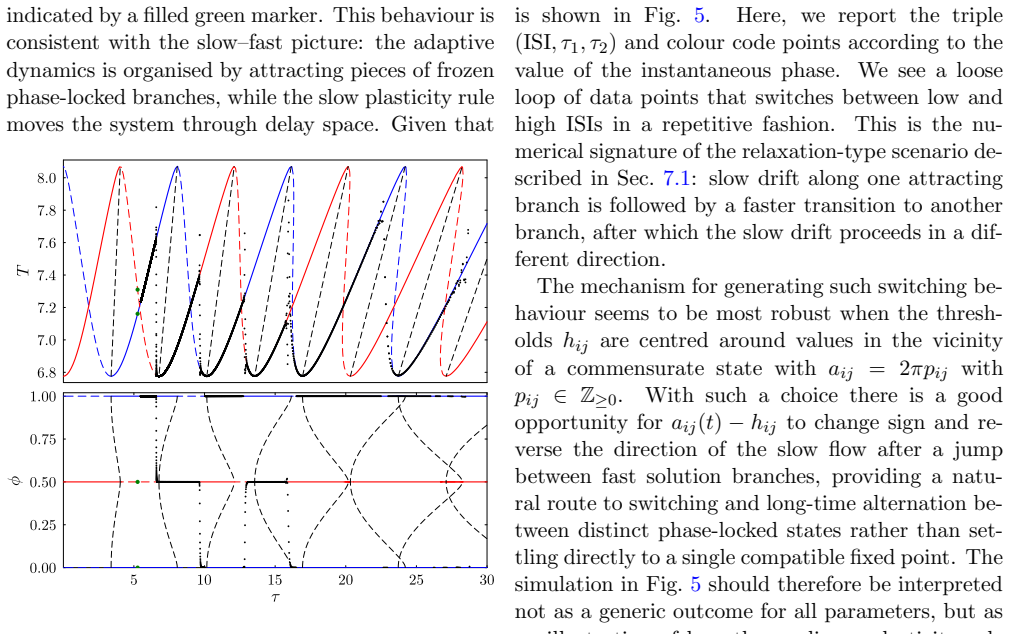
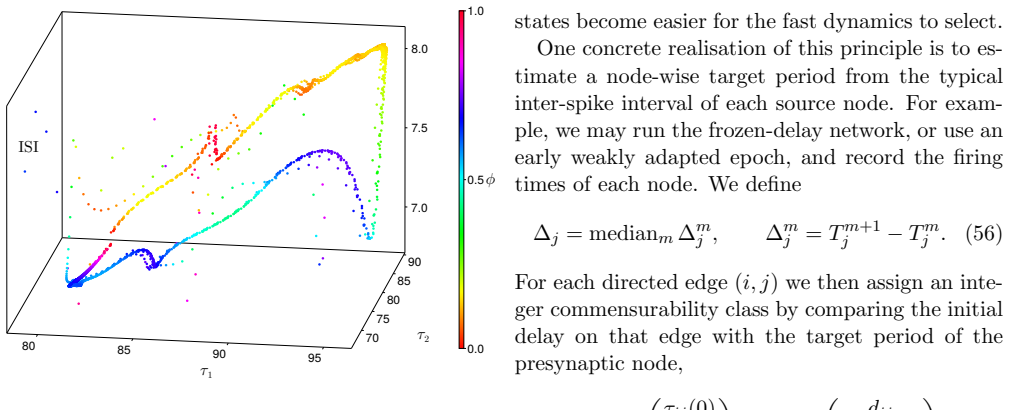
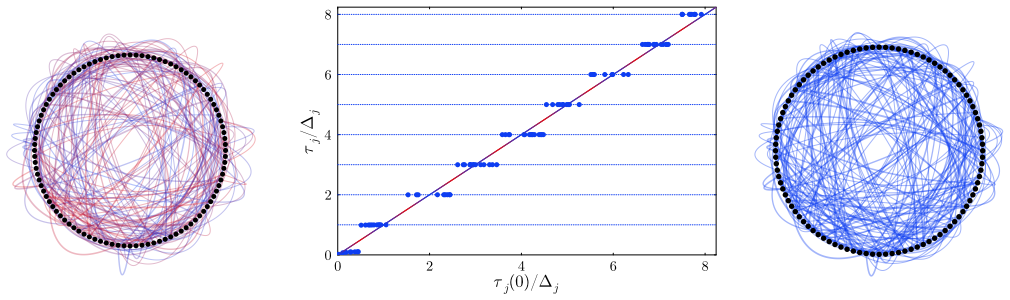
The activity-dependent white matter plasticity rule, in which myelination modulates axonal conduction speed, leads to a slow-fast system with state-dependent delays. Frozen phase-locked branches of the fast subsystem organize the adaptive dynamics, and the rule selects commensurate delay-period relationships.
What carries the argument
The activity-dependent plasticity rule for axonal conduction delays that creates a slow-fast dynamical system organized by phase-locked states.
If this is right
- The emergence of synchrony and other frequency-locked states.
- Slow switching between competing phase-locked patterns.
- The organisation of heterogeneous delays into discrete delay-period classes.
- Reshaping of the attractor structure of delayed spiking networks.
- Generation of long-timescale transitions in network activity.
Where Pith is reading between the lines
- This mechanism could underlie how neural systems achieve temporal coordination through activity-dependent changes in white matter.
- The framework may extend to explaining observed slow switching in brain dynamics.
- It suggests that myelin plasticity acts as a regulator of communication through coherence.
Load-bearing premise
The plasticity rule produces a slow-fast system with state-dependent delays whose attractors are organized by the frozen phase-locked branches of the fast subsystem.
What would settle it
A simulation of the adaptive network that fails to show selection of commensurate delay-period relationships or the predicted phase-locked attractors would falsify the central claim.
Figures
read the original abstract
We develop a theory of phase-locked activity in delayed spiking networks using the Haken Lighthouse model as an analytically tractable event-based description of neural dynamics. For networks with fixed delays, we derive self-consistency conditions for phase-locked states and an associated linear stability theory formulated directly in terms of spike-time perturbations. The framework is illustrated for a delayed autapse, a reciprocally coupled two-cell network, and spatially structured rings with distance-dependent coupling and conduction delays, where circulant symmetry allows stability to be decomposed into Fourier modes. We then introduce an activity-dependent white matter plasticity rule in which myelination modulates axonal conduction speed and hence communication delay. This leads naturally to a slow--fast system with state-dependent delays, in which frozen phase-locked branches organise the adaptive dynamics. The plasticity rule selects commensurate delay--period relationships, providing a mechanism for the emergence of synchrony, other frequency-locked states, slow switching between competing phase-locked patterns, and the organisation of heterogeneous delays into discrete delay--period classes. Direct simulations of the event-driven network support the analytical predictions and illustrate how adaptive conduction can reshape the attractor structure of a delayed spiking network and generate long-timescale transitions. These results provide a tractable mathematical framework for studying how activity-dependent myelination may regulate temporal coordination, synchrony, and communication through coherence in spiking neural systems.
Editorial analysis
A structured set of objections, weighed in public.
Referee Report
Summary. The paper develops a theory of phase-locked activity in delayed spiking networks using the Haken Lighthouse model. For fixed delays it derives self-consistency conditions and linear stability in spike-time perturbations, illustrated on autapses, two-cell networks, and circulant rings via Fourier-mode decomposition. It then introduces an activity-dependent white matter plasticity rule that modulates conduction delays, producing a slow-fast system whose attractors are claimed to be organized by the frozen phase-locked branches of the fixed-delay subsystem. This rule is asserted to select commensurate delay-period relationships, enabling synchrony, frequency locking, slow switching, and discrete delay classes; direct event-driven simulations are stated to support the predictions.
Significance. If the central claim holds, the work supplies a tractable mechanism linking activity-dependent myelination to the emergence and switching of phase-locked states in spiking networks, with potential relevance to communication-through-coherence hypotheses. The fixed-delay analysis, particularly the circulant symmetry reduction to Fourier modes, is analytically clean and yields falsifiable predictions. The simulations are presented as direct support, though quantitative agreement metrics are not detailed in the abstract.
major comments (2)
- [Abstract; section introducing the adaptive rule] Abstract and the section introducing the adaptive rule: the claim that the plasticity rule produces a slow-fast system whose long-term attractors are organized by the frozen phase-locked branches rests on the unshown extension of the event-based map and spike-time perturbation equations to state-dependent delays. The fixed-delay self-consistency conditions and linear stability are derived first, but no re-derivation or continuity argument for time-varying delays is supplied; this extension is load-bearing for the headline result on commensurate delay-period selection and branch organization.
- [Simulations section] Simulations section: the statement that 'direct simulations of the event-driven network support the analytical predictions' lacks quantitative error measures (e.g., deviation of realized delay-period ratios from the predicted commensurate values or comparison of observed switching times to the slow timescale). Without these, it is unclear whether the state-dependent case actually follows the frozen branches or requires additional assumptions on timescale separation.
minor comments (2)
- [Section introducing the adaptive rule] Notation for the plasticity rule (myelination modulating conduction speed) should be introduced with an explicit equation number when first stated, to allow direct reference in the stability discussion.
- [Abstract] The abstract lists 'slow switching between competing phase-locked patterns' as a consequence but does not indicate which network topologies (autapse, two-cell, or rings) exhibit this behavior in the simulations.
Simulated Author's Rebuttal
We thank the referee for the careful reading and for identifying two points where the manuscript would benefit from greater explicitness. We address each major comment below and will revise the manuscript to strengthen the presentation of the state-dependent case and the simulation validation.
read point-by-point responses
-
Referee: Abstract and the section introducing the adaptive rule: the claim that the plasticity rule produces a slow-fast system whose long-term attractors are organized by the frozen phase-locked branches rests on the unshown extension of the event-based map and spike-time perturbation equations to state-dependent delays. The fixed-delay self-consistency conditions and linear stability are derived first, but no re-derivation or continuity argument for time-varying delays is supplied; this extension is load-bearing for the headline result on commensurate delay-period selection and branch organization.
Authors: We agree that an explicit continuity argument or brief re-derivation for slowly varying delays is needed to make the organization of attractors by the frozen branches fully rigorous. Because the plasticity rule evolves on a timescale much slower than the spiking dynamics, the instantaneous event map at any fixed time is identical to the fixed-delay map evaluated at the current delay value; the linear stability analysis then carries over directly to the quasi-static case. We will add a short subsection (or appendix) that states this continuity explicitly and shows how the spike-time perturbation equations remain valid under adiabatic variation of the delays. This will be incorporated in the revised manuscript. revision: yes
-
Referee: Simulations section: the statement that 'direct simulations of the event-driven network support the analytical predictions' lacks quantitative error measures (e.g., deviation of realized delay-period ratios from the predicted commensurate values or comparison of observed switching times to the slow timescale). Without these, it is unclear whether the state-dependent case actually follows the frozen branches or requires additional assumptions on timescale separation.
Authors: We accept that quantitative agreement metrics would make the support for the analytical predictions more convincing. In the revised version we will report (i) the mean and standard deviation of the realized delay-to-period ratios relative to the nearest commensurate values predicted by the fixed-delay theory, and (ii) the ratio of observed switching times to the slow plasticity timescale, together with a brief discussion of how close the separation remains throughout the trajectories. These additions will be placed in the simulations section and its figure captions. revision: yes
Circularity Check
No circularity; fixed-delay derivations and plasticity rule are independent modeling steps
full rationale
The paper first derives self-consistency conditions and spike-time linear stability directly from the Haken Lighthouse event-based equations for fixed delays (autapse, two-cell, circulant rings). The activity-dependent myelination rule is then introduced as an independent modeling choice that induces a slow-fast system with state-dependent delays, with the claim that frozen phase-locked branches organize the attractors. No equation reduces a prediction to a fitted input by construction, no self-citation is load-bearing for the central result, and no ansatz or uniqueness theorem is smuggled in. The derivation chain remains self-contained against the model equations and the stated plasticity rule.
Axiom & Free-Parameter Ledger
axioms (2)
- domain assumption Self-consistency conditions for phase-locked states can be written directly from the event-based delay equations
- standard math Linear stability analysis can be performed via small perturbations of spike times
invented entities (1)
-
Activity-dependent white matter plasticity rule
no independent evidence
Reference graph
Works this paper leans on
-
[1]
Nonsmooth dynamics in spiking neuron mod- els.Physica D, 241:2042–2057, 2012
S Coombes, R Thul, and K C A Wedgwood. Nonsmooth dynamics in spiking neuron mod- els.Physica D, 241:2042–2057, 2012
2042
-
[2]
Springer-Verlag, Berlin, Heidelberg, 2002
H Haken.Brain Dynamics: Synchronization and Activity Patterns in Pulse-coupled Neural Nets with Delays and Noise. Springer-Verlag, Berlin, Heidelberg, 2002
2002
-
[3]
Revisiting the Haken Lighthouse Model.The European Physical Journal Special Topics : In Memoriam Hermann Haken: Syn- ergetics and Self-organisation in Complex Sys- tems, 2025
S Coombes. Revisiting the Haken Lighthouse Model.The European Physical Journal Special Topics : In Memoriam Hermann Haken: Syn- ergetics and Self-organisation in Complex Sys- tems, 2025. URLhttps://doi.org/10.1140/ epjs/s11734-025-01841-3
2025
-
[4]
Time delays in neural systems
S A Campbell. Time delays in neural systems. Handbook of brain connectivity, pages 65–90, 2007
2007
-
[5]
Understanding the effect of white matter delays on large scale brain synchrony.Communications in Nonlinear Science and Numerical Simulation, 131:107803, 2024
M S ¸ayli and S Coombes. Understanding the effect of white matter delays on large scale brain synchrony.Communications in Nonlinear Science and Numerical Simulation, 131:107803, 2024
2024
-
[6]
Can neuromorphic computing help reduce AI’s high energy cost?Proceedings of the National Academy of Sciences USA, 122: e2528654122, 2025
S Ornes. Can neuromorphic computing help reduce AI’s high energy cost?Proceedings of the National Academy of Sciences USA, 122: e2528654122, 2025
2025
-
[7]
Editorial: Theoretical advances and practical applications of spiking neural networks.Frontiers in Neu- roscience, 18:1406502, 2024
G Di Caterina, M Zhang, and J Liu. Editorial: Theoretical advances and practical applications of spiking neural networks.Frontiers in Neu- roscience, 18:1406502, 2024
2024
-
[8]
Boosting reser- voir computer performance with multiple de- lays.Physical Review E, 109:054203, 2024
S K Tavakoli and A Longtin. Boosting reser- voir computer performance with multiple de- lays.Physical Review E, 109:054203, 2024
2024
-
[9]
Neuronal activity pro- motes oligodendrogenesis and adaptive myeli- nation in the mammalian brain.Science, 344: 1252304, 2014
E M Gibson, D Purger, C W Mount, A K Gold- stein, G L Lin, L S Wood, I Inema, S E Miller, G Bieri, J B Zuchero, B A Barres, P J Woo, H Vogel, and M Monje. Neuronal activity pro- motes oligodendrogenesis and adaptive myeli- nation in the mammalian brain.Science, 344: 1252304, 2014
2014
-
[10]
Wrapped to adapt: experience-dependent myelination.Neuron, 95: 743–756, 2017
C W Mount and M Monje. Wrapped to adapt: experience-dependent myelination.Neuron, 95: 743–756, 2017
2017
-
[11]
Myelin plasticity: sculpt- ing circuits in learning and memory.Nature Reviews Neuroscience, 21:682–694, 2020
W Xin and J R Chan. Myelin plasticity: sculpt- ing circuits in learning and memory.Nature Reviews Neuroscience, 21:682–694, 2020
2020
-
[12]
Role of myelin plasticity in oscillations and synchrony 21 of neuronal activity.Neuroscience, 276:135– 147, 2014
S Pajevic, P J Basser, and R D Fields. Role of myelin plasticity in oscillations and synchrony 21 of neuronal activity.Neuroscience, 276:135– 147, 2014
2014
-
[13]
Synchronization and resilience in the Kuramoto white matter network model with adaptive state-dependent delays.The Journal of Mathematical Neuro- science, 10(1):16, 2020
S H Park and J Lefebvre. Synchronization and resilience in the Kuramoto white matter network model with adaptive state-dependent delays.The Journal of Mathematical Neuro- science, 10(1):16, 2020
2020
-
[14]
Homeostatic coordination and up-regulation of neural activity by activity- dependent myelination.Nature Computational Science, 2:665–676, 2022
A Talidou, P W Frankland, D Mabbott, and J Lefebvre. Homeostatic coordination and up-regulation of neural activity by activity- dependent myelination.Nature Computational Science, 2:665–676, 2022
2022
-
[15]
Adaptive myelination causes slow oscillations in recur- rent neural loops.Chaos: An Interdisciplinary Journal of Nonlinear Science, 34:033101, 2024
V V Klinshov and V I Nekorkin. Adaptive myelination causes slow oscillations in recur- rent neural loops.Chaos: An Interdisciplinary Journal of Nonlinear Science, 34:033101, 2024
2024
-
[16]
Myelin-induced gain control in nonlin- ear neural networks.Communications Physics, 8(1):145, 2025
J Lefebvre, A Clappison, A Longtin, and A Hutt. Myelin-induced gain control in nonlin- ear neural networks.Communications Physics, 8(1):145, 2025
2025
-
[17]
Oligodendrocyte-mediated myelin plas- ticity and its role in neural synchronization
S Pajevic, D Plenz, P J Basser, and R D Fields. Oligodendrocyte-mediated myelin plas- ticity and its role in neural synchronization. eLife, 12:e81982, 2023
2023
-
[18]
Network attrac- tors driven by time-delay plasticity.Submitted,
S Ruschel, E Hristov, H G E Meijer, S Coombes, and R Nicks. Network attrac- tors driven by time-delay plasticity.Submitted,
-
[19]
doi: 10.48550/arXiv.2605.23520
work page internal anchor Pith review Pith/arXiv arXiv doi:10.48550/arxiv.2605.23520
-
[20]
Phase oscillator networks with multiple and state-dependent delays: A frame- work for exploring white matter plasticity in neurodynamics.Chaos, In prep, 2026
G Jolly, R Nicks, S Ruschel, G Iskenderoglu, and S Coombes. Phase oscillator networks with multiple and state-dependent delays: A frame- work for exploring white matter plasticity in neurodynamics.Chaos, In prep, 2026
2026
-
[21]
A mechanism for cognitive dynamics: neuronal communication through neuronal co- herence.Trends in Cognitive Sciences, 9:474– 480, 2005
P Fries. A mechanism for cognitive dynamics: neuronal communication through neuronal co- herence.Trends in Cognitive Sciences, 9:474– 480, 2005
2005
-
[22]
Communication through coherence (CTC 2.0).Neuron, 88:220–235, 2015
P Fries. Communication through coherence (CTC 2.0).Neuron, 88:220–235, 2015
2015
-
[23]
Multistability and delayed recurrent loops
J Foss, A Longtin, B Mensour, and J Mil- ton. Multistability and delayed recurrent loops. Physical Review Letters, 76:708–711, 1996
1996
-
[24]
Multistable jittering in oscillators with pulsatile delayed feedback
V Klinshov, L L¨ ucken, D Shchapin, V Neko- rkin, and S Yanchuk. Multistable jittering in oscillators with pulsatile delayed feedback. Physical Review Letters, 114:178103, 2015
2015
-
[25]
Neural synchrony in cortical net- works: mechanisms and implications for neural information processing and coding.Frontiers in Integrative Neuroscience, 16:900715, 2022
K S Gansel. Neural synchrony in cortical net- works: mechanisms and implications for neural information processing and coding.Frontiers in Integrative Neuroscience, 16:900715, 2022
2022
-
[26]
R Noori, D Park, J D Griffiths, S Bells, P W Frankland, D Mabbott, and J Lefebvre. Activity-dependent myelination: A glial mech- anism of oscillatory self-organization in large- scale brain networks.Proceedings of the Na- tional Academy of Sciences USA, 117:13227– 13237, 2020
2020
-
[27]
White matter in learning, cognition and psychiatric disorders.Trends in Neurosciences, 31:361–370, 2008
R Douglas Fields. White matter in learning, cognition and psychiatric disorders.Trends in Neurosciences, 31:361–370, 2008
2008
-
[28]
The role of sleep and wakefulness in myelin plasticity.Glia, 67: 2142–2152, 2019
L de Vivo and M Bellesi. The role of sleep and wakefulness in myelin plasticity.Glia, 67: 2142–2152, 2019
2019
-
[29]
Rapid and widespread white matter plasticity during an intensive reading interven- tion.Nature Communications, 9:2260, 2018
E Huber, P M Donnelly, A Rokem, and J D Yeatman. Rapid and widespread white matter plasticity during an intensive reading interven- tion.Nature Communications, 9:2260, 2018
2018
-
[30]
Learning to be on time: tempo- ral coordination of neural dynamics by activity- dependent myelination.bioRxiv, 2021
A Talidou, P W Frankland, D Mabbott, and J Lefebvre. Learning to be on time: tempo- ral coordination of neural dynamics by activity- dependent myelination.bioRxiv, 2021
2021
-
[31]
Effects of synaptic and myelin plasticity on learning in a network of Kuramoto phase os- cillators.Chaos, 29:083122, 2019
M Karimian, D Dibenedetto, M Moerel, T Bur- wick, R L Westra, P De Weerd, and M Senden. Effects of synaptic and myelin plasticity on learning in a network of Kuramoto phase os- cillators.Chaos, 29:083122, 2019
2019
-
[32]
Geometric singular pertur- bation theory
C K R T Jones. Geometric singular pertur- bation theory. In R Johnson, editor,Dynam- ical Systems, volume 1609 ofLecture Notes in Mathematics, pages 44–118. Springer, Berlin, Heidelberg, 1995
1995
-
[33]
Synchrony measures for biological neural networks.Biological Cy- bernetics, 73:129–137, 1995
P F Pinsky and J Rinzel. Synchrony measures for biological neural networks.Biological Cy- bernetics, 73:129–137, 1995. 22
1995
-
[34]
A new mechanism of nervous system plasticity: Activity-dependent myelina- tion.Nature Reviews Neuroscience, 16:756– 767, 2015
R D Fields. A new mechanism of nervous system plasticity: Activity-dependent myelina- tion.Nature Reviews Neuroscience, 16:756– 767, 2015
2015
-
[35]
Neuronal coherence as a mechanism of effective corticospinal interaction.Science, 308:111–113, 2005
J-M Schoffelen, R Oostenveld, and P Fries. Neuronal coherence as a mechanism of effective corticospinal interaction.Science, 308:111–113, 2005
2005
-
[36]
M Salami, C Itami, T Tsumoto, and F Kimura. Change of conduction velocity by regional myelination yields constant latency irrespective of distance between thalamus and cortex.Pro- ceedings of the National Academy of Sciences USA, 100:6174–6179, 2003
2003
-
[37]
Slow switching in globally coupled oscillators: robustness and oc- currence through delayed coupling.Physical Review E, 63:046214, 2001
H Kori and Y Kuramoto. Slow switching in globally coupled oscillators: robustness and oc- currence through delayed coupling.Physical Review E, 63:046214, 2001
2001
-
[38]
Network attractors and nonlinear dynamics of neural computation.Current Opinion in Neu- robiology, 84:102818, 2024
P Ashwin, M Fadera, and C Postlethwaite. Network attractors and nonlinear dynamics of neural computation.Current Opinion in Neu- robiology, 84:102818, 2024
2024
-
[39]
Life- long oligodendrocyte development and plastic- ity.Seminars in Cell & Developmental Biology, 116:25–37, 2021
A Nishiyama, R Suzuki, and X Zhu. Life- long oligodendrocyte development and plastic- ity.Seminars in Cell & Developmental Biology, 116:25–37, 2021
2021
-
[40]
The role of myelin and oligodendrocytes in axonal energy metabolism.Current Opinion in Neu- robiology, 23:1065–1072, 2013
A S Saab, I D Tzvetanova, and K A Nave. The role of myelin and oligodendrocytes in axonal energy metabolism.Current Opinion in Neu- robiology, 23:1065–1072, 2013
2013
-
[41]
Oligodendroglial energy metabolism and (re)myelination.Life, 11(3): 238, 2021
V Tepavˇ cevi´ c. Oligodendroglial energy metabolism and (re)myelination.Life, 11(3): 238, 2021
2021
-
[42]
Persistence and smoothness of in- variant manifolds for flows.Indiana University Mathematics Journal, 21:193–226, 1971
N Fenichel. Persistence and smoothness of in- variant manifolds for flows.Indiana University Mathematics Journal, 21:193–226, 1971
1971
-
[43]
Numerical bifurcation analysis of delay differ- ential equations.Journal of Computational and Applied Mathematics, 125:265275, 2000
K Engelborghs, T Luzyanina, and D Roose. Numerical bifurcation analysis of delay differ- ential equations.Journal of Computational and Applied Mathematics, 125:265275, 2000
2000
-
[44]
DDE-BIFTOOL Manual - Bifurcation analysis of delay differential equations
J Sieber, K Engelborghs, T Luzyanina, G Samaey, and D Roose. DDE-BIFTOOL manual: Bifurcation analysis of delay differen- tial equations.arXiv preprint arXiv:1406.7144, 2014
work page internal anchor Pith review Pith/arXiv arXiv 2014
-
[45]
S Coombes and H G E Meijer. Synchrony in fir- ing rate neural networks with multiple delays: A harmonic balance approach.Mathematical Neuroscience and its Applications, 2026. doi: 10.48550/arXiv.2509.22495. Under revision
-
[46]
Phase and amplitude responses for delay equations using harmonic balance.Physical Review E, 110: L012202, 2024
R Nicks, R Allen, and S Coombes. Phase and amplitude responses for delay equations using harmonic balance.Physical Review E, 110: L012202, 2024
2024
-
[47]
Insights into oscillator network dynamics using a phase- isostable framework.Chaos, 34:013141, 2024
R Nicks, R Allen, and S Coombes. Insights into oscillator network dynamics using a phase- isostable framework.Chaos, 34:013141, 2024
2024
-
[48]
Dynamical principles in neu- roscience.Reviews of Modern Physics, 78:1213– 1265, 2006
M I Rabinovich, P Varona, A I Selverston, and H D I Abarbanel. Dynamical principles in neu- roscience.Reviews of Modern Physics, 78:1213– 1265, 2006
2006
-
[49]
Real-time computing without stable states: A new framework for neural computation based on perturbations.Neural Computation, 14(11): 2531–2560, 2002
W Maass, T Natschl¨ ager, and H Markram. Real-time computing without stable states: A new framework for neural computation based on perturbations.Neural Computation, 14(11): 2531–2560, 2002
2002
-
[50]
Sorrentino, R
P. Sorrentino, R. Rucco, A. Lardone, M. Li- paroti, F. Trojsi, G. Curcio, F. Baselice, G. Sorrentino, L. Mandolesi, and C. Ba- biloni. Whole-brain propagation delays in multiple sclerosis, a combined tractography- magnetoencephalography study.Journal of Neuroscience, 42:8807–8816, 2022. 23
2022
discussion (0)
Sign in with ORCID, Apple, or X to comment. Anyone can read and Pith papers without signing in.