Mirror-Symmetry-Enforced Photonic Altermagnet
Pith reviewed 2026-06-26 13:16 UTC · model grok-4.3
The pith
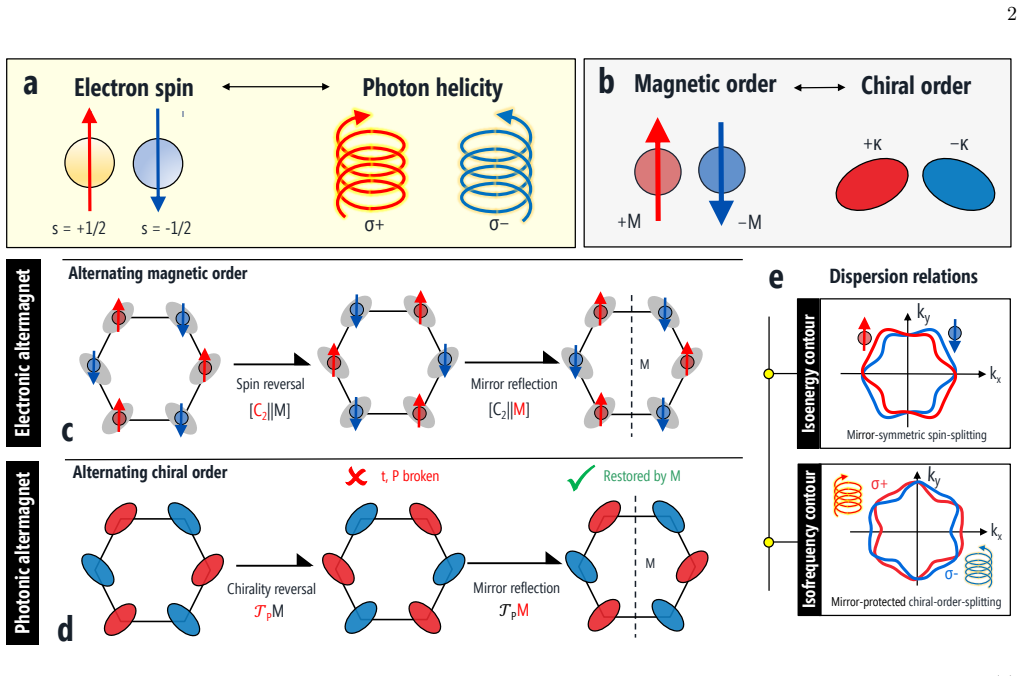
Mirror symmetry in a hexagonal lattice of alternating elliptical chiral elements splits photonic modes of opposite helicity.
A machine-rendered reading of the paper's core claim, the machinery that carries it, and where it could break.
Core claim
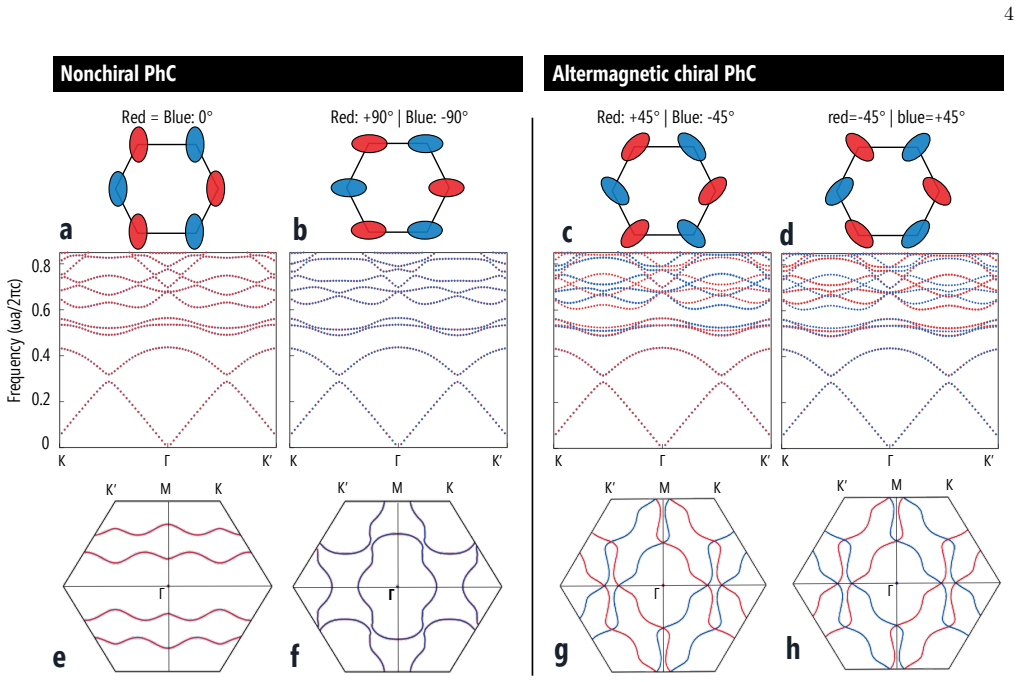
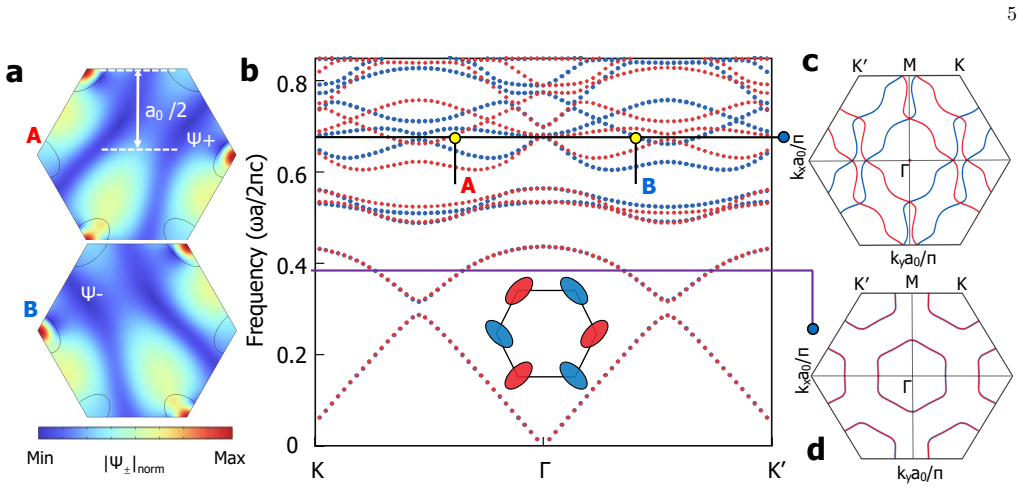
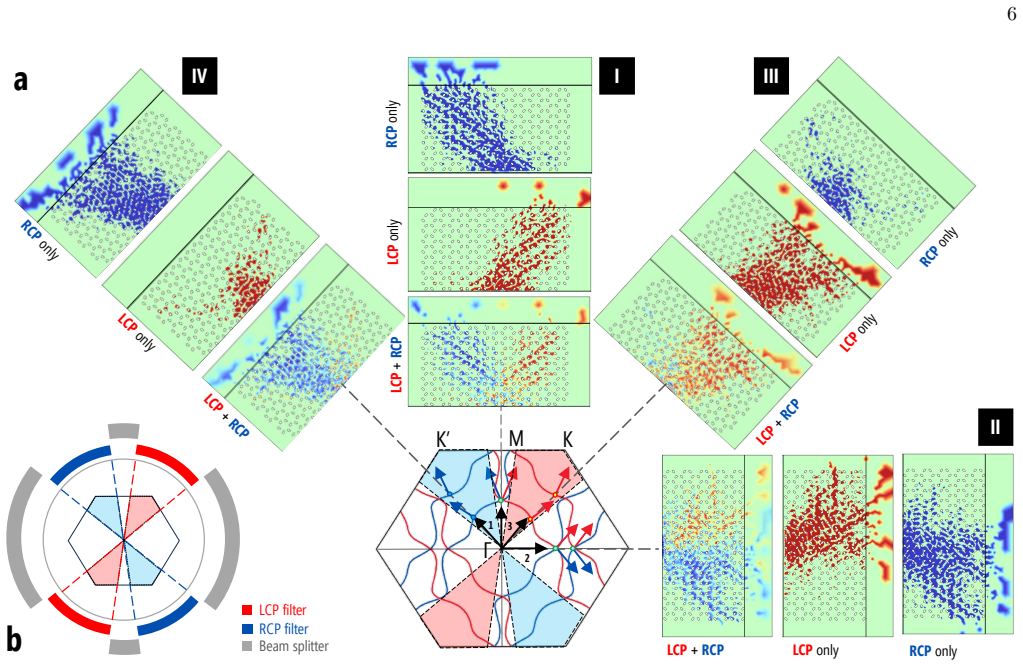
Mirror symmetry enforces momentum-dependent splitting between the two opposite-helicity branches in the band structure and isofrequency contours of a hexagonal photonic crystal built from elliptical chiral elements of alternating handedness; the same symmetry allows a finite slab to separate a linearly polarized input into handedness-resolved output beams whose paths are tunable by ellipse rotation and whose target-helicity fractions exceed 0.85.
What carries the argument
The mirror-symmetric connection between opposite-chirality sublattices formed by placing elliptical elements of alternating handedness at the vertices of a regular hexagon.
If this is right
- The splitting separates a linearly polarized beam into handedness-resolved channels inside a finite slab.
- Target-helicity output fractions exceed 0.85 and the output direction varies continuously with the ellipse rotation angle.
- Reversing the ellipse orientation exchanges the two helicity channels.
- The construction works on a hexagonal lattice, extending photonic altermagnetism beyond square lattices that rely on fourfold rotation.
Where Pith is reading between the lines
- The same mirror-enforced mechanism could be tested in three-dimensional or layered hexagonal stacks to produce volumetric helicity separation.
- Because the splitting is tunable by a single geometric parameter, the design offers a route to reconfigurable on-chip chiral routers without external magnetic fields.
- If the underlying symmetry relation survives fabrication disorder, the approach may generalize to other mirror-symmetric lattices for momentum-space chiral sorting.
Load-bearing premise
The elliptical elements of alternating handedness at hexagon vertices connect the two opposite-chirality sublattices solely by chirality reversal together with a mirror reflection.
What would settle it
A full-wave simulation or measurement that shows no helicity splitting when the mirror symmetry is removed, for example by replacing the elliptical elements with circular ones or by making all elements the same handedness.
Figures
read the original abstract
Altermagnets host momentum-dependent spin splitting without net magnetization, a symmetry-enforced band phenomenon whose photonic analogues have so far been realized only in square lattices governed by fourfold rotation. Here we introduce a photonic altermagnet on a hexagonal lattice whose helicity splitting is governed by mirror rather than rotational symmetry. Elliptical chiral elements of alternating handedness, placed at the vertices of a regular hexagon, leave the two opposite-chirality sublattices connected only by chirality reversal combined with a mirror reflection. Full-wave simulations reveal mirror-related splitting of the two opposite-helicity branches in the band structure and isofrequency contours, with the channels exchanged when the ellipse orientation is reversed. Using a finite photonic crystal slab, we show that such splitting separates a linearly polarized beam into handedness-resolved channels, thus enabling beam splitting and direction-selective helicity filtering with target-helicity output fractions above 0.85 and output paths continuously tunable through the ellipse rotation angle. These results extend photonic altermagnetism to a previously unexplored lattice-symmetry class and establish mirror-symmetric chiral textures as building blocks for altermagnetism-inspired on-chip chiral photonics.
Editorial analysis
A structured set of objections, weighed in public.
Referee Report
Summary. The manuscript proposes a photonic altermagnet on a hexagonal lattice realized with elliptical chiral elements of alternating handedness placed at the vertices of a regular hexagon. It claims that the opposite-chirality sublattices are connected exclusively by the combination of chirality reversal and mirror reflection, leading to mirror-enforced splitting of opposite-helicity branches. Full-wave simulations are used to demonstrate this splitting in band structures and isofrequency contours (with channels exchanged upon ellipse reversal), and a finite photonic crystal slab is shown to separate a linearly polarized beam into handedness-resolved channels, achieving target-helicity output fractions above 0.85 with paths tunable via ellipse rotation angle.
Significance. If the symmetry premise and simulation results hold, the work extends photonic altermagnetism from fourfold-rotation square lattices to a mirror-governed hexagonal class, providing a new symmetry route for chiral photonic devices such as tunable beam splitters and helicity filters. The explicit device-level demonstration with quantitative performance metrics strengthens the practical relevance.
major comments (2)
- [Abstract] Abstract: the central premise that the two opposite-chirality sublattices 'leave the two opposite-chirality sublattices connected only by chirality reversal combined with a mirror reflection' is stated without an accompanying point-group analysis, symmetry table, or explicit verification that no additional operations (e.g., unintended glide or rotation mapping same-helicity elements) are present. This symmetry mapping is load-bearing for the 'mirror-enforced' altermagnet claim; its absence leaves open the possibility that the simulated splitting arises from conventional mechanisms rather than the asserted mirror symmetry.
- Simulation results (throughout): no details are supplied on the full-wave solver parameters, mesh convergence tests, boundary conditions, or quantitative error analysis for the reported band splitting and the >0.85 output fractions. These omissions make it impossible to assess numerical reliability or reproducibility of the quantitative performance claims.
Simulated Author's Rebuttal
We thank the referee for the constructive comments and positive assessment of the significance of our work. We address each major comment below.
read point-by-point responses
-
Referee: [Abstract] Abstract: the central premise that the two opposite-chirality sublattices 'leave the two opposite-chirality sublattices connected only by chirality reversal combined with a mirror reflection' is stated without an accompanying point-group analysis, symmetry table, or explicit verification that no additional operations (e.g., unintended glide or rotation mapping same-helicity elements) are present. This symmetry mapping is load-bearing for the 'mirror-enforced' altermagnet claim; its absence leaves open the possibility that the simulated splitting arises from conventional mechanisms rather than the asserted mirror symmetry.
Authors: The hexagonal lattice with alternating-handedness elliptical elements at hexagon vertices is constructed so that same-helicity elements are not connected by rotations or glides; only mirror reflection plus chirality reversal maps one sublattice to the other. While the geometric description supports this, we agree an explicit point-group analysis strengthens the claim. We will add a symmetry table and verification of operations in a revised methods or supplementary section. revision: yes
-
Referee: [—] Simulation results (throughout): no details are supplied on the full-wave solver parameters, mesh convergence tests, boundary conditions, or quantitative error analysis for the reported band splitting and the >0.85 output fractions. These omissions make it impossible to assess numerical reliability or reproducibility of the quantitative performance claims.
Authors: We agree these details are required for reproducibility. The revised manuscript will specify the full-wave solver, mesh density and convergence tests, boundary conditions (periodic or PML), and error estimates confirming the reported band splitting and output fractions. revision: yes
Circularity Check
No significant circularity; results from numerical simulation of posited symmetry
full rationale
The paper posits a symmetry relation (opposite-chirality sublattices connected only by mirror reflection plus handedness reversal) as the design premise for a hexagonal-lattice photonic altermagnet, then reports band splitting and beam-splitting effects as outcomes of full-wave simulations on the explicit structure. No analytical derivation reduces the observed splitting to the symmetry assumption by construction, no parameters are fitted and relabeled as predictions, and no self-citation chain or ansatz smuggling is load-bearing. The central claims rest on external numerical verification rather than self-referential reduction, yielding a self-contained chain.
Axiom & Free-Parameter Ledger
axioms (2)
- standard math Electromagnetic waves in the structure obey Maxwell's equations.
- domain assumption The lattice symmetry with alternating handedness enforces the described connection between sublattices.
Reference graph
Works this paper leans on
-
[1]
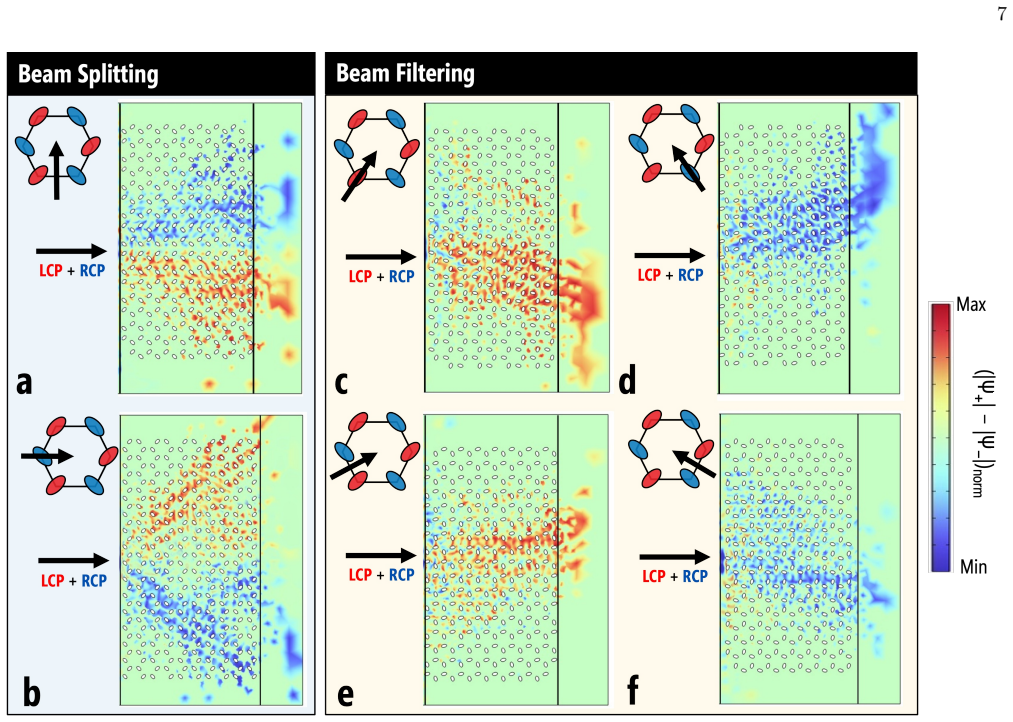
The incident direction strongly shapes the split- ting: relative to Fig
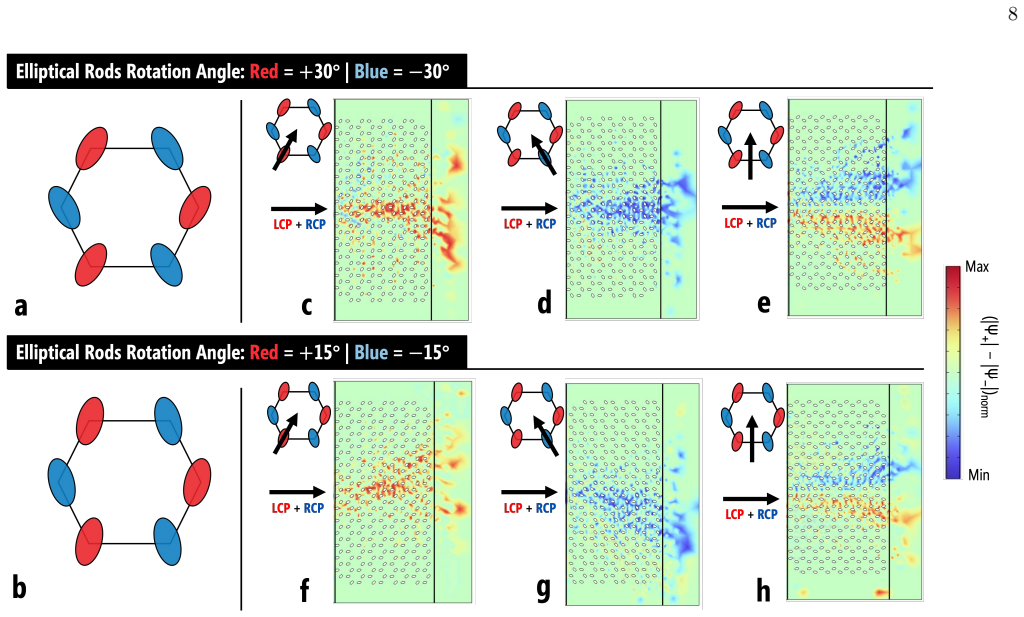
Figures 5(a) and 5(b) how beam splitting under two incident directions, indicated by the bold arrows in the insets. The incident direction strongly shapes the split- ting: relative to Fig. 5(a), the direction in Fig. 5(b) yields a larger spatial separation of the LCP and RCP 7 FIG. 5. Incidence angle dependence of helicity dependent beam propagation. The ...
-
[2]
ˇSmejkal, J
L. ˇSmejkal, J. Sinova, and T. Jungwirth, Beyond conven- tional ferromagnetism and antiferromagnetism: A phase with nonrelativistic spin and crystal rotation symmetry, Phys. Rev. X 12, 031042 (2022)
2022
-
[3]
ˇSmejkal, J
L. ˇSmejkal, J. Sinova, and T. Jungwirth, Emerging re- search landscape of altermagnetism, Phys. Rev. X 12, 040501 (2022)
2022
-
[4]
L. Bai, W. Feng, S. Liu, L. ˇSmejkal, Y. Mokrousov, and Y. Yao, Altermagnetism: Exploring new frontiers in mag- netism and spintronics, Advanced Functional Materials 34, 2409327 (2024)
2024
-
[5]
C. Song, H. Bai, Z. Zhou, L. Han, H. Reichlova, J. H. Dil, J. Liu, X. Chen, and F. Pan, Altermagnets as a new class of functional materials, Nature Reviews Materials 10, 473 (2025)
2025
-
[6]
J. Liu, X. Ma, X. Zhang, W. Jing, Z. Liu, and D. Shen, Symmetry-driven spin splitting in altermagnets: an angle-resolved photoemission spectroscopy perspective, Nano Convergence 13, 6 (2026)
2026
-
[7]
S. Zeng, D. Liu, H. Peng, C.-C. He, X.-B. Yang, and Y.-J. Zhao, Classification and design of two-dimensional altermagnets, arXiv preprint arXiv:2601.10183 (2026)
Pith/arXiv arXiv 2026
-
[8]
Zhang, J
X. Zhang, J. Liu, W. Huang, F. Zhang, M.-Y. Zhu, Y.-P. Zhu, C. Chen, C. Liu, C. Kim, and D. Shen, Arpes studies of spin-splitting antiferromagnets, Chinese Physics Let- ters 43, 050709 (2026)
2026
-
[9]
Cheong and F.-T
S.-W. Cheong and F.-T. Huang, Altermagnetism classi- fication, npj Quantum Materials 10, 38 (2025)
2025
-
[10]
Jungwirth, J
T. Jungwirth, J. Sinova, R. M. Fernandes, Q. Liu, H. Watanabe, S. Murakami, S. Nakatsuji, and L.ˇSmejkal, Symmetry, microscopy and spectroscopy signatures of al- termagnetism, Nature 649, 837 (2026)
2026
-
[11]
ˇSmejkal, R
L. ˇSmejkal, R. Gonz´ alez-Hern´ andez, T. Jungwirth, and J. Sinova, Crystal time-reversal symmetry breaking and spontaneous hall effect in collinear antiferromagnets, Sci. Adv. 6, eaaz8809 (2020)
2020
-
[12]
Jiang, M
B. Jiang, M. Hu, J. Bai, Z. Song, C. Mu, G. Qu, W. Li, W. Zhu, H. Pi, Z. Wei, et al. , A metallic room- temperature d-wave altermagnet, Nature Physics21, 754 (2025)
2025
-
[13]
D. Wang, H. Wang, L. Liu, J. Zhang, and H. Zhang, Electric-field-induced switchable two-dimensional alter- magnets, Nano Letters 25, 498 (2024)
2024
-
[14]
X. Chen, D. Wang, L. Li, and B. Sanyal, Giant spin- splitting and tunable spin-momentum locked transport in room temperature collinear antiferromagnetic semimetal- lic cro monolayer, Applied Physics Letters 123 (2023)
2023
-
[15]
Y. Che, H. Lv, X. Wu, and J. Yang, Realizing alter- magnetism in two-dimensional metal–organic framework semiconductors with electric-field-controlled anisotropic spin current, Chemical Science 15, 13853 (2024)
2024
-
[16]
Zeng and Y.-J
S. Zeng and Y.-J. Zhao, Description of two-dimensional altermagnetism: Categorization using spin group theory, Physical Review B 110, 054406 (2024)
2024
-
[17]
M. Naka, Y. Motome, and H. Seo, Altermagnetic per- ovskites, npj Spintronics 3, 1 (2025)
2025
-
[18]
T. Yu, I. Shahid, P. Liu, D.-F. Shao, X.-Q. Chen, and Y. Sun, N´ eel vector-dependent anomalous transport in altermagnetic metal crsb, npj Quantum Materials 10, 47 (2025)
2025
-
[19]
Z. Zhou, X. Cheng, M. Hu, R. Chu, H. Bai, L. Han, J. Liu, F. Pan, and C. Song, Manipulation of the alter- magnetic order in crsb via crystal symmetry, Nature638, 645 (2025)
2025
-
[20]
S. Liu, Z. Zhang, L. Bai, and W. Feng, Anomalous trans- port properties in the two-dimensional topological alter- magnet v 2 te 2 o, Physical Review B111, 184437 (2025)
2025
-
[21]
H. Jin, Z. Tan, Z. Gong, and J. Wang, Anomalous hall effect in two-dimensional vanadium tetrahalogen with altermagnetic phase, Physical Review B 110, 155125 (2024)
2024
-
[22]
Takahashi, C
K. Takahashi, C. R. Steward, M. Ogata, R. M. Fernan- des, and J. Schmalian, Elasto-hall conductivity and the anomalous hall effect in altermagnets, Physical Review B 111, 184408 (2025)
2025
-
[23]
Sheoran and P
S. Sheoran and P. Dev, Spontaneous anomalous hall ef- fect in two-dimensional altermagnets, Physical Review B 111, 184407 (2025)
2025
-
[24]
T. Sato, S. Haddad, I. C. Fulga, F. F. Assaad, and J. van den Brink, Altermagnetic anomalous hall effect emerging from electronic correlations, Physical Review Letters 133, 086503 (2024)
2024
-
[25]
L.-S. Liu, K. Shao, H.-D. Li, X. Wan, W. Chen, and D. Xing, Altermagnetic spin precession and spin transis- tor, Physical Review Letters 136, 106301 (2026)
2026
-
[26]
Zhang, H
Y. Zhang, H. Bai, J. Dai, L. Han, C. Chen, S. Liang, Y. Cao, Y. Zhang, Q. Wang, W. Zhu, et al. , Electri- cal manipulation of spin splitting torque in altermagnetic ruo2, Nature Communications 16, 5646 (2025)
2025
-
[27]
Y. Guo, J. Zhang, Z. Zhu, Y.-y. Jiang, L. Jiang, C. Wu, J. Dong, X. Xu, W. He, B. He, et al. , Direct and inverse spin splitting effects in altermagnetic ruo2, Advanced Sci- ence 11, 2400967 (2024)
2024
-
[28]
L. Han, X. Fu, R. Peng, X. Cheng, J. Dai, L. Liu, Y. Li, Y. Zhang, W. Zhu, H. Bai, et al., Electrical 180 switching of n´ eel vector in spin-splitting antiferromagnet, Science Advances 10, eadn0479 (2024)
2024
-
[29]
Q. Cui, B. Zeng, P. Cui, T. Yu, and H. Yang, Efficient spin seebeck and spin nernst effects of magnons in alter- magnets, Physical Review B 108, L180401 (2023)
2023
-
[30]
Vakili, E
H. Vakili, E. Schwartz, and A. A. Kovalev, Spin-transfer torque in altermagnets with magnetic textures, Physical Review Letters 134, 176401 (2025)
2025
-
[31]
S. Fang, Z. Yang, J. Wang, X. Yang, J. Lu, C. H. Lee, X. Wang, and Y. S. Ang, One-dimensional electronics with edge states in two-dimensional altermagnets, Phys- ical Review B 113, 224407 (2026)
2026
-
[32]
X. Yang, S. Fang, Z. Yang, P. Ho, J. Lu, and Y. S. Ang, Altermagnetic flatband-driven fermi surface geometry for giant tunneling magnetoresistance (adv. funct. mater. 35/2026), Advanced Functional Materials 36, e75494 (2026)
2026
-
[33]
Samanta, D.-F
K. Samanta, D.-F. Shao, and E. Y. Tsymbal, Spin filter- ing with insulating altermagnets, Nano Letters 25, 3150 (2025)
2025
-
[34]
Samanta, Y.-Y
K. Samanta, Y.-Y. Jiang, T. R. Paudel, D.-F. Shao, and E. Y. Tsymbal, Tunneling magnetoresistance in magnetic tunnel junctions with a single ferromagnetic electrode, Physical Review B 109, 174407 (2024)
2024
-
[35]
Jiang, Z.-A
Y.-Y. Jiang, Z.-A. Wang, K. Samanta, S.-H. Zhang, R.- C. Xiao, W. Lu, Y. Sun, E. Y. Tsymbal, and D.-F. Shao, 11 Prediction of giant tunneling magnetoresistance in ru o 2/ti o 2/ru o 2 (110) antiferromagnetic tunnel junctions, Physical Review B 108, 174439 (2023)
2023
-
[36]
J. Wang, X. Yang, Z. Yang, J. Lu, P. Ho, W. Wang, Y. S. Ang, Z. Cheng, and S. Fang, Pentagonal 2d altermagnets: Material screening and altermagnetic tunneling junction device application, Advanced Functional Materials 36, 2505145 (2026)
2026
-
[37]
Z. Yang, X. Yang, J. Wang, Q. Li, R. Peng, C. H. Lee, L. K. Ang, J. Lu, Y. S. Ang, and S. Fang, Unconventional thickness scaling of coherent tunnel magnetoresistance in altermagnets, Physical Review B 112, 205202 (2025)
2025
-
[38]
X. Li, M. Zhu, J. Dong, K. Wu, F. Zheng, and J. Zhang, Tunneling magnetoresistance effect in altermagnetic tun- nel junctions with g-wave splitting, Chinese Physics Let- ters 42, 100701 (2025)
2025
-
[39]
Noh, G.-H
S. Noh, G.-H. Kim, J. Lee, H. Jung, U. Seo, G. So, J. Lee, S. Lee, M. Park, S. Yang, et al. , Tunneling magnetore- sistance in altermagnetic ruo 2-based magnetic tunnel junctions, Physical Review Letters 134, 246703 (2025)
2025
-
[40]
F. Liu, Z. Zhang, X. Yuan, Y. Liu, S. Zhu, Z. Lu, and R. Xiong, Giant tunneling magnetoresistance in in- sulated altermagnet/ferromagnet junctions induced by spin-dependent tunneling effect, Physical Review B 110, 134437 (2024)
2024
-
[41]
Gonz´ alez-Hern´ andez, L.ˇSmejkal, K
R. Gonz´ alez-Hern´ andez, L.ˇSmejkal, K. V´ yborn´ y, Y. Ya- hagi, J. Sinova, T. Jungwirth, and J. ˇZelezn´ y, Ef- ficient electrical spin splitter based on nonrelativis- tic collinear antiferromagnetism, Phys. Rev. Lett. 126, 127701 (2021)
2021
-
[42]
Bai et al
H. Bai et al. , Observation of spin splitting torque in a collinear antiferromagnet ruo 2, Phys. Rev. Lett. 128, 197202 (2022)
2022
-
[43]
Fukaya, K
Y. Fukaya, K. Maeda, K. Yada, J. Cayao, Y. Tanaka, and B. Lu, Josephson effect and odd-frequency pairing in superconducting junctions with unconventional magnets, Physical Review B 111, 064502 (2025)
2025
-
[44]
Zhang, L.-H
S.-B. Zhang, L.-H. Hu, and T. Neupert, Finite- momentum cooper pairing in proximitized altermagnets, Nature Communications 15, 1801 (2024)
2024
-
[45]
J. A. Ouassou, A. Brataas, and J. Linder, dc josephson ef- fect in altermagnets, Physical review letters 131, 076003 (2023)
2023
-
[46]
M. Gu, Y. Liu, H. Zhu, K. Yananose, X. Chen, Y. Hu, A. Stroppa, and Q. Liu, Ferroelectric switchable alter- magnetism, Phys. Rev. Lett. 134, 106802 (2025)
2025
-
[47]
R. Peng, G. Su, Y. Fan, J. Li, F. Liu, and Y. S. Ang, Sliding ferroelectricity driven spin-layertronics in alter- magnetic multilayers, arXiv preprint arXiv:2603.10907 (2026)
arXiv 2026
-
[48]
W. Sun, W. Wang, C. Yang, S. Huang, and Z. Cheng, A unified symmetry framework for spin–ferroelectric cou- pling in altermagnetic multiferroics, Nature Communi- cations (2026)
2026
-
[49]
X. Duan, J. Zhang, Z. Zhu, Y. Liu, Z. Zhang, I. ˇZuti´ c, and T. Zhou, Antiferroelectric altermagnets: Antiferro- electricity alters magnets, Physical review letters 134, 106801 (2025)
2025
-
[50]
R. Peng, S. Fang, P. Ho, F. Liu, T. Zhou, J. Liu, and Y. S. Ang, Ferroelastic altermagnetism, npj Quantum Materials (2025)
2025
-
[51]
N. Ding, H. Ye, S.-S. Wang, and S. Dong, Ferroelastically tunable altermagnets, Physical Review B 112, L220410 (2025)
2025
-
[52]
Y. Liu, J. Yu, and C.-C. Liu, Twisted magnetic van der waals bilayers: An ideal platform for altermagnetism, Phys. Rev. Lett. 133, 206702 (2024)
2024
-
[53]
B. Pan, P. Zhou, P. Lyu, H. Xiao, X. Yang, and L. Sun, General stacking theory for altermagnetism in bilayer systems, Phys. Rev. Lett. 133, 166701 (2024)
2024
-
[54]
E. W. Hodt, P. Sukhachov, and J. Linder, Interface- induced magnetization in altermagnets and antiferro- magnets, Phys. Rev. B 110, 054446 (2024)
2024
-
[55]
Z. Zhu, X. Duan, J. Zhang, B. Hao, I. Zutic, and T. Zhou, Two-dimensional ferroelectric altermagnets: From model to material realization, Nano Letters 25, 9456 (2025)
2025
-
[56]
Z. Zhu, R. Huang, X. Chen, Z. Cui, X. Duan, J. Zhang, I. ˇZuti´ c, and T. Zhou, Altermagnetic proximity effect, Physical Review Letters 136, 186702 (2026)
2026
-
[57]
R. Peng, J. Yang, L. Hu, W.-L. Ong, P. Ho, C. S. Lau, J. Liu, and Y. S. Ang, All-electrical layer-spintronics in altermagnetic bilayers, Materials Horizons 12, 2197 (2025)
2025
-
[58]
Zeng and Y.-J
S. Zeng and Y.-J. Zhao, Bilayer stacking a-type altermag- net: A general approach to generating two-dimensional altermagnetism, Physical Review B 110, 174410 (2024)
2024
- [59]
-
[60]
T. Qian, A. Rutherford, E. S. Choi, H. Zhou, B. Maiorov, M. Lee, and C. A. Mizzi, Determining the nature of mag- netism in altermagnetic candidate ruo 2, Phys. Rev. Re- search 8, L012072 (2026)
2026
-
[61]
J. D. Joannopoulos, S. G. Johnson, J. N. Winn, and R. D. Meade, Photonic Crystals: Molding the Flow of Light , 2nd ed. (Princeton Univ. Press, 2008)
2008
-
[62]
L. Lu, J. D. Joannopoulos, and M. Soljˇ ci´ c, Topological photonics, Nat. Photon. 8, 821 (2014)
2014
-
[63]
K. Y. Bliokh, F. J. Rodr´ ıguez-Fortu˜ no, F. Nori, and A. V. Zayats, Spin–orbit interactions of light, Nat. Photon. 9, 796 (2015)
2015
-
[64]
M. V. Gorkunov, A. A. Antonov, A. V. Mamonova, E. A. Muljarov, and Y. Kivshar, Substrate-induced maximum optical chirality of planar dielectric structures, Advanced Optical Materials 13, 2402133 (2025)
2025
-
[65]
A. S. Kim, Y. Huang, Z. Sun, Q.-H. Park, and H. Choi, Photonic altermagnets: Magnetic symmetries in pho- tonic structures, arXiv:2506.23497 (2025)
arXiv 2025
-
[66]
S. Qiu, H. Li, Y. Meng, X. Xi, Z. Zhu, C. Shang, Z. Gao, T. J. Cui, and S. Liu, Orbital altermagnetic photonic crystal, arXiv:2605.28656 (2026)
Pith/arXiv arXiv 2026
-
[67]
Serdyukov, I
A. Serdyukov, I. Semchenko, S. Tretyakov, and A. Si- hvola, Electromagnetics of Bi-anisotropic Materials: Theory and Applications (Gordon and Breach Science Publishers, 2001)
2001
-
[68]
Bialynicki-Birula and Z
I. Bialynicki-Birula and Z. Bialynicka-Birula, The role of the Riemann–Silberstein vector in classical and quantum theories of electromagnetism, J. Phys. A: Math. Theor. 46, 053001 (2013)
2013
-
[69]
M. D. Turner, M. Saba, Q. Zhang, B. P. Cumming, G. E. Schr¨ oder-Turk, and M. Gu, Miniature chiral beamsplitter based on gyroid photonic crystals, Nature Photonics 7, 801 (2013)
2013
-
[70]
Voronin, A
K. Voronin, A. S. Taradin, M. V. Gorkunov, and D. G. Baranov, Single-handedness chiral optical cavities, Acs Photonics 9, 2652 (2022)
2022
discussion (0)
Sign in with ORCID, Apple, or X to comment. Anyone can read and Pith papers without signing in.