SU(2) gauge theory with fermions on a semi-simple cubic lattice
Pith reviewed 2026-06-26 12:18 UTC · model grok-4.3
The pith
The semi-simple cubic lattice supports SU(2) gauge theory with staggered fermions using fewer qubits than a simple cubic lattice.
A machine-rendered reading of the paper's core claim, the machinery that carries it, and where it could break.
Core claim
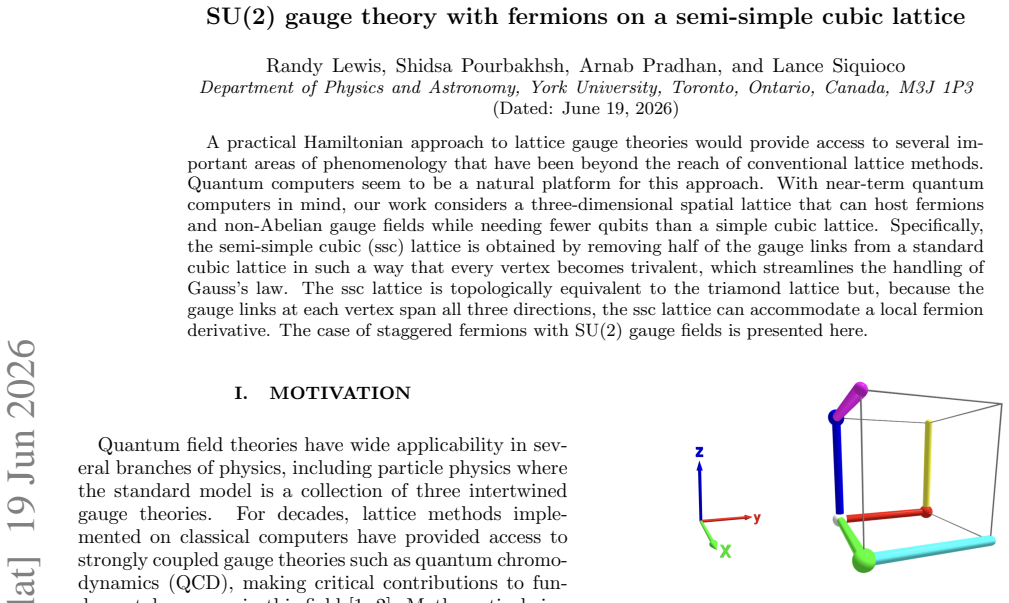
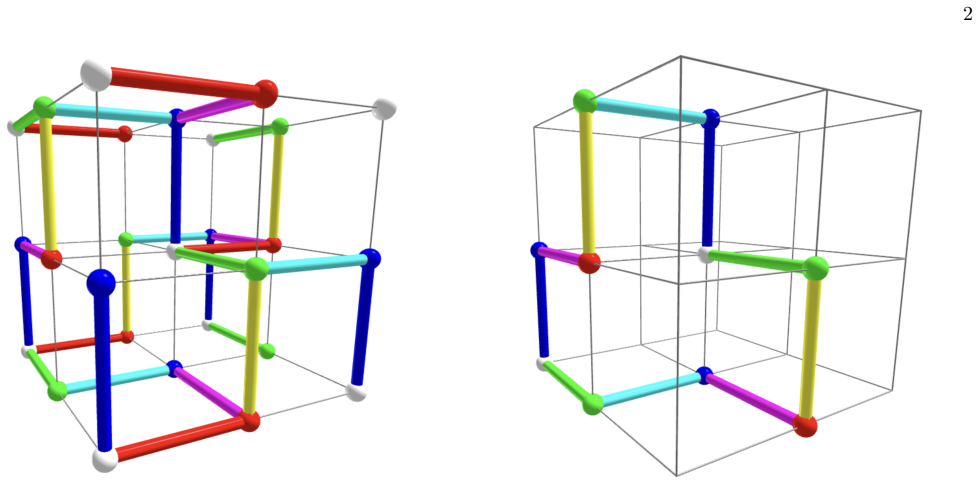
The semi-simple cubic (ssc) lattice is obtained by removing half the gauge links from a standard cubic lattice so that every vertex is trivalent; it is topologically equivalent to the triamond lattice, yet the gauge links at each vertex still span all three spatial directions and therefore accommodate a local fermion derivative, enabling a consistent formulation of SU(2) gauge theory with staggered fermions.
What carries the argument
the semi-simple cubic (ssc) lattice formed by deleting half the links of a cubic lattice to produce trivalent vertices while retaining links in every spatial direction
If this is right
- Fewer qubits are required to represent the gauge and fermion degrees of freedom on quantum hardware.
- The trivalent vertices reduce the number of constraints that must be enforced when imposing Gauss's law.
- A local staggered-fermion derivative operator can be written without additional lattice modifications.
- The same link-removal procedure applies directly to the SU(2) plaquette action and to the fermion-gauge coupling.
Where Pith is reading between the lines
- The lattice could be tested numerically for other gauge groups to check whether the resource savings scale similarly.
- Direct comparison of the low-lying spectrum on the ssc lattice versus the cubic lattice would quantify discretization effects.
- The trivalent structure may simplify the design of gauge-invariant error-correction codes for quantum simulations.
Load-bearing premise
Removing half the gauge links from the cubic lattice preserves gauge invariance, topological properties, and consistency for staggered fermions without introducing new inconsistencies or extra constraints.
What would settle it
An explicit computation showing that the discretized fermion hopping term fails to transform correctly under SU(2) gauge transformations at a trivalent vertex, or that the Gauss law generators no longer close properly, would disprove the construction.
Figures
read the original abstract
A practical Hamiltonian approach to lattice gauge theories would provide access to several important areas of phenomenology that have been beyond the reach of conventional lattice methods. Quantum computers seem to be a natural platform for this approach. With near-term quantum computers in mind, our work considers a three-dimensional spatial lattice that can host fermions and non-Abelian gauge fields while needing fewer qubits than a simple cubic lattice. Specifically, the semi-simple cubic (ssc) lattice is obtained by removing half of the gauge links from a standard cubic lattice in such a way that every vertex becomes trivalent, which streamlines the handling of Gauss's law. The ssc lattice is topologically equivalent to the triamond lattice but, because the gauge links at each vertex span all three directions, the ssc lattice can accommodate a local fermion derivative. The case of staggered fermions with SU(2) gauge fields is presented here.
Editorial analysis
A structured set of objections, weighed in public.
Referee Report
Summary. The manuscript proposes the semi-simple cubic (ssc) lattice, obtained by removing half the links from a standard cubic lattice to produce a trivalent graph whose vertices still connect along all three spatial directions. This construction is intended to host SU(2) gauge fields and staggered fermions in a Hamiltonian formulation suitable for near-term quantum computers, with the trivalence simplifying Gauss-law enforcement and the retained directional links permitting a local fermion derivative.
Significance. A verified construction that reduces qubit overhead while preserving local gauge invariance and a consistent fermion operator would be a useful technical advance for resource-efficient quantum simulations of non-Abelian gauge theories with matter.
major comments (1)
- [Abstract] Abstract: the central claim that the ssc lattice 'can accommodate a local fermion derivative' because 'gauge links at each vertex span all three directions' is asserted without an explicit definition of the staggered-fermion operator on the thinned lattice, without verification that the resulting Dirac matrix remains anti-Hermitian and gauge-covariant, and without any check for additional doublers or zero modes.
Simulated Author's Rebuttal
We thank the referee for their detailed reading and for identifying a point where the abstract could be strengthened. We respond to the single major comment below and will revise the manuscript accordingly.
read point-by-point responses
-
Referee: [Abstract] Abstract: the central claim that the ssc lattice 'can accommodate a local fermion derivative' because 'gauge links at each vertex span all three directions' is asserted without an explicit definition of the staggered-fermion operator on the thinned lattice, without verification that the resulting Dirac matrix remains anti-Hermitian and gauge-covariant, and without any check for additional doublers or zero modes.
Authors: We agree that the abstract is too terse on this point. The body of the manuscript (Section 3) defines the staggered-fermion operator explicitly on the ssc lattice by restricting the standard nearest-neighbor terms to the retained links while preserving the three-directional coverage at each vertex. Gauge covariance follows immediately from the link variables, and anti-Hermiticity is verified by direct computation of the Dirac matrix. The absence of additional doublers is confirmed by diagonalizing the free Dirac operator on finite volumes and showing that the only zero modes are the expected staggered ones. To address the referee's concern we will expand the abstract with a single sentence summarizing these verifications and will add a short appendix tabulating the Dirac-matrix properties. revision: yes
Circularity Check
No circularity in lattice construction or fermion operator definition
full rationale
The paper defines the semi-simple cubic lattice explicitly by removing half the links from the cubic lattice to produce trivalent vertices while retaining one link per direction at each site. This geometric choice is presented as enabling a local staggered-fermion operator by direct construction, without any equation that defines a derived quantity in terms of itself, without fitted parameters relabeled as predictions, and without load-bearing self-citations whose content reduces to the present work. The staggered-fermion case is introduced as a direct application on the new lattice; no uniqueness theorem or ansatz is imported from prior author work to force the result. The derivation chain is therefore self-contained and independent of its own outputs.
Axiom & Free-Parameter Ledger
Reference graph
Works this paper leans on
-
[1]
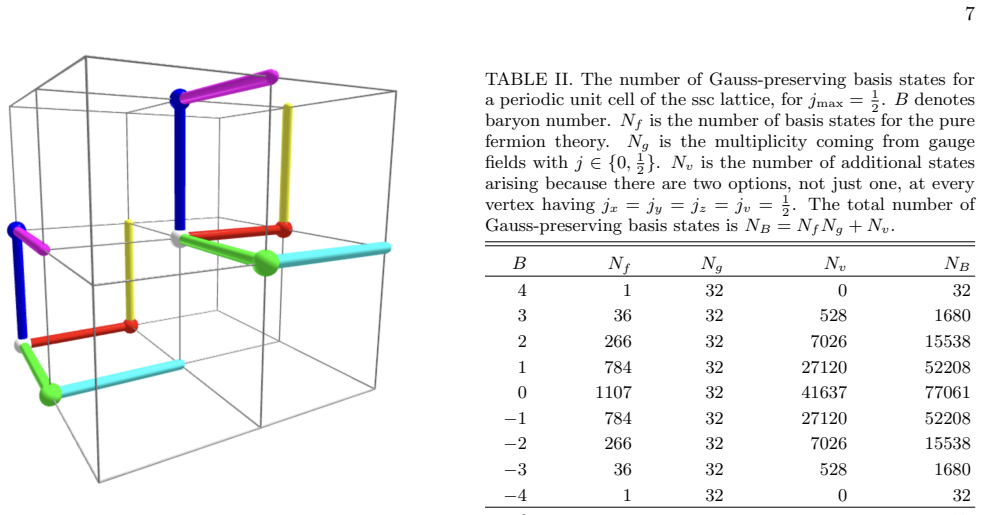
The total number of Gauss-preserving basis states isN B =N f Ng +N v. B N f Ng Nv NB 4 1 32 0 32 3 36 32 528 1680 2 266 32 7026 15538 1 784 32 27120 52208 0 1107 32 41637 77061 −1 784 32 27120 52208 −2 266 32 7026 15538 −3 36 32 528 1680 −4 1 32 0 32 total 3281 32 110985 215977 a conserved quantum number in the SU(2) theory. Each quark has baryon number +...
-
[2]
This means the Hamiltonian is block diagonal inBand we can count the basis states within each block separately
The Hamiltonian can only create and annihilate fermions in pairs, always one quark with one antiquark, so baryon number remains constant. This means the Hamiltonian is block diagonal inBand we can count the basis states within each block separately. Because the unit cell has four quark sites and four an- tiquark sites, the allowed values for the integerBa...
-
[3]
Quantum chromodynam- ics on the lattice,
C. Gattringer and C. B. Lang, “Quantum chromodynam- ics on the lattice,” Lect. Notes Phys.788, 1-343 (2010)
2010
-
[4]
FLAG review 2024,
Y. Aokiet al.[Flavour Lattice Averaging Group (FLAG)], “FLAG review 2024,” Phys. Rev. D113, no.1, 014508 (2026)
2024
-
[5]
Quantum Simulation for High-Energy Physics,
C. W. Bauer, Z. Davoudi, A. B. Balantekin, T. Bhat- tacharya, M. Carena, W. A. de Jong, P. Draper, A. El- Khadra, N. Gemelke and M. Hanada,et al.“Quantum Simulation for High-Energy Physics,” PRX Quantum4, no.2, 027001 (2023)
2023
-
[6]
Quantum Computing for High-Energy Physics: State of the Art and Challenges,
A. Di Meglio, K. Jansen, I. Tavernelli, C. Alexandrou, S. Arunachalam, C. W. Bauer, K. Borras, S. Carrazza, A. Crippa and V. Croft,et al.“Quantum Computing for High-Energy Physics: State of the Art and Challenges,” PRX Quantum5, no.3, 037001 (2024)
2024
-
[7]
Quantum simulation of out-of-equilibrium dynamics in gauge theories,
J. C. Halimeh, N. Mueller, J. Knolle, Z. Papi´ c and Z. Davoudi, “Quantum simulation of out-of-equilibrium dynamics in gauge theories,” arXiv:2509.03586 [quant- ph] (2025)
Pith/arXiv arXiv 2025
-
[8]
Simulating lattice gauge theories on a quantum computer,
T. Byrnes and Y. Yamamoto, “Simulating lattice gauge theories on a quantum computer,” Phys. Rev. A73, 022328 (2006)
2006
-
[9]
Formulation of lattice gauge theories for quantum simulations,
E. Zohar and M. Burrello, “Formulation of lattice gauge theories for quantum simulations,” Phys. Rev. D91, no.5, 054506 (2015)
2015
-
[10]
Quantum Simula- tions of Lattice Gauge Theories using Ultracold Atoms in Optical Lattices,
E. Zohar, J. I. Cirac and B. Reznik, “Quantum Simula- tions of Lattice Gauge Theories using Ultracold Atoms in Optical Lattices,” Rept. Prog. Phys.79, no.1, 014401 (2016)
2016
-
[11]
E. A. Martinez, C. A. Muschik, P. Schindler, D. Nigg, A. Erhard, M. Heyl, P. Hauke, M. Dalmonte, T. Monz and P. Zoller,et al.Nature534, 516-519 (2016)
2016
-
[12]
Low energy spectrum of SU(2) lattice gauge theory: An alternate proposal via loop formula- tion,
I. Raychowdhury, “Low energy spectrum of SU(2) lattice gauge theory: An alternate proposal via loop formula- tion,” Eur. Phys. J. C79, no.3, 235 (2019)
2019
-
[13]
Gauss’s law, duality, and the Hamiltonian formulation of U(1) lattice gauge theory,
D. B. Kaplan and J. R. Stryker, “Gauss’s law, duality, and the Hamiltonian formulation of U(1) lattice gauge theory,” Phys. Rev. D102, no.9, 094515 (2020)
2020
-
[14]
Oracles for Gauss’s law on digital quan- tum computers,
J. R. Stryker, “Oracles for Gauss’s law on digital quan- tum computers,” Phys. Rev. A99, no.4, 042301 (2019)
2019
-
[15]
Solving Gauss’s Law on Digital Quantum Computers with Loop-String- Hadron Digitization,
I. Raychowdhury and J. R. Stryker, “Solving Gauss’s Law on Digital Quantum Computers with Loop-String- Hadron Digitization,” Phys. Rev. Res.2, no.3, 033039 (2020)
2020
-
[16]
Gluon Field Dig- itization for Quantum Computers,
A. Alexandru, P. F. Bedaque, S. Harmalkar, H. Lamm, S. Lawrence and N. C. Warrington, “Gluon Field Dig- itization for Quantum Computers,” Phys. Rev. D100, no.11, 114501 (2019)
2019
-
[17]
SU(2) non- Abelian gauge field theory in one dimension on digital quantum computers,
N. Klco, J. R. Stryker and M. J. Savage, “SU(2) non- Abelian gauge field theory in one dimension on digital quantum computers,” Phys. Rev. D101, no.7, 074512 (2020)
2020
-
[18]
Loop, string, and hadron dynamics in SU(2) Hamiltonian lattice gauge the- ories,
I. Raychowdhury and J. R. Stryker, “Loop, string, and hadron dynamics in SU(2) Hamiltonian lattice gauge the- ories,” Phys. Rev. D101, no.11, 114502 (2020)
2020
-
[19]
Ob- servation of gauge invariance in a 71-site Bose–Hubbard quantum simulator,
B. Yang, H. Sun, R. Ott, H. Y. Wang, T. V. Zache, J. C. Halimeh, Z. S. Yuan, P. Hauke and J. W. Pan, “Ob- servation of gauge invariance in a 71-site Bose–Hubbard quantum simulator,” Nature587, no.7834, 392-396 (2020)
2020
-
[20]
Gluon Field Digitization via Group Space Decimation for Quantum Computers,
Y. Ji, H. Lamm and S. Zhu, “Gluon Field Digitization via Group Space Decimation for Quantum Computers,” Phys. Rev. D102, no.11, 114513 (2020)
2020
-
[21]
Search for efficient formulations for Hamiltonian simulation of non- Abelian lattice gauge theories,
Z. Davoudi, I. Raychowdhury and A. Shaw, “Search for efficient formulations for Hamiltonian simulation of non- Abelian lattice gauge theories,” Phys. Rev. D104, no.7, 074505 (2021)
2021
-
[22]
Trailhead for quantum simulation of SU(3) Yang-Mills lattice gauge theory in the local multiplet basis,
A. Ciavarella, N. Klco and M. J. Savage, “Trailhead for quantum simulation of SU(3) Yang-Mills lattice gauge theory in the local multiplet basis,” Phys. Rev. D103, no.9, 094501 (2021)
2021
-
[23]
SU(2) hadrons on a quantum computer via a variational approach,
Y. Y. Atas, J. Zhang, R. Lewis, A. Jahanpour, J. F. Haase and C. A. Muschik, “SU(2) hadrons on a quantum computer via a variational approach,” Nature Commun.12, no.1, 6499 (2021)
2021
-
[24]
SU(2) lattice gauge theory on a quantum annealer,
S. A Rahman, R. Lewis, E. Mendicelli and S. Powell, “SU(2) lattice gauge theory on a quantum annealer,” Phys. Rev. D104, no.3, 034501 (2021)
2021
-
[25]
Gauge-invariant quantum circuits for U(1) and Yang- Mills lattice gauge theories,
G. Mazzola, S. V. Mathis, G. Mazzola and I. Tavernelli, “Gauge-invariant quantum circuits for U(1) and Yang- Mills lattice gauge theories,” Phys. Rev. Res.3, no.4, 043209 (2021)
2021
-
[26]
Suppressing nonperturbative gauge errors in the thermodynamic limit using local pseudogen- erators,
M. Van Damme, J. Mildenberger, F. Grusdt, P. Hauke and J. C. Halimeh, “Suppressing nonperturbative gauge errors in the thermodynamic limit using local pseudogen- erators,” Commun. Phys.8, no.1, 106 (2025)
2025
-
[27]
Preparation of the SU(3) lattice Yang-Mills vacuum with variational quantum methods,
A. N. Ciavarella and I. A. Chernyshev, “Preparation of the SU(3) lattice Yang-Mills vacuum with variational quantum methods,” Phys. Rev. D105, no.7, 074504 (2022)
2022
-
[28]
Self-mitigating Trotter circuits for SU(2) lattice gauge theory on a quantum computer,
S. A Rahman, R. Lewis, E. Mendicelli and S. Powell, “Self-mitigating Trotter circuits for SU(2) lattice gauge theory on a quantum computer,” Phys. Rev. D106, no.7, 074502 (2022)
2022
-
[29]
Prepa- rations for quantum simulations of quantum chromody- namics in 1+1 dimensions. I. Axial gauge,
R. C. Farrell, I. A. Chernyshev, S. J. M. Powell, N. A. Zemlevskiy, M. Illa and M. J. Savage, “Prepa- rations for quantum simulations of quantum chromody- namics in 1+1 dimensions. I. Axial gauge,” Phys. Rev. D107, no.5, 054512 (2023)
2023
-
[30]
Sim- ulating one-dimensional quantum chromodynamics on a quantum computer: Real-time evolutions of tetra- and pentaquarks,
Y. Y. Atas, J. F. Haase, J. Zhang, V. Wei, 12 S. M. L. Pfaendler, R. Lewis and C. A. Muschik, “Sim- ulating one-dimensional quantum chromodynamics on a quantum computer: Real-time evolutions of tetra- and pentaquarks,” Phys. Rev. Res.5, no.3, 033184 (2023)
2023
-
[31]
Prepa- rations for quantum simulations of quantum chromody- namics in 1+1 dimensions. II. Single-baryonβ-decay in real time,
R. C. Farrell, I. A. Chernyshev, S. J. M. Powell, N. A. Zemlevskiy, M. Illa and M. J. Savage, “Prepa- rations for quantum simulations of quantum chromody- namics in 1+1 dimensions. II. Single-baryonβ-decay in real time,” Phys. Rev. D107, no.5, 054513 (2023)
2023
-
[32]
General quan- tum algorithms for Hamiltonian simulation with applica- tions to a non-Abelian lattice gauge theory,
Z. Davoudi, A. F. Shaw and J. R. Stryker, “General quan- tum algorithms for Hamiltonian simulation with applica- tions to a non-Abelian lattice gauge theory,” Quantum 7, 1213 (2023)
2023
-
[33]
Fermion-qudit quantum processors for simulating lattice gauge theories with matter,
T. V. Zache, D. Gonz´ alez-Cuadra and P. Zoller, “Fermion-qudit quantum processors for simulating lattice gauge theories with matter,” Quantum7, 1140 (2023)
2023
-
[34]
Quan- tum and Classical Spin-Network Algorithms for q- Deformed Kogut-Susskind Gauge Theories,
T. V. Zache, D. Gonz´ alez-Cuadra and P. Zoller, “Quan- tum and Classical Spin-Network Algorithms for q- Deformed Kogut-Susskind Gauge Theories,” Phys. Rev. Lett.131, no.17, 171902 (2023)
2023
-
[35]
String-net formulation of Hamiltonian lattice Yang-Mills theories and quantum many-body scars in a nonabelian gauge theory,
T. Hayata and Y. Hidaka, “String-net formulation of Hamiltonian lattice Yang-Mills theories and quantum many-body scars in a nonabelian gauge theory,” JHEP 09, 126 (2023)
2023
-
[36]
Simple Hamiltonian for quan- tum simulation of strongly coupled (2+1)D SU(2) lattice gauge theory on a honeycomb lattice,
B. M¨ uller and X. Yao, “Simple Hamiltonian for quan- tum simulation of strongly coupled (2+1)D SU(2) lattice gauge theory on a honeycomb lattice,” Phys. Rev. D108, no.9, 094505 (2023)
2023
-
[37]
Quantum simulation of lattice QCD with improved Hamiltonians,
A. N. Ciavarella, “Quantum simulation of lattice QCD with improved Hamiltonians,” Phys. Rev. D108, no.9, 094513 (2023)
2023
-
[38]
New basis for Hamiltonian SU(2) simula- tions,
I. D’Andrea, C. W. Bauer, D. M. Grabowska and M. Freytsis, “New basis for Hamiltonian SU(2) simula- tions,” Phys. Rev. D109, no.7, 074501 (2024)
2024
-
[39]
Eigenstate thermalization in (2+1)-dimensional SU(2) lattice gauge theory,
L. Ebner, B. M¨ uller, A. Sch¨ afer, C. Seidl and X. Yao, “Eigenstate thermalization in (2+1)-dimensional SU(2) lattice gauge theory,” Phys. Rev. D109, no.1, 014504 (2024)
2024
-
[40]
Primitive quantum gates for an SU(2) discrete subgroup: Binary octahedral,
E. J. Gustafson, H. Lamm and F. Lovelace, “Primitive quantum gates for an SU(2) discrete subgroup: Binary octahedral,” Phys. Rev. D109, no.5, 054503 (2024)
2024
-
[41]
From square plaquettes to triamond lattices for SU(2) gauge theory,
A. H. Z. Kavaki and R. Lewis, “From square plaquettes to triamond lattices for SU(2) gauge theory,” Commun. Phys.7, no.1, 208 (2024)
2024
-
[42]
Entanglement entropy of (2+1)-dimensional SU(2) lat- tice gauge theory on plaquette chains,
L. Ebner, A. Sch¨ afer, C. Seidl, B. M¨ uller and X. Yao, “Entanglement entropy of (2+1)-dimensional SU(2) lat- tice gauge theory on plaquette chains,” Phys. Rev. D 110, no.1, 014505 (2024)
2024
-
[43]
Classical and quan- tum computing of shear viscosity for (2+1)D SU(2) gauge theory,
F. Turro, A. Ciavarella and X. Yao, “Classical and quan- tum computing of shear viscosity for (2+1)D SU(2) gauge theory,” Phys. Rev. D109, no.11, 114511 (2024)
2024
-
[44]
Digital Quantum Simula- tion of a (1+1)D SU(2) Lattice Gauge Theory with Ion Qudits,
G. Calaj` o, G. Magnifico, C. Edmunds, M. Ringbauer, S. Montangero and P. Silvi, “Digital Quantum Simula- tion of a (1+1)D SU(2) Lattice Gauge Theory with Ion Qudits,” PRX Quantum5, no.4, 040309 (2024)
2024
-
[45]
Quantum Simulation of SU(3) Lattice Yang-Mills Theory at Leading Order in Large-Nc Expansion,
A. N. Ciavarella and C. W. Bauer, “Quantum Simulation of SU(3) Lattice Yang-Mills Theory at Leading Order in Large-Nc Expansion,” Phys. Rev. Lett.133, no.11, 111901 (2024)
2024
-
[46]
Quan- tum error thresholds for gauge-redundant digitizations of lattice field theories,
M. Carena, H. Lamm, Y. Y. Li and W. Liu, “Quan- tum error thresholds for gauge-redundant digitizations of lattice field theories,” Phys. Rev. D110, no.5, 054516 (2024)
2024
-
[47]
Qu8its for quantum simulations of lattice quantum chromodynam- ics,
M. Illa, C. E. P. Robin and M. J. Savage, “Qu8its for quantum simulations of lattice quantum chromodynam- ics,” Phys. Rev. D110, no.1, 014507 (2024)
2024
-
[48]
Protecting gauge symmetries in the dynamics of SU(3) lattice gauge theo- ries,
E. Mathew and I. Raychowdhury, “Protecting gauge symmetries in the dynamics of SU(3) lattice gauge theo- ries,” Commun. Phys.8, no.1, 313 (2025)
2025
-
[49]
Primitive quantum gates for an SU(3) discrete subgroup: Σ(36×3),
E. J. Gustafson, Y. Ji, H. Lamm, E. M. Murairi, S. O. Perez and S. Zhu, “Primitive quantum gates for an SU(3) discrete subgroup: Σ(36×3),” Phys. Rev. D 110, no.3, 034515 (2024)
2024
-
[50]
Fault-tolerant simulation of Lattice Gauge Theories with gauge covari- ant codes,
L. Spagnoli, A. Roggero and N. Wiebe, “Fault-tolerant simulation of Lattice Gauge Theories with gauge covari- ant codes,” Quantum10, 1968 (2026)
1968
-
[51]
Loop-string-hadron approach to SU(3) lattice Yang-Mills theory: Hilbert space of a trivalent vertex,
S. V. Kadam, A. Naskar, I. Raychowdhury and J. R. Stryker, “Loop-string-hadron approach to SU(3) lattice Yang-Mills theory: Hilbert space of a trivalent vertex,” Phys. Rev. D111, no.7, 074516 (2025)
2025
-
[52]
Efficient Finite- Resource Formulation of Non-Abelian Lattice Gauge Theories beyond One Dimension,
P. Fontana, M. M. Riaza and A. Celi, “Efficient Finite- Resource Formulation of Non-Abelian Lattice Gauge Theories beyond One Dimension,” Phys. Rev. X15, no.3, 031065 (2025)
2025
-
[53]
Fully gauge-fixed SU(2) Hamiltonian for quantum sim- ulations,
D. M. Grabowska, C. F. Kane and C. W. Bauer, “Fully gauge-fixed SU(2) Hamiltonian for quantum sim- ulations,” Phys. Rev. D111, no.11, 114516 (2025)
2025
-
[54]
Gauge loop-string- hadron formulation on general graphs and applications to fully gauge fixed Hamiltonian lattice gauge theory,
I. M. Burbano and C. W. Bauer, “Gauge loop-string- hadron formulation on general graphs and applications to fully gauge fixed Hamiltonian lattice gauge theory,” JHEP12, 060 (2025)
2025
-
[55]
Quantum computing for energy correlators,
K. Lee, F. Turro and X. Yao, “Quantum computing for energy correlators,” Phys. Rev. D111, no.5, 054514 (2025)
2025
-
[56]
Floquet evolution of the q- deformed SU(3)1 Yang-Mills theory on a two-leg ladder,
T. Hayata and Y. Hidaka, “Floquet evolution of the q- deformed SU(3)1 Yang-Mills theory on a two-leg ladder,” Phys. Rev. D111, no.3, 034513 (2025)
2025
-
[57]
Observa- tion of string breaking on a (2 + 1)D Rydberg quantum simulator,
D. Gonzalez-Cuadra, M. Hamdan, T. V. Zache, B. Braverman, M. Kornjaca, A. Lukin, S. H. Cantu, F. Liu, S. T. Wang and A. Keesling,et al.“Observa- tion of string breaking on a (2 + 1)D Rydberg quantum simulator,” Nature642, no.8067, 321-326 (2025)
2025
-
[58]
Entanglement properties of SU(2) gauge theory,
L. Ebner, B. M¨ uller, A. Sch¨ afer, L. Schmotzer, C. Seidl and X. Yao, “Entanglement properties of SU(2) gauge theory,” Commun. Phys.8, no.1, 368 (2025)
2025
-
[59]
String breaking in the heavy quark limit with scalable circuits,
A. N. Ciavarella, “String breaking in the heavy quark limit with scalable circuits,” Phys. Rev. D111, no.5, 054501 (2025)
2025
-
[60]
A universal framework for the quantum simulation of Yang–Mills theory,
J. C. Halimeh, M. Hanada, S. Matsuura, F. Nori, E. Ri- naldi and A. Sch¨ afer, “A universal framework for the quantum simulation of Yang–Mills theory,” Commun. Phys.9, no.1, 67 (2026)
2026
-
[61]
Symmetry verification for noisy quantum simulations of non-Abelian lattice gauge theories,
E. Ballini, J. Mildenberger, M. M. Wauters and P. Hauke, “Symmetry verification for noisy quantum simulations of non-Abelian lattice gauge theories,” Quantum9, 1802 (2025)
2025
-
[62]
The phase diagram of quan- tum chromodynamics in one dimension on a quantum computer,
A. T. Than, Y. Y. Atas, A. Chakraborty, J. Zhang, M. T. Diaz, K. Wen, X. Liu, R. Lewis, A. M. Green and C. A. Muschik,et al.“The phase diagram of quan- tum chromodynamics in one dimension on a quantum computer,” Nature Commun.16, no.1, 10288 (2025)
2025
-
[63]
Emergent hydrodynamic mode on SU(2) plaquette chains and quantum simulation,
F. Turro and X. Yao, “Emergent hydrodynamic mode on SU(2) plaquette chains and quantum simulation,” Phys. Rev. D111, no.9, 094502 (2025)
2025
-
[64]
False vacuum decay in triamond lattice gauge theory,
A. H. Z. Kavaki and R. Lewis, “False vacuum decay in triamond lattice gauge theory,” Phys. Rev. D112, no.1, 014502 (2025)
2025
-
[65]
Quantum circuits for SU(3) lattice gauge theory,
P. Balaji, C. Conefrey-Shinozaki, P. Draper, J. K. El- 13 haderi, D. Gupta, L. Hidalgo, A. Lytle and E. Rinaldi, “Quantum circuits for SU(3) lattice gauge theory,” Phys. Rev. D112, no.5, 054511 (2025)
2025
-
[66]
Improved honeycomb and hyperhoneycomb lattice Hamiltonians for quantum simulations of non-Abelian gauge theories,
M. Illa, M. J. Savage and X. Yao, “Improved honeycomb and hyperhoneycomb lattice Hamiltonians for quantum simulations of non-Abelian gauge theories,” Phys. Rev. D111, no.11, 11 (2025)
2025
-
[67]
Effi- cient truncations of SU(Nc) lattice gauge theory for quan- tum simulation,
A. N. Ciavarella, I. M. Burbano and C. W. Bauer, “Effi- cient truncations of SU(Nc) lattice gauge theory for quan- tum simulation,” Phys. Rev. D112, no.5, 054514 (2025)
2025
-
[68]
Non-Abelian dynamics on a cube: Improving quantum compilation through qudit-based simulations,
J. Jiang, N. Klco and O. Di Matteo, “Non-Abelian dynamics on a cube: Improving quantum compilation through qudit-based simulations,” Phys. Rev. D112, no.7, 074512 (2025)
2025
-
[69]
J. Cobos, J. Fraxanet, C. Benito, F. di Marcanto- nio, P. Rivero, K. Kap´ as, M. A. Werner, ¨O. Legeza, A. Bermudez and E. Rico, “Real-Time Dynamics in a (2+1)-D Gauge Theory: The Stringy Nature on a Su- perconducting Quantum Simulator,” arXiv:2507.08088 [quant-ph] (2025)
arXiv 2025
-
[70]
Efficient Qudit Circuit for Quench Dynamics of 2 + 1D Quantum Link Electro- dynamics,
R. Joshi, M. Meth, J. C. Louw, J. J. Osborne, K. Mato, M. Ringbauer and J. C. Halimeh, “Efficient Qudit Circuit for Quench Dynamics of 2 + 1D Quantum Link Electro- dynamics,” arXiv:2507.12589 [quant-ph]
-
[71]
Three-Qubit Encoding in Ytterbium-171 Atoms for Simulating 1+1D Quantum Chromodynam- ics,
W. Huie, C. Conefrey-Shinozaki, Z. Jia, P. Draper and J. P. Covey, “Three-Qubit Encoding in Ytterbium-171 Atoms for Simulating 1+1D Quantum Chromodynam- ics,” PRX Quantum7, no.1, 010327 (2026)
2026
-
[72]
Truncation uncertainties for accu- rate quantum simulations of lattice gauge theories,
A. N. Ciavarella, S. Hariprakash, J. C. Halimeh and C. W. Bauer, “Truncation uncertainties for accu- rate quantum simulations of lattice gauge theories,” arXiv:2508.00061 [quant-ph]
-
[73]
G. Cataldi, S. Orlando and J. C. Halimeh, “Real-Time String Dynamics in a 2 + 1D Non-Abelian Lattice Gauge Theory: String Breaking, Glueball Formation, Baryon Blockade, and Tension Reduction,” arXiv:2509.08868 [hep-lat]
-
[74]
Perturbation theory, irrep truncations, and state preparation methods for quantum simulations of SU(3) lattice gauge theory,
P. Balaji, C. Conefrey-Shinozaki, P. Draper, J. K. El- haderi, D. Gupta, L. Hidalgo and A. Lytle, “Perturbation theory, irrep truncations, and state preparation methods for quantum simulations of SU(3) lattice gauge theory,” Phys. Rev. D113, no.9, 094505 (2026)
2026
-
[75]
Primitive Quantum Gates for anSU(3) Dis- crete Subgroup: Σ(72×3),
S. O. Perez, E. M. Murairi, E. J. Gustafson and H. Lamm, “Primitive Quantum Gates for anSU(3) Dis- crete Subgroup: Σ(72×3),” arXiv:2511.17437 [hep-lat]
-
[76]
Quantum Error Correction Codes for Truncated SU(2) Lattice Gauge Theories,
X. Yao, “Quantum Error Correction Codes for Truncated SU(2) Lattice Gauge Theories,” Phys. Rev. D113, no.11, 114512 (2026)
2026
-
[77]
S. V. Kadam, A. Naskar, I. Raychowdhury and J. R. Stryker, “Loop-string-hadron approach to SU(3) lattice Yang-Mills theory, II: Operator representation for the trivalent vertex,” arXiv:2512.11796 [hep-lat] (2025)
arXiv 2025
-
[78]
Simulating Fully Gauge-Fixed SU(2) Hamiltonian Dynamics on Dig- ital Quantum Computers,
H. Froland, D. M. Grabowska and Z. Li, “Simulating Fully Gauge-Fixed SU(2) Hamiltonian Dynamics on Dig- ital Quantum Computers,” arXiv:2512.22782 [quant-ph]
-
[79]
Minimally Trun- cated SU(3) Lattice Gauge Theory and String Tension,
V. Chen, B. M¨ uller and X. Yao, “Minimally Trun- cated SU(3) Lattice Gauge Theory and String Tension,” arXiv:2601.10065 [hep-lat] (2026)
arXiv 2026
-
[80]
Onset of ther- malization of q-deformed SU(2) Yang-Mills theory on a trapped-ion quantum computer,
T. Hayata, Y. Hidaka and Y. Kikuchi, “Onset of ther- malization of q-deformed SU(2) Yang-Mills theory on a trapped-ion quantum computer,” arXiv:2601.13530 [hep- lat] (2026)
arXiv 2026
discussion (0)
Sign in with ORCID, Apple, or X to comment. Anyone can read and Pith papers without signing in.