Investigation of Split Comet 240P/NEAT
Pith reviewed 2026-06-26 13:19 UTC · model grok-4.3
The pith
The splitting of comet 240P cannot be explained by tides, impacts or internal pressure and instead matches rotational breakup from outgassing torques.
A machine-rendered reading of the paper's core claim, the machinery that carries it, and where it could break.
Core claim
The splitting of 240P is incompatible with the action of tides, impact, and internal pressure build up. 240P fits a developing picture, in which small comets are destroyed by rotational instabilities triggered by outgassing torques, an explanation that can be tested in 240P by future observations.
What carries the argument
Rotational instabilities triggered by outgassing torques, which spin up the comet until it splits.
If this is right
- Differential outgassing will accelerate the separation of the components.
- The rotational instability model can be tested through future observations of 240P.
- Small comets generally end their lives via this rotational breakup process.
- Dust ejection rates indicate ongoing mass loss consistent with the torque mechanism.
Where Pith is reading between the lines
- Similar splitting events in other comets may also be due to outgassing torques rather than external forces.
- This could imply shorter lifetimes for small comets than previously estimated from other breakup mechanisms.
- Monitoring the spin state of 240P's components could confirm the torque buildup over time.
Load-bearing premise
The photometric and dynamical estimates of radii, dust sizes, and ejection velocities have no systematic errors larger than those stated in the analysis.
What would settle it
Detection of a rotation period or spin-up rate in 240P that does not match the expected torque from the observed outgassing, or new data showing a separation velocity and age consistent with tidal or impact origins.
Figures

read the original abstract
We present time-series observations of the split comet 240P/NEAT near perihelion, obtained using the Nordic Optical Telescope. The brighter component, 240P-A, has an estimated radius in the range 400 m to 600 m, and loses dust at the peak rate 130 kg/s. The ejected dust has characteristic size 50 micron, is expelled sunward at 25 m/s, with a total ejected mass in the period of observation 1.5x10^9 kg. Mass loss from the fainter component, 240P-B, peaks at 35 kg/s and the total ejected mass was 2.3x10^8 kg. The radius of 240P-B is uncertain, with a best estimate about 300 m and an absolute lower limit 50 m. 240P-A and 240P-B are currently separating at about 1 m/s, a speed that is likely accelerating as a result of differential outgassing forces, and have a separation age over 3 years. The splitting of 240P is incompatible with the action of tides, impact, and internal pressure build up. 240P fits a developing picture, in which small comets are destroyed by rotational instabilities triggered by outgassing torques, an explanation that can be tested in 240P by future observations.
Editorial analysis
A structured set of objections, weighed in public.
Referee Report
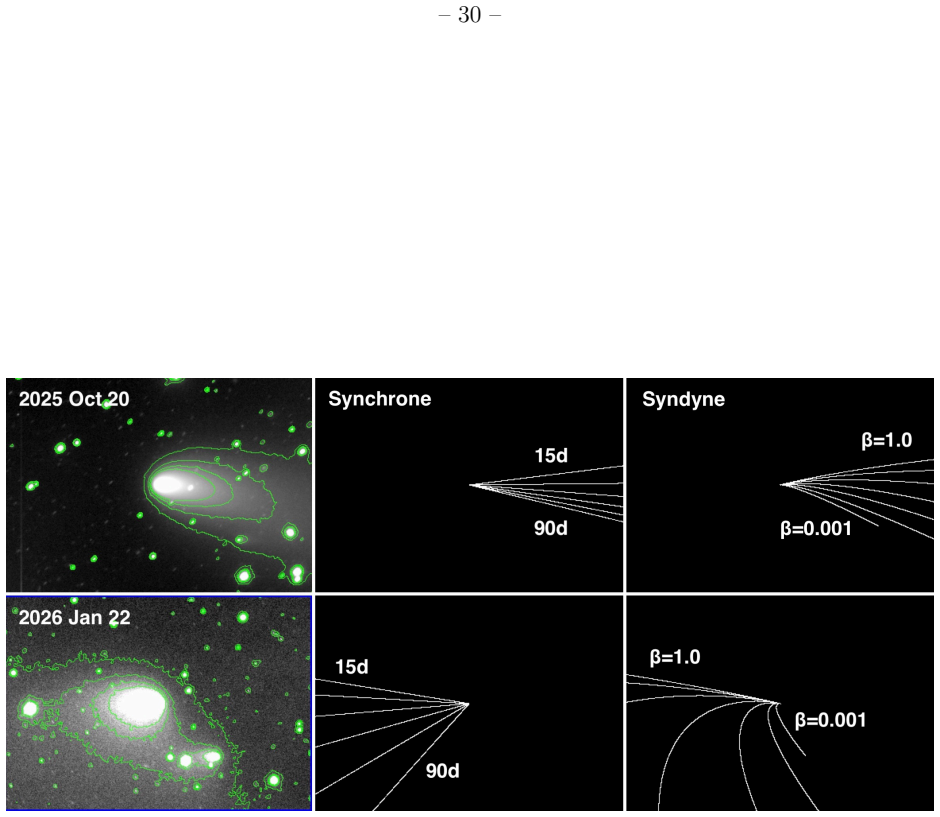
Summary. The manuscript presents time-series observations of the split comet 240P/NEAT from the Nordic Optical Telescope near perihelion. It estimates the radius of component A as 400-600 m with peak dust loss rate 130 kg/s, characteristic dust size 50 μm, sunward ejection at 25 m/s, total ejected mass 1.5×10^9 kg. For component B, peak loss 35 kg/s, total mass 2.3×10^8 kg, radius ~300 m with lower limit 50 m. The components separate at ~1 m/s with age >3 years. The splitting is argued to be incompatible with tides, impacts, or internal pressure, instead supporting rotational instability from outgassing torques, testable by future observations.
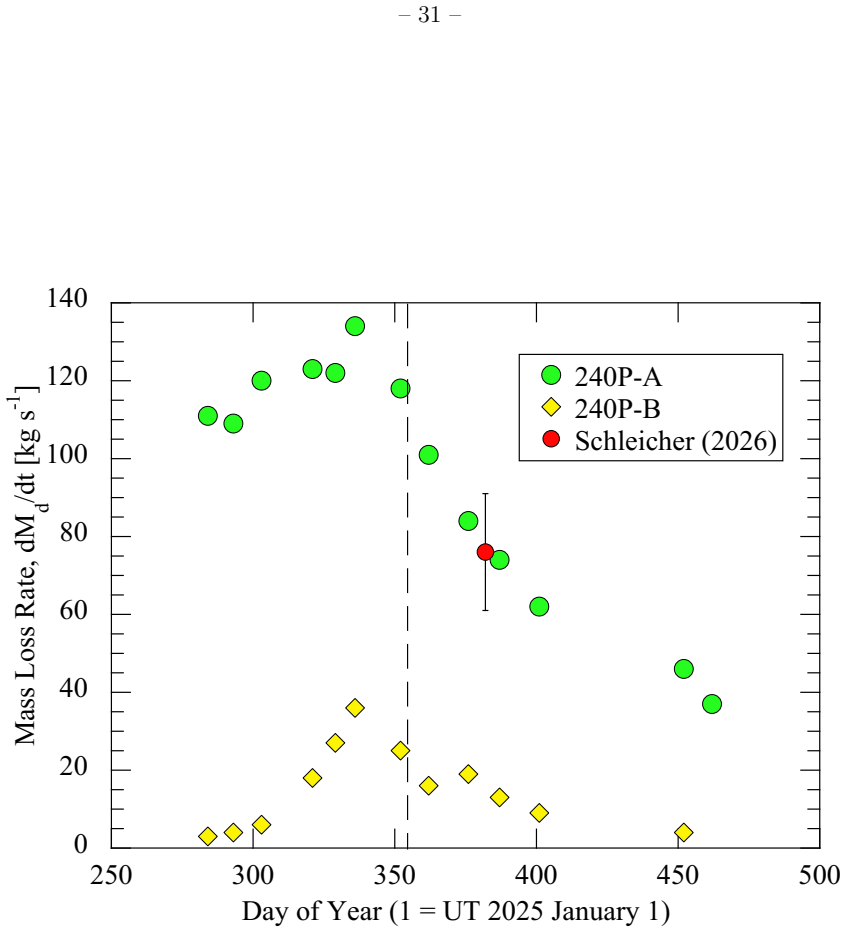
Significance. If the parameter estimates hold, this work strengthens the case for rotational disruption as a dominant destruction mechanism for small comets, adding a well-observed example with explicit uncertainty ranges and a lower limit on the secondary's size. The direct derivation from new data without circular fitting is a positive feature.
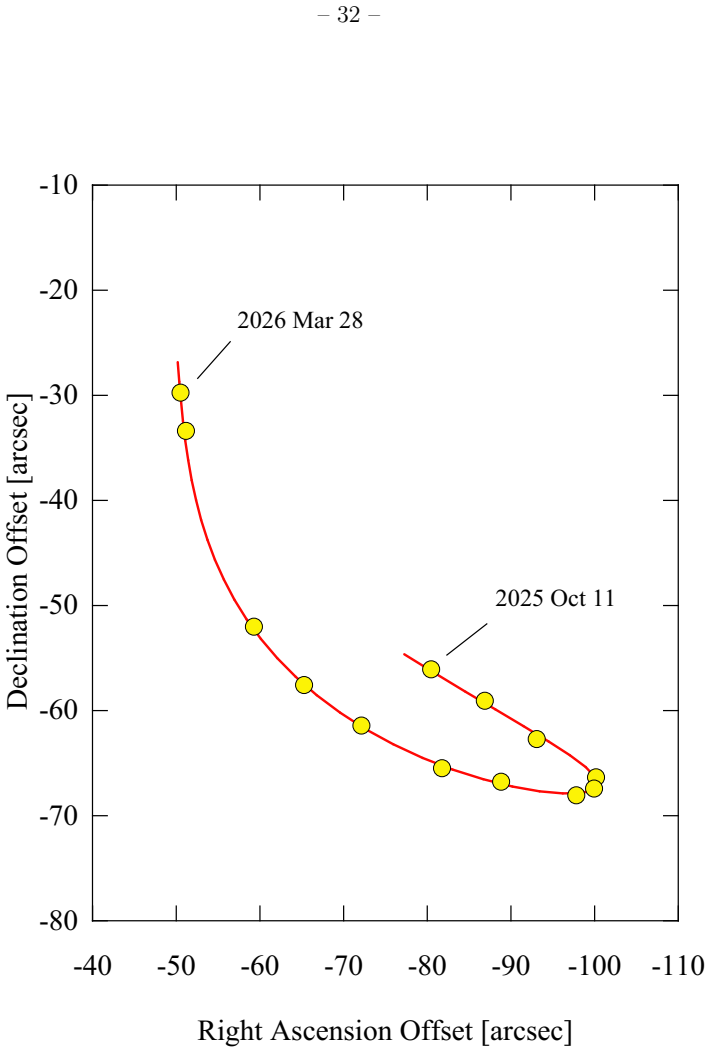
major comments (2)
- [Abstract and discussion of splitting mechanisms] The incompatibility of the observed separation age (>3 yr), velocity (~1 m/s), and mass-loss rates with tidal, impact, and internal pressure mechanisms depends critically on the accuracy of the derived radii (400-600 m for A; ~300 m for B), dust grain size (50 μm), and ejection velocities (25 m/s sunward). The manuscript notes the 50 m lower limit for B but does not provide a quantitative sensitivity analysis showing how plausible systematic errors in albedo, phase function, or grain properties would affect the exclusion of alternatives.
- [Radius and mass-loss estimates] While ranges are provided for A and a lower limit for B, the central claim that 240P fits the rotational instability picture would be strengthened by explicit propagation of uncertainties from the photometric assumptions into the mass and torque calculations used to rule out other mechanisms.
minor comments (1)
- The abstract states 'the radius of 240P-B is uncertain, with a best estimate about 300 m'; consider specifying the method or assumptions used for the best estimate.
Simulated Author's Rebuttal
We thank the referee for the constructive review and recommendation for minor revision. The comments highlight opportunities to strengthen the discussion of mechanism exclusion through additional uncertainty analysis, which we will incorporate.
read point-by-point responses
-
Referee: [Abstract and discussion of splitting mechanisms] The incompatibility of the observed separation age (>3 yr), velocity (~1 m/s), and mass-loss rates with tidal, impact, and internal pressure mechanisms depends critically on the accuracy of the derived radii (400-600 m for A; ~300 m for B), dust grain size (50 μm), and ejection velocities (25 m/s sunward). The manuscript notes the 50 m lower limit for B but does not provide a quantitative sensitivity analysis showing how plausible systematic errors in albedo, phase function, or grain properties would affect the exclusion of alternatives.
Authors: We agree that an explicit quantitative sensitivity analysis would improve the robustness of the mechanism discussion. The reported ranges for component A and the 50 m lower limit for B already reflect conservative photometric assumptions, but we will add a dedicated subsection propagating plausible variations (albedo 0.04–0.1, phase function slope ±0.02 mag/deg, grain size 10–100 μm) through the mass and separation-velocity calculations to demonstrate that the exclusion of tides, impacts, and internal pressure remains valid across this parameter space. revision: yes
-
Referee: [Radius and mass-loss estimates] While ranges are provided for A and a lower limit for B, the central claim that 240P fits the rotational instability picture would be strengthened by explicit propagation of uncertainties from the photometric assumptions into the mass and torque calculations used to rule out other mechanisms.
Authors: We will add explicit uncertainty propagation from the photometric inputs (albedo, phase function, grain size and density) into the derived radii, mass-loss rates, total ejected masses, and outgassing torques. This will include Monte Carlo sampling or analytic error budgets showing how these uncertainties affect the torque timescale and the incompatibility with alternative splitting mechanisms, thereby reinforcing the rotational instability interpretation. revision: yes
Circularity Check
No circularity: all quantities derived from new observations via standard methods; conclusion follows from external model comparisons.
full rationale
The paper computes radii (400-600 m for A, ~300 m for B), dust sizes (~50 μm), mass-loss rates (130 kg/s for A, 35 kg/s for B), ejected masses, separation velocity (~1 m/s), and age (>3 yr) directly from Nordic Optical Telescope time-series photometry and standard dynamical modeling of dust ejection. These are then compared against independent expectations for tides, impacts, and internal pressure. No equation defines a fitted parameter in terms of the rotational-instability conclusion, no self-citation is invoked as a uniqueness theorem, and the incompatibility statement rests on the accuracy of the data-derived numbers rather than on any redefinition or renaming of inputs. The result is therefore self-contained against external benchmarks.
Axiom & Free-Parameter Ledger
free parameters (7)
- radius of 240P-A =
400-600 m
- radius of 240P-B =
~300 m
- peak dust loss rate for A =
130 kg/s
- peak dust loss rate for B =
35 kg/s
- characteristic dust grain size =
50 micron
- sunward ejection speed =
25 m/s
- current separation speed =
1 m/s
axioms (2)
- domain assumption Standard photometric conversion from apparent brightness to nucleus radius assumes known albedo and phase function
- domain assumption Dust mass-loss rates are obtained from coma surface brightness using assumed grain size, density, and velocity distributions
Reference graph
Works this paper leans on
-
[1]
Belton, M. J. S. 2015, Icarus, 245,
2015
-
[2]
doi:10.1016/j.icarus.2014.09.022 Bessell, M. S. 1990, PASP, 102,
-
[3]
doi:10.1086/132749 Boehnhardt, H., Holdstock, S., Hainaut, O., et al. 2002, Earth Moon and Planets, 90, 1,
-
[4]
doi:10.1023/A:1021524720470 Boehnhardt, H. 2004, in Comets II, M. C. Festou, H. U. Keller, and H. A. Weaver (eds.), University of Arizona Press, Tucson, p.301-316 Bohren, C. F. & Huffman, D. R. 1983, Absorption and Scattering of Light by Small Particles. New York: Wiley, 1983 Davidsson, B. J. R. 2024, MNRAS, 527, 1,
-
[5]
doi:10.1093/mnras/stad3055 Finson, M. L. & Probstein, R. F. 1968, ApJ, 154,
-
[6]
doi:10.1086/149761 Groussin, O., Attree, N., Brouet, Y., et al. 2019, Space Sci. Rev., 215, 4,
-
[7]
doi:10.1007/s11214-019-0594-x Jewitt, D. C. & Meech, K. J. 1987, ApJ, 317,
-
[8]
1997, Earth Moon and Planets, 79,
doi:10.1086/165347 Jewitt, D. 1997, Earth Moon and Planets, 79,
-
[9]
doi:10.1023/A:1006272914117 Jewitt, D., Kim, Y., Mutchler, M., et al. 2020, ApJ, 896, 2, L39. doi:10.3847/2041- 8213/ab99cb Jewitt, D. 2021, AJ, 161, 6,
-
[10]
doi:10.3847/1538-3881/abf09c Jewitt, D. 2022, AJ, 164, 4,
-
[11]
Minor Planet Electronic Circular
doi:10.3847/1538-3881/ac886d Jaeger, M., et al. Minor Planet Electronic Circular. 2025-T124 (ISSN 1523-6714), 2025 October 6 – 20 – Jorda, L., Crovisier, J., & Green, D. W. E. 1992, in Proceedings of Asteroids, Comets, Meteors 1991, Editors Harris, A. W. and Bowell, E.,
-
[12]
Kelley, M. S. P., Bodewits, D., Ye, Q., et al. 2019, ApJ, 886, 1, L16. doi:10.3847/2041- 8213/ab53e0 Kim, Y., Ishiguro, M., & Usui, F. 2014, ApJ, 789, 2,
-
[13]
doi:10.1088/0004-637X/789/2/151 Kokotanekova, R., Snodgrass, C., Lacerda, P., et al. 2017, MNRAS, 471, 3,
-
[14]
doi:10.1093/mnras/stx1716 Landolt, A. U. 1992, AJ, 104,
-
[15]
J., Bambery, R., Helin, E., et al
doi:10.1086/116242 Lawrence, K. J., Bambery, R., Helin, E., et al. 2002, IAU Circ., 8029,
-
[16]
Levison, H. F. & Duncan, M. J. 1994, Icarus, 108, 1,
1994
-
[17]
Icarus108, 18–36 (1994) https://doi.org/10.1006/icar.1994.1039
doi:10.1006/icar.1994.1039 Prialnik, D. & Jewitt, D. 2024, In Comets III, Edited by Karen J. Meech et al. Space Science Series, University of Arizona Press, Tucson, pp. 823-844 Samarasinha, N. H. 2001, Icarus, 154, 2,
-
[18]
doi:10.1006/icar.2001.6685 Samarasinha, N. H. 2007, Advances in Space Research, 39, 3,
-
[19]
doi:10.1016/j.asr.2004.07.016 Sekanina, Z. 1982, In: Comets, edited by L. L. Wilkening, University of Arizona Press, Tucson, AZ, p. 251-287. Tauber, F. & Kuhrt, E. 1987, Icarus, 69, 1,
-
[20]
doi:10.1016/0019-1035(87)90008-X This manuscript was prepared with the AAS LATEX macros v5.2. – 21 – Table
-
[21]
Observation Log UT Datea Timeb DOY25c rH d ∆e αf θ−⊙g θ−V h δ⊕i νj Oct 11 04:28 - 04:52 284 2.192 1.394 19.8 279.1 234.1 13.9 333.8 Oct 20 01:11 - 04:40 293 2.175 1.315 17.0 284.9 234.7 13.0 337.0 Oct 30 02:13 - 02:23 303 2.159 1.242 13.3 294.1 235.3 11.4 340.7 Nov 17 00:38 - 00:42 321 2.138 1.167 6.9 337.1 235.6 6.7 347.4 Nov 25 01:29 - 01:32 329 2.131 1...
2025
-
[22]
Observations of 240P Datea DOY25b ∆RAc ∆Decd A/HA/CA/ ˙Mde B/HB/CB/ ˙Mdf ∆(B−A) g Oct 11 284 -80.5 -56.1 14.30/11.08/1390/111 18.27/15.05/36/3 3.97±0.02 Oct 20 293 -86.9 -59.1 14.06/11.10/1368/109 17.72/14.75/47/4 3.66±0.02 Oct 30 303 -93.1 -62.7 13.67/10.99/1503/120 17.01/14.33/69/6 3.34±0.02 Nov 17 321 -100.2 -66.3 13.23/10.97/1534/123 15.28/13.02/232/1...
2025
-
[23]
— aFor brevity the numbers in parentheses show 1σuncertainties in the last digit (e.g., 3.14159(6) = 3.14159±6) ba= semimajor axis (au),e= eccentricity,i= inclination (degree), Ω = longitude of ascending node (degree),ω= argument of perihelion (degree), M= mean anomaly (degree),T P = date of perihelion (2025), Arc = Arc length (days), Root mean square res...
2025
-
[24]
Summary Table Quantity 240P-A 240P-B Radiusa [m] 500±100≥50 Massb [kg] 2.6 +1.9 −1.3 ×10 11 ≥2.3×10 8 ˙M c [kg s−1] 130 36 ∆Mdd [kg orbit−1] 1.5×10 9 2.3×10 8 τ=M t/∆M de [year] 1200≥7 τsf [year] 25<1 aRadius of equal mass sphere bNucleus mass assuming densityρ n = 500 kg m −3 cPeak dust mass loss rate dMass loss per orbit eMass loss lifetime,t= orbital p...
2025
-
[25]
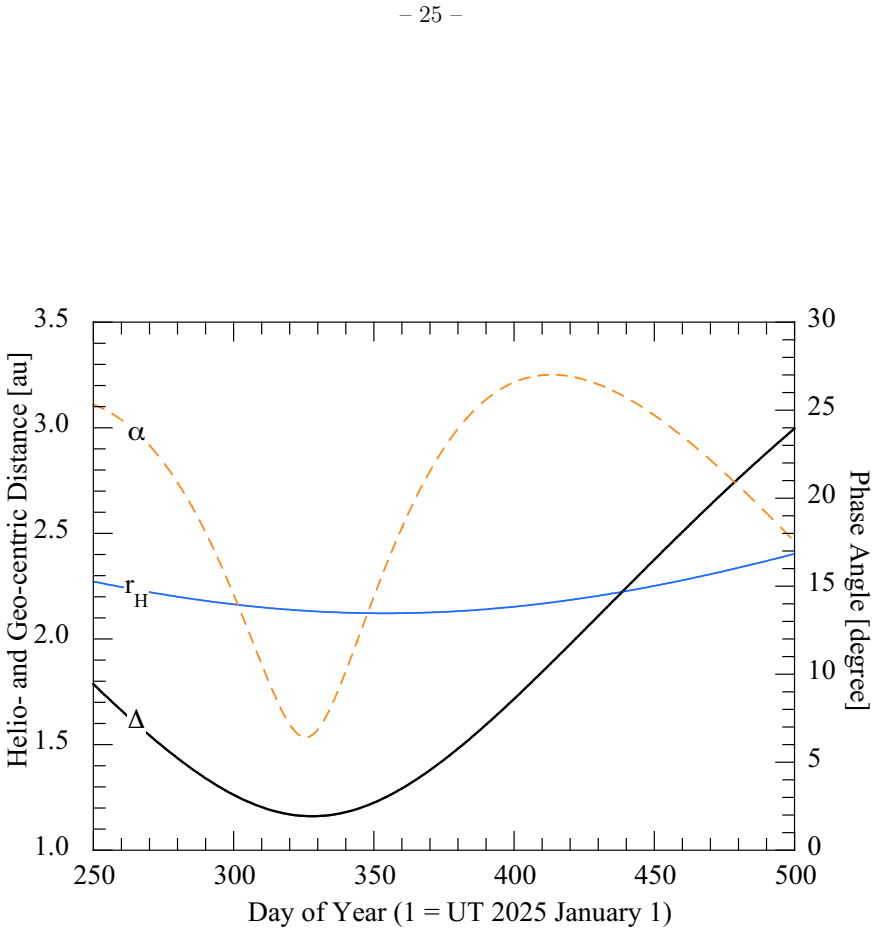
1.— Geometry of observation as a function of observation date
αΔrH Fig. 1.— Geometry of observation as a function of observation date. Heliocentric (r H) and geocentric (∆) distances refer to the left hand axis while phase angle (α) is plotted on the right. – 26 – Fig. 2.— Composite of images showing the development of 240P from 2025 October 11 to 2026 April 7 (c.f., Table 1). 240P-A and 240P-B are marked by short v...
2025
-
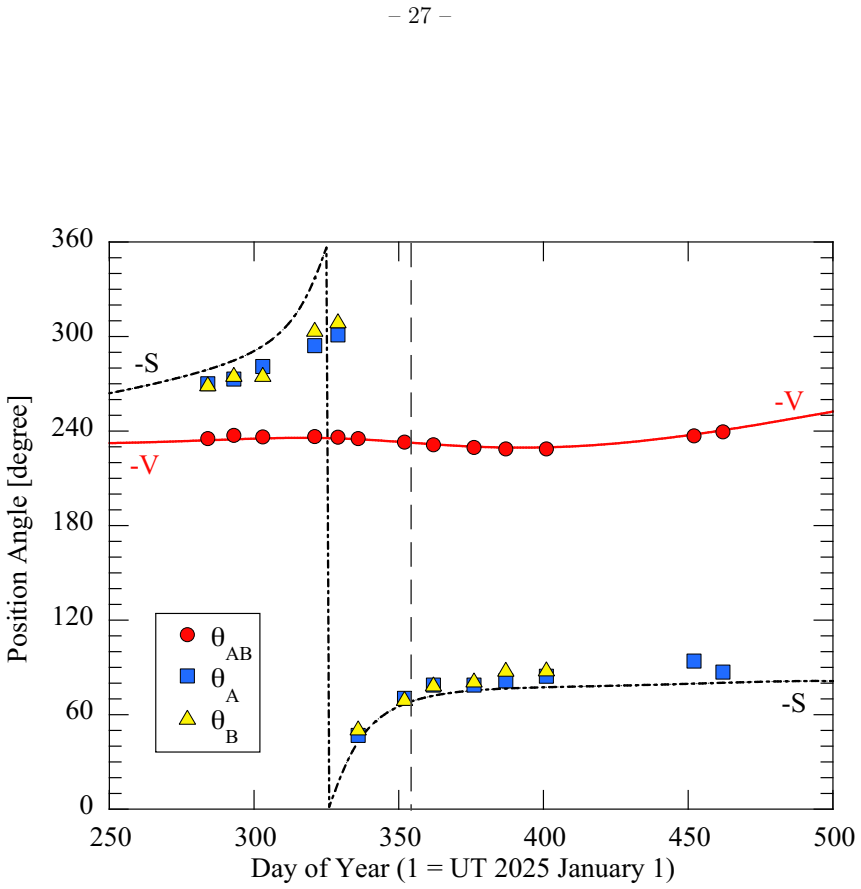
[26]
-V-S-S-V Fig. 3.— Measured position angles of the line connecting 240P-A to 240P-B line (red circles labelledθ AB) and of the tail directions on 240P-A and 240P-B (blue squares and yellow triangles, labelledθ A andθ B, respectively). The solid red line shows the negative projected velocity of the comet while the dot-dash black line shows the projected ant...
2025
-
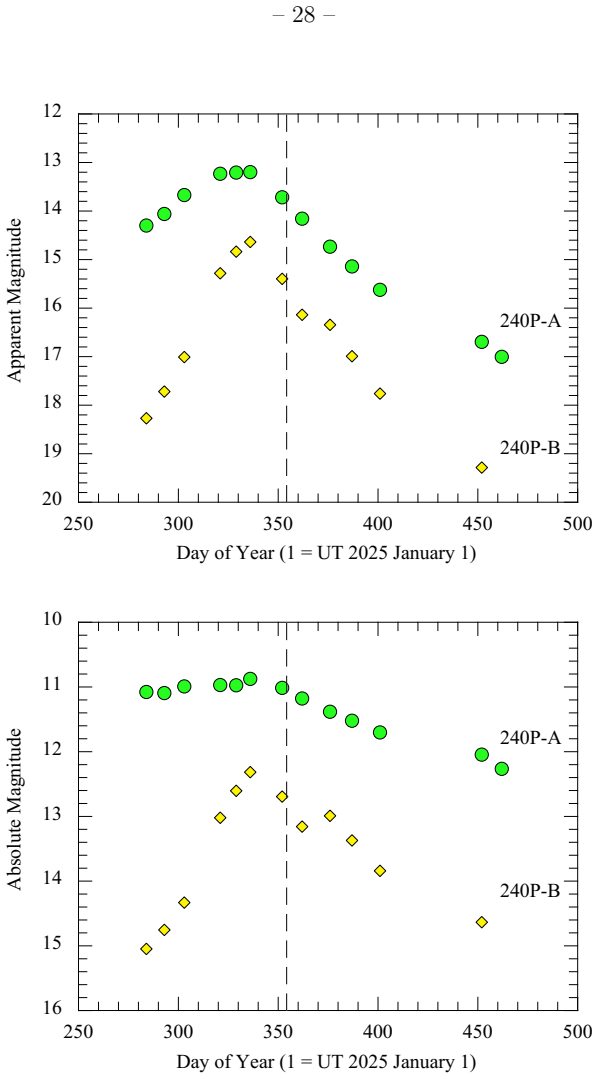
[27]
4.— (Upper:) Apparent R band magnitudes of 240P-A (green circles) and 240P-B (yellow diamonds) measured within an aperture of fixed linear radius 104 km
240P-A240P-B Fig. 4.— (Upper:) Apparent R band magnitudes of 240P-A (green circles) and 240P-B (yellow diamonds) measured within an aperture of fixed linear radius 104 km. Error bars are smaller than the symbols used to show the data. (Lower:) Absolute magnitude as a function of observation date. In both panels, the vertical dashed line marks the date of ...
2025
-
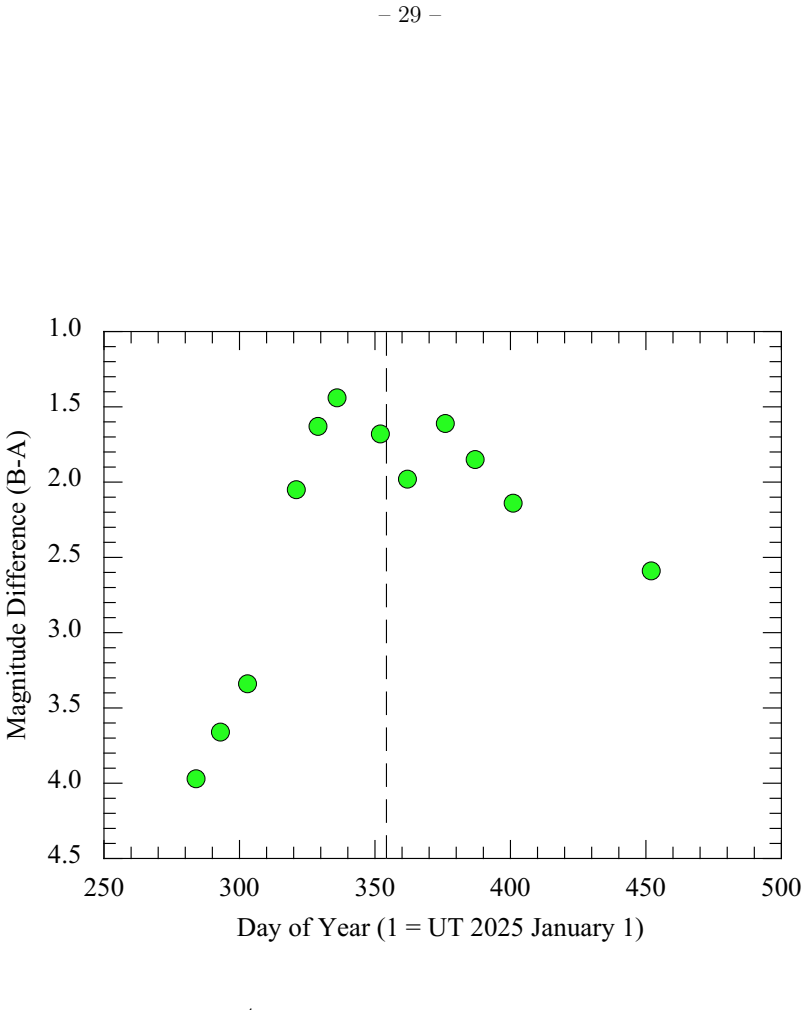
[28]
5.— Difference of the 10 4 km aperture magnitudes, B-A, vs
Fig. 5.— Difference of the 10 4 km aperture magnitudes, B-A, vs. date of observation. The vertical dashed line marks the date of perihelion. – 30 – Fig. 6.— NOT images from (upper) UT 2025 October 20 and (lower) UT 2026 January
2025
-
[29]
– 31 – 020406080100120140 250300350400450500 240P-A240P-BSchleicher (2026) Mass Loss Rate, dM d /dt [kg s -1 ] Day of Year (1 = UT 2025 January
Synchrone and syndyne trajectories are shown in the middle and right-hand panels for each epoch. – 31 – 020406080100120140 250300350400450500 240P-A240P-BSchleicher (2026) Mass Loss Rate, dM d /dt [kg s -1 ] Day of Year (1 = UT 2025 January
2026
-
[30]
7.— Dust mass loss rates from 240P-A (green circles) and 240P-B (yellow diamonds) (c.f., Table 2)
Fig. 7.— Dust mass loss rates from 240P-A (green circles) and 240P-B (yellow diamonds) (c.f., Table 2). The red circle shows the water production rate by Schleicher (2026). The dashed vertical line marks the date of perihelion. – 32 – -80-70-60-50-40-30-20-10 -110-100-90-80-70-60-50-40 Declination Offset [arcsec] Right Ascension Offset [arcsec] 2025 Oct 1...
2026
discussion (0)
Sign in with ORCID, Apple, or X to comment. Anyone can read and Pith papers without signing in.