Instabilities of the continuous superradiant laser
Pith reviewed 2026-06-26 13:33 UTC · model grok-4.3
The pith
A continuous superradiant laser develops chaotic intensity instabilities only when the cavity photon lifetime is much shorter than the atomic lifetime.
A machine-rendered reading of the paper's core claim, the machinery that carries it, and where it could break.
Core claim
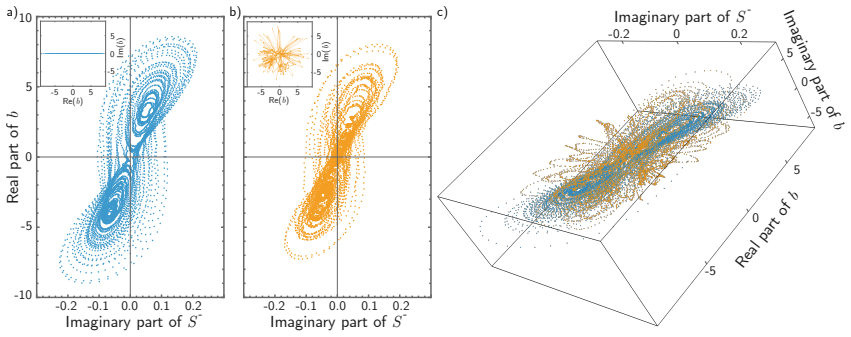
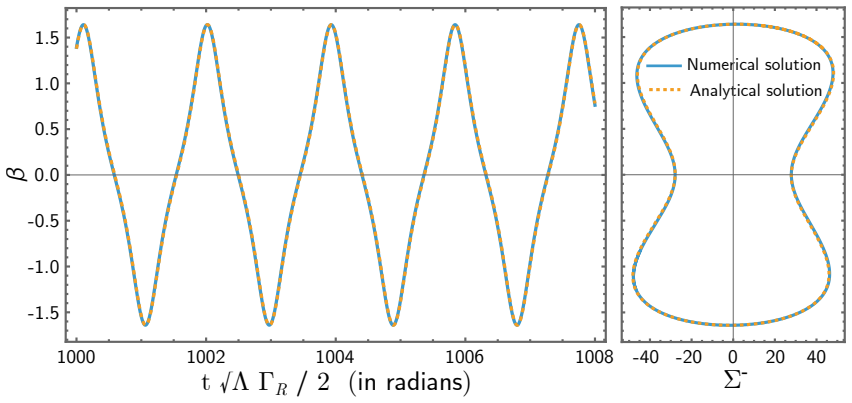
We show that such superradiant laser can become unstable and develop chaotic behavior. We derive an analytical criterion for this instability and find that it may only occur when the lifetime of photons in the cavity is significantly shorter than the lifetime of atoms. This criterion allows for refining the necessary parameters to run a superradiant laser as a frequency reference in the optical domain. In particular, we point-out the consequences of the instability on intensity fluctuations and laser linewidth. On the other hand, we also point out that the superradiant laser, when in the unstable regime, can become an interesting playground for studying chaos. At the mean-field level, there
What carries the argument
The mean-field mapping of the atom-cavity equations onto the Bénard instability, which supplies the closed-form criterion on the photon-to-atom lifetime ratio.
If this is right
- Stable operation as an optical frequency reference requires the photon lifetime to exceed the atomic lifetime by a sufficient margin.
- Crossing the threshold produces increased intensity fluctuations and a broadened laser linewidth.
- At high enough atom numbers the system enters a regular self-pulsing regime rather than sustained chaos.
- The architecture supplies a controllable platform for studying chaos whose attractors are modified by photon out-coupling and atom re-filling.
Where Pith is reading between the lines
- Varying cavity finesse while holding atom flux fixed would provide a direct experimental test of the lifetime-ratio threshold.
- The quantum corrections to the classical Bénard mapping could be exploited to study how dissipation regularizes chaotic dynamics in open quantum systems.
- The self-pulsing regime may offer a route to pulsed superradiant sources without external modulation.
- Similar lifetime-ratio criteria may govern stability in other continuously pumped cavity-QED systems.
Load-bearing premise
The instability threshold is obtained from a mean-field treatment of the atom-cavity dynamics that permits a direct mapping to the Bénard instability.
What would settle it
Stable continuous-wave operation observed when the cavity photon lifetime is made significantly shorter than the atomic lifetime, or the appearance of chaos when the photon lifetime is made longer, would falsify the derived criterion.
Figures
read the original abstract
We investigate the intensity stability of the superradiant laser. Our study focuses on the architecture where a continuous beam of atoms in an electronically excited state crosses the mode of a high-finesse Fabry-Perot cavity, which has been proposed as a new architecture of an active optical clock. We show that such superradiant laser can become unstable and develop chaotic behavior. We derive an analytical criterion for this instability and find that it may only occur when the lifetime of photons in the cavity is significantly shorter than the lifetime of atoms. This criterion allows for refining the necessary parameters to run a superradiant laser as a frequency reference in the optical domain. In particular, we point-out the consequences of the instability on intensity fluctuations and laser linewidth. On the other hand, we also point out that the superradiant laser, when in the unstable regime, can become an interesting playground for studying chaos. At the mean-field level, there is a direct mapping to the B\'enard instability associated with fluid turbulence; however quantum fluctuations associated with photon out-coupling and atom re-filling substantially modify the expected behaviors. Finally, we point-out the existence of a regular self-pulsing regime at large atom numbers.
Editorial analysis
A structured set of objections, weighed in public.
Referee Report
Summary. The manuscript analyzes intensity stability in a continuous superradiant laser formed by a beam of electronically excited atoms traversing the mode of a high-finesse Fabry-Perot cavity. It derives an analytical instability criterion at the mean-field level, showing that chaotic behavior can arise only when the photon lifetime in the cavity is much shorter than the atomic lifetime; this maps directly onto the Bénard instability. The work discusses consequences for intensity fluctuations and linewidth when used as an optical frequency reference, notes that quantum fluctuations from photon out-coupling and atom re-filling substantially alter mean-field expectations, and identifies a regular self-pulsing regime at large atom numbers.
Significance. If the lifetime-ratio criterion remains valid beyond the mean-field approximation, the result supplies a concrete, analytically derived constraint useful for designing stable superradiant lasers as frequency references. The explicit mapping to the Bénard instability together with the identification of a self-pulsing regime offers a concrete link between cavity QED and classical nonlinear dynamics, while the emphasis on quantum modifications highlights an area where further analytic or numerical work could be pursued.
major comments (1)
- [analytical derivation of the instability criterion] The analytical criterion is obtained from the mean-field equations that permit a direct mapping to the Bénard instability. The manuscript explicitly states that quantum fluctuations associated with photon out-coupling and atom re-filling substantially modify the expected behaviors, yet it is not shown whether the photon-lifetime ≪ atom-lifetime threshold itself is altered once these terms are restored. This point is load-bearing for the central claim that the instability “may only occur” under the stated lifetime condition.
minor comments (2)
- [abstract/introduction] The abstract and introduction would benefit from a brief statement of the model equations (or a reference to the section containing them) so that the mean-field approximation and the subsequent inclusion of quantum terms can be followed without ambiguity.
- [throughout] Notation for the photon and atomic decay rates should be introduced once and used consistently when stating the lifetime-ratio condition.
Simulated Author's Rebuttal
We thank the referee for the careful reading of our manuscript and the constructive feedback. We address the single major comment below.
read point-by-point responses
-
Referee: [analytical derivation of the instability criterion] The analytical criterion is obtained from the mean-field equations that permit a direct mapping to the Bénard instability. The manuscript explicitly states that quantum fluctuations associated with photon out-coupling and atom re-filling substantially modify the expected behaviors, yet it is not shown whether the photon-lifetime ≪ atom-lifetime threshold itself is altered once these terms are restored. This point is load-bearing for the central claim that the instability “may only occur” under the stated lifetime condition.
Authors: We agree that the instability criterion is derived strictly from the mean-field equations, as stated in the manuscript (see the paragraph beginning 'At the mean-field level...'). The central claim is therefore that the instability may only occur under the stated lifetime condition within the mean-field description. We explicitly note that quantum fluctuations modify the expected behaviors once the system enters the unstable regime (e.g., the appearance of a regular self-pulsing regime at large atom numbers). However, we have not restored the quantum terms to the equations of motion and re-derived the linear stability threshold, so it remains unproven whether the precise photon-lifetime ≪ atom-lifetime boundary itself shifts. A full quantum treatment would require either a stochastic simulation of the master equation or a cumulant expansion beyond mean-field, both of which lie outside the present scope. We will revise the manuscript to state more explicitly that the reported criterion is a mean-field result and that possible quantum corrections to the onset threshold constitute an open question for future work. revision: yes
Circularity Check
No circularity: analytical instability criterion derived from mean-field equations with external mapping to Bénard instability
full rationale
The paper derives an analytical criterion for instability by mapping the mean-field atom-cavity dynamics onto the known Bénard instability, yielding the photon-lifetime ≪ atom-lifetime condition. No equations or text indicate that this threshold is obtained by fitting parameters to data and then relabeling the fit as a prediction, nor does any load-bearing step reduce to a self-citation whose content is itself unverified. The Bénard reference is an external, independently established fluid-dynamics result. Quantum-fluctuation caveats are explicitly flagged as modifying behaviors beyond the mean-field threshold, but the threshold itself is not claimed to be re-derived from those fluctuations; this is an approximation limitation, not a definitional loop. The derivation chain is therefore self-contained against external benchmarks.
Axiom & Free-Parameter Ledger
axioms (1)
- domain assumption Mean-field approximation suffices to derive the instability threshold and permits mapping onto the Bénard instability
Reference graph
Works this paper leans on
-
[1]
M. A. Norcia, M. N. Winchester, J. R. K. Cline, and J. K. Thompson,Superradiance on the millihertz linewidth strontium clock transition, Sci. Adv.2, e1601231 (2016)
2016
-
[2]
D. Pan, B. Arora, Y. mei Yu, B. K. Sahoo, and J. Chen,Optical-lattice-based Cs active clock with a continual superradiant lasing signal, Phys. Rev. A102, 041101 (2020)
2020
-
[3]
Laske, H
T. Laske, H. Winter, and A. Hemmerich,Pulse delay time statistics in a superradiant laser with calcium atoms, Phys. Rev. Lett.123, 103601 (2019)
2019
-
[4]
S. A. Sch¨ affer, M. Tang, M. R. Henriksen, A. A. Jørgensen, B. T. R. Christensen, and J. W. Thomsen,Lasing on a narrow transition in a cold thermal strontium ensemble, Phys. Rev. A101, 013819 (2020)
2020
-
[5]
Fam` a, S
F. Fam` a, S. Zhou, B. Heizenreder, M. Tang, S. Bennetts, S. B. J¨ ager, S. A. Sch¨ affer, and F. Schreck,Continuous cavity qed with an atomic beam, Phys. Rev. A110, 063721 (2024)
2024
-
[6]
Chen,Active optical clock, Chin
J. Chen,Active optical clock, Chin. Sci. Bull.54, 348 (2009)
2009
-
[7]
Meiser, J
D. Meiser, J. Ye, D. R. Carlson, and M. J. Holland,Prospects for a millihertz-linewidth laser, Phys. Rev. Lett.102, 163601 (2009)
2009
-
[8]
H. Liu, S. B. J¨ ager, X. Yu, S. Touzard, A. Shankar, M. J. Holland, and T. L. Nicholson,Rugged mHz-linewidth superradiant laser driven by a hot atomic beam, Phys. Rev. Lett.125, 253602 (2020)
2020
-
[9]
Laburthe-Tolra, Z
B. Laburthe-Tolra, Z. Amodjee, B. Pasquiou, and M. R. de Saint-Vincent,Correlations and linewidth of the atomic beam continuous superradiant laser, SciPost Phys. Core6, 015 (2023)
2023
-
[10]
Haken,Analogy between higher instabilities in fluids and lasers, Physics Letters A53, 77–78 (1975)
H. Haken,Analogy between higher instabilities in fluids and lasers, Physics Letters A53, 77–78 (1975)
1975
-
[11]
Haken,Light: Laser light dynamics, Vol
H. Haken,Light: Laser light dynamics, Vol. 2 (North-Holl. Publ. Co., Amsterdam, 1986)
1986
-
[12]
S. B. J¨ ager, H. Liu, J. Cooper, T. L. Nicholson, and M. J. Holland,Superradiant emission of a thermal atomic beam into an optical cavity, Phys. Rev. A104, 033711 (2021). 17
2021
-
[13]
S. B. J¨ ager, H. Liu, A. Shankar, J. Cooper, and M. J. Holland,Regular and bistable steady-state superradiant phases of an atomic beam traversing an optical cavity, Phys. Rev. A103, 013720 (2021)
2021
-
[14]
Patra, B
A. Patra, B. L. Altshuler, and E. A. Yuzbashyan,Driven-dissipative dynamics of atomic ensembles in a resonant cavity: Nonequilibrium phase diagram and periodically modulated superradiance, Phys. Rev. A99, 033802 (2019)
2019
-
[15]
H. Hara, J. Han, Y. Imai, N. Sasao, A. Yoshimi, K. Yoshimura, M. Yoshimura, and Y. Miyamoto, Periodic superradiance in an er:yso crystal, Phys. Rev. Res.6, 013005 (2024)
2024
-
[16]
H. Hara, Y. Miyamoto, J. Han, R. Omoto, Y. Imai, A. Yoshimi, K. Yoshimura, M. Yoshimura, and N. Sasao,Analytical and numerical studies of periodic superradiance, Phys. Rev. A113, 043713 (2026)
2026
-
[17]
T. Xie, R. Fukumori, W.-K. Mok, J. Li, J. Choi, and A. Faraon,Observation of tunable superra- diant frequency combs, arXiv:2604.14601 10.48550/ARXIV.2604.14601 (2026)
work page internal anchor Pith review Pith/arXiv arXiv doi:10.48550/arxiv.2604.14601 2026
-
[18]
D. A. Tieri, M. Xu, D. Meiser, J. Cooper, and M. J. Holland,Theory of the crossover from lasing to steady state superradiance, arXiv:1702.04830 10.48550/ARXIV.1702.04830 (2017)
work page internal anchor Pith review Pith/arXiv arXiv doi:10.48550/arxiv.1702.04830 2017
-
[19]
Debnath, Y
K. Debnath, Y. Zhang, and K. Mølmer,Lasing in the superradiant crossover regime, Phys. Rev. A98, 063837 (2018)
2018
-
[20]
S. B. J¨ ager, M. J. Holland, and G. Morigi,Superradiant optomechanical phases of cold atomic gases in optical resonators, Phys. Rev. A101, 023616 (2020)
2020
-
[21]
S. B. J¨ ager, M. Xu, S. Sch¨ utz, M. J. Holland, and G. Morigi,Semiclassical theory of synchronization-assisted cooling, Phys. Rev. A95, 063852 (2017)
2017
-
[22]
Kirton and J
P. Kirton and J. Keeling,Suppressing and restoring the dicke superradiance transition by dephasing and decay, Phys. Rev. Lett.118, 123602 (2017)
2017
-
[23]
Dubey,Quantitative modeling towards continuous superradiant laser on Sr, Ph.D
S. Dubey,Quantitative modeling towards continuous superradiant laser on Sr, Ph.D. thesis, Tech- nische Universit¨ at Wien (2024)
2024
-
[24]
J. A. Fleck,Quantum theory of laser radiation. ii. statistical aspects of laser light, Phys. Rev.149, 322–329 (1966)
1966
-
[25]
J. A. Fleck,Nonlinear laser noise and coherence, Journal of Applied Physics37, 188–193 (1966)
1966
-
[26]
Sargent, M
M. Sargent, M. O. Scully, and W. E. Lamb,Laser physics, 2nd ed., Advanced book program (Addison-Wesley, Reading, Mass. [u.a.], 1977) literaturangaben
1977
-
[27]
Benkert, M
C. Benkert, M. O. Scully, J. Bergou, L. Davidovich, M. Hillery, and M. Orszag,Role of pumping statistics in laser dynamics: Quantum langevin approach, Phys. Rev. A41, 2756–2765 (1990)
1990
-
[28]
Schachenmayer, A
J. Schachenmayer, A. Pikovski, and A. M. Rey,Many-body quantum spin dynamics with Monte Carlo trajectories on a discrete phase space, Phys. Rev. X5, 011022 (2015)
2015
-
[29]
M. P. van Exter, S. J. M. Kuppens, and J. P. Woerdman,Theory for the linewidth of a bad-cavity laser, Phys. Rev. A51, 809 (1995). 18
1995
discussion (0)
Sign in with ORCID, Apple, or X to comment. Anyone can read and Pith papers without signing in.