Heavy-Tailed Dispersal Kernels from Stopped Subdiffusive Fractional Brownian Motion
Pith reviewed 2026-06-26 12:30 UTC · model grok-4.3
The pith
Mixing Gamma-distributed stopping rates with exponential times generates heavy-tailed kernels from subdiffusive fractional Brownian motion.
A machine-rendered reading of the paper's core claim, the machinery that carries it, and where it could break.
Core claim
When the stopping rate of subdiffusive fractional Brownian motion is drawn from a Gamma distribution, the density of final radial positions acquires a heavy tail while the strong localized aggregation characteristic of the underlying motion is retained.
What carries the argument
Gamma-distributed heterogeneity in the exponential stopping-rate parameter, which mixes the stopping times to produce the heavy tail.
If this is right
- The resulting redistribution kernel simultaneously describes localized aggregation and long-distance dispersal events.
- The heavy tail arises directly from the rate mixing without altering the fractional Brownian motion itself.
- The model applies to systems where exponential stopping with fixed rate is insufficient but subdiffusive clumping is observed.
Where Pith is reading between the lines
- Similar rate mixing could be tested on other subdiffusive processes to check whether heavy tails emerge generically.
- Spatial variation in the Gamma parameters might link local environment to dispersal range in biological data.
- The independence assumption between trajectory and stopping rate could be relaxed to explore correlated effects on the tail.
Load-bearing premise
The heterogeneity in stopping rates must be Gamma distributed and independent of the particle trajectories.
What would settle it
Measure the empirical distribution of stopping times in a system exhibiting both clumping and long jumps; if it is not consistent with a Gamma mixture, or if the position density lacks the predicted heavy tail under that mixture, the claim fails.
Figures
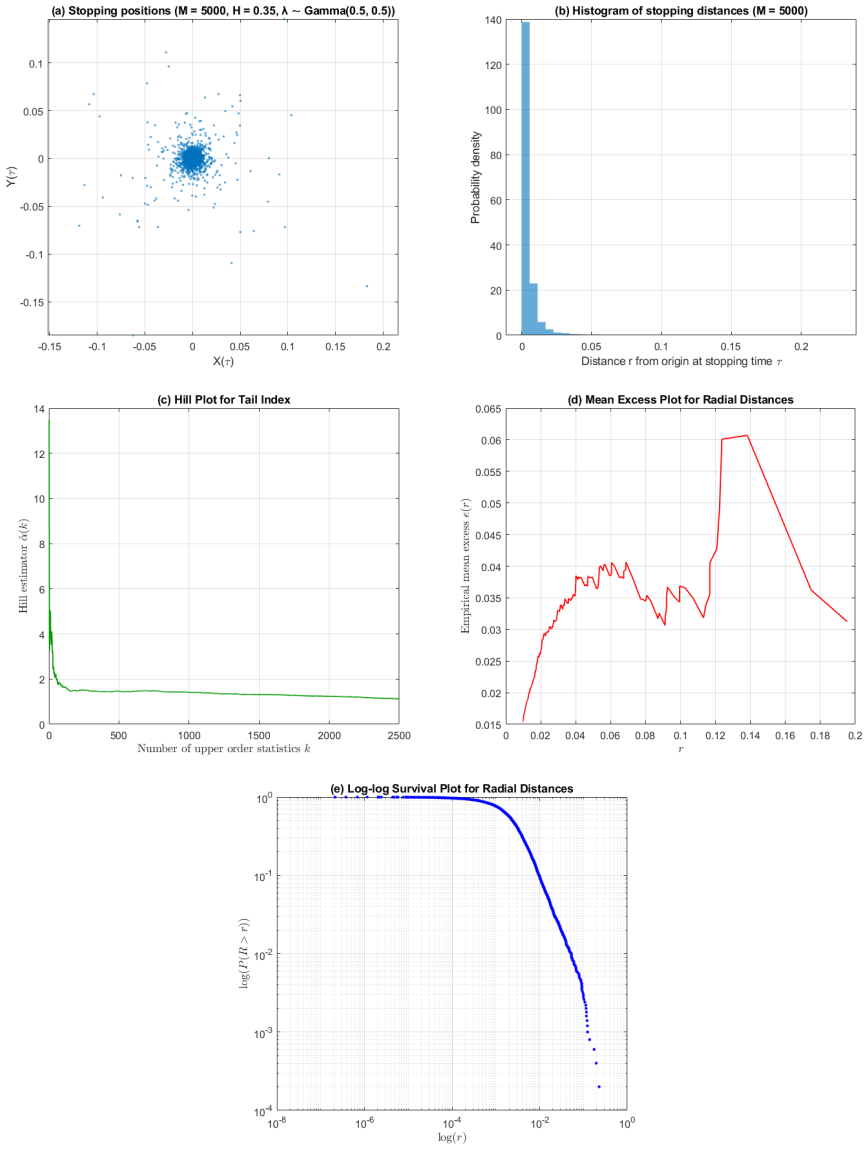
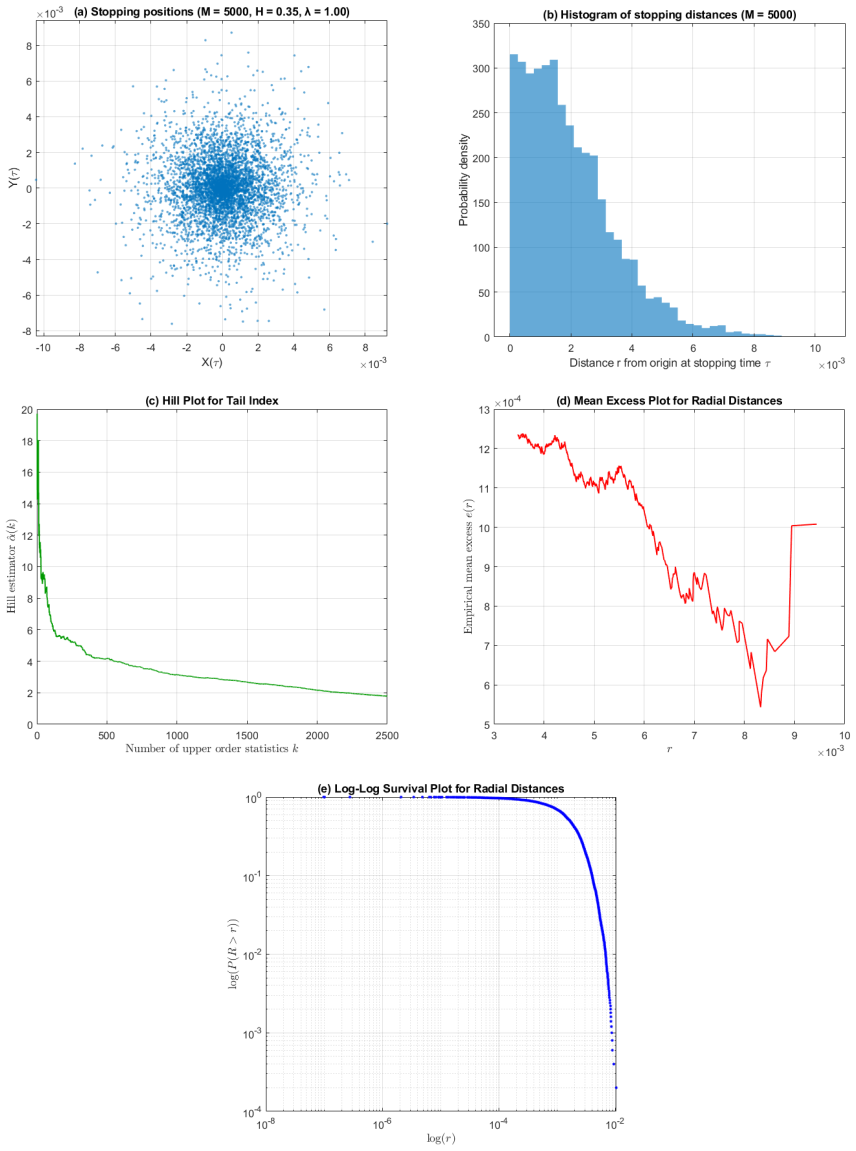
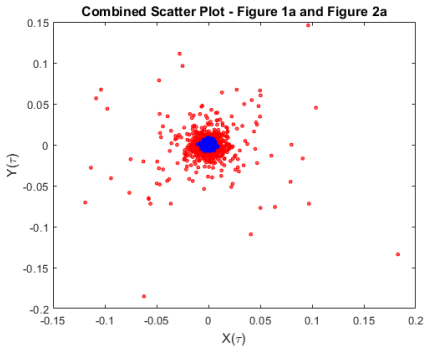
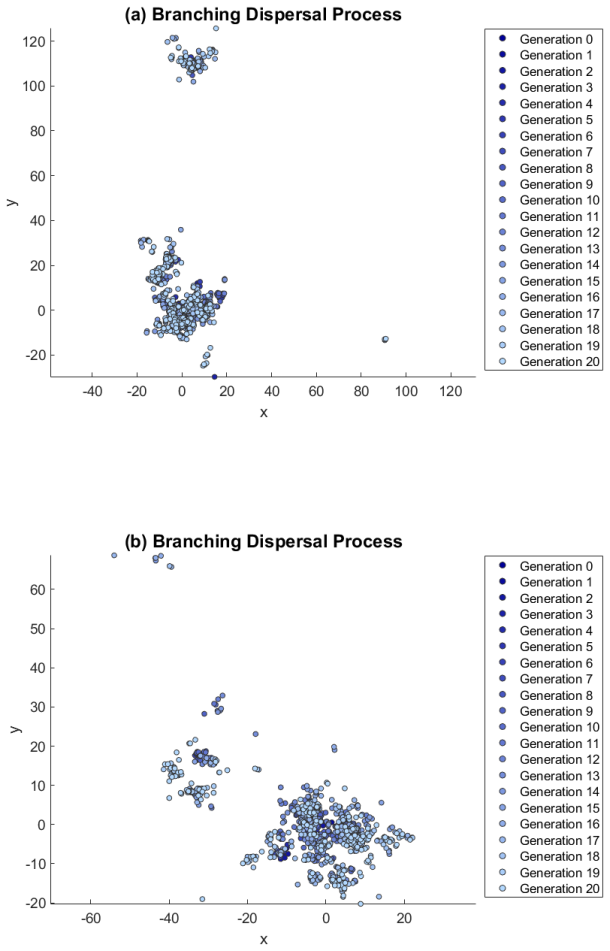
read the original abstract
Subdiffusive fractional Brownian motions produce localized aggregation when particles are stopped at exponentially distributed times. In applications where clumping and long-distance dispersal events are observed simultaneously, such as in some instances of seed dispersal, this model fails to describe the tails of the data. The resulting redistribution kernel has only an exponentially decaying tail, whereas a heavier tail is needed for modeling the long-distance dispersal observed. Here we propose a model in which subdiffusive particles stop at exponentially distributed times, but with a rate parameter that is Gamma distributed. This heterogeneity in stopping rates causes the density of final radial positions to have a heavy-tailed distribution. Our model retains the strong localized clumping characteristic of subdiffusive fractional Brownian motion while simultaneously generating the heavy tails required for realistic long-distance dispersal.
Editorial analysis
A structured set of objections, weighed in public.
Referee Report
Summary. The manuscript proposes a model in which subdiffusive fractional Brownian motion is stopped at exponentially distributed times whose rate parameter is drawn from a Gamma distribution. This heterogeneity produces a heavy-tailed (power-law) distribution for the final radial positions while retaining the strong localized clumping characteristic of the underlying subdiffusive dynamics. The construction is motivated by the need to describe both aggregation and long-distance dispersal events, as observed in some seed-dispersal data.
Significance. If the central derivation holds, the model supplies a transparent mechanism that reconciles subdiffusive clumping with heavy tails via the known mapping from Gamma-mixed exponential rates to Lomax stopping times and the sublinear scaling |X(τ)| ~ τ^H of fBM. This is a strength for applications requiring both features without ad-hoc additions to the trajectory itself.
minor comments (2)
- [Abstract] Abstract: the claim that the Gamma mixture 'causes' the heavy tail would be strengthened by a one-sentence indication of the explicit step (Lomax marginal on τ followed by the fBM scaling), even if the full derivation appears later in the text.
- The independence between the rate draw and the fBM trajectory is stated as a modeling choice; a brief remark on whether this assumption can be relaxed or tested against data would clarify the scope.
Simulated Author's Rebuttal
We thank the referee for their accurate summary of the manuscript and for recommending minor revision. The referee correctly identifies the central construction (Gamma-mixed exponential stopping times applied to subdiffusive fBM) and its intended application to seed-dispersal kernels that combine strong local aggregation with heavy tails.
Circularity Check
No significant circularity identified
full rationale
The paper proposes an explicit modeling construction in which subdiffusive fBM trajectories are stopped at times whose rates are drawn from a Gamma distribution; the resulting marginal on stopping time is Lomax (by standard Gamma-exponential mixture) and the radial position density inherits a power-law tail via the known sublinear scaling of fBM. This is presented as a sufficient mechanism for simultaneous clumping and heavy tails rather than a first-principles derivation whose output is forced by hidden inputs. No equations reduce to tautologies, no parameters are fitted to the target tail and then relabeled as predictions, and no self-citation chain supplies a uniqueness theorem. The derivation chain is therefore self-contained as a proposed stochastic process whose properties follow from elementary probability.
Axiom & Free-Parameter Ledger
free parameters (1)
- Gamma shape and rate parameters for stopping distribution
axioms (1)
- domain assumption Subdiffusive fractional Brownian motion with independent exponential stopping times is an appropriate base process for the dispersal problem.
Reference graph
Works this paper leans on
-
[1]
ISBN 978-1-85233-996-8. doi:10.1007/978-1-84628-797-8. S.R. Broadbent and D.G. Kendall. The random walk ofTrichostrongylus retortaeformis.Biometrics, 9(4): 460–466,
-
[2]
doi:10.1890/0012- 9658(1999)080[1475:SDNAFP]2.0.CO;2. L.F. Gordillo and P.E. Greenwood. Parameter variability can produce heavy tails in a model for the spatial distribution of settling organisms,
-
[3]
URLhttps://arxiv.org/abs/2509.16385. E.C. Johnson, M. Brush, and M.A. Lewis. Modeling stratified dispersal in forest pests: A case study of the mountain pine beetle in alberta.Ecology, 107(2):e70305, feb
-
[4]
doi:10.1002/ecy.70305. N. L. Johnson, S. Kotz, and N. Balakrishnan.Continuous Univariate Distributions, Volume
-
[5]
doi:10.1098/rsif.2020.0434. M.A. Lewis. Variability, patchiness, and jump dispersal in the spread of an invading population. In David Tilman and Peter Kareiva, editors,Spatial Ecology: The Role of Space in Population Dynamics and Interspecific Interactions, pages 46–69. Princeton University Press, Princeton, NJ,
-
[6]
doi:10.1007/s002850000050. M.A. Lewis, S.V. Petrovskii, and J.R. Potts.The Mathematics Behind Biological Invasions, volume 44 of Interdisciplinary Applied Mathematics. Springer International Publishing, Cham,
-
[7]
ISBN 978-3-319- 32042-7. doi:10.1007/978-3-319-32043-4. E.M. Molvar, R. Rosentreter, D. Mansfield, and G.M. Anderson. Cheatgrass invasions: History, causes, consequences, and solutions,
-
[8]
Available online: https://westernwatersheds.org/wp- content/uploads/2024/02/Cheatgrass-Literature-Review-final.pdf
128 pp. Available online: https://westernwatersheds.org/wp- content/uploads/2024/02/Cheatgrass-Literature-Review-final.pdf. J. Nair, A. Wierman, and B. Zwart.The Fundamentals of Heavy Tails: Properties, Emergence, and Estima- tion, volume 53 ofCambridge Series in Statistical and Probabilistic Mathematics. Cambridge University Press,
2024
-
[9]
doi:10.1126/science.1124975. R. Nathan, W.M. Getz, E. Revilla, Ma. Holyoak, R. Kadmon, D. Saltz, and P.E. Smouse. A movement ecology paradigm for unifying organismal movement research.Proceedings of the National Academy of Sciences, 105(49):19052–19059,
-
[10]
doi:10.1073/pnas.0800375105. G. Samorodnitsky and M.S. Taqqu.Stable Non-Gaussian Random Processes: Stochastic Models with Infinite Variance. Chapman & Hall, New York,
-
[11]
doi:10.1086/285796. A. Trakhtenbrot, R. Nathan, G. Perry, and D.M. Richardson. The importance of long-distance disper- sal in biodiversity conservation.Diversity and Distributions, 11(2):173–181,
-
[12]
doi:10.1111/j.1366- 9516.2005.00156.x. 11 K. Zouhar. Bromus tectorum. Fire Effects Information System (FEIS), U.S. Department of Agriculture, Forest Service, Rocky Mountain Research Station, Fire Sciences Laboratory,
discussion (0)
Sign in with ORCID, Apple, or X to comment. Anyone can read and Pith papers without signing in.