Dynamical Decoupling using Universal Optimal Tracking
Pith reviewed 2026-06-26 13:34 UTC · model grok-4.3
The pith
Universal optimal tracking designs dynamical decoupling sequences that prevent residual error accumulation from control imperfections.
A machine-rendered reading of the paper's core claim, the machinery that carries it, and where it could break.
Core claim
By extending tracking to a fully state-independent optimization that monitors the qubit at predefined waypoints, dynamical decoupling sequences can be generated in which residual errors from imperfect pulses do not accumulate, as demonstrated by experiments on a superconducting-qubit platform under static control imperfections and by simulations under time-dependent noise.
What carries the argument
Universal optimal tracking, which monitors qubit evolution at predefined waypoints during optimization to compensate residual errors while preserving regular refocusing.
Load-bearing premise
The optimization process can monitor the qubit's evolution at predefined waypoints to dynamically compensate residual errors while preserving regular refocusing in a fully state-independent setting.
What would settle it
An experiment showing that optimal-tracking DD sequences accumulate errors at the same rate as conventional DD under static control imperfections would falsify the central claim.
Figures





read the original abstract
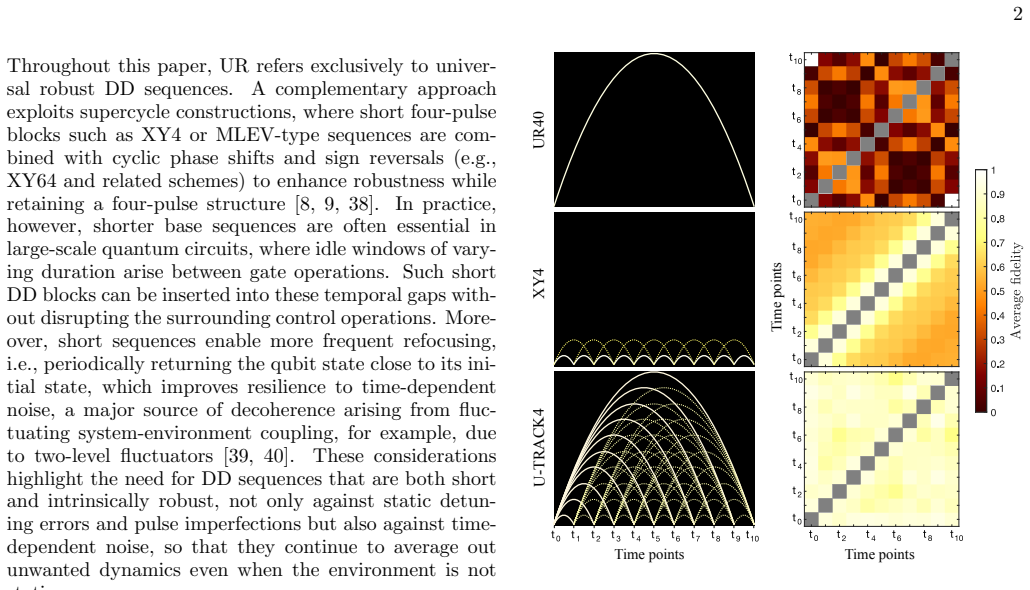
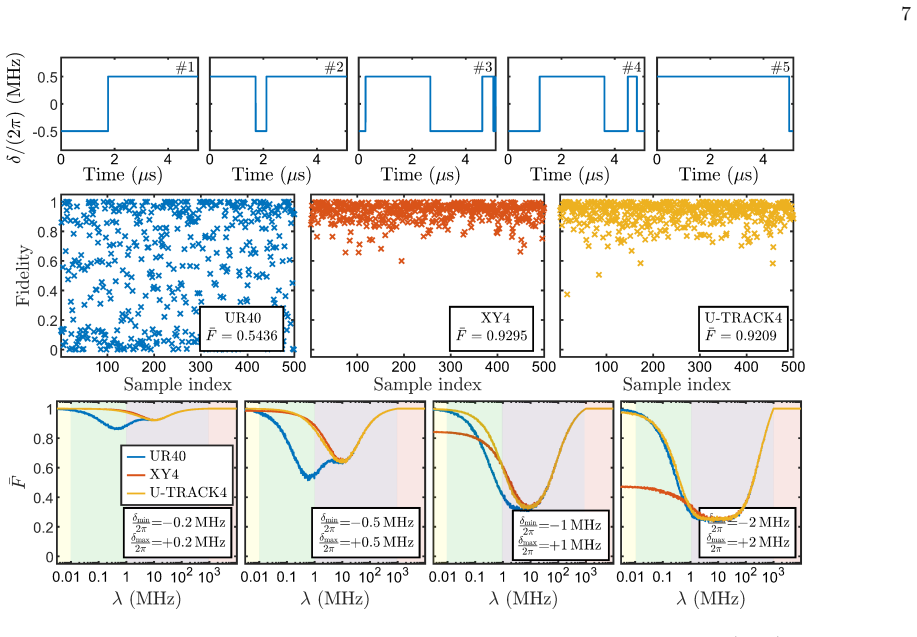
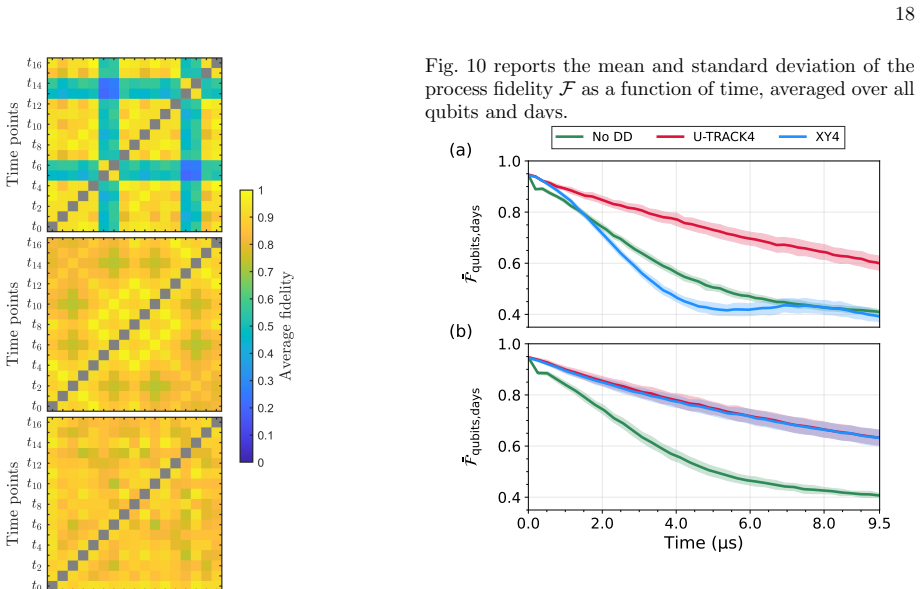
Dynamical decoupling (DD) is a widely used and resource-efficient technique for error suppression, but conventional DD relies on periodically repeating a short pulse block to refocus the qubit state during idle periods. Imperfections in this block cause residual errors to accumulate, ultimately degrading state recovery over long idle times. Here, we introduce a universal optimal tracking approach that extends the original tracking concept to a fully state-independent setting for designing DD sequences. By monitoring the qubit's evolution at predefined waypoints during optimization, the method dynamically compensates residual errors while preserving regular refocusing. Experimental demonstrations on a superconducting-qubit platform confirm the suppression of error accumulation under static control imperfections, in agreement with numerical predictions. Complementary simulations further show that optimal-tracking-based sequences maintain strong performance under time-dependent noise. These results establish optimal tracking as a practical and hardware-agnostic approach to designing short, robust DD sequences suitable for noisy quantum devices.
Editorial analysis
A structured set of objections, weighed in public.
Referee Report
Summary. The paper introduces a universal optimal tracking method for designing dynamical decoupling (DD) sequences. It extends tracking concepts to a state-independent setting by monitoring qubit evolution at predefined waypoints during optimization to compensate residual errors from control imperfections while preserving refocusing. Experimental results on a superconducting-qubit platform demonstrate suppression of error accumulation under static imperfections, agreeing with simulations; additional simulations show robustness under time-dependent noise.
Significance. If the optimization produces sequences that are demonstrably universal (state-independent refocusing for arbitrary initial states), the approach offers a practical, hardware-agnostic route to short robust DD sequences. The reported experimental agreement on superconducting qubits and performance under time-dependent noise would strengthen the case for adoption in noisy intermediate-scale devices.
major comments (2)
- [Optimization procedure (method section describing cost function and waypoints)] The central claim of a 'fully state-independent setting' and 'universal' DD sequences requires that the optimization cost function enforce refocusing independent of the initial Bloch vector (i.e., total propagator close to identity). The manuscript description does not specify whether the cost explicitly averages fidelity over initial states or imposes a propagator-identity constraint; without this, waypoint monitoring alone may yield state-dependent performance, undermining the universality asserted in the abstract and experimental interpretation.
- [Experimental results section] Experimental confirmation is reported for suppression under static imperfections, but the manuscript provides no quantitative details on the prepared/tested states, number of initial states used in validation, or direct comparison of error accumulation across orthogonal initial states. This leaves open whether the observed agreement confirms the state-independent claim or only performance for the specific states employed.
minor comments (1)
- [Abstract] The abstract states 'in agreement with numerical predictions' but does not quantify the level of agreement (e.g., fidelity values or error rates); adding a brief numerical comparison would improve clarity.
Simulated Author's Rebuttal
We thank the referee for the constructive feedback and positive assessment of the significance of our work. We address each major comment below, indicating revisions where appropriate to improve clarity and support for our claims.
read point-by-point responses
-
Referee: [Optimization procedure (method section describing cost function and waypoints)] The central claim of a 'fully state-independent setting' and 'universal' DD sequences requires that the optimization cost function enforce refocusing independent of the initial Bloch vector (i.e., total propagator close to identity). The manuscript description does not specify whether the cost explicitly averages fidelity over initial states or imposes a propagator-identity constraint; without this, waypoint monitoring alone may yield state-dependent performance, undermining the universality asserted in the abstract and experimental interpretation.
Authors: We appreciate the referee's careful reading and agree that the methods section would benefit from greater precision on this point. The optimization procedure is formulated to minimize the deviation of the composite propagator from the identity operator by evaluating the evolution at the chosen waypoints; this propagator-level constraint is what enforces state independence rather than any averaging over specific initial states. We will revise the manuscript to include an explicit statement and mathematical description of the cost function that makes this constraint clear. revision: yes
-
Referee: [Experimental results section] Experimental confirmation is reported for suppression under static imperfections, but the manuscript provides no quantitative details on the prepared/tested states, number of initial states used in validation, or direct comparison of error accumulation across orthogonal initial states. This leaves open whether the observed agreement confirms the state-independent claim or only performance for the specific states employed.
Authors: We agree that additional quantitative information is needed to fully substantiate the state-independent performance. The experiments were performed on multiple initial states spanning different directions on the Bloch sphere, with results compared to simulations for each. In the revised manuscript we will add explicit details on the prepared states, the number of states tested, and direct comparisons of error accumulation across orthogonal initial states. revision: yes
Circularity Check
Optimization-based DD design with external experimental validation; derivation self-contained against benchmarks
full rationale
The abstract frames the contribution as an optimization procedure that monitors qubit evolution at waypoints to compensate errors while preserving refocusing, followed by experimental confirmation on superconducting qubits and separate simulations under time-dependent noise. No equations, cost-function definitions, or derivation steps are supplied that reduce the claimed state-independent universality or performance metrics to fitted parameters, self-citations, or input data by construction. The method is presented as extending a prior tracking idea via numerical search with independent hardware validation, satisfying the criteria for a self-contained, non-circular result.
Axiom & Free-Parameter Ledger
axioms (1)
- domain assumption Optimization at waypoints can compensate residual errors without disrupting the refocusing property of DD sequences.
Reference graph
Works this paper leans on
-
[1]
P. W. Shor, Scheme for reducing decoherence in quantum computer memory, Physical review A52, R2493 (1995)
1995
-
[2]
Preskill, Quantum computing in the nisq era and be- yond, Quantum2, 79 (2018)
J. Preskill, Quantum computing in the nisq era and be- yond, Quantum2, 79 (2018). 11
2018
-
[3]
Krantz, M
P. Krantz, M. Kjaergaard, F. Yan, T. P. Orlando, S. Gus- tavsson, and W. D. Oliver, A quantum engineer’s guide to superconducting qubits, Applied physics reviews6 (2019)
2019
-
[4]
G. Q. AI and Collaborators, Quantum error correc- tion below the surface code threshold, Nature638, 920 (2025)
2025
-
[5]
E. L. Hahn, Spin echoes, Physical Review80, 580 (1950)
1950
-
[6]
H. Y. Carr and E. M. Purcell, Effects of diffusion on free precession in nuclear magnetic resonance experiments, Physical review94, 630 (1954)
1954
-
[7]
Meiboom and D
S. Meiboom and D. Gill, Modified spin-echo method for measuring nuclear relaxation times, Review of Scientific Instruments29, 688 (1958)
1958
-
[8]
M. H. Levitt, R. Freeman, and T. Frenkiel, Supercycles for broadband heteronuclear decoupling, Journal of Mag- netic Resonance (1969)50, 157 (1982)
1969
-
[9]
Gullion, D
T. Gullion, D. B. Baker, and M. S. Conradi, New, compensated carr-purcell sequences, Journal of Magnetic Resonance (1969)89, 479 (1990)
1969
-
[10]
A. M. Souza, G. A. Alvarez, and D. Suter, Robust dy- namical decoupling for quantum computing and quantum memory, Physical Review Letters106, 240501 (2011)
2011
-
[11]
Bylander, S
J. Bylander, S. Gustavsson, F. Yan, F. Yoshihara, K. Harrabi, G. Fitch, D. G. Cory, Y. Nakamura, J.-S. Tsai, and W. D. Oliver, Noise spectroscopy through dy- namical decoupling with a superconducting flux qubit, Nature Physics7, 565 (2011)
2011
-
[12]
Ezzell, B
N. Ezzell, B. Pokharel, L. Tewala, G. Quiroz, and D. A. Lidar, Dynamical decoupling for superconducting qubits: A performance survey, Physical Review Applied20, 064027 (2023)
2023
-
[13]
Gustavsson, F
S. Gustavsson, F. Yan, J. Bylander, F. Yoshihara, Y. Nakamura, T. P. Orlando, and W. D. Oliver, Dynami- cal decoupling and dephasing in interacting two-level sys- tems, Physical review letters109, 010502 (2012)
2012
-
[14]
J.-X. Han, J. Zhang, G.-M. Xue, H. Yu, and G. Long, Protecting logical qubits with dynamical decoupling, Physical Review Applied24, 024003 (2025)
2025
-
[15]
M. J. Biercuk, H. Uys, A. P. VanDevender, N. Shiga, W. M. Itano, and J. J. Bollinger, Optimized dynamical decoupling in a model quantum memory, Nature458, 996 (2009)
2009
-
[16]
M. J. Biercuk, H. Uys, A. P. VanDevender, N. Shiga, W. M. Itano, and J. J. Bollinger, Experimental uhrig dy- namical decoupling using trapped ions, Physical Review A—Atomic, Molecular, and Optical Physics79, 062324 (2009)
2009
-
[17]
Y. Sagi, I. Almog, and N. Davidson, Process tomography of dynamical decoupling in a dense cold atomic ensemble, Physical Review Letters105, 053201 (2010)
2010
-
[18]
bang-bang
S. Damodarakurup, M. Lucamarini, G. Di Giuseppe, D. Vitali, and P. Tombesi, Experimental inhibition of decoherence on flying qubits via “bang-bang” control, Physical Review Letters103, 040502 (2009)
2009
-
[19]
C. L. Degen, F. Reinhard, and P. Cappellaro, Quantum sensing, Reviews of Modern Physics89, 035002 (2017)
2017
-
[20]
Z.-H. Wang, G. De Lange, D. Rist` e, R. Hanson, and V. Dobrovitski, Comparison of dynamical decoupling protocols for a nitrogen-vacancy center in diamond, Physical Review B—Condensed Matter and Materials Physics85, 155204 (2012)
2012
-
[21]
Maudsley, Modified carr-purcell-meiboom-gill se- quence for nmr fourier imaging applications, Journal of Magnetic Resonance (1969)69, 488 (1986)
A. Maudsley, Modified carr-purcell-meiboom-gill se- quence for nmr fourier imaging applications, Journal of Magnetic Resonance (1969)69, 488 (1986)
1969
-
[22]
G. T. Genov, D. Schraft, N. V. Vitanov, and T. Half- mann, Arbitrarily accurate pulse sequences for robust dy- namical decoupling, Physical Review Letters118, 133202 (2017)
2017
-
[23]
Pokharel and D
B. Pokharel and D. A. Lidar, Better-than-classical Grover search via quantum error detection and suppres- sion, npj Quantum Information10, 23 (2024)
2024
-
[24]
Singkanipa, V
P. Singkanipa, V. Kasatkin, Z. Zhou, G. Quiroz, and D. A. Lidar, Demonstration of algorithmic quantum speedup for an abelian hidden subgroup problem, Phys- ical Review X15, 021082 (2025)
2025
-
[25]
Pokharel and D
B. Pokharel and D. A. Lidar, Demonstration of algo- rithmic quantum speedup, Physical Review Letters130, 210602 (2023)
2023
-
[26]
C. Tong, H. Zhang, and B. Pokharel, Empirical learning of dynamical decoupling on quantum processors, PRX Quantum6, 030319 (2025)
2025
-
[27]
Rahman, D
A. Rahman, D. J. Egger, and C. Arenz, Learning how to dynamically decouple by optimizing rotational gates, Physical Review Applied22, 054074 (2024)
2024
-
[28]
Qiskit Community, Qiskit: An open-source framework for quantum computing (2017), accessed: 2026-02
2017
-
[29]
A. M. Souza, G. A. ´Alvarez, and D. Suter, Robust dy- namical decoupling, Philosophical Transactions of the Royal Society A: Mathematical, Physical and Engineer- ing Sciences370, 4748 (2012)
2012
-
[30]
Suter and G
D. Suter and G. A. ´Alvarez, Colloquium: Protecting quantum information against environmental noise, Re- views of Modern Physics88, 041001 (2016)
2016
-
[31]
M. H. Levitt and R. Freeman, Nmr population inversion using a composite pulse, Journal of Magnetic Resonance (1969)33, 473 (1979)
1969
-
[32]
M. H. Levitt, Composite pulses, Progress in Nuclear Magnetic Resonance Spectroscopy18, 61 (1986)
1986
-
[33]
Freeman,Spin choreography(Oxford University Press Oxford, 1998)
R. Freeman,Spin choreography(Oxford University Press Oxford, 1998)
1998
-
[34]
Khodjasteh and D
K. Khodjasteh and D. A. Lidar, Fault-tolerant quan- tum dynamical decoupling, Physical Review Letters95, 180501 (2005)
2005
-
[35]
Khodjasteh and D
K. Khodjasteh and D. A. Lidar, Performance of de- terministic dynamical decoupling schemes: Concate- nated and periodic pulse sequences, Physical Review A—Atomic, Molecular, and Optical Physics75, 062310 (2007)
2007
-
[36]
Kobzar, S
K. Kobzar, S. Ehni, T. E. Skinner, S. J. Glaser, and B. Luy, Exploring the limits of broadband 90°and 180° universal rotation pulses, Journal of Magnetic Resonance 225, 142 (2012)
2012
-
[37]
T. E. Skinner, N. I. Gershenzon, M. Nimbalkar, W. Bermel, B. Luy, and S. J. Glaser, New strategies for designing robust universal rotation pulses: Application to broadband refocusing at low power, Journal of Mag- netic Resonance216, 78 (2012)
2012
-
[38]
M. H. Levitt and R. Freeman, Compensation for pulse imperfections in nmr spin-echo experiments, Journal of Magnetic Resonance (1969)43, 65 (1981)
1969
-
[39]
A. Agarwal, L. P. Lindoy, D. Lall, S. E. de Graaf, T. Lindstr¨ om, and I. Rungger, Fast-tracking and disentangling of qubit noise fluctuations using minimal-data averaging and hierarchical discrete fluctuation auto-segmentation, arXiv:2505.23622 https://doi.org/10.48550/arXiv.2505.23622 (2025). 12
-
[40]
J. M. Martinis, K. B. Cooper, R. McDermott, M. Stef- fen, M. Ansmann, K. D. Osborn, K. Cicak, S. Oh, D. P. Pappas, R. W. Simmonds, and C. C. Yu, Decoherence in josephson qubits from dielectric loss, Phys. Rev. Lett. 95, 210503 (2005)
2005
-
[41]
J. L. Neves, B. Heitmann, N. Khaneja, and S. J. Glaser, Heteronuclear decoupling by optimal tracking, Journal of Magnetic Resonance201, 7 (2009)
2009
-
[42]
Schilling, L
F. Schilling, L. R. Warner, N. I. Gershenzon, T. E. Skinner, M. Sattler, and S. J. Glaser, Next-generation heteronuclear decoupling for high-field biomolecular nmr spectroscopy, Angewandte Chemie International Edition 53, 4475 (2014)
2014
-
[43]
Khaneja, T
N. Khaneja, T. Reiss, C. Kehlet, T. Schulte-Herbr¨ uggen, and S. J. Glaser, Optimal control of coupled spin dy- namics: design of nmr pulse sequences by gradient as- cent algorithms, Journal of Magnetic Resonance172, 296 (2005)
2005
-
[44]
black-box
R. Freeman, T. Frenkiel, and M. H. Levitt, A simple “black-box” decoupler, Journal of Magnetic Resonance (1969)50, 345 (1982)
1969
-
[45]
Malvetti, L
E. Malvetti, L. V. Damme, A. Devra, and S. J. Glaser, Utrack.jl (2026)
2026
-
[46]
Sheldon, L
S. Sheldon, L. S. Bishop, E. Magesan, S. Filipp, J. M. Chow, and J. M. Gambetta, Characterizing errors on qubit operations via iterative randomized benchmarking, Phys. Rev. A93, 012301 (2016)
2016
-
[47]
Wright, L
E. Wright, L. Van Damme, N. Glaser, A. Devra, F. Roy, J. Englhardt, N. Bruckmoser, L. Koch, A. Marx, J. Schirk, C. Schneider, L. S¨ odergren, I. Tsitsilin, F. Wallner, S. Glaser, M. Werninghaus, and S. Filipp, Superconducting-qubit gates robust to parameter fluctu- ations, Phys. Rev. Appl.25, 054037 (2026)
2026
-
[48]
Tripathi, H
V. Tripathi, H. Chen, M. Khezri, K.-W. Yip, E. Levenson-Falk, and D. A. Lidar, Suppression of Crosstalk in Superconducting Qubits Using Dynamical Decoupling, Phys. Rev. Appl.18, 024068 (2022), pub- lisher: American Physical Society
2022
-
[49]
Agarwal, L
A. Agarwal, L. P. Lindoy, D. Lall, F. Jamet, and I. Rung- ger, Modelling non-markovian noise in driven supercon- ducting qubits, QST9, 035017 (2024)
2024
-
[50]
Kumar, S
P. Kumar, S. Sendelbach, M. A. Beck, J. W. Freeland, Z. Wang, H. Wang, C. C. Yu, R. Q. Wu, D. P. Pappas, and R. McDermott, Origin and reduction of 1/fmagnetic flux noise in superconducting devices, Phys. Rev. Appl. 6, 041001 (2016)
2016
-
[51]
Hyypp¨ a, A
E. Hyypp¨ a, A. Veps¨ al¨ ainen, M. Papiˇ c, C. F. Chan, S. Inel, A. Landra, W. Liu, J. Luus, F. Marxer, C. Ockeloen-Korppi, S. Orbell, B. Tarasinski, and J. Heinsoo, Reducing leakage of single-qubit gates for su- perconducting quantum processors using analytical con- trol pulse envelopes, PRX Quantum5, 030353 (2024)
2024
- [52]
-
[53]
M. A. Nielsen and I. L. Chuang,Quantum Computation and Quantum Information: 10th Anniversary Edition (Cambridge University Press, 2010)
2010
-
[54]
D. M. Tennant, L. A. Martinez, K. M. Beck, S. R. O’Kelley, C. D. Wilen, R. McDermott, J. L. DuBois, and Y. J. Rosen, Low-frequency correlated charge-noise mea- surements across multiple energy transitions in a tanta- lum transmon, PRX Quantum3, 030307 (2022)
2022
-
[55]
Paladino, Y
E. Paladino, Y. M. Galperin, G. Falci, and B. L. Alt- shuler, 1/fnoise: Implications for solid-state quantum information, Rev. Mod. Phys.86, 361 (2014)
2014
-
[56]
Cywi´ nski, R
L. Cywi´ nski, R. M. Lutchyn, C. P. Nave, and S. Das Sarma, How to enhance dephasing time in su- perconducting qubits, Phys. Rev. B77, 174509 (2008)
2008
-
[57]
M. H. Levitt, R. Freeman, and T. Frenkiel, Broad- band heteronuclear decoupling, Journal of Magnetic Res- onance (1969)47, 328 (1982)
1969
-
[58]
L. Abdurakhimov, J. Adam, H. Ahmad, O. Ahonen, and et al., Technology and performance benchmarks of iqm’s 20-qubit quantum computer (2024), arXiv:2408.12433 [quant-ph]
-
[59]
Kobzar, B
K. Kobzar, B. Luy, N. Khaneja, and S. J. Glaser, Pattern pulses: design of arbitrary excitation profiles as a func- tion of pulse amplitude and offset, Journal of Magnetic Resonance173, 229 (2005)
2005
-
[60]
M. A. Janich, R. F. Schulte, M. Schwaiger, and S. J. Glaser, Robust slice-selective broadband refocusing pulses, Journal of Magnetic Resonance213, 126 (2011)
2011
-
[61]
Petersen and M
K. Petersen and M. Pedersen,The Matrix Cook- book(Technical University of Denmark, 2006) version 20051003
2006
-
[62]
Devra, P
A. Devra, P. Prabhu, H. Singh, Arvind, and K. Dorai, Efficient experimental design of high-fidelity three-qubit quantum gates via genetic programming, Quantum In- formation Processing17, 67 (2018)
2018
-
[63]
Quiroz and D
G. Quiroz and D. A. Lidar, Optimized dynamical decou- pling via genetic algorithms, Phys. Rev. A88, 052306 (2013)
2013
-
[64]
J. Koch, T. M. Yu, J. Gambetta, A. A. Houck, D. I. Schuster, J. Majer, A. Blais, M. H. Devoret, S. M. Girvin, and R. J. Schoelkopf, Charge-insensitive qubit design de- rived from the cooper pair box, Phys. Rev. A76, 042319 (2007)
2007
-
[65]
Glaser, F
N. Glaser, F. Roy, I. Tsitsilin, L. Koch, N. Bruck- moser, J. Schirk, J. Romeiro, G. Huber, F. Wallner, M. Singh, G. Krylov, A. Marx, L. S¨ odergren, C. Schnei- der, M. Werninghaus, and S. Filipp, Closed-loop opti- mization for high-fidelity controlled-zgates in supercon- ducting qubits, Phys. Rev. Appl.24, 024048 (2025)
2025
-
[66]
(2026), accessed: 2026-06-17
Zurich Instruments AG,SHFSG+ User Manual: 8.5 GHz Signal Generator, Zurich Instruments AG, Technopark- strasse 1, 8005 Zurich, Switzerland, revision 26.04 ed. (2026), accessed: 2026-06-17
2026
-
[67]
Johnston and D
N. Johnston and D. W. Kribs, Quantum gate fidelity in terms of choi matrices, Journal of Physics A: Mathemat- ical and Theoretical44, 495303 (2011). 13 Appendix A: Optimal tracking sequences
2011
-
[68]
Overview The sequence is optimized using a composite pulse made of a concatenation of severalπ-rotations with nu- merically optimized phasesϕ n without inter-pulse delays
Optimization of U-TRACK sequences a. Overview The sequence is optimized using a composite pulse made of a concatenation of severalπ-rotations with nu- merically optimized phasesϕ n without inter-pulse delays. Oneπ-rotation of phaseϕ n is assumed to be of the form: P ϵδ n =e −iϕn σz 2 e−i(Ω(1+ϵ) σx 2 +δ σz 2 )Tπ eiϕn σz 2 ,(A1) whereσ x,y,z are the Pauli m...
-
[69]
As explained earlier, the optimization is performed assuming an ensemble of two-level systems of different amplitude errorsϵand detuningδ
Local optimization via gradient descent Propagation. As explained earlier, the optimization is performed assuming an ensemble of two-level systems of different amplitude errorsϵand detuningδ. For a given pair (ϵ, δ), the evolution operator afterMDD blocks is given by: P ϵδ M NP ϵδ M N−1 · · ·P ϵδ 2N+1 P ϵδ 2N · · ·P ϵδ N+1 P ϵδ N · · ·P ϵδ 1| {z } U ϵδ 1 ...
-
[70]
Hence, the final result strongly depends on the initial pulse
Global optimization via genetic algorithm While the GRAPE algorithm explained in the previous section can efficiently compute the gradient of the total fidelityFwith respect to the pulse phasesϕ n, and hence allows for implementing a gradient-based local optimiza- tion, it turns out that the cost function contains many lo- cal minima that are far from bei...
-
[71]
The GRAPE’s gradient computation is performed in two steps
Highly parallel implementation The optimization algorithm described in the previous two sections lends itself to parallelization. The GRAPE’s gradient computation is performed in two steps. A for- ward and a backward propagation. The same operation must be performed for each value of the amplitude error and detuning (ϵ k, δℓ). Using a GPU, all of these ca...
-
[72]
Evolution operator In the methods described in the appendix. A, Eq. (A1) represents the evolution of a two-level system driven by a constantπ-pulse subject to detuning and amplitude errors. In practice, however, all DD sequences in this work are implemented on transmon-based quantum pro- cessors, where native gates use DRAG pulses calibrated to suppress e...
-
[73]
Computation of DRAG pulses To compute the coefficientsAandBof the DRAG pulse defined in Eq. (C3), we use thefminuncoptimiza- tion routine inMatlabto minimize the following cost function: JDRAG = 1− 1 4 ⟨0|X † πU(T π)|0⟩+⟨1|X † πU(T π)|1⟩ 2 , (C7) where: •X π =|0⟩ ⟨1|+|1⟩ ⟨0|corresponds to aπrotation about thexaxis in the computational subspace spanned by|...
discussion (0)
Sign in with ORCID, Apple, or X to comment. Anyone can read and Pith papers without signing in.