REVIEW 1 major objections 42 references
KineticSim: A Lightweight, High-Performance Execution Engine for Real-Time Market Simulators
T0 review · 1 major / 0 minor · reviewed 2026-06-30 · grok-4.3
Pith's one-line read KineticSim keeps market state in GPU shared memory and clears cooperatively to reach 54.7 billion agent events per second.
desk verdict KineticSim's shared-memory pattern for persistent LOB state delivers large measured speedups over standard baselines, but CPU equivalence rests only on 0.1% aggregate stats rather than exact order-book matches. read the letter →
The pith
A machine-rendered reading of the paper's core claim, the machinery that carries it, and where it could break.
The reading
What carries the argument
Persistent, state-carrying clearing: the pattern that maintains mutable order-book state inside thread-block shared memory and performs cooperative reductions within each block.
What would settle it
A run on any configuration where the price grid exceeds shared-memory capacity per block, or where the produced order books differ from the CPU reference, would show the claimed reduction and equivalence do not hold.
Extended reading notes
Core claim
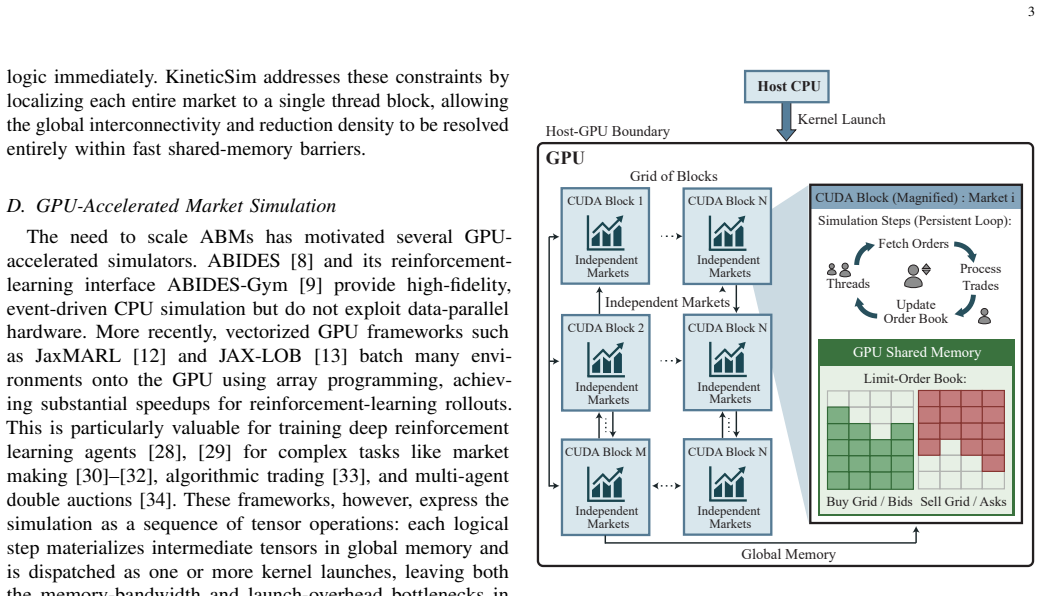
The paper claims that caching mutable simulation state in thread-block shared memory across step boundaries, aggregating agent actions via shared-memory atomics, and resolving the clearing function cooperatively reduces the per-step critical-path depth from Theta(L+A) for sequential clearing (L price-grid ticks, A agents) to Theta(log L + ceil(A/L)) and makes global-memory traffic independent of the step count.
Load-bearing premise
The price-grid size and agent count must allow the full mutable state to fit inside shared memory without spilling, and cooperative clearing must produce bitwise-identical results to sequential CPU execution.
Editorial extensions
If this is right
- Peak throughput exceeds 54.7 billion agent-events per second.
- Speedups reach 3406x over NumPy CPU, 27.8x over PyTorch GPU, 42.8x over JAX GPU, and 8.4x over a naive custom CUDA baseline.
- Order books match the CPU reference bitwise across all 53 tested configurations.
- Aggregate statistics agree with the CPU reference to within 0.1 percent.
- Global-memory traffic stays constant across steps and memory use is roughly an order of magnitude lower than PyTorch.
Reading between the lines
- The constant global-memory traffic could support longer continuous simulations before bandwidth limits appear.
- Lower per-simulation memory footprint may allow more independent market instances to run simultaneously on one GPU.
- The pattern's emphasis on block-local state suggests it could transfer to other domains that need repeated state updates on large agent populations.
Editorial analysis
A structured set of objections, weighed in public.
Referee Report
Summary. The paper presents KineticSim, a lightweight GPU execution engine for real-time multi-agent market simulators. It formalizes a reusable parallel design pattern called persistent, state-carrying clearing that caches mutable simulation state (limit-order books) in thread-block shared memory across steps, aggregates agent actions via shared-memory atomics, and resolves the clearing function cooperatively. This reduces per-step critical-path depth from Θ(L+A) to Θ(log L + ceil(A/L)) and eliminates per-step global-memory traffic. The implementation claims peak throughput exceeding 54.7 billion agent-events per second, speedups of 3406× over NumPy CPU, 27.8× over PyTorch GPU, 42.8× over JAX GPU, and 8.4× over a naive custom CUDA baseline, plus an order-of-magnitude lower GPU memory usage. Validation states that the two custom CUDA engines produce bitwise-identical order books across 53 configurations while aggregate statistics match a CPU reference to within 0.1%. The pattern is claimed to generalize to other iterative multi-agent workloads.
Significance. If the performance and correctness claims hold, the work would be significant for scaling agent-based models in market design, regulatory stress-testing, and reinforcement learning, where CPU simulators are too slow and existing GPU frameworks incur prohibitive launch and memory overhead. The explicit reduction in critical-path depth and the empirical throughput numbers (if reproducible) represent a concrete advance over vectorized baselines. The reusable pattern and low memory footprint are additional strengths.
major comments (1)
- [Abstract (validation paragraph)] Abstract (validation paragraph): The central correctness claim requires that the shared-memory cooperative clearing produces results equivalent to the sequential CPU reference. However, the provided evidence shows bitwise identity only between the two custom CUDA engines; CPU equivalence is limited to aggregate statistics (e.g., totals or averages) matching within 0.1%. This leaves open the possibility that both GPU versions deviate from the CPU reference on individual order placements, cancellations, or price-grid updates in ways that average out but alter simulation semantics. Because the paper positions the CPU reference as the ground truth, this gap is load-bearing for the claim that KineticSim is a drop-in replacement for existing simulators.
Simulated Author's Rebuttal
We thank the referee for the careful reading and for highlighting this important validation gap. We address the concern directly below.
read point-by-point responses
-
Referee: The central correctness claim requires that the shared-memory cooperative clearing produces results equivalent to the sequential CPU reference. However, the provided evidence shows bitwise identity only between the two custom CUDA engines; CPU equivalence is limited to aggregate statistics (e.g., totals or averages) matching within 0.1%. This leaves open the possibility that both GPU versions deviate from the CPU reference on individual order placements, cancellations, or price-grid updates in ways that average out but alter simulation semantics. Because the paper positions the CPU reference as the ground truth, this gap is load-bearing for the claim that KineticSim is a drop-in replacement for existing simulators.
Authors: We agree that the current evidence is weaker than required for a full claim of semantic equivalence to the CPU reference. The manuscript reports bitwise identity only between the two custom CUDA implementations and limits CPU comparison to aggregate statistics within 0.1%. This is a genuine limitation. In the revised manuscript we will (1) add per-order-book state comparisons (e.g., exact match on individual limit-order placements, cancellations, and price-grid updates) for all 53 configurations against the CPU reference where feasible, (2) report any discrepancies found, and (3) revise the abstract and validation paragraph to state the precise scope of the correctness claims rather than implying drop-in replacement. revision: yes
Circularity Check
No circularity; empirical performance claims rest on external baselines and direct complexity analysis
full rationale
The paper's central claims consist of an algorithmic design pattern (persistent shared-memory state, atomic aggregation, cooperative clearing) whose critical-path reduction from Theta(L+A) to Theta(log L + ceil(A/L)) is a standard parallel-algorithm analysis, not a fitted or self-referential equation. Throughput numbers (54.7B events/s, speedups vs NumPy/PyTorch/JAX/naive CUDA) are direct wall-clock measurements against independent external implementations. Validation statements compare the two custom CUDA variants bitwise and report aggregate CPU match to 0.1%; these are empirical checks, not derivations that reduce to the paper's own inputs by construction. No self-citations, ansatzes, or uniqueness theorems appear in the provided text. The derivation chain is therefore self-contained against external benchmarks.
Assumptions & free parameters
assumptions (1)
- standard math CUDA shared memory and atomic operations function as specified in the hardware documentation
Cite this review
Pith. "Pith review of KineticSim: A Lightweight, High-Performance Execution Engine for Real-Time Market Simulators." pith.science (2026). https://pith.science/paper/AVEB53MB
@misc{pith2026260621784,
  author       = {Pith},
  title        = {Pith review of: KineticSim: A Lightweight, High-Performance Execution Engine for Real-Time Market Simulators},
  year         = {2026},
  howpublished = {\url{https://pith.science/paper/AVEB53MB}},
  note         = {Machine review of arXiv:2606.21784}
}
read the original abstract
Simulating financial markets at scale with multi-agent (Agent-Based) models is critical for market design, regulatory stress-testing, and reinforcement learning, but traditional CPU simulators are bottlenecked by sequential processing while vectorized GPU frameworks suffer from kernel-launch overhead and redundant global-memory round-trips. We formalize, analyze, and evaluate a reusable parallel design pattern: persistent, state-carrying clearing for iterative multi-agent reductions. By caching mutable simulation state in thread-block shared memory across step boundaries, aggregating agent actions via shared-memory atomics, and resolving the clearing function cooperatively, the pattern reduces the per-step critical-path depth from Theta(L+A) for sequential clearing (L price-grid ticks, A agents) to Theta(log L + ceil(A/L)) and makes global-memory traffic independent of the step count. We implement this in KineticSim, a lightweight GPU execution engine that simulates massive ensembles of limit-order books in parallel, reaching a peak throughput of over 54.7 billion agent-events per second. On a fixed workload it delivers speedups of 3406x over CPU (NumPy), 27.8x over PyTorch GPU, 42.8x over JAX GPU, and 8.4x over a naive custom CUDA baseline, while using roughly an order of magnitude less GPU memory than PyTorch. Across 53 configurations the two custom CUDA engines produce bitwise-identical order books, and aggregate statistics match the CPU reference to within 0.1%. The pattern generalizes to other iterative multi-agent workloads requiring state-persistent, block-localized reductions.
Figures


Figures from the paper (4 more)


Reference graph
Works this paper leans on
-
[1]
The high-frequency trading arms race: Frequent batch auctions as a market design response,
E. Budish, P. Cramton, and J. Shim, “The high-frequency trading arms race: Frequent batch auctions as a market design response,”The Quarterly Journal of Economics, vol. 130, no. 4, pp. 1547–1621, 2015
work page 2015
-
[2]
The economy needs agent-based modelling,
J. D. Farmer and D. Foley, “The economy needs agent-based modelling,” Nature, vol. 460, no. 7256, pp. 685–686, 2009
work page 2009
-
[3]
Agent-based computational finance
B. LeBaron, “Agent-based computational finance.” Elsevier, 2006, vol. 2, pp. 1187–1233
work page 2006
-
[4]
Strategic bidding in continuous double auctions,
P. Vytelingum, D. Cliff, and N. R. Jennings, “Strategic bidding in continuous double auctions,”Artificial Intelligence, vol. 172, no. 14, pp. 1700–1729, 2008
work page 2008
-
[5]
Agent-based computational economics: A constructive approach to economic theory
L. Tesfatsion, “Agent-based computational economics: A constructive approach to economic theory.” Elsevier, 2006, vol. 2, pp. 831–880
work page 2006
-
[6]
Empirical properties of asset returns: stylized facts and statistical issues,
R. Cont, “Empirical properties of asset returns: stylized facts and statistical issues,”Quantitative finance, vol. 1, no. 2, p. 223, 2001
work page 2001
-
[7]
Price dynamics in a markovian limit order market,
R. Cont and A. De Larrard, “Price dynamics in a markovian limit order market,”SIAM Journal on Financial Mathematics, vol. 4, no. 1, pp. 1–25, 2013
work page 2013
-
[8]
Abides: Towards high-fidelity multi-agent market simulation,
D. Byrd, M. Hybinette, and T. H. Balch, “Abides: Towards high-fidelity multi-agent market simulation,” pp. 11–22, 2020
work page 2020
Show all 42 references
-
[9]
Abides-gym: gym environments for multi-agent discrete event simulation and application to financial markets,
S. Amrouni, A. Moulin, J. Vann, S. Vyetrenko, T. Balch, and M. Veloso, “Abides-gym: gym environments for multi-agent discrete event simulation and application to financial markets,” inProceedings of the Second ACM International Conference on AI in Finance, 2021, pp. 1–9
2021
-
[10]
Get real: Realism metrics for robust limit order book market simulations,
S. Vyetrenko, D. Byrd, N. Petosa, M. Mahfouz, D. Dervovic, M. Veloso, and T. Balch, “Get real: Realism metrics for robust limit order book market simulations,” inProceedings of the First ACM International Conference on AI in Finance, 2020, pp. 1–8
2020
-
[11]
Pytorch: An imperative style, high-performance deep learning library,
A. Paszke, S. Gross, F. Massa, A. Lerer, J. Bradbury, G. Chanan, T. Killeen, Z. Lin, N. Gimelshein, L. Antigaet al., “Pytorch: An imperative style, high-performance deep learning library,” vol. 32, 2019
2019
-
[12]
Jaxmarl: Multi-agent rl environments in jax,
A. Rutherford, B. Ellis, M. Gallici, J. Cook, A. Lupu, G. Ingvarsson, T. Willi, A. Khan, C. S. de Witt, A. Soulyet al., “Jaxmarl: Multi-agent rl environments in jax,” 2023
2023
-
[13]
Jax-lob: A gpu-accelerated limit order book simulator to unlock large scale reinforcement learning for trading,
S. Y . Frey, K. Li, P. Nagy, S. Sapora, C. Lu, S. Zohren, J. Foerster, and A. Calinescu, “Jax-lob: A gpu-accelerated limit order book simulator to unlock large scale reinforcement learning for trading,” inProceedings of the Fourth ACM International Conference on AI in Finance,...
2023
-
[14]
Market microstructure,
M. B. Garman, “Market microstructure,”Journal of financial Economics, vol. 3, no. 3, pp. 257–275, 1976
1976
-
[15]
A simple implicit measure of the effective bid-ask spread in an efficient market,
R. Roll, “A simple implicit measure of the effective bid-ask spread in an efficient market,”The Journal of finance, vol. 39, no. 4, pp. 1127–1139, 1984
1984
-
[16]
Continuous auctions and insider trading,
A. S. Kyle, “Continuous auctions and insider trading,”Econometrica: Journal of the Econometric Society, pp. 1315–1335, 1985
1985
-
[17]
Bid, ask and transaction prices in a specialist market with heterogeneously informed traders,
L. R. Glosten and P. R. Milgrom, “Bid, ask and transaction prices in a specialist market with heterogeneously informed traders,”Journal of financial economics, vol. 14, no. 1, pp. 71–100, 1985
1985
-
[18]
Allocative efficiency of markets with zero-intelligence traders: Market as a partial substitute for individual rationality,
D. K. Gode and S. Sunder, “Allocative efficiency of markets with zero-intelligence traders: Market as a partial substitute for individual rationality,”Journal of political economy, vol. 101, no. 1, pp. 119–137, 1993
1993
-
[19]
Minimal-intelligence agents for bargaining behaviors in market- based environments,
D. Cli, “Minimal-intelligence agents for bargaining behaviors in market- based environments,”Hewlett-Packard Labs Technical Reports, 1997
1997
-
[20]
Cuda c++ programming guide,
D. Guide, “Cuda c++ programming guide,” Tech. Rep., 2020
2020
-
[21]
Scalable parallel programming with cuda: Is cuda the parallel programming model that application developers have been waiting for?
J. Nickolls, I. Buck, M. Garland, and K. Skadron, “Scalable parallel programming with cuda: Is cuda the parallel programming model that application developers have been waiting for?”Queue, vol. 6, no. 2, pp. 40–53, 2008
2008
-
[22]
A survey of general-purpose computation on graphics hardware,
J. D. Owens, D. Luebke, N. Govindaraju, M. Harris, J. Kr ¨uger, A. E. Lefohn, and T. J. Purcell, “A survey of general-purpose computation on graphics hardware,” vol. 26, no. 1, pp. 80–113, 2007
2007
-
[23]
Farber,CUDA application design and development
R. Farber,CUDA application design and development. Elsevier, 2011
2011
-
[24]
Benchmarking gpus to tune dense linear algebra,
V . V olkov and J. W. Demmel, “Benchmarking gpus to tune dense linear algebra,” inSC’08: Proceedings of the 2008 ACM/IEEE conference on Supercomputing. IEEE, 2008, pp. 1–11
2008
-
[25]
Analyzing cuda workloads using a detailed gpu simulator,
A. Bakhoda, G. L. Yuan, W. W. Fung, H. Wong, and T. M. Aamodt, “Analyzing cuda workloads using a detailed gpu simulator,” in2009 IEEE international symposium on performance analysis of systems and software. IEEE, 2009, pp. 163–174
2009
-
[26]
Parallel agent-based simulation with repast for high performance computing,
N. Collier and M. North, “Parallel agent-based simulation with repast for high performance computing,”Simulation, vol. 89, no. 10, pp. 1215–1235, 2013
2013
-
[27]
A framework for megascale agent based model simulations on graphics processing units,
M. Lysenko and R. M. D’Souza, “A framework for megascale agent based model simulations on graphics processing units,”Journal of Artificial Societies and Social Simulation, vol. 11, no. 4, p. 10, 2008
2008
-
[28]
Human-level control through deep reinforcement learning,
V . Mnih, K. Kavukcuoglu, D. Silver, A. A. Rusu, J. Veness, M. G. Bellemare, A. Graves, M. Riedmiller, A. K. Fidjeland, G. Ostrovskiet al., “Human-level control through deep reinforcement learning,”nature, vol. 518, no. 7540, pp. 529–533, 2015
2015
-
[29]
R. S. Sutton, A. G. Bartoet al.,Reinforcement learning: An introduction. MIT press Cambridge, 1998, vol. 1, no. 1
1998
-
[30]
Market making via reinforcement learning,
T. Beysolow II, “Market making via reinforcement learning,” inApplied Reinforcement Learning with Python: With OpenAI Gym, Tensorflow, and Keras. Springer, 2019, pp. 77–94
2019
-
[31]
Deep reinforcement learning for market making under a hawkes process-based limit order book model,
B. Gaˇsperov and Z. Kostanj ˇcar, “Deep reinforcement learning for market making under a hawkes process-based limit order book model,”IEEE control systems letters, vol. 6, pp. 2485–2490, 2022
2022
-
[32]
Model-based reinforcement learning for predictions and control for limit order books,
H. Wei, Y . Wang, L. Mangu, and K. Decker, “Model-based reinforcement learning for predictions and control for limit order books,”arXiv preprint arXiv:1910.03743, 2019
1910
-
[33]
Deep reinforcement learning for algorithmic trading,
´A. Cartea, S. Jaimungal, and L. S´anchez-Betancourt, “Deep reinforcement learning for algorithmic trading,”Available at SSRN 3812473, 2021
2021
-
[34]
Multi-agent reinforcement learning with privacy preservation for continuous double auction-based p2p energy trading,
J. Zheng, Z.-T. Liang, Y . Li, Z. Li, and Q.-H. Wu, “Multi-agent reinforcement learning with privacy preservation for continuous double auction-based p2p energy trading,” vol. 20, no. 4. IEEE, 2024, pp. 6582–6590
2024
-
[35]
Data parallel algorithms,
W. D. Hillis and G. L. Steele Jr, “Data parallel algorithms,”Communi- cations of the ACM, vol. 29, no. 12, pp. 1170–1183, 1986
1986
-
[36]
Scan primitives for gpu computing,
S. Sengupta, M. Harris, Y . Zhang, and J. D. Owens, “Scan primitives for gpu computing,” 2007
2007
-
[37]
Fast splittable pseudorandom number generators,
G. L. Steele Jr, D. Lea, and C. H. Flood, “Fast splittable pseudorandom number generators,” vol. 49, no. 10. ACM New York, NY , USA, 2014, pp. 453–472
2014
-
[38]
Prefix sums and their applications,
G. E. Blelloch, “Prefix sums and their applications,” Tech. Rep., 1990
1990
-
[39]
Parallel prefix sum (scan) with cuda,
M. Harris, S. Sengupta, and J. D. Owens, “Parallel prefix sum (scan) with cuda,” 2007, vol. 3, no. 39, pp. 851–876
2007
-
[40]
Harnessing parallelism in multi/many-cores with streams and parallel patterns,
M. Torquati, “Harnessing parallelism in multi/many-cores with streams and parallel patterns,” 2019
2019
-
[41]
Programming parallel algorithms,
G. E. Blelloch, “Programming parallel algorithms,”Communications of the ACM, vol. 39, no. 3, pp. 85–97, 1996
1996
-
[42]
vectorbt: A python library for quantitative analysis and backtesting,
R. Polakovi ˇc, “vectorbt: A python library for quantitative analysis and backtesting,” https://github.com/polakowo/vectorbt, 2020. Shakya Jayakodyreceived the B.S. and M.S. degrees in electrical engineering from Louisiana Tech University, Ruston, LA, USA, in 2016 and 2020, re...
2020
Reviewed June 30, 2026 · model on record in the stance chip above.
Discussion (0). Continue with ORCID to comment.