Bayesian three-dimensional seismic travel-time tomography for active- and passive-source seismic data using physics-informed neural network
Pith reviewed 2026-06-26 12:11 UTC · model grok-4.3
The pith
A neural representation of velocity structure enables tractable Bayesian 3D seismic travel-time tomography with active and passive sources.
A machine-rendered reading of the paper's core claim, the machinery that carries it, and where it could break.
Core claim
The central claim is that the neural velocity representation combined with function-space particle-based variational inference makes full Bayesian estimation tractable and data-efficient for three-dimensional travel-time tomography, while analytical marginalization of passive-source parameters allows joint use of active- and passive-source data without explicit joint sampling. Synthetic tests confirm recovery of known structures, and application to marine active-source and earthquake data off the Kii Peninsula yields an ensemble that resolves geological features, supplies spatially varying uncertainty, and reduces storage for the full posterior.
What carries the argument
Meshless neural representation of the velocity structure together with function-space particle-based variational inference and analytical marginalization of passive-source parameters.
If this is right
- The method recovers key geological features from a real marine dataset off the Kii Peninsula.
- It produces spatially varying, data-consistent uncertainty maps across the velocity volume.
- Posterior hypocenters shift 10-15 km mainly in the vertical direction, consistent with prior relocation studies.
- Storage cost for the entire ensemble of velocity models drops dramatically compared with grid-based storage.
Where Pith is reading between the lines
- The storage reduction from the neural representation could make ensemble modeling feasible at regional or global scales where grid storage is prohibitive.
- The analytical marginalization step might transfer to other geophysical inverse problems that treat source or instrument parameters as nuisance variables.
- Joint inversion with additional data types such as gravity could be tested by extending the same neural representation and inference scheme.
Load-bearing premise
The neural network must be expressive enough to capture the true velocity structure and the variational approximation must be close enough to the true posterior for the reported uncertainties to be reliable.
What would settle it
A side-by-side comparison, on a known synthetic 3D velocity model, of the posterior mean and credible intervals obtained by this method versus those obtained by a conventional grid-based Bayesian tomography code.
Figures








read the original abstract
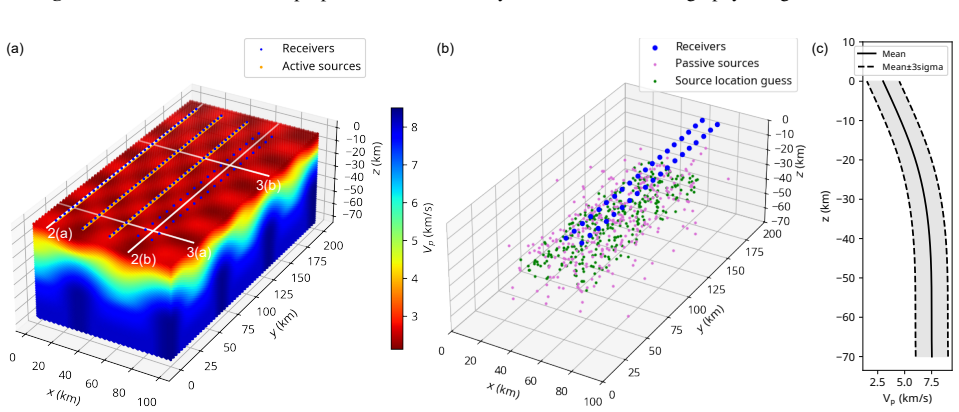
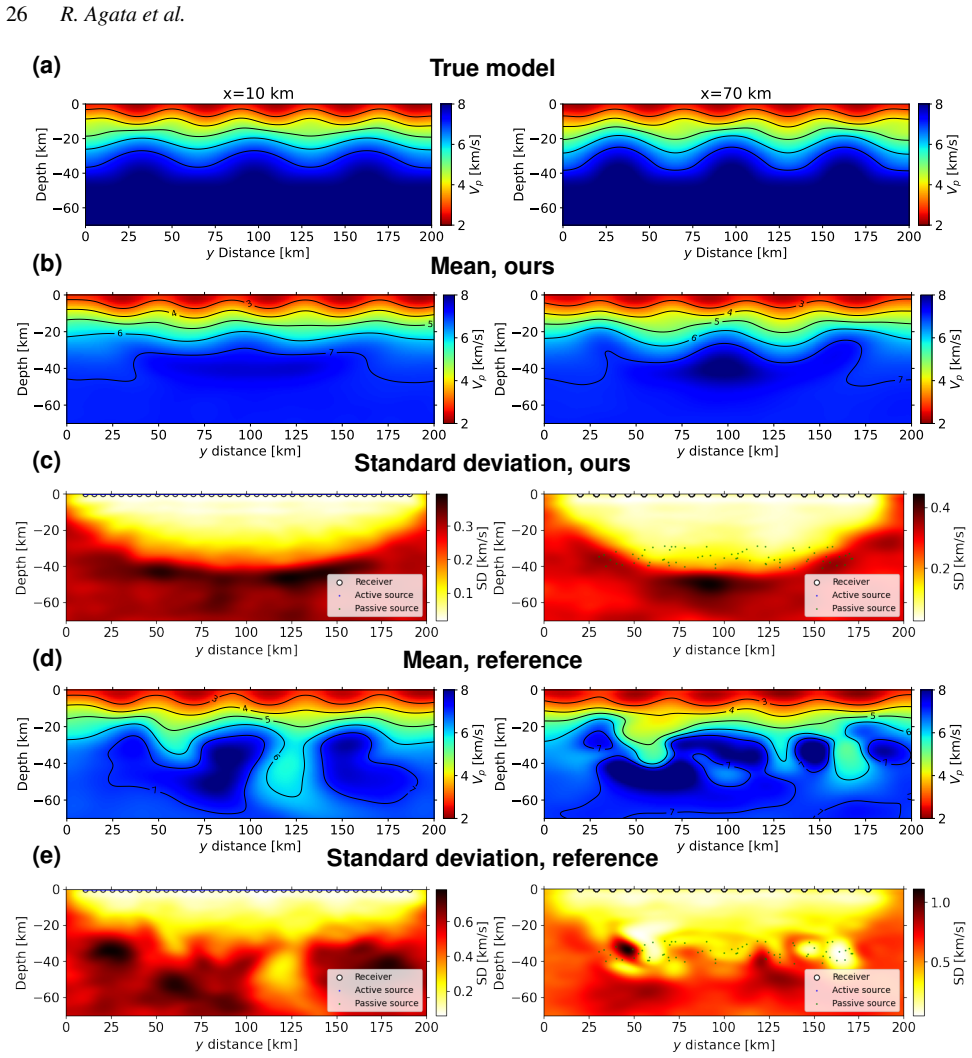
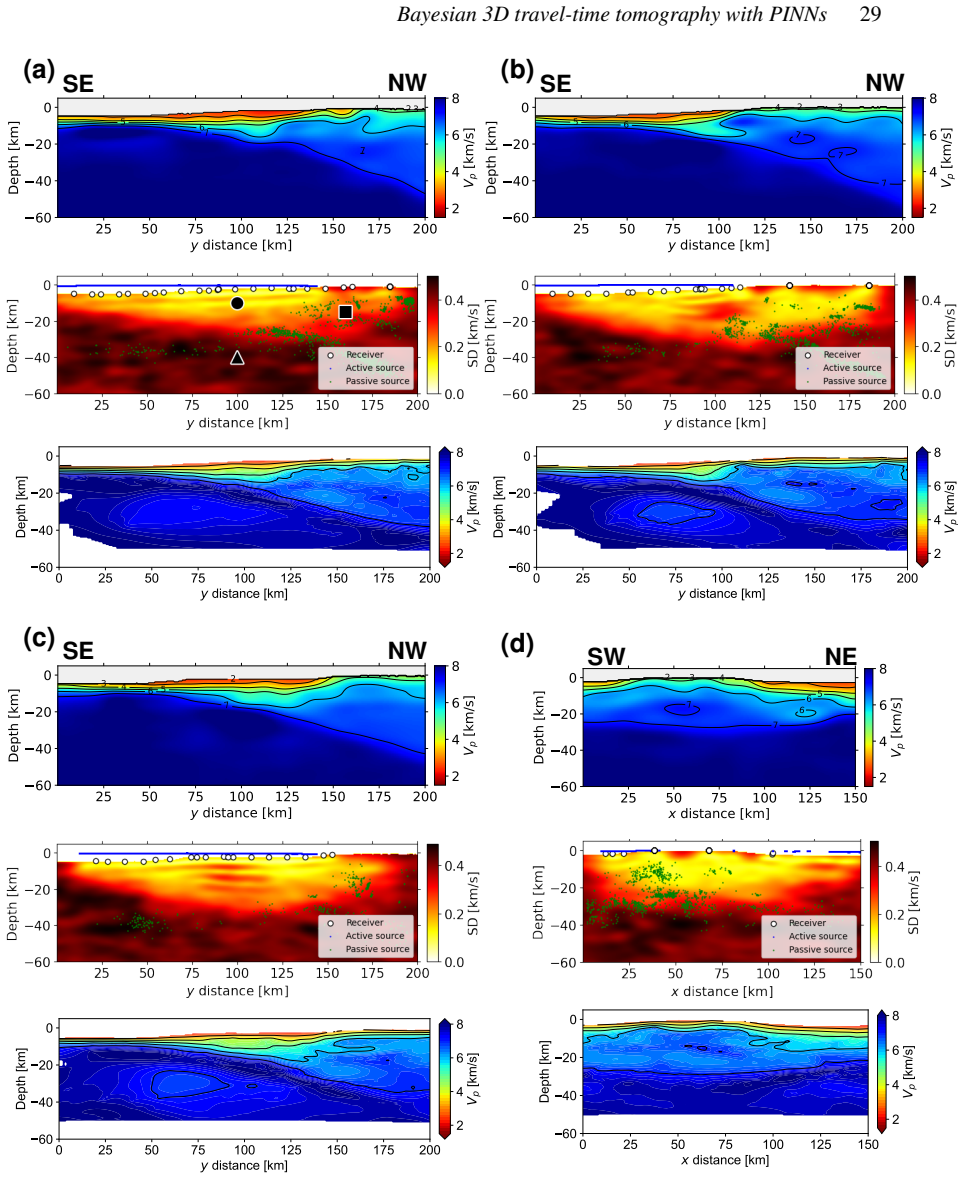
Accurate 3D seismic velocity modeling through seismic travel-time tomography using both active- and passive-source data provides critical underpinning models for seismicity monitoring and hazard assessment. Because travel-time tomography is an inherently ill-posed inverse problem, UQ of the estimated models using Bayesian methods is also important for reliable downstream interpretations and analyses. However, Bayesian inference for 3D tomography based on conventional grid-based representations faces the ``curse of dimensionality'' and severe computational bottlenecks. Consequently, rigorous Bayesian UQ for margin-wide 3D travel-time tomography has remained largely unexplored. In this study, we propose a meshless 3D Bayesian travel-time tomography method that combines PINNs with a neural representation of the velocity structure, enabling tractable and data-efficient Bayesian inference through function-space particle-based variational inference. To efficiently integrate passive-source data into the Bayesian estimation of the velocity structure, we conduct analytical marginalization treating uncertain source parameters as nuisance parameters, with passive-source relocation carried out in post-processing. We validated the capability of our approach for 3D problems through synthetic experiments. Furthermore, we applied the method to a real-world dataset from marine active-source surveys and natural earthquakes off the Kii Peninsula, Nankai Trough. Our probabilistic 3D ensemble successfully resolves key geological features and provides data-consistent uncertainty maps. The posterior mean hypocenters shifted mainly in the vertical direction by 10-15 km, consistent with a previous relocation result. Finally, the neural representation drastically reduces storage requirements for the entire ensemble velocity model, highlighting the scalability and data efficiency of the proposed framework.
Editorial analysis
A structured set of objections, weighed in public.
Referee Report
Summary. The paper claims to introduce a meshless 3D Bayesian travel-time tomography method that represents velocity structure via a neural network within a PINN framework, performs tractable Bayesian inference using function-space particle-based variational inference, and analytically marginalizes over uncertain passive-source parameters (with post-processing relocation). Synthetic experiments validate the approach for 3D problems, and application to marine active-source and earthquake data from the Nankai Trough yields an ensemble that resolves key geological features, supplies data-consistent uncertainty maps, and produces hypocenter shifts of 10-15 km vertically that match prior results; the neural representation is also noted to reduce ensemble storage requirements.
Significance. If the central claims hold, the work is significant because it provides a scalable route to rigorous Bayesian UQ for margin-scale 3D tomography, directly addressing the curse of dimensionality that has limited such analyses. Credit is due for the synthetic experiments that test the full pipeline and the real-data application to the Nankai Trough that demonstrates consistency with independent relocation results; the neural representation's storage reduction is a practical strength for ensemble dissemination.
minor comments (3)
- [§4.2] §4.2: the convergence diagnostics and sensitivity tests for the particle-based VI (e.g., number of particles, learning-rate schedules) are only summarized; explicit reporting of these choices and their effect on posterior spread would strengthen reproducibility.
- [Figure 7] Figure 7 and associated text: the vertical hypocenter shifts are stated as 10-15 km but the figure panels do not include error bars or the full posterior marginals for the relocated events; adding these would clarify the uncertainty quantification.
- [§3] The notation for the neural velocity field (e.g., the precise form of the PINN loss and the parameterization of the velocity network) is introduced in §3 but the explicit functional form is not restated when the marginalization step is derived; a short equation block linking the two would improve clarity.
Simulated Author's Rebuttal
We thank the referee for the constructive and positive review, which recognizes the significance of the meshless Bayesian PINN framework for 3D travel-time tomography and its application to the Nankai Trough dataset. The recommendation for minor revision is appreciated. No specific major comments are listed in the report, so we have no individual points requiring response or revision at this stage.
Circularity Check
No significant circularity
full rationale
The paper proposes a meshless Bayesian tomography method using PINNs for neural velocity representation and function-space particle-based variational inference, with analytical marginalization for passive sources. All load-bearing steps rely on standard PINN physics constraints and VI approximations that are validated directly against synthetic experiments and independent real-world Nankai Trough data; no derivation reduces by construction to fitted inputs, self-citations, or renamed ansatzes within the manuscript. The approach is self-contained against external benchmarks.
Axiom & Free-Parameter Ledger
Reference graph
Works this paper leans on
-
[1]
Agata, R. & Okazaki, T., 2026. Functional-prior-based approaches to bayesian pde-constrained inversion using physics-informed neural networks, arXiv preprint arXiv:2605.07060\/
work page internal anchor Pith review Pith/arXiv arXiv 2026
-
[2]
Agata, R., Kasahara, A., & Yagi, Y., 2021. A bayesian inference framework for fault slip distributions based on ensemble modelling of the uncertainty of underground structure: with a focus on uncertain fault dip, Geophysical Journal International\/ , 225 (2), 1392--1411
2021
-
[3]
Agata, R., Shiraishi, K., & Fujie, G., 2023. Bayesian Seismic Tomography Based on Velocity-Space Stein Variational Gradient Descent for Physics-Informed Neural Network , IEEE Transactions on Geoscience and Remote Sensing\/ , 61 , 1--17
2023
-
[4]
Physics-informed deep learning quantifies propagated uncertainty in seismic structure and hypocenter determination, Scientific Reports\/ , 15 (1), 1846
Agata, R., Shiraishi, K., & Fujie, G., 2025. Physics-informed deep learning quantifies propagated uncertainty in seismic structure and hypocenter determination, Scientific Reports\/ , 15 (1), 1846
2025
-
[5]
Source mechanisms and tectonic significance of historical earthquakes along the Nankai Trough, Japan , Tectonophysics\/ , 27 (2), 119--140
Ando, M., 1975. Source mechanisms and tectonic significance of historical earthquakes along the Nankai Trough, Japan , Tectonophysics\/ , 27 (2), 119--140
1975
-
[6]
Mowlas: Nied observation network for earthquake, tsunami and volcano, Earth, Planets and Space\/ , 72 (1), 1--31
Aoi, S., Asano, Y., Kunugi, T., Kimura, T., Uehira, K., Takahashi, N., Ueda, H., Shiomi, K., Matsumoto, T., & Fujiwara, H., 2020. Mowlas: Nied observation network for earthquake, tsunami and volcano, Earth, Planets and Space\/ , 72 (1), 1--31
2020
-
[7]
F., Bassett, D., Harding, A
Arnulf, A. F., Bassett, D., Harding, A. J., Kodaira, S., Nakanishi, A., & Moore, G., 2022. Upper-plate controls on subduction zone geometry, hydration and earthquake behaviour, Nature Geoscience\/ , 15 (2), 143--148
2022
-
[8]
Bassett, D., Arnulf, A., Kodaira, S., Nakanishi, A., Harding, A., & Moore, G., 2022. Crustal structure of the Nankai subduction zone revealed by two decades of onshore-offshore and ocean-bottom seismic data: Implications for the dimensions and slip behavior of the seismogenic zone , Journal of Geophysical Research: Solid Earth\/ , 127 (10), e2022JB024992
2022
-
[9]
Bassett, D., Henrys, S., Tozer, B., van Avendonk, H., Gase, A., Bangs, N., Kodaira, S., Okaya, D., Jacobs, K., Sutherland, R., Seebeck, H., Barker, D., Fujie, G., Arai, R., Seaward, A., Mochizuki, K., Savage, M., Stern, T., & Luckie, T., 2025. Crustal structure of the Hikurangi subduction zone revealed by four decades of onshore-offshore seismic data: Imp...
2025
-
[10]
& Sambridge, M., 2009
Bodin, T. & Sambridge, M., 2009. Seismic tomography with the reversible jump algorithm, Geophysical Journal International\/ , 178 (3), 1411--1436
2009
-
[11]
A., Rost, S., Guo, Z., Wu, X., & Chen, Y., 2022
Chen, Y., de Ridder, S. A., Rost, S., Guo, Z., Wu, X., & Chen, Y., 2022. Eikonal Tomography With Physics-Informed Neural Networks: Rayleigh Wave Phase Velocity in the Northeastern Margin of the Tibetan Plateau , Geophysical Research Letters\/ , 49 (21), e2022GL099053
2022
-
[12]
D., Pendleton, B
Duane, S., Kennedy, A. D., Pendleton, B. J., & Roweth, D., 1987. Hybrid monte carlo, Physics letters B\/ , 195 (2), 216--222
1987
-
[13]
S., Simons, M., Minson, S
Duputel, Z., Agram, P. S., Simons, M., Minson, S. E., & Beck, J. L., 2014. Accounting for prediction uncertainty when inferring subsurface fault slip, Geophysical Journal International\/ , 197 (1), 464--482
2014
-
[14]
eikonalfm: Python module for solving the Eikonal equation using the fast marching method , https://github.com/kevinganster/eikonalfm, Accessed: 2025-08-14
Ganster, K., 2023. eikonalfm: Python module for solving the Eikonal equation using the fast marching method , https://github.com/kevinganster/eikonalfm, Accessed: 2025-08-14
2023
-
[15]
Propagation of the velocity model uncertainties to the seismic event location , Geophysical Journal International\/ , 200 (1), 52--66
Gesret, A., Desassis, N., Noble, M., Romary, T., & Maisons, C., 2015. Propagation of the velocity model uncertainties to the seismic event location , Geophysical Journal International\/ , 200 (1), 52--66
2015
-
[16]
Neural Eikonal solver: Improving accuracy of physics-informed neural networks for solving eikonal equation in case of caustics , Journal of Computational Physics\/ , 474 , 111789
Grubas, S., Duchkov, A., & Loginov, G., 2023. Neural Eikonal solver: Improving accuracy of physics-informed neural networks for solving eikonal equation in case of caustics , Journal of Computational Physics\/ , 474 , 111789
2023
-
[17]
Delving deep into rectifiers: Surpassing human-level performance on imagenet classification , in Proceedings of the IEEE international conference on computer vision\/ , pp
He, K., Zhang, X., Ren, S., & Sun, J., 2015. Delving deep into rectifiers: Surpassing human-level performance on imagenet classification , in Proceedings of the IEEE international conference on computer vision\/ , pp. 1026--1034
2015
-
[18]
& Kono, Y., 2005
Honda, R. & Kono, Y., 2005. Buried large block revealed by gravity anomalies in the Tonankai and Nankai earthquakes regions, southwestern Japan , Earth, planets and space\/ , 57 (1), e1--e4
2005
-
[19]
Data and Sample Research System for Whole Cruise Information in JAMSTEC , http://www.godac.jamstec.go.jp/darwin/, Accessed 10 June, 2024
JAMSTEC , 2016. Data and Sample Research System for Whole Cruise Information in JAMSTEC , http://www.godac.jamstec.go.jp/darwin/, Accessed 10 June, 2024
2016
-
[20]
User's guide: Monthly report on earthquakes and volcanoes in japan (catalog), https://www.data.jma.go.jp/eqev/data/bulletin/catalog/notes_e.html, Accessed 17 June 2026
Japan Meteorological Agency , 2026. User's guide: Monthly report on earthquakes and volcanoes in japan (catalog), https://www.data.jma.go.jp/eqev/data/bulletin/catalog/notes_e.html, Accessed 17 June 2026
2026
-
[21]
Jiang, F., Hou, X., & Xia, M., 2024. Element-wise multiplication based physics-informed neural networks, arXiv preprint arXiv:2406.04170\/
-
[22]
Development and application of an advanced ocean floor network system for megathrust earthquakes and tsunamis , in Seafloor observatories\/ , pp
Kaneda, Y., Kawaguchi, K., Araki, E., Matsumoto, H., Nakamura, T., Kamiya, S., Ariyoshi, K., Hori, T., Baba, T., & Takahashi, N., 2015. Development and application of an advanced ocean floor network system for megathrust earthquakes and tsunamis , in Seafloor observatories\/ , pp. 643--662, Springer
2015
-
[23]
Kodaira, S., Hori, T., Ito, A., Miura, S., Fujie, G., Park, J.-O., Baba, T., Sakaguchi, H., & Kaneda, Y., 2006. A cause of rupture segmentation and synchronization in the Nankai trough revealed by seismic imaging and numerical simulation , Journal of Geophysical Research: Solid Earth\/ , 111 (B9)
2006
-
[24]
Seismological evidence of mantle flow driving plate motions at a palaeo-spreading centre , Nature Geoscience\/ , 7 (5), 371--375
Kodaira, S., Fujie, G., Yamashita, M., Sato, T., Takahashi, T., & Takahashi, N., 2014. Seismological evidence of mantle flow driving plate motions at a palaeo-spreading centre , Nature Geoscience\/ , 7 (5), 371--375
2014
-
[25]
Korenaga, J., Holbrook, W., Kent, G., Kelemen, P., Detrick, R., Larsen, H.-C., Hopper, J., & Dahl-Jensen, T., 2000. Crustal structure of the southeast Greenland margin from joint refraction and reflection seismic tomography , Journal of Geophysical Research: Solid Earth\/ , 105 (B9), 21591--21614
2000
-
[26]
Lewis, J. M. & Derber, J. C., 1985. The use of adjoint equations to solve a variational adjustment problem with advective constraints , Tellus A\/ , 37 (4)
1985
-
[27]
Understanding and accelerating particle-based variational inference, in International Conference on Machine Learning\/ , pp
Liu, C., Zhuo, J., Cheng, P., Zhang, R., & Zhu, J., 2019. Understanding and accelerating particle-based variational inference, in International Conference on Machine Learning\/ , pp. 4082--4092, PMLR
2019
-
[28]
& Wang, D., 2016
Liu, Q. & Wang, D., 2016. Stein variational gradient descent: A general purpose bayesian inference algorithm , Advances in neural information processing systems\/ , 29
2016
-
[29]
A., & Pathiraja, S., 2025
MacDonald, A., Sisson, S. A., & Pathiraja, S., 2025. Convergence aspects of hybrid kernel SVGD , Transactions on Machine Learning Research\/
2025
-
[30]
Misra, D., 2019. Mish: A self regularized non-monotonic neural activation function , arXiv preprint arXiv:1908.08681\/
-
[31]
& Tarantola, A., 1995
Mosegaard, K. & Tarantola, A., 1995. Monte Carlo sampling of solutions to inverse problems , Journal of Geophysical Research: Solid Earth\/ , 100 (B7), 12431--12447
1995
-
[32]
O., Nakamura, T., Obana, K., Kodaira, S., & Kaneda, Y., 2018
Nakanishi, A., Takahashi, N., Yamamoto, Y., Takahashi, T., Citak, S. O., Nakamura, T., Obana, K., Kodaira, S., & Kaneda, Y., 2018. Three-dimensional plate geometry and P-wave velocity models of the subduction zone in SW Japan: Implications for seismogenesis , Geology and Tectonics of Subduction Zones: A Tribute to Gaku Kimura\/ , 534 , 69
2018
-
[33]
Local three-dimensional earthquake tomography by trans-dimensional Monte Carlo sampling , Geophysical Journal International\/ , 201 (3), 1598--1617
Piana Agostinetti, N., Giacomuzzi, G., & Malinverno, A., 2015. Local three-dimensional earthquake tomography by trans-dimensional Monte Carlo sampling , Geophysical Journal International\/ , 201 (3), 1598--1617
2015
-
[34]
Qin, Y., Fujie, G., Kodaira, S., Nakamura, Y., Kaiho, Y., No, T., Obana, K., & Miura, S., 2021. High-density seismic refraction imaging of plate-boundary structures in the slow earthquake gap zone off Western Kii Peninsula, Nankai Trough , Geophysical Research Letters\/ , 48 (3), e2020GL089132
2021
-
[35]
E., 2019
Raissi, M., Perdikaris, P., & Karniadakis, G. E., 2019. Physics-informed neural networks: A deep learning framework for solving forward and inverse problems involving nonlinear partial differential equations , Journal of Computational physics\/ , 378 , 686--707
2019
-
[36]
Iterative Methods for Sparse Linear Systems (2nd edition)\/ , Society for Industrial and Applied Mathematics
Saad, Y., 2003. Iterative Methods for Sparse Linear Systems (2nd edition)\/ , Society for Industrial and Applied Mathematics
2003
-
[37]
A., 1996
Sethian, J. A., 1996. A fast marching level set method for monotonically advancing fronts., proceedings of the National Academy of Sciences\/ , 93 (4), 1591--1595
1996
-
[38]
Implicit neural representations with periodic activation functions, Advances in neural information processing systems\/ , 33 , 7462--7473
Sitzmann, V., Martel, J., Bergman, A., Lindell, D., & Wetzstein, G., 2020. Implicit neural representations with periodic activation functions, Advances in neural information processing systems\/ , 33 , 7462--7473
2020
-
[39]
D., Azizzadenesheli, K., & Ross, Z
Smith, J. D., Azizzadenesheli, K., & Ross, Z. E., 2021. Eikonet: Solving the eikonal equation with deep neural networks, IEEE Transactions on Geoscience and Remote Sensing\/ , 59 (12), 10685--10696
2021
-
[40]
Implicit seismic full waveform inversion with deep neural representation , Journal of Geophysical Research: Solid Earth\/ , 128 (3), e2022JB025964
Sun, J., Innanen, K., Zhang, T., & Trad, D., 2023. Implicit seismic full waveform inversion with deep neural representation , Journal of Geophysical Research: Solid Earth\/ , 128 (3), e2022JB025964
2023
-
[41]
Fourier features let networks learn high frequency functions in low dimensional domains , Advances in Neural Information Processing Systems\/ , 33 , 7537--7547
Tancik, M., Srinivasan, P., Mildenhall, B., Fridovich-Keil, S., Raghavan, N., Singhal, U., Ramamoorthi, R., Barron, J., & Ng, R., 2020. Fourier features let networks learn high frequency functions in low dimensional domains , Advances in Neural Information Processing Systems\/ , 33 , 7537--7547
2020
-
[42]
Inverse problem theory and methods for model parameter estimation\/ , SIAM
Tarantola, A., 2005. Inverse problem theory and methods for model parameter estimation\/ , SIAM
2005
-
[43]
Tong, P., 2021. Adjoint-state traveltime tomography: Eikonal equation-based methods and application to the Anza area in southern California , Journal of Geophysical Research: Solid Earth\/ , 126 (5), e2021JB021818
2021
-
[44]
M., 2025
Vyas, N., Morwani, D., Zhao, R., Shapira, I., Brandfonbrener, D., Janson, L., & Kakade, S. M., 2025. SOAP: Improving and Stabilizing Shampoo using Adam for Language Modeling , in The Thirteenth International Conference on Learning Representations\/
2025
-
[45]
B., Haghighat, E., Alkhalifah, T., Song, C., & Hao, Q., 2021
Waheed, U. B., Haghighat, E., Alkhalifah, T., Song, C., & Hao, Q., 2021. PINNeik: Eikonal solution using physics-informed neural networks , Computers & Geosciences\/ , 155 , 104833
2021
-
[46]
K., Li, B., & Perdikaris, P., 2025
Wang, S., bhartari, A. K., Li, B., & Perdikaris, P., 2025. Gradient Alignment in Physics-informed Neural Networks: A Second-Order Optimization Perspective , in The Thirty-ninth Annual Conference on Neural Information Processing Systems\/
2025
-
[47]
Function Space Particle Optimization for Bayesian Neural Networks , in International Conference on Learning Representations\/
Wang, Z., Ren, T., Zhu, J., & Zhang, B., 2019. Function Space Particle Optimization for Bayesian Neural Networks , in International Conference on Learning Representations\/
2019
-
[48]
A widely applicable bayesian information criterion, Journal of Machine Learning Research\/ , 14 (Mar), 867--897
Watanabe, S., 2013. A widely applicable bayesian information criterion, Journal of Machine Learning Research\/ , 14 (Mar), 867--897
2013
-
[49]
Piecewise polynomial, positive definite and compactly supported radial functions of minimal degree, Advances in computational Mathematics\/ , 4 (1), 389--396
Wendland, H., 1995. Piecewise polynomial, positive definite and compactly supported radial functions of minimal degree, Advances in computational Mathematics\/ , 4 (1), 389--396
1995
-
[50]
Yamamoto, Y., Yada, S., Ariyoshi, K., Hori, T., & Takahashi, N., 2022. Seismicity distribution in the Tonankai and Nankai seismogenic zones and its spatiotemporal relationship with interplate coupling and slow earthquakes , Progress in Earth and Planetary Science\/ , 9 (1), 1--20
2022
-
[51]
3-D variational inference-based double-difference seismic tomography method and application to the SAFOD site, California , Geophysical Journal International\/ , 241 (1), 378--404
Yang, H., Zhang, X., & Zhang, H., 2025. 3-D variational inference-based double-difference seismic tomography method and application to the SAFOD site, California , Geophysical Journal International\/ , 241 (1), 378--404
2025
-
[52]
Zhang, C., Li, Z., Du, X., & Qian, H., 2022. DPVI: A Dynamic-Weight Particle-Based Variational Inference Framework , in Proceedings of the Thirty-First International Joint Conference on Artificial Intelligence, IJCAI-22 \/ , pp. 4900--4906, International Joint Conferences on Artificial Intelligence Organization, Main Track
2022
-
[53]
& Thurber, C
Zhang, H. & Thurber, C. H., 2003. Double-difference tomography: The method and its application to the Hayward fault, California , Bulletin of the Seismological Society of America\/ , 93 (5), 1875--1889
2003
-
[54]
Multilayer perceptron and Bayesian neural network-based elastic implicit full waveform inversion , IEEE Transactions on Geoscience and Remote Sensing\/ , 61 , 1--16
Zhang, T., Sun, J., Trad, D., & Innanen, K., 2023. Multilayer perceptron and Bayesian neural network-based elastic implicit full waveform inversion , IEEE Transactions on Geoscience and Remote Sensing\/ , 61 , 1--16
2023
-
[55]
& Curtis, A., 2020 a
Zhang, X. & Curtis, A., 2020 a . Seismic tomography using variational inference methods, Journal of Geophysical Research: Solid Earth\/ , 125 (4), e2019JB018589
2020
-
[56]
& Curtis, A., 2020 b
Zhang, X. & Curtis, A., 2020 b . Variational full-waveform inversion, Geophysical Journal International\/ , 222 (1), 406--411
2020
discussion (0)
Sign in with ORCID, Apple, or X to comment. Anyone can read and Pith papers without signing in.