Shuttling in Bidimensional Segmented Ion-Trap Quantum Processors with T-Junctions
Pith reviewed 2026-06-26 12:11 UTC · model grok-4.3
The pith
Two-dimensional ion-trap processors with T-junctions lower total shuttling costs for quantum circuits compared with one-dimensional linear traps when junction and linear costs are set equal.
A machine-rendered reading of the paper's core claim, the machinery that carries it, and where it could break.
Core claim
At equivalent transport cost for junction and linear shuttling, 2D architectures outperform the 1D linear trap with the ratio improving as the number of ions increases.
What carries the argument
Separate cost functions for linear shuttling and for T-junction shuttling, summed over the sequence of moves required to implement each circuit primitive.
If this is right
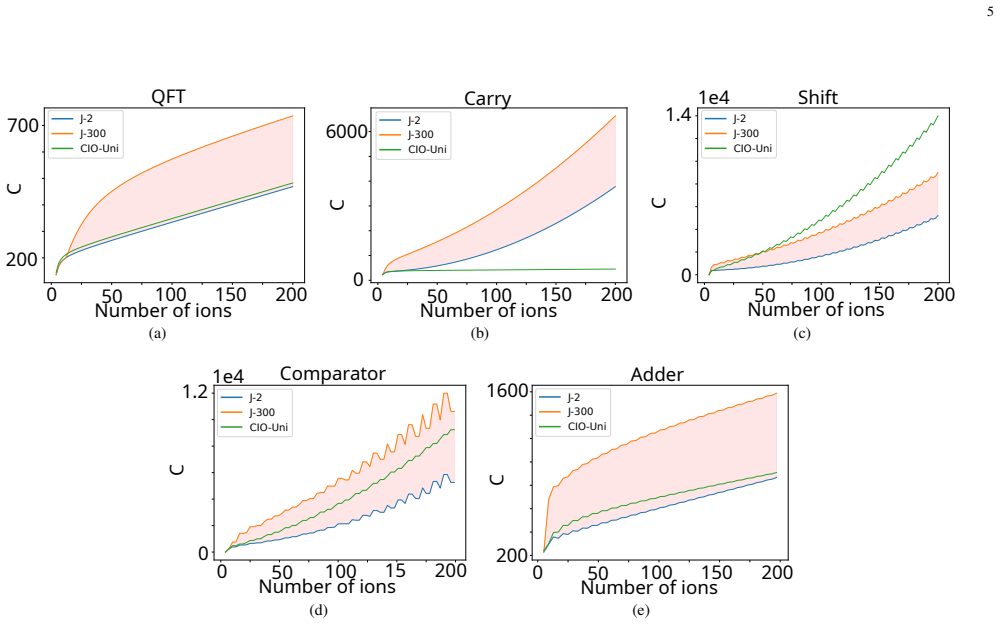
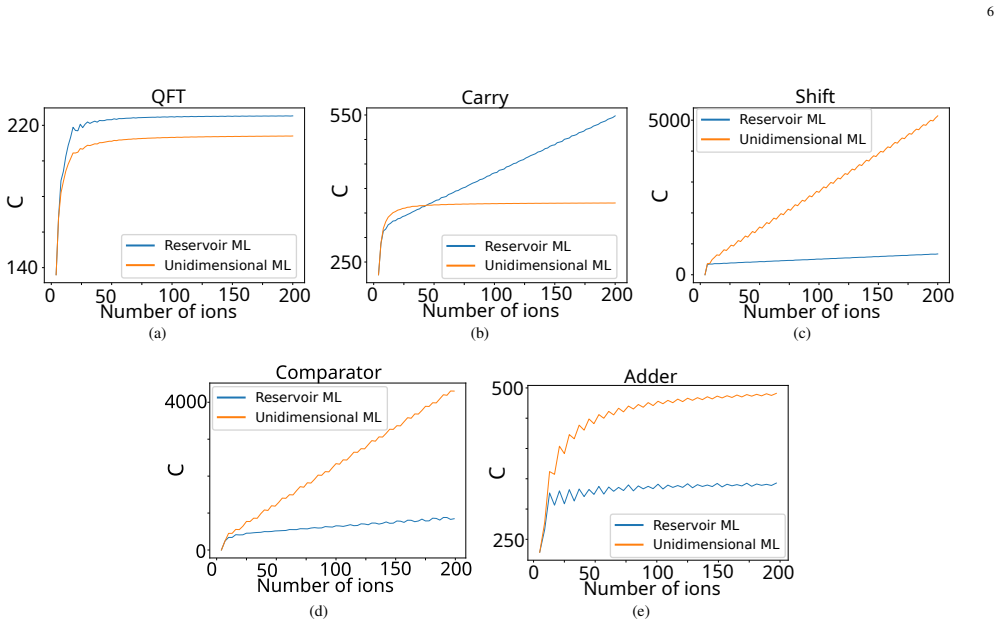
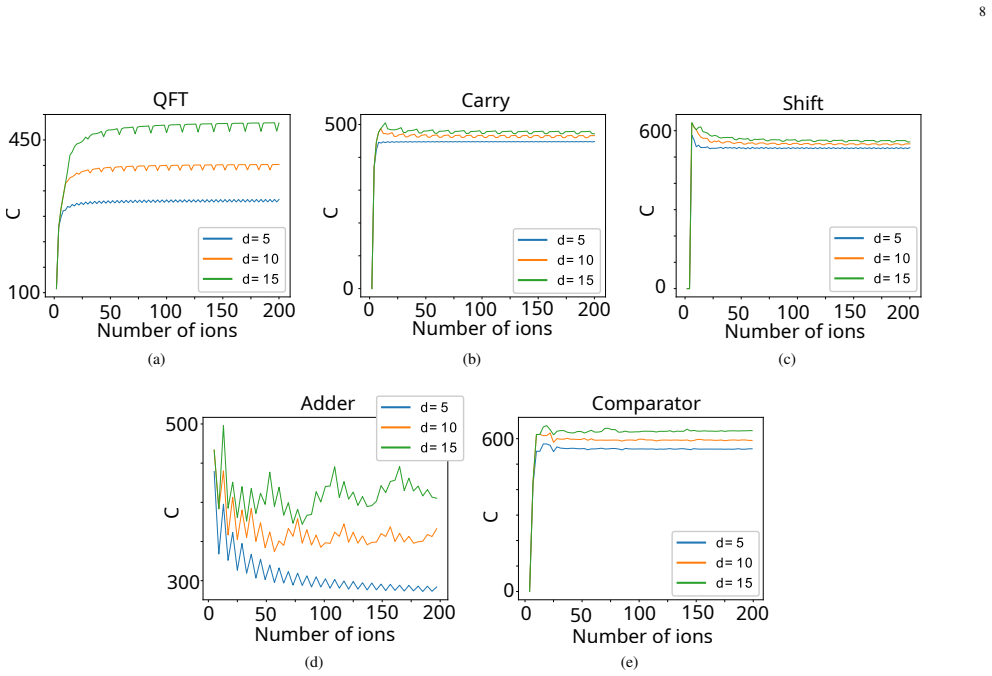
- For circuits such as QFT, Carry, Adder, Shift and Comparator the total shuttling cost in the 2D layout grows more slowly than in the 1D layout once ion number exceeds a few tens.
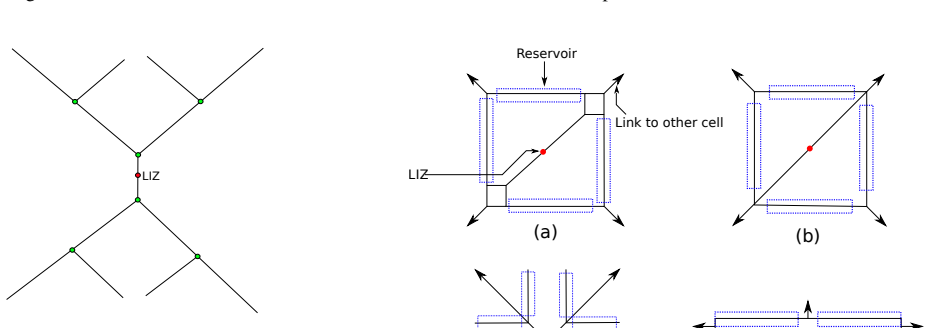
- Tiling the processor from identical cells that each contain junctions and storage segments yields a scalable architecture whose shuttling overhead remains bounded.
- Co-design of the shuttling layer together with the gate zones can be tuned to the specific set of circuit primitives that dominate a target algorithm.
Where Pith is reading between the lines
- Hardware teams may gain more by improving junction fidelity than by further shortening linear segments, because junctions become the dominant cost term at scale.
- The same cost model can be applied to other 2D topologies such as X-junction grids to rank their relative efficiency before fabrication.
- If shuttling costs are later shown to depend on ion number or trap voltage, the scaling advantage of 2D layouts would need recalculation.
Load-bearing premise
The individual cost functions assigned to linear shuttling and to junction shuttling accurately reflect the relative physical effort and time required in real hardware, allowing direct numerical comparison of total costs across circuits.
What would settle it
A laboratory measurement that records the actual duration and motional heating incurred when shuttling a single ion through a T-junction versus along a straight linear segment, then checks whether the measured ratio matches the cost ratio used in the circuit calculations.
Figures
read the original abstract
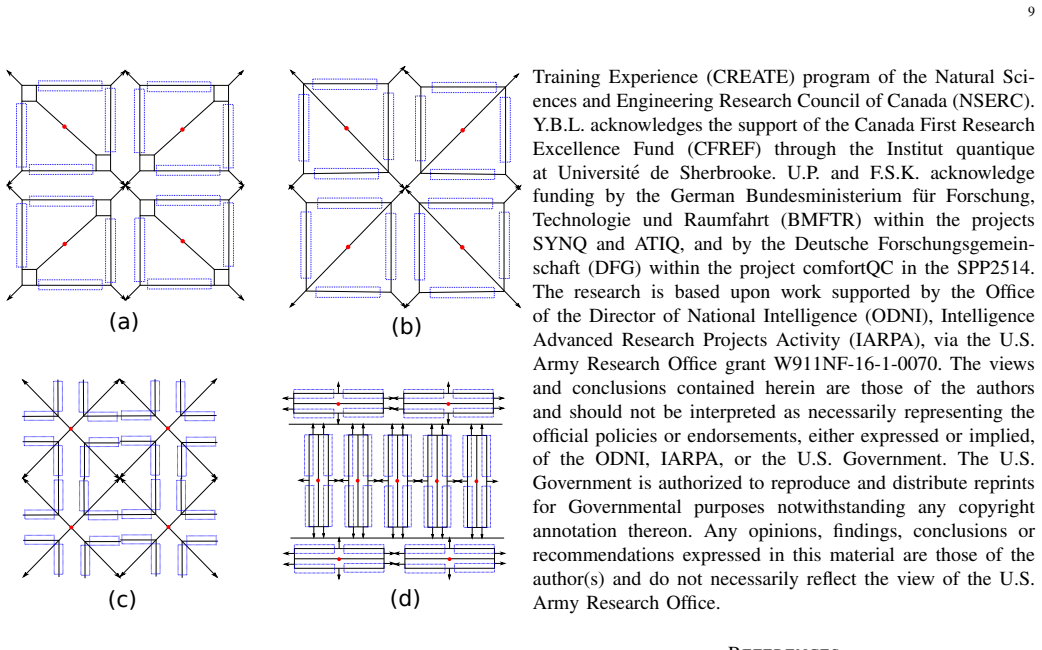
Shuttle-based trapped ion quantum processors typically employ a one-dimensional (1D) linear architecture to transport ion-qubits between one ore more laser interaction zones where the quantum gates are implemented, along with several qubit register storage segments. The two-dimensional (2D) quantum CCD architecture employs also T- or X-junctions for an improved scaling and efficiency. Here, we explore the shuttling layer in the compilation of quantum algorithm typical building blocks in such architecture. To weight the effort of linear shuttle and junction shuttle, we introduce individual cost functions for each operation. This allows comparing the total cost for quantum circuit building blocks such as the QFT, Carry, Adder, Shift, and Comparator circuits. We study their scaling properties with increased qubit numbers. At equivalent transport cost for junction and linear shuttling, we show that 2D architectures outperform the 1D linear trap with the ratio improving as the number of ions increases. Finally, we discuss the use of cells, such that the entire processor is constructed from a 2D array of such interconnected cells. The work aims to optimize quantum processor architectures, implementing a co-design that fits to the specific task and scaling up in a shuttle-efficient way.
Editorial analysis
A structured set of objections, weighed in public.
Referee Report
Summary. The manuscript examines shuttling in 2D segmented ion-trap processors with T-junctions by defining separate cost functions for linear shuttling and junction shuttling. It then compares the aggregate shuttling cost of standard quantum circuit building blocks (QFT, Carry, Adder, Shift, Comparator) when compiled onto 1D linear versus 2D T-junction architectures, reporting that the 2D layout yields lower total cost at equal per-operation transport cost and that the advantage grows with ion number. The work also outlines a modular cell-based construction of the full processor.
Significance. If the introduced cost functions can be shown to map onto measurable hardware quantities (shuttle time, heating, fidelity), the results would supply concrete guidance for co-design of trapped-ion architectures, favoring 2D T-junction layouts for scalable shuttling efficiency. The explicit treatment of shuttling cost at the compilation layer for multiple algorithmic primitives is a constructive contribution.
major comments (2)
- [Cost-function definitions] The central claim that 2D architectures outperform 1D at equivalent transport cost rests entirely on the relative weighting assigned to linear versus junction shuttling; these weights are introduced as free parameters without reference to experimental shuttle durations, heating rates, or fidelity data from the literature. Consequently the reported outperformance and its scaling with ion number are not robust to changes in the parameterization (cost-function definitions and comparison paragraphs).
- [Results on circuit building blocks] No explicit equations, circuit decompositions, or tabulated per-circuit cost breakdowns are supplied for the QFT, Adder, or Comparator examples; without these the scaling trend cannot be independently verified or shown to be independent of the particular gate decompositions and ion-mapping choices used.
minor comments (2)
- [Abstract] Abstract: 'one ore more' is a typographical error and should read 'one or more'.
- [Abstract] The abstract asserts comparative results but supplies neither numerical ratios nor the functional form of the cost functions, reducing immediate readability.
Simulated Author's Rebuttal
We thank the referee for the thoughtful and constructive report. The comments highlight opportunities to strengthen the presentation of our cost model and the verifiability of the circuit results. We address each major comment below and will incorporate revisions accordingly.
read point-by-point responses
-
Referee: [Cost-function definitions] The central claim that 2D architectures outperform 1D at equivalent transport cost rests entirely on the relative weighting assigned to linear versus junction shuttling; these weights are introduced as free parameters without reference to experimental shuttle durations, heating rates, or fidelity data from the literature. Consequently the reported outperformance and its scaling with ion number are not robust to changes in the parameterization (cost-function definitions and comparison paragraphs).
Authors: We agree that grounding the cost parameters in experimental literature would improve the manuscript. The cost functions are deliberately introduced as tunable parameters to enable architecture comparisons across different hardware regimes; the central result is reported specifically for the equal-cost case (linear cost = junction cost). In revision we will (i) cite representative experimental values for shuttle times, heating rates, and fidelities from the trapped-ion literature to motivate the parameter choices, and (ii) add a short sensitivity analysis showing how the 2D advantage varies with the linear-to-junction cost ratio. This will make the robustness of the scaling trend explicit. revision: yes
-
Referee: [Results on circuit building blocks] No explicit equations, circuit decompositions, or tabulated per-circuit cost breakdowns are supplied for the QFT, Adder, or Comparator examples; without these the scaling trend cannot be independently verified or shown to be independent of the particular gate decompositions and ion-mapping choices used.
Authors: We accept that the absence of explicit decompositions and tabulated breakdowns limits independent verification. The manuscript describes the mapping and cost accumulation procedure for each primitive, but does not display the intermediate equations or per-circuit tables. In the revised version we will add (i) the explicit cost equations used for each building block, (ii) the gate decompositions and ion-mapping choices employed, and (iii) a supplementary table listing the linear-shuttle and junction-shuttle counts (and total cost) for representative qubit numbers. These additions will allow readers to reproduce the reported scaling. revision: yes
Circularity Check
No circularity detected; comparison rests on explicit modeling assumptions
full rationale
The paper defines custom cost functions for linear and junction shuttling, then numerically evaluates total costs for circuit building blocks under an equivalence assumption. This is a direct modeling choice and comparison, not a derivation that reduces to its own inputs by construction. No equations, fitted parameters renamed as predictions, or self-citation chains appear in the provided text. The central claim is conditional on the cost model and is presented as such, remaining self-contained against external benchmarks.
Axiom & Free-Parameter Ledger
Reference graph
Works this paper leans on
-
[1]
Quantum Computations with Cold Trapped Ions
J. I. Cirac and P. Zoller. “Quantum Computations with Cold Trapped Ions”.Phys. Rev. Lett.74 (20 1995), pp. 4091–4094.DOI: 10.1103/PhysRevLett.74.4091. URL: https://link.aps.org/doi/10.1103/PhysRevLett.74. 4091
-
[2]
Ion-Based Quantum Computing Hardware: Performance and End-User Perspective
T. Strohm et al. “Ion-Based Quantum Computing Hardware: Performance and End-User Perspective”. arXiv:2405.11450(2024).URL: https://arxiv.org/abs/ 2405.11450
arXiv 2024
-
[3]
Perfor- mance of algorithms for emerging ion-trap quantum hardware
A. Kurlej, S. Alterman, and K. Obenland. “Perfor- mance of algorithms for emerging ion-trap quantum hardware”.Future Generation Computer Systems160 (2024), pp. 654–665.ISSN: 0167-739X.DOI: https : / / doi . org / 10 . 1016 / j . future . 2024 . 06 . 005.URL: https : / / www. sciencedirect . com / science / article / pii / S0167739X24003029
2024
-
[4]
Demonstration of the trapped-ion quantum CCD computer architecture
J. M. Pino et al. “Demonstration of the trapped-ion quantum CCD computer architecture”.Nature592.7853 (2021), pp. 209–213.DOI: 10.1038/s41586-021-03318- 4
-
[5]
D. Schwerdt et al. “Scalable Architecture for Trapped- Ion Quantum Computing Using RF Traps and Dy- namic Optical Potentials”.Phys. Rev. X14 (4 2024), p. 041017.DOI: 10.1103/PhysRevX.14.041017.URL: https://link.aps.org/doi/10.1103/PhysRevX.14.041017
-
[6]
Helios: A 98-qubit trapped-ion quantum computer
A. Ransford et al. “Helios: A 98-qubit trapped-ion quantum computer”.arXiv:2511.05465(2025).URL: https://arxiv.org/abs/2511.05465
Pith/arXiv arXiv 2025
-
[7]
Toolchain for shuttling trapped-ion qubits in segmented traps
A. Conta et al. “Toolchain for shuttling trapped-ion qubits in segmented traps”.AVS Quantum Science8.2 (2026), p. 023801.DOI: 10.1116/5.0323942. 10
-
[8]
T-junction ion trap array for two-dimensional ion shuttling, storage, and manipula- tion
W. K. Hensinger et al. “T-junction ion trap array for two-dimensional ion shuttling, storage, and manipula- tion”.Applied Physics Letters88 (2006), p. 034101. DOI: 10.1063/1.2164910
-
[9]
Hucul et al.On the Transport of Atomic Ions in Linear and Multidimensional Ion Trap Arrays
D. Hucul et al.On the Transport of Atomic Ions in Linear and Multidimensional Ion Trap Arrays. 2008. arXiv: quant- ph/0702175[quant-ph].URL: https: //arxiv.org/abs/quant-ph/0702175
arXiv 2008
-
[10]
Toward scalable ion traps for quan- tum information processing
J. M. Amini et al. “Toward scalable ion traps for quan- tum information processing”.New Journal of Physics 12 (2010), p. 033031.DOI: 10.1088/1367-2630/12/3/ 033031
-
[11]
Reliable transport through a micro- fabricated X-junction surface-electrode ion trap
K. Wright et al. “Reliable transport through a micro- fabricated X-junction surface-electrode ion trap”.New Journal of Physics15 (2013), p. 033004.DOI: 10.1088/ 1367-2630/15/3/033004
2013
-
[12]
Shuttling-based trapped-ion quantum information processing
V . Kaushal et al. “Shuttling-based trapped-ion quantum information processing”.AVS Quantum Science2.1 (2020), p. 014101.DOI: 10.1116/1.5126186
-
[13]
2020 roadmap on plasma accelera- tors,
H. Kaufmann et al. “Dynamics and control of fast ion crystal splitting in segmented Paul traps”.New Journal of Physics16.7 (2014), p. 073012.DOI: 10.1088/1367- 2630/16/7/073012
-
[14]
Complete Methods Set for Scalable Ion Trap Quantum Information Processing
J. P. Home et al. “Complete Methods Set for Scalable Ion Trap Quantum Information Processing”.Science 325 (2009), pp. 1227–1230.DOI: 10 . 1126 / science . 1177077
2009
-
[16]
Experimental realization of fast ion separation in segmented Paul traps
T. Ruster et al. “Experimental realization of fast ion separation in segmented Paul traps”.Phys. Rev. A90 (3 2014), p. 033410.DOI: 10.1103/PhysRevA.90.033410. URL: https://link.aps.org/doi/10.1103/PhysRevA.90. 033410
-
[17]
R. Bowler et al. “Coherent Diabatic Ion Transport and Separation in a Multizone Trap Array”.Phys. Rev. Lett. 109 (8 2012), p. 080502.DOI: 10.1103/PhysRevLett. 109.080502
-
[18]
Automated Generation of Shuttling Sequences for a Linear Segmented Ion Trap Quantum Computer
J. Durandau et al. “Automated Generation of Shuttling Sequences for a Linear Segmented Ion Trap Quantum Computer”.Quantum7 (Nov. 2023), p. 1175.DOI: 10. 22331/q-2023-11-08-1175
2023
-
[19]
Heuristics for Shuttling Sequence Optimization for a Linear Segmented Trapped-Ion Quantum Computer
J. Durandau et al. “Heuristics for Shuttling Sequence Optimization for a Linear Segmented Trapped-Ion Quantum Computer”.arXiv:2603.05464(2026).URL: https://arxiv.org/abs/2603.05464
arXiv 2026
-
[20]
Heating rates and ion-motion control in aY-junction surface-electrode trap
G. Shu et al. “Heating rates and ion-motion control in aY-junction surface-electrode trap”.Phys. Rev. A89 (6 2014), p. 062308.DOI: 10.1103/PhysRevA.89.062308. URL: https://link.aps.org/doi/10.1103/PhysRevA.89. 062308
-
[21]
Fault-Tolerant Parity Readout on a Shuttling-Based Trapped-Ion Quantum Computer
J. Hilder et al. “Fault-Tolerant Parity Readout on a Shuttling-Based Trapped-Ion Quantum Computer”. Phys. Rev. X12 (1 2022), p. 011032.DOI: 10.1103/ PhysRevX.12.011032
2022
discussion (0)
Sign in with ORCID, Apple, or X to comment. Anyone can read and Pith papers without signing in.