Deeper is Not Always Better: Mitigating the Alignment Tax via Confident Layer Decoding
Pith reviewed 2026-06-26 12:19 UTC · model grok-4.3
The pith
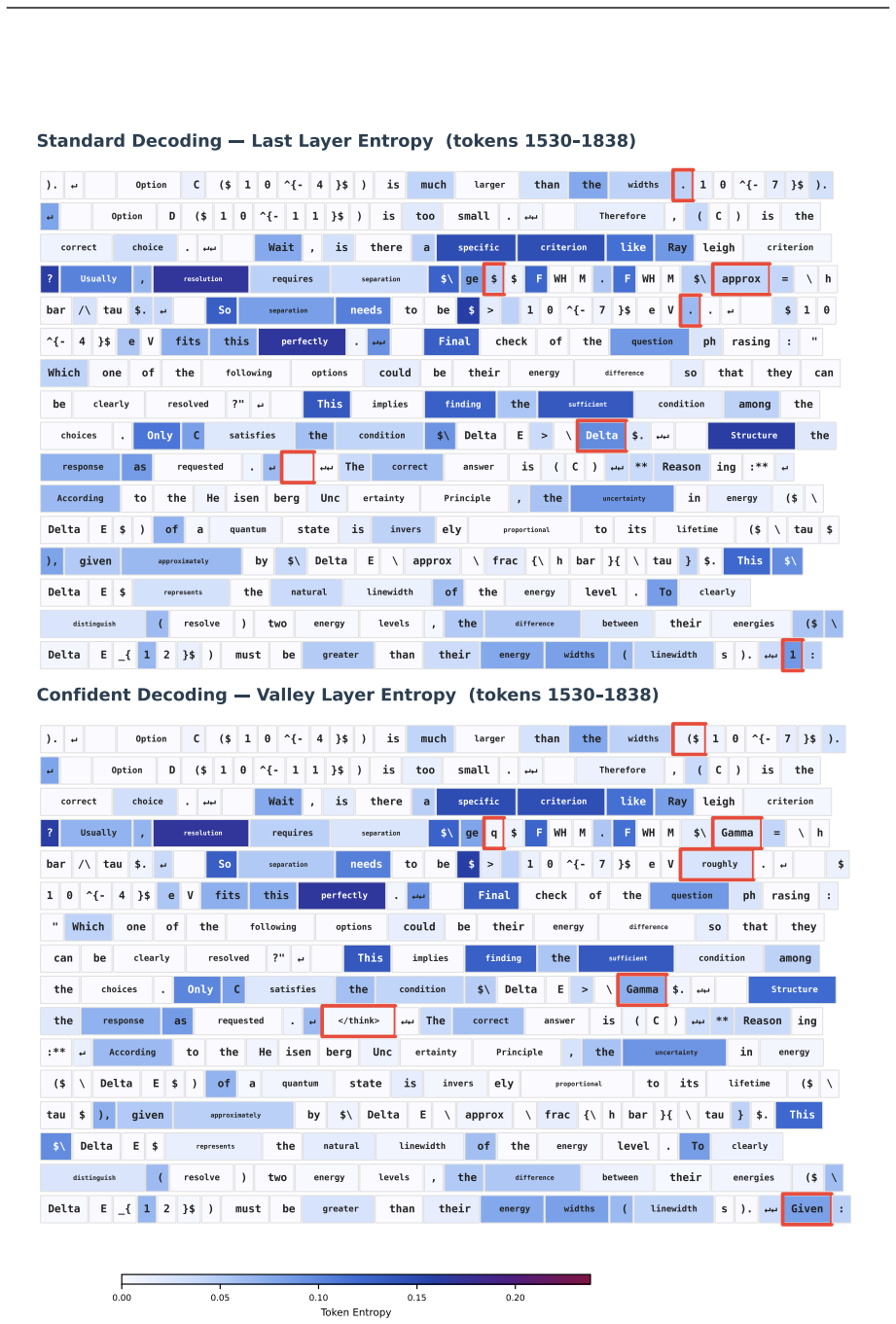
Final layers in aligned LLMs often perturb refined reasoning predictions, and entropy-guided selection of an earlier layer improves results on hard benchmarks.
A machine-rendered reading of the paper's core claim, the machinery that carries it, and where it could break.
Core claim
The paper establishes that autoregressive LLMs exhibit a Guess-Refine-Perturb dynamic across layers, where final-layer perturbations from alignment can be mitigated by dynamically selecting a near-final layer via entropy-guided conservative backward search. This selection is formulated as an optimal stopping problem that bounds performance loss under assumptions of bounded projection noise and dominant late-stage perturbation.
What carries the argument
Confident Decoding, an entropy-guided conservative backward search that selects the most reliable near-final layer for next-token prediction.
Load-bearing premise
The Guess-Refine-Perturb dynamic occurs consistently across models and the entropy search reliably locates the refinement layer without model-specific tuning.
What would settle it
Running Confident Decoding on GPQA-Diamond, Omni-MATH, and HLE and observing no accuracy gain or a loss relative to standard final-layer decoding would falsify the central claim.
Figures






read the original abstract
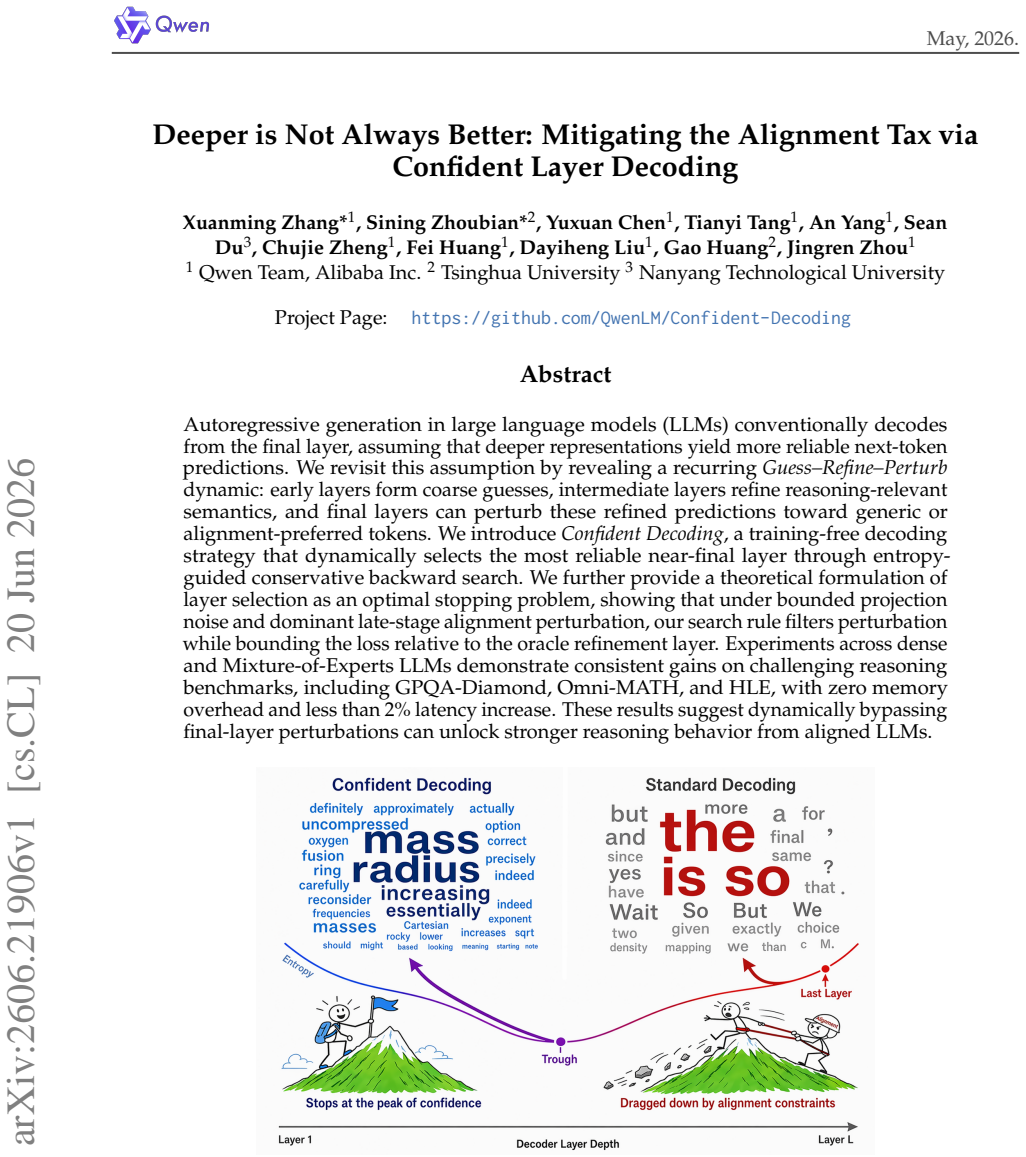
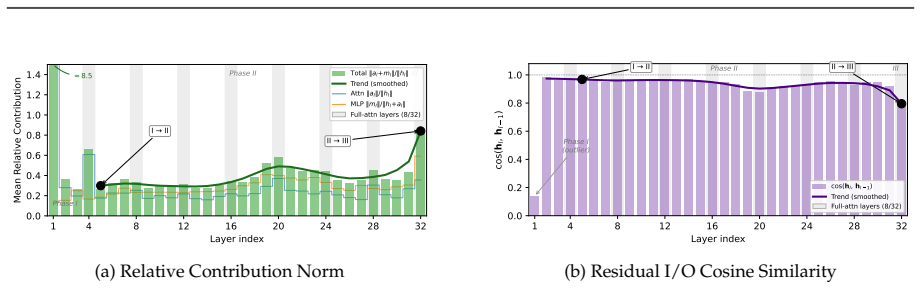
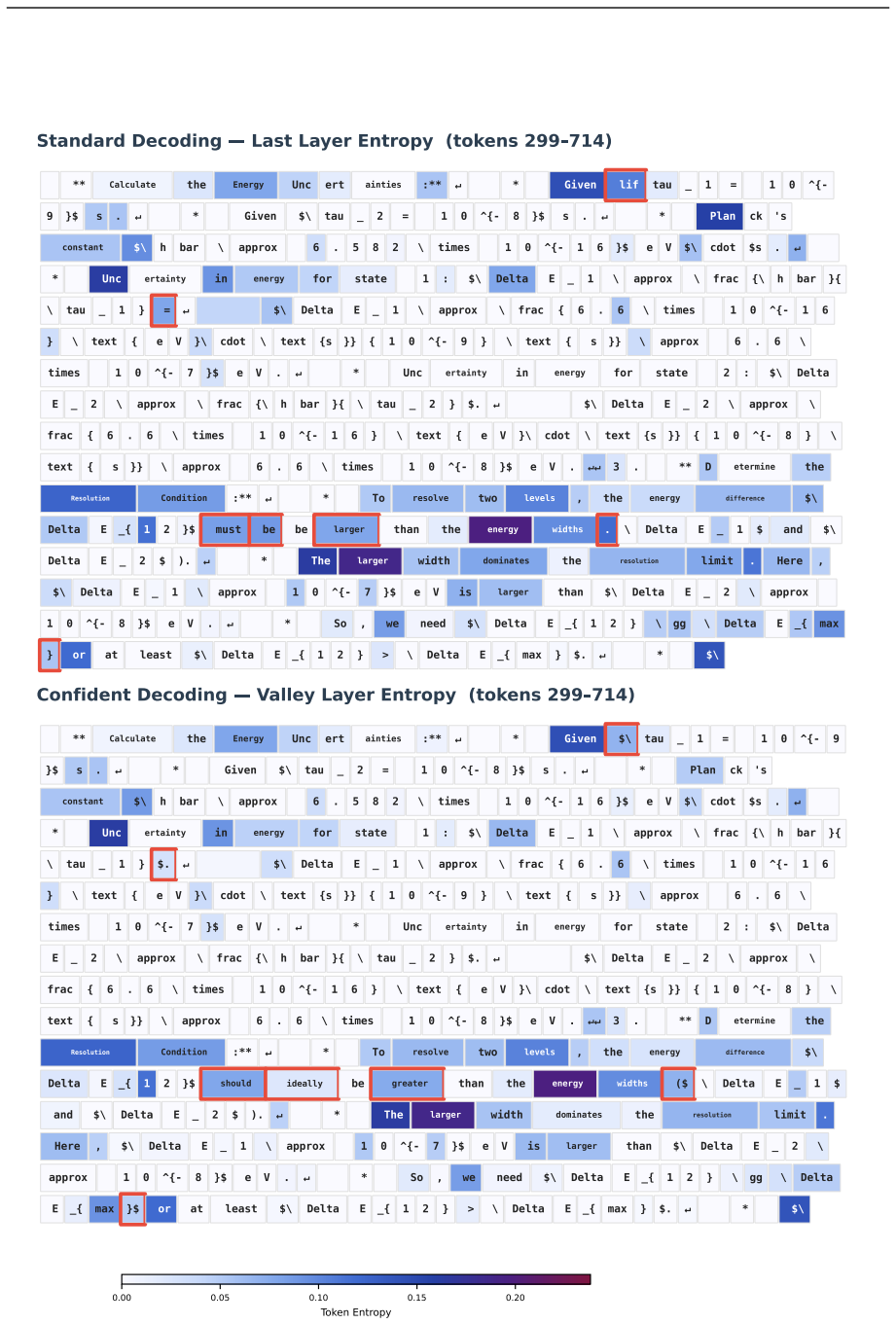
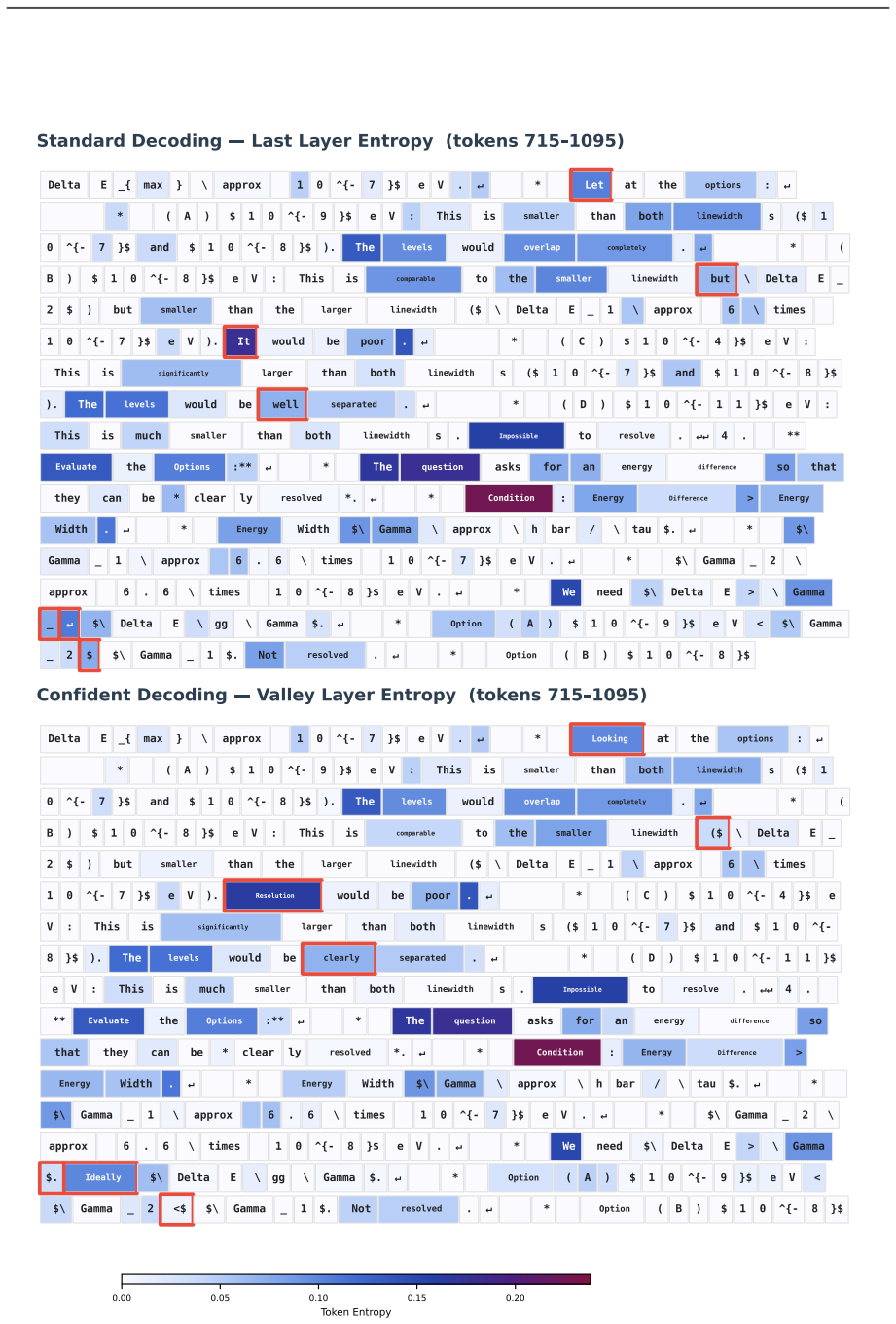
Autoregressive generation in large language models (LLMs) conventionally decodes from the final layer, assuming that deeper representations yield more reliable next-token predictions. We revisit this assumption by revealing a recurring Guess-Refine-Perturb dynamic: early layers form coarse guesses, intermediate layers refine reasoning-relevant semantics, and final layers can perturb these refined predictions toward generic or alignment-preferred tokens. We introduce Confident Decoding, a training-free decoding strategy that dynamically selects the most reliable near-final layer through entropy-guided conservative backward search. We further provide a theoretical formulation of layer selection as an optimal stopping problem, showing that under bounded projection noise and dominant late-stage alignment perturbation, our search rule filters perturbation while bounding the loss relative to the oracle refinement layer. Experiments across dense and Mixture-of-Experts LLMs demonstrate consistent gains on challenging reasoning benchmarks, including GPQA-Diamond, Omni-MATH, and HLE, with zero memory overhead and less than 2% latency increase. These results suggest dynamically bypassing final-layer perturbations can unlock stronger reasoning behavior from aligned LLMs.
Editorial analysis
A structured set of objections, weighed in public.
Referee Report
Summary. The paper claims that autoregressive LLMs exhibit a recurring Guess-Refine-Perturb dynamic in which early layers form coarse guesses, intermediate layers refine reasoning semantics, and final layers perturb predictions toward generic or alignment-preferred tokens. It introduces Confident Decoding, a training-free method that performs entropy-guided conservative backward search to select a reliable near-final layer, formulates the selection as an optimal stopping problem under bounded projection noise and dominant late-stage alignment perturbation, and reports consistent gains on GPQA-Diamond, Omni-MATH, and HLE with zero memory overhead and less than 2% latency increase.
Significance. If the Guess-Refine-Perturb dynamic is empirically validated across models and the entropy-guided search reliably identifies the refinement layer without post-hoc tuning, the work offers a practical, zero-cost approach to mitigating the alignment tax on reasoning tasks. The training-free nature, theoretical framing as optimal stopping, and negligible overhead are strengths that could make the method broadly applicable if the load-bearing assumptions hold.
major comments (3)
- [§3 (dynamic description)] The central claim attributes performance gains to bypassing final-layer perturbations via the Guess-Refine-Perturb dynamic, yet the manuscript provides no quantitative layer-wise analysis (e.g., token-level probability shifts or entropy trajectories) demonstrating that final layers specifically perturb toward alignment-preferred tokens rather than other effects; without this evidence the attribution of gains on GPQA-Diamond, Omni-MATH, and HLE to the claimed mechanism remains unverified.
- [§4.1] §4.1 (optimal stopping formulation): the theoretical bound on loss relative to the oracle layer assumes bounded projection noise and dominant late-stage alignment perturbation; the paper must supply empirical sensitivity checks or counter-examples showing when these assumptions fail, because violation would mean the conservative backward search does not reliably filter perturbation.
- [Experiments] Experiments section: the claim that the entropy-guided search works without post-hoc tuning across dense and MoE models is load-bearing, yet no ablation is described that compares the method against random near-final layer selection or alternative heuristics; such controls are required to confirm that reported gains are not incidental.
minor comments (2)
- Provide pseudocode or a precise algorithmic description of the entropy threshold and conservative backward search rule to ensure reproducibility.
- Report latency and memory figures with standard deviations over multiple runs and model scales to support the <2% latency claim.
Simulated Author's Rebuttal
We thank the referee for the constructive comments, which help clarify the presentation of the Guess-Refine-Perturb dynamic and the supporting evidence. We address each major comment below and will revise the manuscript accordingly.
read point-by-point responses
-
Referee: [§3 (dynamic description)] The central claim attributes performance gains to bypassing final-layer perturbations via the Guess-Refine-Perturb dynamic, yet the manuscript provides no quantitative layer-wise analysis (e.g., token-level probability shifts or entropy trajectories) demonstrating that final layers specifically perturb toward alignment-preferred tokens rather than other effects; without this evidence the attribution of gains on GPQA-Diamond, Omni-MATH, and HLE to the claimed mechanism remains unverified.
Authors: We agree that the manuscript would benefit from explicit quantitative layer-wise evidence to support attribution of the gains to the proposed dynamic rather than other factors. While the performance results and theoretical framing are presented, detailed token-level probability shift and entropy trajectory analyses are not included. In the revision we will add these analyses, including layer-wise entropy plots and representative examples of probability mass shifts toward alignment-preferred tokens on instances from GPQA-Diamond and Omni-MATH. revision: yes
-
Referee: [§4.1] §4.1 (optimal stopping formulation): the theoretical bound on loss relative to the oracle layer assumes bounded projection noise and dominant late-stage alignment perturbation; the paper must supply empirical sensitivity checks or counter-examples showing when these assumptions fail, because violation would mean the conservative backward search does not reliably filter perturbation.
Authors: The derivation in §4.1 is conditioned on bounded projection noise and dominant late-stage alignment perturbation. We concur that empirical checks on the sensitivity of these assumptions are required to delineate the regime in which the search rule is reliable. The revision will include sensitivity experiments that vary noise levels and evaluate the method on settings where alignment perturbation is weaker, together with discussion of observed failure modes. revision: yes
-
Referee: [Experiments] Experiments section: the claim that the entropy-guided search works without post-hoc tuning across dense and MoE models is load-bearing, yet no ablation is described that compares the method against random near-final layer selection or alternative heuristics; such controls are required to confirm that reported gains are not incidental.
Authors: We acknowledge that the absence of controls against random near-final layer selection and alternative heuristics leaves open the possibility that gains are incidental. The current experiments demonstrate consistent improvements but do not contain these ablations. The revised manuscript will add the requested controls, including random layer selection within the candidate window and fixed-layer or forward-entropy baselines, across the dense and MoE models evaluated. revision: yes
Circularity Check
No significant circularity; training-free method with external experimental grounding
full rationale
The paper introduces Confident Decoding as a training-free decoding strategy based on an observed Guess-Refine-Perturb dynamic and formulates layer selection as an optimal stopping problem under explicit assumptions (bounded projection noise, dominant late-stage alignment perturbation). No equations, parameters, or self-citations are shown reducing the central claim to a fit or self-referential definition. The method relies on entropy-guided search with reported gains on external benchmarks (GPQA-Diamond, Omni-MATH, HLE), making the derivation self-contained against those benchmarks rather than circular by construction.
Axiom & Free-Parameter Ledger
axioms (1)
- domain assumption Bounded projection noise and dominant late-stage alignment perturbation
Reference graph
Works this paper leans on
-
[1]
A General Language Assistant as a Laboratory for Alignment
Amanda Askell, Yuntao Bai, Anna Chen, Dawn Drain, Deep Ganguli, Tom Henighan, Andy Jones, Nicholas Joseph, Ben Mann, Nova DasSarma, et al. A general language assistant as a laboratory for alignment.arXiv preprint arXiv:2112.00861,
work page internal anchor Pith review Pith/arXiv arXiv
-
[2]
Eliciting Latent Predictions from Transformers with the Tuned Lens
Nora Belrose, Igor Ostrovsky, Lev McKinney, Zach Furman, Logan Smith, Danny Halawi, Stella Biderman, and Jacob Steinhardt. Eliciting latent predictions from transformers with the tuned lens.arXiv preprint arXiv:2303.08112,
work page internal anchor Pith review Pith/arXiv arXiv
-
[3]
Training Verifiers to Solve Math Word Problems
Karl Cobbe, Vineet Kosaraju, Mohammad Bavarian, Mark Chen, Heewoo Jun, Lukasz Kaiser, Matthias Plappert, Jerry Tworek, Jacob Hilton, Reiichiro Nakano, et al. Training verifiers to solve math word problems.arXiv preprint arXiv:2110.14168,
work page internal anchor Pith review Pith/arXiv arXiv
-
[4]
Transformer feed-forward layers build predictions by promoting concepts in the vocabulary space
Mor Geva, Avi Caciularu, Kevin Ro Wang, and Yoav Goldberg. Transformer feed-forward layers build predictions by promoting concepts in the vocabulary space. InProceedings of the 2022 Conference on Empirical Methods in Natural Language Processing, pages 30–45,
2022
-
[5]
Dissecting recall of factual associations in auto-regressive language models
Mor Geva, Jasmijn Bastings, Katja Filippova, and Amir Globerson. Dissecting recall of factual associations in auto-regressive language models. InProceedings of the 2023 Conference on Empirical Methods in Natural Language Processing, pages 12216–12235,
2023
-
[6]
How do llms use their depth?arXiv preprint arXiv:2510.18871,
Akshat Gupta, Jay Yeung, Gopala Anumanchipalli, and Anna Ivanova. How do llms use their depth?arXiv preprint arXiv:2510.18871,
-
[7]
Inference-time intervention: Eliciting truthful answers from a language model
Kenneth Li, Oam Patel, Fernanda Viégas, Hanspeter Pfister, and Martin Wattenberg. Inference-time intervention: Eliciting truthful answers from a language model. InAdvances in Neural Information Processing Systems, volume 36, 2023a. Xiang Lisa Li, Ari Holtzman, Daniel Fried, Percy Liang, Jason Eisner, Tatsunori Hashimoto, Luke Zettlemoyer, and Mike Lewis. ...
2024
-
[8]
Xukai Liu, Ye Liu, Jipeng Zhang, Yanghai Zhang, Kai Zhang, and Qi Liu. Layer-order inversion: Rethinking latent multi-hop reasoning in large language models.arXiv preprint arXiv:2601.03542,
-
[9]
Diffskip: Differential layer skipping in large language models
Xuan Luo, Weizhi Wang, and Xifeng Yan. Diffskip: Differential layer skipping in large language models. InFindings of the Association for Computational Linguistics: ACL 2025, pages 7221–7231, 2025a. Xuan Luo, Weizhi Wang, and Xifeng Yan. Adaptive layer-skipping in pre-trained llms. InSecond Conference on Language Modeling, 2025b. Xin Men, Mingyu Xu, Qingyu...
2025
-
[10]
Accessed: 2026-02-16
URL https://qwen.ai/blog?id=qwen3.5. Accessed: 2026-02-16. Rafael Rafailov, Archit Sharma, Eric Mitchell, Christopher D Manning, Stefano Ermon, and Chelsea Finn. Direct preference optimization: Your language model is secretly a reward model.Advances in neural information processing systems, 36:53728–53741,
2026
-
[11]
Trusting your evidence: Hallucinate less with context-aware decoding
18 Weijia Shi, Xiaochuang Han, Mike Lewis, Yulia Tsvetkov, Luke Zettlemoyer, and Wen-tau Yih. Trusting your evidence: Hallucinate less with context-aware decoding. InProceedings of the 2024 Conference of the North American Chapter of the Association for Computational Linguistics: Human Language Technologies (Volume 2: Short Papers), pages 783–791,
2024
-
[12]
The diminishing returns of early-exit decoding in modern llms.arXiv preprint arXiv:2603.23701,
Rui Wei, Rui Du, Hanfei Yu, Devesh Tiwari, Jian Li, Zhaozhuo Xu, and Hao Wang. The diminishing returns of early-exit decoding in modern llms.arXiv preprint arXiv:2603.23701,
-
[13]
Chenxu Yang, Qingyi Si, Yongjie Duan, Zheliang Zhu, Chenyu Zhu, Qiaowei Li, Minghui Chen, Zheng Lin, and Weiping Wang. Dynamic early exit in reasoning models.arXiv preprint arXiv:2504.15895,
-
[14]
Air-bench 2024: A safety benchmark based on regulation and policies specified risk categories
Yi Zeng, Yu Yang, Andy Zhou, Jeffrey Ziwei Tan, Yuheng Tu, Yifan Mai, Kevin Klyman, Minzhou Pan, Ruoxi Jia, Dawn Song, et al. Air-bench 2024: A safety benchmark based on regulation and policies specified risk categories. InThe Thirteenth International Conference on Learning Representations,
2024
-
[15]
Active layer-contrastive decoding reduces halluci- nation in large language model generation
Hongxiang Zhang, Hao Chen, Muhao Chen, and Tianyi Zhang. Active layer-contrastive decoding reduces halluci- nation in large language model generation. InProceedings of the 2025 Conference on Empirical Methods in Natural Language Processing, pages 3028–3046, 2025a. Jianyi Zhang, Da-Cheng Juan, Cyrus Rashtchian, Chun-Sung Ferng, Heinrich Jiang, and Yiran Ch...
2025
-
[16]
Generalization or memorization: Dynamic decoding for mode steering
Xuanming Zhang. Generalization or memorization: Dynamic decoding for mode steering. InSocially Responsible and Trustworthy Foundation Models at NeurIPS 2025,
2025
-
[17]
Cognition-of-thought elicits social-aligned reasoning in large language models
Xuanming Zhang, Yuxuan Chen, Samuel Yeh, and Sharon Li. Cognition-of-thought elicits social-aligned reasoning in large language models. InSocially Responsible and Trustworthy Foundation Models at NeurIPS 2025, 2025b. Yuechi Zhou, Chuyue Zhou, Jianxin Zhang, Juntao Li, and Min Zhang. Alw: Adaptive layer-wise contrastive decoding enhancing reasoning ability...
2025
-
[18]
Jingze Zhu, Yongliang Wu, Wenbo Zhu, Jiawang Cao, Yanqiang Zheng, Jiawei Chen, Xu Yang, Bernt Schiele, Jonas Fischer, and Xinting Hu. Layercake: Token-aware contrastive decoding within large language model layers.arXiv preprint arXiv:2507.04404,
-
[19]
Continual pre-training of language models
Ke Zixuan, Shao Yijia, Lin Haowei, Konishi Tatsuya, Kim Gyuhak, Liu Bing, et al. Continual pre-training of language models. InProceedings of The Eleventh International Conference on Learning Representations (ICLR-2023),
2023
-
[20]
Representation Engineering: A Top-Down Approach to AI Transparency
Andy Zou, Long Phan, Sarah Chen, James Campbell, Phillip Guo, Richard Ren, Alexander Pan, Xuwang Yin, Mantas Mazeika, Ann-Kathrin Dombrowski, et al. Representation engineering: A top-down approach to ai transparency. arXiv preprint arXiv:2310.01405,
work page internal anchor Pith review Pith/arXiv arXiv
-
[21]
and in the ablation reported below (Table 7), deterministic valley selection consistently outperforms stochastic mixtures, indicating every additional draw from the perturbed final layer reintroduces precisely the alignment-tax bias that CONFIDENTDECODINGis designed to bypass. Sampling Parameters (T and top-p).For all benchmarks we use greedy-style decodi...
2024
-
[22]
You should think step-by-step and put your final answer within \boxed{}
System Prompt: You are a helpful and harmless assistant. You should think step-by-step and put your final answer within \boxed{}. User Prompt: The problem statement (fieldquestionorproblemin the dataset JSONL). Decoding Settings:T=0.0, top-p=1.0, max tokens 32,768,n=1. Grading: Official rule-based math evaluator —parse_ground_truth+run_execute+math_equal....
2024
-
[23]
You are an expert evaluator with extensive experience in evaluating response of given query
System Prompt:(none — direct user query) User Prompt: Raw writing query from the official benchmark (1,000 queries spanning 6 domains: Academic & Engineering, Finance & Business, Politics & Law, Literature & Arts, Education, Advertising & Marketing). Decoding Settings: T=0.7, top-p=0.8, top-k=20, max tokens 16,000. These generation parameters follow the o...
2024
-
[24]
and Self Logits Evolution Decoding (SLED) (Zhang et al., 2024). Both methods were originally developed and evaluated on standard dense Transformers (e.g., LLaMA-family models), and their official implementations rely on layer-indexing conventions and residual-stream access patterns specific to homogeneous dense architectures. Consequently, neither can be ...
2024
discussion (0)
Sign in with ORCID, Apple, or X to comment. Anyone can read and Pith papers without signing in.