Topological summaries of fingerprint ridge patterns carry identity information
Pith reviewed 2026-06-26 12:44 UTC · model grok-4.3
The pith
Topological summaries of fingerprint ridge patterns carry identity information usable for verification
A machine-rendered reading of the paper's core claim, the machinery that carries it, and where it could break.
Core claim
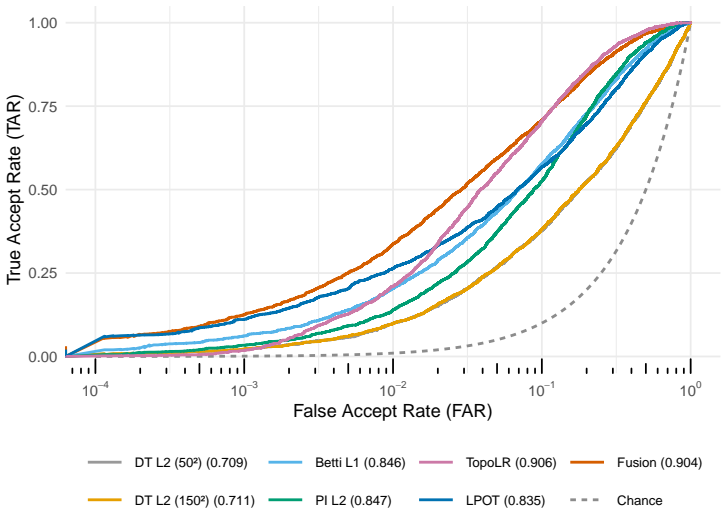
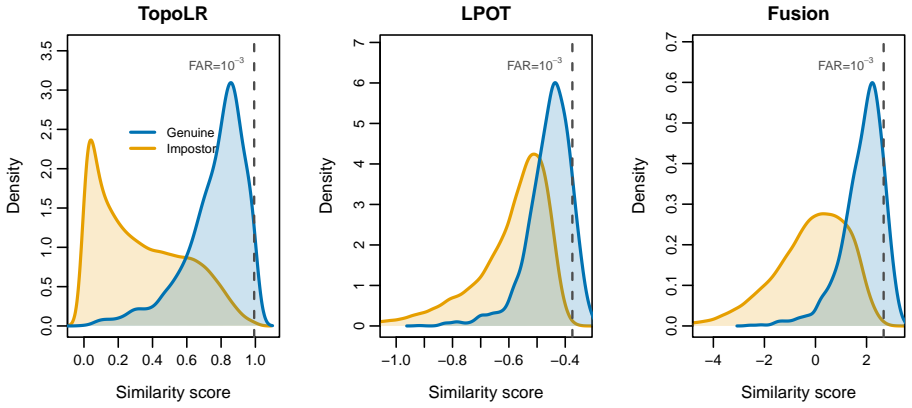
Persistent homology applied to the full ridge-valley pattern produces topological summaries that carry substantial fingerprint identity information. On the FVC2000 DB1 dataset, these summaries enable verification methods that substantially outperform geometry-only baselines, with a trained method achieving an AUC of 0.91 and an optimal-transport approach performing well at strict false-accept thresholds. Fusing the two yields the best results at every low false-accept threshold examined.
What carries the argument
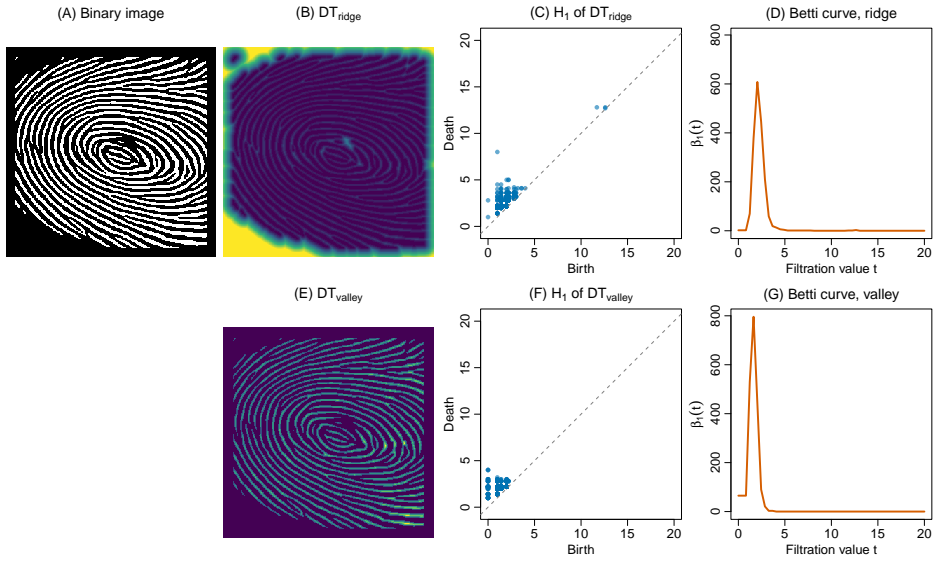
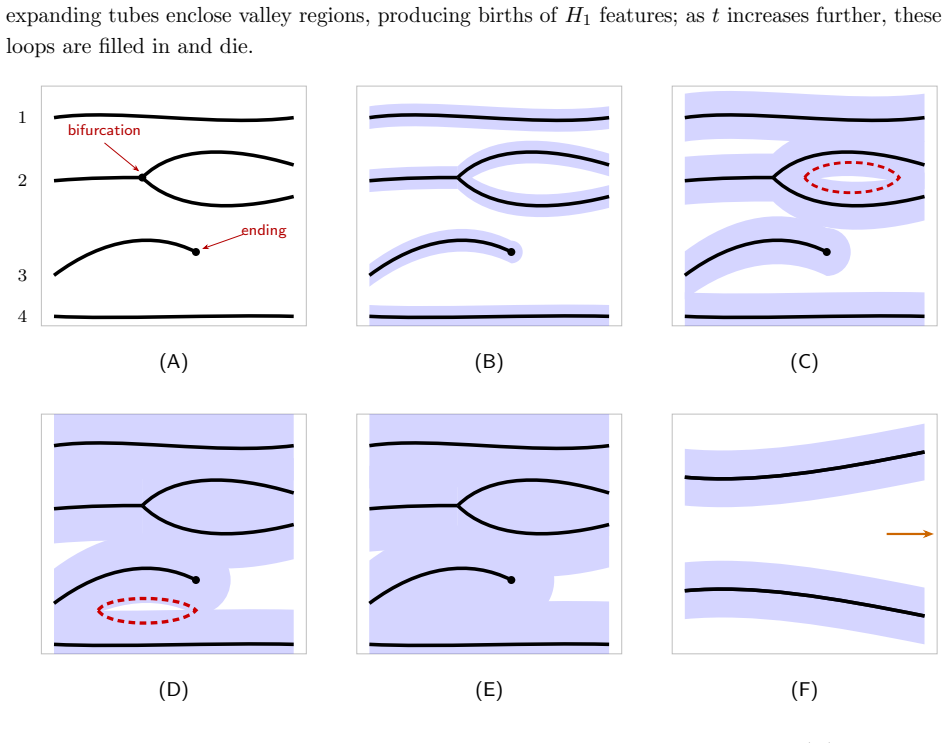
Persistent homology, which computes multi-scale summaries by tracking the formation and filling of loops in the binary ridge pattern across increasing spatial scales
If this is right
- Verification can be performed using the entire ridge pattern rather than isolated minutiae points
- Topological methods provide a transparent complement to existing minutiae-based fingerprint systems
- Different topological approaches capture complementary aspects of the ridge pattern, as shown by their fusion improving performance
- Simple topological summaries without any trained parameters already exceed the effectiveness of pixel-level geometry
Where Pith is reading between the lines
- This topological approach might generalize to other image-based identification tasks where patterns have loop structures
- It could reduce errors in biometric systems by avoiding the multi-stage pipeline prone to failure in noisy images
- Further work could explore how these summaries interact with existing alignment techniques in fingerprint matching
Load-bearing premise
Performance gains observed on the FVC2000 DB1 benchmark will generalize to fingerprints collected under varied real-world conditions without significant overfitting
What would settle it
Evaluating the topological methods on a separate fingerprint dataset with different sensors or demographics and finding that they lose their performance advantage over geometry baselines would indicate the summaries do not reliably carry identity information
Figures
read the original abstract
Fingerprints are the most widely deployed biometric. Verifying whether two impressions come from the same finger typically relies on minutiae, small landmarks such as skin ridge endings and bifurcations. These landmarks are extracted through a multi-stage pipeline of image enhancement, skeletonization, minutiae detection, and alignment. We investigate an alternative: using topological data analysis to represent the full pattern of skin ridges and valleys directly, bypassing minutiae detection and the downstream matching pipeline. We apply persistent homology, a topological tool that tracks how loops in the ridge pattern form and fill in across spatial scales, producing multi-scale summaries of ridge geometry. We develop and compare a range of verification methods on a standard benchmark dataset, FVC2000 DB1. Even the simplest topological summaries, with no trained parameters, substantially outperform geometry-only baselines. A trained method achieves an AUC of 0.91, while an optimal-transport method excels at the strictest false-accept thresholds, suggesting they capture different aspects of the ridge pattern. Fusing these two approaches yields the best performance at every low false-accept threshold we examine. Our results establish that these topological summaries capture substantial fingerprint identity information, far more effective for verification than raw pixel-level geometry. Because the entire pipeline is openly specified, it offers a transparent complement to minutiae-based systems, and we provide a modular framework for constructing, evaluating, and combining topological verification methods.
Editorial analysis
A structured set of objections, weighed in public.
Referee Report
Summary. The paper claims that persistent homology provides topological summaries of fingerprint ridge patterns that capture substantial identity information for verification. On FVC2000 DB1, even parameter-free topological features outperform geometry baselines; a trained method reaches AUC 0.91, an optimal-transport approach performs well at low false-accept rates, and their fusion is best across thresholds. The pipeline is fully specified and offered as a transparent complement to minutiae-based systems.
Significance. If the empirical results are reproducible and generalize, the work would demonstrate a viable TDA-based alternative that bypasses minutiae extraction while remaining interpretable and modular. The open specification and provision of a framework for combining methods are concrete strengths that could support follow-on research in biometrics.
major comments (2)
- [Abstract] Abstract: the reported AUC of 0.91 and statements of outperformance over baselines are given without any description of data splits, cross-validation folds, error bars, or the precise construction of the topological feature vectors; these omissions directly affect assessment of the central performance claim.
- [Abstract] Abstract and results sections: all quantitative claims rest on a single controlled dataset (FVC2000 DB1, 800 images from 100 fingers, one scanner); no cross-dataset or external validation is reported, leaving open whether observed identity information reflects intrinsic ridge topology or dataset-specific imaging conditions.
minor comments (1)
- [Abstract] The abstract states that the pipeline is 'openly specified' yet provides no pointer to code or supplementary material containing the exact persistent-homology parameters or distance functions used.
Simulated Author's Rebuttal
We thank the referee for the constructive feedback on our manuscript. We address each major comment point by point below, proposing targeted revisions where appropriate to strengthen clarity and transparency.
read point-by-point responses
-
Referee: [Abstract] Abstract: the reported AUC of 0.91 and statements of outperformance over baselines are given without any description of data splits, cross-validation folds, error bars, or the precise construction of the topological feature vectors; these omissions directly affect assessment of the central performance claim.
Authors: We agree that the abstract's brevity omits key methodological details necessary for immediate assessment of the performance claims. The full manuscript (Sections 3 and 4) specifies the subject-disjoint data splits, cross-validation procedure, construction of topological feature vectors from persistence diagrams of ridge filtrations, and reports the AUC values. To address the concern directly, we will revise the abstract to include a concise statement on the evaluation protocol and feature construction while preserving length limits, directing readers to the methods for full specifications. revision: yes
-
Referee: [Abstract] Abstract and results sections: all quantitative claims rest on a single controlled dataset (FVC2000 DB1, 800 images from 100 fingers, one scanner); no cross-dataset or external validation is reported, leaving open whether observed identity information reflects intrinsic ridge topology or dataset-specific imaging conditions.
Authors: The study is confined to FVC2000 DB1, a standard controlled benchmark that facilitates direct comparison with prior fingerprint verification methods. The topological summaries are derived from intrinsic ridge geometry via persistent homology, and their superior performance relative to pixel-geometry baselines indicates capture of identity-relevant structure beyond scanner artifacts. We acknowledge the limitation of single-dataset evaluation and will add an explicit discussion of this point, including caveats on generalization and suggestions for future cross-dataset validation on additional benchmarks. revision: partial
Circularity Check
No circularity; empirical validation on public benchmark is self-contained
full rationale
The paper applies persistent homology to produce topological summaries of ridge patterns and evaluates verification performance directly on the public FVC2000 DB1 dataset via comparisons to geometry baselines. No equations, derivations, or first-principles claims are presented that reduce to fitted inputs by construction. No self-citations are used to justify uniqueness theorems, ansatzes, or load-bearing premises. The reported AUC of 0.91 and fusion results are computed outputs on the benchmark, not renamed fits or self-referential predictions, satisfying the criteria for a non-circular empirical study.
Axiom & Free-Parameter Ledger
axioms (1)
- domain assumption Persistent homology of ridge patterns produces summaries that encode identity information independent of minutiae
Reference graph
Works this paper leans on
-
[1]
Davide Maltoni, Dario Maio, Anil K Jain, and Jianjiang Feng.Handbook of fingerprint recognition, volume 3. Springer, 2022. doi: 10.1007/978-3-030-83624-5
-
[2]
Fingerprint classification: a review.Pattern Anal
Neil Yager and Adnan Amin. Fingerprint classification: a review.Pattern Anal. Appl., 7:77–93,
-
[3]
doi: 10.1007/s10044-004-0204-7
-
[4]
Danilo Valdes-Ramirez, Miguel Angel Medina-P´ erez, Ra´ ul Monroy, Octavio Loyola-Gonz´ alez, Jorge Rodr´ ıguez, Aythami Morales, and Francisco Herrera. A review of fingerprint feature representations and their applications for latent fingerprint identification: Trends and evaluation. IEEE Access, 7:48484–48499, 2019. doi: 10.1109/ACCESS.2019.2909497
-
[5]
Hillary Moses Daluz.Fundamentals of fingerprint analysis. CRC Press, 2 edition, 2018. doi: 10.4324/9781351043205
-
[6]
The National Academies Press, Washington, DC, 2009
National Research Council.Strengthening Forensic Science in the United States: A Path Forward. The National Academies Press, Washington, DC, 2009. doi: 10.17226/12589
-
[7]
Forensic science in criminal courts: Ensuring scientific validity of feature-comparison methods
President’s Council of Advisors on Science and Technology. Forensic science in criminal courts: Ensuring scientific validity of feature-comparison methods. Technical report, Executive Office of the President, Washington, DC, 2016
2016
-
[8]
A roadmap for the computation of persistent homology.EPJ Data Sci., 6:1–38, 2017
Nina Otter, Mason A Porter, Ulrike Tillmann, Peter Grindrod, and Heather A Harrington. A roadmap for the computation of persistent homology.EPJ Data Sci., 6:1–38, 2017. doi: 10.1140/epjds/s13688-017-0109-5
-
[9]
Annual Review of Statistics and Its Application , author =
Larry Wasserman. Topological data analysis.Ann. Rev. Statistics Appl., 5:501–532, 2018. doi: 10.1146/annurev-statistics-031017-100045
-
[10]
Topological methods for data modelling.Nature Rev
Gunnar Carlsson. Topological methods for data modelling.Nature Rev. Phys., 2(12):697–708,
-
[11]
doi: 10.1038/s42254-020-00249-3
-
[12]
Bayesian Anytime m-top Exploration
Noah Giansiracusa, Robert Giansiracusa, and Chul Moon. Persistent homology machine learning for fingerprint classification. InProc. 18th IEEE Int. Conf. Machine Learning and Applications (ICMLA), pages 1219–1226. IEEE, 2019. doi: 10.1109/ICMLA.2019.00201
-
[13]
Prasad D. Devkar, Nalini Ajwani, Sudarshan Malla, Aastttha Bhatt, Mahiman Dave, Neha Sharma, Mrityunjoy Panday, and Chittaranjan S. Yajnik. Topological analysis of dermatoglyphic patterns using synthetic and real data. InProc. 26th Int. Conf. Distributed Computing and Networking (ICDCN), pages 295–301. ACM, 2025. doi: 10.1145/3700838.3703694
-
[14]
FVC2000: Fingerprint verification competition.IEEE Trans
Dario Maio, Davide Maltoni, Raffaele Cappelli, James L Wayman, and Anil K Jain. FVC2000: Fingerprint verification competition.IEEE Trans. Pattern Anal. Mach. Intell., 24(3):402–412,
-
[15]
doi: 10.1109/34.990140. 32
-
[16]
Fingerprint image enhancement: Algorithm and performance evaluation.IEEE Trans
Lin Hong, Yifei Wan, and Anil K Jain. Fingerprint image enhancement: Algorithm and performance evaluation.IEEE Trans. Pattern Anal. Mach. Intell., 20(8):777–789, 1998. doi: 10.1109/34.709565
-
[17]
Persistence images: a stable vector representation of persistent homology.J
Henry Adams, Tegan Emerson, Michael Kirby, Rachel Neville, Chris Peterson, Patrick Shipman, Sofya Chepushtanova, Eric Hanson, Francis Motta, and Lori Ziegelmeier. Persistence images: a stable vector representation of persistent homology.J. Mach. Learn. Res., 18(8):1–35, 2017
2017
-
[18]
Fingerprint-Enhancement-Python: Using oriented Gabor fil- ters to enhance fingerprint images
Utkarsh Deshmukh. Fingerprint-Enhancement-Python: Using oriented Gabor fil- ters to enhance fingerprint images. https://github.com/Utkarsh-Deshmukh/ Fingerprint-Enhancement-Python, 2018. Accessed June 20, 2026
2018
-
[19]
Cl´ ement Maria, Jean-Daniel Boissonnat, Marc Glisse, and Mariette Yvinec. The GUDHI library: Simplicial complexes and persistent homology. InMathematical Software–ICMS 2014, volume 8592 ofLecture Notes in Computer Science, pages 167–174. Springer, 2014. doi: 10.1007/978-3-662-44199-2 28
-
[20]
Fasy, Jisu Kim, Fabrizio Lecci, and Cl´ ement Maria
Brittany T. Fasy, Jisu Kim, Fabrizio Lecci, and Cl´ ement Maria. Introduction to the R package TDA, 2014. arXiv:1411.1830 [stat.ME]
Pith/arXiv arXiv 2014
-
[21]
Gr´ egoire Pau, Florian Fuchs, Oleg Sklyar, Michael Boutros, and Wolfgang Huber. EBImage—an R package for image processing with applications to cellular phenotypes.Bioinformatics, 26(7): 979–981, 2010. doi: 10.1093/bioinformatics/btq046
-
[22]
Umar Islambekov and Aleksei Luchinsky. TDAvec: Computing vector summaries of persistence diagrams for topological data analysis in R and Python.J. Open Source Software, 10(114): 8532, 2025. doi: 10.21105/joss.08532
-
[23]
Xavier Robin, Natacha Turck, Alexandre Hainard, Natalia Tiberti, Fr´ ed´ erique Lisacek, Jean- Charles Sanchez, and Markus M¨ uller. pROC: an open-source package for R and S+ to analyze and compare ROC curves.BMC Bioinformatics, 12:77, 2011. doi: 10.1186/1471-2105-12-77
-
[24]
Henrik Bengtsson. A unifying framework for parallel and distributed processing in R using futures.R J., 13(2):208–227, 2021. doi: 10.32614/RJ-2021-048
-
[25]
Dover Publications, New York, NY, 1961
Harold Cummins and Charles Midlo.Finger prints, palms and soles: an introduction to dermatoglyphics. Dover Publications, New York, NY, 1961
1961
-
[26]
Embryologic development of epidermal ridges and their configurations.Birth Def., 27(2):95–112, 1991
William J Babler. Embryologic development of epidermal ridges and their configurations.Birth Def., 27(2):95–112, 1991
1991
-
[27]
K. R. Moses, P. Higgins, M. McCabe, S. Prabhakar, and S. Swann. Automated fingerprint identification system (AFIS). InThe Fingerprint Sourcebook, chapter 6, pages 1–33. National Institute of Justice, United States Department of Justice, Washington, D.C., 2011
2011
-
[28]
Minutiae extraction from fingerprint images: A review.Int
Roli Bansal, Priti Sehgal, and Punam Bedi. Minutiae extraction from fingerprint images: A review.Int. J. Comp. Sci. Iss., 8(5):74–85, 2011. 33
2011
-
[29]
Ben´ ıtez, Humberto Bustince, and Francisco Herrera
Daniel Peralta, Mikel Galar, Isaac Triguero, Daniel Paternain, Salvador Garc´ ıa, Edurne Barrenechea, Jos´ e M. Ben´ ıtez, Humberto Bustince, and Francisco Herrera. A survey on fingerprint minutiae-based local matching for verification and identification: Taxonomy and experimental evaluation.Info. Sci., 315:67–87, 2015. doi: 10.1016/j.ins.2015.04.013
-
[30]
Overview of fingerprint recognition system
Mouad MH Ali, Vivek H Mahale, Pravin Yannawar, and AT Gaikwad. Overview of fingerprint recognition system. In2016 international conference on electrical, electronics, and optimization techniques (ICEEOT), pages 1334–1338. IEEE, 2016. doi: 10.1109/ICEEOT.2016.7754900
-
[31]
Khin Nandar Win, Kenli Li, Jianguo Chen, Philippe Fournier-Viger, and Keqin Li. Fingerprint classification and identification algorithms for criminal investigation: A survey.Future Gener. Comp. Sys., 110:758–771, 2020. doi: 10.1016/j.future.2019.10.019
-
[32]
An overview of touchless 2d fingerprint recognition.EURASIP J
Jannis Priesnitz, Christian Rathgeb, Nicolas Buchmann, Christoph Busch, and Marian Margraf. An overview of touchless 2d fingerprint recognition.EURASIP J. Image Video Proc., 2021(1): 1–28, 2021. doi: 10.1186/s13640-021-00548-4
-
[33]
A user’s guide to topological data analysis.J
Elizabeth Munch. A user’s guide to topological data analysis.J. Learn. Anal., 4(2):47–61,
-
[34]
doi: 10.18608/jla.2017.42.6
-
[35]
Erik J Am´ ezquita, Michelle Y Quigley, Tim Ophelders, Elizabeth Munch, and Daniel H Chitwood. The shape of things to come: Topological data analysis and biology, from molecules to organisms.Develop. Dynam., 249(7):816–833, 2020. doi: 10.1002/dvdy.175
-
[36]
Topological data analysis in biomedicine: A review.J
Yara Skaf and Reinhard Laubenbacher. Topological data analysis in biomedicine: A review.J. Biomed. Inform., 130:104082, 2022. doi: 10.1016/j.jbi.2022.104082
-
[37]
Unveiling intra-person fingerprint similarity via deep contrastive learning.Sci
Gabe Guo, Aniv Ray, Miles Izydorczak, Judah Goldfeder, Hod Lipson, and Wenyao Xu. Unveiling intra-person fingerprint similarity via deep contrastive learning.Sci. Adv., 10(2): eadi0329, 2024. doi: 10.1126/sciadv.adi0329
-
[38]
Monica Nicolau, Arnold J. Levine, and Gunnar Carlsson. Topology based data analysis identifies a subgroup of breast cancers with a unique mutational profile and excellent survival.Proc. Natl. Acad. Sci., 108(17):7265–7270, 2011. doi: 10.1073/pnas.1102826108
-
[39]
Topological data analysis of biological aggregation models.PLOS One, 10(5):e0126383, 2015
Chad M Topaz, Lori Ziegelmeier, and Tom Halverson. Topological data analysis of biological aggregation models.PLOS One, 10(5):e0126383, 2015. doi: 10.1371/journal.pone.0126383
-
[40]
Danielle S Bassett, Eli T Owens, Karen E Daniels, and Mason A Porter. Influence of network topology on sound propagation in granular materials.Physical Review E, 86(4):041306, 2012. doi: 10.1103/PhysRevE.86.041306
-
[41]
Persistent homology of geospatial data: A case study with voting.SIAM Rev., 63(1):67–99, 2021
Michelle Feng and Mason A Porter. Persistent homology of geospatial data: A case study with voting.SIAM Rev., 63(1):67–99, 2021. doi: 10.1137/19M1241519
-
[42]
Mind the gap: A study in global development through persistent homology
Andrew Banman and Lori Ziegelmeier. Mind the gap: A study in global development through persistent homology. InResearch in Computational Topology, pages 125–144. Springer, Cham, Switzerland, 2018. doi: 10.1007/978-3-319-89593-2 8. 34
discussion (0)
Sign in with ORCID, Apple, or X to comment. Anyone can read and Pith papers without signing in.