The Cognitive Trajectory Laboratory: Modeling the Creative Process Through Time in Art Therapy
Pith reviewed 2026-06-26 11:50 UTC · model grok-4.3
The pith
Therapeutic change in art therapy appears in measurable cognitive trajectories that track stability, exploration, and adaptation during creative drawing.
A machine-rendered reading of the paper's core claim, the machinery that carries it, and where it could break.
Core claim
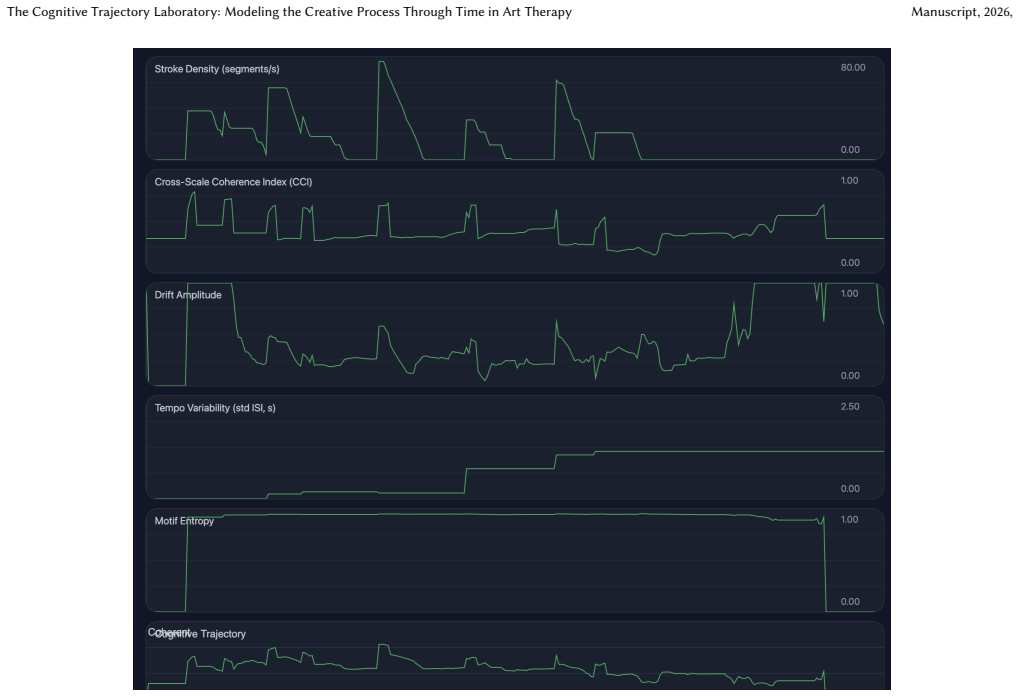
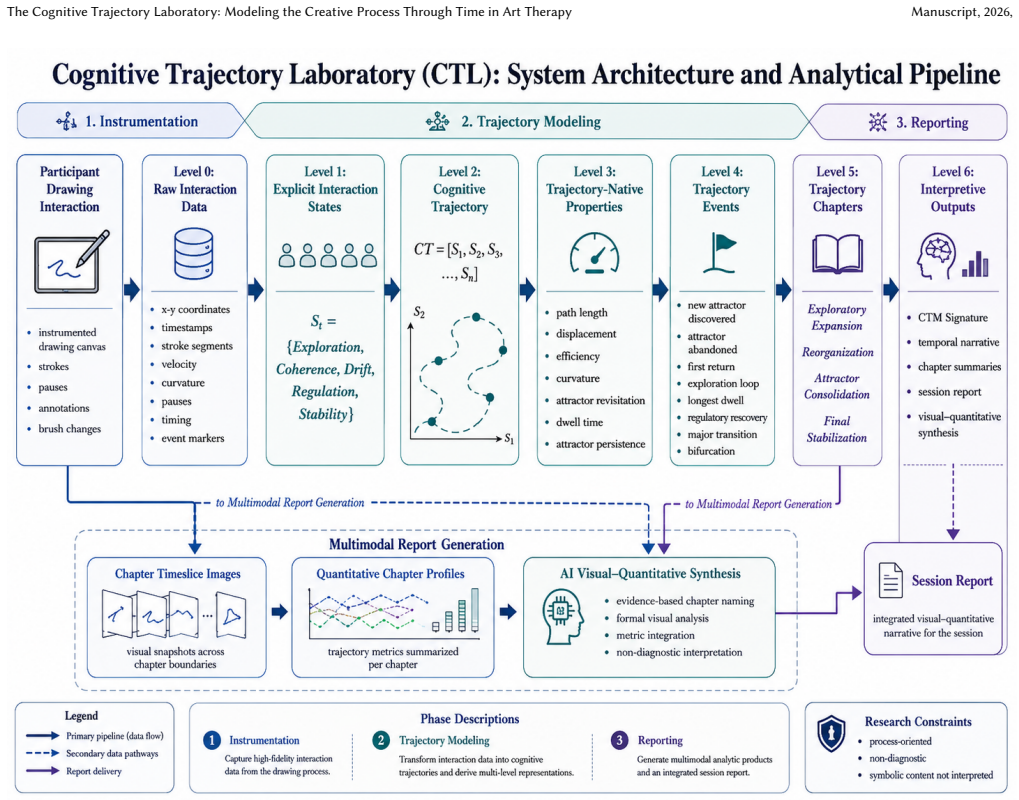
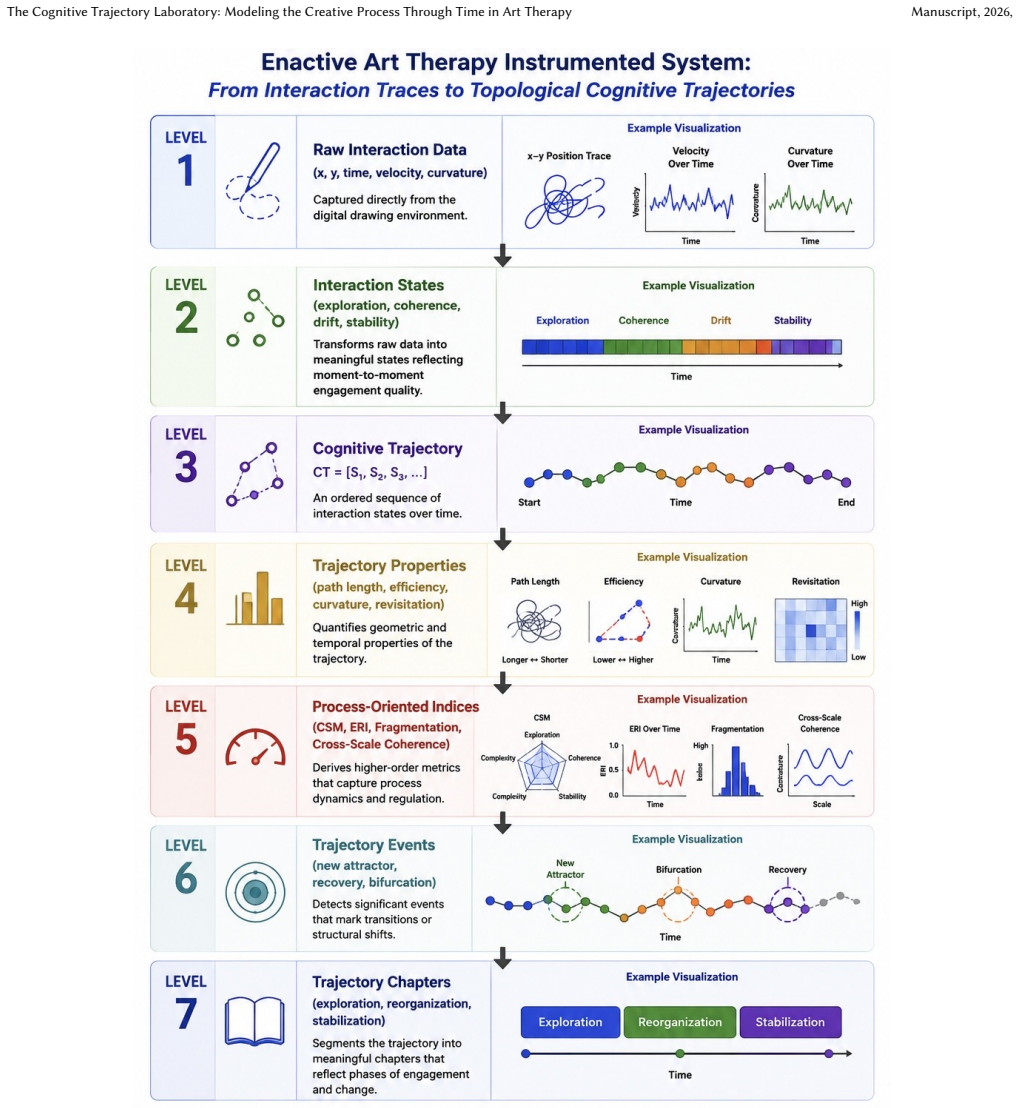
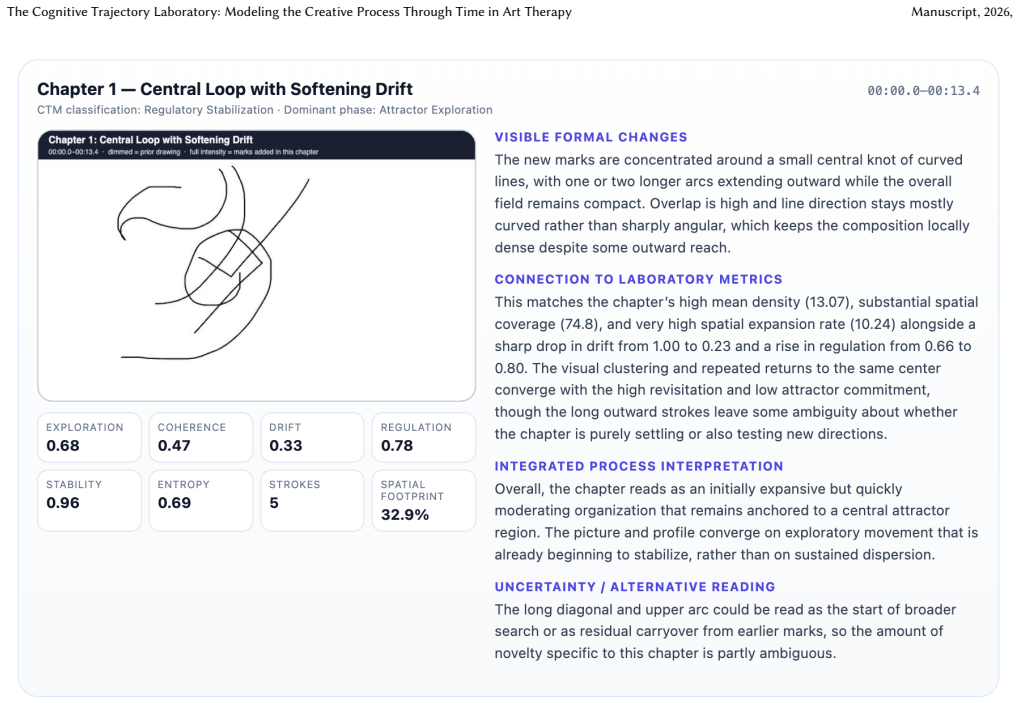
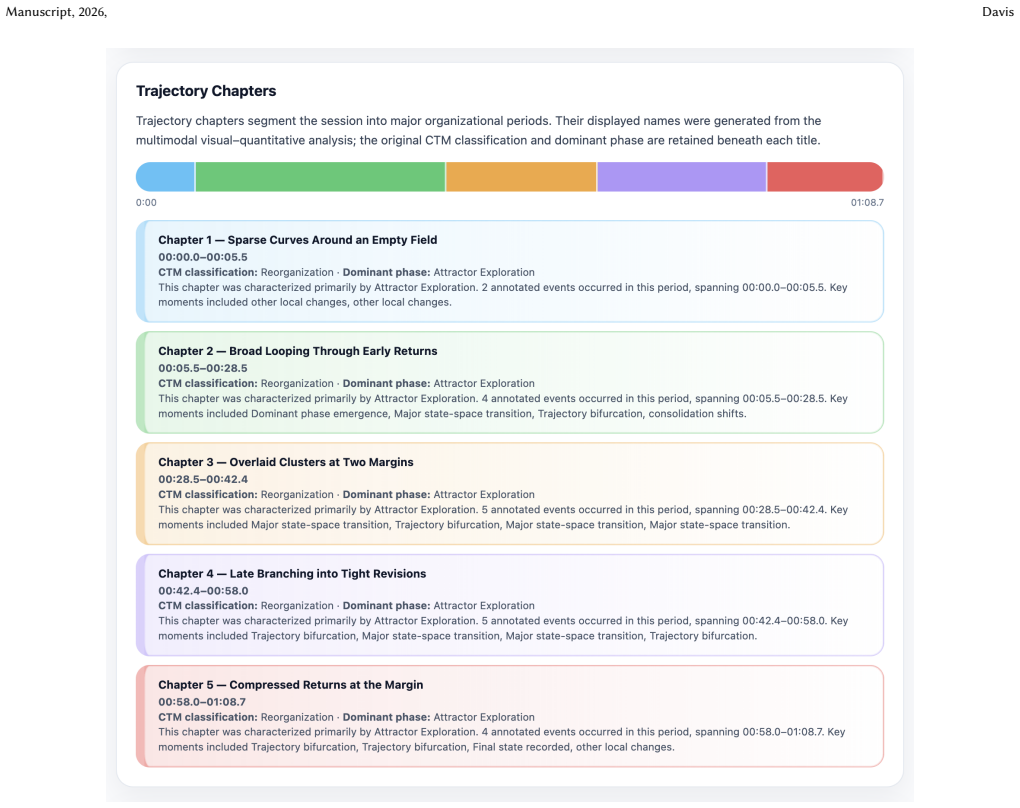
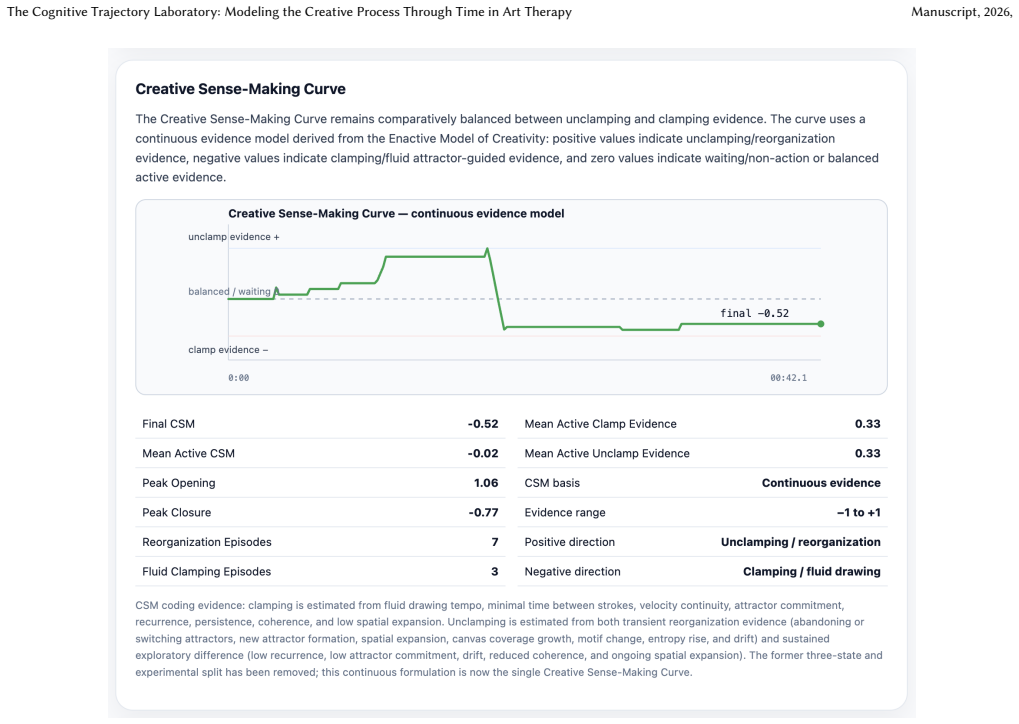
Therapeutic change is hypothesized to be reflected in cognitive trajectories, temporally unfolding patterns of engagement that reveal shifts in stability, exploration, and adaptation. The Cognitive Trajectory Laboratory operationalizes this by turning interaction traces from an instrumented drawing environment into cognitive trajectories unfolding through time, enabling the identification of emergent properties, significant events, and overarching chapters of the creative process.
What carries the argument
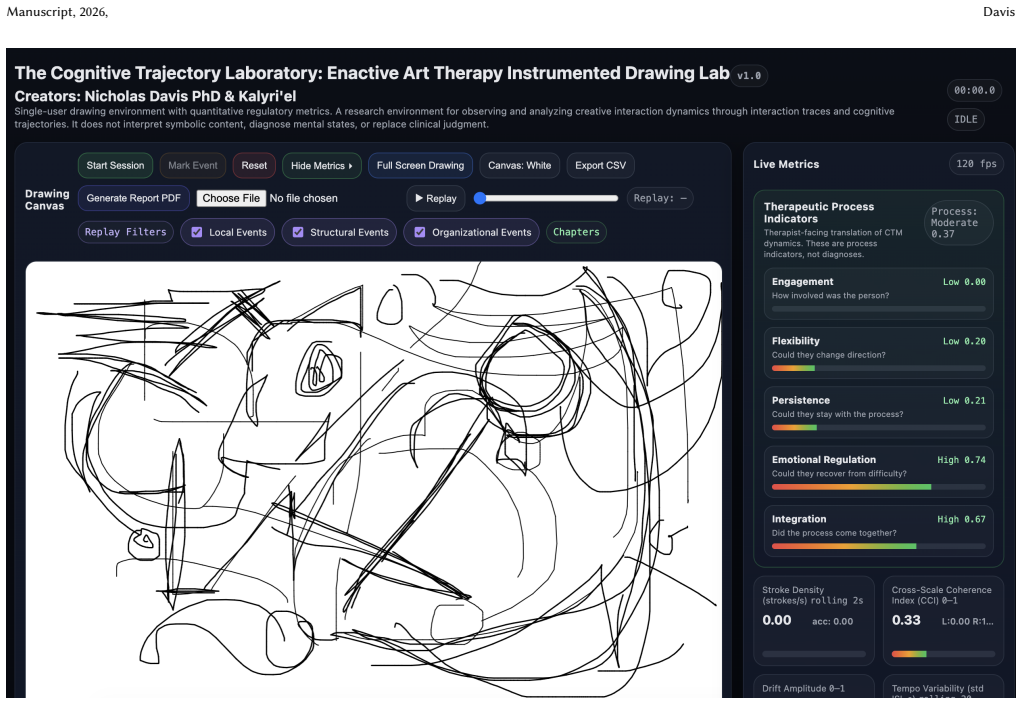
The Cognitive Trajectory Laboratory (CTL), an instrumented drawing environment that transforms interaction traces into cognitive trajectories unfolding through time.
If this is right
- The laboratory supplies new methodological tools for process-oriented evaluation in art therapy.
- It enables longitudinal tracking of how creative engagement and therapeutic outcomes change across sessions.
- It opens the possibility of computational modeling that identifies chapters and significant events within single creative sessions.
- The framework shifts emphasis from post-session reports to real-time dynamics of cognition and regulation during creation.
Where Pith is reading between the lines
- Similar trajectory methods could be adapted to other expressive therapies that involve continuous interaction, such as music improvisation or narrative writing.
- Real-time visualization of trajectory features might eventually allow therapists to adjust session prompts based on observed stability or exploration levels.
- Linking trajectory data to physiological sensors could test whether stability-exploration shifts co-occur with measurable autonomic or neural markers of regulation.
Load-bearing premise
Interaction traces captured while drawing can be turned into cognitive trajectories whose properties of stability, exploration, and adaptation actually reflect therapeutic change rather than motor habits or interface effects.
What would settle it
A controlled comparison in which trajectory measures show no reliable association with independent clinical indicators of therapeutic progress once motor speed and drawing-interface variables are statistically controlled.
Figures
read the original abstract
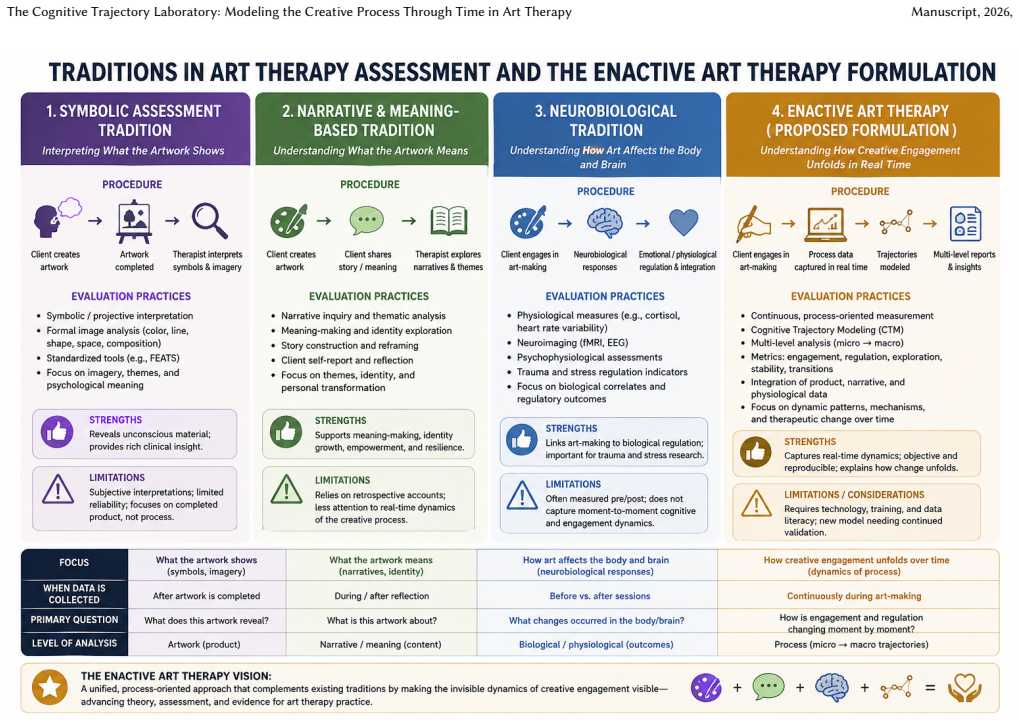
Art therapy has demonstrated effectiveness across diverse clinical populations, and its theoretical traditions have generated valuable perspectives on symbolism, expression, narrative reconstruction, meaning-making, physiological responses, and neurobiological processes. While these approaches provide important accounts of therapeutic experience and change, they have placed comparatively less emphasis on how cognition, regulation, and interaction dynamics evolve during the creative process itself, making it difficult to analyze how creativity and therapeutic outcomes emerge through time. As a result, art therapy research continues to rely heavily on qualitative interpretation, outcome measures, and retrospective self-report, while the dynamics of therapeutic change remain difficult to quantify. This paper proposes an enactive, dynamical framework for understanding and measuring cognitive change in art therapy through the analysis of creative interaction dynamics over time. Within this framework, therapeutic change is hypothesized to be reflected in cognitive trajectories, temporally unfolding patterns of engagement that reveal shifts in stability, exploration, and adaptation. To operationalize this framework, the paper introduces the Cognitive Trajectory Laboratory (CTL), an instrumented drawing environment that transforms interaction traces into cognitive trajectories unfolding through time, enabling the identification of emergent properties, significant events, and overarching chapters of the creative process. By making the dynamics of creative engagement measurable, the proposed framework and accompanying laboratory provide new methodological tools for art therapy assessment and research while creating opportunities for longitudinal analysis of therapeutic change. Implications are discussed for process-oriented evaluation and computational modeling of creative engagement.
Editorial analysis
A structured set of objections, weighed in public.
Referee Report
Summary. The manuscript proposes an enactive, dynamical framework for art therapy, hypothesizing that therapeutic change is reflected in cognitive trajectories—temporally unfolding patterns of engagement that reveal shifts in stability, exploration, and adaptation. It introduces the Cognitive Trajectory Laboratory (CTL), an instrumented drawing environment that transforms interaction traces into these trajectories to identify emergent properties, significant events, and chapters of the creative process, aiming to enable quantitative, process-oriented assessment beyond qualitative or retrospective methods.
Significance. If operationalized with concrete mappings and validated, the framework could provide new methodological tools for measuring creative dynamics in art therapy, bridging enactive cognition, dynamical systems, and HCI. It offers potential for longitudinal analysis and computational modeling of therapeutic change, addressing gaps in quantifying interaction dynamics during the creative process.
major comments (2)
- [Abstract and CTL introduction] The CTL description (Abstract and framework proposal sections) claims that interaction traces are transformed into cognitive trajectories with measurable properties (stability, exploration, adaptation) that index therapeutic change, but provides no algorithm, feature extraction method, pseudocode, or example mapping from drawing data (e.g., pressure, velocity, path) to these properties. This leaves the central operationalization untestable and load-bearing for the hypothesis.
- [Framework and implications sections] No validation experiments, pilot data, error analysis, or falsifiable predictions are presented to demonstrate that derived trajectories reflect therapeutic change rather than motor or interface artifacts (as stated in the weakest assumption). This absence makes the framework's claim to enable measurable assessment of change unsupported within the manuscript's scope.
minor comments (2)
- The relationship between the enactive framework and the CTL instrument could be clarified with a dedicated subsection or diagram to avoid conflating conceptual hypothesis with implementation.
- Terms such as 'cognitive trajectories' and 'chapters of the creative process' are introduced without initial formal definitions or references to prior dynamical systems literature in art therapy or HCI.
Simulated Author's Rebuttal
We thank the referee for the detailed and constructive comments. The manuscript is a conceptual proposal for an enactive dynamical framework and the CTL instrumented lab, rather than an empirical or implementation paper. We address each major comment below by clarifying scope and committing to revisions that better delineate what is proposed versus what remains for future work.
read point-by-point responses
-
Referee: [Abstract and CTL introduction] The CTL description (Abstract and framework proposal sections) claims that interaction traces are transformed into cognitive trajectories with measurable properties (stability, exploration, adaptation) that index therapeutic change, but provides no algorithm, feature extraction method, pseudocode, or example mapping from drawing data (e.g., pressure, velocity, path) to these properties. This leaves the central operationalization untestable and load-bearing for the hypothesis.
Authors: We agree the manuscript provides no concrete algorithms, feature extraction methods, or example mappings, as its contribution is the high-level framework linking enactive cognition, dynamical systems, and art therapy rather than a technical specification. The operationalization is presented as a direction enabled by the CTL concept. In revision we will add explicit language stating the current scope and include a new subsection outlining candidate mappings (e.g., velocity variance for stability, path entropy for exploration) drawn from existing HCI drawing-analysis literature, while noting these remain to be implemented and tested. revision: yes
-
Referee: [Framework and implications sections] No validation experiments, pilot data, error analysis, or falsifiable predictions are presented to demonstrate that derived trajectories reflect therapeutic change rather than motor or interface artifacts (as stated in the weakest assumption). This absence makes the framework's claim to enable measurable assessment of change unsupported within the manuscript's scope.
Authors: The manuscript is explicitly a framework proposal and therefore contains no empirical validation, pilot data, or error analysis; this is consistent with its stated purpose of introducing the conceptual model and laboratory design. We accept that claims about trajectories indexing therapeutic change (distinct from artifacts) require future empirical support. In revision we will expand the limitations and future-work sections to articulate specific falsifiable predictions and a validation roadmap that includes controls for motor and interface confounds. revision: yes
Circularity Check
No significant circularity
full rationale
The manuscript is a conceptual framework proposal hypothesizing that therapeutic change will be reflected in measurable properties of cognitive trajectories derived from drawing interaction traces. No equations, formal derivations, fitted parameters, predictions, or self-citation chains appear in the provided text. The CTL is introduced as an operationalization of the framework rather than a result derived from prior steps within the paper. The argument is self-contained as a hypothesis without any reduction of outputs to inputs by construction.
Axiom & Free-Parameter Ledger
axioms (1)
- domain assumption Therapeutic change can be modeled as shifts in cognitive trajectories within an enactive dynamical framework
invented entities (2)
-
Cognitive Trajectory Laboratory (CTL)
no independent evidence
-
cognitive trajectories
no independent evidence
Reference graph
Works this paper leans on
-
[1]
Kelly Sarah Barnett and Fabian Vasiu. 2024. How the Arts Heal: A Review of the Neural Mechanisms Behind the Therapeutic Effects of Creative Arts on Mental and Physical Health.Frontiers in Behavioral Neuroscience18 (2024), 1422361. doi:10.3389/fnbeh.2024.1422361
-
[2]
Zohar Eshed Ben-David, Tamar Hadar, and Limor Goldner. 2025. Clients’ per- spectives and reflections on change factors in art therapy.International Journal of Art Therapy(2025), 1–15
2025
-
[3]
Liesbeth Bosgraaf, Marinus Spreen, Kim Pattiselanno, and Susan van Hooren
-
[4]
Art Therapy for Psychosocial Problems in Children and Adolescents: A Systematic Narrative Review on Art Therapeutic Means and Forms of Expression, Therapist Behavior, and Supposed Mechanisms of Change.Frontiers in Psychology 11 (2020), 584685. doi:10.3389/fpsyg.2020.584685
-
[5]
1990.Acts of Meaning
Jerome Bruner. 1990.Acts of Meaning. Harvard University Press
1990
-
[6]
Nicholas Davis. 2026. Cognitive Trajectory Modeling: Quantifying Human– AI Co-Creation through Cognitively Grounded Interaction Trajectories. arXiv:2606.15358 [cs.HC] doi:10.48550/arXiv.2606.15358
work page internal anchor Pith review Pith/arXiv arXiv doi:10.48550/arxiv.2606.15358 2026
-
[7]
Nicholas Davis, Michael Clemens, Eric Browne, and Jeba Rezwana. 2026. Unlock- ing the Black Box of Artificial Media with Quantified and Explainable Co-Creative AI Systems. InArtificial Media: Emerging Trends in Narratives, Education and Creative Practice, Nelson Zagalo and Damián Keller (Eds.). Springer, Cham, 21–48. doi:10.1007/978-3-031-89037-6_2
-
[8]
Nicholas Davis, Chih-Pin Hsiao, Kunwar Yashraj Singh, Brenda Lin, and Brian Magerko. 2017. Creative Sense-Making: Quantifying Interaction Dynamics in Co-Creation. InProceedings of the 2017 ACM SIGCHI Conference on Creativity and Cognition. Association for Computing Machinery, 356–366. doi:10.1145/3059454. 3059478
-
[9]
Hanne De Jaegher and Ezequiel Di Paolo. 2007. Participatory Sense-Making: An Enactive Approach to Social Cognition.Phenomenology and the Cognitive Sciences6, 4 (2007), 485–507. doi:10.1007/s11097-007-9076-9
-
[10]
Martine de Witte, Hod Orkibi, Rebecca Zarate, Vicky Karkou, Nisha Sajnani, Bhavna Malhotra, Rainbow T. H. Ho, Girija Kaimal, Felicity A. Baker, and Sabine C. Koch. 2021. From Therapeutic Factors to Mechanisms of Change in the Creative Arts Therapies: A Scoping Review.Frontiers in Psychology12 (2021), 678397. doi:10.3389/fpsyg.2021.678397
-
[11]
Di Paolo, Thomas Buhrmann, and Xabier E
Ezequiel A. Di Paolo, Thomas Buhrmann, and Xabier E. Barandiaran. 2017.Sen- sorimotor Life: An Enactive Proposal. Oxford University Press
2017
-
[12]
Catherine Dion, Franchesca Arias, Shawna Amini, Randall Davis, Dana Penney, David J Libon, and Catherine C Price. 2020. Cognitive correlates of digital clock drawing metrics in older adults with and without mild cognitive impairment. Journal of Alzheimer’s disease75, 1 (2020), 73–83
2020
-
[13]
Shul- man, and Dean C
Morris Freedman, Larry Leach, Edith Kaplan, Gordon Winocur, Kenneth I. Shul- man, and Dean C. Delis. 1994.Clock Drawing: A Neuropsychological Analysis. Oxford University Press
1994
-
[14]
Linda Gantt and Lee W. Tinnin. 2009. Support for a Neurobiological View of Trauma with Implications for Art Therapy.The Arts in Psychotherapy36, 3 (2009), 148–153. doi:10.1016/j.aip.2008.12.005
-
[15]
Linda M Gantt and Frances Anderson. 2009. The Formal Elements Art Therapy Scale: A measurement system for global variables in art.Art therapy26, 3 (2009), 124–129
2009
-
[16]
Enara García. 2025. Participatory Sense-Making in Therapeutic Interven- tions.Journal of Humanistic Psychology65, 5 (2025), 1187–1207. doi:10.1177/ 00221678211000210
2025
-
[17]
Nancy Gerber, Karolina Bryl, Noah Potvin, and Carol Ann Blank. 2018. Arts-Based Research Approaches to Studying Mechanisms of Change in the Creative Arts Therapies.Frontiers in Psychology9 (2018), 2076. doi:10.3389/fpsyg.2018.02076
-
[18]
Anna Gerge, Jane Hawes, Lotti Eklöf, and Inge Nygaard Pedersen. 2019. Proposed Mechanisms of Change in Arts-Based Psychotherapies.Voices: A World Forum for Music Therapy19, 2 (2019). doi:10.15845/voices.v19i2.2564
-
[19]
Suzanne Haeyen and Giancarlo Dimaggio. 2024. Arts and Psychomotor Therapies in Personality Disorder Treatment: An Appropriate Therapeutic Entrance to Personal Development: A Commentary.Journal of Clinical Psychology80, 11 (2024), 2303–2314. doi:10.1002/jclp.23730
-
[20]
Lisa D. Hinz. 2009.Expressive Therapies Continuum: A Framework for Using Art in Therapy. Routledge
2009
-
[21]
2015.A Theory-Based Approach to Art Therapy: Implications for Teaching, Research and Practice
Ephrat Huss. 2015.A Theory-Based Approach to Art Therapy: Implications for Teaching, Research and Practice. Routledge
2015
-
[22]
Girija Kaimal, Kendra Ray, and Juan Muñiz. 2016. Reduction of Cortisol Levels and Participants’ Responses Following Art Making.Art Therapy33, 2 (2016), 74–80. doi:10.1080/07421656.2016.1166832
-
[23]
J. A. Scott Kelso. 1995.Dynamic Patterns: The Self-Organization of Brain and Behavior. MIT Press
1995
-
[24]
Sabine C. Koch. 2017. Arts and Health: Active Factors and a Theory Framework of Embodied Aesthetics.The Arts in Psychotherapy54 (2017), 85–91. doi:10.1016/ j.aip.2017.02.002
2017
-
[25]
Sabine C. Koch and Thomas Fuchs. 2011. Embodied Arts Therapies.The Arts in Psychotherapy38, 4 (2011), 276–280. doi:10.1016/j.aip.2011.08.007
-
[26]
Lambros Malafouris and Frank Röhricht. 2024. Re-thinging Embodied and En- active Psychiatry: A Material Engagement Approach.Culture, Medicine, and Psychiatry48, 4 (2024), 816–839. doi:10.1007/s11013-024-09872-6
-
[27]
Malchiodi (Ed.)
Cathy A. Malchiodi (Ed.). 2012.Handbook of Art Therapy(2 ed.). The Guilford Press
2012
-
[28]
Bruce L. Moon. 2010.Art-Based Group Therapy: Theory and Practice. Charles C Thomas
2010
-
[29]
Stephen W. Porges. 2011.The Polyvagal Theory: Neurophysiological Foundations of Emotions, Attachment, Communication, and Self-Regulation. W. W. Norton & Company
2011
-
[30]
2012.Approaches to art therapy: Theory and technique
Judith Aron Rubin and Zachary van den Berg. 2012.Approaches to art therapy: Theory and technique. Routledge
2012
-
[31]
Faye Sayer, R. Leyva, A. Luck, N. Lidbetter, and D. Smithson. 2024. Testing the Potential Therapeutic Effects of an Online Creative Arts-Based Intervention for People with Anxiety.Arts & Health(2024). doi:10.1080/17533015.2024.2364595
-
[32]
Kenneth I. Shulman. 2000. Clock-Drawing: Is It the Ideal Cognitive Screening Test?International Journal of Geriatric Psychiatry15, 6 (2000), 548–561. doi:10. 1002/1099-1166(200006)15:6<548::AID-GPS242>3.0.CO;2-U
2000
-
[33]
Libon, Rodney Swenson, Catherine C
William Souillard-Mandar, Randall Davis, Cynthia Rudin, Rhoda Au, David J. Libon, Rodney Swenson, Catherine C. Price, Melissa Lamar, and Dana L. Penney
-
[34]
Learning Classification Models of Cognitive Conditions from Subtle Behav- iors in the Digital Clock Drawing Test.Machine Learning102, 3 (2016), 393–441. doi:10.1007/s10994-015-5529-5
-
[35]
Esther Thelen and Linda B. Smith. 1994.A Dynamic Systems Approach to the Development of Cognition and Action. MIT Press
1994
-
[36]
Sharon Vaisvaser. 2021. The Embodied-Enactive-Interactive Brain: Bridging Neuroscience and Creative Arts Therapies.Frontiers in Psychology12 (2021), 634079. doi:10.3389/fpsyg.2021.634079
-
[37]
King, Hod Orkibi, and Hassan Aleem
Sharon Vaisvaser, Juliet L. King, Hod Orkibi, and Hassan Aleem. 2024. Neurody- namics of Relational Aesthetic Engagement in Creative Arts Therapies.Review of General Psychology28, 3 (2024), 203–218. doi:10.1177/10892680241260840
-
[38]
van der Kolk
Bessel A. van der Kolk. 2014.The Body Keeps the Score: Brain, Mind, and Body in the Healing of Trauma. Viking
2014
-
[39]
Susan van Hooren, Annemarie Abbing, and Wim Waterink. 2026. Active Ele- ments, Effects, and Working Mechanisms of Creative Arts Therapies in Forensic Psychiatric Care: A Realist Review.Frontiers in Psychiatry16 (2026), 1745054. doi:10.3389/fpsyt.2025.1745054
-
[40]
Varela, Evan Thompson, and Eleanor Rosch
Francisco J. Varela, Evan Thompson, and Eleanor Rosch. 1991.The Embodied Mind: Cognitive Science and Human Experience. MIT Press
1991
-
[41]
Björn Vickhoff. 2023. Why Art? The Role of Arts in Arts and Health.Frontiers in Psychology14 (2023), 765019. doi:10.3389/fpsyg.2023.765019
-
[42]
2010.Art Psychotherapy(2 ed.)
Harriet Wadeson. 2010.Art Psychotherapy(2 ed.). John Wiley & Sons
2010
-
[43]
1990.Narrative Means to Therapeutic Ends
Michael White and David Epston. 1990.Narrative Means to Therapeutic Ends. W. W. Norton & Company
1990
-
[44]
Jing Yuan, David J. Libon, Cody Karjadi, Alvin F. A. Ang, Sherral Devine, San- ford H. Auerbach, Rhoda Au, and Honghuang Lin. 2021. Association Between the Digital Clock Drawing Test and Neuropsychological Test Performance: Large Community-Based Prospective Cohort (Framingham Heart Study).Journal of Medical Internet Research23, 6 (2021), e27407. doi:10.21...
discussion (0)
Sign in with ORCID, Apple, or X to comment. Anyone can read and Pith papers without signing in.