Cognitive Trajectory Modeling: Quantifying Human-AI Co-Creation through Cognitively Grounded Interaction Trajectories
Pith reviewed 2026-06-27 04:10 UTC · model grok-4.3
The pith
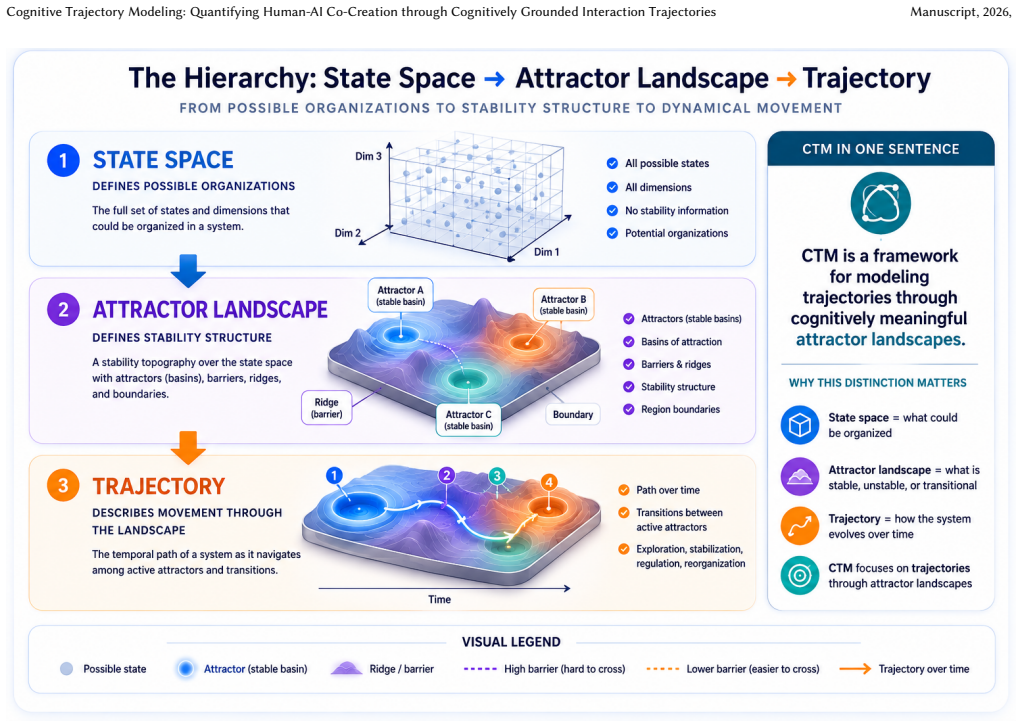
Cognitive Trajectory Modeling frames co-creative interactions as trajectories across meaningful attractor landscapes.
A machine-rendered reading of the paper's core claim, the machinery that carries it, and where it could break.
Core claim
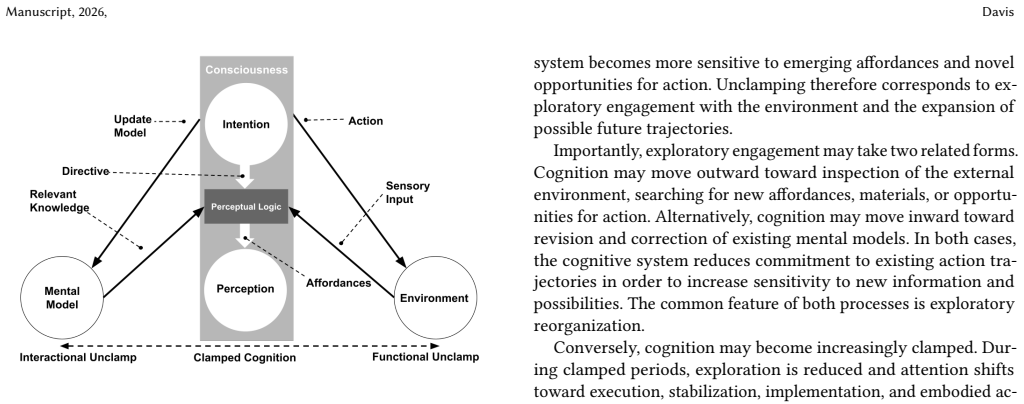
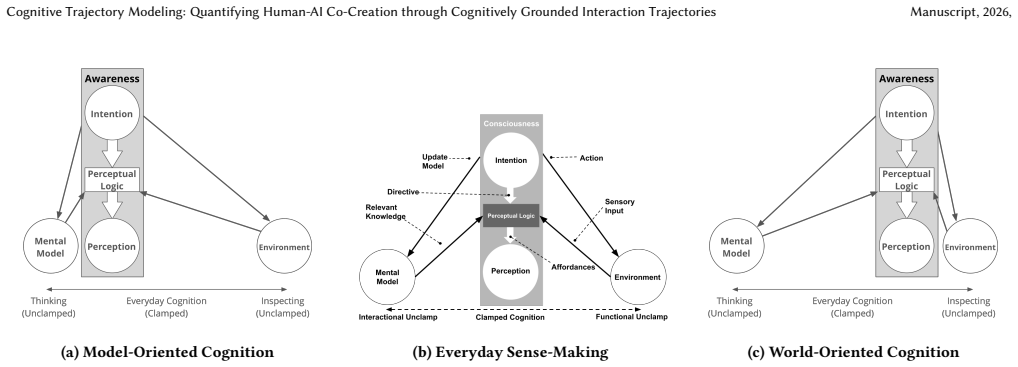
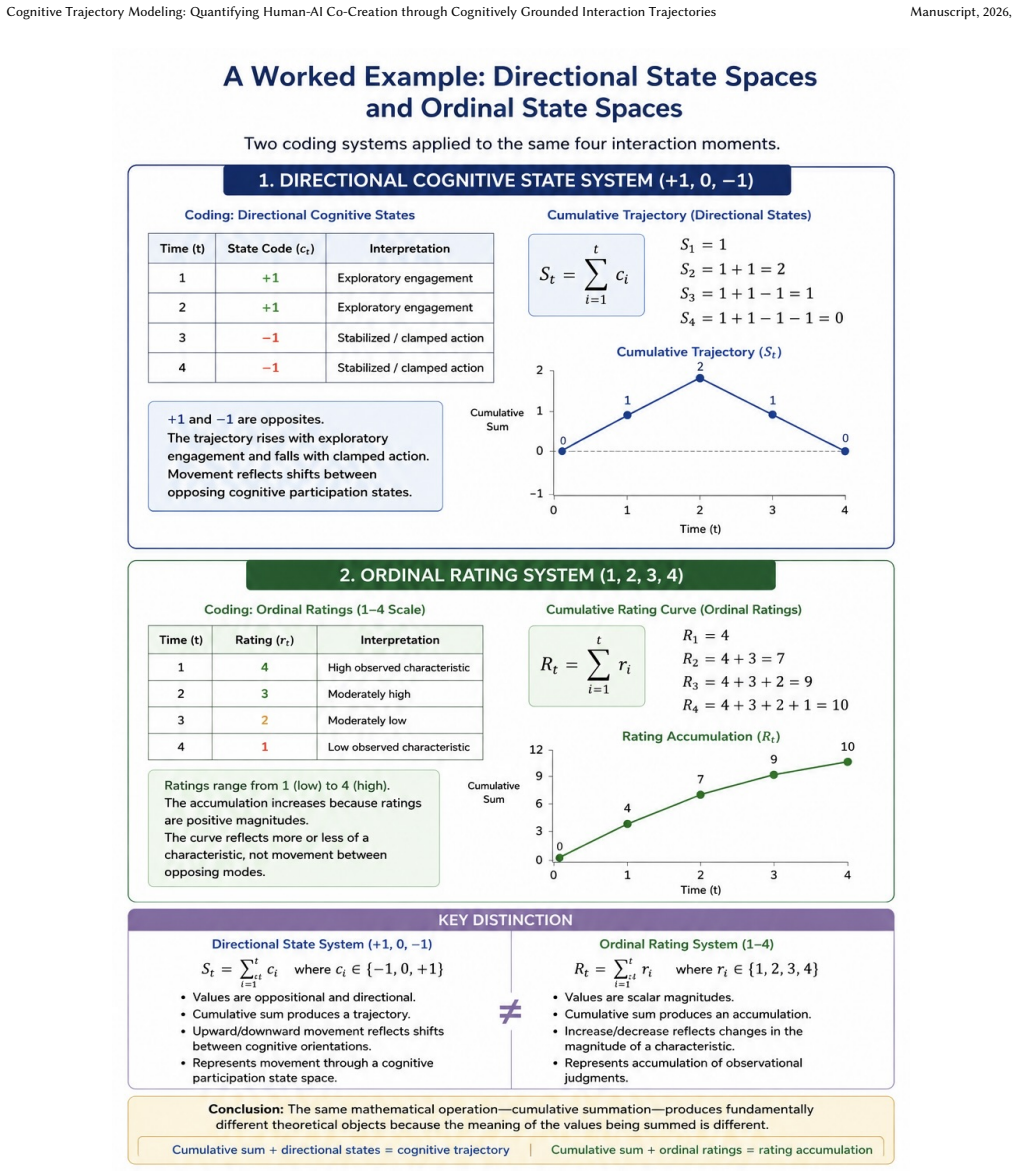
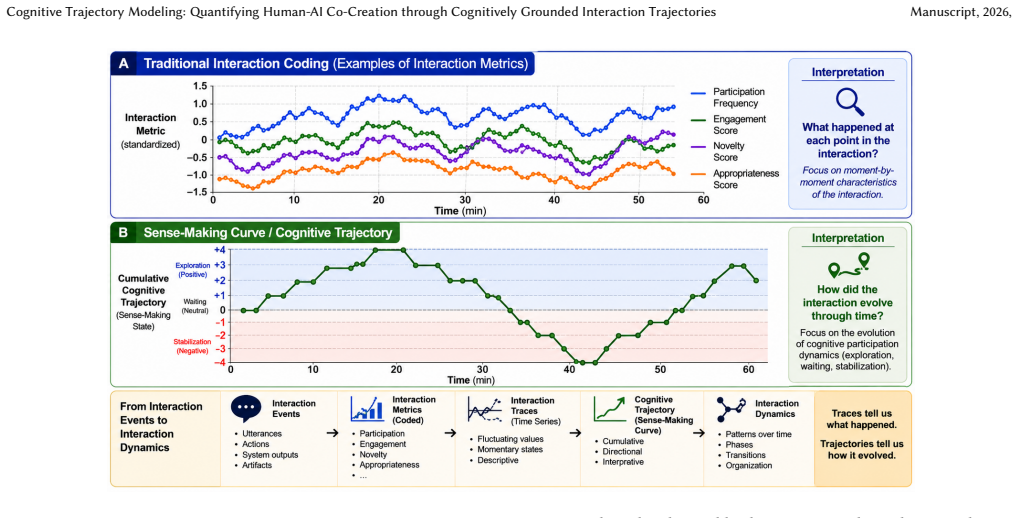
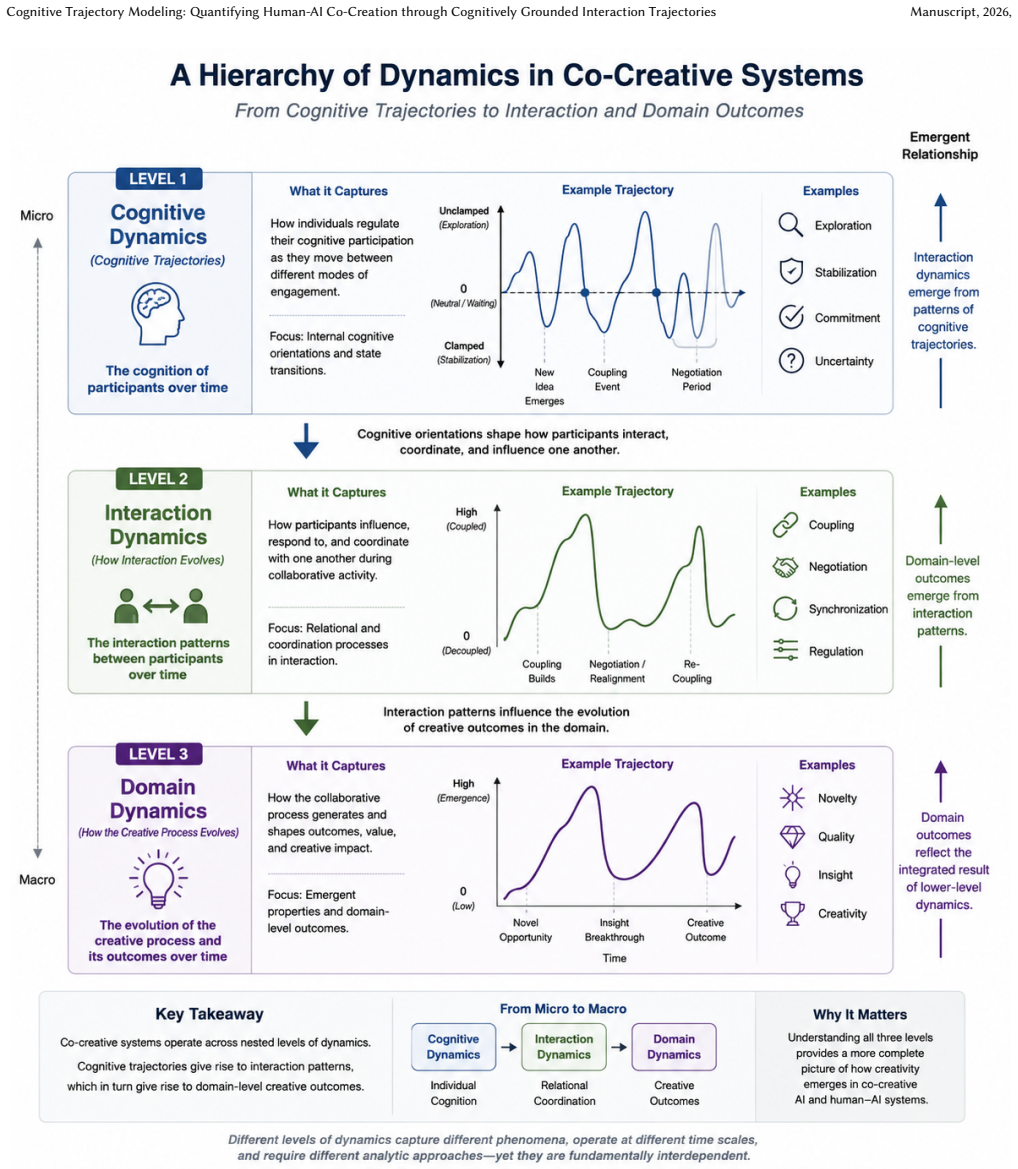
Cognitive Trajectory Modeling conceptualizes cognition, interaction, and creative processes as temporally organized trajectories unfolding across cognitively meaningful attractor landscapes. It rests on the Cognitive Trajectory Principle that temporal representations are only theoretically interpretable as cognitive trajectories when their underlying states possess directional cognitive meaning. CTM generalizes this perspective beyond any particular coding scheme, distinguishes cognitive trajectories from interaction traces, and places the approach inside a hierarchy of cognitive, interaction, and domain dynamics.
What carries the argument
The Cognitive Trajectory Principle, which requires states to possess directional cognitive meaning for temporal representations to count as cognitive trajectories, together with the attractor landscapes that organize these trajectories.
If this is right
- Methods for studying co-creative AI must model how cognition and interaction dynamics unfold through time rather than relying solely on static metrics.
- Cognitive trajectories are distinct from interaction traces and require states with directional cognitive meaning.
- CTM supplies a foundation for analyzing interaction dynamics across co-creative AI and human-AI systems.
- The framework generalizes cognitive trajectories beyond any single coding scheme to a broader class of attractor-landscape models.
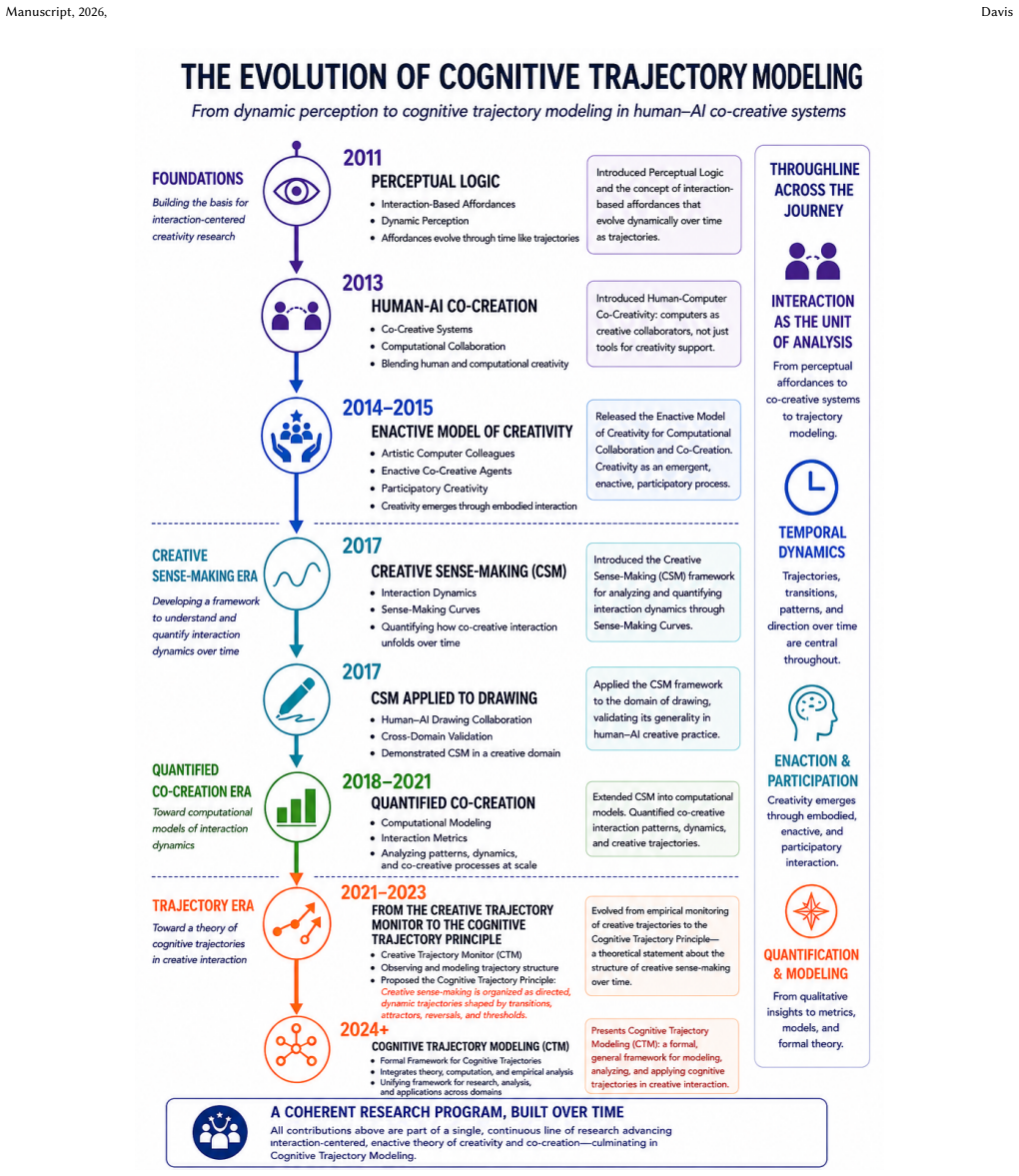
Where Pith is reading between the lines
- Designers of co-creative tools could build visualizations that track sense-making curves and attractor stability in real time.
- The approach may link to dynamical-systems models already used in cognitive science to quantify creative state transitions.
- Empirical tests could measure whether detected trajectories predict user-reported sense of collaboration or creative output quality.
- AI agents might be engineered to detect and respond to shifts between attractor states during ongoing interaction.
Load-bearing premise
Cognition, interaction, and creative processes can be validly conceptualized as trajectories unfolding across cognitively meaningful attractor landscapes derived from the Enactive Model of Creativity and Creative Sense-Making.
What would settle it
A concrete case in which a temporal representation of interaction states lacking directional cognitive meaning is nevertheless shown to be theoretically interpretable as a cognitive trajectory would falsify the Cognitive Trajectory Principle.
Figures
read the original abstract
Co-creative AI research increasingly seeks methods capable of representing how interaction dynamics evolve through time. While many existing approaches focus on observable interaction characteristics, interaction metrics, behavioral coding schemes, or activity traces, these methods often struggle to capture higher-order interaction dynamics, including how collaborative processes reorganize, stabilize, regulate, and evolve through time. This paper introduces Cognitive Trajectory Modeling (CTM) as a cognitive theory of interaction dynamics that conceptualizes cognition, interaction, and creative processes as temporally organized trajectories unfolding across cognitively meaningful attractor landscapes. CTM builds upon the theoretical foundations of the Enactive Model of Creativity and Creative Sense-Making (CSM), revisiting the role of sense-making curves and cognitive trajectories in representing co-creative interaction dynamics. We formalize this perspective through the Cognitive Trajectory Principle, which states that temporal representations are only theoretically interpretable as cognitive trajectories when their underlying states possess directional cognitive meaning. Building on this principle, CTM generalizes the notion of cognitive trajectories beyond any particular coding scheme and provides a broader framework for modeling interaction dynamics through trajectories unfolding across meaningful attractor landscapes. We further distinguish cognitive trajectories from interaction traces and situate CTM within a broader hierarchy of cognitive, interaction, and domain dynamics. More broadly, we argue that understanding co-creative systems requires methods capable of modeling how cognition and interaction dynamics unfold through time. CTM provides a foundation for studying interaction dynamics across co-creative AI and human-AI interaction.
Editorial analysis
A structured set of objections, weighed in public.
Referee Report
Summary. The manuscript introduces Cognitive Trajectory Modeling (CTM) as a cognitive theory of interaction dynamics for human-AI co-creation. It conceptualizes cognition, interaction, and creative processes as temporally organized trajectories unfolding across cognitively meaningful attractor landscapes. The framework builds on the Enactive Model of Creativity and Creative Sense-Making (CSM), with the central contribution being the Cognitive Trajectory Principle: temporal representations are theoretically interpretable as cognitive trajectories only when underlying states possess directional cognitive meaning. CTM generalizes cognitive trajectories beyond particular coding schemes, distinguishes them from interaction traces, and situates them in a hierarchy of dynamics.
Significance. If the principle were formally derived from the referenced models and the framework were supported by empirical tests or falsifiable predictions, CTM could offer a unifying theoretical perspective for analyzing higher-order temporal reorganization in co-creative systems within HCI. As presented, however, the work remains an untested conceptual proposal whose significance is limited to suggesting a direction for future modeling rather than advancing validated understanding.
major comments (3)
- [Abstract / Introduction] Abstract and introduction (Cognitive Trajectory Principle statement): the principle is asserted without derivation or unpacking from the Enactive Model of Creativity or CSM; the text references sense-making curves and attractor structures but does not demonstrate how they yield the required 'directional cognitive meaning' condition or formally define it for interaction data.
- [Abstract] Abstract: no mathematical derivations, data, error analysis, empirical validation, or tests are supplied to support claims that CTM models interaction dynamics through trajectories on meaningful attractor landscapes or generalizes beyond coding schemes.
- [Abstract] Abstract (definition of CTM and principle): 'cognitively meaningful attractor landscapes' and 'directional cognitive meaning' are introduced and defined solely within the framework itself, rendering the central interpretability claim circular by construction with no external grounding or falsifiable predictions.
Simulated Author's Rebuttal
We thank the referee for their constructive review. The manuscript presents a conceptual framework extending prior theoretical work, and we address each major comment below by clarifying scope and indicating revisions where appropriate.
read point-by-point responses
-
Referee: [Abstract / Introduction] Abstract and introduction (Cognitive Trajectory Principle statement): the principle is asserted without derivation or unpacking from the Enactive Model of Creativity or CSM; the text references sense-making curves and attractor structures but does not demonstrate how they yield the required 'directional cognitive meaning' condition or formally define it for interaction data.
Authors: We agree that a more explicit unpacking would strengthen the presentation. The full manuscript revisits sense-making curves from the Enactive Model of Creativity and CSM, but we will revise the introduction to include a clearer step-by-step account of how directional cognitive meaning arises from these models and applies to interaction data. revision: yes
-
Referee: [Abstract] Abstract: no mathematical derivations, data, error analysis, empirical validation, or tests are supplied to support claims that CTM models interaction dynamics through trajectories on meaningful attractor landscapes or generalizes beyond coding schemes.
Authors: This is a theoretical proposal paper whose contribution is the formalization of the Cognitive Trajectory Principle and its placement in a hierarchy of dynamics. Mathematical derivations, data, and empirical tests fall outside the stated scope and would belong to follow-on validation work. We do not claim empirical support in the current manuscript. revision: no
-
Referee: [Abstract] Abstract (definition of CTM and principle): 'cognitively meaningful attractor landscapes' and 'directional cognitive meaning' are introduced and defined solely within the framework itself, rendering the central interpretability claim circular by construction with no external grounding or falsifiable predictions.
Authors: The definitions are explicitly anchored in the external Enactive Model of Creativity and CSM, which supply the grounding for directional cognitive meaning. The principle functions as an interpretability condition derived from those models. We will revise the abstract to foreground these connections more clearly and note that falsifiable predictions are intended for subsequent empirical studies. revision: partial
- Requests for empirical validation, mathematical derivations, error analysis, and falsifiable predictions, which are outside the scope of this conceptual framework manuscript.
Circularity Check
Cognitive Trajectory Principle defined via internal 'directional cognitive meaning' with no derivation from cited models
specific steps
-
self definitional
[Abstract]
"We formalize this perspective through the Cognitive Trajectory Principle, which states that temporal representations are only theoretically interpretable as cognitive trajectories when their underlying states possess directional cognitive meaning. Building on this principle, CTM generalizes the notion of cognitive trajectories beyond any particular coding scheme and provides a broader framework for modeling interaction dynamics through trajectories unfolding across meaningful attractor landscapes."
The principle conditions theoretical interpretability as 'cognitive trajectories' on the presence of 'directional cognitive meaning' and 'meaningful attractor landscapes'. These qualifiers are not derived from the Enactive Model or CSM (which are only referenced); they are introduced as part of the CTM definition itself. Thus the claimed generalization and modeling capability reduces directly to the framework's own definitional input rather than an independent result.
full rationale
The paper's derivation begins with references to the Enactive Model of Creativity and CSM but immediately states the Cognitive Trajectory Principle as a formalization without unpacking or deriving the 'directional cognitive meaning' condition from those sources. The principle and the 'cognitively meaningful attractor landscapes' are defined using terms introduced by CTM itself, reducing the central claim to a self-definitional assertion. This matches pattern 1 exactly, as the interpretability criterion is equivalent to the framework's own inputs by construction. No equations or formal steps are provided to show independence from the definition.
Axiom & Free-Parameter Ledger
axioms (1)
- domain assumption The Enactive Model of Creativity and Creative Sense-Making (CSM) provides valid foundations for representing co-creative interaction dynamics as trajectories.
invented entities (2)
-
Cognitive Trajectory Principle
no independent evidence
-
cognitively meaningful attractor landscapes
no independent evidence
Forward citations
Cited by 1 Pith paper
-
The Cognitive Trajectory Laboratory: Modeling the Creative Process Through Time in Art Therapy
Proposes a dynamical systems framework and instrumented drawing lab to quantify cognitive trajectories as markers of change in art therapy.
Reference graph
Works this paper leans on
-
[1]
Di Paolo (Eds.)
John Stewart, Olivier Gapenne, and Ezequiel A. Di Paolo (Eds.). 2010.Enaction: Toward a New Paradigm for Cognitive Science. MIT Press, Cambridge, MA
2010
-
[2]
Saleema Amershi, Maya Cakmak, William Bradley Knox, and Todd Kulesza. 2014. Power to the people: The role of humans in interactive machine learning.AI magazine35, 4 (2014), 105–120
2014
-
[3]
Michel Beaudouin-Lafon. 2004. Designing interaction, not interfaces. InProceed- ings of the working conference on Advanced visual interfaces. 15–22
2004
-
[4]
Randall D Beer. 2000. Dynamical approaches to cognitive science.Trends in cognitive sciences4, 3 (2000), 91–99
2000
-
[5]
Oliver Bown, Kazjon Grace, Liam Bray, and Dan Ventura. 2020. A Speculative Exploration of the Role of Dialogue in Human-Computer Co-creation.. InICCC. 25–32
2020
-
[6]
1997.Being There: Putting Brain, Body, and World Together Again
Andy Clark. 1997.Being There: Putting Brain, Body, and World Together Again. MIT Press, Cambridge, MA
1997
-
[7]
Nicholas Davis. 2013. Human-computer co-creativity: Blending human and com- putational creativity. InProceedings of the AAAI conference on artificial intelligence and interactive digital entertainment, Vol. 9. 9–12
2013
-
[8]
Nicholas Davis. 2024. Creative Sense-Making: A Cognitive Framework for Mod- elling Interaction Dynamics in Co-Creative AI. InArtificial Intelligence, Co- Creation and Creativity. Routledge, 45–60
2024
-
[9]
Nicholas Davis. 2026. Interaction-Centered Intelligence: Toward Interaction as the Primary Unit of Analysis in Co-Creative AI and Human-AI Systems.arXiv preprint arXiv:2606.00807(2026)
Pith/arXiv arXiv 2026
-
[10]
Nicholas Davis, Michael Clemens, Eric Browne, and Jeba Rezwana. 2025. Unlock- ing the Black Box of artificial media with quantified and explainable co-creative AI systems. InArtificial Media: Emerging Trends in Narratives, Education and Creative Practice. Springer, 21–48
2025
-
[11]
Nicholas Davis, Michael Clemens, Jeba Rezwana, and Eric Browne. 2026. Human- AI co-creation: A new interaction paradigm for human-AI interaction. InHand- book of Human-Centered Artificial Intelligence. Springer, 833–889
2026
-
[12]
Nicholas Davis, Margeaux Comerford, Mikhail Jacob, Chih-Pin Hsiao, and Brian Magerko. 2015. An enactive characterization of pretend play. InProceedings of the 2015 ACM SIGCHI Conference on Creativity and Cognition. 275–284
2015
-
[13]
Nicholas Davis, Ellen Yi-Luen Do, Pramod Gupta, and Shruti Gupta. 2011. Com- puting harmony with PerLogicArt: perceptual logic inspired collaborative art. In Proceedings of the 8th ACM conference on Creativity and cognition. 185–194
2011
-
[14]
Nicholas Davis, Chih-Pin Hsiao, Yulia Popova, and Brian Magerko. 2015. An Enactive Model of Creativity for Computational Collaboration and Co-Creation. InCreativity in the Digital Age, Nelson Zagalo and Pedro Branco (Eds.). Springer, 109–133. doi:10.1007/978-1-4471-6681-8_7
-
[15]
Nicholas Davis, Chih-Pin Hsiao, Kunwar Yashraj Singh, Brenda Lin, and Brian Magerko. 2017. Creative Sense-Making: Quantifying Interaction Dynamics in Co-Creation. InProceedings of the 2017 ACM SIGCHI Conference on Creativity and Cognition. ACM, 356–366. doi:10.1145/3059454.3059478 19 Manuscript, 2026, Davis
-
[16]
Nicholas Davis, Chih-Pin Hsiao, Kunwar Yashraj Singh, Brenda Lin, and Brian Magerko. 2017. Quantifying Collaboration with a Co-Creative Drawing Agent. ACM Transactions on Interactive Intelligent Systems7, 4, Article 25 (2017), 25 pages. doi:10.1145/3002426
-
[17]
Nicholas Davis and Janet Rafner. 2025. AI drawing partner: co-creative drawing agent and research platform to model co-creation.arXiv preprint arXiv:2501.06607 (2025)
arXiv 2025
-
[18]
Nicholas M Davis, Yanna Popova, Ivan Sysoev, Chih-Pin Hsiao, Dingtian Zhang, and Brian Magerko. 2014. Building Artistic Computer Colleagues with an Enactive Model of Creativity.. InICCC. 38–45
2014
-
[19]
Di Paolo
Hanne De Jaegher and Ezequiel A. Di Paolo. 2007. Participatory Sense-Making: An Enactive Approach to Social Cognition.Phenomenology and the Cognitive Sciences6, 4 (2007), 485–507
2007
-
[20]
Manoj Deshpande, Milka Trajkova, Andrea Knowlton, and Brian Magerko. 2023. Observable Creative Sense-Making (OCSM): A Method for Quantifying Improvi- sational Co-Creative Interaction. InProceedings of the 2023 ACM Creativity and Cognition Conference. ACM, 103–115. doi:10.1145/3591196.3593514
-
[21]
Di Paolo, Marieke Rohde, and Hanne De Jaegher
Ezequiel A. Di Paolo, Marieke Rohde, and Hanne De Jaegher. 2010. Horizons for the Enactive Mind: Values, Social Interaction, and Play. InEnaction: Toward a New Paradigm for Cognitive Science, John Stewart, Olivier Gapenne, and Ezequiel A. Di Paolo (Eds.). MIT Press, 33–87
2010
-
[22]
Kees Dorst. 2011. The core of ‘design thinking’and its application.Design studies 32, 6 (2011), 521–532
2011
-
[23]
Jerry Fails and Dan Olsen. 2003. Interactive Machine Learning. InProceedings of IUI. 39–45
2003
-
[24]
Finke, Thomas B
Ronald A. Finke, Thomas B. Ward, and Steven M. Smith. 1992.Creative Cognition: Theory, Research, and Applications. MIT Press, Cambridge, MA
1992
-
[25]
Gerhard Fischer. 2005. Distances and Diversity: Sources for Social Creativity. In Proceedings of the Fifth Conference on Creativity and Cognition. ACM, 128–136. doi:10.1145/1056224.1056243
-
[26]
Jonas Frich, Lindsay MacDonald Vermeulen, Christian Remy, Michael Mose Biskjaer, and Peter Dalsgaard. 2019. Mapping the Landscape of Creativity Support Tools in HCI. InProceedings of the 2019 CHI Conference on Human Factors in Computing Systems. ACM, Article 389, 18 pages. doi:10.1145/3290605.3300619
-
[27]
Liane Gabora. 2017. Honing Theory: A Complex Systems Framework for Cre- ativity.Nonlinear Dynamics, Psychology, and Life Sciences21, 1 (2017), 35–88
2017
-
[28]
2014.The ecological approach to visual perception: classic edition
James J Gibson. 2014.The ecological approach to visual perception: classic edition. Psychology press
2014
-
[29]
Matthew Guzdial and Mark Riedl. 2019. An interaction framework for studying co-creative ai.arXiv preprint arXiv:1903.09709(2019)
Pith/arXiv arXiv 2019
-
[30]
1995.Cognition in the Wild
Edwin Hutchins. 1995.Cognition in the Wild. MIT Press
1995
-
[31]
Tae Hee Jo and Kyung Hoon Hyun. 2026. From Logs to Agents: Reconstructing High-Level Creative Workflows from Low-Level Raw System Traces.arXiv preprint arXiv:2603.07609(2026)
arXiv 2026
-
[32]
Anna Jordanous. 2016. Four PPPPerspectives on computational creativity in theory and in practice.Connection Science28, 2 (2016), 194–216
2016
-
[33]
Anna Kantosalo and Hannu Toivonen. 2016. Modes for Creative Human- Computer Collaboration. InProceedings of the Seventh International Conference on Computational Creativity. 77–84
2016
-
[34]
Pegah Karimi, Kazjon Grace, Mary Lou Maher, and Nicholas Davis. 2018. Evalu- ating Creativity in Computational Co-Creative Systems. arXiv:1807.09886 [cs.AI]
Pith/arXiv arXiv 2018
-
[35]
1995.Dynamic patterns: The self-organization of brain and behavior
JA Scott Kelso. 1995.Dynamic patterns: The self-organization of brain and behavior. MIT press
1995
-
[36]
John E. Laird, Allen Newell, and Paul S. Rosenbloom. 1987. Soar: An Architecture for General Intelligence.Artificial Intelligence33, 1 (1987), 1–64. doi:10.1016/0004- 3702(87)90050-6
-
[37]
Zhiyu Lin and Mark Riedl. 2023. An ontology of co-creative AI systems.arXiv preprint arXiv:2310.07472(2023)
arXiv 2023
-
[38]
Brian Magerko, Waleed Manzoul, Mark Riedl, Allan Baumer, Daniel Fuller, Kurt Luther, and Celia Pearce. 2009. An empirical study of cognition and theatrical improvisation. InProceedings of the seventh ACM conference on Creativity and cognition. 117–126
2009
-
[39]
Allen Newell. 1980. Physical Symbol Systems.Cognitive Science4, 2 (1980), 135–183. doi:10.1207/s15516709cog0402_2
-
[40]
Allen Newell and Herbert A. Simon. 1976. Computer Science as Empirical Inquiry: Symbols and Search.Commun. ACM19, 3 (1976), 113–126. doi:10.1145/360018. 360022
-
[41]
2004.Action in perception
Alva Noë. 2004.Action in perception. MIT press
2004
-
[42]
Xiaohan Peng, Sotiris Piliouras, and Carl Abou Saada Nujaim. 2026. From State Changes to Creative Decisions: Documenting and Interpreting Traces Across Creative Domains.arXiv preprint arXiv:2603.07184(2026)
arXiv 2026
-
[43]
Keith Sawyer
R. Keith Sawyer. 2007.Group Genius: The Creative Power of Collaboration. Basic Books
2007
-
[44]
Ben Shneiderman. 2007. Creativity Support Tools: Accelerating Discovery and Innovation.Commun. ACM50, 12 (2007), 20–32. doi:10.1145/1323688.1323689
-
[45]
Herbert A. Simon. 1979.Models of Thought. Yale University Press, New Haven, CT
1979
-
[46]
Esther Thelen and Linda B. Smith. 1994.A Dynamic Systems Approach to the Development of Cognition and Action. MIT Press, Cambridge, MA
1994
-
[47]
2010.Mind in life: Biology, phenomenology, and the sciences of mind
Evan Thompson. 2010.Mind in life: Biology, phenomenology, and the sciences of mind. Harvard University Press
2010
-
[48]
Tim van Gelder. 1998. The Dynamical Hypothesis in Cognitive Science.Behavioral and Brain Sciences21, 5 (1998), 615–628. doi:10.1017/S0140525X98001733
-
[49]
Varela, Evan Thompson, and Eleanor Rosch
Francisco J. Varela, Evan Thompson, and Eleanor Rosch. 1991.The Embodied Mind: Cognitive Science and Human Experience. MIT Press
1991
-
[50]
Lauren Winston and Brian Magerko. 2017. Turn-taking with improvisational co-creative agents. InProceedings of the AAAI conference on artificial intelligence and interactive digital entertainment, Vol. 13. 129–135. 20
2017
discussion (0)
Sign in with ORCID, Apple, or X to comment. Anyone can read and Pith papers without signing in.