Guarded Equivalence Predicates for Scalable Formal Hardware Information-Flow Verification
Pith reviewed 2026-06-26 11:43 UTC · model grok-4.3
The pith
Guarded equivalence predicates turn hardware information-flow verification timeouts into completed proofs in under 90 seconds.
A machine-rendered reading of the paper's core claim, the machinery that carries it, and where it could break.
Core claim
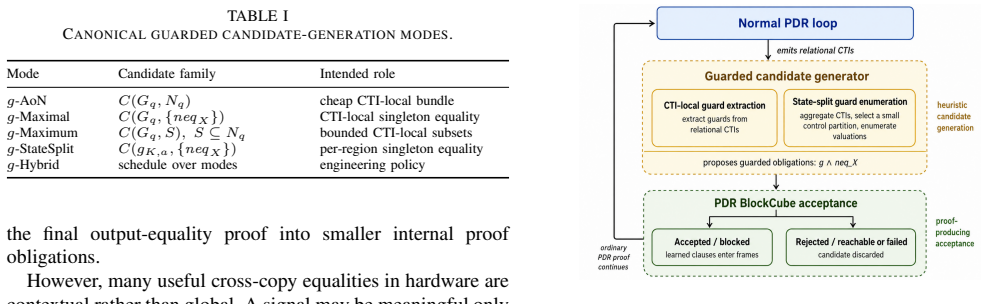
Guarded equivalence predicates expose contextual relations in hardware IFV by proposing guards from CTI-local extraction and state-split search; only those proved unreachable by the backend are used, converting timeouts to proofs within 34.2-89.5s and reducing time by up to 10.8x.
What carries the argument
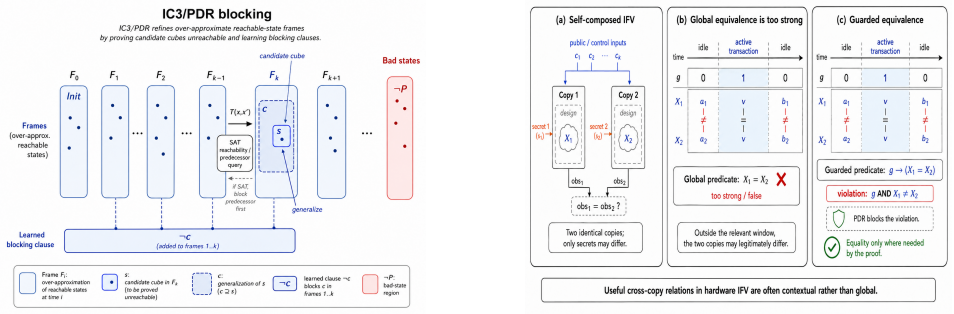
guarded equivalence predicates, which treat proposed contextual equalities by submitting the mismatch condition as a blocking obligation rather than an assumption
If this is right
- Two contextual baseline timeouts are converted to completed proofs within 34.2-89.5s
- Proof time is reduced by up to 10.8x on additional benchmarks
- The method works across 12 IFV benchmarks and two PDR backends
- It captures equalities relevant only in specific control phases or protocol regions
Where Pith is reading between the lines
- This technique could be applied to other relational verification problems beyond hardware information flow.
- It might allow verification of larger designs without increasing manual effort for predicates.
- Testing on more diverse PDR implementations could reveal the limits of the guard proposal strategy.
Load-bearing premise
The paper assumes that contextual relations arising in hardware IFV proofs can be reliably proposed via CTI-local extraction and state-split search, and that only those proved unreachable by the backend will affect the final proof.
What would settle it
Observing whether a proposed guard whose mismatch condition is actually reachable still allows the overall proof to complete would test if the approach depends on accurate unreachability proofs.
Figures
read the original abstract
Formal hardware information-flow verification is a principled way to rule out secret-dependent functional or timing observations, but scaling such proofs remains difficult. Self-composition reduces information-flow verification to safety checking over two circuit copies, creating relational proof obligations that are hard for a generic PDR engine to discover from bit-level logic alone. Recent PDR-based techniques exploit this duplicated structure through copy symmetry and global cross-copy equivalence predicates. These predicates are effective when corresponding internal signals agree throughout the reachable state space, but they do not capture equalities that are relevant only in a specific control context. We observe that such contextual relations arise naturally in hardware IFV proofs: an internal signal pair may need to agree only within a control phase, transaction window, loop state, or protocol region. We introduce guarded equivalence predicates to expose these relations to PDR. Rather than treating a proposed contextual equality as an assumption, the verifier submits the corresponding mismatch condition as an auxiliary blocking obligation. Guards are proposed from relational counterexamples-to-induction using CTI-local extraction and state-split search; only candidates proved unreachable by the backend affect the proof. Across 12 IFV benchmarks and two PDR backends, guarded predicates convert two contextual baseline timeouts into completed proofs within 34.2--89.5s under an 1800s limit, while reducing proof time by up to 10.8x on additional benchmarks.
Editorial analysis
A structured set of objections, weighed in public.
Referee Report
Summary. The manuscript introduces guarded equivalence predicates for scaling formal hardware information-flow verification (IFV) via self-composition and PDR. These predicates expose contextual equalities between corresponding signals in two circuit copies that hold only within specific control phases or protocol regions. Guards are proposed heuristically from relational CTIs using CTI-local extraction and state-split search; a candidate is retained only if the PDR backend proves the corresponding mismatch unreachable, discharging an auxiliary blocking obligation. Evaluation across 12 IFV benchmarks and two PDR backends reports that the technique completes two proofs that timed out under the baseline within 34.2--89.5 s (1800 s limit) and yields speedups up to 10.8x on additional cases.
Significance. If the reported outcomes hold, the technique provides a practical, sound extension to existing PDR-based IFV methods that rely on global cross-copy equivalences. A notable strength is the explicit soundness argument: because a guard is used only after its blocking obligation is discharged by the same engine, the approach introduces no unsound assumptions about the heuristic proposal step. This could meaningfully improve verification of hardware security properties involving timing or functional leaks in designs where contextual relations are common.
major comments (1)
- [Evaluation/results (as summarized in abstract)] The central empirical claim (conversion of two timeouts and up to 10.8x speedups on 12 benchmarks) is load-bearing for the paper's contribution, yet the abstract and reported results provide no information on benchmark selection criteria, diversity of the suite, whether choices were post-hoc, or any error bars/statistical measures. This limits independent verification of the scalability claim.
Simulated Author's Rebuttal
We thank the referee for the positive assessment and recommendation for minor revision. We address the single major comment below.
read point-by-point responses
-
Referee: [Evaluation/results (as summarized in abstract)] The central empirical claim (conversion of two timeouts and up to 10.8x speedups on 12 benchmarks) is load-bearing for the paper's contribution, yet the abstract and reported results provide no information on benchmark selection criteria, diversity of the suite, whether choices were post-hoc, or any error bars/statistical measures. This limits independent verification of the scalability claim.
Authors: We agree that the evaluation section would benefit from additional transparency on the benchmark suite. In the revised manuscript we will add a dedicated subsection (placed before the results tables) that explicitly states: the selection criteria (standard IFV benchmarks drawn from prior literature on self-composition and PDR-based security verification); the diversity of the 12 designs (covering processors, bus protocols, cryptographic modules, and timing-sensitive controllers); confirmation that the suite was assembled prior to experimentation and not chosen post-hoc; and any available statistical information (multiple independent runs with reported min/median/max times where wall-clock data is presented). These additions will be reflected in both the body text and an expanded abstract sentence. revision: yes
Circularity Check
No significant circularity
full rationale
The paper introduces guarded equivalence predicates as an algorithmic heuristic for exposing contextual relations in hardware IFV proofs. Guards are proposed via CTI-local extraction and state-split search but are only retained when the PDR backend itself proves the corresponding mismatch unreachable; this soundness condition is external to the proposal step and does not reduce the method to its own inputs. No equations, fitted parameters, self-definitional relations, or load-bearing self-citations appear in the described derivation. The central claim is an empirical demonstration on 12 benchmarks across two backends, with success measured by wall-clock outcomes rather than by internal construction. The derivation chain is therefore self-contained against external evaluation.
Axiom & Free-Parameter Ledger
axioms (1)
- domain assumption PDR engines correctly decide reachability when supplied with the auxiliary blocking obligations generated by the guards.
invented entities (1)
-
guarded equivalence predicate
no independent evidence
discussion (0)
Sign in with ORCID, Apple, or X to comment. Anyone can read and Pith papers without signing in.