Spectral and thermodynamic properties of supersymmetric quantum systems with self-adjoint deformed momentum
Pith reviewed 2026-07-01 06:51 UTC · model grok-4.3
The pith
Geometric deformations of momentum operators produce distinct heat capacity signatures in supersymmetric quantum systems.
A machine-rendered reading of the paper's core claim, the machinery that carries it, and where it could break.
Core claim
The GEMO formalism guarantees intrinsic self-adjointness for both linear (μ(x)=αx) and quadratic (μ(x)=αx²) deformations inside a unified supersymmetric scheme, yielding exact spectra and partition functions whose associated density of states ρ(E) produces a divergent heat-capacity peak for linear deformation and saturation C/k_B → 0.6 for quadratic deformation.
What carries the argument
The generalized extended momentum operator (GEMO) formalism, which enforces intrinsic self-adjointness of the deformed momentum inside a non-Hermitian supersymmetric factorization scheme.
If this is right
- Exact analytical spectra become available for supersymmetric systems with these deformations.
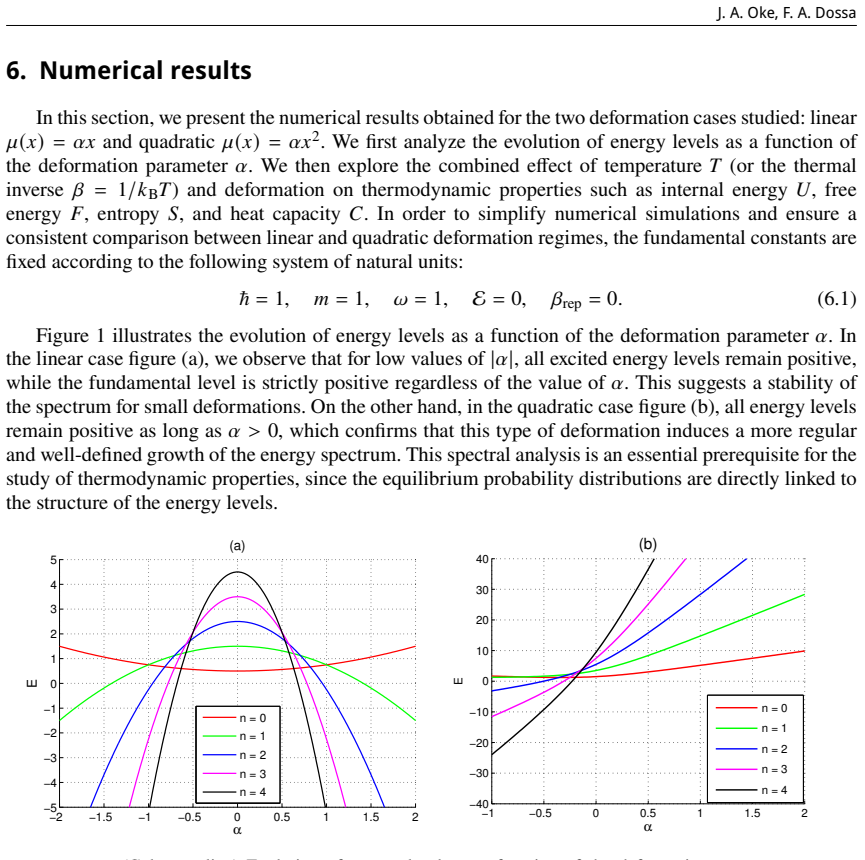
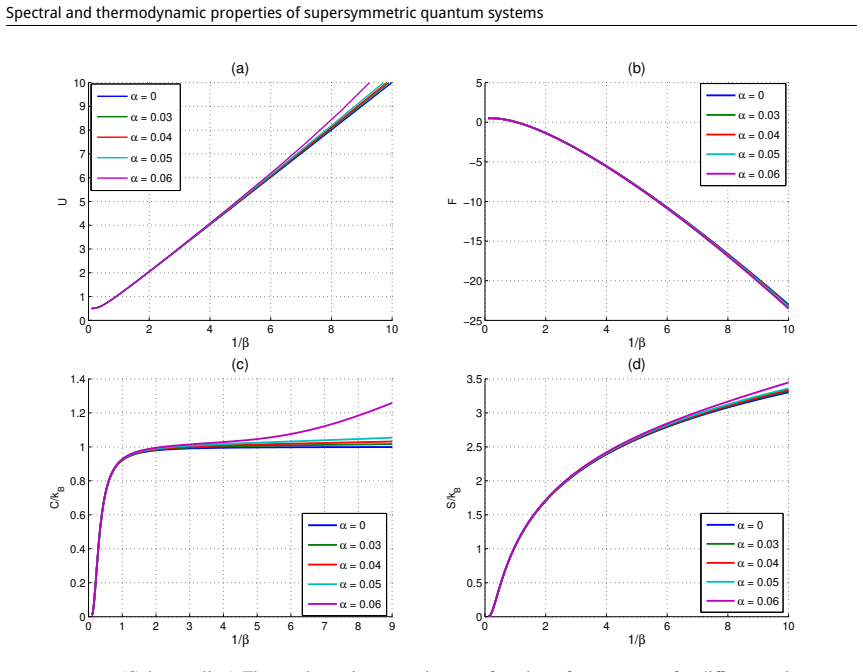
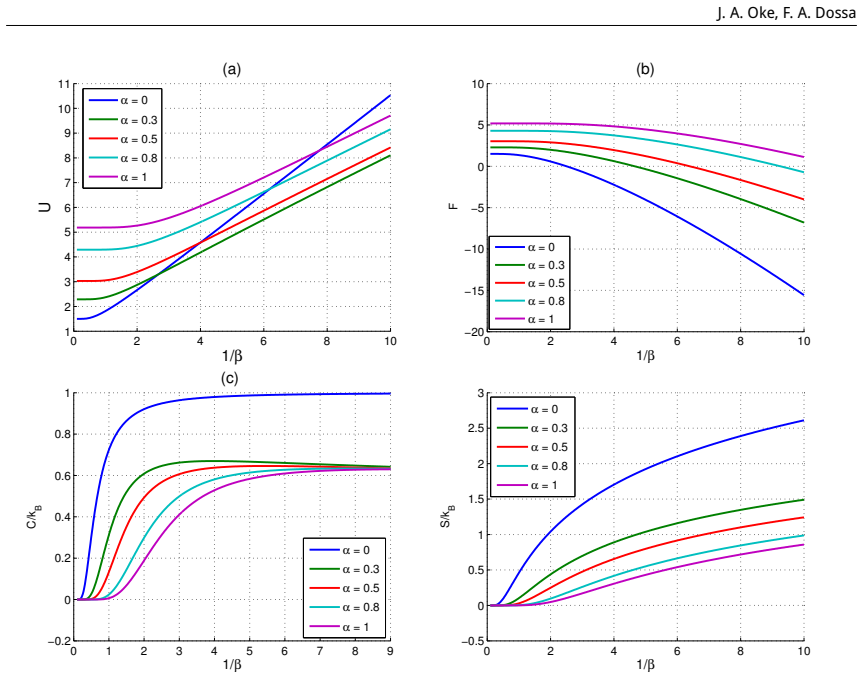
- The linear deformation produces a divergent heat-capacity peak caused by accumulation of states at a finite maximum energy.
- The quadratic deformation produces a heat capacity that saturates at C/k_B ≈ 0.6, below the Dulong-Petit value.
- Geometric deformation functions as a tunable control parameter for the thermodynamic response.
Where Pith is reading between the lines
- The same construction may supply solvable models for effective-mass or curved-space nanostructures.
- Comparison of the two deformation classes could guide selection of position-dependent mass profiles in device design.
- The hidden su(1,1) symmetry might allow algebraic computation of higher thermodynamic moments without explicit summation.
Load-bearing premise
The GEMO formalism automatically supplies intrinsic self-adjointness for both chosen deformations without any additional boundary-condition requirements.
What would settle it
Measurement of heat capacity versus temperature in a physical realization of a linear-deformation system that shows a divergent peak near the maximal energy, or in a quadratic-deformation system that saturates near 0.6 k_B, would confirm or refute the thermodynamic predictions.
Figures
read the original abstract
We establish a rigorous framework for quantum systems with geometric deformations by constructing a strictly self-adjoint deformed momentum operator through the generalized extended momentum operator (GEMO) formalism. Unlike previous approaches relying on boundary-condition hermiticity, our method ensures intrinsic self-adjointness for both linear ($\mu(x)=\alpha x$) and quadratic ($\mu(x)=\alpha x^{2}$) deformations within a unified non-Hermitian supersymmetric factorization scheme. This yields exact analytical spectra while revealing hidden $\mathfrak{su}(1,1)$ symmetry structures. Crucially, we provide the first complete thermodynamic characterization of such systems by analytically evaluating the partition function via the Euler--Maclaurin approximation. Geometric deformation fundamentally reshapes the density of states $\rho(E)$, producing distinct thermal signatures: a divergent heat capacity peak for linear deformation due to state accumulation near a maximal energy, and a saturation $C/k_{\mathrm{B}}\to 0.6$ (below the Dulong--Petit limit) for quadratic deformation. These results establish geometric deformation as a tunable parameter for engineering quantum thermodynamic responses in curved nanostructures.
Editorial analysis
A structured set of objections, weighed in public.
Referee Report
Summary. The paper introduces the generalized extended momentum operator (GEMO) formalism to construct strictly self-adjoint deformed momentum operators for linear (μ(x)=αx) and quadratic (μ(x)=αx²) geometric deformations within a unified non-Hermitian supersymmetric factorization scheme. This is claimed to yield exact analytical spectra exhibiting hidden su(1,1) symmetry, without relying on boundary-condition adjustments. The partition function is then evaluated analytically via the Euler-Maclaurin approximation to obtain the density of states ρ(E) and thermodynamic quantities, revealing a divergent heat-capacity peak for linear deformation (due to state accumulation near a maximal energy) and saturation of C/k_B to 0.6 (below the Dulong-Petit value) for quadratic deformation.
Significance. If the self-adjointness construction and exact spectra are rigorously established, the work would provide a tunable geometric parameter for engineering distinct thermodynamic responses in quantum systems, with potential relevance to curved nanostructures. The unified treatment of two deformation types and the identification of su(1,1) symmetry are positive features. However, the central claims rest on unverified aspects of the GEMO construction and the approximation step, limiting the current impact.
major comments (3)
- [GEMO formalism] The GEMO formalism section: the claim of intrinsic self-adjointness for both deformations via non-Hermitian SUSY factorization without boundary adjustments is load-bearing for the exact real spectra and subsequent thermodynamics, yet no domain specification, deficiency-index calculation, or explicit verification that the operator is essentially self-adjoint on the chosen dense domain is provided; this directly undermines the asserted exact analytical spectra and the derived divergent/saturation behaviors of C.
- [Thermodynamic characterization] The Euler-Maclaurin step for the partition function: no error estimates or convergence analysis for the approximation are supplied, which is required to support the quantitative claims such as C/k_B → 0.6 for quadratic deformation and the divergent peak for linear deformation.
- [Spectra and symmetry] Abstract and § on spectra: the assertion of 'exact analytical spectra' for both deformations is not accompanied by the explicit eigenvalue expressions or the demonstration that the non-Hermitian factorization closes the operator without implicit boundary conditions, making the thermal signatures (state accumulation near maximal energy, saturation below Dulong-Petit) rest on an unproven foundation.
minor comments (2)
- Notation for the deformation parameter α and the function μ(x) should be introduced with a clear table or equation early in the manuscript for consistency across sections.
- The abstract states 'the first complete thermodynamic characterization'; this should be qualified with references to prior partial studies on deformed systems if they exist.
Simulated Author's Rebuttal
We thank the referee for the careful and constructive review of our manuscript. We address each major comment point by point below, indicating where revisions will be made to strengthen the presentation.
read point-by-point responses
-
Referee: [GEMO formalism] The GEMO formalism section: the claim of intrinsic self-adjointness for both deformations via non-Hermitian SUSY factorization without boundary adjustments is load-bearing for the exact real spectra and subsequent thermodynamics, yet no domain specification, deficiency-index calculation, or explicit verification that the operator is essentially self-adjoint on the chosen dense domain is provided; this directly undermines the asserted exact analytical spectra and the derived divergent/saturation behaviors of C.
Authors: We agree that an explicit deficiency-index calculation is not included in the current manuscript and would strengthen the self-adjointness claim. The GEMO construction ensures symmetry on the dense domain of compactly supported smooth functions, with the non-Hermitian SUSY factorization guaranteeing real spectra through the partner Hamiltonian. In the revised version we will add a dedicated subsection specifying the domain and proving essential self-adjointness (deficiency indices (0,0)) via the bounded deformation-induced properties. revision: yes
-
Referee: [Thermodynamic characterization] The Euler-Maclaurin step for the partition function: no error estimates or convergence analysis for the approximation are supplied, which is required to support the quantitative claims such as C/k_B → 0.6 for quadratic deformation and the divergent peak for linear deformation.
Authors: We acknowledge that explicit error estimates and convergence analysis for the Euler-Maclaurin approximation are absent. The approximation is used to evaluate the partition function from the density of states, and the leading-order terms capture the reported qualitative behaviors. We will incorporate remainder bounds and convergence analysis in the revision, leveraging the specific forms of ρ(E) for each deformation to support the quantitative thermodynamic claims. revision: yes
-
Referee: [Spectra and symmetry] Abstract and § on spectra: the assertion of 'exact analytical spectra' for both deformations is not accompanied by the explicit eigenvalue expressions or the demonstration that the non-Hermitian factorization closes the operator without implicit boundary conditions, making the thermal signatures (state accumulation near maximal energy, saturation below Dulong-Petit) rest on an unproven foundation.
Authors: The manuscript derives the explicit eigenvalue expressions in the spectra section from the SUSY partner equations and identifies the su(1,1) generators. The factorization closes without boundary conditions because the superpotential satisfies the Riccati equation exactly, producing square-integrable solutions. We will revise by adding the explicit expressions to the abstract and expanding the closure argument with a dedicated paragraph to make these steps fully transparent. revision: yes
Circularity Check
No circularity: GEMO construction and Euler-Maclaurin thermodynamics are independent of the reported spectra and heat-capacity signatures.
full rationale
The provided abstract and reader summary contain no equations, fitted parameters, or self-citations that reduce the claimed spectra, density of states, or thermodynamic quantities (divergent C peak, C/k_B → 0.6) to tautological redefinitions of the deformation parameter α or the GEMO formalism itself. The partition function is evaluated via the standard Euler-Maclaurin approximation applied to analytically obtained spectra; no step is shown to be a statistical fit renamed as a prediction, nor does any uniqueness theorem or ansatz reduce to prior self-authored work by construction. The derivation chain is therefore self-contained against external benchmarks.
Axiom & Free-Parameter Ledger
free parameters (1)
- deformation strength α
axioms (2)
- domain assumption The generalized extended momentum operator (GEMO) formalism guarantees intrinsic self-adjointness for linear and quadratic deformations inside a non-Hermitian supersymmetric factorization scheme.
- domain assumption The Euler-Maclaurin formula yields an accurate analytic approximation to the partition function for the deformed spectra.
invented entities (1)
-
GEMO formalism
no independent evidence
Reference graph
Works this paper leans on
-
[1]
Kempf A., Mangano G., Mann R. B., Phys. Rev. D, 1995,52, 1108, doi:10.1103/PhysRevD.52.1108
-
[2]
Hinrichsen H., Kempf A., J. Math. Phys., 1996,37, 2121, doi:10.1063/1.531501
-
[3]
Maggiore M., Phys. Lett. B, 1993,319, 83, doi:10.1016/0370-2693(93)90785-G
-
[4]
Quesne C., Tkachuk V. M., Czech. J. Phys., 2006,56, 1269, doi:10.1007/s10582-006-0436-4
-
[5]
Mazharimousavi S. H., Phys. Rev. A, 2012,85, 034102, doi:10.1103/PhysRevA.85.034102
-
[6]
Brito F. A., Santos F. F., Santos J. R. L., Physica A, 2019,516, 78, doi:10.1016/j.physa.2018.10.018
-
[7]
Costa Filho R. N., Almeida M. P., Farias G. A., Andrade J. S., Phys. Rev. A, 2011,84, 050102, doi:10.1103/PhysRevA.84.050102
-
[8]
Izadparast M., Mazharimousavi S. H., Phys. Scr., 2020,95, 075220, doi:10.1088/1402-4896/ab97cf
-
[9]
TchoffoM.,MigueuF.B.,VubangsiM.,FaiL.C.,Heliyon,2019,5,e02395,doi:10.1016/j.heliyon.2019.e02395
-
[10]
Midya B., Roy B., J. Phys. A: Math. Theor., 2009,42, 285301, doi:10.1088/1751-8113/42/28/285301
-
[11]
Lévy-Leblond J.-M., Phys. Rev. A, 1995,52, 1845, doi:10.1103/PhysRevA.52.1845
-
[12]
Jafarov E. I., Nagiyev S. M., Rom. J. Phys., 2023,68, 111, doi:10.59277/RomJPhys.2023.68.111
-
[13]
Rep., 1995,251, 267, doi:10.1016/0370-1573(94)00080-M
Cooper F., Khare A., Sukhatme U., Phys. Rep., 1995,251, 267, doi:10.1016/0370-1573(94)00080-M
-
[14]
Junker G., Supersymmetric Methods in Quantum and Statistical Physics, Springer, 1996, doi:10.1007/978-3- 642-61194-0
-
[15]
E., JETP Lett., 1983,38, 356
Gendenshteïn L. E., JETP Lett., 1983,38, 356
1983
-
[16]
Bagchi B., Banerjee A., Quesne C., Tkachuk V. M., J. Phys. A: Math. Gen., 2005,38, 2929, doi:10.1088/0305- 4470/38/13/008
-
[17]
Mustafa O., J. Phys. A: Math. Theor., 2015,48, 225206, doi:10.1088/1751-8113/48/22/225206
-
[18]
Spector D., J. Math. Phys., 2008,49, 082101, doi:10.1063/1.2955795
-
[19]
Dossou A. E., Dossa F. A., Int. J. Theor. Phys., 2025,64, 264, doi:10.1007/s10773-025-06155-7
-
[20]
High Energy Phys., 2018,2018, 7450607, doi:10.1155/2018/7450607
Gangopadhyay S., Dutta A., Adv. High Energy Phys., 2018,2018, 7450607, doi:10.1155/2018/7450607
-
[21]
Dossa F. A., Phys. Scr., 2021,96, 105703, doi:10.1088/1402-4896/ac0956
-
[22]
Dagoudo L., Dossa F. A., Avossevou G. Y. H., EPL, 2024,147, 16001, doi:10.1209/0295-5075/ad5374
-
[23]
Lett., 1997,40, 667, doi:10.1209/epl/i1997-00520-y
Serra L., Lipparini E., Europhys. Lett., 1997,40, 667, doi:10.1209/epl/i1997-00520-y
-
[24]
Dossa F. A., Phys. Lett. A, 2020,384, 126891, doi:10.1016/j.physleta.2020.126891
-
[25]
Dong S.-H., Lozada-Cassou M., Yu J., Jiménez-Ángeles F., Rivera A. L., Int. J. Quantum Chem., 2007,107, 366, doi:10.1002/qua.21103
-
[26]
Rep., 1998,304, 229, doi:10.1016/S0370-1573(98)00022-2
Grifoni M., Hänggi P., Phys. Rep., 1998,304, 229, doi:10.1016/S0370-1573(98)00022-2. 23704-13 J. A. Oke, F. A. Dossa Спектральнi та термодинамiчнi властивостi суперсиметричних квантових систем iз самоспряженим деформованим iмпульсом Й. А. Оке 1, Ф. А. Досса 2,3 1 Школа наук, технологiй, iнженерiї та математики (ED-STIM), Нацiональний унiверситет наук, тех...
discussion (0)
Sign in with ORCID, Apple, or X to comment. Anyone can read and Pith papers without signing in.