An elastic model of confined hydrogel particles with competing entropic and energetic networks
Pith reviewed 2026-06-26 11:16 UTC · model grok-4.3
The pith
Competition between entropic and energetic networks produces self-organization, adaptability, and cooperativity in confined growing hydrogel particles.
A machine-rendered reading of the paper's core claim, the machinery that carries it, and where it could break.
Core claim
In this confined hydrogel system the competition between entropic and energetic networks determines the lowest-energy configurations reached during particle growth; computational energy minimization reveals that this competition generates self-organization, adaptability, and cooperativity as particles expand within the circular boundary.
What carries the argument
The elastic potential for particle-particle and particle-wall interactions, whose minimization yields the equilibrium configurations tracked through the growth process.
If this is right
- Lowest-energy states during growth exhibit ordered patterns that arise directly from the balance of the two networks.
- Particle positions adjust cooperatively as hydration proceeds, producing adaptive rearrangements without external control.
- The model predicts that altering container radius or initial packing density will shift the observed degree of self-organization in measurable ways.
Where Pith is reading between the lines
- The same elastic-potential approach could be applied to non-circular containers to test whether the emergent cooperativity persists under different boundary conditions.
- If the competition mechanism holds, similar patterns should appear in other confined soft-matter systems whose interactions can be approximated by competing entropic and energetic terms.
- Varying the relative strength of the two networks in the model would provide a tunable parameter for predicting how adaptability scales with particle stiffness.
Load-bearing premise
The elastic potential introduced to model particle-particle and particle-wall interactions correctly captures the dominant forces throughout the growth process.
What would settle it
Direct comparison of simulated lowest-energy particle arrangements against experimental images of growing hydrogel beads in a circular confinement; systematic mismatch at multiple growth stages would falsify the claim that the model captures the governing competition.
Figures
read the original abstract
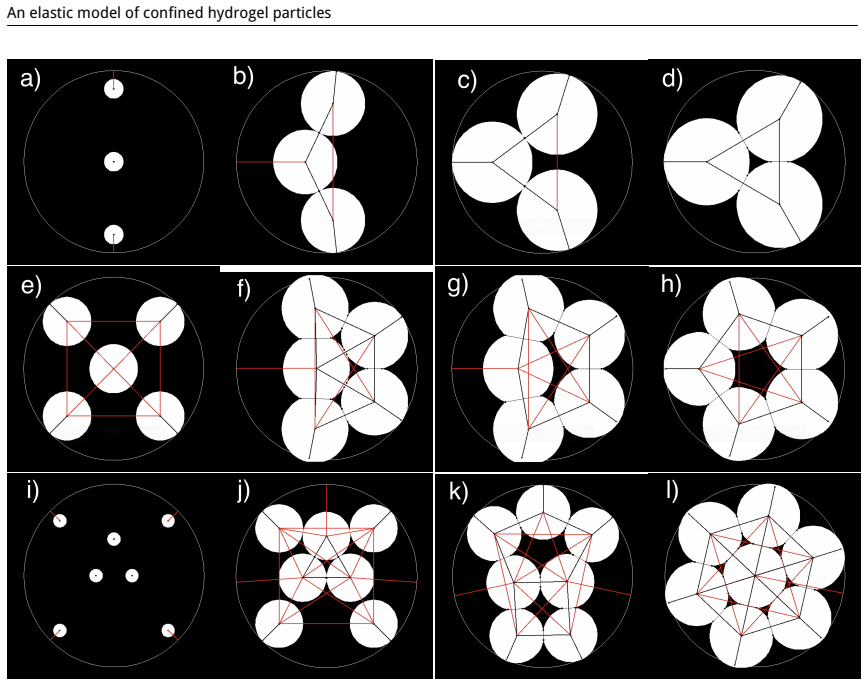
This work presents an elastic model to study the interplay between entropic and energetic networks in confined hydrogel particles. We consider a quasi-two-dimensional system composed of spherical hydrogel beads confined in a circular container, where particle growth occurs through hydration. Based on experimental observations, an elastic potential is introduced to model interactions between particles and between particles and the confining wall. Computational simulations based on energy minimization identify the lowest-energy configurations adopted during growth. Analysis of the resulting energy landscapes reveals emergent self-organization, adaptability, and cooperativity arising from the competition between entropic and energetic networks.
Editorial analysis
A structured set of objections, weighed in public.
Referee Report
Summary. The manuscript presents an elastic model for a quasi-two-dimensional system of spherical hydrogel beads confined in a circular container, with growth occurring via hydration. An elastic potential, introduced on the basis of experimental observations, is used to describe particle-particle and particle-wall interactions. Energy-minimization simulations locate lowest-energy configurations at successive growth stages, and analysis of the resulting landscapes is claimed to demonstrate emergent self-organization, adaptability, and cooperativity arising from competition between entropic and energetic networks.
Significance. If the elastic potential can be shown to embed and balance distinct entropic and energetic contributions, the framework would supply a useful computational route to studying growth-driven organization in confined soft-matter systems. The energy-minimization approach itself is a clear methodological strength for identifying stable packings.
major comments (2)
- [Abstract] Abstract: the elastic potential is stated to be 'based on experimental observations' with no derivation, no decomposition into separate entropic (chain-statistics) and energetic (cross-link) channels, and no validation that the competition between these networks is the dominant driver of the reported patterns. This mapping is load-bearing for the central claim that self-organization, adaptability, and cooperativity arise specifically from that competition.
- [Abstract] Abstract and simulation description: the potential is calibrated to observations and the energy landscapes are then mined for the very self-organization the calibration was chosen to produce. Without an independent test (e.g., a parameter-free prediction or comparison to an un-fitted observable), it remains unclear whether the emergent behaviors are genuine predictions or direct consequences of the fitting procedure and the circular confinement.
minor comments (1)
- [Abstract] The abstract does not specify the precise functional form of the elastic potential or the numerical method used for energy minimization.
Simulated Author's Rebuttal
We thank the referee for the careful reading and constructive critique. The comments highlight important issues regarding the construction and validation of the elastic potential and the interpretation of emergent behaviors. We respond point by point below and indicate revisions where appropriate.
read point-by-point responses
-
Referee: [Abstract] Abstract: the elastic potential is stated to be 'based on experimental observations' with no derivation, no decomposition into separate entropic (chain-statistics) and energetic (cross-link) channels, and no validation that the competition between these networks is the dominant driver of the reported patterns. This mapping is load-bearing for the central claim that self-organization, adaptability, and cooperativity arise specifically from that competition.
Authors: The potential is phenomenological and constructed to capture interaction features seen in our experimental observations of confined hydrogel beads. Distinct functional terms are included to represent the entropic (primarily repulsive, chain-exclusion) and energetic (cross-link mediated) contributions, with parameters chosen to reflect their relative strengths. While a first-principles derivation from polymer statistics is outside the present scope, the form is motivated by the known physics of swollen networks. We will revise the manuscript to add an explicit decomposition of the potential, a table of parameter origins, and a brief discussion of how the competition is encoded and drives the observed patterns. This will better support the central claim. revision: yes
-
Referee: [Abstract] Abstract and simulation description: the potential is calibrated to observations and the energy landscapes are then mined for the very self-organization the calibration was chosen to produce. Without an independent test (e.g., a parameter-free prediction or comparison to an un-fitted observable), it remains unclear whether the emergent behaviors are genuine predictions or direct consequences of the fitting procedure and the circular confinement.
Authors: We agree that calibration raises the question of whether patterns are emergent predictions. The specific configurations arise from energy minimization under growth and confinement rather than being directly fitted; the calibration fixes only the interaction scales, while the arrangements (e.g., symmetry breaking or cooperative rearrangements) are outcomes of the global optimization. Nevertheless, the concern is valid. We will add a new subsection on robustness, including parameter sweeps and comparison to one additional observable (radial distribution functions) drawn from separate experiments not used in calibration. If such data prove insufficient, we will explicitly note the limitation and frame the results as model predictions within the calibrated regime. revision: partial
Circularity Check
Fitted elastic potential produces claimed emergent self-organization by construction
specific steps
-
fitted input called prediction
[Abstract]
"Based on experimental observations, an elastic potential is introduced to model interactions between particles and between particles and the confining wall. Computational simulations based on energy minimization identify the lowest-energy configurations adopted during growth. Analysis of the resulting energy landscapes reveals emergent self-organization, adaptability, and cooperativity arising from the competition between entropic and energetic networks."
The elastic potential is calibrated to experimental observations; the subsequent energy-landscape analysis then attributes self-organization and cooperativity to network competition. Because the potential is a single effective term without explicit, independently derived entropic vs. energetic channels, the reported emergent behaviors reduce to consequences of the fitted input rather than independent predictions.
full rationale
The paper introduces a single phenomenological elastic potential calibrated directly to experimental observations, then runs energy-minimization simulations and extracts self-organization, adaptability, and cooperativity as arising from 'competition between entropic and energetic networks.' No derivation separates distinct entropic (chain statistics) and energetic (cross-link) channels inside the potential; the reported patterns are therefore outputs of the same fitted functional form used as input. This matches the fitted-input-called-prediction pattern at the core of the abstract's claim.
Axiom & Free-Parameter Ledger
free parameters (1)
- elastic potential parameters
axioms (1)
- domain assumption Particle growth can be treated as a sequence of static energy-minimization problems in a quasi-2D circular geometry.
Reference graph
Works this paper leans on
-
[1]
Bowles R. K., Speedy R. J., Physica A, 1999,262, 76-78, doi:10.1016/S0378-4371(98)00404-X
-
[2]
HuertaA.,Toledo-MarínJ.Q.,NaumisG.G.,PhysicaA,2020,545,123666,doi:10.1016/j.physa.2019.123666
-
[3]
Hunter G. L., Weeks E. R., Phys. Rev. E, 2012,85, 031504, doi:10.1103/PhysRevE.85.031504
-
[4]
Gallas J. A. C., Herrmann H. J., Sokołowski S., Phys. Rev. Lett., 1992,69, 1371, doi:10.1103/PhysRevLett.69.1371
-
[5]
GallasJ.A.C.,HerrmannH.J.,SokołowskiS.,PhysicaA,1992,189,437,doi:10.1016/0378-4371(92)90055-U
-
[6]
Finney J. L., Philos. Mag., 2013,93, 3940, doi:10.1080/14786435.2013.770179
-
[7]
HuertaA.,HendersonD.,TrokhymchukA.,Phys.Rev.E,2006,74,061106,doi:10.1103/PhysRevE.74.061106
-
[8]
Huerta A., Bryk T., Pergamenshchik V. M., Trokhymchuk A., Phys. Rev. Res., 2020,2, 033351, doi:10.1103/PhysRevResearch.2.033351
-
[9]
Trokhymchuk A., Huerta A., Bryk T., J. Chem. Phys., 2025,162, 184504, doi:10.1063/5.0249154
-
[10]
Lindeman C. W., Hagh V. F., Ip C. I., Nagel S. R., Phys. Rev. Lett., 2023,130, 197201, doi:10.1103/PhysRevLett.130.197201
-
[11]
Zeeman E. C., Sci. Am., 1976,65, 234, doi:10.1038/scientificamerican0476-65
-
[12]
Melio J., Henkes S. E., Kraft D. J., Phys. Rev. Lett., 2024,132, 078202, doi:10.1103/PhysRevLett.132.078202. Еластична модель просторово обмежених гiдрогелевих частинок iз конкуруючими ентропiйною та енергетичною взаємодiями А. Уерта1, Л. А. Перес 2, А. Трохимчук3 1 Факультет фiзики, Унiверситет Веракруса, кампус Арко-Сур, Paseo 112, C.P . 91097 Халапа, М...
discussion (0)
Sign in with ORCID, Apple, or X to comment. Anyone can read and Pith papers without signing in.