Reversible nonrelativistic magnon spin transport in ferroelastic altermagnets
Pith reviewed 2026-06-26 11:34 UTC · model grok-4.3
The pith
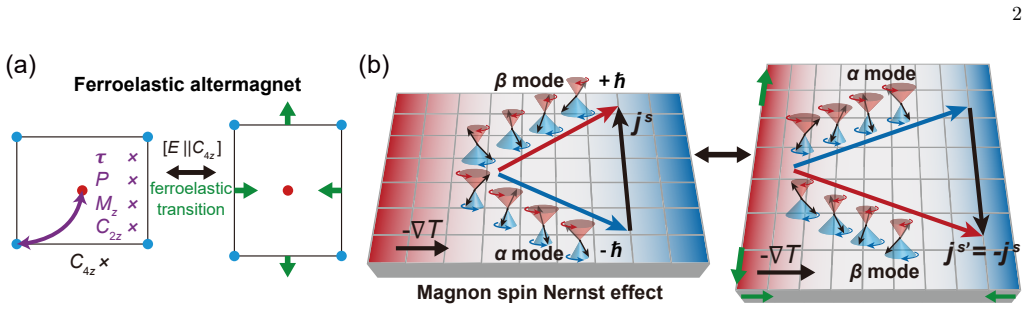
Ferroelastic transitions in 2D altermagnets switch the sign of nonrelativistic magnon spin Seebeck and Nernst conductivities by reorienting crystal axes.
A machine-rendered reading of the paper's core claim, the machinery that carries it, and where it could break.
Core claim
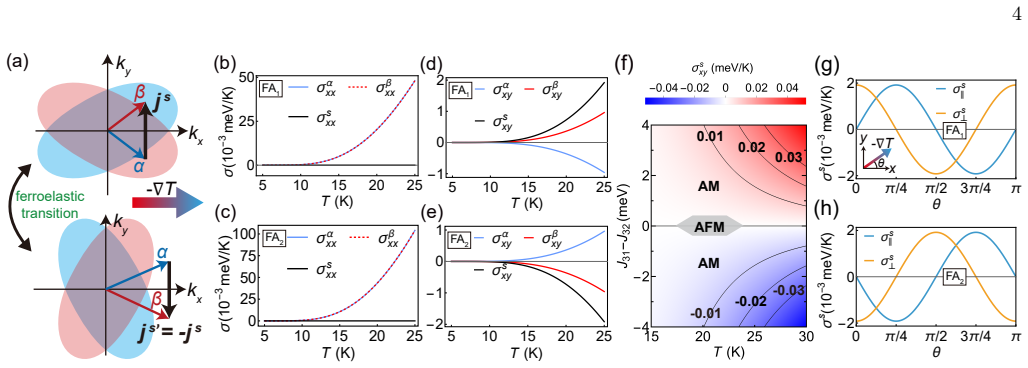
In two-dimensional altermagnets, ferroelastic transitions reorient principal crystal axes and modulate the underlying magnetic exchange anisotropy; the resulting magnetoelastic coupling produces nonrelativistic anisotropic spin transport that is ferroelastically switchable, yielding sign reversals in the spin Seebeck and spin Nernst conductivities without external magnetic fields or Berry curvature, as shown by first-principles and spin-model calculations on the CoTe2 monolayer.
What carries the argument
Magnetoelastic coupling between ferroelastic strain and magnetic exchange anisotropy that reorients crystal axes and reverses magnon transport signs.
If this is right
- Spin Seebeck conductivity reverses sign upon ferroelastic switching.
- Spin Nernst conductivity reverses sign upon ferroelastic switching.
- Magnon spin currents become controllable by strain alone in the absence of net magnetization or external fields.
- The same symmetry mechanism applies to other 2D altermagnets that support ferroelasticity.
Where Pith is reading between the lines
- Strain control could be combined with existing ferroelectric substrates to achieve electrical writing of magnon transport states.
- The mechanism may extend to other magnon-mediated effects such as spin pumping or thermal Hall responses in the same class of materials.
- Device architectures could exploit the two stable ferroelastic states as binary memory elements for magnonic signals.
Load-bearing premise
Ferroelastic transitions can be induced and stabilized in the 2D altermagnet monolayer without disrupting the compensated magnetic order.
What would settle it
First-principles calculations or measurements on CoTe2 showing that ferroelastic strain produces no change in spin Seebeck or spin Nernst sign.
Figures
read the original abstract
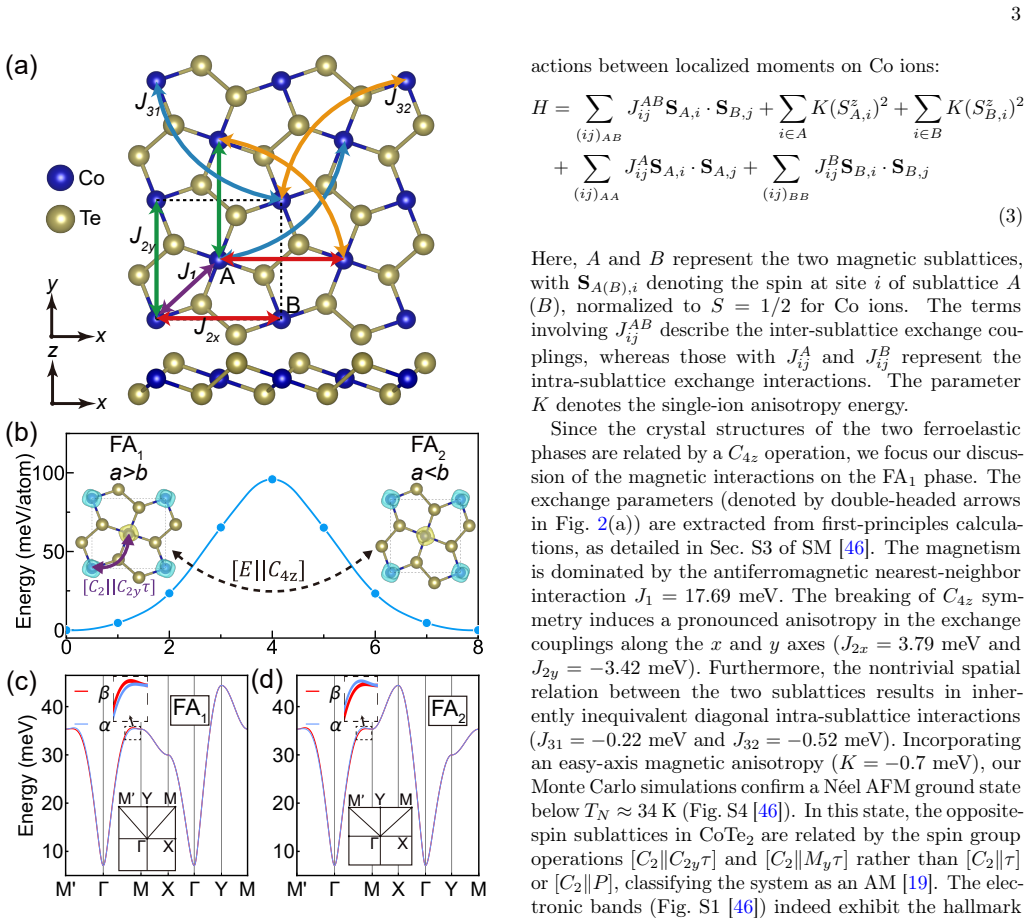
Magnons in antiferromagnetic (AFM) insulators facilitate low-dissipation, stray-field-free spin transport. However, achieving nonvolatile, field-free control over magnon spin currents remains elusive. Here, based on symmetry analysis, we propose a universal mechanism for the active manipulation of magnon spin transport via ferroelastic transitions in two-dimensional (2D) altermagnets (AMs)-a class of unconventional AFMs simultaneously exhibiting compensated magnetization and nonrelativistic spin splitting. We show that these transitions effectively reorient principal crystal axes and modulate the underlying magnetic exchange anisotropy. Consequently, this magnetoelastic coupling drives nonrelativistic anisotropic spin transport that is ferroelastically switchable without the need for external magnetic fields or Berry curvature, leading to sign reversals in the spin Seebeck and spin Nernst conductivities. We validate this mechanism using first-principles calculations and spin-model analyses of an AM CoTe2 monolayer. Our findings establish a symmetry-based magnetoelastic paradigm for the nonvolatile control of magnon spin transport in 2D AMs, opening new avenues toward energy-efficient, reconfigurable AFM magnonic devices.
Editorial analysis
A structured set of objections, weighed in public.
Referee Report
Summary. The manuscript proposes a symmetry-based mechanism in which ferroelastic transitions in 2D altermagnets reorient principal crystal axes, modulate magnetic exchange anisotropy, and thereby produce nonrelativistic, field-free, switchable magnon spin transport with sign reversals in the spin Seebeck and spin Nernst conductivities. The mechanism is illustrated on a CoTe2 monolayer and supported by first-principles calculations together with spin-model analyses.
Significance. If substantiated, the work supplies a magnetoelastic route to nonvolatile control of magnon currents that avoids external fields and Berry curvature, which would be of clear interest for reconfigurable AFM magnonics.
major comments (3)
- [Symmetry analysis] Symmetry analysis: the claim that a ferroelastic transition can be realized in the CoTe2 monolayer while preserving compensated altermagnetic order and nonrelativistic spin splitting is not yet load-bearing; the energy landscape under strain must be shown explicitly to confirm that the transition barrier is accessible, that net magnetization remains zero, and that the altermagnetic splitting survives.
- [First-principles calculations and spin-model analyses] First-principles and spin-model section: the reported sign reversals in the magnon conductivities depend on the modulation of exchange anisotropy; the values of the relevant exchange parameters (J1, J2, anisotropy terms) before and after the transition, together with the magnon dispersion used to compute the conductivities, must be tabulated so that the reversal can be reproduced and shown not to arise from parameter adjustment.
- [Spin Seebeck and spin Nernst conductivities] Conductivity calculations: the temperature dependence and any cutoff or approximation employed in evaluating the spin Seebeck and spin Nernst responses should be stated, because small changes in the anisotropy ratio can alter the sign; without this information the robustness of the reversal cannot be assessed.
minor comments (2)
- [Abstract] The phrase 'symmetry analysis section of the abstract' in the abstract is unclear; replace with the appropriate section number in the main text.
- [Figures] Figure captions should indicate the strain values at which the ferroelastic switch is evaluated and whether the plotted conductivities include thermal broadening.
Simulated Author's Rebuttal
We thank the referee for the constructive comments. We address each major point below and will revise the manuscript to provide the requested details and calculations.
read point-by-point responses
-
Referee: [Symmetry analysis] Symmetry analysis: the claim that a ferroelastic transition can be realized in the CoTe2 monolayer while preserving compensated altermagnetic order and nonrelativistic spin splitting is not yet load-bearing; the energy landscape under strain must be shown explicitly to confirm that the transition barrier is accessible, that net magnetization remains zero, and that the altermagnetic splitting survives.
Authors: We agree that explicit mapping of the energy landscape under strain will make the ferroelastic transition claim more robust. In the revised manuscript we will add first-principles total-energy calculations versus uniaxial strain, demonstrating an accessible barrier, confirming that net magnetization remains zero, and verifying that the altermagnetic spin splitting is preserved across the transition. revision: yes
-
Referee: [First-principles calculations and spin-model analyses] First-principles and spin-model section: the reported sign reversals in the magnon conductivities depend on the modulation of exchange anisotropy; the values of the relevant exchange parameters (J1, J2, anisotropy terms) before and after the transition, together with the magnon dispersion used to compute the conductivities, must be tabulated so that the reversal can be reproduced and shown not to arise from parameter adjustment.
Authors: We appreciate the request for full reproducibility. The revised manuscript will contain a new table listing the first-principles values of J1, J2 and all anisotropy terms for both the unstrained and ferroelastically strained configurations, together with the magnon dispersion relations employed in the conductivity calculations. revision: yes
-
Referee: [Spin Seebeck and spin Nernst conductivities] Conductivity calculations: the temperature dependence and any cutoff or approximation employed in evaluating the spin Seebeck and spin Nernst responses should be stated, because small changes in the anisotropy ratio can alter the sign; without this information the robustness of the reversal cannot be assessed.
Authors: We will expand the methods section to state explicitly the temperature range, the Brillouin-zone integration scheme, any magnon-mode energy cutoffs, and the linear spin-wave approximation used. These additions will allow readers to assess the sensitivity of the sign reversals to the anisotropy ratio. revision: yes
Circularity Check
Symmetry analysis plus independent first-principles validation on CoTe2 yields no circular reduction
full rationale
The derivation proceeds from symmetry-allowed magnetoelastic coupling under ferroelastic reorientation of principal axes, which modulates exchange anisotropy and thereby produces sign reversal in the nonrelativistic spin Seebeck and spin Nernst conductivities. These relations are then checked by explicit first-principles spin-model calculations on the CoTe2 monolayer. No equation is defined in terms of its own output, no fitted parameter is relabeled as a prediction, and no load-bearing uniqueness claim rests on a self-citation chain. The central result therefore remains externally falsifiable by the DFT data rather than tautological with its inputs.
Axiom & Free-Parameter Ledger
Reference graph
Works this paper leans on
-
[1]
A. V. Chumak, A. A. Serga, and B. Hillebrands, Magnon transistor for all-magnon data processing, Nat. Commun. 5, 4700 (2014)
2014
-
[2]
A. V. Chumak, V. I. Vasyuchka, A. A. Serga, and B. Hille- brands, Magnon spintronics, Nat. Phys.11, 453 (2015)
2015
-
[3]
Flebus, D
B. Flebus, D. Grundler, B. Rana, Y. Otani, I. Bar- sukov, A. Barman, G. Gubbiotti, P. Landeros, J. Ak- erman, U. Ebels, P. Pirro, V. E. Demidov, K. Schultheiss, G. Csaba, Q. Wang, F. Ciubotaru, D. E. Nikonov, P. Che, R. Hertel, T. Ono, D. Afanasiev, J. Mentink, T. Rasing, B. Hillebrands, S. V. Kusminskiy, W. Zhang, C. R. Du, A. Finco, T. van der Sar, Y. K...
2024
-
[4]
Cheng, J
R. Cheng, J. Xiao, Q. Niu, and A. Brataas, Spin Pumping and Spin-Transfer Torques in Antiferromagnets, Phys. Rev. Lett.113, 057601 (2014)
2014
-
[5]
Baltz, A
V. Baltz, A. Manchon, M. Tsoi, T. Moriyama, T. Ono, and Y. Tserkovnyak, Antiferromagnetic spintronics, Rev. Mod. Phys.90, 015005 (2018)
2018
-
[6]
S. M. Rezende, A. Azevedo, and R. L. Rodríguez-Suárez, Introduction to antiferromagnetic magnons, J. Appl. Phys. 126, 151101 (2019)
2019
-
[7]
Flebus, Magnonics in collinear magnetic insulating systems, J
B. Flebus, Magnonics in collinear magnetic insulating systems, J. Appl. Phys.129, 161101 (2021)
2021
-
[8]
Y. Wang, J. Xia, H. Xu, G. Lan, X. Han, and G. Yu, Magnons in van der Waals antiferromagnetic materials, Adv. Funct. Mater.36, e17690 (2026)
2026
-
[9]
S. Seki, T. Ideue, M. Kubota, Y. Kozuka, R. Takagi, M. Nakamura, Y. Kaneko, M. Kawasaki, and Y. Tokura, Thermal generation of spin current in an antiferromagnet, Phys. Rev. Lett.115, 266601 (2015)
2015
-
[10]
S. M. Rezende, R. L. Rodríguez-Suárez, and A. Azevedo, Theory of the spin Seebeck effect in antiferromagnets, Phys. Rev. B93, 014425 (2016)
2016
-
[11]
J. Li, Z. Shi, V. H. Ortiz, M. Aldosary, C. Chen, V. Aji, P. Wei, and J. Shi, Spin Seebeck effect from antiferromag- netic magnons and critical spin fluctuations in epitaxial FeF2 films, Phys. Rev. Lett.122, 217204 (2019)
2019
-
[12]
Cheng, S
R. Cheng, S. Okamoto, and D. Xiao, Spin Nernst effect of magnons in collinear antiferromagnets, Phys. Rev. Lett. 117, 217202 (2016)
2016
-
[13]
V. A. Zyuzin and A. A. Kovalev, Magnon spin Nernst effect in antiferromagnets, Phys. Rev. Lett.117, 217203 (2016)
2016
-
[14]
K. H. Lee, S. B. Chung, K. Park, and J.-G. Park, Magnonic quantum spin Hall state in the zigzag and stripe phases of the antiferromagnetic honeycomb lattice, Phys. Rev. B97, 180401 (2018)
2018
-
[15]
Bazazzadeh, M
N. Bazazzadeh, M. Hamdi, F. Haddadi, A. Khavasi, A. Sadeghi, and S. M. Mohseni, Symmetry enhanced spin-Nernst effect in honeycomb antiferromagnetic transi- tion metal trichalcogenide monolayers, Phys. Rev. B103, 014425 (2021)
2021
-
[16]
L.-D. Yuan, Z. Wang, J.-W. Luo, E. I. Rashba, and A. Zunger, Giant momentum-dependent spin splitting in centrosymmetric low-Z antiferromagnets, Phys. Rev. B 102, 014422 (2020)
2020
-
[17]
H.-Y. Ma, M. Hu, N. Li, J. Liu, W. Yao, J.-F. Jia, and J. Liu, Multifunctional antiferromagnetic materials with giant piezomagnetism and noncollinear spin current, Nat. Commun.12, 2846 (2021)
2021
-
[18]
Mazin and The PRX Editors, Editorial: Altermagnetism—A new punch line of fundamen- tal magnetism, Phys
I. Mazin and The PRX Editors, Editorial: Altermagnetism—A new punch line of fundamen- tal magnetism, Phys. Rev. X12, 040002 (2022)
2022
-
[19]
Šmejkal, J
L. Šmejkal, J. Sinova, and T. Jungwirth, Beyond conven- tional ferromagnetism and antiferromagnetism: A phase with nonrelativistic spin and crystal rotation symmetry, Phys. Rev. X12, 031042 (2022)
2022
-
[20]
C. Song, H. Bai, Z. Zhou, L. Han, H. Reichlova, J. H. Dil, J. Liu, X. Chen, and F. Pan, Altermagnets as a new class of functional materials, Nat. Rev. Mater.10, 473 (2025). 6
2025
-
[21]
Huang, C
Y. Huang, C. Hua, R. Xu, J. Liu, Y. Zheng, and Y. Lu, Spin inversion enforced by crystal symmetry in ferroelastic altermagnets, Phys. Rev. Lett.135, 266701 (2025)
2025
-
[22]
Šmejkal, A
L. Šmejkal, A. Marmodoro, K.-H. Ahn, R. González- Hernández, I. Turek, S. Mankovsky, H. Ebert, S. W. D’Souza, O. Šipr, J. Sinova, and T. Jungwirth, Chiral magnons in altermagnetic RuO2, Phys. Rev. Lett.131, 256703 (2023)
2023
-
[23]
Z. Liu, M. Ozeki, S. Asai, S. Itoh, and T. Masuda, Chiral split magnon in altermagnetic MnTe, Phys. Rev. Lett. 133, 156702 (2024)
2024
-
[24]
Hoyer, P
R. Hoyer, P. P. Stavropoulos, A. Razpopov, R. Valentí, L. Šmejkal, and A. Mook, Altermagnetic splitting of magnons in hematiteα-Fe2O3, Phys. Rev. B112, 064425 (2025)
2025
-
[25]
X. Chen, Y. Liu, P. Liu, Y. Yu, J. Ren, J. Li, A. Zhang, and Q. Liu, Unconventional magnons in collinear magnets dictated by spin space groups, Nature640, 349 (2025)
2025
-
[26]
Q. Sun, J. Guo, D. Wang, D. L. Abernathy, W. Tian, and C. Li, Observation of chiral magnon band splitting in altermagnetic hematite, Phys. Rev. Lett.135, 186703 (2025)
2025
-
[27]
Y. Xie, D. Wang, C. Li, X. Shen, and J. Zhang, A general theory of chiral splitting of magnons in two-dimensional magnets (2026), arXiv:2601.15031 [cond-mat]
arXiv 2026
-
[28]
Q. Cui, B. Zeng, P. Cui, T. Yu, and H. Yang, Efficient spin Seebeck and spin Nernst effects of magnons in alter- magnets, Phys. Rev. B108, L180401 (2023)
2023
-
[29]
H. Yu, W. Feng, F. Zheng, and Y. Yao, Chiral magnons in an altermagnetic Janus Mn2SeTe Monolayer, Compu- tational Materials Today4, 100021 (2024)
2024
-
[30]
Weißenhofer and A
M. Weißenhofer and A. Marmodoro, Atomistic spin dy- namics simulations of magnonic spin Seebeck and spin Nernst effects in altermagnets, Phys. Rev. B110, 094427 (2024)
2024
-
[31]
Y. Yang, D. Wang, B. Yang, P. Wang, Y. Mu, Y. Tian, B. Zheng, W. Qin, K. Wang, B. Huang, B. Wang, X. Wan, and D. Wu, Altermagnet-driven magnon spin splitting Nernst effect, Phys. Rev. Lett.136, 026701 (2026)
2026
-
[32]
Y. Wang, D. Zhu, Y. Yang, K. Lee, R. Mishra, G. Go, S.-H. Oh, D.-H. Kim, K. Cai, E. Liu, S. D. Pollard, S. Shi, J. Lee, K. L. Teo, Y. Wu, K.-J. Lee, and H. Yang, Magnetization switching by magnon-mediated spin torque through an antiferromagnetic insulator, Science366, 1125 (2019)
2019
-
[33]
Huang, X
X. Huang, X. Chen, Y. Li, J. Mangeri, H. Zhang, M. Ramesh, H. Taghinejad, P. Meisenheimer, L. Caretta, S. Susarla, R. Jain, C. Klewe, T. Wang, R. Chen, C.-H. Hsu, I. Harris, S. Husain, H. Pan, J. Yin, P. Shafer, Z. Qiu, D. R. Rodrigues, O. Heinonen, D. Vasudevan, J. Íñiguez, D. G. Schlom, S. Salahuddin, L. W. Martin, J. G. Analytis, D. C. Ralph, R. Cheng,...
2024
-
[34]
Zhang, H
Y. Zhang, H. Bai, J. Dai, L. Han, C. Chen, S. Liang, Y. Cao, Y. Zhang, Q. Wang, W. Zhu, F. Pan, and C. Song, Electrical manipulation of spin splitting torque in alter- magnetic RuO2, Nat. Commun.16, 5646 (2025)
2025
-
[35]
C. Liu, Y. Luo, D. Hong, S. S.-L. Zhang, H. Saglam, Y. Li, Y. Lin, B. Fisher, J. E. Pearson, J. S. Jiang, H. Zhou, J. Wen, A. Hoffmann, and A. Bhattacharya, Electric field control of magnon spin currents in an antiferromagnetic insulator, Sci. Adv.7, eabg1669 (2021)
2021
-
[36]
Cheng, R
J. Cheng, R. Yu, L. Sun, K. He, T. Ji, M. Yang, Z. Zhang, X. Hu, H. Niu, X. Yang, P. Chen, G. Chen, J. Xiao, F. Huang, X. Lu, H. Cai, H. Yuan, B. Miao, and H. Ding, A nonvolatile magnon field effect transistor at room tem- perature, Nat. Commun.15, 9314 (2024)
2024
-
[37]
D. L. Esteras, A. Rybakov, A. M. Ruiz, and J. J. Baldoví, Magnon straintronics in the 2D van der Waals ferromagnet CrSBr from first-principles, Nano Lett.22, 8771 (2022)
2022
-
[38]
Y. Zhou, T. Guo, L. Qiao, Q. Wang, M. Zhu, J. Zhang, Q. Liu, M. Zhao, C. Wan, W. He, H. Bai, L. Han, L. Huang, R. Chen, Y. Zhao, X. Han, F. Pan, and C. Song, Piezoelectric strain-controlled magnon spin current trans- port in an antiferromagnet, Nano Lett.22, 4646 (2022)
2022
-
[39]
Geprägs, A
S. Geprägs, A. Kehlberger, F. D. Coletta, Z. Qiu, E.-J. Guo, T. Schulz, C. Mix, S. Meyer, A. Kamra, M. Al- thammer, H. Huebl, G. Jakob, Y. Ohnuma, H. Adachi, J. Barker, S. Maekawa, G. E. W. Bauer, E. Saitoh, R. Gross, S. T. B. Goennenwein, and M. Kläui, Origin of the spin Seebeck effect in compensated ferrimagnets, Nat. Commun.7, 10452 (2016)
2016
-
[40]
Parsonnet, L
E. Parsonnet, L. Caretta, V. Nagarajan, H. Zhang, H. Taghinejad, P. Behera, X. Huang, P. Kavle, A. Fer- nandez, D. Nikonov, H. Li, I. Young, J. Analytis, and R. Ramesh, Nonvolatile electric field control of thermal magnons in the absence of an applied magnetic field, Phys. Rev. Lett.129, 087601 (2022)
2022
-
[41]
K. Li, L. Wang, Y. Wang, Y. Guo, S. Lv, Y. He, W. Lin, T. Min, S. Hu, S. Yang, D. Xue, A. Zheng, S. Yang, and X. Ding, Electric field switching of magnon spin current in a compensated ferrimagnet, Adv. Mater.36, 2312137 (2024)
2024
-
[42]
L. Wang, L. Shen, H. Bai, H.-A. Zhou, K. Shen, and W. Jiang, Electrical excitation and detection of chiral magnons in a compensated ferrimagnetic insulator, Phys. Rev. Lett.133, 166705 (2024)
2024
-
[43]
Kawamoto, T
Y. Kawamoto, T. Kikkawa, M. Kawamata, Y. Umemoto, A. G. Manning, K. C. Rule, K. Ikeuchi, K. Kamazawa, M. Fujita, E. Saitoh, K. Kakurai, and Y. Nambu, Un- derstanding spin currents from magnon dispersion and polarization: Spin-Seebeck effect and neutron scatter- ing study on Tb3Fe5O12, Appl. Phys. Lett.124, 132406 (2024)
2024
-
[44]
J. Fu, M. Kuisma, A. H. Larsen, K. Shinohara, A. Togo, and K. S. Thygesen, Symmetry classification of 2D ma- terials: Layer groups versus space groups, 2D Mater.11, 035009 (2024)
2024
-
[45]
Zeng and Y.-J
S. Zeng and Y.-J. Zhao, Description of two-dimensional altermagnetism: Categorization using spin group theory, Phys. Rev. B110, 054406 (2024)
2024
-
[46]
[12, 28, 29, 45, 47, 49, 52, 56, 62–81]
See Supplemental Material at [URL to be inserted] for moredetailson(1)first-principlescalculations, (2)phonon spectra and mechanical properties, (3) calculations of the magnon bands, and (4) derivation and symmetry analysis of magnon conductivities, which includes Refs. [12, 28, 29, 45, 47, 49, 52, 56, 62–81]
-
[47]
Höpfner, I
Y. Höpfner, I. Mertig, and R. R. Neumann, Sign changes in heat, spin, and orbital magnon transport coefficients in Kitaev ferromagnets, Phys. Rev. B111, 214404 (2025)
2025
-
[48]
ferroelastic
K. Aizu, Possible species of “ferroelastic” crystals and of simultaneously ferroelectric and ferroelastic crystals, J. Phys. Soc. Jpn.27, 387 (1969)
1969
-
[49]
R. Peng, S. Fang, P. Ho, F. Liu, T. Zhou, J. Liu, and Y. S. Ang, Ferroelastic altermagnetism, npj Quantum Mater. 11, 5 (2025)
2025
-
[50]
Henkelman and H
G. Henkelman and H. Jónsson, Improved tangent estimate 7 in the nudged elastic band method for finding minimum energy paths and saddle points, J. Chem. Phys.113, 9978 (2000)
2000
-
[51]
Sheppard, P
D. Sheppard, P. Xiao, W. Chemelewski, D. D. Johnson, and G. Henkelman, A generalized solid-state nudged elas- tic band method, J. Chem. Phys.136, 074103 (2012)
2012
-
[52]
N. Ding, H. Ye, S.-S. Wang, and S. Dong, Ferroelastically tunable altermagnets, Phys. Rev. B112, L220410 (2025)
2025
-
[53]
Zhang, Y
T. Zhang, Y. Ma, X. Xu, C. Lei, B. Huang, and Y. Dai, Two-dimensional ferroelastic semiconductors in Nb2SiTe4 and Nb2GeTe4 with promising electronic properties, J. Phys. Chem. Lett.11, 497 (2020)
2020
-
[54]
Wu and X
M. Wu and X. C. Zeng, Intrinsic ferroelasticity and/or multiferroicity in two-dimensional phosphorene and phos- phorene analogues, Nano Lett.16, 3236 (2016)
2016
-
[55]
Wang, W.-W
S. Wang, W.-W. Wang, J. Fan, X. Zhou, X.-P. Li, and L. Wang, Two-dimensional dual-switchable ferroelectric altermagnets: Altering electrons and magnons, Nano Lett. 25, 14618 (2025)
2025
-
[56]
Q. Cui, X. Bai, and A. Delin, Anisotropic magnon trans- port in van der Waals ferromagnetic insulators, Adv. Funct. Mater.35, 2407469 (2025)
2025
-
[57]
González-Hernández, L
R. González-Hernández, L. Šmejkal, K. Výborný, Y. Ya- hagi, J. Sinova, T. Jungwirth, and J. Železný, Efficient electrical spin splitter based on nonrelativistic collinear antiferromagnetism, Phys. Rev. Lett.126, 127701 (2021)
2021
-
[58]
Karube, T
S. Karube, T. Tanaka, D. Sugawara, N. Kadoguchi, M. Ko- hda, and J. Nitta, Observation of spin-splitter torque in collinear antiferromagnetic RuO2, Phys. Rev. Lett.129, 137201 (2022)
2022
-
[59]
H. Bai, L. Han, X. Y. Feng, Y. J. Zhou, R. X. Su, Q. Wang, L. Y. Liao, W. X. Zhu, X. Z. Chen, F. Pan, X. L. Fan, and C. Song, Observation of spin splitting torque in a collinear antiferromagnet RuO2, Phys. Rev. Lett.128, 197202 (2022)
2022
-
[60]
Sarkar and A
S. Sarkar and A. Agarwal, Spin-split magnon bands induce pure spin current in insulating altermagnets, Phys. Rev. B112, 195420 (2025)
2025
-
[61]
Y.Guo, A.Chen, Z.Zeng, T.An, Q.Cui, Y.Ga, D.Zheng, X. Deng, X. Zhang, M. Tang, Z. Zhu, C. Wu, J. Zhang, Y. Fan, Z. Wang, W. Song, P. Yan, T. Zhu, S. Wang, X. Han, J. Zhao, K. L. Wang, G. Yu, X. Zhang, and H. Wu, Magnetic memory driven by spin splitting torque in nonrelativistic collinear antiferromagnet, Nat. Commun. 17, 1309 (2025)
2025
-
[62]
P. E. Blöchl, Projector augmented-wave method, Phys. Rev. B50, 17953 (1994)
1994
-
[63]
G.KresseandD.Joubert,Fromultrasoftpseudopotentials to the projector augmented-wave method, Phys. Rev. B 59, 1758 (1999)
1999
-
[64]
Kresse and J
G. Kresse and J. Furthmüller, Efficiency of ab-initio total energy calculations for metals and semiconductors using a plane-wave basis set, Comput. Mater. Sci.6, 15 (1996)
1996
-
[65]
Kresse and J
G. Kresse and J. Furthmüller, Efficient iterative schemes for ab initio total-energy calculations using a plane-wave basis set, Phys. Rev. B54, 11169 (1996)
1996
-
[66]
J. P. Perdew, K. Burke, and M. Ernzerhof, Generalized gradient approximation made simple, Phys. Rev. Lett.77, 3865 (1996)
1996
-
[67]
S. L. Dudarev, G. A. Botton, S. Y. Savrasov, C. J. Humphreys, and A. P. Sutton, Electron-energy-loss spec- tra and the structural stability of nickel oxide: An LSDA+U study, Phys. Rev. B57, 1505 (1998)
1998
-
[68]
Togo and I
A. Togo and I. Tanaka, First principles phonon calcula- tions in materials science, Scr. Mater.108, 1 (2015)
2015
-
[69]
V. Wang, N. Xu, J.-C. Liu, G. Tang, and W.-T. Geng, VASPKIT: A user-friendly interface facilitating high- throughput computing and analysis using VASP code, Comput. Phys. Commun.267, 108033 (2021)
2021
-
[70]
Xiang, C
H. Xiang, C. Lee, H.-J. Koo, X. Gong, and M.-H. Whangbo, Magnetic properties and energy-mapping anal- ysis, Dalton Trans.42, 823 (2013)
2013
-
[71]
X. Li, H. Yu, F. Lou, J. Feng, M.-H. Whangbo, and H. Xiang, Spin Hamiltonians in magnets: Theories and computations, Molecules26, 803 (2021)
2021
-
[72]
R. F. L. Evans, W. J. Fan, P. Chureemart, T. A. Ostler, M. O. A. Ellis, and R. W. Chantrell, Atomistic spin model simulations of magnetic nanomaterials, J. Phys.: Condens. Matter26, 103202 (2014)
2014
-
[73]
W. Pan, C. Xu, X. Li, Z. Xu, B. Liu, B.-L. Gu, and W. Duan, Chiral magnetism in lithium-decorated mono- layer CrTe2: Interplay between Dzyaloshinskii-Moriya interaction and higher-order interactions, Phys. Rev. B 109, 214405 (2024)
2024
-
[74]
Holstein and H
T. Holstein and H. Primakoff, Field dependence of the intrinsic domain magnetization of a ferromagnet, Phys. Rev.58, 1098 (1940)
1940
-
[75]
J. H. P. Colpa, Diagonalization of the quadratic boson Hamiltonian, Phys. A93, 327 (1978)
1978
-
[76]
R. M. White, M. Sparks, and I. Ortenburger, Diagonaliza- tion of the antiferromagnetic magnon-phonon interaction, Phys. Rev.139, A450 (1965)
1965
-
[77]
Keffer, H
F. Keffer, H. Kaplan, and Y. Yafet, Spin Waves in Ferro- magnetic and Antiferromagnetic Materials, Am. J. Phys 21, 250 (1953)
1953
-
[78]
McCreary, J
A. McCreary, J. R. Simpson, T. T. Mai, R. D. McMichael, J. E. Douglas, N. Butch, C. Dennis, R. Valdés Aguilar, and A. R. Hight Walker, Quasi-two-dimensional magnon identification in antiferromagnetic FePS3 via magneto- Raman spectroscopy, Phys. Rev. B101, 064416 (2020)
2020
-
[79]
T. T. Mai, K. F. Garrity, A. McCreary, J. Argo, J. R. Simpson, V. Doan-Nguyen, R. V. Aguilar, and A. R. H. Walker, Magnon-phonon hybridization in 2D antiferro- magnet MnPSe3, Sci. Adv.7, eabj3106 (2021)
2021
-
[80]
H. Cai, Z. Xu, J. Wu, and W. Pan, Tunable Chern in- sulator states with coexisting magnonic and electronic topology in two-dimensional honeycomb Kitaev ferromag- nets, Phys. Rev. B113, 134413 (2026)
2026
discussion (0)
Sign in with ORCID, Apple, or X to comment. Anyone can read and Pith papers without signing in.