Cladding Layer Enhanced GHz Bulk Acoustic Wave Resonance in Sodium Niobate Thin Films on Silicon
Pith reviewed 2026-06-26 11:32 UTC · model grok-4.3
The pith
Cladding sodium niobate films between high-band-gap insulators produces stable lead-free bulk acoustic resonators at 4 GHz with 31.3 percent coupling on silicon.
A machine-rendered reading of the paper's core claim, the machinery that carries it, and where it could break.
Core claim
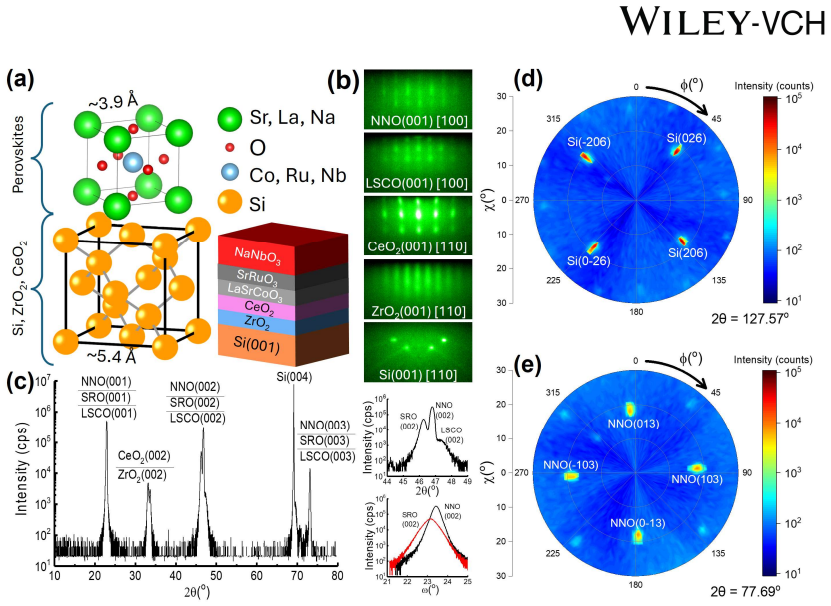
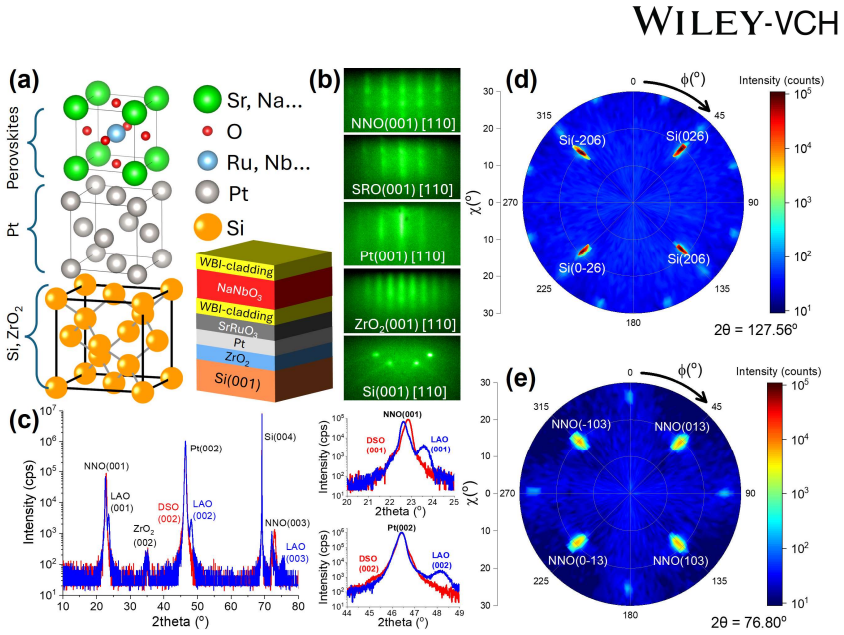
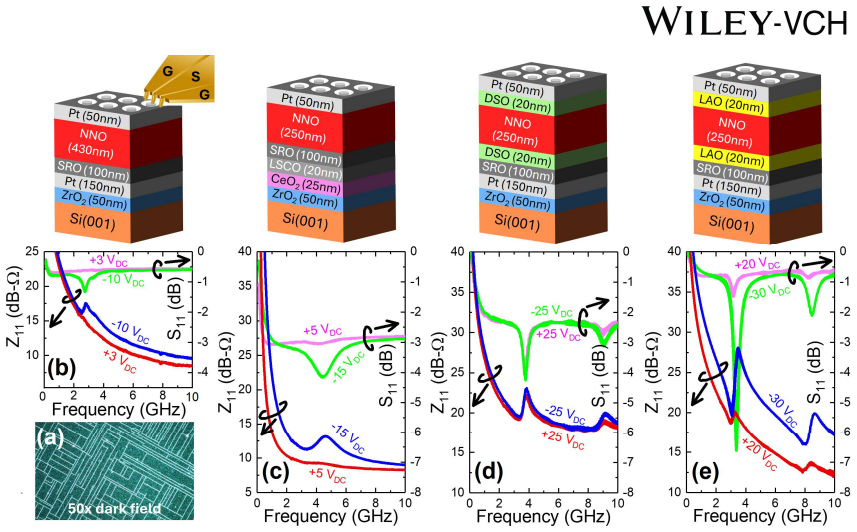
Cladding the NaNbO3 layer between two thin layers of high band gap insulators mitigates leakage current and avoids cracks; reducing the lattice parameters of those cladding layers further promotes a vertically distorted tetragonal phase in the NaNbO3 that yields stronger bulk acoustic wave resonance signals at ~4 GHz with electromechanical coupling up to 31.3 percent.
What carries the argument
Cladding layers of high band gap insulators placed above and below the NaNbO3 film, which simultaneously block leakage paths, suppress cracking, and induce lattice distortion that favors the tetragonal phase needed for strong resonance.
If this is right
- Lead-free BAWR devices can be integrated directly on silicon for LTE and broadband filters without relying on lead-based piezoelectrics.
- The same cladding method can be tested on other niobate or tantalate films to reach comparable GHz performance.
- Reducing cladding lattice parameters becomes a design knob that trades off insulation quality against resonance strength.
- Crack-free films enable thicker piezoelectric stacks, potentially raising power-handling capability in filters.
Where Pith is reading between the lines
- If the cladding also improves thermal stability, the resonators could operate at higher power levels than uncladded films.
- The approach may extend to other substrate materials beyond silicon if the cladding lattice mismatch can be controlled.
- Process compatibility with standard silicon foundry steps would allow co-integration with CMOS circuitry for compact RF modules.
Load-bearing premise
Cladding the sodium niobate film with high-band-gap insulators is sufficient to cut leakage current and stop cracks while the reduced lattice spacing of the cladding forces the desired tetragonal distortion.
What would settle it
Fabricate identical sodium niobate resonators on silicon without the cladding layers and measure whether leakage current rises above device-usable levels, cracks appear, and the electromechanical coupling at 4 GHz falls below 20 percent.
Figures
read the original abstract
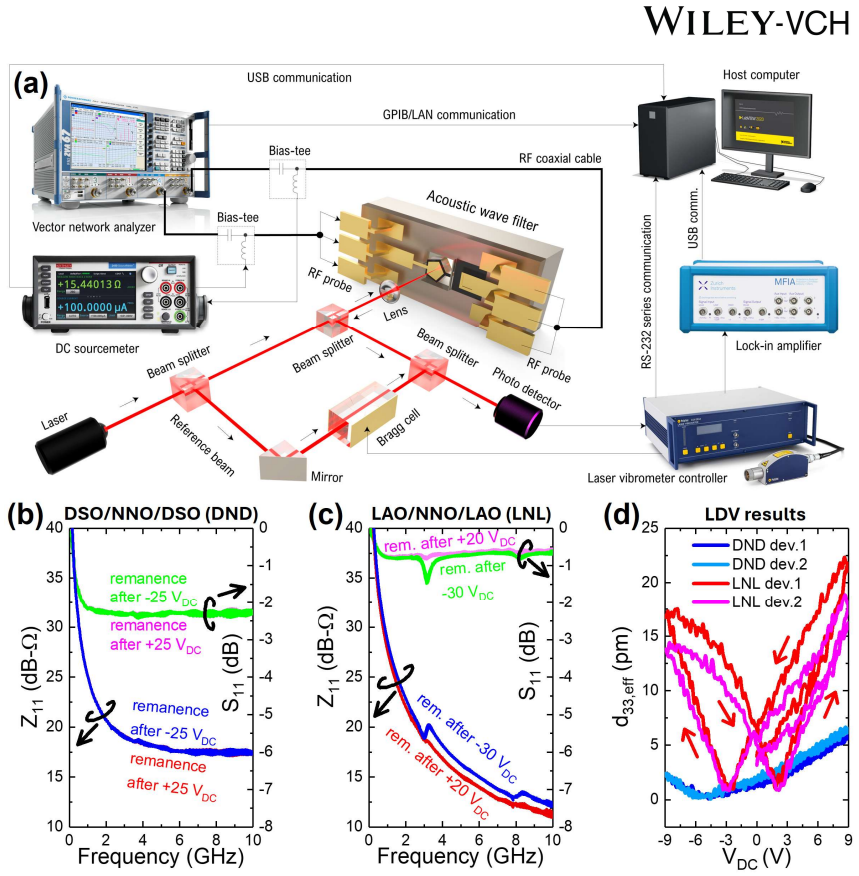
Bulk acoustic wave resonators (BAWR) and bandpass filters operating at GHz frequency are the workhorse of (Vo-)LTE telecommunication and broadband internet. In line with the Singapore Green Plan 2030 for innovating environmentally friendly products, we fabricated lead-free BAWR with sodium niobate (NaNbO3) piezoelectric on silicon with a high electromechanical coupling factor up to 31.3% operating at ~4 GHz. We disclose our crucial strategy where the NaNbO3 layer is cladded between two thin layers of high band gap insulators, which satisfies two primary objectives, i.e. leakage current mitigation and crack avoidance. In addition, we also verified the efficacy of reducing lattice parameters of the cladding layers in promoting vertically distorted tetragonal phase NaNbO3 and producing stronger BAWR signals.
Editorial analysis
A structured set of objections, weighed in public.
Referee Report
Summary. The manuscript reports fabrication of lead-free bulk acoustic wave resonators (BAWRs) using sodium niobate (NaNbO3) thin films on silicon, achieving an electromechanical coupling factor k_t^2 up to 31.3% at ~4 GHz. The central strategy is cladding the NaNbO3 between thin high-band-gap insulator layers to mitigate leakage current and avoid cracking, combined with reduced lattice parameters in the cladding layers to stabilize a vertically distorted tetragonal NaNbO3 phase that yields stronger resonance signals. The claims rest on S-parameter measurements, leakage-current data, and XRD/structural characterization that link the cladding directly to the reported performance.
Significance. If the measured metrics hold, the work is significant for enabling high-performance, environmentally friendly (lead-free) GHz BAWRs compatible with silicon integration, directly supporting green-technology goals in telecommunications. Credit is due for the direct experimental linkage via S-parameter, leakage, and XRD datasets that address the cladding effects on leakage, cracking, and phase stabilization without internal inconsistencies or unsupported leaps.
minor comments (3)
- [Abstract] Abstract: the phrase 'we verified the efficacy of reducing lattice parameters...' would be clearer if it referenced the specific figure or section (e.g., Fig. 5 or §4.3) showing the correlation between cladding lattice constant and BAWR signal strength.
- [Experimental methods] The manuscript would benefit from an explicit table listing cladding-layer thicknesses, deposition conditions, and measured leakage currents for the different insulator combinations to aid reproducibility.
- [Results] Figure captions for the S-parameter and leakage plots should state the number of devices measured and whether error bars represent standard deviation or range.
Simulated Author's Rebuttal
We thank the referee for the positive evaluation of our work and the recommendation for minor revision. We appreciate the recognition of the experimental linkage between cladding strategy, leakage mitigation, phase stabilization, and the achieved k_t^2 performance.
Circularity Check
No significant circularity; experimental report with no derivations
full rationale
The manuscript is a pure experimental report on device fabrication, S-parameter measurements, leakage current data, XRD structural characterization, and phase identification. No equations, fitted parameters, predictive models, or derivation chains appear in the abstract or described content. Performance metrics (k_t^2 up to 31.3%, ~4 GHz resonance) are presented as measured outcomes, not quantities defined or predicted by the paper's own constructs. The cladding strategy is described as an empirical fabrication choice whose effects are verified by direct experiment, with no self-referential predictions or load-bearing self-citations. This satisfies the default expectation of no circularity for self-contained experimental work.
Axiom & Free-Parameter Ledger
axioms (1)
- standard math Standard definitions and measurement protocols for electromechanical coupling factor and BAWR resonance frequency from prior piezoelectric literature.
Reference graph
Works this paper leans on
-
[1]
a)H. Liu, H. Wu, K. P. Ong, T. Yang, P. Yang, P. K. Das, X. Chi, Y. Zhang, C. Diao, W. K. A. Wong, E. P. Chew, Y. F. Chen, C. K. I. Tan, A. Rusydi, M. B. H. Breese, D. J. Singh, L.-Q. Chen, S. J. Pennycook, K. Yao, Science 2020, 369, 292; b)M. Waqar, H. Wu, K. P. Ong, H. Liu, C. Li, P. Yang, W. Zang, W. H. Liew, C. Diao, S. Xi, D. J. Singh, Q. He, K. Yao,...
2020
-
[2]
a)L. Li, S. Lu, W. Cao, Q. Zhu, R. Li, Y. Wei, S. Yang, C. Wang, Inorganic Chemistry 2024, 63, 11745; b)J. Wang, Z. Peng, J. Wang, D. Wu, Z. Yang, X. Chao, Scripta Materialia 2022, 221, 114976; c)P. Li, S. Ouyang, G. Xi, T. Kako, J. Ye, The Journal of Physical Chemistry C 2012, 116, 7621; d)J. Lv, T. Kako, Z. Li, Z. Zou, J. Ye, The Journal of Physical Che...
2024
-
[3]
Zhang, H
M.-H. Zhang, H. Ding, S. Egert, C. Zhao, L. Villa, L. Fulanović, P. B. Groszewicz, G. Buntkowsky, H.-J. Kleebe, K. Albe, A. Klein, J. Koruza, Nature Communications 2023, 14, 1525
2023
-
[4]
a)M. A. L. Nobre, S. Lanfredi, Applied Physics Letters 2003, 83, 3102; b)P. Hu, N. Bein, C. Chandan Parhi, T. Rojac, B. Malič, M. Amirabbasi, A. Volodin, K. Albe, J. Koruza, A. Klein, Reports on Progress in Physics 2026, 89, 028004
2003
-
[5]
a)T. Yang, Q. Xu, Y. Wang, Y. Cai, H. Li, Y. Zheng, M. Zeng, J. Qu, L. Li, C. Gao, X. Gu, B. Lin, S. Guo, C. Lei, S. Liu, C. Sun, Nature Communications 2026, 17, 2114; b)L. W. Hung, C. T. C. Nguyen, Journal of Microelectromechanical Systems 2015, 24, 458
2026
-
[6]
Baek, C.-B
S.-H. Baek, C.-B. Eom, Acta Materialia 2013, 61, 2734
2013
-
[7]
Yoshida, H
S. Yoshida, H. Hanzawa, K. Wasa, M. Esashi, S. Tanaka, IEEE Transactions on Ultrasonics, Ferroelectrics, and Frequency Control 2014, 61, 1552
2014
-
[8]
a)Y. Wei, X. Hu, Y. Liang, D. C. Jordan, B. Craigo, R. Droopad, Z. Yu, A. Demkov, J. L. Edwards, Jr., W. J. Ooms, Journal of Vacuum Science & Technology B: Microelectronics and Nanometer Structures Processing, Measurement, and Phenomena 2002, 20, 1402; b)J. W. Reiner, K. F. Garrity, F. J. Walker, S. Ismail-Beigi, C. H. Ahn, Physical Review Letters 2008, 1...
2002
-
[9]
Yoshida, H
S. Yoshida, H. Hanzawa, K. Wasa, S. Tanaka, Sensors and Actuators A: Physical 2016, 239, 201
2016
-
[10]
P. N. Thao, S. Yoshida, S. Tanaka, Japanese Journal of Applied Physics 2017, 56, 127201
2017
-
[11]
Lapano, M
J. Lapano, M. Brahlek, L. Zhang, J. Roth, A. Pogrebnyakov, R. Engel-Herbert, Nature Communications 2019, 10, 2464. 18 Cladding Layer Enhanced GHz Bulk Acoustic Wave Resonance in Sodium Niobate Thin Films on Silicon We fabricate NaNbO3-based solidly mounted bulk acoustic resonators on silicon (001) wafer without Bragg reflector and acoustic cavity. With th...
2019
discussion (0)
Sign in with ORCID, Apple, or X to comment. Anyone can read and Pith papers without signing in.