Thermodynamic and Topological Phase Transitions of AdS Black Holes with Nonminimal F^(αβ)F^(γλ)R_(αγ)R_(βλ) Coupling
Pith reviewed 2026-06-26 11:27 UTC · model grok-4.3
The pith
A non-minimal coupling term changes the topological class of four-dimensional AdS black holes from W^{1+} to W^{0-}.
A machine-rendered reading of the paper's core claim, the machinery that carries it, and where it could break.
Core claim
Switching on the non-minimal coupling fundamentally transforms the topology to the W^{0-} class (W = 0). This transition occurs while the van der Waals-type first-order phase transition survives in the intermediate region, embedded within the overall Hawking--Page pattern, rendering the system a hybrid black hole thermodynamic system. The coupling ε thus acts as a topological deformation parameter that alters the universal classification of the system, despite the perturbative nature of the solution.
What carries the argument
The coupling constant ε in the term F^{αβ}F^{γλ}R_{αγ}R_{βλ}, which deforms the topological class of the black hole thermodynamics.
If this is right
- The first law of thermodynamics and Smarr relation continue to hold to first order in ε.
- The van der Waals-type first-order phase transition persists in the intermediate region.
- The overall thermodynamic structure combines Hawking-Page and van der Waals features into a hybrid pattern.
- The topological class switches from W^{1+} (W = +1) to W^{0-} (W = 0) when the coupling is activated.
Where Pith is reading between the lines
- Comparable non-minimal couplings in higher dimensions or with different matter fields may produce similar shifts in topological class.
- If topological class influences any observable thermodynamic quantity, measurements could distinguish coupled from uncoupled black holes.
- Going beyond first-order perturbation in ε would test whether the topology change survives in the full nonlinear regime.
Load-bearing premise
The first-order perturbative expansion in the coupling ε is sufficient to reliably determine the change in the topological invariant W.
What would settle it
An exact non-perturbative computation of the topological number W that yields a value other than zero for nonzero ε would falsify the topology change.
Figures
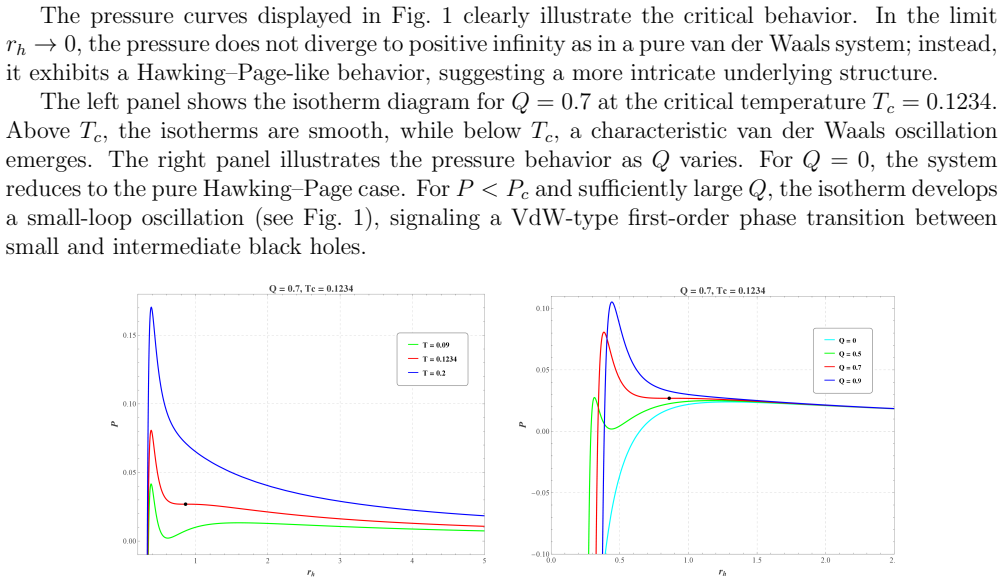
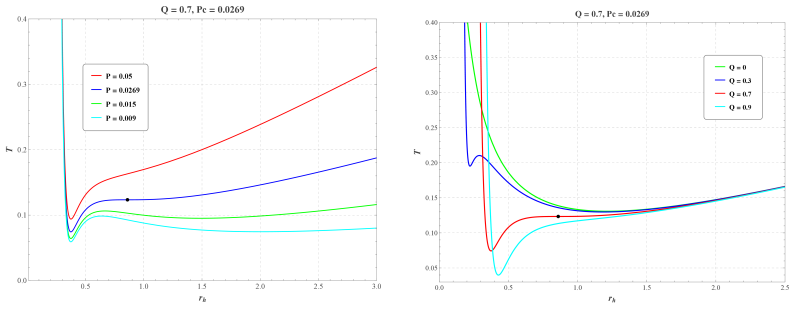
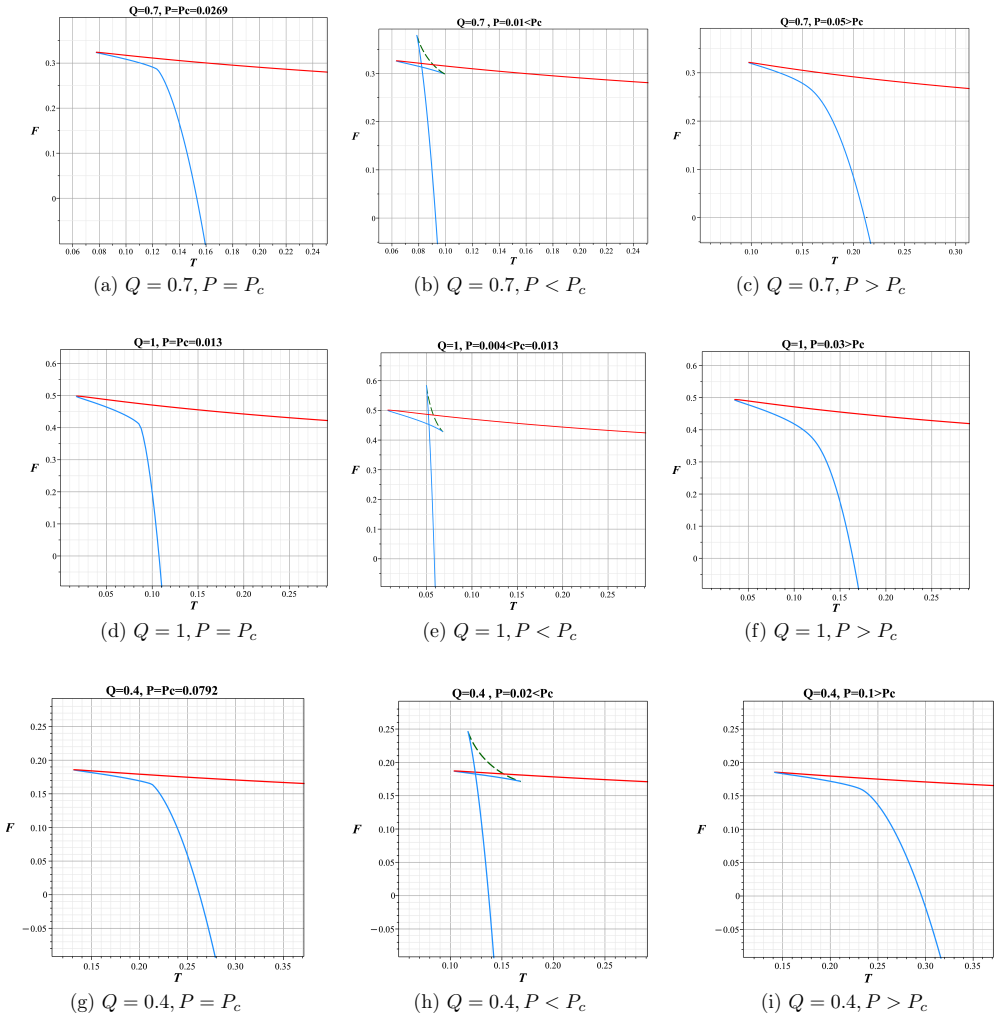
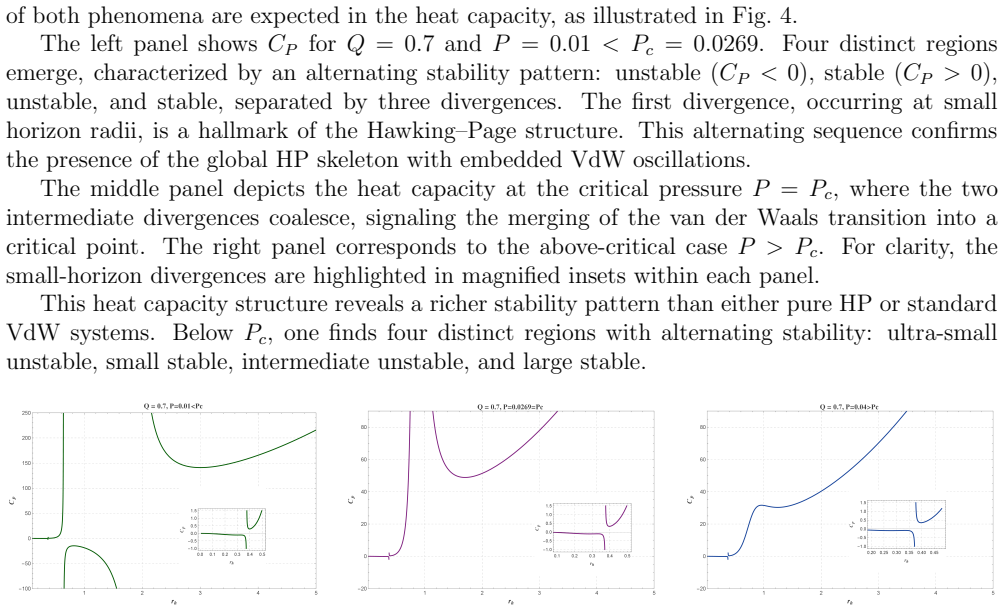
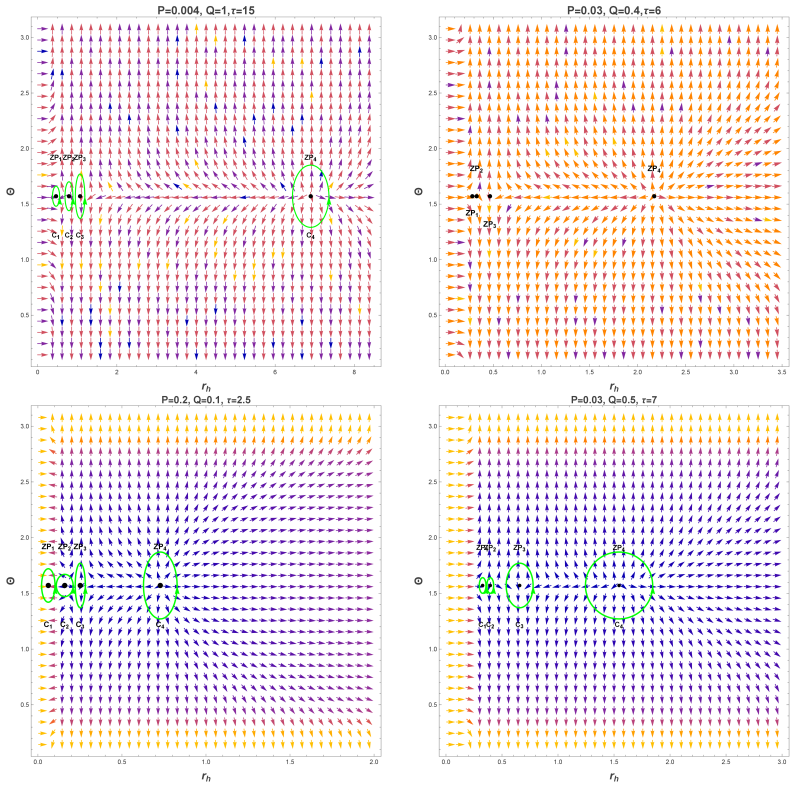
read the original abstract
The conventional and topological phase transitions of a four-dimensional asymptotically AdS black hole with a non-minimal coupling term $F^{\alpha\beta}F^{\gamma\lambda}R_{\alpha\gamma}R_{\beta\lambda}$ are investigated. Using a perturbative approach to first order in the coupling $\epsilon$, the thermodynamic quantities are derived and the first law and Smarr relation are verified. Intriguingly, while the $\epsilon = 0$ limit yields the standard Reissner--Nordstr\"om--AdS black hole belonging to the $W^{1+}$ topological class ($W = +1$), switching on the non-minimal coupling fundamentally transforms the topology to the $W^{0-}$ class ($W = 0$). This transition occurs while the van der Waals-type first-order phase transition survives in the intermediate region, embedded within the overall Hawking--Page pattern, rendering the system a hybrid black hole thermodynamic system. The coupling $\epsilon$ thus acts as a topological deformation parameter that alters the universal classification of the system, despite the perturbative nature of the solution.
Editorial analysis
A structured set of objections, weighed in public.
Referee Report
Summary. The manuscript studies four-dimensional asymptotically AdS black holes with a non-minimal coupling ε F^{αβ} F^{γλ} R_{αγ} R_{βλ}. Working perturbatively to first order in ε, the authors derive the metric and thermodynamic quantities, verify the first law and Smarr relation, and compute the topological invariant W. They report that the ε=0 limit recovers the RN-AdS black hole in the W^{1+} class (W=+1), while any nonzero ε shifts the system to the W^{0-} class (W=0). The van der Waals-type first-order phase transition persists in an intermediate regime, embedded in the Hawking–Page structure, producing a hybrid thermodynamic system in which ε acts as a topological deformation parameter.
Significance. If the reported change in W is robust, the result supplies a concrete example in which a non-minimal curvature–Maxwell coupling alters the universal topological classification of black-hole thermodynamics while preserving local phase-transition phenomenology. The explicit verification of the first law and Smarr relation at O(ε) and the retention of the van der Waals feature are positive features of the calculation.
major comments (1)
- [Topological analysis section (following the thermodynamic quantities)] The central claim that the topological class changes from W^{1+} to W^{0-} at first order in ε rests on applying the standard winding-number construction directly to the O(ε)-truncated thermodynamic potentials. Because W is an integer sensitive to the global structure of the normalized vector field (including large-r and large-T asymptotics), it is not a priori clear that an O(ε) truncation preserves the reported degree; higher-order terms could shift critical-point locations or alter the contour behavior enough to restore W=+1. The manuscript does not provide an explicit check that the vector-field degree remains stable under the truncation or that the exact solution (if obtainable) yields the same class.
minor comments (1)
- The abstract states that thermodynamic quantities are derived to first order, but the main text should include the explicit O(ε) expressions for T, S, Φ, and the free energy used to construct the vector field for W, together with the contour chosen for the degree calculation.
Simulated Author's Rebuttal
We thank the referee for the careful reading of our manuscript and for the constructive comment on the topological analysis. We respond to the major comment below.
read point-by-point responses
-
Referee: [Topological analysis section (following the thermodynamic quantities)] The central claim that the topological class changes from W^{1+} to W^{0-} at first order in ε rests on applying the standard winding-number construction directly to the O(ε)-truncated thermodynamic potentials. Because W is an integer sensitive to the global structure of the normalized vector field (including large-r and large-T asymptotics), it is not a priori clear that an O(ε) truncation preserves the reported degree; higher-order terms could shift critical-point locations or alter the contour behavior enough to restore W=+1. The manuscript does not provide an explicit check that the vector-field degree remains stable under the truncation or that the exact solution (if obtainable) yields the same class.
Authors: We agree that the integer-valued nature of the topological invariant W requires justification when applied to perturbatively truncated potentials. Our calculation constructs the normalized vector field directly from the O(ε) thermodynamic quantities, which are obtained consistently from the perturbative metric. Within this framework the winding number evaluates to zero. To address the stability concern we will add a brief discussion in the topological section showing that the leading large-r and large-T asymptotics of the vector field remain unchanged at O(ε), so that the degree is preserved for sufficiently small nonzero ε. We will also include a short numerical scan confirming that no critical-point coalescence occurs in the small-ε regime that could allow the winding number to jump discontinuously. We note, however, that an exact non-perturbative solution is not available, as the modified field equations do not admit a closed-form solution beyond the perturbative expansion employed in the manuscript. revision: partial
- Verification of the topological class using an exact (non-perturbative) solution to the field equations, which is not obtainable in closed form.
Circularity Check
No significant circularity detected
full rationale
The derivation proceeds by constructing a perturbative metric solution to first order in the coupling ε, deriving thermodynamic quantities from it, and explicitly verifying the first law and Smarr relation on those quantities. The topological invariant W is then evaluated on the resulting free-energy or temperature function using the standard normalized-vector-field construction from prior external literature; the ε=0 limit is shown to recover the known RN-AdS class W=+1 without re-deriving that class inside the paper. No step reduces a claimed prediction to a fitted parameter defined by the same paper, nor does any load-bearing premise rest on a self-citation whose content is itself unverified. The central claim that nonzero ε shifts the class to W=0 is therefore an independent output of the perturbative calculation rather than a definitional or self-referential input.
Axiom & Free-Parameter Ledger
free parameters (1)
- ε
axioms (2)
- domain assumption The spacetime is asymptotically AdS
- ad hoc to paper Perturbative expansion to first order in ε captures the leading topological change
Reference graph
Works this paper leans on
-
[1]
R. M. Wald,General Relativity(University of Chicago Press, 1984)
1984
-
[2]
S. M. Carroll,Spacetime and Geometry(Addison-Wesley, 2004)
2004
-
[3]
Observation of Gravitational Waves from a Binary Black Hole Merger,
B. P. Abbott et al. (LIGO Scientific Collaboration and Virgo Collaboration), “Observation of Gravitational Waves from a Binary Black Hole Merger,”Physical Review Letters116(2016) 061102
2016
-
[4]
The Four Laws of Black Hole Mechanics,
J. M. Bardeen, B. Carter, and S. W. Hawking, “The Four Laws of Black Hole Mechanics,” Communications in Mathematical Physics31(1973) 161. 31
1973
-
[5]
Particle Creation by Black Holes,
S. W. Hawking, “Particle Creation by Black Holes,”Communications in Mathematical Physics43(1975) 199
1975
-
[6]
Thermodynamics of Black Holes in anti-De Sitter Space,
S. W. Hawking and D. N. Page, “Thermodynamics of Black Holes in anti-De Sitter Space,” Communications in Mathematical Physics87(1983) 577
1983
-
[7]
The Large-NLimit of Superconformal Field Theories and Supergravity,
J. M. Maldacena, “The Large-NLimit of Superconformal Field Theories and Supergravity,” International Journal of Theoretical Physics38(1999) 1113
1999
-
[8]
Gauge Theory Correlators from Non- Critical String Theory,
S. S. Gubser, I. R. Klebanov, and A. M. Polyakov, “Gauge Theory Correlators from Non- Critical String Theory,”Physics Letters B428(1998) 105
1998
-
[9]
Anti de Sitter Space and Holography,
E. Witten, “Anti de Sitter Space and Holography,”Advances in Theoretical and Mathematical Physics2(1998) 253
1998
-
[10]
Lectures on Holographic Methods for Condensed Matter Physics,
S. A. Hartnoll, “Lectures on Holographic Methods for Condensed Matter Physics,”Classical and Quantum Gravity26(2009) 224002
2009
-
[11]
Lectures on Holographic Superfluidity and Superconductivity,
C. P. Herzog, “Lectures on Holographic Superfluidity and Superconductivity,”Journal of Physics A: Mathematical and Theoretical42(2009) 343001
2009
-
[12]
Enthalpy and the Mechanics of AdS Black Holes,
D. Kastor, S. Ray, and J. Traschen, “Enthalpy and the Mechanics of AdS Black Holes,” Classical and Quantum Gravity26(2009) 195011
2009
-
[13]
The Cosmological Constant and the Black Hole Equation of State,
B. P. Dolan, “The Cosmological Constant and the Black Hole Equation of State,”Classical and Quantum Gravity28(2011) 125020
2011
-
[14]
P−VCriticality of Charged AdS Black Holes,
D. Kubizˇ n´ ak and R. B. Mann, “P−VCriticality of Charged AdS Black Holes,”Journal of High Energy Physics2012(2012) 033
2012
-
[15]
Charged AdS Black Holes and Catastrophic Holography,
A. Chamblin, R. Emparan, C. V. Johnson, and R. C. Myers, “Charged AdS Black Holes and Catastrophic Holography,”Physical Review D60(1999) 064018
1999
-
[16]
Holography, Thermodynamics, and Fluctuations of Charged AdS Black Holes,
A. Chamblin, R. Emparan, C. V. Johnson, and R. C. Myers, “Holography, Thermodynamics, and Fluctuations of Charged AdS Black Holes,”Physical Review D60(1999) 104026
1999
-
[17]
Thermodynamics of Born-Infeld Black Holes,
S. Gunasekaran, D. Kubiznak, and R. B. Mann, “Thermodynamics of Born-Infeld Black Holes,”Journal of High Energy Physics2012(2012) 110
2012
-
[18]
Reentrant Phase Transitions in Black Hole Thermodynamics,
A. M. Frassino, J. V. Rocha, and A. Svesko, “Reentrant Phase Transitions in Black Hole Thermodynamics,”Physical Review D107(2023) 044057
2023
-
[19]
Thermodynamics of Rotating Black Holes and Black Rings: Phase Transitions and Thermodynamic Volume,
N. Altamirano, D. Kubizˇ n´ ak, R. B. Mann, and Z. Sherkatghanad, “Thermodynamics of Rotating Black Holes and Black Rings: Phase Transitions and Thermodynamic Volume,” Galaxies2(2014) 89
2014
-
[20]
Superfluid Black Holes,
R. A. Hennigar, R. B. Mann, and E. Tjoa, “Superfluid Black Holes,”Physical Review Letters 118(2017) 021301. 32
2017
-
[21]
Compressibility of Rotating Black Holes,
B. P. Dolan, “Compressibility of Rotating Black Holes,”Physical Review D90(2014) 084002
2014
-
[22]
Black Hole Enthalpy and an Entropy Inequality for the Thermodynamic Volume,
M. Cvetic, G. W. Gibbons, D. Kubizˇ n´ ak, and C. N. Pope, “Black Hole Enthalpy and an Entropy Inequality for the Thermodynamic Volume,”Physical Review D84(2011) 024037
2011
-
[23]
Holographic Heat Engines,
C. V. Johnson, “Holographic Heat Engines,”Classical and Quantum Gravity31(2014) 205002
2014
-
[24]
Higher Derivative Gravity, Surface Terms and String Theory,
R. C. Myers, “Higher Derivative Gravity, Surface Terms and String Theory,”Physical Review D36(1987) 392
1987
-
[25]
The 4D Einstein-Gauss- Bonnet Theory of Gravity: A Review,
P. G. S. Fernandes, P. Carrilho, T. Clifton, and D. J. Mulryne, “The 4D Einstein-Gauss- Bonnet Theory of Gravity: A Review,”Classical and Quantum Gravity39(2022) 063001
2022
-
[26]
f(R) Theories of Gravity,
T. P. Sotiriou and V. Faraoni, “f(R) Theories of Gravity,”Reviews of Modern Physics82 (2010) 451
2010
-
[27]
f(R) Theories,
A. De Felice and S. Tsujikawa, “f(R) Theories,”Living Reviews in Relativity13(2010) 3
2010
-
[28]
Mach’s Principle and a Relativistic Theory of Gravitation,
C. Brans and R. H. Dicke, “Mach’s Principle and a Relativistic Theory of Gravitation,” Physical Review124(1961) 925
1961
-
[29]
Second-Order Scalar-Tensor Field Equations in a Four-Dimensional Space,
G. W. Horndeski, “Second-Order Scalar-Tensor Field Equations in a Four-Dimensional Space,”International Journal of Theoretical Physics10(1974) 363
1974
-
[30]
Horndeski Theory and Beyond: A Review,
T. Kobayashi, “Horndeski Theory and Beyond: A Review,”Reports on Progress in Physics 82(2019) 086901
2019
-
[31]
QED Vacuum Polarization in a Background Gravita- tional Field,
I. T. Drummond and S. J. Hathrell, “QED Vacuum Polarization in a Background Gravita- tional Field,”Physical Review D22(1980) 343
1980
-
[32]
Gravitational Couplings of Gauge Fields in String Theory,
Y. Kats and A. Petrov, “Gravitational Couplings of Gauge Fields in String Theory,”Journal of High Energy Physics2009(2009) 044
2009
-
[33]
Nonminimal Couplings in Gravitational and Electromag- netic Fields,
A. B. Balakin and J. P. S. Lemos, “Nonminimal Couplings in Gravitational and Electromag- netic Fields,”Classical and Quantum Gravity33(2016) 195009
2016
-
[34]
Nonlinear Electrodynamics and Black Hole Thermodynamics,
D. A. Rasheed, “Nonlinear Electrodynamics and Black Hole Thermodynamics,”Physics Let- ters B402(1997) 38
1997
-
[35]
ϕ-Mapping Theory and Its Applications in Gauge Fields,
Y. S. Duan and M. L. Ge, “ϕ-Mapping Theory and Its Applications in Gauge Fields,”Scientia Sinica A27(1984) 1095
1984
-
[36]
Topological Structure of the Ginzburg-Landau Theory,
Y. S. Duan, X. H. Zhang, and S. Li, “Topological Structure of the Ginzburg-Landau Theory,” Physical Review B59(1999) 119
1999
-
[37]
Topology of Black Hole Thermodynamics,
S. W. Wei and Y. X. Liu, “Topology of Black Hole Thermodynamics,”Physical Review D 104(2021) 104056. 33
2021
-
[38]
Topological Approach to Black Hole Phase Transitions,
S. W. Wei, “Topological Approach to Black Hole Phase Transitions,”Journal of High Energy Physics2022(2022) 1
2022
-
[39]
Topological Phases of Black Holes,
P. K. Yerra and C. Bhamidipati, “Topological Phases of Black Holes,”Physical Review D 105(2022) 104053
2022
-
[40]
Antiblack Holes and Topological Transitions in Nonlinear Electrodynamics,
P. K. Yerra, C. Bhamidipati, and A. Chatterjee, “Antiblack Holes and Topological Transitions in Nonlinear Electrodynamics,”Journal of High Energy Physics2024(2024) 102
2024
-
[41]
Fedpseudo: Pseudo value-based deep learning models for federated survival analysis,
M. Belhaj Ahmed, D. Kubizˇ n´ ak, and R. B. Mann, “Vortex/anti-vortex pair creation in black hole thermodynamics,”Physical Review D106(2022) 046009, arXiv:2207.05247
-
[42]
Topological Aspects of Born-Infeld Black Holes,
C. Bhamidipati, P. K. Yerra, and S. K. Modak, “Topological Aspects of Born-Infeld Black Holes,”Physical Review D108(2023) 064018
2023
-
[43]
Topological Classification of Born-Infeld-AdS Black Holes: The Role of thebParameter,
Y. Liu, H. Zhang, and X. Chen, “Topological Classification of Born-Infeld-AdS Black Holes: The Role of thebParameter,”Physical Review D111(2025) 064012
2025
-
[44]
Topological Classification in Gauss-Bonnet Black Holes,
L. Chen, “Topological Classification in Gauss-Bonnet Black Holes,”Physical Review D109 (2024) 084021
2024
-
[45]
Topology and Scalarization in Einstein-Gauss-Bonnet Gravity,
P. Liang and R. Zhong, “Topology and Scalarization in Einstein-Gauss-Bonnet Gravity,” Classical and Quantum Gravity41(2024) 115007
2024
-
[46]
Topological Classification of Critical Points inF(R) AdS Black Holes,
A. Kumar and S. Sen, “Topological Classification of Critical Points inF(R) AdS Black Holes,” Physics Letters B850(2025) 138521
2025
-
[47]
Topological Phase Diagrams inf(R) Black Holes,
Z. Zhao, “Topological Phase Diagrams inf(R) Black Holes,”Physical Review D111(2025) 024045
2025
-
[48]
Topological Signatures of Higher-Curvature Corrections in f(R) Gravity,
M. Zhang, L. Chen, and H. Li, “Topological Signatures of Higher-Curvature Corrections in f(R) Gravity,”Physical Review D110(2024) 064017
2024
-
[49]
Topological Phase Transitions in Nonminimally Coupled AdS Black Holes,
L. Chen, Y. Wang, and H. Zhang, “Topological Phase Transitions in Nonminimally Coupled AdS Black Holes,”Journal of High Energy Physics2024(2024) 123
2024
-
[50]
Higher Curvature Corrections to Topological Phases of Black Holes,
Y. Liu and J. Wang, “Higher Curvature Corrections to Topological Phases of Black Holes,” Physical Review D111(2025) 045018
2025
-
[51]
Topological classification of a 4D AdS black hole with non-minimal Maxwell coupling,
F. Rahmani and M. Sadeghi, “Topological classification of a 4D AdS black hole with non-minimal Maxwell coupling,”Classical and Quantum Gravity43(2026) 105011, doi:10.1088/1361-6382/ae64a3
-
[52]
Thermodynamic topology of 4D charged AdS black holes withF αβF γλRαγβλ coupling,
M. Sadeghi and F. Rahmani “Thermodynamic topology of 4D charged AdS black holes withF αβF γλRαγβλ coupling,”European Physical Journal C86(2026) 581, doi:10.1140/epjc/s10052-026-15747-4. 34
-
[53]
Black-hole Thermodynamics and the Euclidean Einstein Action,
J. W. York, Jr., “Black-hole Thermodynamics and the Euclidean Einstein Action,”Physical Review D33(1986) 2092
1986
-
[54]
Black hole solutions as topological thermodynamic defects,
S.-W. Wei, Y.-X. Liu, and R. B. Mann, “Black hole solutions as topological thermodynamic defects,”Physical Review Letters129(2022) 191101
2022
-
[55]
Universal topological classifications of black hole thermodynamics,
S.-W. Wei, Y.-X. Liu, and R. B. Mann, “Universal topological classifications of black hole thermodynamics,”Physical Review D110(2024) L081501
2024
-
[56]
Topological classes of rotating black holes,
D. Wu, “Topological classes of rotating black holes,”Physical Review D107(2023) 024024
2023
-
[57]
Topological classes of thermodynamics of rotating AdS black holes,
D. Wu and S.-Q. Wu, “Topological classes of thermodynamics of rotating AdS black holes,” Physical Review D107(2023) 084002
2023
-
[58]
Topological classes of thermodynamics of the rotating charged AdS black holes in gauged supergravities,
X.-D. Zhu, D. Wu, and D. Wen, “Topological classes of thermodynamics of the rotating charged AdS black holes in gauged supergravities,”Physics Letters B856(2024) 138919
2024
-
[59]
Topological classes of thermody- namics of the static multicharge AdS black holes in gauged supergravities: Novel temperature- dependent thermodynamic topological phase transition,
D. Wu, S.-Y. Gu, X.-D. Zhu, Q.-Q. Jiang, and S.-Z. Yang, “Topological classes of thermody- namics of the static multicharge AdS black holes in gauged supergravities: Novel temperature- dependent thermodynamic topological phase transition,”Journal of High Energy Physics06 (2024) 213
2024
-
[60]
Thermodynamical topology with multiple defect curves for dyonic AdS black holes,
Z.-Q. Chen and S.-W. Wei, “Thermodynamical topology with multiple defect curves for dyonic AdS black holes,”European Physical Journal C84(2024) 1294
2024
-
[61]
The topological natures of the Gauss-Bonnet black hole in AdS space,
C. H. Liu and J. Wang, “The topological natures of the Gauss-Bonnet black hole in AdS space,”Physical Review D107(2023) 064023
2023
-
[62]
Topological classes of thermodynamics of the four-dimensional static accelerating black holes,
D. Wu, “Topological classes of thermodynamics of the four-dimensional static accelerating black holes,”Physical Review D108(2023) 084041
2023
-
[63]
Topology of Born-Infeld-AdS black hole phase transitions,
M. S. Ali, H. El Moumni, J. Khalloufi, and K. Masmar, “Topology of Born-Infeld-AdS black hole phase transitions,”Physics Letters B849(2024) 138465
2024
-
[64]
Thermodynamic topology of phantom AdS black holes in massive gravity,
H. Chen, D. Wu, M.-Y. Zhang, H. Hassanabadi, and Z.-W. Long, “Thermodynamic topology of phantom AdS black holes in massive gravity,”Physics of the Dark Universe46(2024) 101617
2024
-
[65]
Bulk-boundary thermodynamic equivalence: A topology viewpoint,
M. Zhang and J. Jiang, “Bulk-boundary thermodynamic equivalence: A topology viewpoint,” Journal of High Energy Physics06(2023) 115
2023
-
[66]
Thermodynamics, Phase Transitions and Ruppeiner Geometry for Einstein- dilaton Lifshitz Black Holes,
S. Mahapatra, “Thermodynamics, Phase Transitions and Ruppeiner Geometry for Einstein- dilaton Lifshitz Black Holes,”Journal of High Energy Physics2016(2016) 135
2016
-
[67]
Colloquium: Topological Insulators,
M. Z. Hasan and C. L. Kane, “Colloquium: Topological Insulators,”Reviews of Modern Physics82(2010) 3045, doi:10.1103/RevModPhys.82.3045. 35
discussion (0)
Sign in with ORCID, Apple, or X to comment. Anyone can read and Pith papers without signing in.