Deterministic control of the probabilistic phase dynamics in injection-locked spin-torque nano-oscillators
Pith reviewed 2026-06-26 11:27 UTC · model grok-4.3
The pith
A weak radio-frequency perturbation at the free-running frequency enables continuous deterministic control of phase occupation probabilities in injection-locked spin-torque nano-oscillators.
A machine-rendered reading of the paper's core claim, the machinery that carries it, and where it could break.
Core claim
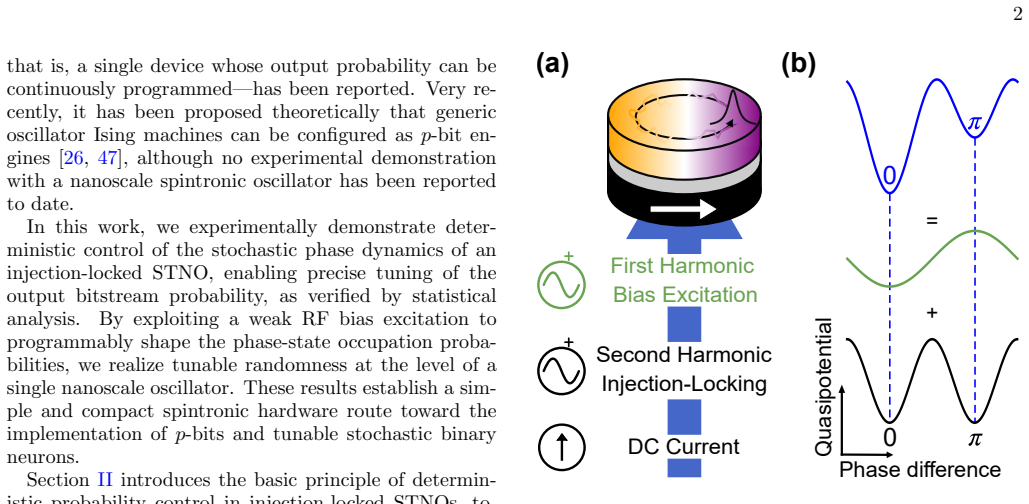
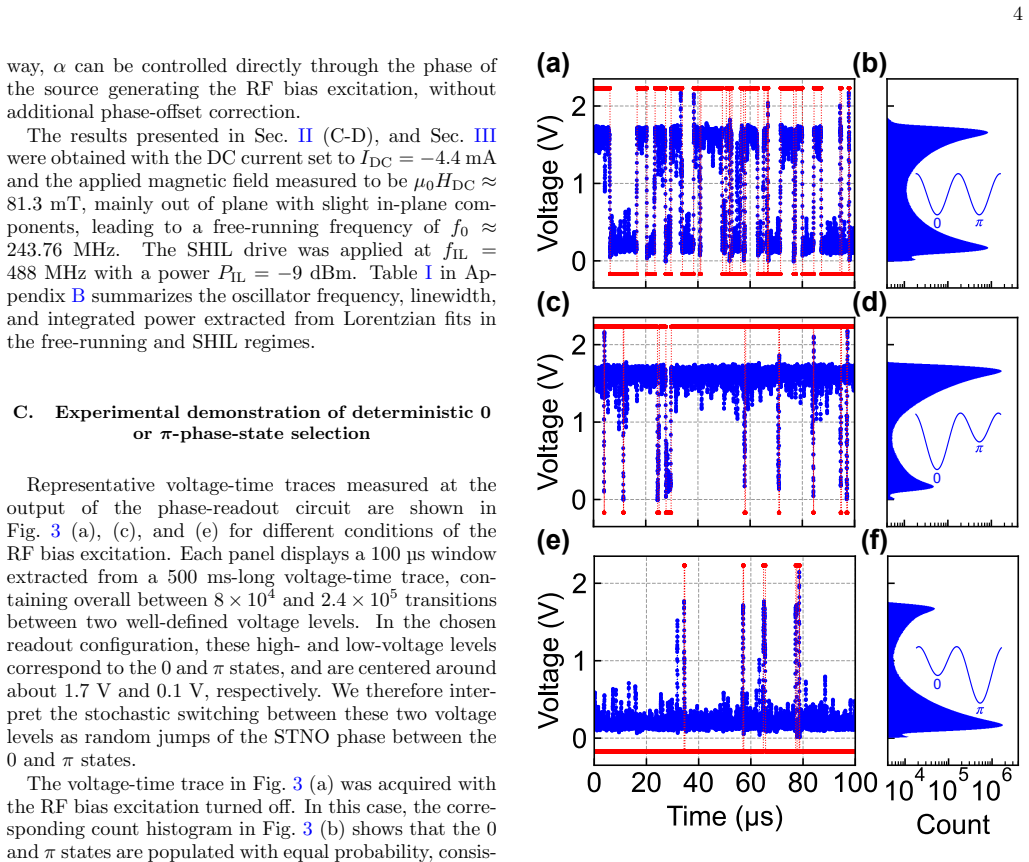
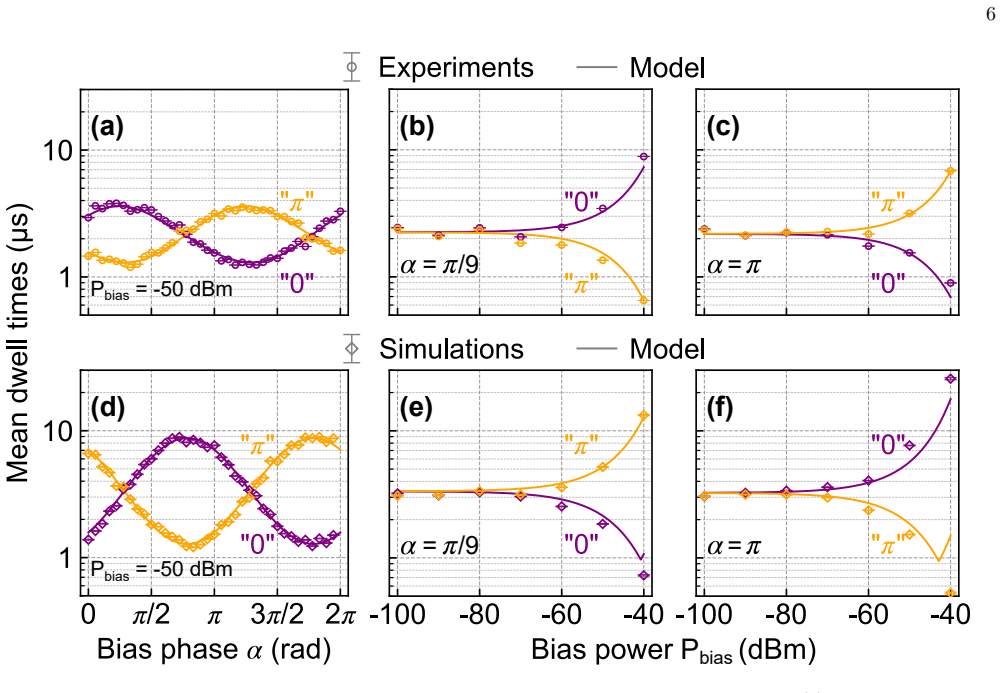
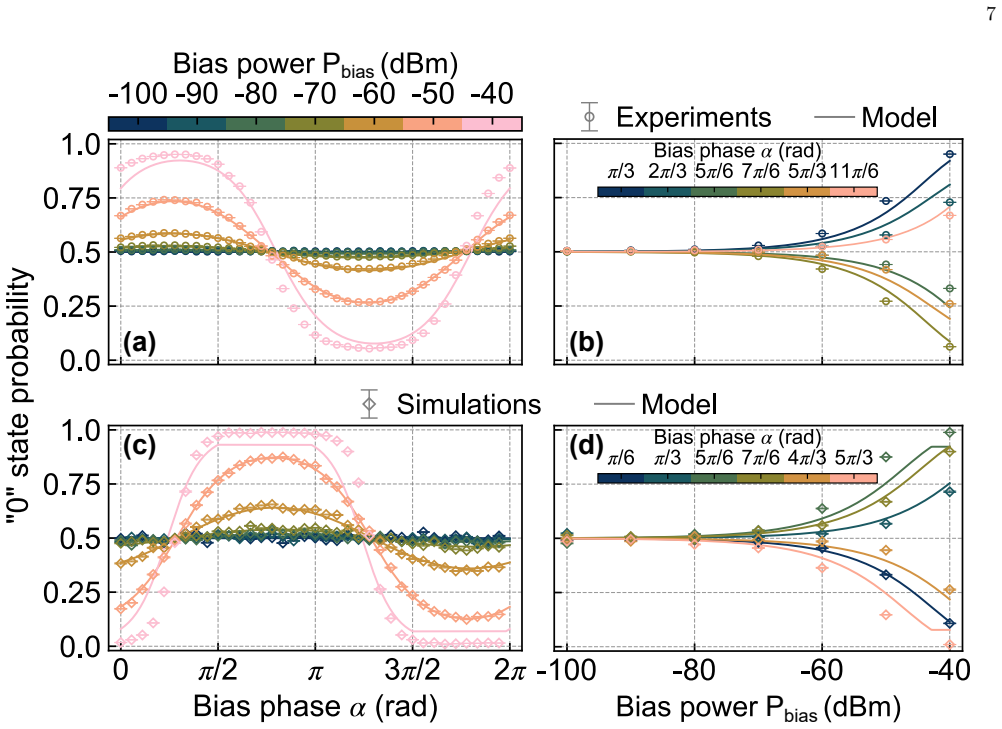
In a vortex-based STNO under second-harmonic injection-locking, the phase occupies two degenerate attractors separated by π with thermally activated jumps between them. Applying a weak RF perturbation at the free-running frequency tunes the jump rates between the attractors, achieving continuous probability control from the unbiased case to values approaching 0 or 1. The bias phase selects the favored attractor while the bias amplitude sets the imbalance strength.
What carries the argument
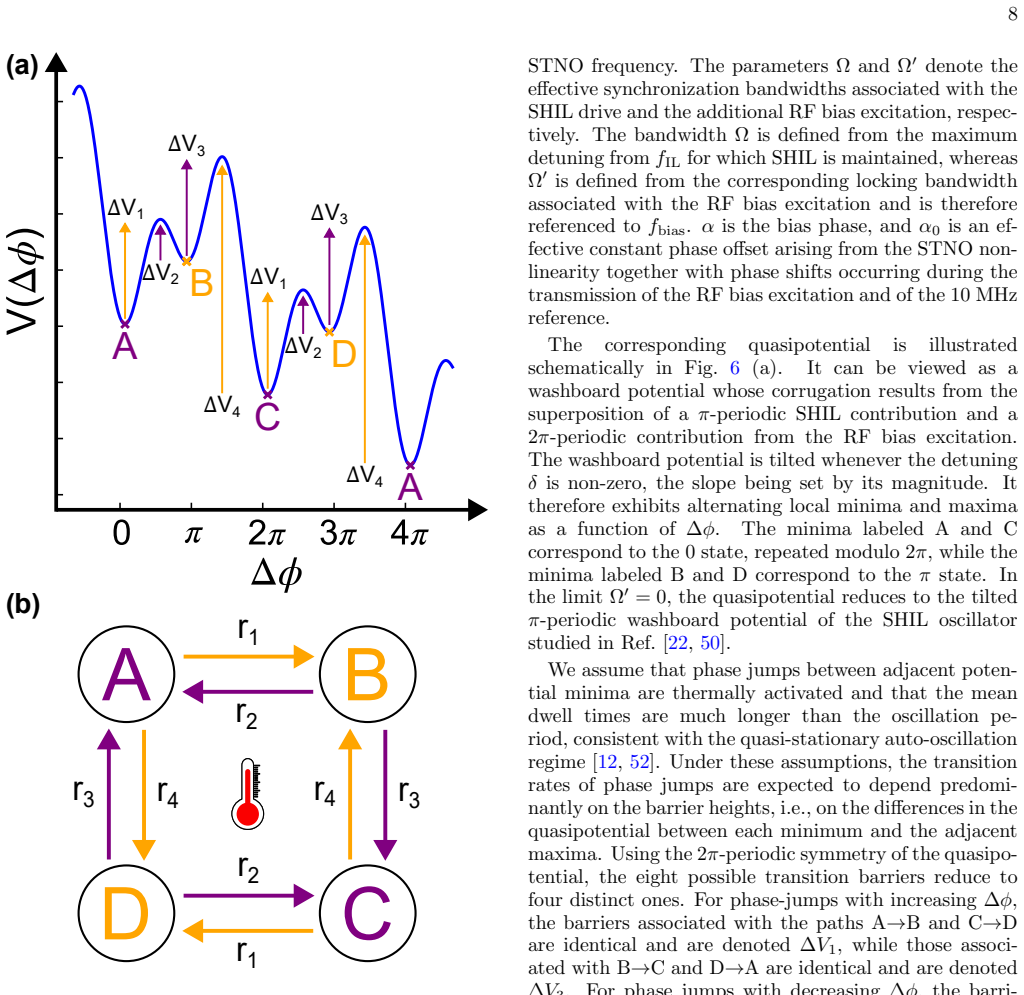
Effective quasipotential in the phase-reduced description that quantitatively accounts for the bias in phase-jump rates.
If this is right
- STNOs function as programmable stochastic elements.
- The bias phase and amplitude provide two complementary control knobs in a single device.
- These devices serve as hardware primitives for probabilistic computing, Ising machines, and brain-inspired architectures.
- The control preserves the intrinsic fluctuations while directing their statistics.
Where Pith is reading between the lines
- Arrays of such controlled oscillators could form the basis for scalable probabilistic computing hardware.
- Similar perturbation techniques might be applied to other bistable oscillator systems to achieve probability control.
- Further work could test whether this control remains effective at higher temperatures or in coupled oscillator networks.
Load-bearing premise
The phase-reduced description based on an effective quasipotential quantitatively accounts for the observed changes in phase-jump rates.
What would settle it
If the measured occupation probabilities do not vary continuously with the amplitude of the perturbation or fail to match the predictions of the quasipotential model, the deterministic control claim would be falsified.
Figures
read the original abstract
Spin-torque nano-oscillators (STNOs) inherently exhibit thermally driven phase fluctuations that render their dynamics truly stochastic. Here, we demonstrate that, despite this intrinsic randomness, the probability of occupying each phase state can be deterministically and continuously programmed. We experimentally investigate a vortex-based STNO operating under second-harmonic injection-locking, where the oscillator phase settles into two degenerate attractors separated by $\pi$ and undergoes thermally activated phase jumps. By applying a weak radio-frequency perturbation at the free-running frequency, we tune the phase-jump rates between the two attractors without suppressing the fluctuations, achieving continuous probability control from the unbiased limit to values approaching 0 or 1. The bias phase selects which attractor is favored while the bias amplitude sets the strength of the imbalance, providing two complementary control knobs within a single nanoscale device. A phase-reduced description based on an effective quasipotential quantitatively accounts for the observations. These results establish injection-locked STNOs as programmable stochastic elements and provide a hardware primitive for probabilistic computing, Ising machines, and brain-inspired computing architectures.
Editorial analysis
A structured set of objections, weighed in public.
Referee Report
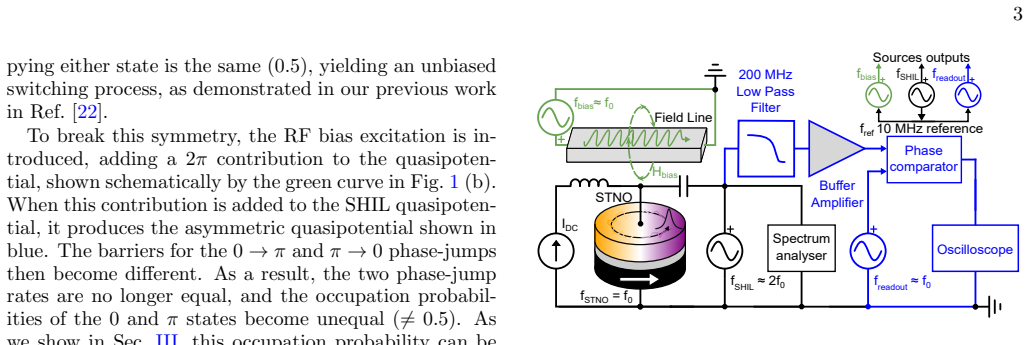
Summary. The paper experimentally demonstrates continuous, deterministic control of the stationary occupation probabilities of two degenerate phase attractors (separated by π) in a vortex-based spin-torque nano-oscillator under second-harmonic injection locking. A weak RF perturbation applied exactly at the free-running frequency is shown to tune the thermally activated phase-jump rates between the attractors without suppressing fluctuations; the bias phase selects the favored attractor and the bias amplitude sets the imbalance strength. A phase-reduced effective quasipotential model is reported to quantitatively account for the measured probabilities.
Significance. If the central experimental result and the quantitative model agreement hold, the work supplies a compact, electrically tunable stochastic element whose occupation probability can be programmed over the full [0,1] range. This directly addresses a hardware primitive needed for probabilistic computing, Ising machines, and neuromorphic architectures that exploit intrinsic noise rather than fighting it. The demonstration that a single nanoscale device can provide two orthogonal control knobs (phase and amplitude of the bias tone) while preserving fluctuation strength is a concrete advance over prior injection-locking studies.
major comments (1)
- [Abstract and modeling section] Abstract and modeling section: the central claim that the phase-reduced quasipotential 'quantitatively accounts for the observations' rests on the assumption that the free-running-frequency perturbation leaves amplitude fluctuations unchanged. In vortex STNOs the dynamics are governed by coupled amplitude-phase equations; a perturbation at the free-running frequency can in principle modulate amplitude via the nonlinear frequency shift. The manuscript must therefore include explicit data (or an analysis) demonstrating that the amplitude variance remains constant to within experimental precision when the bias RF is applied; otherwise the extracted escape rates and stationary probabilities cannot be attributed solely to the phase quasipotential.
Simulated Author's Rebuttal
We thank the referee for their careful reading of the manuscript and for highlighting an important point regarding the validation of the phase-reduced model. We address the major comment below.
read point-by-point responses
-
Referee: [Abstract and modeling section] Abstract and modeling section: the central claim that the phase-reduced quasipotential 'quantitatively accounts for the observations' rests on the assumption that the free-running-frequency perturbation leaves amplitude fluctuations unchanged. In vortex STNOs the dynamics are governed by coupled amplitude-phase equations; a perturbation at the free-running frequency can in principle modulate amplitude via the nonlinear frequency shift. The manuscript must therefore include explicit data (or an analysis) demonstrating that the amplitude variance remains constant to within experimental precision when the bias RF is applied; otherwise the extracted escape rates and stationary probabilities cannot be attributed solely to the phase quasipotential.
Authors: We agree that an explicit check on amplitude variance is necessary to fully justify the phase-reduced quasipotential description. Although the perturbation is weak and applied under second-harmonic locking, the coupled amplitude-phase dynamics in vortex STNOs warrant direct verification. In the revised manuscript we will add experimental data (or a dedicated analysis section) comparing the amplitude variance with and without the bias RF tone, confirming that it remains constant within experimental precision across the explored bias amplitudes and phases. This addition will strengthen the attribution of the observed stationary probabilities to the phase quasipotential alone. revision: yes
Circularity Check
No circularity: experimental demonstration with independent model support
full rationale
The paper reports experimental tuning of phase-jump rates and stationary probabilities via weak RF bias at the free-running frequency in vortex STNOs, with a phase-reduced quasipotential model stated to account for the data. No quoted equations or sections show probabilities or control parameters reducing by construction to fitted inputs, self-citations, or ansatzes imported from the same authors' prior work. The central claims rest on direct measurements and an effective model whose validity is presented as an external check rather than a definitional identity. This is the normal case of an experimental result with supporting theory that does not collapse into its own inputs.
Axiom & Free-Parameter Ledger
Reference graph
Works this paper leans on
-
[1]
S. I. Kiselev, J. C. Sankey, I. N. Krivorotov, N. C. Em- ley, R. J. Schoelkopf, R. A. Buhrman, and D. C. Ralph, Microwave oscillations of a nanomagnet driven by a spin- polarized current, Nature425, 380 (2003)
2003
-
[2]
W. H. Rippard, M. R. Pufall, S. Kaka, S. E. Russek, and T. J. Silva, Direct-current induced dynamics in CoFe/NiFe point contacts, Phys. Rev. Lett.92, 027201 (2004)
2004
-
[3]
H. S. Choi, S. Y. Kang, S. J. Cho, I.-Y. Oh, M. Shin, H. Park, C. Jang, B.-C. Min, S.-I. Kim, S.-Y. Park,et al., Spin nano–oscillator–based wireless communication, Sci- entific reports4, 5486 (2014)
2014
-
[4]
Litvinenko, A
A. Litvinenko, A. Sidi El Valli, V. Iurchuk, S. Louis, V. Tyberkevych, B. Dieny, A. N. Slavin, and U. Ebels, Ultrafast ghz-range swept-tuned spectrum analyzer with 20 ns temporal resolution based on a spin-torque nano- 18 Toy model parameters used to fit experiments using Eq.(4) Constant parameters n= 2 δ= -3.02 MHz Ω = 21.86 MHz T= 300 K Fitting paramete...
2022
-
[5]
K. Zhu, M. Carpentieri, L. Zhang, B. Fang, J. Cai, R. Verba, A. Giordano, V. Puliafito, B. Zhang, G. Finoc- chio,et al., Nonlinear amplification of microwave signals in spin-torque oscillators, Nature Communications14, 2183 (2023)
2023
-
[6]
Grollier, D
J. Grollier, D. Querlioz, K. Camsari, K. Everschor-Sitte, S. Fukami, and M. Stiles, Neuromorphic spintronics, Nat. Electron.3, 360 (2020)
2020
-
[7]
Finocchio, M
G. Finocchio, M. Di Ventra, K. Y. Camsari, K. Everschor-Sitte, P. K. Amiri, and Z. Zeng, The promise of spintronics for unconventional computing, Journal of Magnetism and Magnetic Materials521, 167506 (2021)
2021
-
[8]
R. Ma, A. Sidi El Valli, M. Kreißig, G. Di Pendina, F. Protze, U. Ebels, G. Prenat, A. Chavent, V. Iurchuk, R. Sousa,et al., Microwave functionality of spintronic devices implemented in a hybrid complementary metal oxide semiconductor and magnetic tunnel junction tech- nology, Electronics Letters57, 264 (2021)
2021
-
[9]
Berger, Emission of spin waves by a magnetic mul- tilayer traversed by a current, Phys
L. Berger, Emission of spin waves by a magnetic mul- tilayer traversed by a current, Phys. Rev. B54, 9353 (1996)
1996
-
[10]
J. C. Slonczewski, Current-driven excitation of magnetic multilayers, J. Magn. Magn. Mater.159, L1 (1996)
1996
-
[11]
D. C. Ralph and M. D. Stiles, Spin transfer torques, J. Magn. Magn. Mater.320, 1190 (2008)
2008
-
[12]
Slavin and V
A. Slavin and V. Tiberkevich, Nonlinear auto-oscillator theory of microwave generation by spin-polarized current, IEEE Trans. Magn.45, 1875 (2009)
2009
-
[13]
Rippard, M
W. Rippard, M. Pufall, S. Kaka, T. J. Silva, S. E. Russek, and J. A. Katine, Injection locking and phase control of spin transfer nano-oscillators, Physical review letters95, 067203 (2005)
2005
-
[14]
Quinsat, J
M. Quinsat, J. Sierra, I. Firastrau, V. Tiberkevich, A. Slavin, D. Gusakova, L. Buda-Prejbeanu, M. Zarud- niev, J.-P. Michel, U. Ebels,et al., Injection locking of tunnel junction oscillators to a microwave current, Ap- plied Physics Letters98, 182503 (2011)
2011
-
[15]
Dussaux, A
A. Dussaux, A. Khvalkovskiy, J. Grollier, V. Cros, A. Fukushima, M. Konoto, H. Kubota, K. Yakushiji, S. Yuasa, K. Ando,et al., Phase locking of vortex based spin transfer oscillators to a microwave current, Applied Physics Letters98, 132506 (2011)
2011
-
[16]
Hamadeh, N
A. Hamadeh, N. Locatelli, V. Naletov, R. Lebrun, G. De Loubens, J. Grollier, O. Klein, and V. Cros, Per- fect and robust phase-locking of a spin transfer vortex nano-oscillator to an external microwave source, Applied Physics Letters104, 022408 (2014). 19
2014
-
[17]
Pikovsky, M
A. Pikovsky, M. Rosenblum, and J. Kurths, Synchroniza- tion: a universal concept in nonlinear science (2002)
2002
-
[18]
Tamaru, H
S. Tamaru, H. Kubota, K. Yakushiji, S. Yuasa, and A. Fukushima, Extremely coherent microwave emission from spin torque oscillator stabilized by phase locked loop, Scientific reports5, 1 (2015)
2015
-
[19]
Kreissig, R
M. Kreissig, R. Lebrun, F. Protze, K. Merazzo, J. Hem, L. Vila, R. Ferreira, M. Cyrille, F. Ellinger, V. Cros, et al., Vortex spin-torque oscillator stabilized by phase locked loop using integrated circuits, AIP advances7, 056653 (2017)
2017
-
[20]
S. Wittrock, M. Kreißig, B. Lacoste, A. Litvinenko, P. Talatchian, F. Protze, F. Ellinger, R. Ferreira, R. Le- brun, P. Bortolotti,et al., Stabilization of phase noise in spin torque nano oscillators by a phase locked loop, arXiv preprint arXiv:2110.13073 (2021)
arXiv 2021
-
[21]
Martins, A
L. Martins, A. S. Jenkins, J. Borme, J. Ventura, P. P. Fre- itas, and R. Ferreira, Second harmonic injection locking of coupled spin torque vortex oscillators with an individ- ual phase access, Communications Physics6, 72 (2023)
2023
-
[22]
N.-T. Phan, N. Prasad, A. Hakam, A. S. E. Valli, L. Anghel, L. Benetti, A. Madhavan, A. S. Jenkins, R. Ferreira, M. D. Stiles, U. Ebels, and P. Talatchian, Unbiased random bitstream generation using injection- locked spin-torque nano-oscillators, Physical Review Ap- plied21, 034063 (2024)
2024
-
[23]
Mohseni, P
N. Mohseni, P. L. McMahon, and T. Byrnes, Ising ma- chines as hardware solvers of combinatorial optimization problems, Nature Reviews Physics4, 363 (2022)
2022
-
[24]
P. L. McMahon, A. Marandi, Y. Haribara, R. Hamerly, C. Langrock, S. Tamate, T. Inagaki, H. Takesue, S. Ut- sunomiya, K. Aihara,et al., A fully programmable 100- spin coherent ising machine with all-to-all connections, Science354, 614 (2016)
2016
-
[25]
Inagaki, Y
T. Inagaki, Y. Haribara, K. Igarashi, T. Sonobe, S. Ta- mate, T. Honjo, A. Marandi, P. L. McMahon, T. Umeki, K. Enbutsu,et al., A coherent ising machine for 2000- node optimization problems, Science354, 603 (2016)
2000
-
[26]
Dutta, A
S. Dutta, A. Khanna, A. S. Assoa, H. Paik, D. G. Schlom, Z. Toroczkai, A. Raychowdhury, and S. Datta, An ising hamiltonian solver based on coupled stochastic phase-transition nano-oscillators, Nature Electronics4, 502 (2021)
2021
-
[27]
Honjo, T
T. Honjo, T. Sonobe, K. Inaba, T. Inagaki, T. Ikuta, Y. Yamada, T. Kazama, K. Enbutsu, T. Umeki, R. Kasa- hara,et al., 100,000-spin coherent ising machine, Science advances7, eabh0952 (2021)
2021
-
[28]
M. A. Iftakher, H. Levices, K.-E. Harabi, A. Re- naudineau, M.-C. Faye, C. Bouchard, F. Disdier, B. Viala, E. Vianello, P. Talatchian,et al., Intrinsic an- nealing in a hybrid memristor-magnetic tunnel junction ising machine, Nature Communications (2026)
2026
-
[29]
N. A. Aadit, A. Grimaldi, M. Carpentieri, L. Theogara- jan, J. M. Martinis, G. Finocchio, and K. Y. Camsari, Massively parallel probabilistic computing with sparse ising machines, Nature Electronics5, 460 (2022)
2022
-
[30]
Mizrahi, T
A. Mizrahi, T. Hirtzlin, A. Fukushima, H. Kubota, S. Yuasa, J. Grollier, and D. Querlioz, Neural-like com- puting with populations of superparamagnetic basis func- tions, Nat. Comm.9, 1533 (2018)
2018
-
[31]
M. W. Daniels, A. Madhavan, P. Talatchian, A. Mizrahi, and M. D. Stiles, Energy-efficient stochastic computing with superparamagnetic tunnel junctions, Physical re- view applied13 3(2019)
2019
-
[32]
R. Zand, K. Y. Camsari, S. D. Pyle, I. Ahmed, C. H. Kim, and R. F. DeMara, Low-energy deep belief networks us- ing intrinsic sigmoidal spintronic-based probabilistic neu- rons, inProceedings of the 2018 Great Lakes Symposium on VLSI(2018) pp. 15–20
2018
-
[33]
Kaiser, W
J. Kaiser, W. A. Borders, K. Y. Camsari, S. Fukami, H. Ohno, and S. Datta, Hardware-aware in situ learning based on stochastic magnetic tunnel junctions, Physical Review Applied17, 014016 (2022)
2022
-
[34]
Faria, K
R. Faria, K. Y. Camsari, and S. Datta, Low-barrier nano- magnets asp-bits for spin logic, IEEE Magnetics Letters 8, 1 (2017)
2017
-
[35]
Sutton, K
B. Sutton, K. Y. Camsari, B. Behin-Aein, and S. Datta, Intrinsic optimization using stochastic nanomagnets, Sci- entific reports7, 44370 (2017)
2017
-
[36]
K. Y. Camsari, R. Faria, B. M. Sutton, and S. Datta, Stochastic p-bits for invertible logic, Phys. Rev. X7, 031014 (2017)
2017
-
[37]
Chowdhury, A
S. Chowdhury, A. Grimaldi, N. A. Aadit, S. Niazi, M. Mohseni, S. Kanai, H. Ohno, S. Fukami, L. Theogara- jan, G. Finocchio,et al., A full-stack view of probabilistic computing with p-bits: Devices, architectures, and algo- rithms, IEEE Journal on Exploratory Solid-State Com- putational Devices and Circuits9, 1 (2023)
2023
-
[38]
A. Z. Pervaiz, L. A. Ghantasala, K. Y. Camsari, and S. Datta, Hardware emulation of stochastic p-bits for in- vertible logic, Scientific reports7, 10994 (2017)
2017
-
[39]
W. A. Borders, A. Z. Pervaiz, S. Fukami, K. Y. Cam- sari, H. Ohno, and S. Datta, Integer factorization using stochastic magnetic tunnel junctions, Nature573, 390 (2019)
2019
-
[40]
Soumah, L
L. Soumah, L. Desplat, N.-T. Phan, A. S. E. Valli, A. Madhavan, F. Disdier, S. Auffret, R. C. Sousa, U. Ebels, M. D. Stiles,et al., Entropy-assisted nanosec- ond stochastic operation in perpendicular superparam- agnetic tunnel junctions, Physical Review Applied24, L011002 (2025)
2025
-
[41]
Hutin, P
L. Hutin, P. Talatchian, P. I. Vaz, A. S. El Valli, A. Bazzi, N.-T. Phan, and F. Andrieu, Importance of stochastic components for ising hamiltonian-based invertible logic, in2022 IEEE Silicon Nanoelectronics Workshop (SNW) (IEEE, 2022) pp. 1–2
2022
-
[42]
Danouchi, L
K. Danouchi, L. Soumah, C. Bouchard, F. Disdier, A. Fassatoui, N.-T. Phan, M. Ezzadeen, B. Delaet, B. Viala, G. Prenat,et al., Designing networks of resistively-coupled stochastic magnetic tunnel junctions for energy-based optimum search, in2023 International Electron Devices Meeting (IEDM)(IEEE, 2023) pp. 1–4
2023
-
[43]
N. S. Singh, K. Kobayashi, Q. Cao, K. Selcuk, T. Hu, S. Niazi, N. A. Aadit, S. Kanai, H. Ohno, S. Fukami, et al., Cmos plus stochastic nanomagnets enabling het- erogeneous computers for probabilistic inference and learning, Nature Communications15, 2685 (2024)
2024
-
[44]
Wang and J
T. Wang and J. Roychowdhury, Oim: Oscillator-based ising machines for solving combinatorial optimisation problems, inInternational Conference on Unconventional Computation and Natural Computation(Springer, 2019) pp. 232–256
2019
-
[45]
Raimondo, E
E. Raimondo, E. Garz´ on, Y. Shao, A. Grimaldi, S. Chi- appini, R. Tomasello, N. Davila-Melendez, J. A. Katine, M. Carpentieri, M. Chiappini,et al., High-performance and reliable probabilistic ising machine based on simu- lated quantum annealing, Physical Review X15, 041001 (2025). 20
2025
-
[46]
E. Raimondo, A. Grimaldi, V. Tyberkevych, R. Tomasello, A. Giordano, M. Carpentieri, A. Slavin, M. Chiappini, and G. Finocchio, Adaptive ising ma- chine based on phase locking of an auto-oscillator to a biharmonic external driving with noise, Physical Review Letters136, 10.1103/jv9m-4mny (2026)
-
[47]
E. M. H. Ekanayake, N. Khan, and N. Shukla, Configur- ing oscillator ising machines as p-bit engines, Communi- cations Physics9, 10.1038/s42005-026-02492-z (2026)
-
[48]
Litvinenko, P
A. Litvinenko, P. Sethi, C. Murapaka, A. Jenkins, V. Cros, P. Bortolotti, R. Ferreira, B. Dieny, and U. Ebels, Analog and digital phase modulation and signal transmission with spin-torque nano-oscillators, Physical Review Applied16, 024048 (2021)
2021
-
[49]
J. Hem, L. D. Buda-Prejbeanu, and U. Ebels, Power and phase dynamics of injection-locked spin torque nano- oscillators under conservative and dissipative driving sig- nals, Physical Review B100, 054414 (2019)
2019
-
[50]
N. T. Phan,Leveraging stochastic properties of spintronic nanodevices for unconventional computing, Ph.D. thesis, Universit´ e Grenoble Alpes [2020-....] (2025)
2020
-
[51]
Adler, A study of locking phenomena in oscillators, Proceedings of the IRE34, 351–357 (1946)
R. Adler, A study of locking phenomena in oscillators, Proceedings of the IRE34, 351–357 (1946)
1946
-
[52]
J.-V. Kim, V. Tiberkevich, and A. N. Slavin, Generation linewidth of an auto-oscillator with a nonlinear frequency shift: Spin-torque nano-oscillator, Phys. Rev. Lett.100, 017207 (2008)
2008
-
[53]
A. H. Nayfeh,Introduction to Perturbation Techniques (John Wiley & Sons, Ltd, 2011)
2011
-
[54]
S. H. Strogatz,Nonlinear Dynamics and Chaos(CRC Press, 2018)
2018
-
[55]
Grimaldi, A
E. Grimaldi, A. Dussaux, P. Bortolotti, J. Grollier, G. Pillet, A. Fukushima, H. Kubota, K. Yakushiji, S. Yuasa, and V. Cros, Response to noise of a vortex based spin transfer nano-oscillator, Phys. Rev. B89, 104404 (2014)
2014
-
[56]
D. I. Albertsson, M. Zahedinejad, A. Houshang, R. Khymyn, J. ˚Akerman, and A. Rusu, Ultrafast ising machines using spin torque nano-oscillators, Applied Physics Letters118, 10.1063/5.0041575 (2021)
-
[57]
Hakam, C
A. Hakam, C. Chopin, L. Martins, E. Aubouin, S. de Wergifosse, C. de Barbarin, N. Mollard, E. Yildiz, L. Hutin, F. Badets, L. Benetti, A. Jenkins, R. Fer- reira, L. D. Buda-Prejbeanu, F. A. Araujo, P. Talatchian, and U. Ebels, A programmable Ising machine using vor- tex spin-torque nano-oscillator, inSpintronics and Nano- magnetism, Vol. 14081, edited by ...
2026
-
[58]
N. G. Berloff, M. Silva, K. Kalinin, A. Askitopoulos, J. D. T¨ opfer, P. Cilibrizzi, W. Langbein, and P. G. Lagoudakis, Realizing the classical XY Hamiltonian in polariton sim- ulators, Nature Materials16, 1120 (2017)
2017
-
[59]
Honari-Latifpour and M.-A
M. Honari-Latifpour and M.-A. Miri, Optical Potts ma- chine through networks of three-photon down-conversion oscillators, Physical Review Research2, 043335 (2020)
2020
-
[60]
Chalupnik, A
M. Chalupnik, A. Singh, J. Leatham, M. Lonˇ car, and M. Soltani, Nanophotonic phased array XY Hamiltonian solver, APL Photonics9, 031306 (2024)
2024
-
[61]
Prasad, P
N. Prasad, P. Mukim, A. Madhavan, and M. D. Stiles, Associative memories using complex-valued Hopfield net- works based on spin-torque oscillator arrays, Neuromor- phic Computing and Engineering2, 034003 (2022)
2022
-
[62]
Lebrun, A
R. Lebrun, A. Jenkins, A. Dussaux, N. Locatelli, S. Tsunegi, E. Grimaldi, H. Kubota, P. Bortolotti, K. Yakushiji, J. Grollier, A. Fukushima, S. Yuasa, and V. Cros, Understanding of phase noise squeezing under fractional synchronization of a nonlinear spin transfer vortex oscillator, Phys. Rev. Lett.115(2015)
2015
-
[63]
Urazhdin, P
S. Urazhdin, P. Tabor, V. Tiberkevich, and A. Slavin, Fractional synchronization of spin-torque nano- oscillators, Phys. Rev. Lett.105, 104101 (2010)
2010
-
[64]
A. Mallick, M. K. Bashar, Z. Lin, and N. Shukla, Com- putational models based on synchronized oscillators for solving combinatorial optimization problems, Physical Review Applied17, 10.1103/physrevapplied.17.064064 (2022)
-
[65]
D. E. Nikonov, A. Kurtoglu, T. A. Nirschl, J. Skinner, M. M. A. Faruque, and I. A. Young, Polychronous oscil- latory cellular neural networks for solving graph coloring problems, IEEE Transactions on Circuits and Systems I: Regular Papers (2023)
2023
-
[66]
Y. Cheng and Z. Lin, From ising to potts: Physics- inspired potts machines of coupled oscillators for low- energy sampling and combinatorial optimization, arXiv 10.48550/arXiv.2507.18379 (2025)
-
[67]
Faria, K
R. Faria, K. Y. Camsari, and S. Datta, Implementing bayesian networks with embedded stochastic mram, AIP Adv.8, 045101 (2018)
2018
-
[68]
M. W. Daniels, A. Madhavan, P. Talatchian, A. Mizrahi, and M. D. Stiles, Energy-efficient stochastic comput- ing with superparamagnetic tunnel junctions, Phys. Rev. Appl.13, 034016 (2020)
2020
-
[69]
Csaba and W
G. Csaba and W. Porod, Coupled oscillators for comput- ing: A review and perspective, Applied physics reviews 7(2020)
2020
-
[70]
Todri-Sanial, C
A. Todri-Sanial, C. Delacour, M. Abernot, and F. Sabo, Computing with oscillators from theoretical underpin- nings to applications and demonstrators, Npj unconven- tional computing1, 14 (2024)
2024
-
[71]
S. Wittrock, P. Talatchian, M. Romera, S. Menshawy, M. Jotta Garcia, M.-C. Cyrille, R. Ferreira, R. Lebrun, P. Bortolotti, U. Ebels, J. Grollier, and V. Cros, Be- yond the gyrotropic motion: Dynamic c-state in vor- tex spin torque oscillators, Applied Physics Letters118, 10.1063/5.0029083 (2021)
-
[72]
Naaman and J
O. Naaman and J. Aumentado, Poisson transition rates from time-domain measurements with a finite band- width, Phys. Rev. Lett.96, 100201 (2006)
2006
-
[73]
A. A. Thiele, Steady-state motion of magnetic domains, Phys. Rev. Lett.30, 230 (1973)
1973
-
[74]
Khalsa, M
G. Khalsa, M. D. Stiles, and J. Grollier, Critical current and linewidth reduction in spin-torque nano-oscillators by delayed self-injection, Applied Physics Letters106, 242402 (2015)
2015
-
[75]
F. Abreu Araujo, C. Chopin, and S. de Wergifosse, Ampere–oersted field splitting of the nonlinear spin- torque vortex oscillator dynamics, Scientific Reports12, 10.1038/s41598-022-14574-3 (2022)
-
[77]
A. Dussaux, A. V. Khvalkovskiy, P. Bortolotti, J. Grol- lier, V. Cros, and A. Fert, Field dependence of 21 spin-transfer-induced vortex dynamics in the nonlin- ear regime, Physical Review B86, 10.1103/phys- revb.86.014402 (2012)
-
[78]
M. Quinsat, D. Gusakova, J. F. Sierra, J. P. Michel, D. Houssameddine, B. Delaet, M.-C. Cyrille, U. Ebels, B. Dieny, L. D. Buda-Prejbeanu, J. A. Katine, D. Mauri, A. Zeltser, M. Prigent, J.-C. Nallatamby, and R. Som- met, Amplitude and phase noise of magnetic tun- nel junction oscillators, Applied Physics Letters97, 10.1063/1.3506901 (2010)
discussion (0)
Sign in with ORCID, Apple, or X to comment. Anyone can read and Pith papers without signing in.