Rare Exclusive Decays of the Z-boson into S-wave Quarkonia within the Bethe-Salpeter Formalism
Pith reviewed 2026-06-26 11:33 UTC · model grok-4.3
The pith
Z-boson decays to charmonium pairs and radiative charmonium yield larger branching fractions in the Bethe-Salpeter formalism than in NRQCD, while bottomonium fractions are smaller.
A machine-rendered reading of the paper's core claim, the machinery that carries it, and where it could break.
Core claim
Within the Bethe-Salpeter formalism and the heavy-quark limit, the calculated branching fractions for double-charmonium and radiative-charmonium Z decays exceed the corresponding NRQCD values, whereas the bottomonium branching fractions are smaller than NRQCD results. This pattern demonstrates that charmonium is a relativistic particle while bottomonium is non-relativistic.
What carries the argument
Bethe-Salpeter wave functions for S-wave quarkonia in the heavy-quark limit, which supply the relativistic bound-state amplitudes for both QCD and QED transition diagrams.
If this is right
- The mixed QED channel Z to J/psi plus Upsilon(1S) and its charge-conjugate processes receive explicit leading-order predictions.
- Radiative modes Z to eta_c gamma, Z to J/psi gamma, Z to eta_b gamma and Z to Upsilon gamma obtain new numerical estimates that differ from NRQCD.
- Charmonium production rates require relativistic corrections beyond the NRQCD approximation.
- Bottomonium rates remain consistent with a non-relativistic treatment.
Where Pith is reading between the lines
- If the pattern holds, Bethe-Salpeter calculations would be preferred for any process involving the lighter charmonium system.
- Precision measurements at a future Z factory could directly discriminate between the two formalisms for these rare decays.
- The same Bethe-Salpeter amplitudes could be reused for related rare decays such as Z to quarkonium plus light meson.
Load-bearing premise
The heavy quark limit is adopted to simplify calculations.
What would settle it
A measured branching ratio for Z to J/psi J/psi or Z to J/psi gamma that matches the NRQCD number within experimental precision while lying outside the Bethe-Salpeter band would falsify the central claim.
Figures
read the original abstract
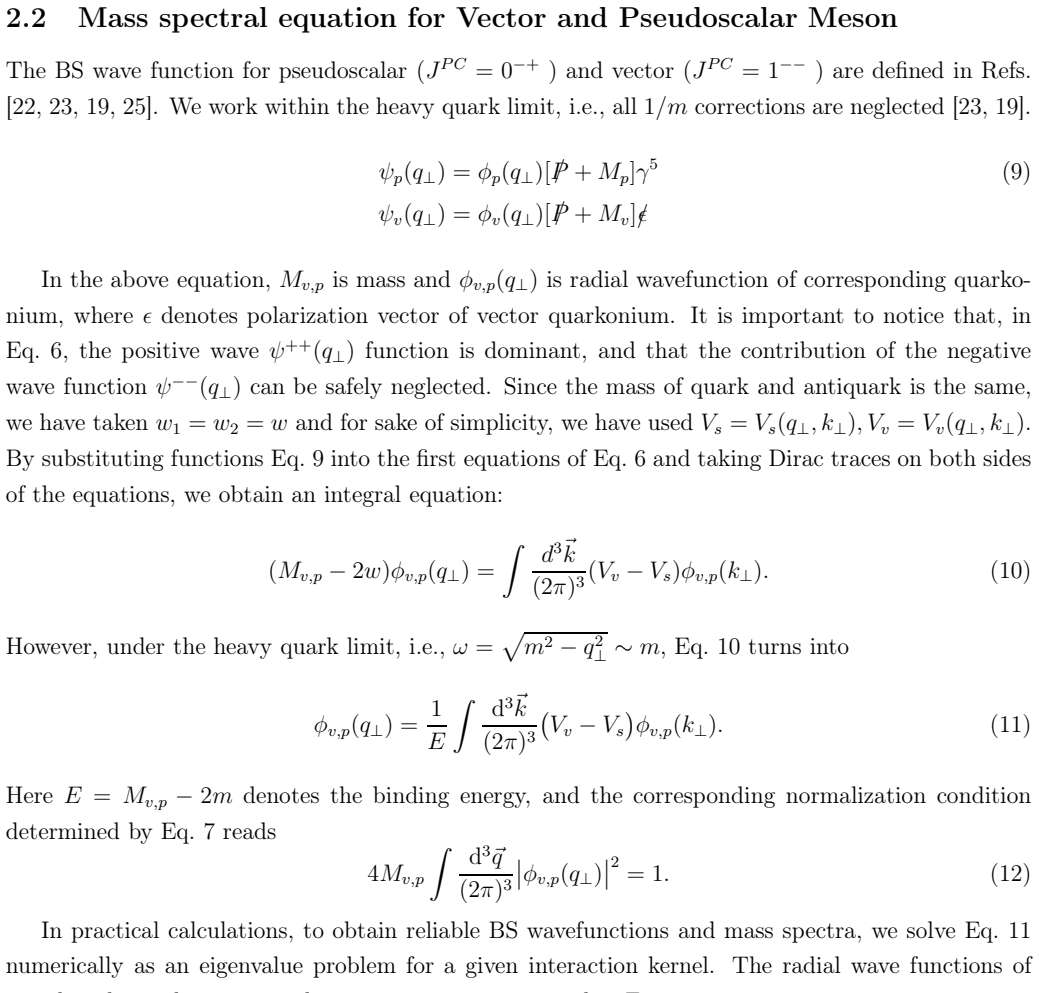
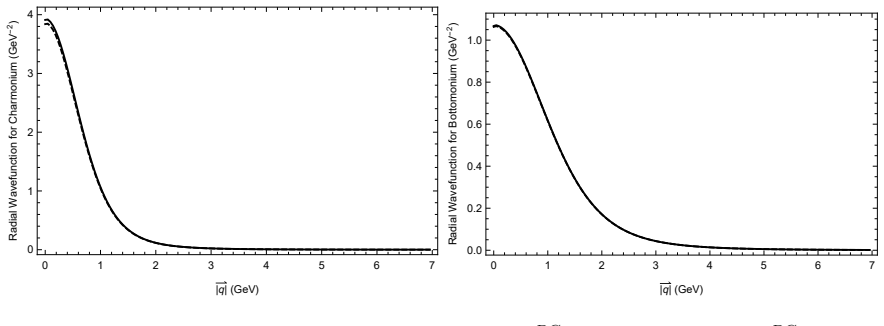
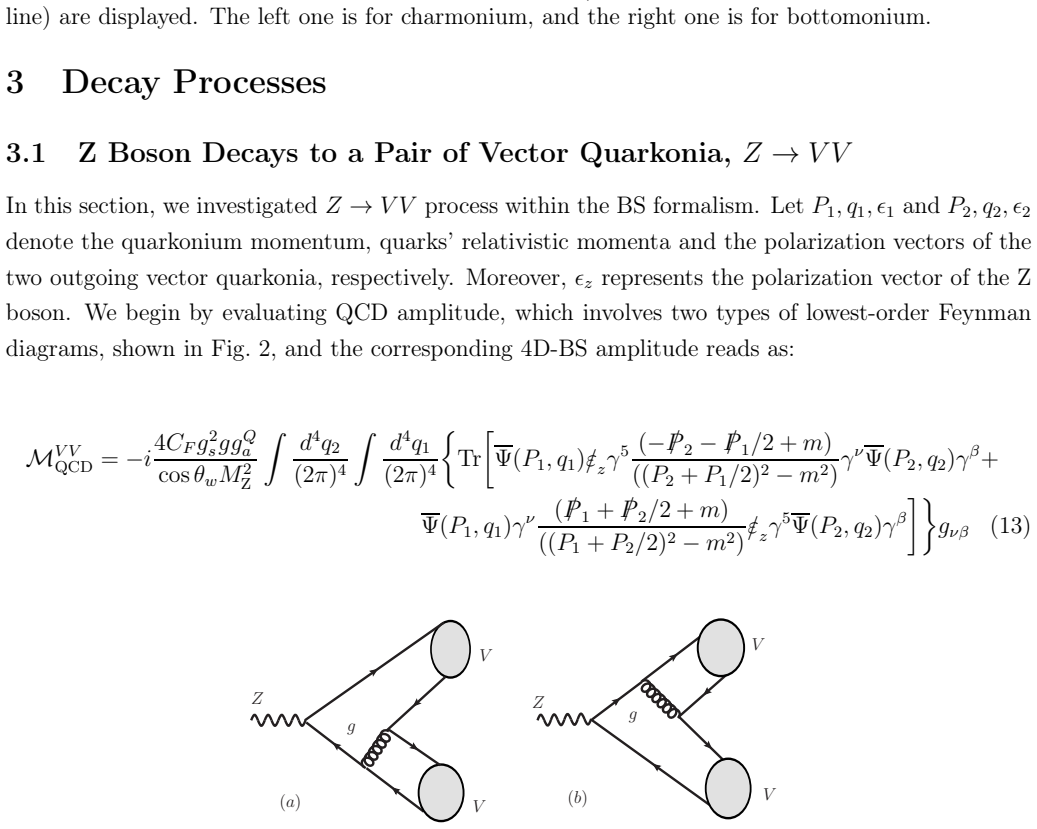
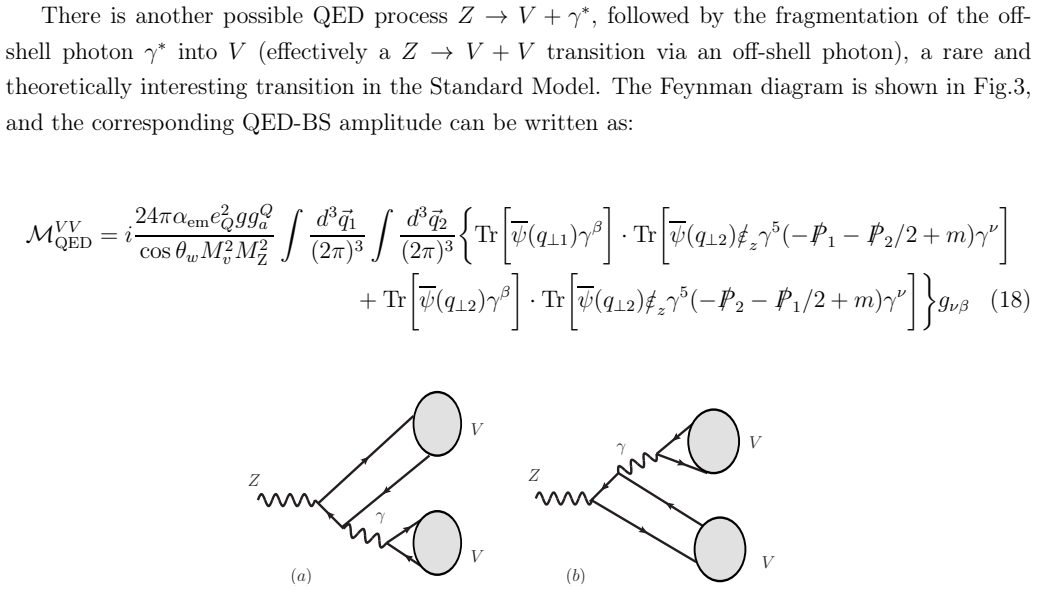
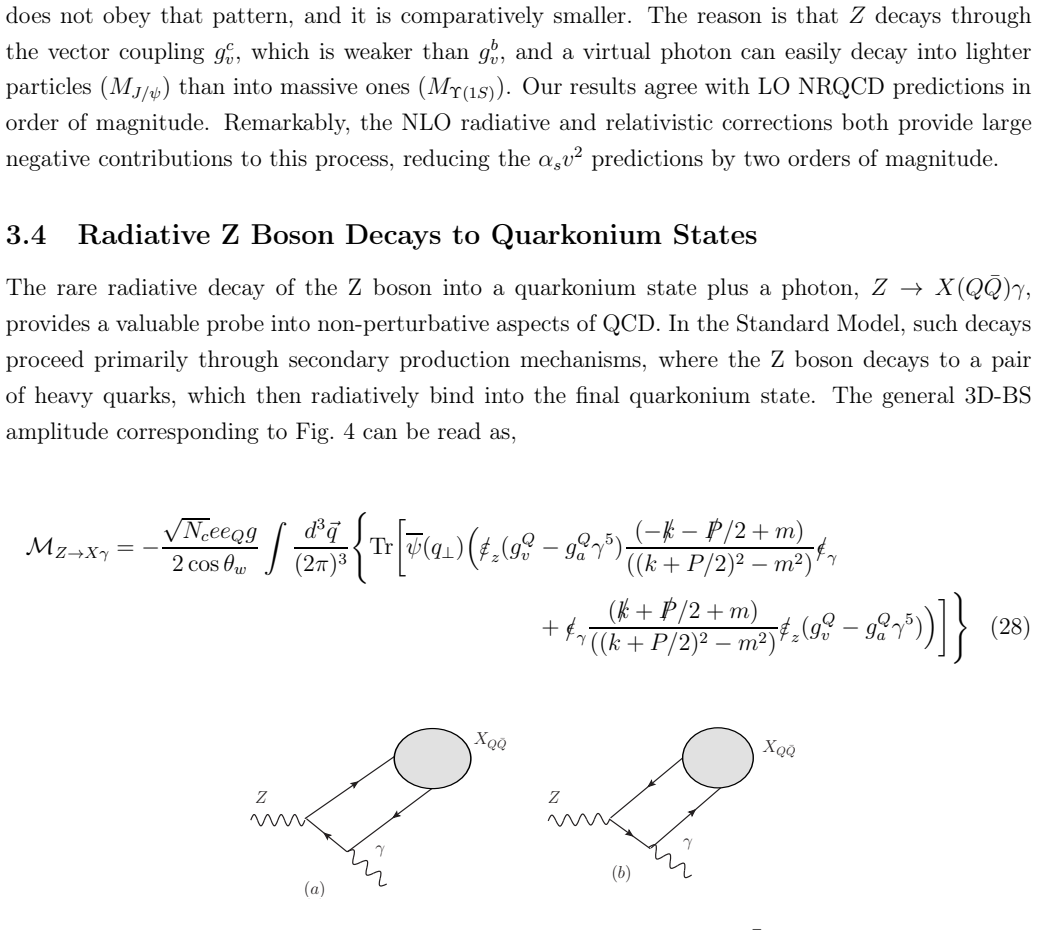
This paper investigates the rare decays of the Z boson into S-wave quarkonia within the Bethe-Salpeter formalism. Both the production of double S-wave quarkonia and radiative decays into single S-wave quarkonium are analyzed. For double quarkonia production, i.e., $Z\to VV$ and $Z\to VP$ (where $V$ and $P$ represent vector and pseudoscalar quarkonia, respectively), we consider the leading order contribution from both QCD as well as electromagnetic transition via virtual photon (QED) amplitudes. The heavy quark limit is adopted to simplify calculations. Additionally, we have introduced another possible leading order channel for Z-boson decays to double S-wave quarkonia, where the Z boson decays into bottomonium plus charmonium via QED amplitude. Such processes may include $Z\to J/\psi+\Upsilon(1S)$, $Z\to\eta_{b}+J/\psi$ and $Z\to\eta_{c}+\Upsilon(1S)$. Moreover, we have also studied radiative Z boson decays to S-wave quarkonium, namely $Z\to X(Q\bar{Q})\gamma$, where $X(Q\bar{Q})=J/\psi$, $\Upsilon$, $\eta_{c}$, and $\eta_{b}$. Interestingly, for double charmonium and radiative charmonium production, our results are larger than the NRQCD finding, while for the bottomonium case, our findings are comparatively smaller. This shows that charmonium is a relativistic particle, while bottomonium is a non-relativistic particle.
Editorial analysis
A structured set of objections, weighed in public.
Referee Report
Summary. The manuscript investigates rare exclusive decays of the Z-boson into S-wave quarkonia using the Bethe-Salpeter formalism. It analyzes double S-wave quarkonia production (Z→VV, Z→VP) including QCD and QED contributions, introduces a new QED channel for mixed bottomonium-charmonium states, and studies radiative decays Z→X(QQ̄)γ. The heavy quark limit is used to simplify calculations. Results for charmonium processes are larger than NRQCD, while for bottomonium they are smaller, interpreted as indicating that charmonium is relativistic and bottomonium is non-relativistic.
Significance. If the results hold, the work offers a relativistic treatment of these rare decays via the Bethe-Salpeter approach, providing a comparison to NRQCD that could highlight the importance of relativistic effects in lighter quarkonia. The introduction of the mixed flavor production channel is a novel contribution. Credit is given for considering both QCD and QED amplitudes and for exploring the implications for quarkonium dynamics.
major comments (1)
- [Abstract and §2] Abstract and §2: The heavy quark limit is adopted to simplify the Bethe-Salpeter amplitudes for both charmonium and bottomonium. Yet the central interpretive claim uses larger BS results (vs NRQCD) for charmonium processes to conclude that charmonium is relativistic while bottomonium is non-relativistic. This is load-bearing for the conclusion but internally inconsistent: if the limit suffices to trust the numerics for both systems, the deviation for charm should be small; the observed deviation instead questions the limit's applicability to charm without an independent check (e.g., extracted v² or explicit 1/m correction size) referenced in the text.
minor comments (2)
- The abstract would benefit from quoting at least one or two explicit branching-ratio values (or ratios to NRQCD) to make the size of the reported deviations concrete.
- Ensure all NRQCD comparison references are explicitly cited with paper numbers in the text and reference list.
Simulated Author's Rebuttal
We thank the referee for the careful reading of the manuscript and the constructive comment. We address the major point below.
read point-by-point responses
-
Referee: [Abstract and §2] Abstract and §2: The heavy quark limit is adopted to simplify the Bethe-Salpeter amplitudes for both charmonium and bottomonium. Yet the central interpretive claim uses larger BS results (vs NRQCD) for charmonium processes to conclude that charmonium is relativistic while bottomonium is non-relativistic. This is load-bearing for the conclusion but internally inconsistent: if the limit suffices to trust the numerics for both systems, the deviation for charm should be small; the observed deviation instead questions the limit's applicability to charm without an independent check (e.g., extracted v² or explicit 1/m correction size) referenced in the text.
Authors: The heavy quark limit is applied uniformly to simplify the propagators and reduce the BS amplitudes to their leading covariant structures for both systems. Within this framework the BS equation remains relativistic, so the resulting amplitudes differ from the NRQCD expansion even after the limit is taken. The larger rates obtained for charmonium therefore indicate that relativistic kinematics and binding effects retained by the BS approach are numerically important for charm, while the smaller rates for bottomonium show closer agreement with the non-relativistic expectation. The direct numerical comparison to NRQCD thus functions as the consistency check on the applicability of the limit. We will add a clarifying paragraph in §2 and a corresponding sentence in the abstract stating that the observed deviations themselves test the validity of the heavy-quark approximation for each system. revision: partial
Circularity Check
No significant circularity; derivation remains independent of its inputs
full rationale
The paper applies the Bethe-Salpeter formalism to Z-boson decay amplitudes, explicitly adopting the heavy-quark limit as an approximation to simplify the wave functions and vertices for both charmonium and bottomonium channels. Numerical results are then compared to existing NRQCD literature values, with the difference interpreted as evidence of relativistic effects in charm systems. No equation in the provided text reduces a computed observable to a parameter fitted from the same observable; the heavy-quark limit is stated as an external modeling choice rather than derived from the target decay rates; and no self-citation chain is invoked to justify uniqueness or to rename a fitted quantity as a prediction. The central interpretive claim therefore rests on an external benchmark (NRQCD) rather than on any internal redefinition or tautological substitution, rendering the derivation self-contained.
Axiom & Free-Parameter Ledger
axioms (1)
- domain assumption Heavy quark limit simplifies calculations
Reference graph
Works this paper leans on
-
[1]
Search for Hi ggs and Z boson decays to J/ψ or Υ pairs in the four-muon final state in proton-proton collisio ns at √ s = 13 TeV
A.M. Sirunyan et al. (CMS Collaboration), “Search for Hi ggs and Z boson decays to J/ψ or Υ pairs in the four-muon final state in proton-proton collisio ns at √ s = 13 TeV”, Phys. Lett. B 797, 134811 (2019). 17
2019
-
[2]
Search fo r Higgs boson decays into Z and J/ψ and for Higgs and Z boson decays into J/ψ or Υ pairs in p-p collisions at √ s = 13 TeV
Tumasyan, Armen, et al. (CMS Collaboration), “Search fo r Higgs boson decays into Z and J/ψ and for Higgs and Z boson decays into J/ψ or Υ pairs in p-p collisions at √ s = 13 TeV”, Physics Letters B 842, 137534 (2023)
2023
-
[3]
Aad et al
G. Aad et al. [ATLAS], Searches for exclusive Higgs and Z b oson decays into a vector quarkonium state and a photon using 139 fb − 1 of ATLAS √ s = 13 TeV proton–proton collision data, Eur. Phys. J. C 83, 781 (2023)
2023
-
[4]
Aad et al
G. Aad et al. [ATLAS], Search for Higgs and Z Boson Decays t o J/ψγ and Υ(nS)γ with the ATLAS Detector, Phys. Rev. Lett. 114, 121801 (2015)
2015
-
[5]
H. Baer et al. [ILC], The International Linear Collider T echnical Design Report- Volume 2: Physics, arXiv:1306.6352 [hep-ph]
-
[6]
J. P. Ma and Z. X. Zhang (The super Z-factory group), Prefa ce, Sci. China: Phys., Mech. Astron. 53, 1947(2010)
1947
-
[7]
J. B. Guimarães da Costa et al. [CEPC Study Group], CEPC Co nceptual Design Report: Volume 2- Physics & Detector, arXiv:1811.10545 [hep-ex]
-
[8]
Abada et al
A. Abada et al. [FCC], FCC-ee: The Lepton Collider: Futur e Circular Collider Conceptual Design Report Volume 2, Eur. Phys. J. ST 228, 261 (2019)
2019
-
[9]
On the rare decays Z → VV and Z → VP
L. Bergström and R.W. Robinett, “On the rare decays Z → VV and Z → VP ”, Phys. Rev. D 41, 3513 (1990)
1990
-
[10]
Note on rare Z-boson decays to dou ble heavy quarkonia
D.-N. Gao and X. Gong, “Note on rare Z-boson decays to dou ble heavy quarkonia”, Chin. Phys. C 47, 043106 (2023)
2023
-
[11]
Analysis of double- J/ψ production in Z decay at next-to- leading-order QCD accuracy
C. Li, Z. Sun, and G.-Y. Zhang, “Analysis of double- J/ψ production in Z decay at next-to- leading-order QCD accuracy”, J. High Energ. Phys. 10, 001 (2 023)
-
[12]
Double charmonia pr oduction in exclusive Z-boson decays
A.K. Likhoded and A.V. Luchinsky, “Double charmonia pr oduction in exclusive Z-boson decays”, Mod. Phys. Lett. A 33, 1850078 (2018)
2018
-
[13]
Rare D ecays of the Z 0
B. Guberina, J.H. Kühn, R.D. Peccei and R. Röckl, “Rare D ecays of the Z 0”, Nucl. Phys. B 174, 317 (1980)
1980
-
[14]
A. V. Luchinsky, Leading order NRQCD and Light-Cone Ana lysis of Exclusive Charmonia Pro- duction in Radiative Z-boson Decays, arXiv:1706.04091
-
[15]
T. C. Huang and F. Petriello, Rare exclusive decays of th e Z-boson revisited, Phys. Rev. D 92, 014007 (2015). 18
2015
-
[16]
Z-boso n decays into S-wave quarkonium plus a photon up to O(αsv2) corrections
G.-Y. Wang, X.-C. Zheng, X.-G. Wu, and G.-Z. Xu, “Z-boso n decays into S-wave quarkonium plus a photon up to O(αsv2) corrections”, Phys. Rev. D 109, 074004 (2024)
2024
-
[17]
A dynamical principle f or 3D–4D interlinkage in Salpeter-like equations
A.N. Mitra and B.M. Sodermark, “A dynamical principle f or 3D–4D interlinkage in Salpeter-like equations”, Nucl. Phys. A 695, 328 (2001)
2001
-
[18]
Mass Corrections to the Fine Structure of Hydrogen-like Atoms
E.E. Salpeter, “Mass Corrections to the Fine Structure of Hydrogen-like Atoms”, Phys. Rev. 87, 328 (1952)
1952
-
[19]
Decays of the meson BC to a P-wave charmonium state χc or hc
C. H. Chang, Y. Q. Chen, G. L. Wang, and H. S. Zong, “Decays of the meson BC to a P-wave charmonium state χc or hc”, Phys. Rev. D 65(1), 014017 (2001)
2001
-
[20]
Decay constants of heavy vector mesons in r elativistic Bethe-Salpeter method
G.-L. Wang, “Decay constants of heavy vector mesons in r elativistic Bethe-Salpeter method”, Phys. Lett. B 633, 492 (2006)
2006
-
[21]
Some of semileptonic and nonleptonic decays of Bc meson in a Bethe-Salpeter relativistic quark model
C. Chang, H.-F. Fu, G.-L. Wang, and J.-M. Zhang, “Some of semileptonic and nonleptonic decays of Bc meson in a Bethe-Salpeter relativistic quark model”, Sci. C hina Phys. Mech. Astron. 58, 011001 (2015)
2015
-
[22]
(γ,χ cJ(J = 0, 1)) and (γ,η c) production in electron-positron annihilation at √ s = 10.6 GeV and 4.6 GeV in the framework of Bethe-Salpeter equa tion
S. Bhatnagar and V. Guleria, “ (γ,χ cJ(J = 0, 1)) and (γ,η c) production in electron-positron annihilation at √ s = 10.6 GeV and 4.6 GeV in the framework of Bethe-Salpeter equa tion”, Nucl. Phys. A 1041, 122783 (2024)
2024
-
[23]
X.-H. Guo, H.-W. Ke, X.-Q. Li, and X.-H. Wu, “Double heav y-quarkonium production from electron-positron annihilation in the Bethe-Salpeter for malism”, arXiv:0804.0949 [hep-ph] (2008)
Pith/arXiv arXiv 2008
-
[24]
Double Charmonium Product ions in Electron-Positron Annihila- tion Using Bethe-Salpeter Approach
H. Negash and S. Bhatnagar, “Double Charmonium Product ions in Electron-Positron Annihila- tion Using Bethe-Salpeter Approach”, Adv. High Energy Phys . 2019, 4029356 (2019)
2019
-
[25]
Spectrum for heavy quarkonia a nd mixture of the relevant wave functions within the framework of Bethe-Salpeter equation
C. Chang and G.-L. Wang, “Spectrum for heavy quarkonia a nd mixture of the relevant wave functions within the framework of Bethe-Salpeter equation ”, Sci. China Phys. Mech. Astron. 53, 2005 (2010)
2005
-
[26]
Next-to-leading order QCD and relativistic corrections to Z → J/ψ + Υ(nS)
G.-Y. Wang, X.-C. Zheng and G.-Z. Xu, “Next-to-leading order QCD and relativistic corrections to Z → J/ψ + Υ(nS)”, arXiv:2604.19439 [hep-ph] (2026)
Pith/arXiv arXiv 2026
-
[27]
Cross section for double charmonium production in electron- positron annihilation at energy √ s = 10. 6 GeV
E. Mengesha and S. Bhatnagar, “Cross section for double charmonium production in electron- positron annihilation at energy √ s = 10. 6 GeV”, Int. J. Mod. Phys. E 20, 2521–2533 (2011)
2011
-
[28]
Observation of do uble c¯c production in e+e− annihilation at √ s ≈ 10. 6 GeV
K. Abe et al. (Belle Collaboration), “Observation of do uble c¯c production in e+e− annihilation at √ s ≈ 10. 6 GeV”, Phys. Rev. Lett. 89, 142001 (2002). 19
2002
-
[29]
Study of Double Ch armonium Production in e+e− Annihi- lation at √ s ≈ 10. 6 GeV
K. Abe et al. (Belle Collaboration), “Study of Double Ch armonium Production in e+e− Annihi- lation at √ s ≈ 10. 6 GeV”, Phys. Rev. D 70, 071102 (2004)
2004
-
[30]
Measurement o f double charmonium production in e+e− annihilations at √ s = 10. 6 GeV
B. Aubert et al. (BaBar Collaboration), “Measurement o f double charmonium production in e+e− annihilations at √ s = 10. 6 GeV”, Phys. Rev. D 72, 031101 (2005)
2005
-
[31]
Exclusive Double Charmonium Pro duction from e+e− Annihilation into a Virtual Photon
E. Braaten and J. Lee, “Exclusive Double Charmonium Pro duction from e+e− Annihilation into a Virtual Photon”, Phys. Rev. D 67, 054007 (2003) [Erratum: P hys. Rev. D 72, 099901 (2005)]
2003
-
[32]
Problems of double c harm production in e+e− annihilation at √ s = 10. 6 GeV
K.-Y. Liu, Z.-G. He and K.-T. Chao, “Problems of double c harm production in e+e− annihilation at √ s = 10. 6 GeV”, Phys. Lett. B 557, 45–54 (2003)
2003
-
[33]
Next-to-leadin g order QCD correction to e+e− → J/ψ +ηc at √ s = 10. 6 GeV
Y.-J. Zhang, Y.-J. Gao and K.-T. Chao, “Next-to-leadin g order QCD correction to e+e− → J/ψ +ηc at √ s = 10. 6 GeV”, Phys. Rev. Lett. 96, 092001 (2006)
2006
-
[34]
QCD corrections to J/ψ plus ηc production in e+e− annihilation at√ s = 10. 6 GeV
B. Gong and J.-X. Wang, “QCD corrections to J/ψ plus ηc production in e+e− annihilation at√ s = 10. 6 GeV”, Phys. Rev. D 77, 054028 (2008)
2008
-
[35]
Relativistic correcti ons to J/ψ exclusive and inclusive double charm production at B factories
Z.-G. He, Y. Fan and K.-T. Chao, “Relativistic correcti ons to J/ψ exclusive and inclusive double charm production at B factories”, Phys. Rev. D 75, 074011 (20 07)
-
[36]
Resummation of Relativis tic Corrections to e+e− → J/ψ +ηc
G. T. Bodwin, J. Lee and C. Yu, “Resummation of Relativis tic Corrections to e+e− → J/ψ +ηc”, Phys. Rev. D 77, 094018 (2008)
2008
-
[37]
O(αsv2) correction to J/ψ plusηc production in e+e− annihilation at√ s = 10. 6 GeV
X.-H. Li and J.-X. Wang, “ O(αsv2) correction to J/ψ plusηc production in e+e− annihilation at√ s = 10. 6 GeV”, Chin. Phys. C 38, 043101 (2014)
2014
-
[38]
Analytical two-loop ampli- tudes of e+e− → J/ψ +ηc at B factories
X. Chen, X. Guan, C.-Q. He, Y.-Q. Ma, J. Wang and D.-J. Zha ng, “Analytical two-loop ampli- tudes of e+e− → J/ψ +ηc at B factories”, (2025)
2025
-
[39]
Next-to-next-to- leading-order QCD corrections to J/ψ plus ηc production at the B factories
X.-D. Huang, B. Gong and J.-X. Wang, “Next-to-next-to- leading-order QCD corrections to J/ψ plus ηc production at the B factories”, JHEP 02, 049 (2023). 20
2023
discussion (0)
Sign in with ORCID, Apple, or X to comment. Anyone can read and Pith papers without signing in.