Open-quantum-system theory of non-Markovian electron-phonon dynamics
Pith reviewed 2026-06-26 11:26 UTC · model grok-4.3
The pith
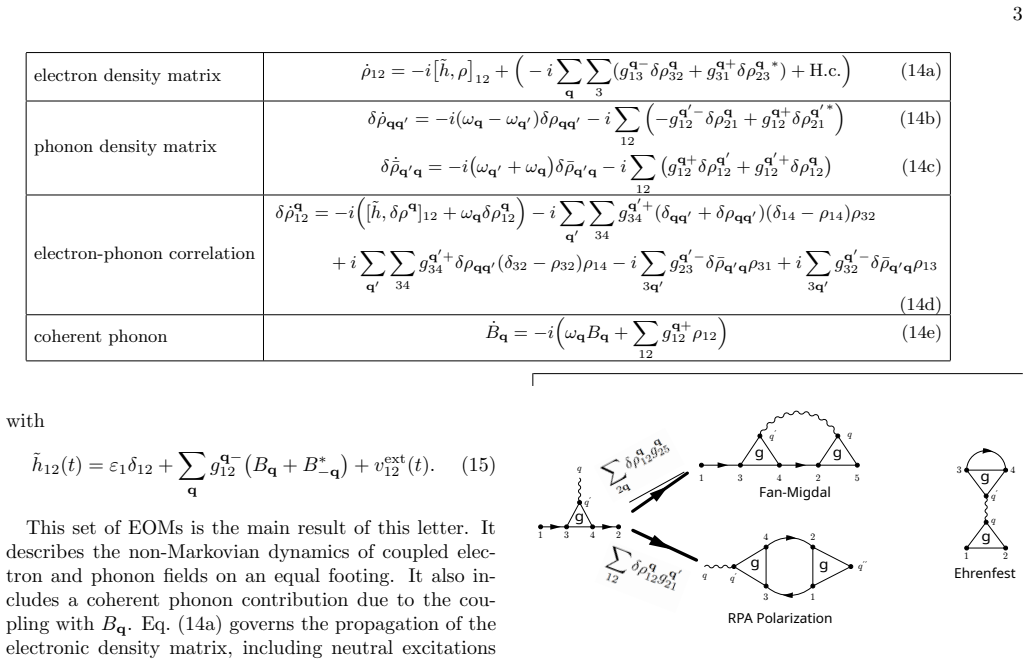
A closed set of four coupled equations captures non-Markovian electron-phonon dynamics in open quantum systems.
A machine-rendered reading of the paper's core claim, the machinery that carries it, and where it could break.
Core claim
The non-Markovian open quantum dynamics of electron-phonon systems is fully described by a closed set of four coupled equations of motion for the electronic one-body reduced density matrix, the phonon density matrix, the coherent phonon, and the electron-phonon correlations. Memory effects emerge naturally from the coupling between the electronic density matrix and the correlation equations. In appropriate limits the equations recover the Fan-Migdal, random-phase-approximation polarization, and Ehrenfest self-energies, as well as the Lindblad and Boltzmann equations.
What carries the argument
Closed set of four coupled equations of motion for the electronic one-body reduced density matrix, phonon density matrix, coherent phonon, and electron-phonon correlations.
If this is right
- Memory effects appear automatically from the coupling between the electronic density matrix and electron-phonon correlations.
- Coherent phonon dynamics and dissipative broadening are treated simultaneously without separate approximations.
- The equations reduce to the Fan-Migdal, RPA polarization, and Ehrenfest self-energies in suitable limits.
- The Lindblad and Boltzmann equations are recovered as further special cases.
- Energy is conserved and dissipative spectral broadening is reproduced in the Holstein dimer under strong external driving.
Where Pith is reading between the lines
- The method could be applied to time-resolved pump-probe experiments on materials where polaron lifetimes matter.
- Extension to other bosonic environments, such as photon or magnon baths, would follow the same four-variable structure.
- Because two-time storage is avoided, the formalism may scale to larger supercells than full nonequilibrium Green's function calculations.
- Testing against exact solutions for driven multi-mode phonon systems would directly check the closure assumption.
Load-bearing premise
The four chosen quantities form a closed set whose equations of motion are sufficient to capture the full non-Markovian dynamics without higher-order correlations.
What would settle it
Numerical comparison of the four-equation solution against the exact many-body dynamics of the Holstein dimer (or a larger Holstein chain) for a new driving protocol; mismatch in energy conservation or spectral features while two-time methods agree would falsify the closure.
Figures
read the original abstract
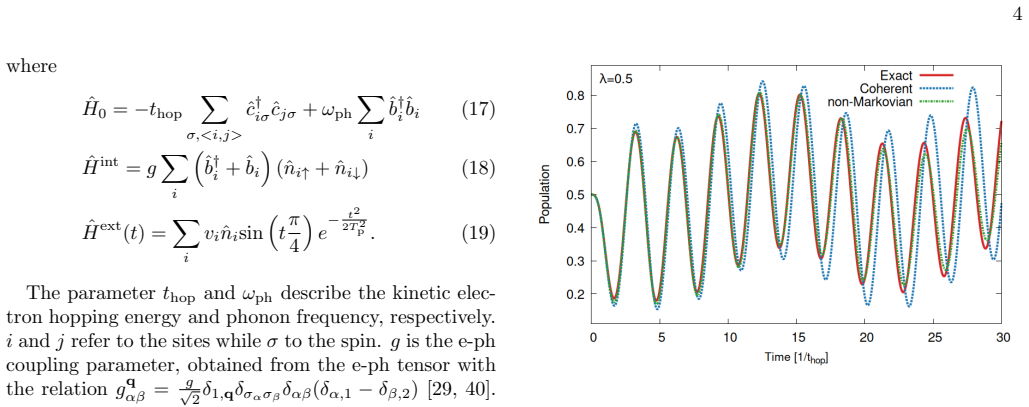
We present a non-Markovian open quantum dynamics formalism for the study of nonequilibrium electron-phonon interactions, based on a closed set of four coupled equations of motion for the electronic one-body reduced density matrix, the phonon density matrix, the coherent phonon, and the electron-phonon correlations. Memory effects in the electronic dynamics emerge naturally from the coupling between the electronic density matrix and the electron-phonon correlation equations, beyond the Markovian approximation. The formalism treats coherent-phonon dynamics and dissipative broadening on an equal footing, making it particularly suited to polaron formation and the finite lifetimes of driven electronic excitations. In appropriate limits it recovers the Fan-Migdal, polarization in random-phase-approximation, and Ehrenfest self-energies of nonequilibrium Green's function theory, as well as the Lindblad and Boltzmann equations, while avoiding the storage of two-time correlators. To drive the system out of equilibrium, we study its interaction with an external time-dependent field. As an illustrative application, we benchmark our theory against the exact solution of the Holstein dimer under a strong external perturbation, where the non-Markovian dynamics correctly captures dissipative spectral broadening and energy conservation.
Editorial analysis
A structured set of objections, weighed in public.
Referee Report
Summary. The manuscript presents a non-Markovian open-quantum-system formalism for nonequilibrium electron-phonon interactions, based on a claimed closed set of four coupled equations of motion for the electronic one-body reduced density matrix, the phonon density matrix, the coherent phonon, and the electron-phonon correlations. Memory effects arise from the coupling between the electronic density matrix and correlation equations. The formalism is asserted to recover the Fan-Migdal, RPA polarization, Ehrenfest, Lindblad, and Boltzmann limits while avoiding two-time correlators, and is benchmarked on the Holstein dimer under strong time-dependent driving where it captures dissipative spectral broadening and energy conservation.
Significance. If the four quantities indeed form an exactly closed set without unstated truncation, the approach would provide a practical route to non-Markovian electron-phonon dynamics that treats coherent and dissipative effects on equal footing and sidesteps storage of two-time functions. This could be useful for polaron formation and driven excitations in materials, with the recovery of standard limits offering a consistency check.
major comments (1)
- [Abstract / derivation of EOMs] Abstract and derivation of the equations of motion: The central claim that the four quantities form a closed set whose EOMs capture the full non-Markovian dynamics requires explicit demonstration that the electron-phonon correlation equation does not generate higher-order terms (e.g., three-body electron-phonon or two-phonon correlators). Standard NEGF or master-equation treatments produce an infinite hierarchy; the manuscript must either prove those terms vanish identically or quantify the truncation error. The Holstein-dimer benchmark (finite Hilbert space) cannot expose truncation errors that would appear in extended systems.
Simulated Author's Rebuttal
We thank the referee for their detailed review and for identifying the need to strengthen the demonstration of closure in our formalism. We address the major comment below and will revise the manuscript accordingly to provide a more explicit proof of the absence of higher-order terms.
read point-by-point responses
-
Referee: [Abstract / derivation of EOMs] Abstract and derivation of the equations of motion: The central claim that the four quantities form a closed set whose EOMs capture the full non-Markovian dynamics requires explicit demonstration that the electron-phonon correlation equation does not generate higher-order terms (e.g., three-body electron-phonon or two-phonon correlators). Standard NEGF or master-equation treatments produce an infinite hierarchy; the manuscript must either prove those terms vanish identically or quantify the truncation error. The Holstein-dimer benchmark (finite Hilbert space) cannot expose truncation errors that would appear in extended systems.
Authors: We agree that an explicit demonstration of closure is essential and will add a dedicated subsection deriving the EOMs term-by-term from the full Hamiltonian to show that, for the linear electron-phonon coupling, the time derivative of the electron-phonon correlation operator only involves the four retained quantities (one-body electronic density matrix, phonon density matrix, coherent phonon amplitude, and the correlation itself) without generating three-body electron-phonon or two-phonon correlators. This follows because the interaction Hamiltonian is bilinear in the phonon displacement and linear in the electronic operators, so commutators close within this set; no truncation is introduced. The Holstein dimer benchmark validates the resulting dynamics against exact results but is not the sole justification for closure—the algebraic structure of the EOMs holds for any system size. We will also clarify this distinction in the revised text. revision: yes
Circularity Check
No circularity: derivation presented as independent open-system closure
full rationale
The paper states its central result as a closed set of four EOMs derived from open-quantum-system principles for the chosen observables. No quoted step reduces a prediction to a fitted input, self-citation chain, or definitional renaming. Recovery of known limits (Fan-Migdal, Lindblad, etc.) is shown as consistency checks rather than load-bearing justification. The Holstein-dimer benchmark supplies external validation against an exact solution. The closure assumption is explicit and falsifiable but does not collapse the claimed dynamics onto the inputs by construction.
Axiom & Free-Parameter Ledger
Reference graph
Works this paper leans on
-
[1]
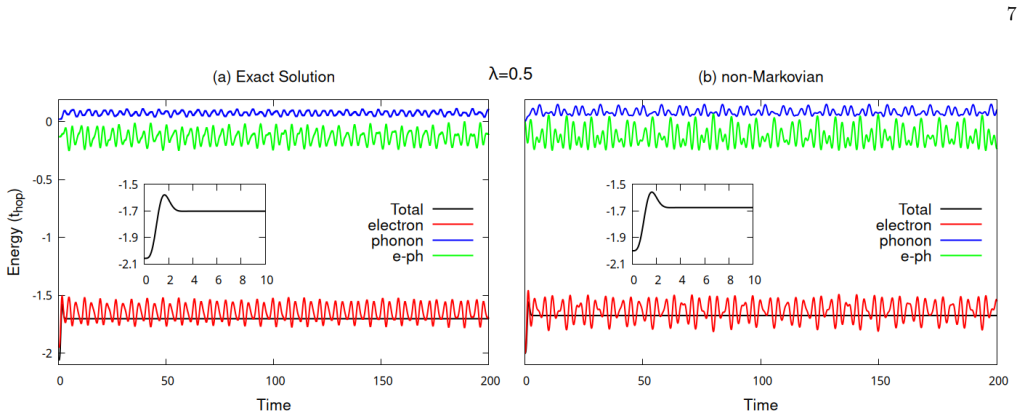
(22) The energy depends only on the computed dynamical quantities, so it is easy to calculate for both exact and non-Markovian dynamics
+ X 12q gq+ 12 (B∗ qρ12 +δρ q∗ 21 ) | {z } electron-phonon . (22) The energy depends only on the computed dynamical quantities, so it is easy to calculate for both exact and non-Markovian dynamics. Fig. (5) shows the compari- son between the exact and non-Markovian solution for λ= 0.5 andγ= 0.5. We observe that, after an initial total-energy variation due...
-
[2]
T. M. Rice and G. K. Scott, Phys. Rev. Lett.35, 120 (1975)
1975
-
[3]
S. Cao, C. Xu, H. Fukui, T. Manjo, Y. Dong, M. Shi, Y. Liu, C. Cao, and Y. Song, Nature Communications 14, 7671 (2023)
2023
-
[4]
G. L. Goodvin, M. Berciu, and G. A. Sawatzky, Phys. Rev. B74, 245104 (2006)
2006
-
[5]
Lafuente-Bartolome, C
J. Lafuente-Bartolome, C. Lian, W. H. Sio, I. G. Gur- tubay, A. Eiguren, and F. Giustino, Phys. Rev. B106, 075119 (2022)
2022
-
[6]
V. I. Klimov, The Journal of Physical Chemistry B104, 6112 (2000), https://doi.org/10.1021/jp9944132
-
[7]
Othonos, Journal of Applied Physics83, 1789 (1998)
A. Othonos, Journal of Applied Physics83, 1789 (1998)
1998
-
[8]
J. Xu, A. Habib, R. Sundararaman, and Y. Ping, Phys. Rev. B104, 184418 (2021)
2021
-
[9]
Xu and Y
J. Xu and Y. Ping, J. Chem. Theory Comput.20, 492 (2024)
2024
-
[10]
Stefanucci and R
G. Stefanucci and R. van Leeuwen,Nonequilibrium Many-Body Theory of Quantum Systems: A Modern In- troduction(Cambridge University Press, 2013)
2013
-
[11]
Giustino, Rev
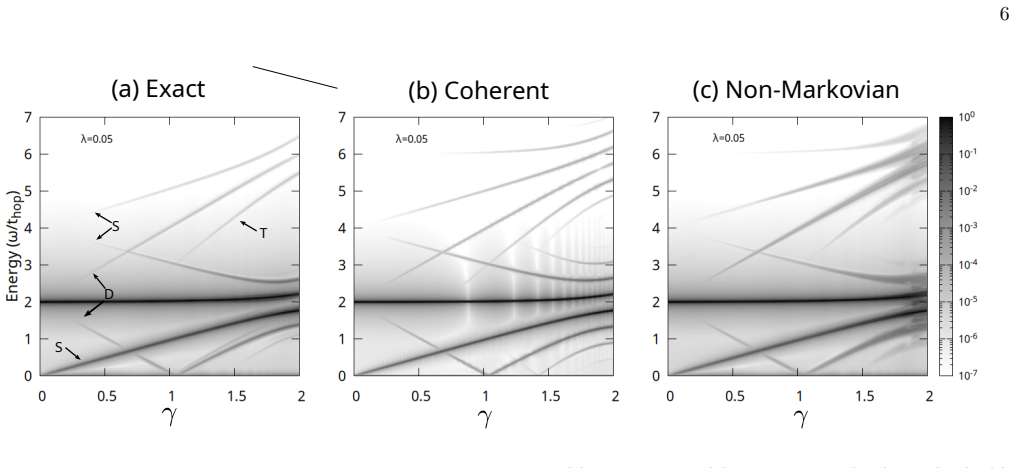
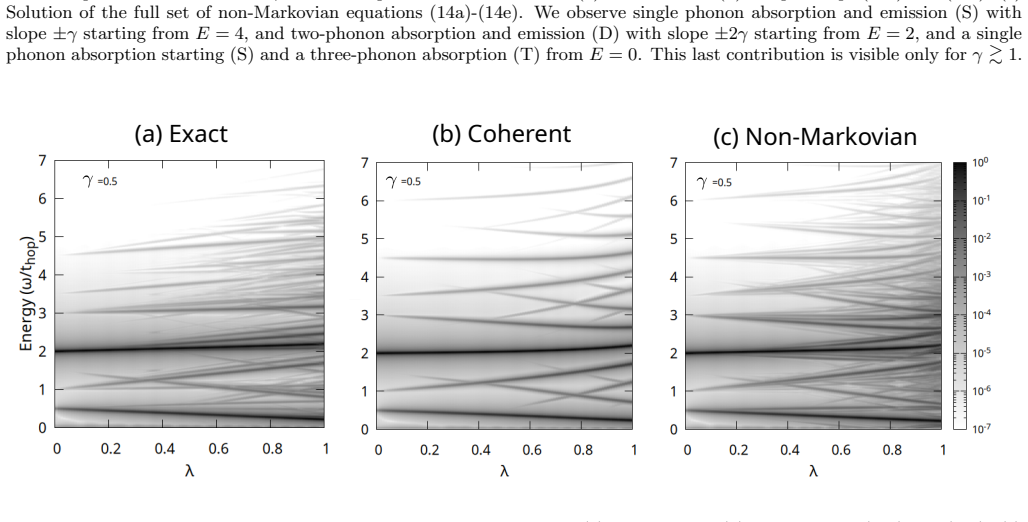
F. Giustino, Rev. Mod. Phys.89, 015003 (2017). 6 (a) Exact (b) Coherent (c) Non-Markovian S S D T FIG. 3. Spectra as a function ofγfor small e-ph interactionλ= 0.05. (a) Exact result. (b) Coupled Eqs. (14a) and (14e). (c) Solution of the full set of non-Markovian equations (14a)-(14e). We observe single phonon absorption and emission (S) with slope±γstart...
2017
-
[12]
Andreoni and S
W. Andreoni and S. Yip,Handbook of Materials Mod- eling: Methods: Theory and Modeling(Springer Cham, 2018)
2018
-
[13]
E. Perfetto and G. Stefanucci, Nano Let- ters23, 7029 (2023), pMID: 37493350, https://doi.org/10.1021/acs.nanolett.3c01772
-
[14]
P. M. M. C. de Melo and A. Marini, Phys. Rev. B93, 155102 (2016)
2016
-
[15]
Pavlyukh, E
Y. Pavlyukh, E. Perfetto, D. Karlsson, R. van Leeuwen, and G. Stefanucci, Phys. Rev. B105, 125134 (2022)
2022
-
[16]
C. C. Reeves and V. c. v. Vlˇ cek, Phys. Rev. Lett.133, 226902 (2024)
2024
-
[17]
Karlsson, R
D. Karlsson, R. van Leeuwen, E. Perfetto, and G. Ste- fanucci, Phys. Rev. B98, 115148 (2018)
2018
-
[18]
P. J. Robinson, I. S. Dunn, and D. R. Reichman, Phys. Rev. B105, 224304 (2022)
2022
-
[19]
P. J. Robinson, I. S. Dunn, and D. R. Reichman, Phys. Rev. B105, 224305 (2022)
2022
-
[20]
C. C. Reeves, Y. Zhu, C. Yang, and V. c. v. Vlˇ cek, Phys. Rev. B108, 115152 (2023)
2023
-
[21]
Stefanucci and E
G. Stefanucci and E. Perfetto, SciPost Phys.16, 073 (2024)
2024
-
[22]
Marini, Journal of Physics: Conference Series427, 012003 (2013)
A. Marini, Journal of Physics: Conference Series427, 012003 (2013)
2013
-
[23]
Breuer and F
H.-P. Breuer and F. Petruccione,The Theory of Open Quantum Systems(Oxford University Press, 2007). 7 FIG. 5. Comparison between different energy contributions in Eq. (22). Black curve, total energy. Red, blue and green line, energy contributions of the electron, phonon and electron-phonon correlation, respectively. Left panel, exact result. Right panel, n...
2007
-
[24]
Rossi and T
F. Rossi and T. Kuhn, Rev. Mod. Phys.74, 895 (2002)
2002
-
[25]
R. C. Iotti and F. Rossi, Eur. Phys. J. B90, 250 (2017)
2017
-
[26]
Bonitz,Quantum kinetic theory, Vol
M. Bonitz,Quantum kinetic theory, Vol. 412 (Springer, 2016)
2016
-
[27]
M. J. Stern, L. P. Ren´ e de Cotret, M. R. Otto, R. P. Chatelain, J.-P. Boisvert, M. Sutton, and B. J. Siwick, Phys. Rev. B97, 165416 (2018)
2018
-
[28]
A. Zong, P. E. Dolgirev, A. Kogar, E. Erge¸ cen, M. B. Yilmaz, Y.-Q. Bie, T. Rohwer, I.-C. Tung, J. Straqua- dine, X. Wang, Y. Yang, X. Shen, R. Li, J. Yang, S. Park, M. C. Hoffmann, B. K. Ofori-Okai, M. E. Koz- ina, H. Wen, X. Wang, I. R. Fisher, P. Jarillo-Herrero, and N. Gedik, Phys. Rev. Lett.123, 097601 (2019)
2019
-
[29]
Simoni, G
J. Simoni, G. Riva, and Y. Ping, The Journal of Chem- ical Physics163, 170901 (2025)
2025
-
[30]
S¨ akkinen, Y
N. S¨ akkinen, Y. Peng, H. Appel, and R. van Leeuwen, The Journal of Chemical Physics143, 234101 (2015)
2015
-
[31]
Pavlyukh, E
Y. Pavlyukh, E. Perfetto, D. Karlsson, R. van Leeuwen, and G. Stefanucci, Phys. Rev. B105, 125135 (2022)
2022
-
[32]
Stefanucci and E
G. Stefanucci and E. Perfetto, Phys. Rev. B111, 144309 (2025)
2025
-
[33]
O. B. Wright and K. Kawashima, Phys. Rev. Lett.69, 1668 (1992)
1992
-
[34]
Loudon, Advances in Physics50, 813 (2001), https://doi.org/10.1080/00018730110101395
R. Loudon, Advances in Physics50, 813 (2001), https://doi.org/10.1080/00018730110101395
-
[35]
Matsuda, O
O. Matsuda, O. B. Wright, D. H. Hurley, V. E. Gusev, and K. Shimizu, Phys. Rev. Lett.93, 095501 (2004)
2004
-
[36]
J. Xu, A. Habib, S. Kumar, F. Wu, R. Sundararaman, and Y. Ping, Nat. Commun.11, 2780 (2020)
2020
-
[37]
J. Xu, K. Li, U. N. Huynh, M. Fadel, J. Huang, R. Sun- dararaman, V. Vardeny, and Y. Ping, Nat. Commun. 15, 188 (2024)
2024
-
[38]
Stefanucci, R
G. Stefanucci, R. van Leeuwen, and E. Perfetto, Phys. Rev. X13, 031026 (2023)
2023
-
[39]
Schl¨ unzen, J.-P
N. Schl¨ unzen, J.-P. Joost, and M. Bonitz, Phys. Rev. Lett.124, 076601 (2020)
2020
-
[40]
Joost, N
J.-P. Joost, N. Schl¨ unzen, and M. Bonitz, Phys. Rev. B 101, 245101 (2020)
2020
-
[41]
S¨ akkinen, Y
N. S¨ akkinen, Y. Peng, H. Appel, and R. van Leeuwen, The Journal of Chemical Physics143, 234102 (2015)
2015
-
[42]
Takimoto, F
Y. Takimoto, F. D. Vila, and J. J. Rehr, The Journal of Chemical Physics127, 154114 (2007)
2007
-
[43]
Attaccalite, M
C. Attaccalite, M. Gr¨ uning, and A. Marini, Phys. Rev. B84, 245110 (2011)
2011
-
[44]
Luppi, H
E. Luppi, H. H¨ ubener, and V. V´ eniard, Phys. Rev. B 82, 235201 (2010)
2010
-
[45]
Perfetto, D
E. Perfetto, D. Sangalli, A. Marini, and G. Stefanucci, Phys. Rev. B92, 205304 (2015)
2015
-
[46]
W. H. Press, S. A. Teukolsky, W. T. Vetterling, and B. P. Flannery,Numerical Recipes 3rd Edition: The Art of Scientific Computing, 3rd ed. (Cambridge University Press, USA, 2007)
2007
-
[47]
H. Lee, S. Ponc´ e, K. Bushick, S. Hajinazar, J. Lafuente- Bartolome, J. Leveillee, C. Lian, J.-M. Lihm, F. Macheda, H. Mori, H. Paudyal, W. H. Sio, S. Tiwari, M. Zacharias, X. Zhang, N. Bonini, E. Kioupakis, E. R. Margine, and F. Giustino, npj Computational Materials 9, 156 (2023)
2023
discussion (0)
Sign in with ORCID, Apple, or X to comment. Anyone can read and Pith papers without signing in.