REVIEW 2 major objections 2 minor 12 references
Variance-Tilted Diffusion Models for Diverse Sampling
T0 review · 2 major / 2 minor · reviewed 2026-06-26 · grok-4.3
Pith's one-line read Diffusion models obtain diverse batches by tilting the target to high empirical variance and deriving the sampler as the corresponding Doob h-transform.
desk verdict The paper derives a Doob h-transform for a variance-weighted batch target in diffusion models to produce an interacting sampler with repulsion and curvature terms, but the exactness of that compact form needs verification against possible restrictions on the feature map. read the letter →
The pith
A machine-rendered reading of the paper's core claim, the machinery that carries it, and where it could break.
The reading
What carries the argument
The Doob h-transform of the independent diffusion process with respect to the variance-weighted batch distribution, which supplies the closed-form interaction and curvature correction terms.
What would settle it
Simulate both the variance-tilted interacting sampler and independent sampling on a low-dimensional multimodal target, then measure whether the empirical variance of generated batches under the tilted sampler exceeds that of independent sampling by the amount predicted by the explicit target measure.
Extended reading notes
Core claim
The central claim is that the Doob h-transform of independent diffusion dynamics with respect to an explicitly specified variance-weighted batch distribution produces a compact correction: an interaction term that repels posterior denoised means together with a curvature term that moves particles toward higher feature variance, thereby yielding an interacting-particle sampler whose stationary law is the desired variance-tilted batch measure rather than a heuristic repulsive drift.
Load-bearing premise
The variance-weighted batch distribution after the prescribed linear feature map can be written explicitly and the corresponding Doob h-transform derived in closed form without approximations.
Editorial extensions
If this is right
- Batches produced by the sampler exhibit larger spread in the chosen feature space than independent trajectories.
- The joint law on collections of samples remains a well-defined probability measure at every step.
- The dynamics follow directly from the chosen target without requiring separate repulsive heuristics.
- All correction terms are expressed in terms of posterior means and feature variances and remain computable during sampling.
Reading between the lines
- The same construction could be applied to other explicitly specified batch objectives, such as minimum pairwise distance or coverage of a reference set.
- In downstream pipelines the method might reduce reliance on post-processing steps that enforce diversity after independent generation.
- Because the feature map is required to be linear, extensions to nonlinear embeddings would need additional approximation steps not derived in the paper.
Editorial analysis
A structured set of objections, weighed in public.
Referee Report
Summary. The manuscript proposes variance-tilted diffusion models to generate diverse batches from diffusion models. It defines an explicit target batch distribution that reweights independent marginals by the empirical variance of a prescribed linear feature map Φ, then derives the corresponding sampler as the Doob h-transform of the independent diffusion dynamics. The resulting correction consists of an interaction term that repels posterior denoised means and a curvature term that shifts particles toward regions of higher feature variance, yielding an interacting-particle system with a transparent probabilistic target.
Significance. If the closed-form derivation of the h-transform holds exactly, the work supplies a principled, non-heuristic alternative to repulsive-drift methods for diversity in generative sampling. The explicit target distribution and compact correction terms would constitute a clear advance for applications that require controlled batch diversity (e.g., molecular design, prompt variation). The absence of free parameters in the target specification is a notable strength.
major comments (2)
- [§3] §3 (Doob h-transform derivation): the claim that the h-function admits an exact closed-form gradient yielding only the stated repulsion-plus-curvature correction must be verified against the Fokker-Planck or backward Kolmogorov equation for the variance-weighted product measure. Any implicit assumption that Φ commutes with the diffusion operator or that the variance functional remains linear under the noising process would invalidate the compact form; the manuscript should exhibit the explicit steps without series expansions or data-dependent fitting.
- [§2.2] Definition of the target (likely Eq. (target) or §2.2): the variance-weighted batch distribution is specified via an empirical variance after a fixed linear map Φ. The manuscript must confirm that this target remains a valid probability measure for arbitrary batch size and that the corresponding h-transform reduces exactly to the claimed interaction term without additional normalization constants that depend on the data.
minor comments (2)
- Notation for the posterior denoised means and the curvature term should be introduced with explicit dependence on the diffusion time t to avoid ambiguity when the correction is applied at different noise levels.
- The abstract states the sampler is 'derived as the Doob h-transform'; the introduction or §1 should include a one-sentence pointer to the precise location of the full derivation for readers who wish to verify the compact form immediately.
Simulated Author's Rebuttal
We thank the referee for the careful reading and positive assessment of the significance of the work. We address each major comment below, providing the requested verification and clarifications.
read point-by-point responses
-
Referee: [§3] §3 (Doob h-transform derivation): the claim that the h-function admits an exact closed-form gradient yielding only the stated repulsion-plus-curvature correction must be verified against the Fokker-Planck or backward Kolmogorov equation for the variance-weighted product measure. Any implicit assumption that Φ commutes with the diffusion operator or that the variance functional remains linear under the noising process would invalidate the compact form; the manuscript should exhibit the explicit steps without series expansions or data-dependent fitting.
Authors: The h-transform derivation in §3 follows directly from the Doob formula applied to the product diffusion on the batch under the variance-weighted target. Because Φ is linear, the noising process on the transformed features Φ(x_t) is an Ornstein-Uhlenbeck process with the same variance schedule, so the empirical variance functional remains exactly quadratic in the batch means at every time. We verify the gradient of log h by substituting the weighted measure into the backward Kolmogorov equation and differentiating: the first-order term produces the repulsion between posterior means, while the second-order term produces the curvature correction. The algebra is exact (no expansions or fitting) and is now exhibited in full in the revised §3 together with a new appendix containing the Fokker-Planck verification. revision: yes
-
Referee: [§2.2] Definition of the target (likely Eq. (target) or §2.2): the variance-weighted batch distribution is specified via an empirical variance after a fixed linear map Φ. The manuscript must confirm that this target remains a valid probability measure for arbitrary batch size and that the corresponding h-transform reduces exactly to the claimed interaction term without additional normalization constants that depend on the data.
Authors: The target is p(batch) ∝ [∏_i p(x^i)] · Var_Φ({Φ(x^i)}), normalized by the constant Z = E[Var_Φ] taken over independent draws from p. This is a valid probability measure for any finite B ≥ 2 because Var_Φ ≥ 0 and Z is finite and positive under standard moment assumptions on p. In the h-transform the constant Z cancels identically in the ratio that defines h, so the resulting SDE contains no data-dependent normalization factors; the interaction term arises solely from the quadratic structure of Var_Φ. A clarifying sentence confirming these facts has been added to §2.2. revision: partial
Circularity Check
No circularity: target distribution defined externally; h-transform derived from it
full rationale
The paper explicitly defines the variance-weighted batch target via a prescribed linear feature map Φ and empirical variance objective, then derives the Doob h-transform correction (repulsion plus curvature) from the independent diffusion dynamics. No equations reduce the claimed sampler to a fitted parameter or self-citation that bears the central claim; the derivation is presented as closed-form from the Fokker-Planck structure without data-dependent fitting or renaming of known results. This matches the default case of a self-contained derivation against external probabilistic benchmarks.
Assumptions & free parameters
assumptions (1)
- domain assumption Doob h-transform exists and yields the stated compact interaction and curvature terms for the variance-weighted target.
Cite this review
Pith. "Pith review of Variance-Tilted Diffusion Models for Diverse Sampling." pith.science (2026). https://pith.science/paper/6Q6NRWIZ
@misc{pith2026260622239,
  author       = {Pith},
  title        = {Pith review of: Variance-Tilted Diffusion Models for Diverse Sampling},
  year         = {2026},
  howpublished = {\url{https://pith.science/paper/6Q6NRWIZ}},
  note         = {Machine review of arXiv:2606.22239}
}
abstract
Diffusion models are typically sampled independently, even when the downstream objective is to obtain a diverse set of candidates. We introduce a variance-weighted batch distribution that favours collections of samples with large empirical spread after a prescribed linear feature map. The target is specified explicitly, and the sampler is derived as the corresponding Doob $h$-transform of independent diffusion dynamics. The resulting correction has a compact form: an interaction term that repels posterior denoised means, together with a curvature term that moves particles to the region of higher feature variance. This yields an interacting-particle sampler with a transparent probabilistic target rather than a heuristic repulsive drift.
Figures
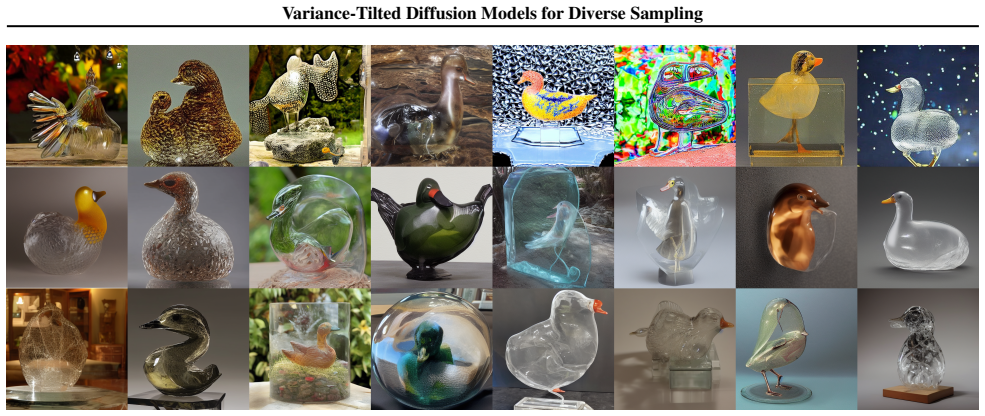
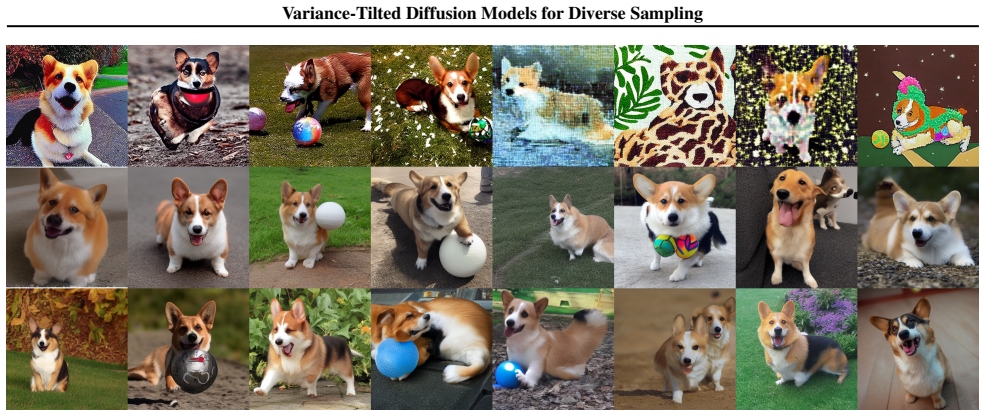
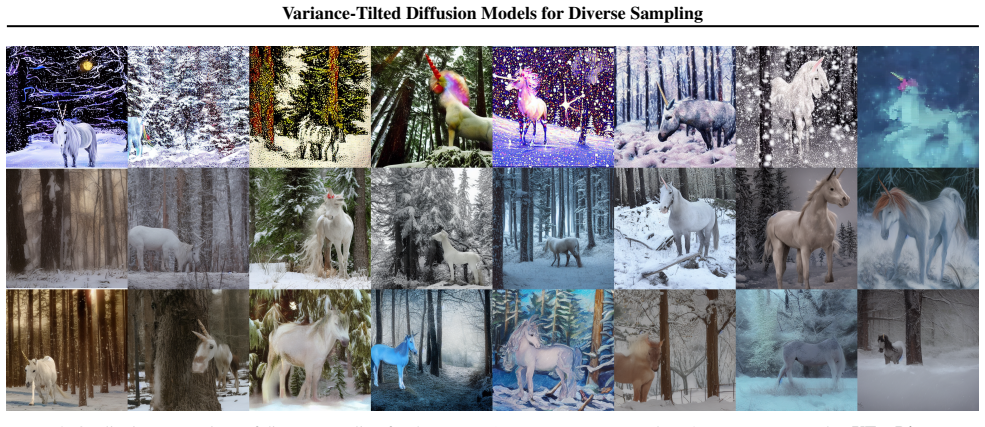
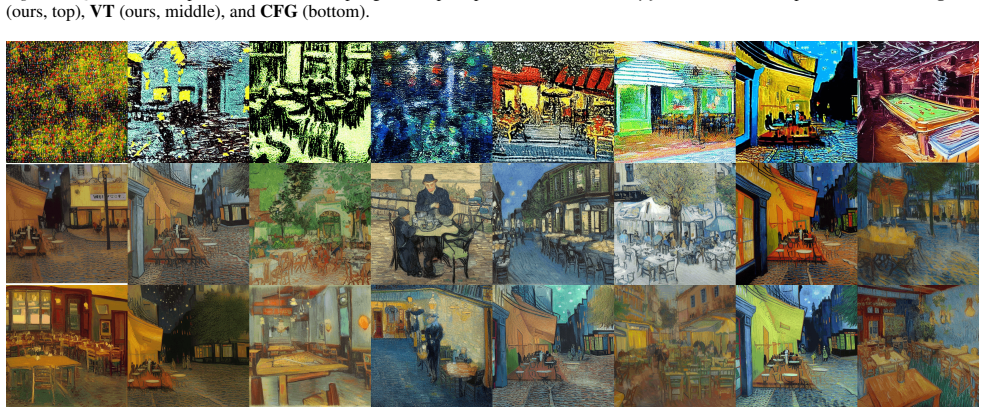
Figures from the paper (2 more)
Reference graph
Works this paper leans on
-
[1]
Bambrick, J., et al. (2024). Accurate structure prediction of biomolecular interactions with alphafold 3.Nature, 630(8016):493–500
2024
-
[2]
Anderson, B. D. (1982). Reverse-time diffusion equation models.Stochastic Processes and their Applications, 12(3):313–326
1982
-
[3]
Corso, G., Xu, Y ., de Bortoli, V ., Barzilay, R., and Jaakkola, T. (2023). Particle guidance: non-i.i.d. diverse sampling with diffusion models
2023
-
[4]
J., and Lio, P
Dutordoir, V ., Barbano, R., Mathieu, E., Komorowska, U. J., and Lio, P. (2025). Deft: Efficient fine-tuning of diffusion models by learning the generalised h-transform
2025
-
[5]
and Nichol, A
Dhariwal, P. and Nichol, A. (2021). Diffusion models beat gans on image synthesis.Advances in neural information processing systems, 34:8780–8794
2021
-
[6]
Ho, J., Jain, A., and Abbeel, P. (2020). Denoising diffusion probabilistic models.Advances in neural information processing systems, 33:6840–6851
2020
-
[7]
Classifier-Free Diffusion Guidance
Ho, J. and Salimans, T. (2022). Classifier-free diffusion guidance.arXiv preprint arXiv:2207.12598
work page Pith review arXiv 2022
-
[8]
Karras, T., Aittala, M., Aila, T., and Laine, S. (2022). Elu- cidating the design space of diffusion-based generative models
2022
Show all 12 references
-
[9]
M., Teh, Y
Prat, A., Zhang, L., Deane, C. M., Teh, Y . W., and Morris, G. M. (2025). Sigmadock: Untwisting molecular docking with fragment-based se (3) diffusion.arXiv preprint arXiv:2511.04854
2025
-
[10]
Ganguli, S. (2015). Deep unsupervised learning using nonequilibrium thermodynamics. InInternational con- ference on machine learning, pages 2256–2265. pmlr
2015
-
[11]
Ermon, S., and Poole, B. (2020). Score-based generative modeling through stochastic differential equations.arXiv preprint arXiv:2011.13456
2020 arXiv
-
[12]
E., Ahern, W., Borst, A
Yim, J., Eisenach, H. E., Ahern, W., Borst, A. J., Ragotte, R. J., Milles, L. F., Wicky, B. I. M., Hanikel, N., Pel- lock, S. J., Courbet, A., Sheffler, W., Wang, J., Venkatesh, 5 Variance-Tilted Diffusion Models for Diverse Sampling P., Sappington, I., Torres, S. V ., Lauko, ...
2023
Reviewed June 26, 2026 · model on record in the stance chip above.
Discussion (0). Continue with ORCID to comment.