Delafossites as an unexpected competing phase to infinite-layer oxides
Pith reviewed 2026-06-26 11:18 UTC · model grok-4.3
The pith
Delafossites rival or exceed infinite-layer phases in stability for nickelates and analogs, with reversed Fermi surface character.
A machine-rendered reading of the paper's core claim, the machinery that carries it, and where it could break.
Core claim
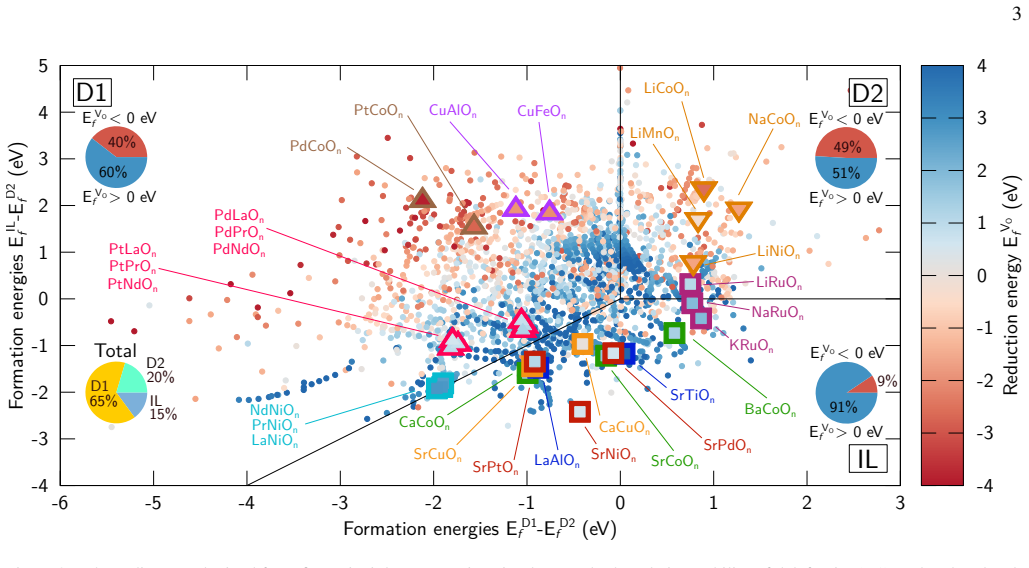
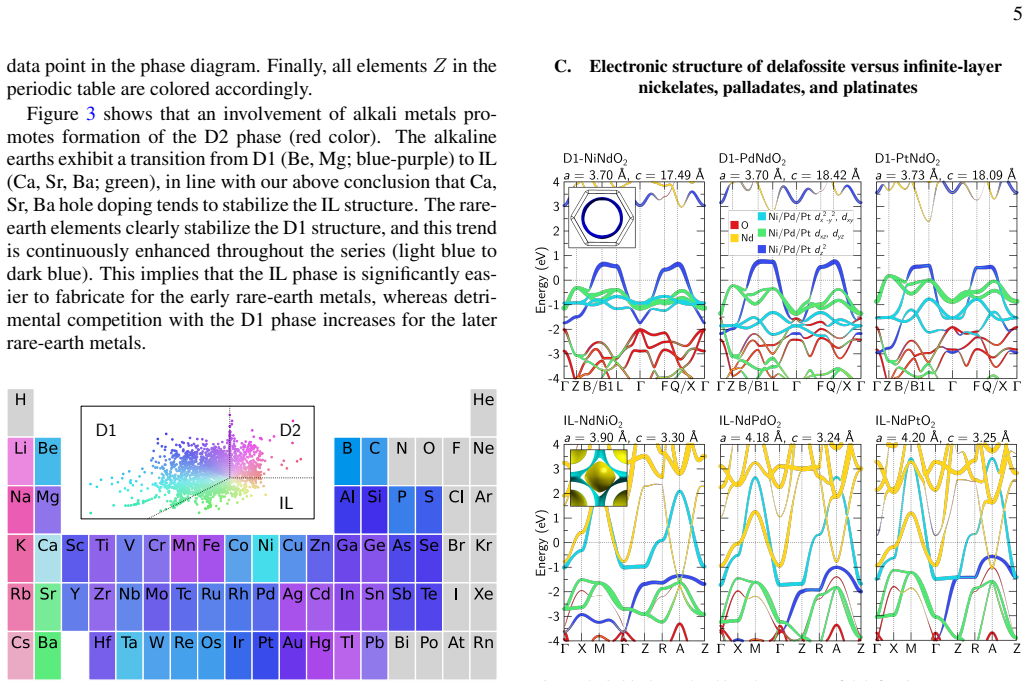
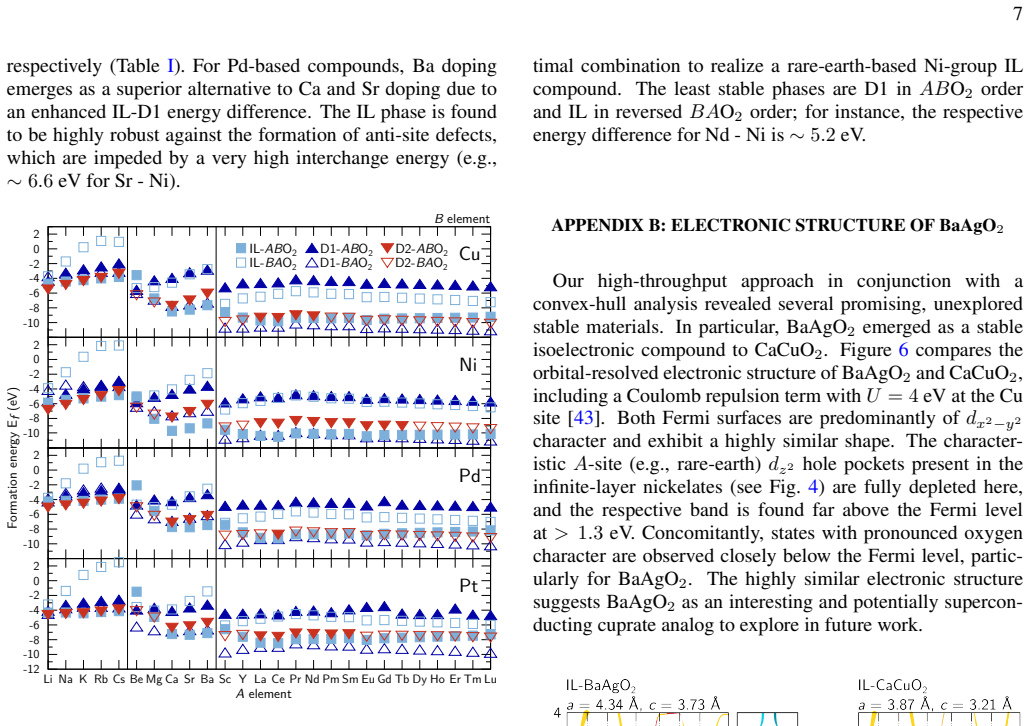
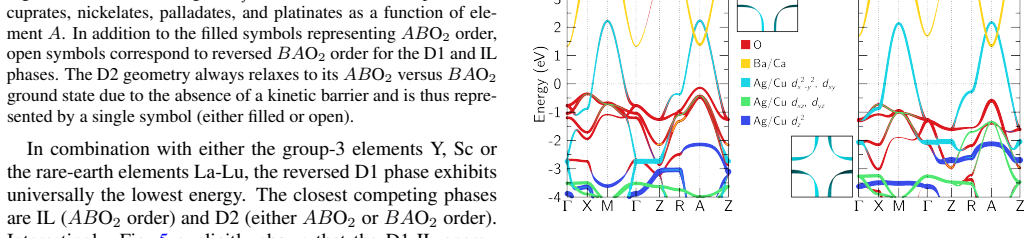
Motivated by superconductivity in Sr-doped infinite-layer nickelate films, the calculations reveal that the delafossite structure rivals the infinite-layer phase in thermodynamic stability for the nickelates, and even more for the recently suggested palladate and platinate analogs. The delafossite compounds are characterized by reversed cation order and exhibit a strongly d_z2-dominated Fermi surface, in stark contrast to the d_x2-y2 character observed in the infinite-layer phases. Among all candidates, the La-Ni combination stands out as a thermodynamic optimum for stabilizing the infinite-layer motif. Hole doping via Ca, Sr, and Ba systematically enhances the stability of the infinite-laye
What carries the argument
High-throughput first-principles density functional theory comparisons of formation energies and electronic band structures for the four AB O2 structure types across transition-metal families.
Load-bearing premise
Standard density functional theory calculations can correctly rank the thermodynamic stabilities of delafossite, infinite-layer, and related structures without major errors from exchange-correlation approximations or unexamined competing phases.
What would settle it
Experimental measurement of formation energies or successful synthesis of bulk delafossite nickelates, palladates, or platinates would directly test whether their stability exceeds or matches that of the corresponding infinite-layer phases.
Figures
read the original abstract
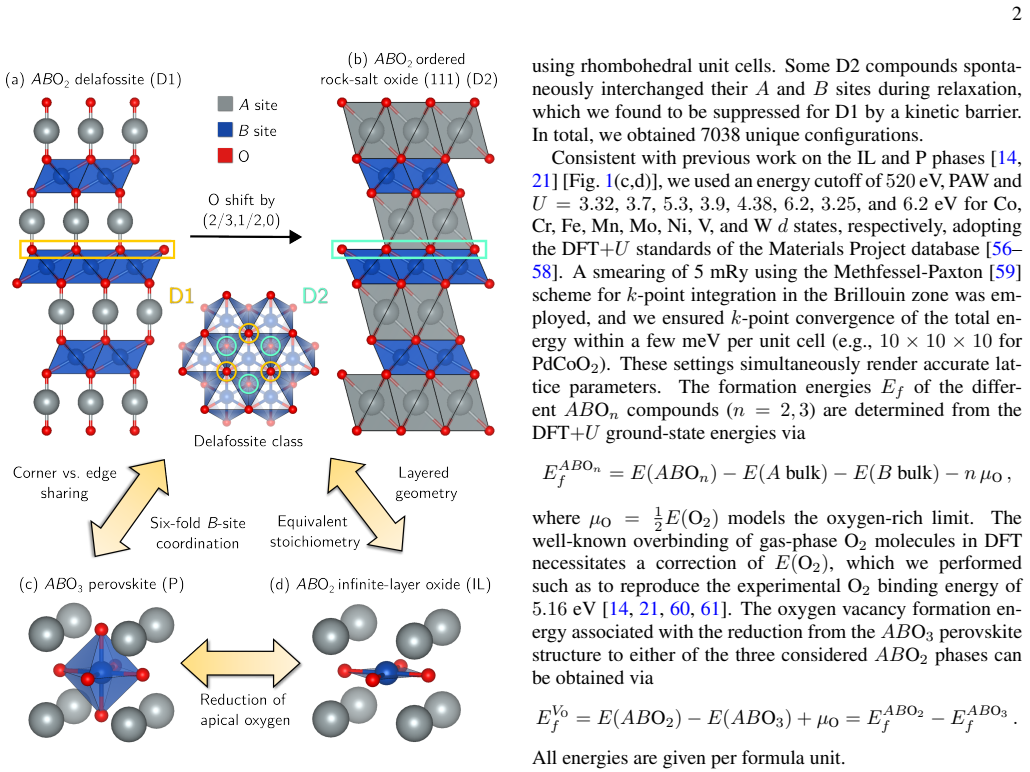
Motivated by the discovery of superconductivity in Sr-doped infinite-layer nickelate films on SrTiO$_3$(001), we explore the broader landscape of $AB$O$_2$ oxides through comprehensive high-throughput first-principles simulations. Specifically, delafossites and their ordered rock-salt (111) variants stand out as intriguing layered oxides that share the infinite-layer $AB$O$_2$ stoichiometry and simultaneously retain a perovskite-like octahedral motif. This positions them as a unique structural bridge between these two phases and as promising candidates for novel correlated electronic states. We compile a phase diagram that compares the relative stability of these four distinct oxides across the periodic table. Surprisingly, we find that the delafossite structure rivals the infinite-layer phase in thermodynamic stability for the nickelates, and even more for the recently suggested palladate and platinate analogs. Comparison of the respective electronic structures reveals that the delafossite compounds, which we find to be characterized by reversed cation order, exhibit a strongly $d_{z^2}$-dominated Fermi surface, in stark contrast to the $d_{x^2-y^2}$ character observed in the infinite-layer phases. Among all candidates, the La-Ni combination stands out as a thermodynamic optimum for stabilizing the infinite-layer motif. Furthermore, we show that hole doping via Ca, Sr, and Ba systematically enhances the stability of the infinite-layer phase in all three transition-metal families. These results reveal fundamental challenges in realizing bulk substrate-free infinite-layer oxides, and simultaneously offer guidance for future experimental synthesis efforts targeting novel superconducting compounds.
Editorial analysis
A structured set of objections, weighed in public.
Referee Report
Summary. The paper uses high-throughput first-principles DFT simulations to map the relative thermodynamic stability of four ABO2 structure types (delafossite, ordered rock-salt (111), infinite-layer, perovskite-like) across the periodic table, with focus on Ni, Pd, and Pt families. It reports that delafossite phases rival or exceed infinite-layer stability (especially for Pd/Pt analogs), identifies reversed cation ordering in delafossites, shows d_z2-dominated Fermi surfaces in delafossites versus d_x2-y2 in infinite-layer phases, highlights La-Ni as optimal for infinite-layer stability, and finds that hole doping with Ca/Sr/Ba enhances infinite-layer stability. The work aims to guide synthesis of substrate-free infinite-layer oxides and potential new correlated materials.
Significance. If the reported stability orderings prove robust, the results would directly inform experimental routes toward bulk infinite-layer nickelates and related compounds, while identifying delafossites as competing phases with qualitatively different Fermi-surface character. The high-throughput scope across multiple transition-metal families and the explicit comparison of electronic structures constitute a useful contribution to the materials-design literature for layered oxides.
major comments (1)
- [Abstract (phase-diagram claims) and implied Methods/Results sections on total-energy comparisons] The central claim that delafossite structures rival or surpass infinite-layer stability for the Ni/Pd/Pt compounds rests entirely on total-energy rankings from standard DFT. The abstract invokes these rankings to construct the phase diagram and doping trends, yet no information is provided on the exchange-correlation functional, Hubbard U values (if any), magnetic orderings considered, or convergence tests with respect to k-point sampling and plane-wave cutoff. Given that self-interaction errors and missing van der Waals or correlation contributions are known to affect relative energies of layered oxides, the manuscript must demonstrate that the delafossite–infinite-layer ordering is insensitive to these choices; otherwise the reported stability reversal for palladates and platinates cannot be considered reliable.
minor comments (2)
- [Abstract and electronic-structure discussion] The phrase 'reversed cation order' in the delafossite compounds is introduced without a clear definition or structural diagram; a figure or explicit description of the A/B site occupancy relative to the infinite-layer case would improve clarity.
- [Abstract] The abstract states that 'comprehensive high-throughput first-principles simulations support the stability and electronic-structure claims,' but the provided text does not reference any supplementary data repository or raw energy tables; inclusion of such data would strengthen reproducibility.
Simulated Author's Rebuttal
We thank the referee for the detailed and constructive feedback on the methodological transparency of our DFT calculations. We will revise the manuscript to fully address the concerns regarding computational details and robustness of the reported stability trends.
read point-by-point responses
-
Referee: The central claim that delafossite structures rival or surpass infinite-layer stability for the Ni/Pd/Pt compounds rests entirely on total-energy rankings from standard DFT. The abstract invokes these rankings to construct the phase diagram and doping trends, yet no information is provided on the exchange-correlation functional, Hubbard U values (if any), magnetic orderings considered, or convergence tests with respect to k-point sampling and plane-wave cutoff. Given that self-interaction errors and missing van der Waals or correlation contributions are known to affect relative energies of layered oxides, the manuscript must demonstrate that the delafossite–infinite-layer ordering is insensitive to these choices; otherwise the reported stability reversal for palladates and platinates cannot be considered reliable.
Authors: We agree that explicit documentation of the DFT protocol and sensitivity tests are required to support the stability rankings. In the revised manuscript we will add a dedicated Methods section specifying the PBE functional, a plane-wave cutoff of 520 eV, Γ-centered k-point meshes with a density of 0.025 Å⁻¹, and the magnetic configurations (ferromagnetic and A-type antiferromagnetic) used for the high-throughput total-energy comparisons. We will also report that a subset of Ni, Pd, and Pt compounds was re-evaluated with PBEsol, with Hubbard U = 4 eV on the transition-metal d states, and with DFT-D3 van der Waals corrections; in all cases the delafossite–infinite-layer ordering and the reversal for Pd/Pt analogs remain unchanged, with energy differences for the palladates and platinates exceeding 40 meV per formula unit. These additional results will be presented in a new supplementary figure and table. revision: yes
Circularity Check
No circularity: stabilities and band characters are direct DFT outputs
full rationale
The paper derives relative thermodynamic stabilities and Fermi-surface characters solely from high-throughput first-principles DFT total-energy and band-structure calculations on four structure types (delafossite, ordered rock-salt (111), infinite-layer, perovskite-like) across the periodic table. These quantities are computed outputs, not quantities defined in terms of themselves, fitted to subsets of the same data, or justified only by self-citations. No equations or claims reduce by construction to prior results from the same authors; the derivation chain is self-contained against external benchmarks (standard DFT codes and functionals).
Axiom & Free-Parameter Ledger
axioms (1)
- domain assumption Density functional theory approximations accurately predict relative thermodynamic stabilities of ABO2 oxide phases.
Reference graph
Works this paper leans on
-
[1]
D. Li, K. Lee, B. Y . Wang, M. Osada, S. Crossley, H. R. Lee, Y . Cui, Y . Hikita, and H. Y . Hwang, Superconductivity in an infinite-layer nickelate, Nature572, 624 (2019)
2019
-
[2]
D. Li, B. Y . Wang, K. Lee, S. P. Harvey, M. Osada, B. H. Goodge, L. F. Kourkoutis, and H. Y . Hwang, Superconducting dome inNd 1−xSrxNiO2 infinite layer films, Phys. Rev. Lett. 125, 027001 (2020)
2020
-
[3]
S. Zeng, C. S. Tang, X. Yin, C. Li, M. Li, Z. Huang, J. Hu, W. Liu, G. J. Omar, H. Jani, Z. S. Lim, K. Han, D. Wan, P. Yang, S. J. Pennycook, A. T. S. Wee, and A. Ariando, Phase diagram and superconducting dome of infinite-layerNd 1−xSrxNiO2 thin films, Phys. Rev. Lett.125, 147003 (2020)
2020
-
[4]
Nomura, M
Y . Nomura, M. Hirayama, T. Tadano, Y . Yoshimoto, K. Naka- mura, and R. Arita, Formation of a two-dimensional single- component correlated electron system and band engineering 8 in the nickelate superconductorNdNiO 2, Phys. Rev. B100, 205138 (2019)
2019
-
[5]
Jiang, L
P. Jiang, L. Si, Z. Liao, and Z. Zhong, Electronic structure of rare-earth infinite-layerRNiO 2 (R=La, Nd), Phys. Rev. B 100, 201106 (2019)
2019
-
[6]
Sakakibara, H
H. Sakakibara, H. Usui, K. Suzuki, T. Kotani, H. Aoki, and K. Kuroki, Model construction and a possibility of cuprate- like pairing in a newd 9 nickelate superconductor (Nd,Sr)NiO2, Phys. Rev. Lett.125, 077003 (2020)
2020
-
[7]
Jiang, M
M. Jiang, M. Berciu, and G. A. Sawatzky, Critical nature of the Ni spin state in dopedNdNiO 2, Phys. Rev. Lett.124, 207004 (2020)
2020
-
[8]
A. S. Botana and M. R. Norman, Similarities and differences betweenLaNiO 2 andCaCuO 2 and implications for supercon- ductivity, Phys. Rev. X10, 011024 (2020)
2020
-
[9]
Lechermann, Late transition metal oxides with infinite-layer structure: Nickelates versus cuprates, Phys
F. Lechermann, Late transition metal oxides with infinite-layer structure: Nickelates versus cuprates, Phys. Rev. B101, 081110 (2020)
2020
-
[10]
L. Si, W. Xiao, J. Kaufmann, J. M. Tomczak, Y . Lu, Z. Zhong, and K. Held, Topotactic hydrogen in nickelate superconduc- tors and akin infinite-layer oxidesABO 2, Phys. Rev. Lett.124, 166402 (2020)
2020
-
[11]
X. Wu, D. Di Sante, T. Schwemmer, W. Hanke, H. Y . Hwang, S. Raghu, and R. Thomale, Robustd x2−y2-wave superconduc- tivity of infinite-layer nickelates, Phys. Rev. B101, 060504 (2020)
2020
-
[12]
Q. Gu, Y . Li, S. Wan, H. Li, W. Guo, H. Yang, Q. Li, X. Zhu, X. Pan, Y . Nie, and H.-H. Wen, Single particle tunneling spec- trum of superconducting Nd1−xSrxNiO2 thin films, Nat. Com- mun.11, 6027 (2020)
2020
-
[13]
H. Lu, M. Rossi, A. Nag, M. Osada, D. F. Li, K. Lee, B. Y . Wang, M. Garcia-Fernandez, S. Agrestini, Z. X. Shen, E. M. Been, B. Moritz, T. P. Devereaux, J. Zaanen, H. Y . Hwang, K.- J. Zhou, and W. S. Lee, Magnetic excitations in infinite-layer nickelates, Science373, 213 (2021)
2021
-
[14]
Sahinovic and B
A. Sahinovic and B. Geisler, Active learning and element- embedding approach in neural networks for infinite-layer ver- sus perovskite oxides, Phys. Rev. Res.3, L042022 (2021)
2021
-
[15]
B. Y . Wang, D. Li, B. H. Goodge, K. Lee, M. Osada, S. P. Harvey, L. F. Kourkoutis, M. R. Beasley, and H. Y . Hwang, Isotropic Pauli-limited superconductivity in the infinite-layer nickelate Nd0.775Sr0.225NiO2, Nat. Phys.17, 473 (2021)
2021
-
[16]
Geisler, S
B. Geisler, S. Follmann, and R. Pentcheva, Oxygen vacancy formation and electronic reconstruction in strainedLaNiO 3 andLaNiO 3/LaAlO3 superlattices, Phys. Rev. B106, 155139 (2022)
2022
-
[17]
S. W. Zeng, X. M. Yin, C. J. Li, L. E. Chow, C. S. Tang, K. Han, Z. Huang, Y . Cao, D. Y . Wan, Z. T. Zhang, Z. S. Lim, C. Z. Diao, P. Yang, A. T. S. Wee, S. J. Pennycook, and A. Ariando, Observation of perfect diamagnetism and interfacial effect on the electronic structures in infinite layer Nd0.8Sr0.2NiO2 super- conductors, Nat. Commun.13, 743 (2022)
2022
-
[18]
Kreisel, B
A. Kreisel, B. M. Andersen, A. T. Rømer, I. M. Eremin, and F. Lechermann, Superconducting instabilities in strongly cor- related infinite-layer nickelates, Phys. Rev. Lett.129, 077002 (2022)
2022
-
[19]
Rossi, M
M. Rossi, M. Osada, J. Choi, S. Agrestini, D. Jost, Y . Lee, H. Lu, B. Y . Wang, K. Lee, A. Nag, Y .-D. Chuang, C.-T. Kuo, S.-J. Lee, B. Moritz, T. P. Devereaux, Z.-X. Shen, J.-S. Lee, K.- J. Zhou, H. Y . Hwang, and W.-S. Lee, A broken translational symmetry state in an infinite-layer nickelate, Nat. Phys.18, 869 (2022)
2022
-
[20]
Fowlie, M
J. Fowlie, M. Hadjimichael, M. M. Martins, D. Li, M. Osada, B. Y . Wang, K. Lee, Y . Lee, Z. Salman, T. Prokscha, J.-M. Triscone, H. Y . Hwang, and A. Suter, Intrinsic magnetism in superconducting infinite-layer nickelates, Nat. Phys.18, 1043 (2022)
2022
-
[21]
Sahinovic and B
A. Sahinovic and B. Geisler, Quantifying transfer learning syn- ergies in infinite-layer and perovskite nitrides, oxides, and fluo- rides, J. Phys.: Condens. Matter34, 214003 (2022)
2022
-
[22]
N. N. Wang, M. W. Yang, Z. Yang, K. Y . Chen, H. Zhang, Q. H. Zhang, Z. H. Zhu, Y . Uwatoko, L. Gu, X. L. Dong, J. P. Sun, K. J. Jin, and J.-G. Cheng, Pressure-induced mono- tonic enhancement of tc to over 30 k in superconducting Pr0.82Sr0.18NiO2 thin films, Nat. Commun.13, 4367 (2022)
2022
-
[23]
Sahinovic, B
A. Sahinovic, B. Geisler, and R. Pentcheva, Nature of the mag- netic coupling in infinite-layer nickelates versus cuprates, Phys. Rev. Mater.7, 114803 (2023)
2023
-
[24]
Geisler, Rashba spin-orbit coupling in infinite-layer nicke- late films onSrTiO 3(001) andKTaO 3(001), Phys
B. Geisler, Rashba spin-orbit coupling in infinite-layer nicke- late films onSrTiO 3(001) andKTaO 3(001), Phys. Rev. B108, 224502 (2023)
2023
-
[25]
Osada, B
M. Osada, B. Y . Wang, B. H. Goodge, K. Lee, H. Yoon, K. Sakuma, D. Li, M. Miura, L. F. Kourkoutis, and H. Y . Hwang, A superconducting praseodymium nickelate with in- finite layer structure, Nano Lett.20, 5735 (2020)
2020
-
[26]
Osada, B
M. Osada, B. Y . Wang, B. H. Goodge, S. P. Harvey, K. Lee, D. Li, L. F. Kourkoutis, and H. Y . Hwang, Nickelate super- conductivity without rare-earth magnetism: (La,Sr)NiO 2, Adv. Mater.33, 2104083 (2021)
2021
-
[27]
G. A. Pan, D. Ferenc Segedin, H. LaBollita, Q. Song, E. M. Nica, B. H. Goodge, A. T. Pierce, S. Doyle, S. Novakov, D. Cór- dova Carrizales, A. T. N’Diaye, P. Shafer, H. Paik, J. T. Heron, J. A. Mason, A. Yacoby, L. F. Kourkoutis, O. Erten, C. M. Brooks, A. S. Botana, and J. A. Mundy, Superconductivity in a quintuple-layer square-planar nickelate, Nat. Mat...
2022
-
[28]
Kitatani, L
M. Kitatani, L. Si, O. Janson, R. Arita, Z. Zhong, and K. Held, Nickelate superconductors—a renaissance of the one- band Hubbard model, npj Quantum Mater.5, 59 (2020)
2020
-
[29]
Kitatani, L
M. Kitatani, L. Si, P. Worm, J. M. Tomczak, R. Arita, and K. Held, Optimizing Superconductivity: From Cuprates via Nickelates to Palladates, Phys. Rev. Lett.130, 166002 (2023)
2023
-
[30]
H. Sun, M. Huo, X. Hu, J. Li, Z. Liu, Y . Han, L. Tang, Z. Mao, P. Yang, B. Wang, J. Cheng, D.-X. Yao, G.-M. Zhang, and M. Wang, Signatures of superconductivity near 80 K in a nick- elate under high pressure, Nature621, 493 (2023)
2023
-
[31]
Hou, P.-T
J. Hou, P.-T. Yang, Z.-Y . Liu, J.-Y . Li, P.-F. Shan, L. Ma, G. Wang, N.-N. Wang, H.-Z. Guo, J.-P. Sun, Y . Uwatoko, M. Wang, G.-M. Zhang, B.-S. Wang, and J.-G. Cheng, Emer- gence of high-temperature superconducting phase in pressur- ized la3ni2o7 crystals, Chin. Phys. Lett.40, 117302 (2023)
2023
-
[32]
Zhang, D
Y . Zhang, D. Su, Y . Huang, Z. Shan, H. Sun, M. Huo, K. Ye, J. Zhang, Z. Yang, Y . Xu, Y . Su, R. Li, M. Smidman, M. Wang, L. Jiao, and H. Yuan, High-temperature superconductivity with zero resistance and strange-metal behaviour in La 3Ni2O7−δ, Nat. Phys.20, 1269 (2024)
2024
-
[33]
Z. Luo, X. Hu, M. Wang, W. Wú, and D.-X. Yao, Bilayer two- orbital model of La 3Ni2O7 under pressure, Phys. Rev. Lett. 131, 126001 (2023)
2023
-
[34]
Geisler, J
B. Geisler, J. J. Hamlin, G. R. Stewart, R. G. Hennig, and P. J. Hirschfeld, Structural transitions, octahedral rotations, and electronic properties ofA 3Ni2O7 rare-earth nickelates under high pressure, npj Quantum Mater.9, 38 (2024)
2024
-
[35]
Geisler, L
B. Geisler, L. Fanfarillo, J. J. Hamlin, G. R. Stewart, R. G. Hen- nig, and P. J. Hirschfeld, Optical properties and electronic cor- relations in La 3Ni2O7 bilayer nickelates under high pressure, npj Quantum Mater.9, 89 (2024). 9
2024
-
[36]
Q. Li, C. He, J. Si, X. Zhu, Y . Zhang, and H.-H. Wen, Absence of superconductivity in bulk Nd1−xSrxNiO2, Commun. Mater. 1, 16 (2020)
2020
-
[37]
B.-X. Wang, H. Zheng, E. Krivyakina, O. Chmaissem, P. P. Lopes, J. W. Lynn, L. C. Gallington, Y . Ren, S. Rosenkranz, J. F. Mitchell, and D. Phelan, Synthesis and characterization of bulkNd 1−xSrxNiO2 andNd 1−xSrxNiO3, Phys. Rev. Mater. 4, 084409 (2020)
2020
-
[38]
K. Hu, Q. Li, D. Song, Y . Jia, Z. Liang, S. Wang, H. Du, H.- H. Wen, and B. Ge, Atomic scale disorder and reconstruction in bulk infinite-layer nickelates lacking superconductivity, Nat. Commun.15, 5104 (2024)
2024
-
[39]
Geisler and R
B. Geisler and R. Pentcheva, Fundamental difference in the electronic reconstruction of infinite-layer versus perovskite neodymium nickelate films onSrTiO 3(001), Phys. Rev. B102, 020502(R) (2020)
2020
-
[40]
Bernardini and A
F. Bernardini and A. Cano, Stability and electronic properties of LaNiO 2/SrTiO3 heterostructures, JPhys Mater.3, 03LT01 (2020)
2020
-
[41]
R. He, P. Jiang, Y . Lu, Y . Song, M. Chen, M. Jin, L. Shui, and Z. Zhong, Polarity-induced electronic and atomic reconstruc- tion atNdNiO 2/SrTiO3 interfaces, Phys. Rev. B102, 035118 (2020)
2020
-
[42]
Zhang, L.-F
Y . Zhang, L.-F. Lin, W. Hu, A. Moreo, S. Dong, and E. Dagotto, Similarities and differences between nickelate and cuprate films grown on aSrTiO 3 substrate, Phys. Rev. B102, 195117 (2020)
2020
-
[43]
Geisler and R
B. Geisler and R. Pentcheva, Correlated interface electron gas in infinite-layer nickelate versus cuprate films onSrTiO3(001), Phys. Rev. Res.3, 013261 (2021)
2021
-
[44]
B. H. Goodge, B. Geisler, K. Lee, M. Osada, B. Y . Wang, D. Li, H. Y . Hwang, R. Pentcheva, and L. F. Kourkoutis, Resolving the polar interface of infinite-layer nickelate thin films, Nat. Mater. 22, 466 (2023)
2023
-
[45]
Y . Lee, X. Wei, Y . Yu, L. Bhatt, K. Lee, B. H. Goodge, S. P. Harvey, B. Y . Wang, D. A. Muller, L. F. Kourkoutis,et al., Synthesis of superconducting freestanding infinite-layer nicke- late heterostructures on the millimetre scale, Nat. Synth.4, 573 (2025)
2025
-
[46]
S. Yan, W. Mao, W. Sun, Y . Li, H. Sun, J. Yang, B. Hao, W. Guo, L. Nian, Z. Gu, P. Wang, and Y . Nie, Superconduc- tivity in freestanding infinite-layer nickelate membranes, Adv. Mater.36, 2402916 (2024)
2024
-
[47]
Lechermann, From basic properties to the mott design of cor- related delafossites, npj Comput
F. Lechermann, From basic properties to the mott design of cor- related delafossites, npj Comput. Mater.7, 120 (2021)
2021
-
[48]
A. P. Mackenzie, The properties of ultrapure delafossite metals, Rep. Prog. Phys.80, 032501 (2017)
2017
-
[49]
K. P. Ong, D. J. Singh, and P. Wu, Unusual transport and strongly anisotropic thermopower inPtCoO 2 andPdCoO 2, Phys. Rev. Lett.104, 176601 (2010)
2010
-
[50]
M. E. Gruner, U. Eckern, and R. Pentcheva, Impact of strain- induced electronic topological transition on the thermoelectric properties of PtCoO 2 and PdCoO 2, Phys. Rev. B92, 235140 (2015)
2015
-
[51]
Yordanov, W
P. Yordanov, W. Sigle, P. Kaya, M. E. Gruner, R. Pentcheva, B. Keimer, and H.-U. Habermeier, Large thermopower anisotropy inPdCoo 2 thin films, Phys. Rev. Mater.3, 085403 (2019)
2019
-
[52]
Kohn and L
W. Kohn and L. J. Sham, Self-consistent equations includ- ing exchange and correlation effects, Phys. Rev.140, A1133 (1965)
1965
-
[53]
Kresse and D
G. Kresse and D. Joubert, From ultrasoft pseudopotentials to the projector augmented-wave method, Phys. Rev. B59, 1758 (1999)
1999
-
[54]
P. E. Blöchl, Projector augmented-wave method, Phys. Rev. B 50, 17953 (1994)
1994
-
[55]
J. P. Perdew, K. Burke, and M. Ernzerhof, Generalized gradient approximation made simple, Phys. Rev. Lett.77, 3865 (1996)
1996
-
[56]
A. Jain, S. P. Ong, G. Hautier, W. Chen, W. D. Richards, S. Dacek, S. Cholia, D. Gunter, D. Skinner, G. Ceder, and K. A. Persson, The Materials Project: A materials genome approach to accelerating materials innovation, APL Mater.1, 011002 (2013)
2013
-
[57]
S. P. Ong, W. D. Richards, A. Jain, G. Hautier, M. Kocher, S. Cholia, D. Gunter, V . L. Chevrier, K. A. Persson, and G. Ceder, Python materials genomics (pymatgen): A robust, open-source python library for materials analysis, Comp. Mat. Sci.68, 314 (2013)
2013
-
[58]
A. I. Liechtenstein, V . I. Anisimov, and J. Zaanen, Density- functional theory and strong interactions: Orbital ordering in Mott-Hubbard insulators, Phys. Rev. B52, R5467 (1995)
1995
-
[59]
Methfessel and A
M. Methfessel and A. T. Paxton, High-precision sampling for brillouin-zone integration in metals, Phys. Rev. B40, 3616 (1989)
1989
-
[60]
Geisler and R
B. Geisler and R. Pentcheva, Inducingn- andp-type thermo- electricity in oxide superlattices by strain tuning of orbital- selective transport resonances, Phys. Rev. Appl.11, 044047 (2019)
2019
-
[61]
Geisler and R
B. Geisler and R. Pentcheva, Competition of defect or- dering and site disproportionation in strainedLaCoO 3 on SrTiO3(001), Phys. Rev. B101, 165108 (2020)
2020
-
[62]
Kim, S.-I
H.-S. Kim, S.-I. Kim, and W.-S. Kim, A study on electrochem- ical characteristics of LiCoO 2/LiNi1/3Mn1/3Co1/3O2 mixed cathode for Li secondary battery, Electrochim. Acta52, 1457 (2006)
2006
-
[63]
Y . Wang, T. Cheng, Z.-E. Yu, Y . Lyu, and B. Guo, Study on the effect of Ni and Mn doping on the structural evolution of LiCoO2 under 4.6V high-voltage cycling, J. Alloys Compd. 842, 155827 (2020)
2020
-
[64]
B. R. Ortiz, P. M. Sarte, A. H. Avidor, A. Hay, E. Kenney, A. I. Kolesnikov, D. M. Pajerowski, A. A. Aczel, K. M. Tad- dei, C. M. Brown, C. Wang, M. J. Graf, R. Seshadri, L. Ba- lents, and S. D. Wilson, Quantum disordered ground state in the triangular-lattice magnet NaRuO2, Nat. Phys.19, 943 (2023)
2023
-
[65]
W. J. Kim, M. A. Smeaton, C. Jia, B. H. Goodge, B.-G. Cho, K. Lee, M. Osada, D. Jost, A. V . Ievlev, B. Moritz, L. F. Kourk- outis, T. P. Devereaux, and H. Y . Hwang, Geometric frustration of jahn–teller order in the infinite-layer lattice, Nature615, 237 (2023)
2023
-
[66]
Piombo, D
R. Piombo, D. Jezierski, H. P. Martins, T. Jaro ´n, M. N. Gas- tiasoro, P. Barone, K. Tokár, P. Piekarz, M. Derzsi, Z. Mazej, M. Abbate, W. Grochala, and J. Lorenzana, Strength of correla- tions in a silver-based cuprate analog, Phys. Rev. B106, 035142 (2022)
2022
-
[67]
Yoshida, R
T. Yoshida, R. Maezono, and K. Hongo, Exploring heat- shielding nanoparticle-based materials via first-principles cal- culations and transfer learning, ACS Appl. Nano Mater.4, 1932 (2021)
1932
-
[68]
Hashimoto, M
Y . Hashimoto, M. Wakeshima, K. Matsuhira, Y . Hinatsu, and Y . Ishii, Structures and Magnetic Properties of Ternary Lithium Oxides LiRO 2 (R= Rare Earths), Chem. Mater.14, 3245 (2002)
2002
-
[69]
Miyasaka, Y
N. Miyasaka, Y . Doi, and Y . Hinatsu, Synthesis and magnetic properties of ALnO2 (A=Cu or Ag; Ln=rare earths) with the delafossite structure, J. Solid State Chem.182, 2104 (2009)
2009
-
[70]
B. R. Ortiz, M. M. Bordelon, P. Bhattacharyya, G. Pokharel, P. M. Sarte, L. Posthuma, T. Petersen, M. S. Eldeeb, G. E. Granroth, C. R. Dela Cruz, S. Calder, D. L. Abernathy, L. Ho- 10 zoi, and S. D. Wilson, Electronic and structural properties ofRbCeX 2 (X2 : O 2,S 2,SeS,Se 2,TeSe,Te 2), Phys. Rev. Mater.6, 084402 (2022)
2022
discussion (0)
Sign in with ORCID, Apple, or X to comment. Anyone can read and Pith papers without signing in.