Van Hove Singularity and Phase Instability: Exploring the Role of Electron Correlation in the Magnetic Behavior of Fe₁₆N₂
Pith reviewed 2026-06-26 10:55 UTC · model grok-4.3
The pith
Electron correlation via Hubbard U in Fe16N2 positions a van Hove singularity near the Fermi level that tunes magnetization and anisotropy while linking to phase instability.
A machine-rendered reading of the paper's core claim, the machinery that carries it, and where it could break.
Core claim
The electronic structure of Fe16N2 exhibits a van Hove singularity near the Fermi level that is inherently tied to the material's structural and thermal phase instability. Selection of the Hubbard U parameter not only tunes the saturation magnetization and magneto-crystalline anisotropy energy toward experimental values but also reveals an underlying electronic mechanism potentially responsible for the phase's metastability.
What carries the argument
The van Hove singularity near the Fermi level, whose position under varying Hubbard U links electron correlation to both the tuning of magnetic properties and the origin of phase metastability.
If this is right
- Appropriate choice of U brings calculated saturation magnetization and anisotropy energy into agreement with experiment.
- The singularity supplies an electronic mechanism that can account for the observed metastability.
- The same framework accounts for the correlation-driven character of the magnetic behavior.
- The approach supplies a concrete route to optimize both stability and performance for permanent-magnet applications.
Where Pith is reading between the lines
- Analogous van Hove features may control metastability in other iron-nitride or rare-earth-free magnetic phases.
- Temperature- or strain-dependent spectroscopy could test whether the singularity moves under conditions that trigger decomposition.
- The method of tuning interaction strength to position a singularity may extend to the design of additional metastable magnets.
Load-bearing premise
The van Hove singularity near the Fermi level is directly responsible for the material's structural and thermal instability rather than being produced only by the chosen interaction parameter.
What would settle it
Spectroscopic measurement of the density of states in Fe16N2 that shows no pronounced peak within a few tens of meV of the Fermi level would remove the proposed connection between the singularity, the magnetic properties, and the phase instability.
Figures
read the original abstract
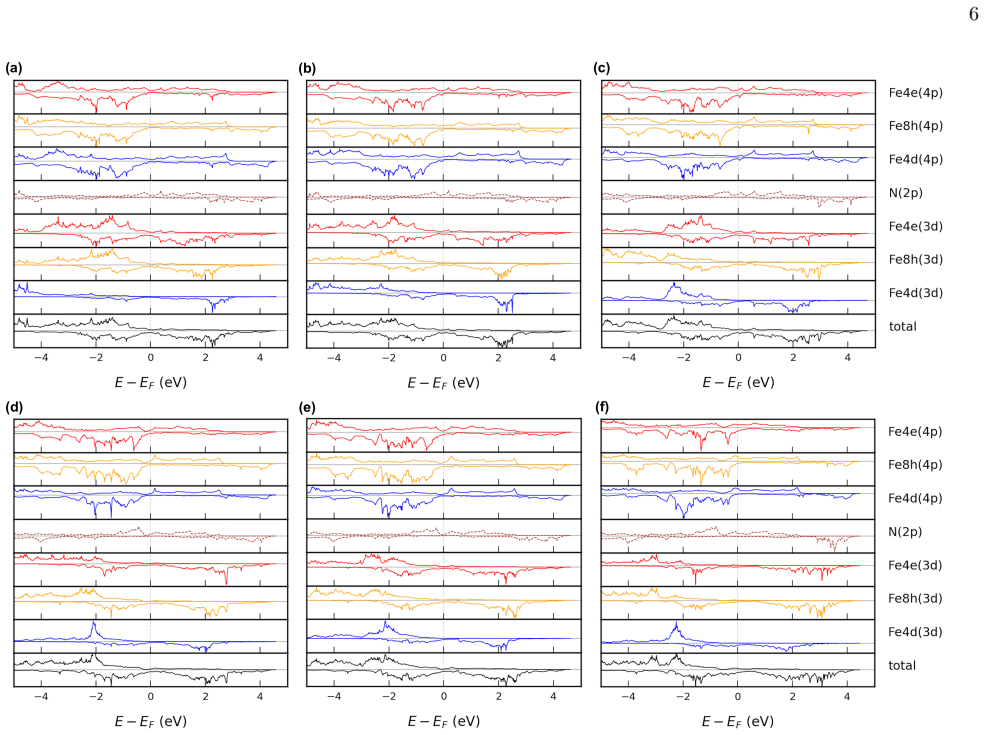
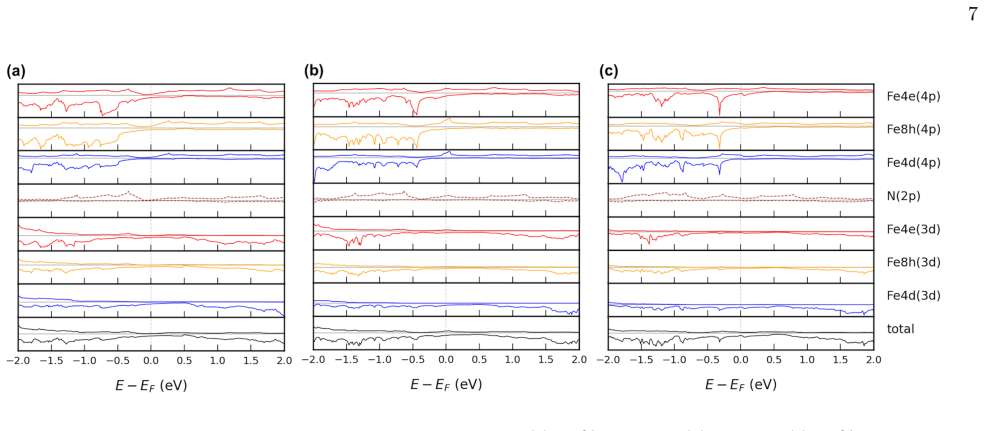
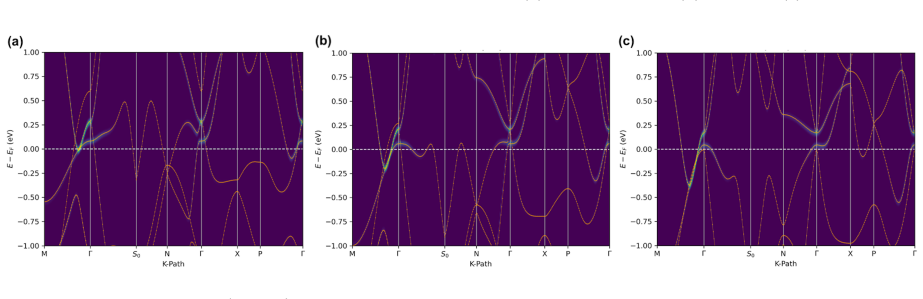
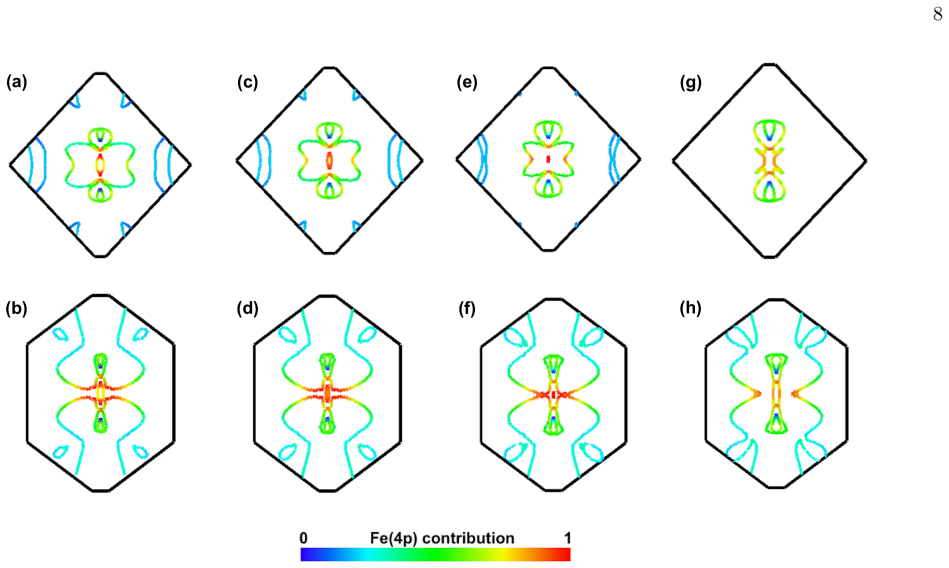
The ordered iron nitride phase $\alpha''-\mathrm{Fe}_{16}\mathrm{N}_2$ is a promising candidate for environment-friendly, rare-earth-free permanent magnets due to its demonstrated giant saturation magnetization ($M_s$). However, first-principles electronic-structure calculations have struggled to consistently reproduce experimentally-observed high $M_s$, and have yielded highly variable magneto-crystalline anisotropy (MCA) values. In this work, we employ Density Functional Theory under the GGA+$U$ framework to study the effect of the Hubbard parameters $U$ and $J$ on the magnetic properties of $\mathrm{Fe}_{16}\mathrm{N}_2$. We demonstrate that the electronic structure exhibits high sensitivity to these parameters, specifically uncovering a van Hove singularity near the Fermi level ($E_F$), inherently tied to the material's structural and thermal phase instability. By linking this topological anomaly to the calculated magnetic properties, we demonstrate that the selection of $U$ not only tunes $M_s$ and MCA energy towards experimental values but also reveals an underlying electronic mechanism potentially responsible for the phase's metastability. This provides a framework for understanding the correlation-driven magnetic behavior of $\mathrm{Fe}_{16}\mathrm{N}_2$ and offers a pathway for optimizing its stability and performance in practical applications.
Editorial analysis
A structured set of objections, weighed in public.
Referee Report
Summary. The manuscript uses GGA+U DFT to examine how Hubbard parameters U and J affect the saturation magnetization Ms and magneto-crystalline anisotropy (MCA) of α''-Fe16N2. It reports that a van Hove singularity near EF emerges for certain U values, claims this singularity is inherently tied to the phase's structural and thermal metastability, and states that tuning U to match experimental Ms and MCA simultaneously reveals an electronic mechanism for the observed instability.
Significance. If the claimed direct link between the van Hove singularity and phase instability can be established independently of the U-fitting procedure, the work would supply a useful electronic-structure rationale for the metastability of this high-Ms nitride and a route toward stabilization. The sensitivity analysis of magnetic properties to U and J is a standard and potentially valuable contribution in the field.
major comments (2)
- [Abstract] Abstract: The central claim that the van Hove singularity 'is inherently tied to the material's structural and thermal phase instability' is presented without supporting calculations (phonon spectra, elastic constants, or free-energy surfaces) that would demonstrate the instability originates from the singularity rather than from the specific choice of U.
- [Abstract] Abstract: Selection of U to bring calculated Ms and MCA into agreement with experiment creates a circularity risk; the manuscript must show that the singularity and its connection to metastability survive under a range of U values or under an independent, non-fitted criterion rather than appearing only after the fit is imposed.
minor comments (1)
- Notation for the Hubbard parameters should be defined explicitly at first use (e.g., effective U_eff = U - J) and kept consistent throughout.
Simulated Author's Rebuttal
We thank the referee for the constructive feedback on our manuscript. We address each major comment below and outline proposed revisions to strengthen the presentation of our results.
read point-by-point responses
-
Referee: [Abstract] Abstract: The central claim that the van Hove singularity 'is inherently tied to the material's structural and thermal phase instability' is presented without supporting calculations (phonon spectra, elastic constants, or free-energy surfaces) that would demonstrate the instability originates from the singularity rather than from the specific choice of U.
Authors: We agree that the current manuscript does not contain direct calculations of phonon spectra, elastic constants, or free-energy surfaces that would independently establish the origin of the phase instability. The proposed connection is inferred from the electronic-structure results, specifically the emergence of the van Hove singularity at the U value that simultaneously reproduces the experimental Ms and MCA, together with the known tendency of van Hove singularities to promote instabilities in other materials. To address the concern, we will revise the abstract to replace 'inherently tied' with 'suggests a possible electronic mechanism underlying' the observed metastability. We will also add a short discussion paragraph citing analogous cases in the literature. This is a partial revision; a full first-principles stability analysis lies outside the scope of the present GGA+U study of magnetic properties. revision: partial
-
Referee: [Abstract] Abstract: Selection of U to bring calculated Ms and MCA into agreement with experiment creates a circularity risk; the manuscript must show that the singularity and its connection to metastability survive under a range of U values or under an independent, non-fitted criterion rather than appearing only after the fit is imposed.
Authors: The manuscript already reports a systematic variation of Ms and MCA with both U and J, and the density-of-states plots show the van Hove singularity developing as U is increased. To remove any ambiguity about circularity, we will add an explicit statement in the results section and, if space permits, an additional panel in the relevant figure that displays the density of states for a broader range of U values (U = 0–5 eV). This will demonstrate that the singularity appears and moves relative to EF in a continuous manner, independent of the precise experimental matching point. We believe this addition directly satisfies the request for robustness under a range of U. revision: yes
Circularity Check
U fitted to experimental Ms/MCA makes vHS-instability link a direct consequence of the fit
specific steps
-
fitted input called prediction
[Abstract]
"By linking this topological anomaly to the calculated magnetic properties, we demonstrate that the selection of U not only tunes Ms and MCA energy towards experimental values but also reveals an underlying electronic mechanism potentially responsible for the phase's metastability."
U is chosen specifically to reproduce experimental magnetic saturation and anisotropy; the van Hove singularity uncovered at this tuned U is then asserted to explain the material's structural/thermal metastability, making the claimed mechanism a direct output of the fitting procedure rather than an independent result.
full rationale
The abstract explicitly states that U is selected to tune Ms and MCA toward experimental values and that this selection 'reveals' the vHS mechanism for metastability. This matches the fitted_input_called_prediction pattern: the parameter is adjusted to known data, after which the topological feature at that U is presented as explaining an independent physical property (phase instability) without separate verification such as phonon or free-energy calculations. The central claim therefore reduces to the outcome of the fit rather than an independent derivation. No other circular patterns are identifiable from the provided text.
Axiom & Free-Parameter Ledger
free parameters (2)
- U (Hubbard parameter)
- J (Hund's coupling)
axioms (2)
- domain assumption The GGA+U method with chosen U and J accurately represents electron correlations in Fe16N2
- ad hoc to paper The van Hove singularity is directly responsible for phase instability
Reference graph
Works this paper leans on
-
[1]
Wang, Environment-friendly bulk Fe16N2 perma- nent magnet: Review and prospective, Journal of Mag- netism and Magnetic Materials497, 165962 (2020)
J.-P. Wang, Environment-friendly bulk Fe16N2 perma- nent magnet: Review and prospective, Journal of Mag- netism and Magnetic Materials497, 165962 (2020)
2020
-
[2]
K. H. Jack, The occurrence and the crystal structure of α”-iron nitride; a new type of interstitial alloy formed during the tempering of nitrogen-martensite, Proceed- ings of the Royal Society of London. Series A. Mathe- matical and Physical Sciences208, 216 (1951)
1951
-
[3]
T. K. Kim and M. Takahashi, New Magnetic Material Having Ultrahigh Magnetic Moment, Applied Physics Letters20, 492 (1972)
1972
-
[4]
Sugita, K
Y. Sugita, K. Mitsuoka, M. Komuro, H. Hoshiya, Y. Ko- zono, and M. Hanazono, Giant magnetic moment and other magnetic properties of epitaxially grown Fe16N2 single-crystal films (invited), Journal of Applied Physics 70, 5977 (1991)
1991
-
[5]
J. M. D. Coey, The magnetization of bulkα‘Fe 16 N 2 (invited), Journal of Applied Physics76, 6632 (1994)
1994
-
[6]
N. Ji, L. F. Allard, E. Lara-Curzio, and J.-P. Wang, N site ordering effect on partially ordered Fe16N2, Appl. Phys. Lett. , 4 (2011)
2011
-
[7]
J.-P. Wang, N. Ji, X. Liu, Y. Xu, C. Sanchez-Hanke, Y. Wu, F. M. F. de Groot, L. F. Allard, and E. Lara- Curzio, Fabrication of$\hbox{Fe} {16}\hbox{N} {2}$ Films by Sputtering Process and Experimental Investi- gation of Origin of Giant Saturation Magnetization in $\hbox{Fe} {16}\hbox{N} {2}$, IEEE Transactions on Magnetics48, 1710 (2012)
2012
-
[8]
N. Ji, V. Lauter, X. Zhang, H. Ambaye, and J.-P. Wang, Strain induced giant magnetism in epitaxial Fe 16 N 2 thin film, Applied Physics Letters102, 072411 (2013)
2013
-
[9]
W. Y. Lai, Q. Q. Zheng, and W. Y. Hu, The giant mag- netic moment and electronic correlation effect in ferro- magnetic nitride Fe 16 N 2, Journal of Physics: Con- densed Matter6, L259 (1994)
1994
-
[10]
N. Ji, X. Liu, and J.-P. Wang, Theory of giant saturation magnetization inα ′′-Fe 16 N 2 : Role of partial local- ization in ferromagnetism of 3d transition metals, New Journal of Physics12, 063032 (2010)
2010
-
[12]
A. A. S. Devi, J. Nokelainen, B. Barbiellini, M. Devaraj, M. Alatalo, and A. Bansil, Re-examining the giant mag- netization density inα′′-Fe 16 N 2 with the SCAN+U method, Physical Chemistry Chemical Physics24, 17879 (2022)
2022
-
[13]
Takahashi, M
H. Takahashi, M. Igarashi, A. Kaneko, H. Miyajima, and Y. Sugita, Perpendicular uniaxial magnetic anisotropy of Fe/sub 16/N/sub 2/[001] single crystal films grown by molecular beam epitaxy, IEEE Transactions on Magnet- ics35, 2982 (1999)
1999
-
[14]
E. Kita, K. Shibata, H. Yanagihara, Y. Sasaki, and M. Kishimoto, Magnetic properties of core–shell type Fe16N2 nanoparticles, Journal of Magnetism and Mag- netic Materials Proceedings of the 17th International Conference on Magnetism,310, 2411 (2007)
2007
-
[15]
N. Ji, M. S. Osofsky, V. Lauter, L. F. Allard, X. Li, K. L. Jensen, H. Ambaye, E. Lara-Curzio, and J.-P. Wang, Perpendicular magnetic anisotropy and high spin- polarization ratio in epitaxial Fe-N thin films, Physical Review B84, 10.1103/PhysRevB.84.245310 (2011)
-
[16]
Ogawa, Y
T. Ogawa, Y. Ogata, R. Gallage, N. Kobayashi, N. Hayashi, Y. Kusano, S. Yamamoto, K. Kohara, M. Doi, M. Takano, and M. Takahashi, Challenge to the Synthesis ofα”-Fe16N2 Compound Nanoparticle with High Saturation Magnetization for Rare Earth Free New Permanent Magnetic Material, Applied Physics Express 6, 073007 (2013)
2013
-
[17]
X. Li, M. Yang, M. Jamali, F. Shi, S. Kang, Y. Jiang, X. Zhang, H. Li, S. Okatov, S. Faleev, A. Kalitsov, G. Yu, P. M. Voyles, O. N. Mryasov, and J.-P. Wang, Heavy- Metal-Free, Low-Damping, and Non-Interface Perpendic- ular Fe 16 N 2 Thin Film and Magnetoresistance Device, physica status solidi (RRL) – Rapid Research Letters13, 1900089 (2019)
2019
-
[18]
J. Liu, G. Guo, X. Zhang, F. Zhang, B. Ma, and J.- P. Wang, Synthesis ofα ′′-Fe16N2 foils with an ultralow temperature coefficient of coercivity for rare-earth-free magnets, Acta Materialia184, 143 (2020)
2020
-
[19]
Weller, A
D. Weller, A. Moser, L. Folks, M. Best, W. Lee, M. Toney, M. Schwickert, J.-U. Thiele, and M. Doerner, High K/sub u/ materials approach to 100 Gbits/in/sup 2/, IEEE Transactions on Magnetics36, 10 (2000)
2000
-
[20]
L. Ke, K. D. Belashchenko, M. van Schilfgaarde, T. Kotani, and V. P. Antropov, Effects of alloying and strain on the magnetic properties of Fe 16 N 2, Physical Review B88, 10.1103/PhysRevB.88.024404 (2013)
-
[21]
W. Zhou, L. Liu, and P. Wu, Effect of biaxial strain on the magnetism of Fe16N2: Density-functional investiga- tions, Physics Letters A378, 909 (2014)
2014
-
[22]
X. Zhao, C.-Z. Wang, Y. Yao, and K.-M. Ho, Large mag- netic anisotropy predicted for rare-earth-free F e 16 - x C o x N 2 alloys, Physical Review B94, 10.1103/Phys- RevB.94.224424 (2016)
-
[23]
M. H. Han, W. J. Kim, E. K. Lee, H. Kim, S. Leb` egue, and J. J. Kozak, Theoretical study of the microscopic origin of magnetocrystalline anisotropy in Fe16N2 and its alloys: Comparison with the other L10 alloys, Journal of Physics: Condensed Matter32, 035801 (2019)
2019
-
[24]
Islam and J
R. Islam and J. P. Borah, Prediction of large magnetic anisotropy for non-rare-earth based permanent magnet of Fe 16 - x Mn x N 2 alloys, Journal of Applied Physics 128, 114902 (2020)
2020
- [25]
-
[26]
Ochirkhuyag, S
T. Ochirkhuyag, S. C. Hong, and D. Odkhuu, Enhancing magnetic anisotropy and stability ofα ′′-Fe 16 N 2 phase by Co and V co-substitution, AIP Advances11, 015227 (2021)
2021
-
[27]
Kota and A
Y. Kota and A. Sakuma, Effects of local distortion on magnetocrystalline anisotropy inα ′′-Fe 16 N 2 : A first- principles study, Japanese Journal of Applied Physics62, 128004 (2023)
2023
-
[28]
Sakuma, First-principles study on the effects of atomic configuration on the magnetic anisotropy energy of (Fe,Co)16(N,C)2 alloys, Journal of Applied Physics 10 133, 205102 (2023)
A. Sakuma, First-principles study on the effects of atomic configuration on the magnetic anisotropy energy of (Fe,Co)16(N,C)2 alloys, Journal of Applied Physics 10 133, 205102 (2023)
2023
-
[29]
See Supplemental Material at [URL to Be Inserted] for Summary of MCA Energy Literature; Details of Previ- ous Dataset; Additional Data for GGA+U Landscape; Crystal-Field Split pDOS; and Analogous Figures for Cases A5 and B3
-
[30]
M. Cococcioni and S. de Gironcoli, Linear response ap- proach to the calculation of the effective interaction pa- rameters in the LDA + U method, Physical Review B 71, 10.1103/PhysRevB.71.035105 (2005)
-
[31]
Stoeckl, P
P. Stoeckl, P. Swatek, and J.-P. Wang, Magnetocrys- talline anisotropy ofα ′′–Fe16N2 under various DFT ap- proaches, AIP Advances11, 015039 (2021)
2021
-
[32]
Stoeckl, P
P. Stoeckl, P. W. Swatek, and J.-P. Wang, Effect of Hub- bardUon calculations of magnetic properties ofα ′′– Fe16N2, AIP Advances13, 025014 (2023)
2023
-
[33]
Giannozzi, S
P. Giannozzi, S. Baroni, N. Bonini, M. Calandra, R. Car, C. Cavazzoni, D. Ceresoli, G. L. Chiarotti, M. Cococ- cioni, I. Dabo, A. D. Corso, S. de Gironcoli, S. Fabris, G. Fratesi, R. Gebauer, U. Gerstmann, C. Gougoussis, A. Kokalj, M. Lazzeri, L. Martin-Samos, N. Marzari, F. Mauri, R. Mazzarello, S. Paolini, A. Pasquarello, L. Paulatto, C. Sbraccia, S. Sc...
2009
-
[34]
Giannozzi, O
P. Giannozzi, O. Andreussi, T. Brumme, O. Bunau, M. Buongiorno Nardelli, M. Calandra, R. Car, C. Cavaz- zoni, D. Ceresoli, M. Cococcioni, N. Colonna, I. Carn- imeo, A. Dal Corso, S. de Gironcoli, P. Delugas, R. A. DiStasio, A. Ferretti, A. Floris, G. Fratesi, G. Fugallo, R. Gebauer, U. Gerstmann, F. Giustino, T. Gorni, J. Jia, M. Kawamura, H.-Y. Ko, A. Ko...
2017
-
[35]
J. P. Perdew, K. Burke, and M. Ernzerhof, Generalized Gradient Approximation Made Simple, Physical Review Letters77, 3865 (1996)
1996
-
[36]
Dal Corso, Pseudopotentials periodic table: From H to Pu, Computational Materials Science95, 337 (2014)
A. Dal Corso, Pseudopotentials periodic table: From H to Pu, Computational Materials Science95, 337 (2014)
2014
-
[37]
A. I. Liechtenstein, V. I. Anisimov, and J. Zaanen, Density-functional theory and strong interactions: Or- bital ordering in Mott-Hubbard insulators, Physical Re- view B52, R5467 (1995)
1995
-
[38]
P. E. Bl¨ ochl, O. Jepsen, and O. K. Andersen, Im- proved tetrahedron method for Brillouin-zone integra- tions, Physical Review B49, 16223 (1994)
1994
-
[39]
Kawamura, FermiSurfer: Fermi-surface viewer providing multiple representation schemes, Computer Physics Communications239, 197 (2019)
M. Kawamura, FermiSurfer: Fermi-surface viewer providing multiple representation schemes, Computer Physics Communications239, 197 (2019)
2019
-
[40]
Wolfram Research, Inc., Mathematica, Version 11.3.0, Champaign, IL (2018)
2018
-
[41]
Jiang, V
Y. Jiang, V. Dabade, L. F. Allard, E. Lara-Curzio, R. James, and J.-P. Wang, Synthesis of$\alphaˆ{”}- \mathrm{Fe} {16}\mathrm{N} {2}$Compound Anisotropic Magnet by the Strained-Wire Method, Physical Review Applied6, 024013 (2016)
2016
-
[42]
C. Feng, J. Yin, J.-G. Niu, Q. Zhang, L. Gu, F. Yang, X. Tang, L. Xu, K. Gong, Y. Cao, M. Yang, X. Cui, S. Ogata, W.-T. Geng, and G. Yu, Construction of FeN alloy films with ultra-strong magnetism and tunable mag- netic anisotropy for spintronic application, Journal of Al- loys and Compounds725, 32 (2017)
2017
-
[43]
Zhang, V
X. Zhang, V. Lauter, H. Ambaye, and J.-P. Wang, Thermal stability of Fe16N2 thin film on GaAs (0\hspace0.167em0\hspace0.167em1) substrate, Materi- als Research Express4, 066401 (2017)
2017
-
[44]
X. Chen, S. Higashikozono, K. Ito, L. Jin, P.-L. Ho, C.-P. Yu, N.-H. Tai, J. Mayer, R. E. Dunin-Borkowski, T. Suemasu, and X. Zhong, Nanoscale measurement of giant saturation magnetization inα ′′-Fe16N2 by electron energy-loss magnetic chiral dichroism, Ultramicroscopy 75th Birthday of Christian Colliex, 85th Birthday of Archie Howie, and 75th Birthday of...
2019
-
[45]
X. Hang, M. Matsuda, J. T. Held, K. A. Mkhoyan, and J.-P. Wang, Magnetic structure of ${\mathrm{Fe}} {16}{\mathrm{N}} {2}$determined by polarized neutron diffraction on thin-film samples, Physical Review B102, 104402 (2020)
2020
-
[46]
Fawcett, H
E. Fawcett, H. L. Alberts, V. Yu. Galkin, D. R. Noakes, and J. V. Yakhmi, Spin-density-wave antiferromagnetism in chromium alloys, Reviews of Modern Physics66, 25 (1994)
1994
-
[47]
Szytu la, S
A. Szytu la, S. Baran, D. Kaczorowski, W. Sikora, and A. Hoser, Magnetic ordering in Tm5Ni2In4, Journal of Alloys and Compounds617, 149 (2014)
2014
-
[48]
Fujita, Y
T. Fujita, Y. Chen, Y. Kono, S. Takahashi, H. Ka- sai, D. Campi, M. Bernasconi, K. Ohara, H. Yumoto, T. Koyama, H. Yamazaki, Y. Senba, H. Ohashi, I. In- oue, Y. Hayashi, M. Yabashi, E. Nishibori, R. Mazzarello, and S. Wei, Pressure-induced reversal of Peierls-like dis- tortions elicits the polyamorphic transition in GeTe and GeSe, Nature Communications14,...
2023
-
[49]
O’Leary, L.-L
E. O’Leary, L.-L. Wang, Y. Kushnirenko, B. Schrunk, A. Eaton, P. Herrera-Siklody, S. L. Bud’ko, P. C. Can- field, and A. Kaminski, Band structure and Fermi surface nesting in${\mathrm{LaSb}} {2}$, Physical Review B 110, 035145 (2024)
2024
-
[50]
B lawat, G
J. B lawat, G. Chajewski, D. Gnida, J. Single- ton, O. Ayala Valenzuela, D. Kaczorowski, and R. D. McDonald, Competing Electronic Ground States in the Heavy-Fermion Superconductor ${\mathrm{CeRh}} {2}{\mathrm{As}} {2}$, Physical Review X15, 041057 (2025)
2025
-
[51]
H. Wang, Z. Ma, E. Jiang, Y. He, and H. Huang, Effect of annealing on structure and magnetic properties of Fe- N and Fe-Ti-N thin films, Applied Physics A: Materials Science & Processing68, 559 (1999)
1999
-
[52]
Takahashi, H
Y. Takahashi, H. Shoji, and M. Takahashi, Impurity ef- fect of carbon on structure and saturation magnetization of Fe–N films, Journal of Magnetism and Magnetic Ma- terials210, 333 (2000)
2000
-
[53]
H. Y. Wang, Jun-Liu, H. S. Huang, W. H. Mao, H. Chen, H. Y. Zhang, Y. J. He, and E. Y. Jiang, The structure and magnetic properties of FeNiN films, Journal of Applied Physics91, 1453 (2002)
2002
-
[54]
Zhang, N
X. Zhang, N. Ji, V. Lauter, H. Ambaye, and J.-P. Wang, Strain effect of multilayer FeN structure on GaAs sub- 11 strate, Journal of Applied Physics113, 17E149 (2013)
2013
-
[55]
Jiang, B
Y. Jiang, B. Himmetoglu, M. Cococcioni, and J.-P. Wang, DFT calculation and experimental investigation of Mn doping effect in Fe 16 N 2, AIP Advances6, 056007 (2016)
2016
-
[56]
B. Ma, J. Liu, G. Guo, and J.-P. Wang, Critical thickness ofα ′′-Fe16N2 layer prepared in low-temperature nitrid- ing, Journal of Applied Physics128, 223902 (2020)
2020
-
[57]
C. Liu, T. Kondo, R. M. Fernandes, A. D. Palczewski, E. D. Mun, N. Ni, A. N. Thaler, A. Bostwick, E. Roten- berg, J. Schmalian, S. L. Bud’ko, P. C. Canfield, and A. Kaminski, Evidence for a Lifshitz transition in electron-doped iron arsenic superconductors at the onset of superconductivity, Nature Physics6, 419 (2010)
2010
-
[58]
Y. Wu, N. H. Jo, M. Ochi, L. Huang, D. Mou, S. L. Bud’ko, P. C. Canfield, N. Trivedi, R. Arita, and A. Kaminski, Temperature-Induced Lifshitz Transition in WTe 2, Physical Review Letters115, 166602 (2015)
2015
-
[59]
Swatek, M
P. Swatek, M. Kleinert, P. Wi´ sniewski, and D. Kac- zorowski, Electronic properties of RX2Al20 (R= La, Ce, Yb, Th, U;X= Ti, V, Cr and Mn) cage compounds, Computational Materials Science153, 461 (2018)
2018
-
[60]
Stoeckl and J.-P
P. Stoeckl and J.-P. Wang, Theoretical study of thermal stability range ofα ′′–Fe16N2 within the iron nitride bi- nary phase diagram, AIP Advances15, 035209 (2025)
2025
-
[61]
effective strain
W. Li, J. T. Reichanadter, S. Wu, J. S. Oh, R. Basak, S. C. Haley, S. Wang, J. E. Cha- parro Mata, E. Vescovo, D. Lu, M. Hashimoto, C. Klewe, S. Sarker, J. L. McChesney, A. Fra˜ n´ o, J. G. Analytis, R. J. Birgeneau, J. B. Neaton, and Y. He, Electronic Origin of Delicate Antiferromagnetism in${\mathrm{Fe}} {x}{\mathrm{NbS}} {2}$, Physi- cal Review Letters...
2026
discussion (0)
Sign in with ORCID, Apple, or X to comment. Anyone can read and Pith papers without signing in.